5142
THE DRIVERS OF ERP CLOUD COMPUTING FROM AN
INSTITUTIONAL PRESPECTIVE
MOHAMMAD ATWAH AL-MA’AITAH
AL-BALQA’ APPLIED UNIVERSITY, DEPARTMENT OF MIS, JORDAN
E-mail:[email protected]
ABSTRACT
The purpose of this study is to examine the impact of the institutional factors (coercive, mimetic, and normative pressures) and the organizational context on the adoption of cloud ERPs in the Jordanian business institutions. Therefore, a questionnaire was developed to gather data from seventeen companies with a sample of 122 respondents. Structural equation modeling using PLS3 was processed to analyze the data. The conclusion from this study designates that the cloud ERPs adoption can be understood through the external and internal factors that have an important influence on cloud ERPs adoption. The main findings of this study confirm that institutional pressures have a significant impact on the adoption of cloud ERPs models, but they do not have a important influence on the adoption of cloud ERPs applications. In contrast, the organizational context has an effect on the adoption of cloud ERPs application, but it does not have a significant impact on the adoption of cloud ERPs model.
Keywords:Cloud ERPS; Institutional Pressures; Cloud Model; Top Management Support, Expected Performance.
1. INTRODUCTION
The use of enterprise recourse planning system widely spreads throughout years and there becomes an increase in the organizations that expand in the use of it because of the advantages and opportunities of using ERPs. In Jordan, with the development in the business environment, many large organizations and SME’s start adopting this software to integrate all functions; such as, product planning, development, manufacturing, sales and marketing. Some of these organizations succeed in adopting ERP software while others do not, for many reasons. In the current times, cloud computing technology becomes an important revolution in the field of information systems development. It provides many services with business; such as, on-demand self-service and resource pooling [1]. Service online is one of the key concepts for this new Information System (IS) infrastructure. A recent study of webhosting and cloud computing specialist, [2] refers that mainly small and medium sized enterprises (SME) are drivers of exceptional growth in this field. Therefore, as cloud concept appears, many organizations have to modify their strategies by using cloud ERPs. From the previous discussion, we notice that there is an obvious difference between the two concepts: ERPs and Cloud ERPs. ERPs software is locally installed while cloud ERPs
are managed by vendor and all users can access to the system through internet. [3] argues that cloud-based ERP solutions offer a lot of benefits related to saving in cost and enhancing competitive advantage. Also, he argues that the cloud-based enterprise systems are more proper for small and medium enterprises. As a result, hosted and cloud-based enterprise resource planning (ERP) has noticeably increased in the past few years.
5143 According to [6], institutional pressures may be the cause of mindless innovation with IT that happens when organizations join the bandwagon of earlier adopters just because others do so.
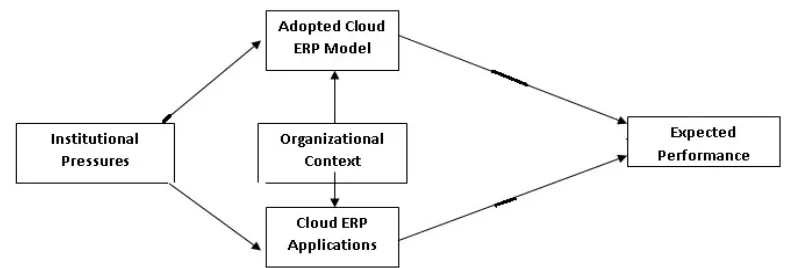
This paper aims at addressing the drivers and expected performance of cloud-based ERPs from an institutional perspective. It also investigates the impact of organizational context on the adoption and uses of cloud ERPs.Based on the related literature, the present study seeks to develop and validate an institutional model to study the drivers of cloud ERPs adoption and use. The research model discusses institutional pressures; such as, the external factors that may affect the adoption of cloud ERP system. It; also, takes into consideration the role of organizational context that supports and affects the cloud ERPs adoption. According to this study, the level of the adoption and use of cloud ERPs and its applications represents a valuable indicator; reflecting the extent of organizations’ response to these pressures and their expected performance.
2. GENERAL BACKGROUND 2.1 Cloud ERPs
The use of the cloud ERPs in business environment increasingly plays a critical role in supporting business operations and the way organizations deal with intense market competition while cloud mean businesses and users have capability to access their systems from anywhereon any device at any time in the world when required [9]. According to [10] Cloud computing could be defined as inter-connected and virtualized computers that help to obtain a integrated computing resource(s) depend on the level of service during some type of agreements between providers and users. On the other hand, [11] define ERPs as “extensive, integrated software systems supporting the internal operations of an enterprise”. In the last two decades, ERPs noticeably spread in many organizations ([12];[13]). Many literatures confirm that SAP was the leading in ERPs fields [14]. As a consequence, many organizations in Jordan adopted these technologies to get the advantages of the benefits of this integrated system. But the implementation of the ERPs was considered as a complex, costly and risky project because it could affect all organizations’ performances. So, organizations needed to plan carefully before taking a decision to implement ERPs [15]. Recently, a new business solution has appeared; it is called SaaS. Software as a Service(SaaS)is the provision
of an application which is hosted by a provider as a service to customers who contact it using the Internet. This new model lets many customers use the same system but it allows them to have their own private data places [16]. By using this new technology, organizations do not need to pay huge amount of money to implement complex ERP system. Recently, some organizations shifted to the new paradigm Cloud ERPs and some did not. [14] argue that organizations that seek to compete and survive should adopt modern technology.
2.2 Institutional Pressures
The Institutional theory mentioned that organizations and their strategies are influenced by the institutional settings in which they work, and formed by the institutional legacies which reflect the culture, history, and the system of the governance of the certain country or area [17]. Institutional environment plays a major role in determining organizational structure and form its behavior and attitude of individuals in line with institutional theory [8]. Moreover; [18] addressed that productivity and efficiency do not have a role within the institutional theory, however; its main concern is legitimacy of innovative organizational structures. Organizations faces many difficulty in gaining resources and retaining customers cause of the pressure they faces to acquire a sustain legitimacy and help to secure resources and social support. . Isomorphic pressures are divided into three types: coercive, normative, and mimetic [19]. In the last years, many researchers; such as, ([20];[21]) depend on this theory to understand why organizations adopt new technological innovations or do not do so.
2.3 Organizational Context
5144 environment [24] argue that organizational context has an important effect on the organizational performance back to the decision-making styles. [25] show that organizational context plays vital roles in constructing sustainable competitive advantage during strategic change. For the purpose of this study, we choose four of the organizational contexts: Organization Readiness, Top Management Support, Perceived Risk, Training and Education).
3. LITRETURE REVIEW
Even though there is a significant literature in the field of ERPs adoption, many of vital issues in diverse areas are still sparse especially in cloud ERPs. However, [26] argues that organizations which adopt ERPs have better performance than non-adopters and yield benefits and expected values less than risk that may appear. [26;27] argue that organizational culture and national issues should be considered before implementing ERPs. [27] show that resource availability, functional requirements, IT infrastructure, data security, internet connection, and the total cost are very important factors that affect organizations’ decisions to adopt cloud ERPs. Some researchers study cloud ERPs adoption from a technological aspect as follow: [28] study data security and privacy, flexibility, scalability and easy implementation. [29] study on-demand IT resources, [30] take into consideration accessibility alone. Other researchers examine the organizational aspects; such as, circular factors in cloud ERPs adoption. [31]refer to top management support as an important factor that influences organizations’ decisions whether to adopt Cloud ERPs or not. [32] studies IT readiness [33] study firm size. In addition, some researchers study cloud ERP drivers from an environmental aspect; such as, adequate user and technical support from provider, policy, government and competitors, competitive pressure ([31]; [33]). Also, ([31]; [32]; [28]) look to drivers from the vendor aspect and they studied the following factors: reputation, customer support, co-creation of value.
Former researchers develop many theories of IT adoption, some of these theories are developed on the individual level; such as, technology acceptance model (TAM) by ([34];[35]), and the unified theory of acceptance
and use of technology (UTAUT) by [36]. While diffusion on innovation theory is developed by (Rogers 1995) and technology, organization, and environment context(TOE)framework is carried out by [37] and is developed on the organization level. Many researchers depend on TOE to investigate the factors that influence the adoption of technology innovation on the organizational level; such as,
([18]; [38]).
Also, an important theory which is used by many information systems’ studies is the Institutional Theory. [39] study IS adoption achievement from an institutional theory’s perception. The three legitimacy (coercive, mimetic, and normative pressures) are examined to understand their impacts on the project management approach and team competence.
The purpose of this study is to cover the impact of institutional factors (coercive, mimesis, and normative pressures), organizational context on the adoption of cloud ERPs in the Jordanian business institutions; in addition, to investigate the effect of cloud ERPs adoption on the expected performance. For that, the study will examine the following research questions:
1- Identifying to what extent Jordanian organizations use cloud ERPs.
2- Is there a significant effect of the institutional pressures on the adoption of cloud ERP systems?
3- Is there a significant effect of the organizational context on the adoption of cloud ERPs?
4- Is there an effect of ERP cloud computing adoption on organization efficiency?
Take into account that the institutional factors and organization context have not yet received much attention in the previous researches about this issue; especially in the Jordanian business environment.
4. RESEARCH MODEL AND HYPOTHESES
5145
Figure (1): The Model of Research
Below: the variables of study model are discussed in more details, followed by the related hypotheses.
4.1 Institutional Pressures
Today’s, organizations have to identify their stakeholders, get their respect and follow the norms and policy they pose In order to get success. Organizations usually make every effort for legitimacy with the aim of mobilizing the support of external stakeholders who have vital decision about how the organization is form, how it is managed, how it is developed and maintained [40]. Institutional theory take into consideration how social and cultural pressures affect organizational structures and practices. It also, describes sustainable organizations. The mentioned theory propose that organizations with a comparable social framework of norms and values, have a tendency to act the same way to attain social legitimacy which are those whose behaviors are considered wanted or suitable by the affected community.
Three types of institutional forces describe how organizations act considering innovation and institutionalization [19]. These are coercive, mimetic, and normative pressures. Each of these pressures is discussed below.
4.1.1 Coercive Pressures
[19] define Coercive pressures as “formal and informal pressures exerted on organizations by other organizations upon which they are dependent and by the prospect of the people members within which organizations work”. Coercive pressures are derivative from the Resource-Dependence Theory
[19]. According to this theory, a leading organization that controls sparse and essential resources may demand organizations that are dependent on its demonstrate similar structures, polices, or technologies that serve its interests, where these resource-dependent partners may act in accordance with the demands to keep their continued existence [41]. Governmental institutions have an exceptional position because they can effect and influence organizations and individuals with legitimate coercion, which presents a sources for the regulative element that primarily connected with authority. It is typically associated with governmental activities, whether it is law enforcement or benefit programs of different types. Experimental research studies governmental effects on organizational actions; such as, how property laws influence the organizational action [42] and how governmental regulations affect telecommunication organizations [43]. ([44];[20];[45];[46]) argue that Coercive pressures play an important role in adopting cloud computing technology. [47] confirm there is important effect of coercive pressures on organizational performance.
4.1.2 Mimetic Pressures
[image:4.612.108.506.116.250.2]5146 surrounding environment. The previous studies ([47]; [48]) explain that when a firm has vague goals in a high manner about the outcomes, organizations may be able to achieve legitimacy by following the collective actions of others ([44];[20];[45];[46]) argue that mimetic pressures play an important role in adopting cloud computing technology.
4.1.3 Normative Pressures
Standardized pressures produce professionals' expectations about how to conduct work. Organizational learning, social networks determines these. So Normative forces demonstrate the impact of specialized values and the impact of professional societies on regulation [19]. Under normative pressures, the organizations are subject to the values, standards, and expectations shared between members of social networks in order to attain effective coordination and collaboration [49]. Normative forces faced by an organization stand to be improved by a higher diffusion of collaborative IT adoption with its business partners; and by its participation in professional deals or business relations that encourage the adoption of
such technology ([41];[48]).
([44];[20];[45];[46])argue that mimetic pressures play an important role in adopting cloud computing technology.
4.2 Cloud Erp Model
Based on previous studies and researches, there are different types of clouds that hold different names; such as, personal clouds, general or public clouds, mixed or hybrid clouds, and domain-specific or private clouds. But the common models are public, private and hybrid ones. Organizations can choose any type of given clouds depending on their unique requirements.
4.2.1 Public Clouds
In this type, services are provided to common people. The service provider provides multiple property through the internet to the general public; such as, applications, storage, and infrastructure. The main advantages of using general cloud services which are listed in ([50];[51])are:
The supplier cover all system requirements cost.
Ability to meet desires. suitable for broad-spectrum.
Data availability and continuous uptime No wasted resources
While the drawbacks for this type of cloud appear in [52]:
Data security Privacy
In this type, Clouds are owned and managed by the organization(s) that provide cloud services to anthers [1].
4.2.2 Private Clouds
In this type, a collection of organizations maintained their cloud system for specific
requirements. They limit access to that group only. In addition, this type of cloud may be operating solely for one organization. The core advantages of using private cloud services are compliance and auditing ([50];[51]), in addition to:
security features. right to use
Anti-Virus protection
More control over the infrastructure and computational resources.
While the drawbacks for this type of cloud appears in the higher cost which comes from owning their software, equipment and staffing [53]. In addition [53] argue that private clouds have more security than public cloud, so this will affect the organization’s choice between clouds’ models.
4.2.3 Hybrid Clouds
A hybrid cloud is a mix of private cloud and public cloud. In this type of cloud organizations could be uses and manage external and internal resources. It able a business to get benefit of the scalability and cost reduction ([50];[51]) and it can minimize Risk of numerous users, Continuing compliance concerns and determine management and usage. The time organizations make the decision to take the cloud, the first challenge will appear which is the cloud model’s appropriateness for their business requirements and size.
5147
4.3 Cloud ERPS Application
Enterprise resource planning comes to connect all enterprise systems that need their process in a single system. It has many applications; such as, purchasing system, inventory management, forecasting, scheduling, order processing, and collaborative designing. Cloud ERPs can support same application but over internet.
[54] argues that SaaS and cloud applications move to a wide set of enterprise applications including enterprise resource planning (ERP); such as, cloud CRM applications (call center/contact center), financial/accounting applications, human resource applications, supply chain and logistics. Solutions based cloud ERPs are very suitable to change in business environment and E-business organization [55]. [56] assert that using ERPs package will enhance organizations expected performance.
H2: Institutional Pressures Have a Significant Impact on the Adoption of Cloud ERPs Applications.
4.4 Organizational Context
[23] defines the organizational context as a broad concept that includes several aspects; such as, company’s size, strategy, technology, culture, and business environment. So, there are many shared characteristics of the organizational context. Many researchers use some of them in their studies, [57] use firms’ country of origin, firms’ age and firms’ size. While [58] discuss role differentiation, order and organization, and leadership capability. In addition he argues that organizational characteristics determined by association with supervisors, affiliation with co-workers, culture of organization , and size of place of work. [46] suggests that organizational context, top management support, organization readiness, organization size, have a significant impact on the intention to adopt cloud computing, and his results support this suggestion. In addition, [59] study the impact of the organizational context, organizational competency, training and education, top management support, on the perceived ease of use and usefulness to adopt cloud computing adoption. [55] argues that organizational characteristics play an important role in determining cloud ERPs models and services. For the purpose of this study, we choose the following factors to study: organizational characteristics’ factors (organization
readiness, top management support, perceived risk, and training and education).
4.4.1 Perceived Risk
[60] argue that the risk assessment process for adopting cloud computing is very difficult and is affected by security issues related to data confidentiality, integrity and availability. Moreover, they confirm that the perception of risk has a significant impact on enhancing organizations decision about cloud techniques’ adoption. [61] list four types of recognizing risk in cloud platform: cloud service users, organizations using the cloud service, implementers of cloud platforms and providers of applications on top of cloud platforms. [62] said that the supervision of information security in cloud computing platform is very difficult and it needs many parties to collaborate. [28] assert that data security and privacy have influence on cloud computing adoption. Furthermore [63] confirm that cloud environment is coupled with many risks and challenges. Also, from a previous analysis of a study sample, we notice that risk and security are the main challenge to cloud ERPs adoption.
4.4.2 Organization Readiness
[64] argue that organization readiness is a critical factor that affects the organization’s decisions to change in many aspects: strategy, program, or any new trends. Organizational readiness refers to what extent employees of organization are ready to execute organizational change [65]. In addition they confirm that evaluating readiness is very necessary to determine to what extent an organization is ready to change and apply new innovations ideas. [66] Shows that To be able to adopt cloud computing, organizations must have the preparedness for several dimensions such as governance, improvement and process analysis, hardware and software standardization, and application rationalization and modernization. ([67];[59) argue that organization readiness is an important factor; it affects adopting cloud computing by decision makers.
4.4.3 Training and Education
5148 describe training and education as to what extent organization directs its employees to use new tools in optimal way. Because cloud computing environment is very complicated and composite, organization should train their employees before adopting this new system. Employee’s Training before implementing any new technological system will reduce worry, uncertainty and give him more understanding and motivation to this new technology [59].
4.4.4 Top Management Support
Top management support refers to the important adoption of new technologies and innovations to the team because if they don’t provide their full commitment and support for any new project, it will fail [70]. Moreover, many previous information system researchers assert of the role of top management support in implementing many information system project ([70];[71];[31]). [46] confirm that top management support plays an important role in the perceived ease of use and usefulness to adopt cloud computing adoption.
H3: Organizational Context Has a Significant Impact on the Adoption of Cloud ERPs Models.
H4: Organizational Context Has a Significant Impact on the Adoption of Cloud ERPs Applications.
4.5 Expected Performance
Cloud computing brings a bundle of added value for the organizations in many areas; such as, cost reduction, more time for innovation, elasticity and agility, big data analytics [72]. In addition, he argued that cloud computing adoption will affect organization’s performance. [73] argue that using cloud computing technology will help in costs reduction , enhance profitability and less customer loss. Moreover it will focus directly cost-effective activities of producing outcomes, rather than support activities and secondary activities. [70] assert that using information technology in organization will enhance manufacturer’s flexibility and supplier’s responsiveness. According [54] using information technology will be lead to information exchange, coordination and focus on collaborative capabilities and the enhancing real-time decision making [54]. Moreover, [72] confirms that organizations will obtain added values for all their departments when they adopt
Cloud ERPs, but this new technique will bring new challenges for organization; such as, security challenge.
H5: Cloud ERPs models have a significant impact on the expected performance.
H6: Cloud ERPs applications have a significant impact on the expected performance.
5. The Measurement
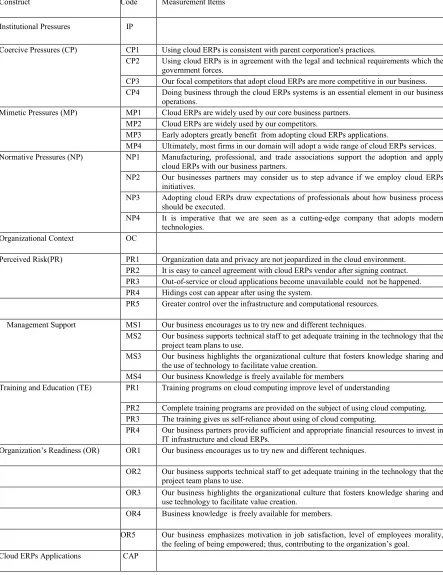
In this study, many measures and constructs were adapted from relevant studies and related literature to serve the study purpose. All constructs are described in Table (1).
5.1 Instrument Development
A self-administered questionnaire was used to collect the realistic data of this research. Previous studies were used to adopt the questionnaire and it was modified where necessary. Table (1) shows that the questionnaire included a total of 48 items representing the constructs of institutional pressures which were adopted from ([41];[74];[70];[75]).Organizational context were adopted from ([46];[75];[76];[59];63]). Cloud ERPs Application was adopted from ([55];[54]) and the expected performance was adopted from [77]. As for cloud ERPs model, the question was about the type of models that your (the surveyed person) company adopted (public, private hybrid). A five point Likert-scale was used to guarantee content validity. The survey was reviewed by seven specialist in the major of computer information system and management information system and provided their comments. Therefore, some variables and items were eliminated or modified and new items were added when necessary, based on the feedback.
5.2 Sampling and Questionnaire Distribution
5149 procurement and purchasing directors, customer service directors in these companies. 124 questionnaires were collected. It was a
questionnaire with122 usable responses resulting 0.93response rate.
Table (1): Study Instruments
Construct Code Measurement Items
Institutional Pressures IP
Coercive Pressures (CP) CP1 Using cloud ERPs is consistent with parent corporation's practices.
CP2 Using cloud ERPs is in agreement with the legal and technical requirements which the government forces.
CP3 Our focal competitors that adopt cloud ERPs are more competitive in our business. CP4 Doing business through the cloud ERPs systems is an essential element in our business
operations.
Mimetic Pressures (MP) MP1 Cloud ERPs are widely used by our core business partners. MP2 Cloud ERPs are widely used by our competitors.
MP3 Early adopters greatly benefit from adopting cloud ERPs applications.
MP4 Ultimately, most firms in our domain will adopt a wide range of cloud ERPs services. Normative Pressures (NP) NP1 Manufacturing, professional, and trade associations support the adoption and apply
cloud ERPs with our business partners.
NP2 Our businesses partners may consider us to step advance if we employ cloud ERPs initiatives.
NP3 Adopting cloud ERPs draw expectations of professionals about how business process should be executed.
NP4 It is imperative that we are seen as a cutting-edge company that adopts modern technologies.
Organizational Context OC
Perceived Risk(PR) PR1 Organization data and privacy are not jeopardized in the cloud environment. PR2 It is easy to cancel agreement with cloud ERPs vendor after signing contract. PR3 Out-of-service or cloud applications become unavailable could not be happened. PR4 Hidings cost can appear after using the system.
PR5 Greater control over the infrastructure and computational resources.
Management Support MS1 Our business encourages us to try new and different techniques.
MS2 Our business supports technical staff to get adequate training in the technology that the project team plans to use.
MS3 Our business highlights the organizational culture that fosters knowledge sharing and the use of technology to facilitate value creation.
MS4 Our business Knowledge is freely available for members
Training and Education (TE) PR1 Training programs on cloud computing improve level of understanding
PR2 Complete training programs are provided on the subject of using cloud computing. PR3 The training gives us self-reliance about using of cloud computing.
PR4 Our business partners provide sufficient and appropriate financial resources to invest in IT infrastructure and cloud ERPs.
Organization’s Readiness (OR) OR1 Our business encourages us to try new and different techniques.
OR2 Our business supports technical staff to get adequate training in the technology that the project team plans to use.
OR3 Our business highlights the organizational culture that fosters knowledge sharing and use technology to facilitate value creation.
OR4 Business knowledge is freely available for members.
[image:8.612.91.534.164.739.2]5150
CRM APP1 To what extent does your organization use cloud ERPs in CRM
HR APP2 To what extent does your organization use cloud ERPs in HR
Finance/Accounting APP3 To what extent does your organization use cloud ERPs in finance/accounting.
Collaboration APP4 To what extent does your organization use cloud ERPs in collaboration.
Procurement APP5 To what extent does your organization use cloud ERPs in procurement
Document Management APP6 To what extent does your organization use cloud ERPs in document management.
Distribution Management APP7 To what extent does your organization us cloud ERPs in distribution management
Expected Performance EP
To what extent do you agree to use the cloud ERPs enhancing?
EP1 Excellent improvement
EP2 Better-quality decision making and planning
EP3 Cycle time decrease
EP4 Improve resource management
EP5 Customer service improvement
EP6 Cost saving
EP7 Productivity development
EP8 Support business evolution
EP9 Building business flexibility at lower cost
EP10 Support business alliance
EP11 Creating competitiveness
EP12 Allowing worldwide growth
6. DATA ANALYSIS AND RESULTS
Structural Equation Modeling (SEM), using PLS software, will be used to assess the fitness of the model and to test research hypotheses. Two stages are usually used to analyse and interpret PLS model; first stage conducting by evaluating the reliability and validity of the measurement model (constructs and items); and second stage conducting by evaluating the structural model through interpreting the path coefficients and determining the adequacy of the research model [78]. The next sections examine both of these two stages.
6.1 Measurement Model Results
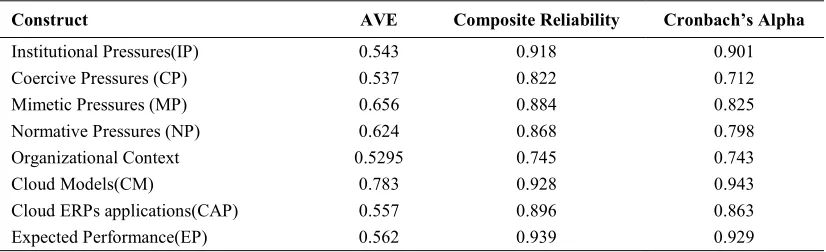
5151 this research accomplish good convergent validity with the evidence of the vast majority items load is much higher on the hypothesized factors than other factors (own loading are higher than cross loadings). On the other hand, one item seems to be severely cross loaded (APP4). So, as suggested by Hair et al. (2013) [78], these items are dropped from this study and are not included in analysis. An additional approach to measure the convergent validity of the constructs is to investigate the composite reliability of the constructs (Fornell and
Larcker, 1981) [79]. All constructs exhibit adequate to high scores of composite reliability, as shown in Table (2), which is beyond the 0.70, threshold, it is suggested by Hair et al. (2013). This result supports, the AVE values of the constructs, and ensures the validity criterion in this research. Also the Cronbach’s alphas are above the 0.70 threshold; they are suggested by Field (2005) and Hair et al. (1998); thus, agreeable the second condition of convergent validity.
Table (2): Validity and Reliability Estimates of the Constructs
Construct AVE Composite Reliability Cronbach’s Alpha
Institutional Pressures(IP) 0.543 0.918 0.901
Coercive Pressures (CP) 0.537 0.822 0.712
Mimetic Pressures (MP) 0.656 0.884 0.825
Normative Pressures (NP) 0.624 0.868 0.798
Organizational Context 0.5295 0.745 0.743
Cloud Models(CM) 0.783 0.928 0.943
Cloud ERPs applications(CAP) 0.557 0.896 0.863
Expected Performance(EP) 0.562 0.939 0.929
A further method to measure the discriminant validity used in the present study is the examining of the cross-loadings comparisons between constructs. The AVE of every latent construct must be higher than the construct’s highest squared correlation with any other latent construct (Hair et al., 2013) [80]. The square roots of the AVE values of all constructs are superior to the inter-construct correlations. Table (3) shows the
results which show that all constructs in the study model achieve this criterion as none of the off-diagonal elements pass the respective off-diagonal factor. Thus, discriminant validity is confirmed.
Table (3): Discriminant Validity- Using Fornell and Larcker (1981) Criterion
Constructs IP CP MP NP OC CM CAP EP
Institutional Pressures 0.855
Coercive Pressures 0.584 0.796
Mimetic Pressures 0.644 0.538 0.833 Normative Pressures 0.601 0.409 0.672 0.722
Organization Context 0.587 0.485 0.483 0.686 0.790
Cloud Models 0.491 0.366 0.625 0.587 0.587 0.893
Applications 0.546 0.635 0.694 0.628 0.674 0.779 0.894
Expected Performance 0.414 0.517 0.542 0.409 0.635 0.602 0.534 0.882
From the previous analysis, we confirm that the measurement model results maintain the reliability, convergent and discriminant validities of the constructs and their measures are used in the present study. Furthermore, the majority of the
[image:10.612.100.513.251.377.2] [image:10.612.153.527.537.665.2]5152
6.2 Assessing the Structural Model and Testing Research Hypotheses
PLS algorithm is used to assess the structural model and find out the significance of the paths and the predictive power of the model. First of all, an organized assessment of the structural model is conducted to evaluate the significance of path coefficients by investigating the standard error, t-statistics, R² value and confidence interval (Chin., 1998) [81]. Because PLS does not produce an
overall goodness of model fit, the amount of variance explained by R² provides an indication of the model fit as well as the predictive ability of the endogenous variables (Chin, 1998) [81]. Hair et al. (2013) [80] argue that the minimum level for R² must be superior to a minimum adequate level of 0.10. The bootstrap critical ratios (T Statistics) determine the strength of the estimates and are suitable above the value of 2 on 0.05 significant levels. Figure (2) displays the results of the structured model.
Figure (2): Tested Research Mode
Table (4) presents the results of testing hypotheses. As shown in Table (4), most of hypotheses are supported. The results reveal that the institutional pressures have a significant impact on the cloud ERPs application adoption (The path coefficients of relationships is 0.836, with t value >6), but doesn’t have a significant impact on cloud model adoption (The path coefficients of relationships is 0.035, with t value <1). Organizational context has a significant impact on
the cloud ERPs models adoption (The path coefficients of relationships is 0.852, with t value >7), but doesn’t have a significant impact on cloud ERPs application model adoption (The path coefficients of relationships is 0.021, with t value <1). Adoption of cloud ERPs applications and model have a significant impact on the expected performance (The path coefficients of relationships are 0.218, 0.723; respectively, with t values >2 and t value> 7 for both relationships.
Table (4): The Path Coefficient and Hypotheses Results
H# Path Coefficient (β) T Statistics P value The results
H1 0.035 0.294 0.781 Not Supported
H2 0.832** 6.025 0.000 Supported
H3 0.852** 7.935 0.000 Supported
H4 0.021 0.141 0.088 Not Supported
H5 0.218** 11.073 0.007 Supported
H6 0.723** 3.950 0.000 Supported
[image:11.612.101.516.251.457.2] [image:11.612.85.527.607.710.2]5153
In summary, four paths are found significant; and accordingly, their four associated hypotheses are supported (H2, H3, H5 and H6). Whereas tow
hypotheses are not supported because the paths of the variables are not found significant (H1, H4).
7. DISCUSSION, CONCLUSION, AND IMPLICATION
Cloud computing, more specifically, cloud ERPs are new trends in the Jordanian business environment. Moreover, there is no deep understanding of these concepts and the use of this new technology. The purpose of this study is to provide better understanding of cloud ERPs through presenting related literature and by examining the factors that have an effect on adopting cloud ERPs from an institutional perspective. The present study examines the impact of institutional pressures (coercive, mimetic, and normative) as external factors and organizational context(organization readiness, perceived risk, training and education and top management support) as internal factors on cloud ERPs adoption. This study goes beyond what previous studies concentrate on; examining the impact of institutional pressures and organizational context on both: the adoption of cloud ERPs model and cloud ERPs applications independently. The main findings of this study confirm that institutional pressures have a significant impact on the adoption of cloud ERPs models but do not have a significant impact on the adoption of cloud ERPs applications. The values of path coefficient (β) show that comparing with other institutional pressures, mimetic pressures have the highest impact on adopting the cloud ERPs model, with β = 0.416, followed by normative and coercive pressures with β= 0.401 and 0.291 respectively as shown in figure(2). This result is logical as all companies seek to imitate the modern technology used in other companies in order to achieve competitive advantage and increase their market share. In contrast, organizational context has a significant impact on the adoption of cloud ERPs application and does not have a significant impact on the adoption of cloud ERPs model. We can explain these findings that the institutional pressures; such as, the pressures exerted by government, regulatory or other agencies, or pressures result from resource-dominant organizations or from parent corporations will force the organization to adopt one of the cloud ERPs models. Moreover, cloud ERPs applications are governed by different factors: most of them are internal; such as, costs, permanence needs, and alternatives availability of such applications. Furthermore, the internal factors of the company; such as, its readiness, perceived risk and the extent
of training employees to use modern software and the continuous support for development by the senior management have an impact on the adoption of cloud ERPs especially in applications’ types more than models’ type. These results are partially consistent with ([46];[59];[55]). Moreover, this study shows that there is a significant impact of cloud ERPs type and applications on the performance of the organization. The performance is affected by the adopted model and applications of cloud ERPs. This result agrees with [72]. The values of path coefficient (β) show that cloud ERPs applications have more impact than the models of cloud ERPS on expected performance, with β = 0.723 as shown in figure(2). This is a logical result, as performance efficiency is affected by the type, number and intensity of applications used. The study also found that the use of cloud ERPs is still very limited, and is narrow used in small and medium enterprises, so we emphasize that organizations do not adopt cloud ERPs to change their strategy towards adopting this new technology to enhance their performance.
The findings of this study are of importance to both educational and specialist communities. This study can give a superior perceptive of the role of the institutional pressures and organizational context in ERPs adoption. As a conclusion, an understanding of how institutional pressures and organizational context affect the cloud ERPs adoption will not only help in developing the foundations of a sound implementing this technology, but also will allow for better planning towards cloud ERPs adoption in the Jordanian business environment. Therefore, we ask all organizations that intend to adopt cloud ERPs and organizations that provide this service to take into consideration all of these factors because they have great significance in the success of organization’s e-business entrepreneurship.
8. LIMITATIONS AND FUTURE RESEARCH
5154 ERPs. Furthermore, the present study did not has an opportunity to gather data from international organizations and all of our data was collected from the organizations in Jordan. Therefore, we are limited in generalizing our finding widely. Finally, the present study has ignored the organizational characteristics. Therefore, the future research has to investigate theses characteristics, such as business size, organizational culture, type of products, and the level of competitiveness.
ACKNOWLEDGEMENT:
This work has been carried out during sabbatical leave granted to the author Mohammad Atwah Al-ma’aitah from Al-Balqa’ Applied University (BAU) during the academic year 2016-2017.
REFRENCES:
[1] Grance, T., Mell, P. (2011) The NIST Definition of Cloud Computing. Retrieved
March 15, 2012 from
http://www.nist.gov/itl/cloud/upload/cloud-def-v15.pdf.
[2] Parallels(2013). Parallels global SMB cloud insights 2013: Profit from the cloud. [Online]. Available:http://bit.ly/1dXrQ4e. [3]Botta-Genoulaz , V., Millet, P.A. and Grabot, B.
(2005). A survey on the recent research literature on ERP systems.Computers in Industry 56:510–522
[4] Abrahamson, E. and Rosenkopf, L. (1993). Institutional and Competitive Bandwagons: Using Mathematical Modeling as a Tool to Explore Innovation Diffusion. Academy of
Management Review, 18 (3), pp. 487–517.
[5] Frohlich, M.T. and Westbrook, R. (2002).
Demand Chain Management in
Manufacturing and Services: Web-based Integration, Drivers and Performance.
Journal of Operations Management, 20(6),
pp. 729-745.
[6] Swanson, E.B. and Ramiller, N.C. (2004). Innovating Mindfully with Information Technology. MIS Quarterly, 28(4), pp. 553-583.
[7] Gengatharen, D.E. and Standing, C. (2005). A Framework to Assess the Factors Affecting Success or Failure of the Implementation of Government-supported Regional E-marketplaces for SMEs. European Journal of
Information Systems, 14(4), pp. 417-433.
[8] Scott, W.R. (2008). Institutions and Organizations: Ideas and Interests, 3rd Edi, Thousand Oaks, CA: Sage Publications, Inc. [9] Low, C. and Chen, Y. (2011). Understanding
the determinants of cloud computing adoption. Industrial Management and Data
Systems, Vol. 111 No. 7, pp. 1006-1023.
[10] Buyya, R., Yeo, C. S., Venugopal, S., Broberg, J. and Brandic, I. (2009). Cloud computing and emerging it platforms: Vision, and reality for delivering computing as the 5th utility. Future
Generation Computer Systems, 25(6), 599-616.
[11] Doom, C., Milis, K., Poelmans, S., and Bloemen, E.(2010). Critical success factors for ERP implementations in Belgian SMEs.
Journal of Enterprise Information
Management, Vol. 23 No. 3, 2010 pp.
378-406.
[12] Gargeya, V.B. and Brady, C. (2005), Success and failure factors of adopting SAP in ERP system implementation, Business Process Management Journal, Vol. 11 No. 5, pp. 501-516.
[13] Pishdad , A. and Haider, A.(2013). ERP institutionalization: exploring the influential factors. Journal of Enterprise Information
Management, Vol. 26 No. 6, pp. 642-660.
[14] Lal, P.(2016). Understanding the impact of cloud-based services adoption on organizational flexibility An exploratory study. Journal of Enterprise Information
Management, Vol. 29 No. 4, pp. 566-588.
[15] Afaneh, S., AlHadid, I., and AlMalahmeh, H.(2015). Relationship between organizational factors, Technical Factors and Enterprise Recourse System Implementation. International Journal of Managing Information Technology , Vol.7, No.1. [16] Velte, T., and Elsenpeter, R. (2010): Cloud
Computing: A Practical Approach, New York et al.: McGraw-Hill, 2010.
[17] Doh, J.P., Guay, T.R. (2006). Corporate Social Responsibility, Public Policy, and NGO Activism in Europe and the United States: An Institutional-Stakeholder Perspective. Journal of Management Studies, 43(1), pp.47-73.
[18] Liu, C., Sia, C.-L., and Wei, K. (2008). Adopting organizational virtualization in B2B firms: an empirical study in Singapore. Information & Management, 45 (7), 429–437.
5155 Organizational Fields. American Sociological
Review, 48(2), pp. 147-160.
[20] Messerschmidt , C. and Hinz , O. (2013). Explaining the adoption of grid computing: An integrated institutional theory and organizational capability approach, Journal of Strategic Information Systems 22 (2013), pp. 137–156.
[21] Mignerat, M. and Rivard, S.(2005). Positioning the Institutional Perspective in Information Technology Research. HEC
Montréal.
[22] Premkumar, G. and King, W. (1994). Organizational Characteristics and Information Systems Planning: An Empirical Study. Information system and research, Volume 5 Issue, pp. 75-109.
[23] Daft, L.R., and Noe, R.(2000).
Organizational Behavior, 4th Ed,
South-Western.
[24] Dibrell, C.C., and Miller, R.T.(2002), Organization Design: The Continuing Influence of Information Technology. Management Decision, Vol. 40, No 6:620. [25] Abudho, R., Kenya, N., and Kenya,
N.(2013). Impact Of Organization Characteristics On Sustainable Competitive Advantage During Strategic Change In Airlines Marcella. European Journal of Business, Vol.5, No.7.
[26] Singla, A. (2008). Impact of ERP Systems on Small and Mid Sized Public Sector Enterprises. Journal of Theoretical and
Applied Information Technology.
www.jatit.org.
[27] Esteves, J., Pastor, J., and Alvaro, J.(2003). Organizational and National Issues of an ERP Implementation in a Portuguese Company ,Technical Research Report.
[28] Saeed, I., Juell-Skielse, G., & Uppström, E. (2012). Cloud enterprise resource planning adoption: Motives & barriers. Advances in Enterprise Information Systems II, 429. [29] Zhong, F., & Rohde, M. E. (2014). Cloud
Computing and ERP: A Framework of Promises and Challenges.
[30] Mæland, B., Haddara, M., and Fagerstrom, A. (2014). Perception on OF SaaS adoption in Norwegian enterprises: Focus on ERP.
Paper presented at the Norsk conference for organisasjoners bruk av IT.
[31] Yeboah, E. O., and Essandoh, K. A. (2014). Factors Influencing the Adoption of Cloud Computing by Small and Medium Enterprises (SMEs) in Developing
Economies. International Journal of
Emerging Science and Engineering, 2(4), pp.
13-20.
[32] Seethamraju, R. (2014). Adoption of Software as a Service (SaaS) Enterprise Resource Planning (ERP) Systems in Small and Medium Sized Enterprises (SMEs).
Information systems frontiers, 1-18.
[33] Oliveira, T., Thomas, M., & Espadanal, M. (2014). Assessing the determinants of cloud computing adoption: Journal of Information
Systems Research and Innovation 9(1), 9-20.
[34] Davis, F.D. (1986) A technology acceptance model for empirically testing new end-user information systems: Theory and results,
Sloan School of Management, Massachusetts
Institute of Technology.
[35] Davis, F.D., Bagozzi, R.P. and Warshaw, P.R. (1989) User acceptance of computer-technology - a comparison of 2 theoretical-models, Management Science, Vol. 35, No. 8, pp 982-1003.
[36] Venkatesh, V., Morris, M.G., Davis, G.B. and Davis, F.D. (2003) User acceptance of information technology: Toward a unified view, MIS Quarterly, Vol. 27, No. 3, pp. 425-478.
[37] Tornatzky, L. and Fleischer, M. (1990) The
process of technology innovation, Lexington,
MA, Lexington Books.
[38] Zhu, K., Kraemer, Kl., and Xu S (2006) The process of innovation assimilation by firms in different countries: a technology diffusion perspective on e-business. Management
Science 52(10), 1557–1576.
[39] Krell , K., Matook , S., and Rohde , F. (2016). The impact of legitimacy-based motives on IS adoption success: An institutional theory perspective. Information
and Management, Volume 53, Issue 6, PP.
683–697.
[40] Suchman, M.C.(1995). Managing legitimacy: Strategic and institutional approaches. Acad. Manag. 1995, 20, PP. 571–610.
[41] Teo, H.H., Wei, K.K., and Benbasat, I. (2003). Predicting Intention to Adopt Interorganizational Linkages: An Institutional
Perspective. MIS Quarterly, 27(1), pp. 19-49.
[42] Campbell, L., Lindberg, N. (1990). Property rights and the organization of economic activity by the state. American Sociological
Review, Vol. 55, No. 5 , pp. 634-647.
5156 telephone companies. Adm. Sci. Q. 1987, 32, 400–421.
[44] Kshetri , N.(2013). Privacy and security issues in cloud computing: The role of institutions and institutional evolution.
Telecommunications Policy, 37,PP. 372–386.
[45] Fan , Y., Chen, C., Wu, C., and Fang , Y.(2015). The Effect of Status Quo Bias on Cloud System Adoption. Journal of
Computer Information Systems, Volume 55,
Issue 3, pp. 55-64.
[46] Malak, J. (2016). An Analysis of the Technological, Organizational, and Environmental Factors Influencing Cloud Adoption, Doctorate thesis , Walden University, Walden Dissertations and Doctoral Studies.
[47] Elnihewi, I., Fadzil, F., and Mohamed, R.(2014). The effect of institutional factors on the organizational performance through performance measures of commercial banks in Libya. Social and Behavioral Sciences, 164 , PP. 635 – 640.
[48] Son, J-Y. and Benbasat, I. (2007). Organizational Buyers' Adoption and Use of B2B Electronic Marketplaces: Efficiency-and Legitimacy-Oriented Perspectives. Journal of
Management Information Systems, 24(1), pp.
55-99.
[49] Lai, K.-H., Wong, C. W. Y., and Cheng, T. C. E. (2006). Institutional Isomorphism and the Adoption of Information Technology for Supply Chain Management. Computers in
Industry, 57(1), pp. 93-98.
[50] Sharma, M., Bansal, H., and Kumar, A.(2012) Cloud Computing: Different Approach & Security Challenge,
International Journal of Soft Computing and
Engineering, Volume-2, Issue-1.
[51] Huth, A., and Cebula, J.(2011), The Basics of cloud computing, available at:http://www.uscert.gov/sites/default/files/pu blications/CloudComputingHuthCebula.pdf [52] Goyal ,S.(2014). Public vs Private vs Hybrid
vs Community - Cloud Computing: A Critical Review, I.J. Computer Network and
Information Security, 3, 20-29
[53] Wahab,A, 2012, Public Cloud Computing vs. Private Cloud Computing: How Security Matters, Research Paper.
[54] Fauscette , M.(2013). ERP in the Cloud and the Modern Business , Executive Summary, December 2013, IDC #244611.
[55] Raihana , F.(2012). Cloud ERP – Solution Model. International Journal of Computer
Science and Information Technology and
Security (IJCSITS), Vol. 2, No. 1.
[56] Hitt, L. M., D. J. Wu, and X. Zhou (2002), Investment in enterprise resource planning: Business impact and productivity measures‖, Journal of Management Information Systems, 19 (1), pp.71-98.
[57] Ibrahim, H., and Shah , K.(2013). Effects of Organizational Characteristics Factors on the Implementation of Strategic Human Resource Practices: Evidence from Malaysian. Economia
Seria Management, Vol. 16, Issue 1.
[58] Maton KI, Salem DA.(1995). Organizational characteristics of empowering community settings: A multiple case study approach. American Journal of Community Psychology. 23(5), PP.631–656.
[59] Gangwar, H., Date, H., and Ramaswamy, R.(2015). Understanding determinants of cloud computing adoption using an integrated TAM-TOE model. Journal of
Enterprise Information Management Vol. 28
No. 1,pp. 107-130.
[60] Elena , G. and Johnson, C.(2015) Laypeople’s and Experts’ Risk Perception of Cloud Computing Services. International Journal on Cloud Computing: Services and
Architecture,Vol. 5,No. 4.
[61] Pearson, S.(2009). Taking Account of Privacy when Designing Cloud Computing Services, ICSE Workshop on Software Engineering Challenges of Cloud Computing, p. 44-52.
[62] Farahmand ,F. (2010), Risk Perception and Trust in Cloud, ISACA Journal, Volume 4. [63] Dutta, A., Peng, G.C. and Choudhary, A.
(2013). Risks in enterprise cloud computing: the perspective of IT experts. Journal of
Computer Information Systems, 53 (4), pp.
39-48.
[64] Shea, M., Jacobs, R., and Weiner,B.(2008). Organizational readiness for implementing change: a psychometric assessment of a new
measure, Available at:
http://www.implementationscience.com/cont ent/
[65] Weiner, B., Amick, H., and Lee S(2008). Conceptualization and measurement of organizational readiness for change: a review of the literature in health services research and other fields. Med Care Res Rev, 65(4),pp.379–436.
5157 Systems Laboratory (CISL) Sloan School of Management.
[67] Gutierrez , A., Boukrami , E., and Lumsden , R.(2015)Technological, organizational and environmental factors influencing managers’ decision to adopt cloud computing in the UK. [68] Kum ,F., Cowden , R., and Karodia , A.(2014). The Impact of Training and Development on Employee Performance: A Case Study of Escon Consulting. Journal of business Economics and management
studies, Vol.3, no.3.
[69] Schillewaert, N., Ahearne, M.J., Frambach, R.T. and Moenaert, R.K. (2005). The adoption of information technology in the sales force, Industrial Marketing
Management, Vol. 34 No. 4, pp. 323-336.
[70] Lee, J. C., Shiue, Y. C., & Chen, C. Y. (2016). Examining the impacts of organizational culture and top management support of knowledge sharing on the success of software process improvement. Computers
in Human Behavior,54, PP.462-474.
[71] Shi, W., Shambare, N., and Wang, J.(2008). The adoption of internet banking: An Institutional Theory perspective, Journal of
Financial Services Marketing, 12,4), pp.
272-286.
[72] Alami , A., Sadok , H., and Elhaoud, N.(2015). Cloud computing & the organizational performance Different approach of assessment . 978-1-4673-8149-9/15/$31.00 ©2015 IEEE
[73] Čudanov ,M., Krivokapić , J., and Krunić , J. (2016). The influence of cloud computing concept on organizational performance and structure, Journal Management, Issue 80. [74] Liang, H., Saraf, N., Hu, Q., and Xue,
Y.(2007) Assimilation of Enterprise Systems: The effect of Institutional Pressures and the Mediating Role of Top Management, MIS
Quarterly ,31,1, pp. 59-87.
[75] Trope, J. (2014). Adoption of Cloud Computing by South African Firms: an Institutional Theory and Diffusion of Innovation Theory Perspective, Master
Thesis, University of the Witwatersrand,
Johannesburg.
[76] Bouchbout, K. and Alimazighi, Z. (2008). A Framework for Identifying the Critical
Factors Affecting the Decision to Adopt and Use Inter-Organizational Information Systems.In Proceedings of World Academy
of Science, Engineering and Technology,
Vol.33, Heidelberg, Germany, September 2008, pp. 348-355.
[77] Ahmad, N. and Mehmood , R.(2015). Enterprise systems: are we ready for future sustainable cities. Supply Chain Management: An International Journal , 20/3, PP.264–283.
[78] Hair, J. F., Jr, Black, B., Babin, B. J., Anderson, R. E., and Tatham, R. L. (2006). Multivariate data analysis, 6th Edi. Upper Saddle River, NJ: Prentice Hall.
[79] Fornell, C., Larcker, D.F., (1981). Evaluating structural equation models with unobservable variables and measurement error. Journal of
Marketing Research 18 (1), 39-50.
[80] Hair, J. F., Hult, G. T., Ringle, C. M. & Sarstedt, M. (2013). A primer on partial least squares structural equation modeling (PLS-SEM). Sage Publications Ltd., Thousand Oaks, Carlifornia.