Learning Discriminative Feature
Representations for Visual
Categorization
Li Liu
Department of Electronic and Electrical Engineering
University of Sheffield
This thesis is submitted for the degree of
Doctor of Philosophy
Abstract
Learning discriminative feature representations has attracted a great deal of attention due to its potential value and wide usage in a variety of areas, such as image/video recogni-tion and retrieval, human activities analysis, intelligent surveillance and human-computer interaction.
In this thesis we first introduce a new boosted key-frame selection scheme for action recognition. Specifically, we propose to select a subset of key poses for the representation of each action via AdaBoost and a new classifier, namely WLNBNN, is then developed for
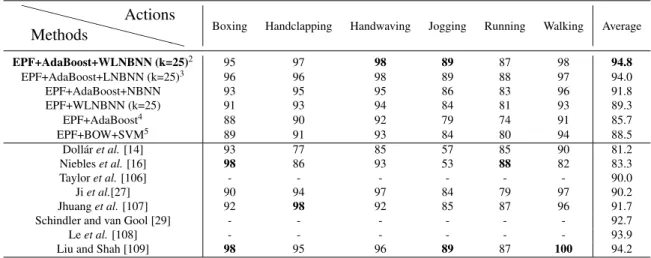
final classification. The experimental results of the proposed method are 0.6%∼13.2%
better than previous work. After that, a domain-adaptive learning approach based on multi-objective genetic programming (MOGP) has been developed for image classification. In this method, a set of primitive 2-D operators are randomly combined to construct feature descriptors through the MOGP evolving and then evaluated by two objective fitness crite-ria, i.e., the classification error and the tree complexity. Later, the (near-)optimal feature
descriptor can be obtained. The proposed approach can achieve 0.9%∼25.9% better
per-formance compared with state-of-the-art methods. Moreover, effective dimensionality re-duction algorithms have also been widely used for obtaining better representations. In this thesis, we have proposed a novel linear unsupervised algorithm, termed Discriminative Par-tition Sparsity Analysis (DPSA), explicitly considering different probabilistic distributions that exist over the data points, simultaneously preserving the natural locality relationship among the data. All these above methods have been systematically evaluated on
sever-al public datasets, showing their accurate and robust performance (0.44%∼6.69% better
than the previous) for action and image categorization. Targeting efficient image classifi-cation , we also introduce a novel unsupervised framework termed evolutionary compact embedding (ECE) which can automatically learn the task-specific binary hash codes. It is regarded as an optimization algorithm which combines the genetic programming (GP) and a boosting trick. The experimental results manifest ECE significantly outperform others by
1.58%∼2.19% for classification tasks. In addition, a supervised framework, bilinear local
feature hashing (BLFH), has also been proposed to learn highly discriminative binary codes on the local descriptors for large-scale image similarity search. We address it as a
noncon-vex optimization problem to seek orthogonal projection matrices for hashing, which can successfully preserve the pairwise similarity between different local features and simultane-ously take image-to-class (I2C) distances into consideration. BLFH produces outstanding
Acknowledgements
My deepest gratitude goes first and foremost to my supervisor Prof. Ling Shao for his kind and delicate supervision in both research and life. He gives me constant encouragement and leads me into the field of computer vision and machine learning. He has walked me through all the stages of my Ph.D research and shared a professional attitude with me. Without his consistent and illuminating instruction, I could not reach the present progress. Besides, my thanks also go to Dr. Peter Rockett who as my secondary supervisor always conveys novel ideas and his strict working style inspires me a lot.
I would like to thank my colleagues: Dr. Xiantong Zhen, Dr. Simon Jones, Dr. Ruomei Yan, Dr. Di Wu, Fan Zhu, Bo Dong, Peng Peng, Redzuan Bin Abdul Manap, Mengyang Yu, Yang Long, Ziyun Cai, Xu Dai, Danyang Wang and Feng Zheng. I feel grateful to Mengyang and Feng who show their strong background of mathematics and excellent col-laboration on our research. Xiaotong, Di and Fan have also expressed their kind assistance along my whole Ph.D study. Thanks to Yang and Ziyun for bringing me joyful experience in my leisure time. My special thanks express to Postgraduate Administrator, Ms. Hilary J Levesley, as well.
I would also like to thank other researchers in our laboratory: Dr. Yilong Cao, Dr. Ji Ni, Dr. Wenting Duan, Dr. Jing Li, Zhizhong Yu, Zia Khan, Yanxiang Wang and Tian Feng for their kind help on my research.
I would like to thank Dr. Dabo Guo, Dr. Hui Zhang, Dr. Peng Li, Dr. Jun Tang, Dr. Shoubiao Tan and Dr. Xuezhi Wen. I feel happy to have refreshing conversations with them on both study and life, and also learn a lot from them.
I also express my thanks to my friends. Gaochao Zhang, a kind boy and good chef, delivers his consistent encouragement to me when I am in my hardest time. Thanks also go to Dr. Haoyu Zhang, Miss Jiaxin Xu, Miss Qian Guo, and Miss Mei Li.
Particularly, I would like to thank Prof. Xuelong Li who is always regarded as a brother and friend to mentor my research and career. Without him, I may not have had the change to do my PhD in Sheffield.
My grateful thanks also go to Dr. Matt Mellor and his team. I am very happy to have a unforgettable internship experience with them in Createc.Ltd. In there, I learned more
piratical skills on realistic vision applications. Thanks for this rare opportunity. I highly appreciate the amazing techniques there and the worthy discussions with them.
I would like to thank Dr. Tao Xiang and Dr. Charith Abhayaratne as my examiners for carefully reviewing my thesis.
At last, I would like to thank my loving parents for their unconditional supports in the period of my Ph.D. I am also grateful to my wife Xiaoyu for her constant love and for taking care of my life in UK.
My Publications
I hereby declare that parts of the following papers have been included in this thesis.
Journal Articles:
• L. Liu, L. Shao, X. Zhen and X. Li, "Learning Discriminative Key Poses for Action
Recogni-tion", IEEE Transactions on Cybernetics, vol. 43, no. 6, pp. 1860-1870, Dec. 2013.[Chapter 2]
• L. Liu, L. Shao and P. Rockett, "Boosted Key-Frame Selection and Correlated Pyramidal
Motion Feature Representation for Human Action Recognition", Pattern Recognition, vol. 46, no. 7, pp. 1810-1818, Jul. 2013.
• L. Liu, L. Shao and P. Rockett, "Human Action Recognition Based on Boosted Feature
Se-lection and Naive Bayes Nearest Neighbor Classification", Signal Processing, vol. 93, no. 6, pp. 1521-1530, Jun. 2013.
• L. Liu, L. Shao and X. Li, "Evolutionary Compact Embedding for Large-scale Image
Classi-fication", Information Sciences (2014), doi: org/10.1016/j.ins.2014.06.030. [Chapter 6]
• L. Liu, L. Shao and F. Zheng and X. Li, "Realistic Action Recognition via Sparsely-Constructed
Gaussian Processes", Pattern Recognition, vol. 47, no. 12, pp. 3819-3827, Dec. 2014.
• L. Liu, L. Shao and M. Yu, "Multiview Alignment Hashing for Image Search", IEEE
Trans-actions on Image Processing (2015), doi: 10.1109/TIP.2015.2390975.
• L. Shao, L. Liu and X. Li, "Feature Learning for Image Classification via Multiobjective Genetic Programming", IEEE Transactions on Neural Networks and Learning Systems, vol. 25, no. 7, pp. 1359-1371, Jul. 2014.[Chapter 4]
• R. Yan, L. Shao,L. Liuand Y. Liu, "Natural Image Denoising Using Evolved Local Adaptive Filters", Signal Processing, vol. 103, pp. 36-44, Oct. 2014.
• L. Liu, L. Shao, X. Li and K. Lu, "Learning Spatio-Temporal Representations for Action
Recognition: A Genetic Programming Approach", IEEE Transactions on Cybernetics (2015), doi: 10.1109/TCYB.2015.2399172.
• L. Liu, L. Shao and M. Yu, "Bilinear Local Feature Hashing via Bigraph Regularization", submitted to International Journal of Computer Vision.[Chapter 7]
Conference Papers:
• L. Liu, L. Shao and X. Li, "Building Holistic Descriptors for Scene Recognition: A
Mul-tiobjective Genetic Programming Approach", ACM International Conference on Multimedia (MM), Barcelona, Spain, 2013. [Full Paper: Oral]
• L. Liu and L. Shao, "Learning Discriminative Representations from RGBD Video Data",
International Joint Conference on Artificial Intelligence (IJCAI), Beijing, China, 2013.
• L. Liuand L. Shao, "Synthesis of Spatio-Temporal Descriptors for Dynamic Hand Gesture
Recognition Using Genetic Programming", IEEE International Conference on Automatic Face and Gesture Recognition (FG), Shanghai, China, 2013.[Chapter 3]
• L. Liu, L. Shao and P. Rockett, "Genetic Programming Evolved Spatio-Temporal Descriptor
for Human Action Recognition", British Machine Vision Conference (BMVC), Surrey, UK, 2012.
• L. Liuand L. Shao, "Discriminative Partition Sparsity Analysis", International Conference on
Pattern Recognition (ICPR), Stockholm, Sweden, 2014.[Chapter 5]
Li Liu February 2015
Table of contents
Table of contents xi
List of figures xv
List of tables xxi
Nomenclature xxii
1 Introduction 1
1.1 Boosted Key-pose Selection for Action Recognition . . . 3
1.2 Genetic Programming-evolved Feature Learning . . . 5
1.3 Learning Compact Embedding . . . 7
1.3.1 Manifold Learning for Dimensionality Reduction . . . 7
1.3.2 Hashing . . . 9
1.4 Summary of Remaining Chapters . . . 12
2 Learning Discriminative Key Poses for Action Recognition 13 2.1 Overview . . . 13
2.1.1 Contributions . . . 14
2.2 Literature Review . . . 14
2.3 Methodology . . . 16
2.3.1 Extensive Pyramidal Features . . . 16
2.3.2 Key-Pose Selection by AdaBoost . . . 21
2.3.3 Weighted Local Naive Bayes Nearest Neighbor . . . 24
2.4 Experiments and Results . . . 25
2.4.1 Datasets . . . 25
2.4.2 Comparison Results . . . 26
2.4.3 Performance Analysis . . . 33
3 Dynamic Hand Gesture Recognition Using Genetic Programming 35
3.1 Overview . . . 35
3.2 Literature Review . . . 36
3.3 Methodology . . . 37
3.3.1 Function Set and Terminal Set . . . 38
3.3.2 Fitness Function . . . 43
3.4 Experiments and Results . . . 44
3.4.1 GP Implementation . . . 44
3.4.2 Datasets . . . 44
3.4.3 Results . . . 46
3.5 Summary . . . 49
4 Feature Learning for Image Classification via Multi-objective Genetic Program-ming 51 4.1 Overview . . . 51
4.2 Literature Review . . . 52
4.3 Methodology . . . 54
4.3.1 Program Structure Design . . . 55
4.3.2 Terminal Set . . . 56
4.3.3 Function Set . . . 58
4.3.4 Fitness Function . . . 62
4.4 Experiments and results . . . 63
4.4.1 GP Implementation . . . 65
4.4.2 Datasets . . . 65
4.4.3 Results . . . 68
4.4.4 Performance Analysis . . . 73
4.5 Summary . . . 74
5 Discriminative Partition Sparsity Analysis 77 5.1 Overview . . . 77
5.2 Literature Review . . . 78
5.3 Linear Reduction framework . . . 79
5.4 Discriminative Partition Sparsity Analysis . . . 79
5.4.1 Part Optimization . . . 80
5.4.2 Global Optimization . . . 82
5.4.3 Complexity Analysis . . . 83
Table of contents xiii
5.5.1 Datasets . . . 84
5.5.2 Results . . . 86
5.6 Summary . . . 88
6 Evolutionary Compact Embedding for Large-scale Image Classification/Retrieval 91 6.1 Overview . . . 91
6.2 Literature Review . . . 92
6.3 Evolutionary Compact Embedding . . . 93
6.3.1 Problem Formulation . . . 93
6.3.2 Genetic Programming Bit Optimization . . . 94
6.3.3 Boosting-Based Global Optimization . . . 98
6.4 Improved ECE Implementation for Large-Scale Applications . . . 100
6.5 Experiments on Image Classification . . . 102
6.5.1 Datasets . . . 102
6.5.2 Compared Algorithms . . . 103
6.5.3 Results . . . 105
6.5.4 Large-Scale Image Classification . . . 109
6.6 Experiments on Image Retrieval . . . 109
6.6.1 Compared Methods and Settings . . . 110
6.6.2 Results Comparison . . . 111
6.7 Summary . . . 113
7 Bilinear Local Feature Hashing 117 7.1 Overview . . . 117
7.2 Literature Review . . . 118
7.3 Bilinear Local Feature Hashing . . . 118
7.3.1 Bilinear Projection for Hashing . . . 119
7.3.2 Objective Function . . . 120
7.3.3 Alternate Optimization via Relaxation . . . 122
7.4 Semi-supervised BLFH . . . 125
7.4.1 Optimizing SBLFH . . . 127
7.5 Indexing via Local Hashing Voting . . . 129
7.6 Complexity Analysis . . . 130
7.7 Experiments and Results . . . 132
7.7.1 Experiments on Efficient Image Classification . . . 132
7.7.2 Experiments on Image Searching . . . 132
7.8 Summary . . . 138
8 Conclusions and Future Work 141
8.1 Conclusions . . . 141
8.2 Future Work . . . 143
List of figures
2.1 The flowchart of the proposed method . . . 16
2.2 Illustration of the max pooling mechanism . . . 17
2.3 The outline of the Gabor feature map extraction . . . 19
2.4 Illustration of the Gaussisan center-surround feature map . . . 20
2.5 The proposed extensive pyramidal features (EPF) extraction procedure: First-ly, bounding boxes are extraction for all sequences; SecondFirst-ly, simulating the human brain cognition, the three different feature maps are extracted. Thirdly, the feature map is concatenated and then fed to PCA to generate the final EPF representation. . . 22
2.6 The left sub-figure shows some selected key pose samples from the KTH dataset. The middle sub-figure illustrates the final AdaBoost boundary for pattern classification. The right sub-figure shows the error rate Vs. iterations during the AdaBoost learning. . . 22
2.7 The left sub-figure shows the NBNN algorithm which finds the nearest neighbors from each of the classes (different shapes mean different class-es in this figure). The right sub-figure shows the LNBNN algorithm which only searches the local neighbors, and the k nearest neighbors may come from only some of the classes. . . 24
2.8 Some failure recognition samples on the KTH dataset. . . 27
2.9 The confusion matrix of classification results on the KTH dataset. . . 28
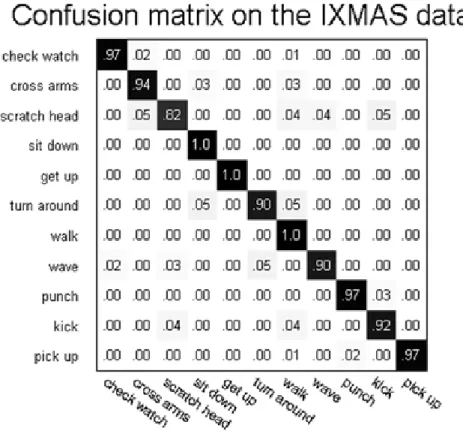
2.10 The confusion matrix of the multiple camera fusion results on the IXMAS dataset. . . 30
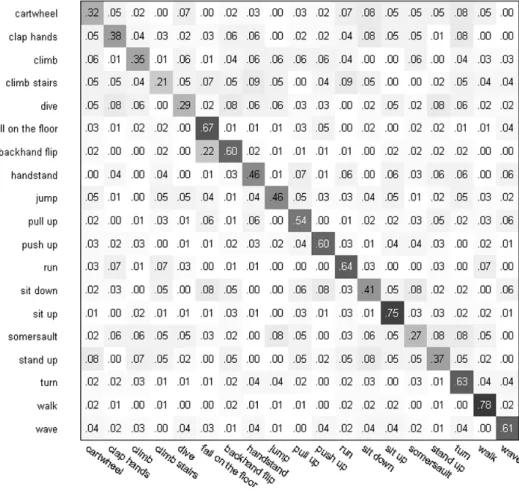
2.11 The confusion matrix of classification results on the HMDB51 dataset. . . . 31
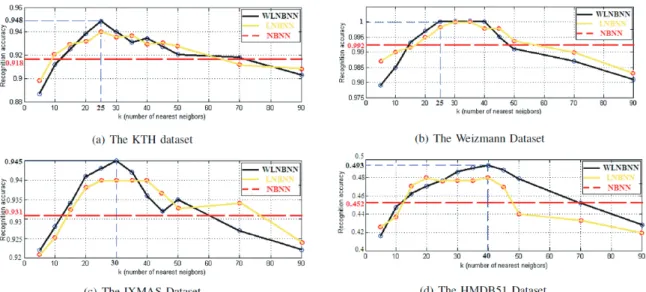
2.12 Evaluation of the effects of k on the performance of the proposed method on the KTH, the Weizmann, the IXMAS and the HMDB51 datasets. . . 32
3.1 The outline of our architecture. . . 37
3.3 The outline of multi-scale-max Gabor filter. This figure illustrates an
exam-ple of multi-scale-max Gabor filter with fixed orientation of 45 degrees . . . 40
3.4 Illustration of the mechanism of max-pooling filter . . . 40
3.5 Illustration of the tree structure of genetic programming . . . 42
3.6 The procedure of spatio-temporal sequence representation . . . 43
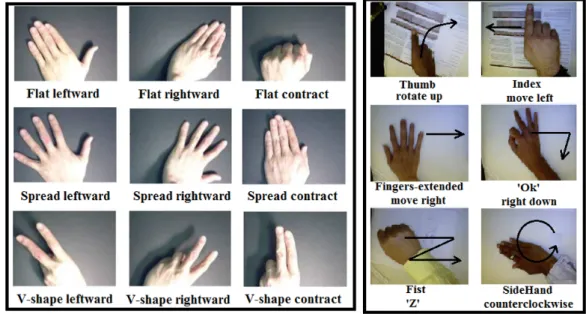
3.7 Some example frames of two datasets. Images in the left black-box are from the Cambridge hand gesture dataset and images in the right black-box are from the Northwestern University hand gesture dataset. . . 45
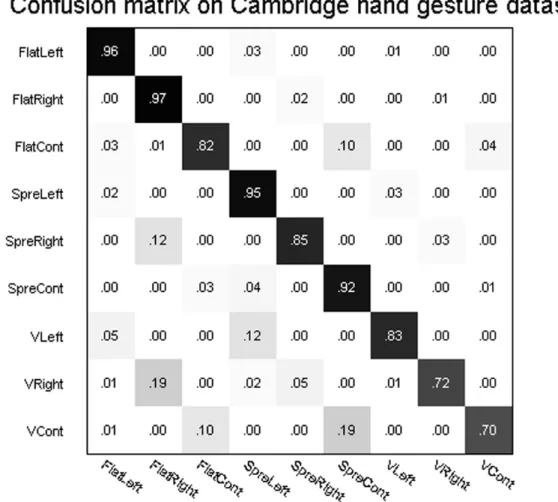
3.8 The confusion matrix of classification results on the Cambridge hand ges-ture dataset. . . 46
3.9 The LISP format of the GP-generated descriptor on the Cambridge hand gesture dataset. . . 47
3.10 The confusion matrix of classification results on the Northwestern Univer-sity hand gesture dataset. . . 48
3.11 The LISP format of the GP-generated descriptor on the Northwestern Uni-versity hand gesture dataset. . . 48
4.1 The outline of our method. . . 54
4.2 The grammatical structure of an individual. . . 55
4.3 The Terminal Set, Fitness Measure and Function Set (shown at the top of the figure) are the human-supplied inputs to the MOGP system. The computer program (shown at the bottom) is the output of the MOGP system. . . 56
4.4 The illustration of the max-pooling mechanism. . . 56
4.5 An example of the components of an input image. . . 57
4.6 The outline of multi-scale-max Gabor feature extraction. . . 59
4.7 An illustration of Concatenation Layer. . . 62
4.8 A simple illustration of the Error-Complexity Pareto front. Given a set of objectives, a solution is said to Pareto dominate another if the first is not inferior to the second in all objectives, and, additionally, there is at least one objective where it is better. This notion can lead to a partial order, where there is no longer a strict linear ordering of solutions. Here, Point B signif-icantly dominates Point A (A and B have the same error rate, while B has less tree complexity than A), but is equal to point C. The final ’rank-1’ so-lutions are a set of feature descriptors which dominate the other candidates but are equivalent to each other according to our multi-objectives. In this figure, we consider that all the solutions (e.g., Point B and Point C) existing on the Pareto front compose the ’rank-1’ solution set. . . 64
List of figures xvii
4.9 Some image examples of four datasets. Images in the top black-box are
from the Caltech-101 dataset, images in the second black-box are from the MIT urban and Nature scene dataset, images in the third black-box are from the CMU PIE face dataset and images at the bottom black-box are from the
Jochen Triesch II hand posture dataset. . . 66
4.10 The division of a dataset. . . 66
4.11 The LISP format of the (near-)optical feature descriptor generated through
MOGP on the Caltech-101 dataset. . . 68
4.12 The LISP format of the (near-)optimal feature descriptor generated through
MOGP on the MIT urban and natural scene dataset. . . 70
4.13 The confusion matrix of classification results on the MIT urban and natural
scene dataset. . . 71
4.14 The LISP format of the (near-)optimal feature descriptor generated through
MOGP on the CMU PIE face dataset. . . 71
4.15 The LISP format of the (near-)optimal feature descriptor generated through
MOGP on the Jochen Triesch Static II Hand Posture Dataset. . . 72
5.1 The outline of DPSA. Here three clusters are used for illustration. . . 80
5.2 The recognition error rate vs. number of dimensions on three datasets. . . . 85
5.3 The first 6 basis vectors of Eigenfaces, Fisherfaces, and DPSAfaces
calcu-lated from the face images in the CMU PIE dataset. . . 87
6.1 Classification strategy using a GP program. Note: Attrb(i)indicates thei-th
feature of the input training vector. . . 96
6.2 Each bit of ECE is iteratively optimized by GP over same-labeled and
differently-labeled sample pairs. Initially, each data pair is assigned the same weight. At each iteration, incorrectly embedded samples, such as pairs of differently-labeled samples mistakenly assigned to the same embedding value, are as-signed a larger weight, while the weight of correctly embedded samples is reduced. Hence, the next bit tends to correct the errors of the preceding ones. 99
6.3 Comparison between basic ECE and RBPL-ECE. . . 101
6.4 A few example images from the CIFAR10 dataset. From top row to bottom
row, the image classes are airplane, automobile, bird, cat, deer, dog, frog, horse, ship, and truck, respectively. . . 104
6.5 Classification results via the basic ECE and RBPL-ECE: the left sub-figure
shows the results of the basic ECE with afull-possibility N2-sized data pair
set for training. Each bit of the basic ECE code is a binary number - 1 or 0.
The right sub-figure shows the results of RBPL-ECE, which adoptsK =3
random assignedN-sized learning batches to compute ECE codes in parallel. 106
6.6 The classification accuracies on the SUN397 scene dataset with different
training-test partitions. . . 110
6.7 The Mean Average Precision of all the algorithms on SIFT 1M and GIST
1M data sets. . . 111
6.8 The precision-recall curves of all algorithms on SIFT 1M and GIST 1M data
sets for the codes of 48 bits. The AUC values are illustrated in the brackets. 112
6.9 The GP-evolved tree hash functions for embedding 16-bits binary codes on
the SIFT 1M dataset. From top-left to bottom right, each tree illustrates a hashing function for a bit, respectively. (Note., the nodes ’plus’, ’minus’,
’times’ and ’AQ’ in the tree correspond with ’+’, ’−’, ’×’ and ’÷’,
respec-tively.) . . . 114
7.1 The illustration of the working flow of BLFH learning. The algorithm
in-tends to preserve the pairwise structure and the I2C distances and outputs
the optimal bilinear projection matricesΘ1andΘ2. . . 119
7.2 An illustration of the proposed LHV. Specifically, given a query image, local
features are first extracted and embedded into hash codes via BLFH. Then, each hash code (e.g., “1100101001”) corresponding to a local feature in the query image is then searched in the Hamming lookup table within the
Ham-ming radiusrand this gives the corresponding images’ indices. Finally, we
vote and accumulate the times of each image’s index appearing in relevant
buckets and rank them to return the retrieved results. . . 130
7.3 Performance comparison of NBNN on the Caltech256 dataset. . . 133
7.4 Performance comparison with different numbers of bits. . . 134
7.5 Comparison performance (MAP) of our BLFH and other global hashing
schemes. Note: KSH and BRE are the top-performing supervised hashing methods. . . 134
7.6 The precision-recall curves of all compared algorithms on the three datasets
with the code length of 96 bits. The corresponding AUC values of compared methods are illustrated in the brackets. . . 135
List of figures xix
7.7 Semi-supervised performance comparison with different numbers of bits. l
denotes the number of labeled examples for semi-supervised hashing train-ing methods. . . 135
List of tables
2.1 Comparison of action recognition accuracies in percentage (%) on the KTH
dataset with different methods . . . 27
2.2 Comparison of action recognition accuracies in percentage (%) on the Weiz-mann dataset with different methods . . . 29
2.3 Comparison of action recognition accuracies in percentage (%) on the IX-MAS dataset with different methods . . . 30
2.4 Classification accuracies (%) on the HMDB51 dataset . . . 31
2.5 The comparison of computational complexity (seconds) between NBNN and WLNBNN. . . 32
2.6 Evaluation of individual features on the KTH, the Weizmann, the IXMAS and the HMDB51 datasets. NB:(1) for WLNBNN classification, the number of nearest neighbors k on each dataset is consistent in previous tables. (2) the accuracies of the IXMAS dataset in this table denote the multi-view fusion results. . . 32
2.7 The analysis of the computational complexity for the entire system on the KTH dataset . . . 33
3.1 Function set in genetic programming . . . 39
3.2 Parameter settings for genetic programming running . . . 44
3.3 Comparison of gesture recognition accuracies (%) on the Cambridge hand gesture dataset . . . 47
3.4 Comparison of gesture recognition accuracies (%) on the Northwestern U-niversity hand gesture dataset. . . 49
4.1 Statement of terminal nodes . . . 57
4.2 Filtering Layer functions . . . 58
4.3 Max-pooling Layer functions . . . 60
4.5 Comparison of image classification accuracies (%) based on color images. . 69
4.6 Evaluation of different evolutionary methods on the Caltech-101, the MIT
urban and nature, the CMU PIE and the Jochen Triesch Static Hand Posture II datasets. NB: for single-objective genetic programming, we do not need to use the evaluation set and only adopt the learning set and the testing set for final results. The rest of the experimental setting is totally the same as
our proposed method. . . 74
4.7 The time costs of feature learning on the four datasets we used by applying
three different genetic programming methods (Note that Matlab 2011a is
used for coding) . . . 74
5.1 The top recognition performance (%) on the USPS dataset, CMU PIE dataset
and CIFAR-10 dataset, respectively. . . 84
5.2 Computational costs for DPSA with the highest classification accuracies. . . 86
6.1 Functions in Genetic Programming . . . 95
6.2 Parameters for our GP algorithm. . . 98
6.3 Basic ECE computational time with the highest classification accuracies. . . 106
6.4 RBPL-ECE computational time with the highest classification accuracies. . 107
6.5 Performance (%) comparison on the USPS dataset. . . 107
6.6 Time complexity analysis for best performance on the USPS dataset. (Note:
Coding time denote the time used for each sample . . . 107
6.7 Performance (%) comparison on the CMU PIE dataset . . . 108
6.8 Performance comparison (%) on the CIFAR-10 dataset . . . 108
6.9 MAP of 32 bits and 48 bits with training and testing time of all algorithms
on SIFT1M and GIST1M data sets. . . 112
7.1 Computational complexity of BLFH and SBLFH. . . 131
Chapter 1
Introduction
Representation learning has become a field in itself in the machine learning community. A discriminative feature representations of the data can make it easier to extract useful in-formation when building classifiers or other predictors. This thesis is about representation learning, i.e., learning representations of the data that make it easier to extract useful in-formation when building classifiers or other predictors. In the case of probabilistic models, a good representation is often one that captures the posterior distribution of the underlying explanatory factors for the observed input. A good representation is also one that is useful as input to a supervised predictor. In this thesis, three different branches of discriminative rep-resentation learning schemes, i.e., feature selection, feature learning and feature embedding, are carefully discussed. The rapid increase in scientific activity on representation learning has been accompanied and nourished by a remarkable string of empirical successes both in academia and in industry. For instance, learning discriminative feature representations has successfully involved in speech recognition and signal processing. The recent revival of interest in representation learning has had a strong impact in the area of speech recognition, with breakthrough results [1–3] obtained by several academics as well as researchers at industrial labs bringing these algorithms to a larger scale and into products. Furthermore, MNIST digit image classification problem as a object recognition task has attracted lots of researchers using various feature learning schemes [4] on it. Besides, natural language processing (NLP) needs the phase of representation learning, as well. Among the various applications using learned representations, in this thesis, high-level visual categorization and retrieval tasks are focused and discussed in detail.
Visual categorization is regarded as a wide and significant tasks attracts increasing num-ber of attentions. It Includes 2D applications such as, object classification, face recognition and scene classification, and also cover the relevant 3D problems such as action recognition and gesture recognition. The basic visual categorization algorithm is generally introduced
in [5, 6], and involves two main stages: (1) low/middle level feature extraction and repre-sentation; (2) high level visual classification. The low level part is commonly accomplished
by local or global feature descriptors,e.g., histogram of oriented gradients (HOG) [7], scale
invariant feature transform (SIFT) [8] and local binary pattern (LBP) [9], to represent the extracted most salient features such as: edges, corners, orientations, which significantly af-fect high level classification performance. To learn discriminative feature representations, some learning schemes can be used. One of the effective and intuitive way is to select the most discriminative features from the original feature pool. This scheme can successful-ly discard the noisy data and make the classifier easier to conduct the final decisions. In addition to select features, another big branch of research focuses on learning the totally new but discriminative feature representations. This kind of scheme is usually based on ad-vanced machine learning techniques such as: deep learning and genetic programming and can automatically learn the feature representations from the raw visual sources. Of course, besides the low/middle-level feature extraction, some embedding schemes are also proposed to learn the discriminative representation such as principal component analysis (PCA) and linear discriminative analysis (LDA). Although, these previously published techniques lead to reasonable results in various applications, they are only suitable for a particular research domain or data type and would result in poor performance on other unknown usages. So how to propose an optimal solution that can be considered as a generalized way to extract the most meaningful features for any user-defined application is presented to us.
Moreover, with spreading of World Wide Web and development of computer technolo-gies, a huge amount of digital data, including text, images and videos, is generated, stored, analyzed, and accessed every day. To overcome the shortcomings of text-based image re-trieval, content-based image classification and retrieval has attracted substantial attention. The most basic but essential scheme for image retrieval is the nearest neighbor search: given a query image, to find an image that is most similar to it within a large database and assign the same label of the nearest neighbor to this query image. However,
greedi-ly searching a dataset withN samples is infeasible because linear complexityO(N)is not
scalable in practical applications. Due to this kind of computational complexity problem, researcher have already developed some approach to fast index data, e.g., K-D tree and R tree [10]. Nevertheless, most of these methods can only handle the data within
dimension-ality of 100 [11, 12]. In addition, curse of dimensiondimension-ality problems1 always exists in the
most of the vision-based applications due to visual representations usually with hundreds or even thousands of dimensions. Thus, to make large-scale search or classification practical,
1The effectiveness and efficiency of these methods drop exponentially as the dimensionality increases,
1.1 Boosted Key-pose Selection for Action Recognition 3
some hash-based methods have been proposed to effectively reduce the dimension of data and increase the retrieval speed and accuracy. In the following sections, some of our main work with its motivations for categorization and retrieval tasks will be briefly introduced.
1.1
Boosted Key-pose Selection for Action Recognition
Huamn action recognition, nowadays, plays a significant role in various applications, e.g.,
human-computer interaction [13], human activities analysis [14], [15], [16], [17], and real-time surveillance systems [18], [19]. The goal of human action recognition is to identify the actions being performed in a video sequence under different complications such as clutter-ing, occlusion and change of lighting conditions.
Generally, the approaches to action recognition involve two main stages: (1) feature extraction and representation; (2) action classification.
In recent years, some popular spatio-temporal features extracted from video sequences are commonly extended from their counterparts in the 2D image domain, and are demon-strated to achieve relatively good results for action recognition. Those methods include histogram of optical flow (HOF) [20], 3D scale invariant feature transform (3D-SIFT) [21], 3D histogram of oriented gradients HOG) [22], 3D speeded up robust features (3D-SURF) [23], etc. These spatio-temporal features can be used either globally or locally for human action representation.
Local methods [24], [14] [25] represent human actions as a set of spatio-temporal in-terest points detected from video sequences. Local methods based on the bag-of-features model have achieved impressive results in various action recognition tasks. They follow a typical procedure: unsupervised techniques are used to detect interest points around which
spatio-temporal features are extracted; then clustering methods, e.g., K-means clustering
[26], are employed to construct a codebook on which all the features from a video sequence are mapped to form a histogram representation; the final representation is then fed to a
clas-sifier,e.g., SVM, for action classification. The bag-of-features [16] model tends to be more
robust in challenging scenarios, but this kind of sparse representation is often not precise and informative because of the quantization error during codebook construction and the loss of structural relationships among local features.
On the contrary, global methods [27] represent corresponding actions by treating the entire video sequence as a whole which contains the complete motion and appearance in-formation. Such a representation has attracted much attention due to its abilities to extract more informative and accurate motion features from both spatial and temporal dimension-s. However, global methods are quite sensitive to shift, scaling, occlusion and cluttering,
which commonly exist in action sequences because the required background subtraction and segmentation [28] tend not to be very accurate.
Both local and global methods have achieved remarkable results, but action recognition by human suggests that they might be using more information than required [29]. Given the available actions, the human brain can easily recognize what a person is doing by just looking at a few poses without examining the whole sequence [30]. Inspired by this, re-cently, pose representations for human action recognition have drawn more attention and achieved promising results [30–33]. Pose-based representations can capture sufficient ap-pearance information of actions and spatial layout of human bodies, and therefore it can to a large extent overcome the information loss induced in local representations. If key poses are selected well [30, 31, 33], pose-based representations are able to avoid the limitations such as background variations, occlusions and shifts in global representations.
Considering all the advantages and drawbacks mentioned above, thus, human actions is modeled based on the key pose representation. Each frame in an action sequence is treated as a pose. Inspired by the multi-resolution analysis in image processing, we describe poses using the extensive pyramidal features (EPF), which are composed of the Gabor pyramid, the Gaussian pyramid and the wavelet Laplacian pyramid. These features capture the orien-tation, intensity and contour information and thus provide an informative representation of poses.
Directly representing the video sequence by all the poses (frames), which contain re-dundant and indiscriminate information, would confuse the classifiers in action recognition [29]. We, therefore, propose to select a subset of key poses for the representation of each
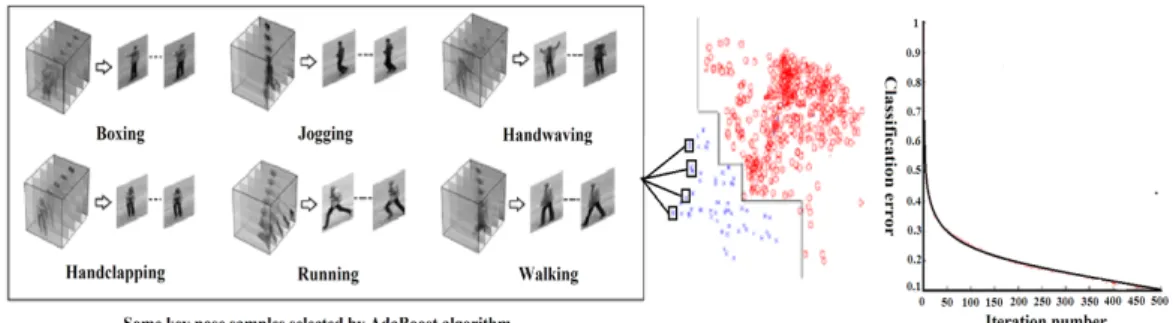
action by a supervised machine learning algorithm, i.e., AdaBoost [34]. The selected key
poses for each action type are not only more compact but also constitute the most discrimi-native body poses of an action, because the common poses that can exist in different action types have been eliminated.
In the proposed action representation, each frame contains the whole human body with the full spatial structural information, which shares the advantages with the global repre-sentation methods, while each video sequence is sparsely represented by a subset of key poses, which enjoys advantages of local representations. Therefore, the proposed method can be regarded as a semi-holistic representation of human actions and inherits the advan-tages of global features in the spatial dimensions and, meanwhile, has the superiority of local features in the temporal axis.
For local representations, the bag-of-features model and its variants plus SVM is the standard method for action recognition. Recently, a classifier called Naive Bayes Nearest Neighbor (NBNN) [35] is proposed for image classification tasks based on sets of local
1.2 Genetic Programming-evolved Feature Learning 5
features. The NBNN classifier avoids the quantization error in the bag-of-features model by computing ’Image-to-Class’ distance rather than the ’Image-to-Image’ distance. McCann and Lowe [36] later developed the local Naive Bayes Nearest Neighbor (LNBNN) classifier with a remarkable increase of accuracy and decrease of running time compared with NBNN. Inspired by LNBNN, we propose to further improve the NBNN model and introduce an enhanced version of NBNN, named weighted local Naive Bayes Nearest Neighbor (WLNBN-N), for the final action classification.
1.2
Genetic Programming-evolved Feature Learning
Much of previous work for feature representation has explored the use of low-level image features for high-level classification. Commonly, we adopt either dense sampling with lo-cal descriptors or pure holistic descriptors for feature representations. Popular choices for densely sampled feature descriptors include SIFT, HOG, P-HOG [37], LBP and shape con-text [38]. These features can work well for certain image types but may not be so descriptive for other types, since this kind of "hand-crafted“ features are not adaptive for more complex and challenging work. With the development of artificial intelligence, evolutionary methods simulate biological evolution to automatically generate solutions for user-defined tasks. GP, as one of the most outstanding evolutionary methods (see Algorithm 1), has been widely used in the computer vision domain.
Genetic Programming (GP), which is inspired by biological evolution and widely used in machine learning, artificial intelligence and other human-computer interaction applica-tions, allows the computer automatically solving pre-defined tasks without requiring users to know or specify the form or structure of the solution in advance. In genetic program-ming, we initially generate a population of computer programs which are regarded as the potential candidates going through the following evolution strategies and optimized by the fitness evaluation according to programs’ ability to perform the target task. After running all of evolution generations, computer can successfully select the best-so-far solution for user as the optimal result. The relevant Genetic programming algorithm flow is shown in Algorithm. 1.
Since the previous methods for human action recognition are highly depended on a fixed group of popular computer vision techniques and commonly achieve better results in some certain domain or application type, we aim to use Genetic Programming (GP) to find a rel-atively generalized motion feature descriptor for human action/gesture/objects recognition. Each of the individual in our GP population represents a candidate feature descriptor. The pre-processed action sequences as the input of GP are then calculated by computer programs
Algorithm 1 Genetic Programming
Start
Initialization Randomly create an initial population of computer programs from the
available primitives (terminal set & function set).
Repeat
(1) Execute each program and evaluate its fitness;
(2) Choose one program from the population with a particular probability based on the fitness to involve genetic operations;
(3) Create a new generation programs by applying genetic operations;
If An acceptable solution is found or reach the maximum number of generations
defined by user;
Stop
Return The best-so-far solution selected by Genetic Programming.
End
and the output form is a vector matrix of feature representations. To start with our GP algo-rithm, here we need to pre-define three most significant concepts: terminal set, function set and fitness functions.
The terminal and function sets are regarded as the key components of genetic program-ming. The variables and constants of the genetic programming are always included in the terminal set. While, the functions usually can be as set of mathematical functions, i.e., addi-tion, subtracaddi-tion, multiplication and division, or other task-specific orders such as complex filtering operations.
The most important concept of genetic programming is the fitness function which deter-mines how well a program is able to solve a problem. The basis of evolutionary methods is always to maximize the performance of individual solutions as gauged by some appro-priate fitness function. Fitness function can be regarded as a ’Engine’ driving the genetic programming to find the optimal solutions.
Furthermore, for pattern recognition, GP with a single fitness objective, which is always the accuracy of the program in recognising patterns, is usually used to measure solutions over a learning set. However, the single-objective GP is limited by the manner in which other objective criteria could be added to help guide the search, especially when conflicts exist. Moreover, during the GP process, the complexity of evolved solutions is one of the most difficult things to control in evolutionary systems, where the size and shape of the evolved solutions are under the control of evolution. In some applications, the trees in GP
have a tendency to grow without limit - this phenomenon is calledbloat[39], which always
causes serious overfittingat the pattern classification phase. To avoid bloat, we adopt an
1.3 Learning Compact Embedding 7
both the accuracy rate and the tree complexity as the fitness objectives based on Pareto
dominance relations, to optimize the solutions and simultaneously reduce the overfitting
effectively.
Inspired by MOGP, a new approach using MOGP for generating (near-)optimal fea-ture descriptors has been developed in image classification applications. Given a group
of primitive operators and a set of terminals (i.e., labelled training examples and random
constants), MOGP evolves (hopefully) better-performing individuals in the next generation.
Since MOGP selection depends on two fitness objectives, we use the Pareto frontto
rep-resent a set of non-dominated ’rank-1’ solutions which provide different trade-offs among the two objectives based on standard evaluation criteria. Furthermore, we test these evolved solutions on the evaluation set to select the (near-)optimal one with the lowest test error as the final feature descriptor. Typically, the features extracted by the MOGP system contain domain-specific information which makes the later image classification easier. It should be noted that our proposed method does not guarantee any mathematical optimum, while, in practice, it usually finds a ’good’ solution to an NP-hard problem in an acceptable amount of computing time. A preliminary version of this approach has been applied to evolve holistic scene features for scene recognition [40].
1.3
Learning Compact Embedding
Learning compact embedding has been a critical preprocessing step in many fields of infor-mation processing and analysis, such as data mining [41–45], inforinfor-mation retrieval [46, 47], and pattern recognition [48–51]. In this section, we mainly introduce manifold learning based dimensionality reduction methods and hashing based binary code learning methods.
1.3.1
Manifold Learning for Dimensionality Reduction
Dimensionality reduction [52] has been a key problem attracting much attention in many fields of information processing, such as data mining [53], information retrieval, and pat-tern recognition [54, 55]. When data are represented as points in a high-dimensional space, one is often confronted with tasks like nearest neighbor search. Actually, greedily
search-ing a dataset with N samples is infeasible because linear complexity O(N)is not scalable
in practical applications. To overcome this shortcoming of linear search, researchers have developed methods to index the data for fast query response, such as K-D tree, R tree,
R* tree [10], which efficiently decrease the computational complexity from linear O(N)
the effectiveness and efficiency of those searching schemes will drop exponentially as the dimensionality increases, which is commonly referred to as the ‘curse of dimensionality’. During the last decade, with the advances in computer technologies and the advent of the World Wide Web, there has been an explosion in the amount and complexity of digital data being generated, stored, analyzed, and accessed. Much of this information is multimedi-a in nmultimedi-ature, including text, immultimedi-age, multimedi-and video dmultimedi-atmultimedi-a. The multimedimultimedi-a dmultimedi-atmultimedi-a multimedi-are typicmultimedi-ally of very high dimensionality, ranging from several thousands to several hundreds of thousands. Learning with such high dimensionality in many cases is almost infeasible. Therefore, to make large-scale search or classification practical, many methods have been proposed to effectively reduce the dimension of data and increase the classification speed and accuracy. Among them, linear embedding techniques show their promising efficiency and robustness for scalable data reduction tasks.
For manifold learning based dimensionality reduction algorithms, one of the most base-line methods might be principal component analysis (PCA). PCA is usually applied to com-pact the feature with a large amount of original variables into a smaller set of newly pro-jected variables or dimensions, also guarantees a minimum loss of information. Another effective scheme for dimensionality reduction is linear discriminant analysis (LDA). LDA is a supervised method that has been proved successful on classification problems [56, 57]. Following the Fisher discriminant criterion, in which we maximize the between-class co-variance meanwhile minimize the within-class coco-variance, the final projection vectors can be obtained. However, the classical LDA is a linear method and cannot tackle nonlinear problems. In order to overcome this limitation, kernel discriminant analysis (KDA) [58] is then developed. KDA is the nonlinear extension of LDA using the kernel trick that can be implicitly performed in a new feature space, which allows non-linear mappings to be learned. Beyond that, some other dimension reduction methods can also achieve promising results for different applications. In addition, another popular method, termed discrimina-tive locality alignment (DLA) [59], is also been used as dimensionality reduction algorithms for classification.
we also review some structure preserving learning methods, such as ISOMAP [52], Laplacian Eigenmap (LE) [60] and Locally Linear Embedding (LLE) [61], were designed to preserve the manifold structure in the original space. A unified review and other manifold learning algorithms can be seen in [62]. Generally, linear methods possess high efficiency. Locality preserving projections (LPP) [42] are linear projective maps that are obtained by solving a variational problem that preserves the neighborhood structure of the data set. LPP aims to find the optimal linear approximations to the eigenfunctions of the Laplace Beltra-mi operator on the manifold. Neighborhood Preserving Embedding (NPE) [63] also tried
1.3 Learning Compact Embedding 9
to preserve the local representation of data. Capturing the intrinsic geometrical structure of data, Sparse Concept Coding (SCC) [64], a matrix factorization method, provides a sparse representation of the image space. For fast vision applications, pairwise structure preserv-ing was adopted in [65] and each image was represented by a binary vector calculated via boosting coding.
In this thesis, we also introduce a novel linear unsupervised algorithm, termed Discrimi-native Partition Sparsity Analysis (DPSA), explicitly considering different probabilistic dis-tributions that exist over the data points, meanwhile preserving the natural locality relation-ship among the data. Specifically, the Gaussian mixture model (GMM) is first applied to partition all samples into several clusters. In each cluster, a number of sparse sub-graphs are
computed via theℓ1-norm constraint to optimally represent the intrinsic data structure. Such
sub-graphs are demonstrated to be robust to data noise, automatically sparse and adaptive to the neighborhood. All the sub-graphs from the clusters are then combined into a whole discriminative optimization framework for final reduction.
1.3.2
Hashing
Hashing on global representation
Recently, hashing has become a popular method applied to large-scale vision problems in-cluding object recognition, image retrieval, local descriptor compression, image matching, etc. In these problems, hashing is exploited to expedite similarity computation and search. Since the encoding of high-dimensional image feature vectors to short binary codes as pro-posed in, compact hashing has enabled significant efficiency gains in both storage and speed. In many cases, hashing with only several tens of bits per image allows search into a collec-tion of millions of images in a constant time. The early exploracollec-tion of hashing focuses on using random projections to construct randomized hash functions. One of the well-known representatives is Locality-Sensitive Hashing (LSH) which has been continuously expanded
to accommodate more distance/similarity metrics includingℓp distance for p∈(0,2],
Ma-halanobis distance, and kernel similarity. Furthermore, kernelized locality-sensitive hashing (KLSH) [44] has also been successfully proposed and utilized for large-scale image retrieval and classification. Because of theoretical guarantees that original metrics are asymptotically preserved in the Hamming (code) space with increasing code length, LSH-related methods usually require long codes to achieve good precision. Nonetheless, long codes result in low recall since the collision probability that two codes fall into the same hash bucket decreases exponentially as the code length increases
for hashing have been introduced. In [66], the authors proposed to use stacked Restrict-ed Boltzmann Machine (RBM) [67], and showRestrict-ed that it is indeRestrict-ed able to generate compact binary codes to accelerate document retrieval. Recently, another attempt called boosted sim-ilarity sensitive coding (BSSC) [65] has also been proposed to learn a weighted Hamming embedding for task specific similarity search. Furthermore, principled linear projections like PCA Hashing (PCAH) [68] has been developed for better quantization compared with ran-dom projection hashing. Additionally, another popular technique called Spectral Hashing (SpH) [69] was proposed, which preserves the data locality relationship to keep neighbors in the input space as neighbors in the Hamming space. After that, researchers utilize an-chor graphs to obtain tractable low-rank adjacency matrices for efficient similarity search, termed Anchor Graphs Hashing (AGH) [70]. Beyond that, Self-Taught Hashing (STH) [71],
Kernel-Based Supervised Hashing (KSH) [72], Compressed Hashing (CH) [73],etc., have
been effectively applied for large-scale data retrieval tasks, as well.
Although the existing learning methods achieve promising results in a variety of appli-cations, they basically rely on complex and advanced mathematical knowledge to optimize the pre-defined object functions. However, for some optimization problems, direct solution-s cannot alwaysolution-s be found. Besolution-sidesolution-s, in large-solution-scale solution-settingsolution-s, matrix factorization techniquesolution-s used in the above methods can also cause a heavy computational burden. So how to auto-matically generate better solutions to optimization problems becomes an interesting topic for real-world vision applications. In this thesis, we propose evolutionary compact embed-ding (ECE), which applies genetic programming (GP) in combination with AdaBoost to automatically evolve dimensionality reduction. ECE is demonstrated to enable accurate and robust large-scale image classification/retrieval.
In particular, we intentionally combine GP with a boosting trick to obtain a novel
embed-ding method. For anM-bits embedding, GP is used to iteratively generate a best-performing
weighted binary classifier for each bit by jointly minimizing its empirical risk with the Gen-tle AdaBoost strategy [74] on a training set. This embedding scheme reduces the Hamming distance between the data from the same class, while increasing the Hamming distance for data from different classes. The final optimized reduction representation is defined as the code calculated from the non-linear GP-evolved binary learner for each embedding bit.
Local feature hashing
However, being either unsupervised or supervised, all these existing hashing algorithms are primitively designed for global representations, e.g., GIST features [75] computed from w-hole images. For realistic image retrieval tasks, however, these global hashing techniques achieve suboptimal performance when images contain different complications such as
clut-1.3 Learning Compact Embedding 11
tering, scaling, occlusion and viewpoint changes. To overcome these problems, local fea-tures, e.g., SIFT [8], are usually adopted to represent the images, which has been proved to be more robust in challenging scenarios. Inspired by advantages of local representations, in this thesis, we intend to develop a local feature based, supervised hashing method for im-proving the retrieval performance on realistic datasets. Being applied to detected keypoints, local hash codes are able to avoid the limitations such as background variations, occlusions, and shifts in global representations.
The goal of the work is to model a unified image retrieval technique based on supervised local feature hashing. To obtain more meaningful hashing code, two preserving schemes are adopted in our optimization, i.e., pairwise structure preserving and bigraph regularization. For pairwise structure preserving, a related work for fast vision applications has been
car-ried out by Shakhnarovichet al.[65], in which each image is represented by a binary vector
calculated via boosting coding. For the learning stage, positive examples are pairs of images
xi, xj, so thatxj is one of the nearest neighbors ofxi,xj ∈NN(xi). Negative examples are
pairs of images that are not neighbors. A more related approach that works for local fea-ture learning has also been introduced in [76]. In our framework, we preserve the pairwise structure information in hashing learning to embed high dimensional feature descriptors in-to a similarity-preserved Hamming space with a low dimension. However, only considering the pairwise relationship between each local features is not informative, since it lacks the high level measurement from source images. In fact, the images, which local features come from, and their corresponding class labels are noteworthy as well for pattern recognition tasks. Therefore, we are interested in the structure of the bipartite graph (a.k.a. bigraph) consisted of images and classes, i.e., the relationship between images and classes connect-ed by local features. Image-to-class (I2C) distance provides a feasible way to measure it, which was first introduced in the naive Bayes nearest neighbor (NBNN) classifier [35]. It represents the sum of all distances from the local features of an image to their correspond-ing nearest neighbors in each class. This mechanism effectively avoids the quantization error in the bag-of-features model by computing ‘image-to-class’ distance rather than the ‘image-to-image’ distance. Furthermore, motivated by [77], to alleviate the computation of the eigen-decomposition of matrix in our method, a bilinear projection is employed to make the algorithm more efficient. To be specific, bilinear projection applies two projection matrices to local features, which have much smaller sizes than the original single projection matrix. Since the computational complexity of eigen-decomposition is cubic degree on the dimension of the matrix, the effect of applying smaller matrices is quite conspicuous.
We first propose a supervised Bilinear Local Feature Hashing (BLFH) framework for large-scale image similarity search, in which the pairwise structure preserving and the I2C
distance preserving are naturally combined together. Since the raised problem is regarded as nonconvex and discrete, our objective function is then optimized via an alternate way with relaxation and converges to a near-optimal solution. Considering a more realistic application where not all samples’ labels in dataset are available, a semi-supervised version of BLFH (referred as SBLFH) is additionally proposed. In the case of SBLFH, all the data can be used but only a few data are labeled. The relevant results show that our SBLFH can effectively learn the hash codes for image retrieval tasks as well. Moreover, our method is designed for local feature hashing, however, the original Hamming Ranking and Hamming Table cannot be directly applied to local feature based image indexing. Thus, we also introduce an image indexing/searching scheme named Local Hashing Voting (LHV), which has been demonstrated to be efficient and accurate for image similarity search in our experiments.
1.4
Summary of Remaining Chapters
The rest of the thesis is organized as follows. In Chapter 2, the work of learning discrimina-tive key poses for action recognition is systematically reviewed. In Chapter 3, the detailed architecture of our genetic programming-based hand gesture recognition is presented. The work on feature learning for image Classification via multiobjective genetic programming is also illustrated in Chapter 4. In Chapter 5, the proposed work of discriminative parti-tion sparsity analysis for dimensionality reducparti-tion is presented. The evoluparti-tionary compact embedding for large-scale image classification and retrieval is then presented in Chapter 6. In Chapter 7, a novel bilinear local feature hashing via bigraph regularization for improved image retrieval is demonstrated in detail. In the last chapter, a brief conclusion and future works is included.
Chapter 2
Learning Discriminative Key Poses for
Action Recognition
2.1
Overview
In this chapter, we aim to model human actions based on the key pose representation. Each frame in an action sequence is treated as a pose. Inspired by the multi-resolution analy-sis in image processing, we describe poses using the extensive pyramidal features (EPF), which are composed of the Gabor pyramid, the Gaussian pyramid and the wavelet Lapla-cian pyramid. These features capture the orientation, intensity and contour information and thus provide an informative representation of poses.
Directly representing the video sequence by all the poses (frames), which contain re-dundant and indiscriminate information, would confuse the classifiers in action recognition [29]. We, therefore, propose to select a subset of key poses for the representation of each
action by a supervised machine learning algorithm, i.e., AdaBoost [34]. The selected key
poses for each action type are not only more compact but also constitute the most discrimi-native body poses of an action, because the common poses that can exist in different action types have been eliminated.
In our proposed action representation, each frame contains the whole human body with the full spatial structural information, which shares the advantages with the global represen-tation methods, while each video sequence is sparsely represented by a subset of key poses, which enjoys advantages of local representations.Therefore, the proposed method can be regarded as a semi-holistic representation of human actions and inherits the advantages of global features in the spatial dimensions and, meanwhile, has the superiority of local fea-tures in the temporal axis. Besides, another motivation of using pose representation is that it
is possible to recognize actions by just looking at a few poses without examining the whole sequence.
After obtaining the feature representations, the bag-of-features model and its variants plus SVM is the standard method for action recognition. Recently, a classifier called Naive Bayes Nearest Neighbor (NBNN) [35] is proposed for image classification tasks based on sets of local features. The NBNN classifier avoids the quantization error in the bag-of-features model by computing ’Image-to-Class’ distance rather than the ’Image-to-Image’ distance. McCann and Lowe [36] later developed the local Naive Bayes Nearest Neighbor (LNBNN) classifier with a remarkable increase of accuracy and decrease of running time compared with NBNN.
Inspired by LNBNN, in this chapter, we propose to further improve the NBNN model and introduce an enhanced version of NBNN, named weighted local Naive Bayes Nearest Neighbor (WLNBNN), for the final action classification. We will show experimentally that WLNBNN is a more efficient and accurate classifier for action recognition.
2.1.1
Contributions
The contributions of this work lie in the following three aspects:
(1) We propose to describe action poses by extensive pyramidal features (EPF), which can effectively capture the orientation, intensity and contour properties in a pose, and are tolerant to shifts and scaling.
(2) The AdaBoost learning algorithm is employed for selecting discriminative poses, which can significantly improve the performance of action recognition.
(3) A new classifier named weighted local Naive Bayes Nearest Neighbor (WLNBNN)
is proposed for final action classification which outperforms other classifiers,e.g., NBNN.
2.2
Literature Review
Action recognition based on pose representation has been applied in a large number of pre-vious works. Thurau and Hlavác [78] presented a method to recognize actions in videos or images based on primitive pose representations which are described by Histogram of Ori-ented Gradients (HOG) [79]. Niebels and Fei-Fei [80] have employed a pose-based method using a hierarchical model of shape and appearance for action recognition. Yang et al.[81] proposed a approach that treats the pose of the person in an image as latent variables and
recognizes human actions from still images. Shaoet al. [32] combined the pose silhouettes
2.2 Literature Review 15
(KNN) classifier.
In a video sequence, however, not all of the poses are informative and discriminative for action recognition. Some poses carry neither complete nor accurate information and would even contain common patterns shared by various action types. Since these poses in a video sequence cannot well represent the action and would cause confusion during the classifica-tion phase, a great deal of work has been carried out to select the most representative and
discriminative poses,i.e., the key poses. To obtain visually distinct representations, Cooper
and Foote [83] presented methods for key frame selection based on capturing the similarity to the represented segment and preserving the differences from other segments’ key frames, so that different segments will have visually distinct representations. Zhao and Elgammal [84] developed an effective approach for action classification, in which they first described all the poses with the distribution of local motion features and their spatio-temporal ar-rangements, and then selected a small set of most discriminative poses by comparing their
discriminative power for each independent action. Zhuanget al. [85] have applied an
un-supervised clustering method for key pose selection. Baysalel at. [30] selected the most
representative and discriminative poses from a set of candidates by ranking the potentiality
of each candidate pose in distinguishing an action from others. Caoet al. [31] developed a
PageRank-based centrality measure to select key poses according to the geometric structure recovered by a manifold learning technique.
However, the above methods all use unsupervised techniques to measure pose similarity or calculate the pose probability distribution for key pose selection. Since such unsupervised methods do not consider the relationship among poses from different classes and are not able to select the very discriminative poses from each actin type. Accordingly, in this chapter,
we propose to use a supervised method,i.e., the AdaBoost algorithm, to select a subset of
key poses for action classification.
AdaBoost as a popular machine learning algorithm is widely used in computer vision. A pyramidal architecture has been developed by Fathi and Mori [86] to extract boosted mid-level motion features for action recognition. Shen and Bai [87] have combined Gabor wavelet features with AdaBoost selection algorithm for image classification. Due to its remarkable performance on various vision tasks, we adopt the AdaBoost algorithm to select discriminative key poses for action representation.
The use of the AdaBoost algorithm [88] for feature selection in computer vision is fairly
recent although hitherto has only been applied to 2D data. Shanet al.[89] have used image
tilings of local binary patterns (LBPs) for facial expression recognition where each feature ture was constructed from a fixed-size sub-region to yield a complete description of each face image. A small set of the most discriminative LBP features were extracted using the
Fig. 2.1 The flowchart of the proposed method
AdaBoost learning algorithm for each independent facial expression and a support-vector machine (SVM) employed for classification.
Zhang et al. [90] have also used LBPs selected using AdaBoost for face recognition. Zhou and Wei [91] have used a similar method combining Gabor wavelet descriptors with AdaBoost to select features for face verification. The boosted-feature selection method has also been employed for real-time object detection [92] and fast pedestrian recognition [93] with improvements in recognition accuracy, compared to the original methods. Laptev [94] has applied the method to retrieving actions in movies.
2.3
Methodology
Our recognition system is comprised of three principal stages.1)Pose description: for each
video sequence, the extensive pyramidal features are extracted from each frame to represent
the pose appearing in it. 2) Pose selection: the AdaBoost algorithm is adopted to select
the most discriminative key poses for each video sequence to represent the corresponding
action. 3) Action recognition: based on the boosted poses, a newly proposed classifier,
i.e., weighted local Naive Bayes Nearest Neighbor (WLNBNN), is employed for action
classification. The flowchart of the proposed method is illustrated in Fig. 2.1. We will detail the three stages in the following subsections.
2.3.1
Extensive Pyramidal Features
Given a frame containing a pose, we would like to describe it with informative features extracted from it. The descriptor is expected to capture the orientation, intensity and con-tour information which is the main cue of a pose. We therefore employ Gabor filters, the Gaussian pyramid and the wavelet transform to obtain extensive pyramidal features for pose representation.
2.3 Methodology 17
Fig. 2.2 Illustration of the max pooling mechanism
Gabor feature map
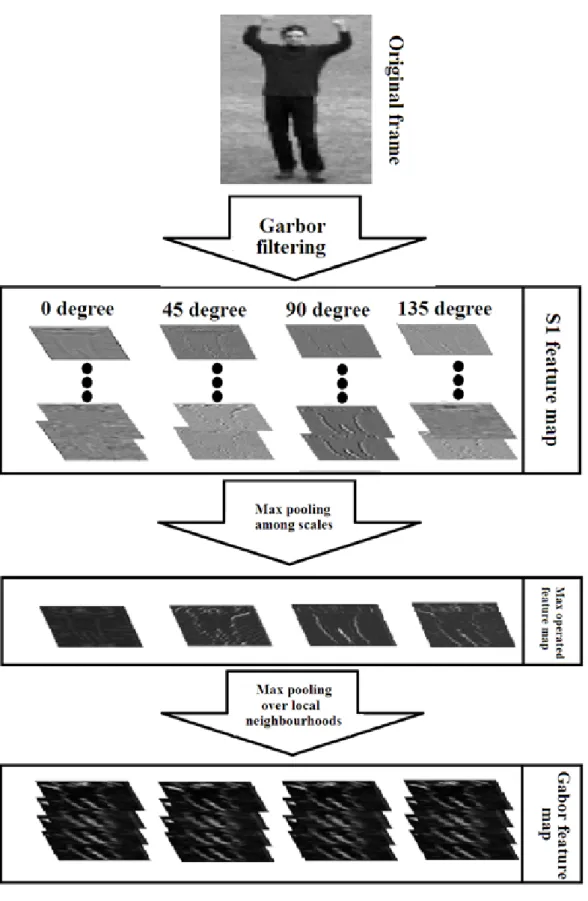
Gabor filtering is regarded as the most effective method to obtain the orientation informa-tion, which is widely used in feature extraction due to its property of orientation selection. To mimic the biological mechanism of the visual cortex, Riesenhuber and Poggio [95] pro-posed the HMAX model compro-posed of four hierarchical feed-forward layers: S1, C1, S2 and C2, in which S1 is obtained by Gabor filtering. Inspired by their work, we convolve each pose frame with a bank of Gabor filters with multiple scales and orientations to extract the
S1 feature map. More specifically, we adopt Gabor filters with six different scales: 7×7,
9×9, 11×11, 13×13, 15×15, 17×17, and four different orientations: 0, 45, 90, and 135
degrees. As a result, by convolving with 6×4=24 Gabor filters, we obtain 24 S1 feature
maps. The Gabor filter function is defined as follows:
G(x,y) =exp −(X 2+γ2Y2) 2σ2 cos 2π λ x , (2.1)
where, X =xcosθ−ysinθ,Y =xsinθ+ycosθ, (2.2)
and (x, y) is the coordinate relative to the center of the filter.
To obtain our Gabor feature maps that are equivalent to C1 in the HMAX model, we perform max pooling operations among the different scales. In the other words, we pick the maximum value across all the S1 feature maps with filter scales in each orientation. The pooling among different scales is defined below:
IMAX =max
(x,y)
[I7×7(x,y,θs),I9×9(x,y,θs), ...,I17×17(x,y,θs)] (2.3)
where,IMAX is the output of max pooling andIi×i(x,y,θs)denotes the feature map with the
scalei×iand the orientationθs.
8×8 to 12×12 and a shifting step of 2 pixels. It is regarded as a key mechanism for object recognition in human brain cortex, which can achieve more robust response when human recognize objects with clutter and complex background in the receptive field [95]. An example of max pooling over local neighborhoods is given in Fig. 2.2. The procedure of Gabor feature map extraction is illustrated in Fig. 2.3.
Gaussian center-surround feature map
Center-surround (CS) fields have the properties of edge enhancement, which can effectively work for the detection, location in the human visual system [96]. The features with different scales are enhanced and segregated into a series of sub-band images via the center-surround operation. Gaussian center-surround feature map is also inspired from neuroscience [96] similarity by mimicking perception of nerve cells which commonly respond to the dramatic
change of colors (i.e., the dark pixels surrounded by bright ones or the bright pixels
sur-rounded by dark ones). Center-surround operation has been successfully used to capture the intensity information for scene classification. We first construct a seven-level Gaussian pyramid on each frame (pose) of the input action sequence. For one given pose which is viewed as the first level of pyramid, the Gaussian pyramid can be built by successfully
con-volving a Gaussian filter (withσ =2) with several copies of the original pose image with
reduced resolutions obtained by down sampling. In this way, we obtain the corresponding Gaussian pyramid. To be precise, the construction of the Gaussian pyramid as follows:
W(x,y) = 1 (√2π σ)2 e− x2+y2 2σ2 (2.4) Gaussianlevel=l(i,j) =
∑
x∑
y W(x,y)Gaussianlevel=l−1(2i+x,2j+y) (2.5)where,ldenotes the levels of a Gaussian pyramid and (i, j) represents the position of a pixel
in the pose image.
Gaussian center-surround feature map is then computed by subtracting point-by-point between different center levels (we use center level=2, 3) and surrounded levels (we use surround level=center level + d, where d=3, 4). However, since scales are different between center levels and surround levels, we need to interpolate images of surround levels to the same size as the corresponding center levels. In this way, the center levels and surround levels can be subtracted point-by-point to generate the relevant sub-band images. As a
2.3 Methodology 19