University of Massachusetts Amherst University of Massachusetts Amherst
ScholarWorks@UMass Amherst
ScholarWorks@UMass Amherst
Doctoral Dissertations Dissertations and Theses
Spring March 2015
Universal Schema for Knowledge Representation from Text and
Universal Schema for Knowledge Representation from Text and
Structured Data
Structured Data
Limin YaoFollow this and additional works at: https://scholarworks.umass.edu/dissertations_2
Part of the Data Storage Systems Commons
Recommended Citation Recommended Citation
Yao, Limin, "Universal Schema for Knowledge Representation from Text and Structured Data" (2015). Doctoral Dissertations. 338.
https://scholarworks.umass.edu/dissertations_2/338
This Open Access Dissertation is brought to you for free and open access by the Dissertations and Theses at ScholarWorks@UMass Amherst. It has been accepted for inclusion in Doctoral Dissertations by an authorized administrator of ScholarWorks@UMass Amherst. For more information, please contact
UNIVERSAL SCHEMA FOR
KNOWLEDGE REPRESENTATION
FROM TEXT AND STRUCTURED DATA
A Dissertation Presented
by
LIMIN YAO
Submitted to the Graduate School of the
University of Massachusetts Amherst in partial fulfillment of the requirements for the degree of
DOCTOR OF PHILOSOPHY
February 2015
c
Copyright by Limin Yao 2015 All Rights Reserved
UNIVERSAL SCHEMA FOR
KNOWLEDGE REPRESENTATION
FROM TEXT AND STRUCTURED DATA
A Dissertation Presented
by
LIMIN YAO
Approved as to style and content by:
Andrew McCallum, Chair
Benjamin Marlin, Member
Daniel Sheldon, Member
Rajesh Bhatt, Member
Luke Zettlemoyer, Member
Lori Clarke, Chair Computer Science
ABSTRACT
UNIVERSAL SCHEMA FOR
KNOWLEDGE REPRESENTATION
FROM TEXT AND STRUCTURED DATA
FEBRUARY 2015
LIMIN YAO
B.Sc., XI’AN JIAOTONG UNIVERSITY
M.Sc., TSINGHUA UNIVERSITY
Ph.D., UNIVERSITY OF MASSACHUSETTS AMHERST
Directed by: Professor Andrew McCallum
In data integration we transform information from a source into a target schema.
A general problem in this task is loss of fidelity and coverage: the source expresses
more knowledge than that can be fit into the target schema, or knowledge that is
hard to fit into any schema at all. This problem is taken to an extreme in
informa-tion extracinforma-tion (IE) where the source is natural language—one of the most expressive
forms of knowledge representation. To address this issue, one can either automatically
learn a latent schema emergent in text (a brittle and ill-defined task), or manually
define schemas. We propose instead to store data in a probabilistic representation
of universal schema. This schema is simply the union of all source schemas, and we learn how to predict the cells of each source relation in this union. For example, we
surface patterns. To populate such a database of universal schema, we present
ma-trix factorization models that learn latent embedding vectors for entity tuples and
relations.
We show that such latent models achieve substantially higher accuracy than a
traditional classification approach on New York Times and Freebase data. Besides
binary relations, we use universal schema for unary relations, i.e., entity types. We
explore various facets of universal schema matrix factorization models on a
large-scale web corpus, including implicature among the relations. We also evaluate our
approach on the task of question answering using features obtained from universal
TABLE OF CONTENTS
Page
ABSTRACT. . . .iv
LIST OF TABLES. . . x
LIST OF FIGURES. . . .xiv
CHAPTER 1. INTRODUCTION . . . 1
1.1 Contributions . . . 2
1.2 Declaration of Previous Work . . . 3
2. BACKGROUND . . . 4 2.1 Relations . . . 4 2.2 Mentions . . . 4 2.3 Dependency Path . . . 5 2.4 Relation Extraction . . . 5 2.5 Entity Types . . . 6 2.6 Selectional Preferences . . . 6 2.7 Data Preprocessing . . . 6 2.8 Entity Linking . . . 7 2.9 Graphical Models . . . 8 2.9.1 Discriminative Models . . . 8 2.9.2 Generative Models . . . 9
3. DISTANT SUPERVISION FOR RELATION EXTRACTION . . . 12
3.1 Distant Supervision . . . 12
3.2 Modeling Relations and Their Mentions . . . 13
3.2.1 Models . . . 14
3.3 Joint Inference for Entity and Relation Extraction . . . 17
3.3.1 Model . . . 19
3.3.2 Learning and Inference . . . 21
3.3.3 Experiments . . . 22
3.3.3.1 Wikipedia data . . . 24
3.3.3.2 New York Times data . . . 26
3.4 Related Work . . . 29
3.4.1 Supervised Relation Extraction . . . 29
3.4.2 Distant Supervision . . . 29
3.4.3 Joint Entity and Relation Extraction . . . 30
3.5 Conclusion . . . 30
4. UNSUPERVISED RELATION EXTRACTION USING GENERATIVE MODELS. . . 32 4.1 Introduction . . . 32 4.2 Models . . . 34 4.2.1 Rel-LDA Model . . . 34 4.2.2 Rel-LDA1 model . . . 36 4.2.3 Type-LDA model . . . 37 4.3 Experiments . . . 39
4.3.1 Relations discovered by different models . . . 39
4.3.2 Distant Supervision based Relation Extraction . . . 42
4.3.3 Comparing against USP . . . 46
4.4 Related Work . . . 47
4.5 Conclusion . . . 48
5. UNSUPERVISED RELATION DISCOVERY WITH SENSE DISAMBIGUATION . . . 49
5.1 Introduction . . . 49
5.2 Our Approach . . . 51
5.2.1 Sense Disambiguation . . . 52
5.2.2 Hierarchical Agglomerative Clustering . . . 54
5.3.1 Feature Extraction . . . 55
5.3.2 Sense clusters and relation clusters . . . 57
5.3.3 Baselines . . . 58
5.3.4 Automatic Evaluation against Freebase . . . 59
5.3.5 Path Intrusion . . . 60
5.3.6 Error Analysis . . . 62
5.4 Related work . . . 63
5.5 Conclusion . . . 64
6. UNIVERSAL SCHEMA FOR ENTITY TYPE CLASSIFICATION . . . 65 6.1 Introduction . . . 65 6.2 Factorization Models . . . 70 6.2.1 Neighbor Model . . . 73 6.3 Experiments . . . 74 6.3.1 Data Sets . . . 74 6.3.2 Baselines . . . 77
6.3.3 Pattern Analysis on NYT data . . . 77
6.3.4 Closed Set Evaluation . . . 78
6.3.5 Evaluation on WikiLinks . . . 80
6.3.6 Parameter Selection . . . 82
6.4 Related Work . . . 82
6.5 Conclusion . . . 83
7. UNIVERSAL SCHEMA FOR RELATION EXTRACTION . . . 84
7.1 Introduction . . . 84
7.2 Models . . . 86
7.2.1 Matrix Factorization . . . 86
7.2.2 Neighbor Model . . . 88
7.2.3 Entity Model . . . 88
7.2.4 Alternative Training Objectives . . . 89
7.3 Evaluation . . . 90
7.3.1 Data . . . 91
7.3.2 Evaluation Measures . . . 92
7.3.3 Baselines . . . 93
7.3.5 Classification based Evaluation . . . 96
7.3.6 Integrating entity types . . . 96
7.4 Exploration on Facets of Universal Schema . . . 98
7.4.1 Does more training data lead to better performance? . . . 99
7.4.2 Does the number of components matter? . . . 100
7.4.3 Does the non-convex objective affect the performance? . . . 100
7.4.4 How does coreference affect the final performance? . . . 100
7.4.5 Can our approach discover implications among relations? . . . 101
7.4.6 Error Analysis . . . 105
7.5 Related Work . . . 108
7.6 Conclusion . . . 110
8. QUESTION ANSWERING FROM FREEBASE . . . 112
8.1 Question Answering System . . . 112
8.2 Experiments . . . 114
8.2.1 Error Analysis . . . 115
8.3 Related Work . . . 116
8.4 Conclusion . . . 117
9. CONCLUSIONS AND FUTURE DIRECTIONS . . . 118
LIST OF TABLES
Table Page
3.1 The statistics of held-out evaluation on Wikipedia and New York
Times . . . 25
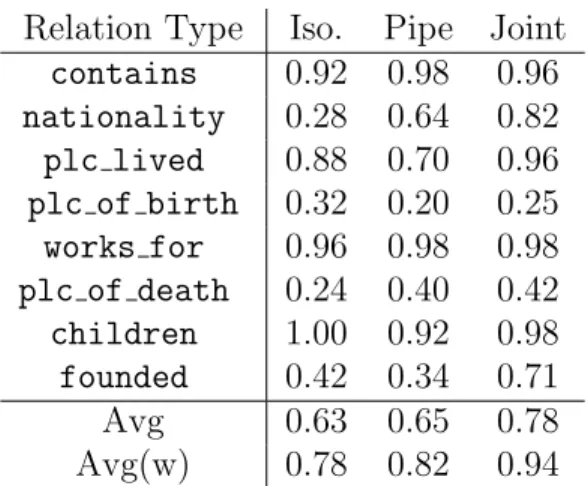
3.2 Average and weighted (w) average precision over frequent relations for New York Times and Wikipedia data, based on manual evaluation . . . 26
3.3 Precision@50 for the most frequent relations on New York Times . . . 28
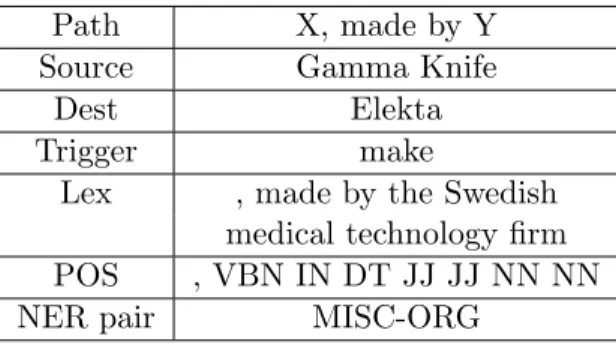
4.1 The features of tuple ‘(Gamma Knife, made by, Elekta)’ in sentence “Gamma Knife, made by the Swedish medical technology firm Elekta, focuses low-dosage gamma radiation” . . . 35
4.2 The notation used in our models . . . 35
4.3 Clustering quality evaluation (%). Recall is measured against Freebase. Precision is based on human annotations . . . 40
4.4 The path, source and destination arguments of some relations found by Rel-LDA1 . . . 42
4.5 The entity clusters found by Type-LDA . . . 42
4.6 Precision (%) of some frequent relations . . . 44
5.1 Example sense clusters for pattern “A play B” produced by sense disambiguation. We randomly sample 5 entity pairs for each sense and show the top features. Each row shows one feature type, where “num” stands for digital numbers, and prefix “l:” for source argument, prefix “r:” for destination argument. Some features overlap with each other. We manually label each sense for easy understanding. We can see the last two senses are close to each other. For two theme features, we replace the theme number with the top words. For example, the document theme of the first sense is Topic30, and Topic30 has top words “sports”. The lower four rows are four types of features: document theme, sentence
theme, lexical words and entity names . . . 55
5.2 Example semantic relation clusters produced by our approach. For each cluster, we list the top paths in it, and each is followed by “:number”, indicating its sense obtained from sense
disambiguation. They are ranked by the number of entity pairs they take. The column on the left shows sense of each relation. They are added manually by looking at the sense numbers
associated with each path . . . 56
5.3 Pairwise and B3 evaluation for various systems. Since our systems predict more fine-grained clusters than Freebase, the recall
measure is underestimated . . . 61
5.4 A path intrusion task. We show 5 paths and ask the annotator to identify one path which does not belong to the cluster. And we show one example sentence for each path. The entities (As and Bs) in the sentences are bold. And the italic row here indicates
the intruder . . . 61
5.5 Results of intruding tasks of all systems . . . 62
6.1 Some entities, observed types and predicted ones by our system. We can describe an entity in any granularity based on the patterns or types from ontologies. The patterns are translated from
dependency parsing paths . . . 70
6.2 Top similar patterns to the target queries . . . 78
6.3 Top ranked patterns learned by the baseline classifiers. Not all patterns can imply the target patterns. The patterns are not as
diverse as patterns learned by our approach . . . 79
6.5 Performance on predicting Freebase entity types on WikiLink . . . 80
6.6 F1 measure on some human annotated fine-grained types. We take
these types as representatives of pattern based types . . . 81
7.1 Average and (weighted) Mean Average Precisions for Freebase relations based on pooled results. The # column shows the number of true facts in the pool. NFE is statistically different to all but NF and F according to the sign test. Bold faced are
winners per relation, italics indicate ties. . . 95
7.2 Performance on predicting Freebase relations in universal schema. +Unary indicates adding predicted pattern based types as
features. +Unary(FB) for adding predicted Freebase types . . . 97
7.3 Selectional preferences learned by our model . . . 98
7.4 Statistics of processed data . . . 99
7.5 Performance variations of relation extraction as the amount of
training data increases . . . 99
7.6 Performance variations of relation extraction as the number of
dimensions varies . . . 100
7.7 Performance variations of relation extraction for different
initializations . . . 100
7.8 Performance variations of relation extraction as we use different
coreference approaches . . . 101
7.9 Examples of asymmetric implication pairs . . . 102
7.10 Top narrower relations for some broader relations . . . 103
7.11 The number of relations predicted as true based on only one observed relation. Broad relations (i.e., “player”) turn on more predictions; narrow relations (e.g., “pitcher”) turn on fewer predictions . . . 104
8.1 Combined features from question and candidates. ‘ctype’ stands for entity types of a candidate. ‘qtype’ stands for entity types of a question topic. ‘qword’ and ‘qfocus’ are similar to those defined
8.2 Performance on WebQuestions: a question answering data set
LIST OF FIGURES
Figure Page
2.1 Latent Dirichlet Allocation model. z represents a topic, w represents a word token in a document, Z represents the number of topics,
and D represents the number of documents . . . 10
3.1 Overview of distant supervision . . . 13
3.2 Factor Graph for joint relation mention prediction and relation type identification. For each pair of entities that are mentioned together in at least one sentence we create one relation variable (the top variable here). For each of the pairs of entity mentions that appear in a sentence we create one relation mention variable, and connect it to the corresponding relation variable. Note that relation variables for different pairs of entities are considered to be independent . . . 14
3.3 The recall and precision curves for the held out evaluation of three approaches: distant supervision, joint supervision, and
at-least-once supervision . . . 16
3.4 Precision at Kfor manually evaluated predictions . . . 17
3.5 Factor Graph of our model that captures selectional preferences and functionality constraints. For readability we only label a subsets of equivalent variables and factors. Note that the graph shows an example assignment to variables . . . 19
3.6 Precision-recall curves for various setups in Wikipedia held-out
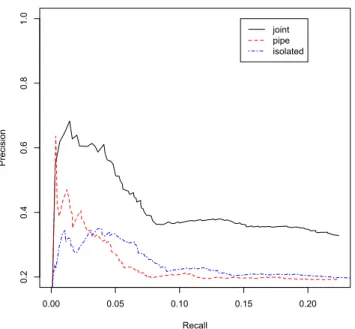
setting . . . 25
3.7 Precision-recall curves for isolated, pipeline and joint approaches in
New York Times held-out setting . . . 27
4.1 Rel-LDA model. Shaded circles are observations, and unshaded ones are hidden variables. A document consists of N tuples. Each tuple has a set of features. Each feature of a tuple is generated
4.2 Type-LDA model. Each document consists ofN tuples. Each tuple has a set of features, relation level featuresf and entity level features of source argument fs and destination argument fd.
Relation level features and two hidden entity types T1 and T2 are generated from hidden relation variable r independently. Source entity features are generated from T1 and destination features are
generated fromT2 . . . 38
5.1 Sense-LDA model . . . 54
6.1 Overview of our system . . . 68
7.1 Averaged 11-point precision recall curve for surface pattern
relations . . . 94
7.2 Different factorization models for relation extraction. They are different in terms of how they model relations and entities. The first model represents relations as matrices. The remaining models represent relations as vectors. All the first three models represent each entity as a vector. The fourth model, our
factorization model, represents each entity pair as a vector.
CHAPTER 1
INTRODUCTION
Natural language is a highly expressive representation of knowledge. Yet, for many
tasks knowledge bases are more suitable, as they support more effective querying,
question answering and data mining. But knowledge bases usually have a pre-defined
schema, and they can only capture so much of the information natural language
can express. For example, Freebase [Bollacker et al., 2008] captures the content of
Wikipedia to some extent, but has no criticized(Person,Person) relation and hence
cannot answer a question like “Who criticized George Bush,” even though partial
an-swers are expressed in Wikipedia. This makes the database schema a major bottleneck
in information extraction (IE). From a more general point of view, data integration
al-ways suffers from schema mismatch between knowledge source and knowledge target,
for example, integrating natural language text with Freebase.
To overcome this problem, one could attempt to manually extend the schema
whenever needed, but this is a time-consuming and expensive process. Alternatively,
in the case of IE, we can automatically induce latent schemas from text, but this
is a brittle, ill-defined and error-prone task. This thesis presents a third alternative:
sidestep the issue of incomplete schemas altogether, by simply combining the relations
of all knowledge sources into what we refer to as a universal schema. So universal
schema is the union of all relations seen among natural language surface patterns and
other structured knowledge sources. We generalize these source relations by learning
implications among them using matrix factorization. Experimental results on New
systems, relation extraction using universal schema achieves better performance. We
explore various facets of universal schema matrix factorization models on a
large-scale web corpus, including implicature among the relations. We also evaluate our
approach on the task of question answering using features obtained from universal
schema, achieving state-of-the-art accuracy on a benchmark dataset.
In this thesis, we first introduce background knowledge in Chapter 2. After that,
we introduce alternative approaches to relation extraction: distant supervision in
Chapter 3, unsupervised relation discovery with topic models in Chapter 4, and
pat-tern sense disambiguation in Chapter 5. Then we describe our core approach universal
schema, starting with universal schema for entity types in Chapter 6, and exploring
universal schema for relation extraction in Chapter 7. We also describe a question
answering application using universal schema in Chapter 8. Finally we conclude and
list future research directions in Chapter 9.
1.1
Contributions
This thesis mainly describes our work on building knowledge bases of entities and
relations using different approaches. Here are my contributions.
• Present universal schema for representing entities (6) and relations (7), allowing surface patterns to stand for themselves without information loss, and employ
matrix factorization for learning implications among relations (§7.2).
• Explore different applications of universal schema, including relation instance prediction, question answering. (§7.3, 8).
• Develop relation extraction models based on distant supervision, addressing the challenge that not all relation mentions in the text corpus express the relation
from the distant supervision source, and incorporating selectional preferences
• Develop generative models for unsupervised relation discovery, assuming each relation tuple is generated from a relation topic, and dealing with the ambiguity
of pattern senses by clustering entity pairs of each pattern (4, 5).
1.2
Declaration of Previous Work
I declare my previous work and collaborations with other researchers. All of them
are directed by my advisor Andrew McCallum.
• Work on modeling the mismatching between the knowledge base and the text corpus in distant supervision (§3.2) is in collaboration with Sebastian Riedel, published as [Riedel et al., 2010].
• Work on joint modeling of entity and relation types in distant supervision (§3.3) is in collaboration with Sebastian Riedel, published as [Yao et al., 2010].
• Work of developing topic models for unsupervised relation extraction (4) is published as [Yao et al., 2011], and in collaboration with Aria Haghighi and
Sebastian Riedel.
• Work of disambiguating pattern senses using topic model (5) is published as [Yao et al., 2012b], and in collaboration with Sebastian Riedel.
• Work of developing efficient inference algorithms for topic models is in collabo-ration with David Mimno, published as [Yao et al., 2009].
• Work of universal schema for entity types (6) is published as [Yao et al., 2013], and in collaboration with Sebastian Riedel.
• Work of universal schema (7) for relation extraction is in collaboration with Sebastian Riedel, published as [Yao et al., 2012a, Riedel et al., 2013].
CHAPTER 2
BACKGROUND
This chapter briefly introduces the terminology for defining the tasks, and machine
learning models for addressing the tasks.
2.1
Relations
Relation extraction deals with extraction of relationships among entities. Example
entities include the company founder Bill Gates, the company Microsoft, and
the country USA. A relation R is a set of tuples over entities. We call R(e1, . . . en)
with tuple (e1, . . . en)∈R arelation instance. It denotes the membership of the tuple
in the relation R. For example, founded (Bill Gates, Microsoft) is a relation
instance denoting thatBill GatesandMicrosoftare related in relation founded.
2.2
Mentions
In natural language, text spans of tokens are used to refer to entities. We call
such spans entity mentions. Consider, for example, the sentence snippet: “Political opponents of President Evo Morales of Bolivia have in recent days stepped up”
Here “Evo Morales” is an entity mention of presidentEvo Morales, and “Bolivia”
a mention of the country Bolivia he is the president of.
People often express relations between entities in natural language texts by
men-tioning the participating entities in specific syntactic and lexical patterns. Any tuple
Note that tuples across sentences are not considered in our work. If such a
candi-date expresses the relation R, then it is a relation mention of the relation instance
R(e1, . . . , en). In this thesis, we mostly work on binary relation instances. Usually
our basic data unit is a triple (e1, pattern,e2) that has two argumentse1 ande2, and
a pattern that expresses the relationship between them.
2.3
Dependency Path
As described in §2.2, relations between entities are expressed by specific syntac-tic and lexical patterns. To obtain such patterns, we first parse sentences to get
dependency trees. In a dependency tree, each word is a node and a dependency
relation between two words is an edge. For binary relations, we employ
depen-dency paths that connect entity pairs to represent relations. A dependepen-dency path
is a concatenation of dependency relations (edges) and words (nodes) along a path
in a dependency tree [Lin and Pantel, 2001]. For instance, the sentence “John
Lennnon was born in Liverpool” would yield the relation tuple (John Lennon,
[←nsubjpass←bear→prep→in→pobj→], Liverpool). This relation instance re-flects a semanticbornIn relation between theJohn LennonandLiverpoolentities.
The dependency path in this example corresponds to the “X was born in Y” textual
expression. Through this proposal, we mainly use dependency paths to represent
relationships of entity pairs.
2.4
Relation Extraction
The goal of relation extraction is to discover the truth about underlying relations
among entities—to discover the semantic meanings of relations irrespective of how
they are expressed. For example, in supervised and weakly supervised approaches,
relation types are defined to represent relations. In unsupervised approaches, a set of
surface pattern or a relation type represents a relation. The underlying semantics of
these relations are expressed by implications among them.
2.5
Entity Types
An entity can be categorized into one or several entity types. For example, Bill Gates is a person, and a founder of a company. Entity types correspond to the
special case of relations with arity one, and we usually name them unary relations.
Discovering entity types can help us understand the concepts of specific domains.
For relation extraction, we care about entity types because they are useful for
ex-tracting binary relations due to selectional preferences—see §2.6.
We care about entity types due to their importance in downstream applications:
if consumers of our extracted facts know the type of entities, they can find them more
easily, visualize them more adequately, and perform operations specific to these types
(write emails to persons, book a hotel in a city, etc.).
2.6
Selectional Preferences
There are type constraints between relations and entities, known as selectional preferences. Specifically, relations require, or prefer, their arguments to be of certain types. For example, the nationality relation requires the first argument to be a
person, and the second to be a country. In relation extraction, we expect that
modeling these type constraints can improve the performance [Roth and Yih, 2007,
Pantel et al., 2007].
2.7
Data Preprocessing
We use the following procedure to generate candidate relation tuples: first we
use the Stanford named entity recognizer (NER) [Finkel et al., 2005] to find entity
classifies each token into four categories: PERSON, ORGANIZATION, LOCATION
and NONE. We treat consecutive tokens that share the same category as single entity
mention.
We extract a pair of entity mentions that occur in the same sentence as one
candidate tuple, and extract a set of features from the sentence for relation extraction.
The features are similar to those used in [Mintz et al., 2009]: lexical, part-of-speech
(POS), named entity and dependency path features, as explained in§2.3. We use the openNLP POS tagger1 to obtain POS tags and employ the MaltParser [Nivre et al.,
2004] for dependency parsing.
Our entity type extraction uses the following features: the surface form of the
entity, the POS sequence, the head of the entity in the dependency parse tree, the
named entity tag, and the left and right words to the current entity mention phrase.
2.8
Entity Linking
Most of our approaches discussed in this thesis require linking entities from a
text corpus (e.g., NYT articles) to a knowledge base (e.g., Freebase). For example,
most approaches learn models that leverage co-occurrences among multiple relation
mentions of the same entity pair. To find these multiple mentions, entity resolution
is a prerequisite. However, entity resolution is not our main focus in this thesis,
and there are many complex alternative methods from which to choose. To ease
reproducibility and demonstrate the robustness of our approaches we use simple string
matching to link entity mentions in NYT documents to Freebase entities. Specifically,
if the Freebase entity has the same string form as the entity mention, we link them as
one entity. If multiple Freebase entities have the same string form, we use the most
popular one. For example, “Canada” could be a country, or a kind ofwine. We use
country. This method has been employed by many researchers [Mintz et al., 2009, Lin and Pantel, 2001, Yao et al., 2010]. Integrating relation extraction with more
complex entity resolution systems is a topic for future work.
2.9
Graphical Models
Graphical models have been proven useful for formalizing learning tasks. This
sec-tion describes graphical model representasec-tion and how to learn parameters for these
models. In graphical models, we usually formalize a task as predicting the values of
variables. There are observed variables and hidden variables. Observed variables
cap-ture the information of observed data. Hidden variables capcap-ture the latent struccap-ture
of the data. Usually we predict hidden variables based on observed variables. In this
thesis, we useY to represent hidden variables and X to represent observed variables.
We note the values of hidden variables as labels, and instances of observed variables
as data, observations and evidence. One can categorize graphical models into two
categories in terms of how they define their objectives as functions of observed and
hidden variables. Discriminative models define the objectives as the conditional
prob-abilities of hidden variables given observed variables, while generative models define
the objectives as the joint probabilities of observed and hidden variables.
2.9.1 Discriminative Models
In this thesis we mainly use exponential family models. The models define the
conditional probabilities as
p(Y|X) = exp(
~λF(X,Y))
P
Y0exp(~λF(X,Y0))
In these models, F(X,Y) represents features defined over hidden and observed
vari-ables. For example, if a word “baseball” occurs in a document where “sports” is a
We employ maximum log likelihood estimation to learn the parameters ~λ. Given a
list of pairs (~xi, ~yi), we define the objective function as:
X i logpi(~yi|~xi)− 1 2σ2||~λ|| 2
In this formula, the first term is the log likelihood of the data and the second one
is the regularization term. In this thesis we mainly use L2 regularization. Other
regularizations are possible too. To maximize the objective function, we use the
gradient descent optimization method. We derive the gradients with respect to the
parameters:
5~λ =F(X,Y)−Ep~λ(X,Y)
The gradients have two terms, the constraints term and the expectation term. The
constraints are the statistics obtained from the training data. The expectation term
calculates the expectations of the features under the assumption that the data
fol-lows the distribution defined by the model. The objective is maximized when the
constraints match the expectations. Intuitively, one set of parameters define a
dis-tribution, and the goal of learning is to find one distribution in the whole parameter
space that can explain the data well.
2.9.2 Generative Models
Discriminative models are usually used in supervised settings, i.e. when we have
annotated relations available. When we do not have labeled data, we can use
unsu-pervised models. Generative models, mainly topic models are popular unsuunsu-pervised
models. Generative models assume the data is generated from a probabilistic process.
Take one document as an example: in a simple case, we can assume that each word
is generated independently from a probabilistic distribution.
One example of a generative process is the standard topic model named Latent
Z D
φ
w
α θ z β
Figure 2.1. Latent Dirichlet Allocation model. z represents a topic, w represents a word token in a document, Z represents the number of topics, and D represents the number of documents
has a distribution over topics, each topic has a distribution over words in a vocabulary
and each word is drawn from a topic. Figure 2.1 shows the graphical representation
of this model.
Here is the generative process in detail:
1. For each topic z, generate a distribution φz over each word from Dir(β)
2. For each documentd, generate its topic distribution θd from Dir(α)
3. For each word in a document d,
- Draw a topic z from Multi(θd),
- Generate a word w from Multi(φz) independently
There are various ways to estimate the document topic distribution θd and the
topic word distribution φz. We use Gibbs sampling in this thesis. We iteratively
sample a topic for each word in each document based on current parameters Θ and
Φ, and update parameters based on the current topic assignments.
p(z|w)∝p(z|d)p(w|z) ∝(αz+nz|d)
βw+nw|z
P
w(βw+nw|z)
θd = α+nz|d P z(α+nz|d) φzw = βw+nw|z P w(βw+nw|z)
Topic models are successful in modeling documents. We will adapt topic models
CHAPTER 3
DISTANT SUPERVISION FOR RELATION
EXTRACTION
In distant supervision, we align knowledge bases with text data to set up the
train-ing source. In this chapter, we first review distant supervision. After that, we point
out challenges in distant supervision and present our approach for explicitly modeling
mentions. Last, we extend the distant supervision approach to model entities and
relations jointly.
3.1
Distant Supervision
In relation extraction we often encounter a lack of explicitly annotated text, but
an abundance of structured data sources such as company databases or collaborative
knowledge bases like Freebase are available. In distant supervision, we align relation
instances from structured data sources with a text corpus in which they are mentioned
to set up the training data [Mintz et al., 2009, Bunescu and Mooney, 2007, Bellare
et al., 2007]. The knowledge base plays the role of a distant supervisor for training a
relation extractor.
This approach performs relation extraction within a larger scope that considers
mentions across documents and takes advantage of redundancy. Often facts are
men-tioned in several sentences and documents. It may be difficult to parse some of these
mentions, or they use unseen patterns. However, the more mentions we consider, the
higher the probability that it is easier to parse a mention, and encounter a pattern
founded(Bill Gates, Microsoft)
nationality(Xi Jinping, China)
...(…, …)
founded(Paul Porter, Industry Ears)
Microsoft was founded by Bill Gates
With Microsoft chairman Bill Gates soon
relinquishing ...
Paul Porter, a founder of Industry Ears
founded founded
Classifier
Figure 3.1. Overview of distant supervision
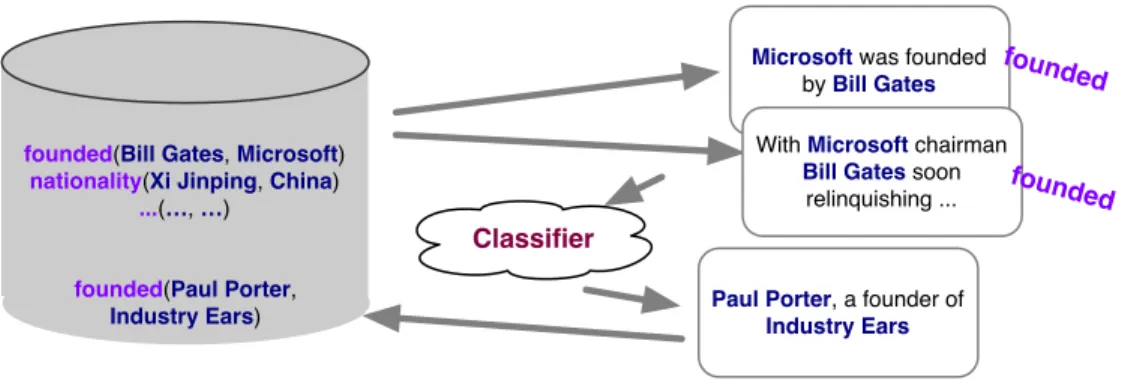
Figure 3.1 shows an overview process of distant supervision. Starting with a
knowledge base of relation instances, we find mentions of them in the text corpus. This
requires co-reference and entity linking, we use a simple string matching approach for
both of these tasks §2.8. After linking relation instances to sentences in the text, for each entity pair, we collect features from all the sentences that mention them.
We train a multi-class classifier for relation extraction. At test time, given new
text documents, we first identify candidate tuples, i.e., entity pairs that occur in the
same sentence. We then extract a feature vector from all sentences that mention
the entity pair. Finally we apply our trained classifier to categorize this pair into
one relation type. To expand our knowledge base, we can add this newly predicted
relation instance into the knowledge base.
3.2
Modeling Relations and Their Mentions
One challenge in distant supervision arises from the mismatch between relation
instances in the knowledge base and their mentions in the form of textual
expres-sions. That is, sometimes two entity mentions appear together in a sentence, but the
sentence is not expressing the relation that appears in the KB.
We present a novel approach to distant supervision that can alleviate this problem
1
founded
...
0
Elevation Partners, the private the $ 1.9 billion private equity group that was founded by
Roger McNamee ...
relation(Roger McNamee,Elevation Partners)
Roger McNamee , a managing director at Elevation Partners ...
Figure 3.2. Factor Graph for joint relation mention prediction and relation type identification. For each pair of entities that are mentioned together in at least one sentence we create one relation variable (the top variable here). For each of the pairs of entity mentions that appear in a sentence we create one relation mention variable, and connect it to the corresponding relation variable. Note that relation variables for different pairs of entities are considered to be independent
decision whether two entities are related, and the decision whether this relation is
mentioned in a given sentence. Second, we apply constraint-driven semi-supervision
to train this model without any knowledge about which sentences express the relations
in our training KB [Riedel et al., 2010] .
3.2.1 Models
For modeling, we employ the following expressed-at-least-once assumption: If two
entities participate in a relation, at least one sentence that mentions these two entities
express that relation.
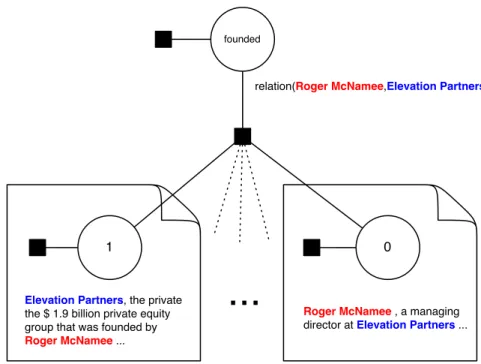
Figure 3.2 shows the factor graph of our model. Our model connects a relation
if and only if mention iis indeed expressing the relation Y between the two entities.
Crucially, the relation mention variablesZis are unobserved at training time: we only
know that a relation is expressed at least once, but not in which sentences. During
training, the model prefers at least one Zi is active if Y is true. In Figure 3.2, we
show two example mention variables. For each relation mention, we collect features
from the sentence, such as the dependency path between the two entities (§2.7). Our model is implemented in FACTORIE [McCallum et al., 2009], a probabilistic
programming language that simplifies the construction process, as well as inference
and learning.
3.2.2 Experiments
We carry out experiments on New York Times articles, and use Freebase as distant
supervision source.
We follow [Mintz et al., 2009] and perform two types of evaluation: held-out and
manual. In both cases we have a training and a test corpus of documents, and training
and test sets of entities. For held-out evaluation we split the set of entities in Freebase
into training and test sets. For manual evaluation we use all Freebase entities during
training. For testing we use all entities that appear in the test document corpus. This
setting is used again in distant supervision experiments in the following chapters.
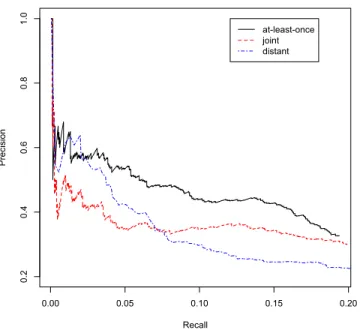
In Figure 3.3 we compare the precision and recall curve for the baseline
distant-supervision model (distant), the supervised joint model (joint) and the distant model
with expressed-at-least-once assumption (at-least-once). The joint model favors
as-signing 1 to eachZi if Y is true, otherwise prefers assigning each Zi to 0. The curve
is constructed by ranking predicted relation instances using their log linear score.
For the distant supervision baseline this score is first normalized by the number of
mentions. We traverse this list from high score to low score, and measure precision
0.00 0.05 0.10 0.15 0.20 0.2 0.4 0.6 0.8 1.0 Recall Pre ci si on at-least-once joint distant
Figure 3.3. The recall and precision curves for the held out evaluation of three approaches: distant supervision, joint supervision, and at-least-once supervision
assumption is consistently outperforming the distant supervision baseline and the
su-pervised joint model. This suggests that the at-least-once model has the best sense
of how relations that are already contained in Freebase are expressed in NYT data.
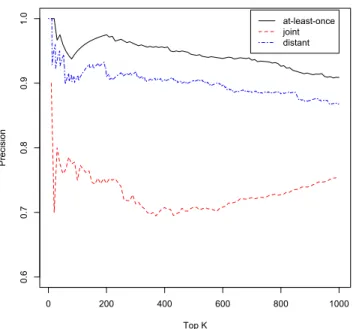
Figure 3.4 shows the manual evaluation results for the three approaches. We
first note that the precision is much higher for manual evaluation than for held-out
evaluation. This shows that false negatives in Freebase are an issue when doing
held-out evaluation. Many of the false positives we predict are in fact true relation
instances that just do not appear in Freebase.
For manual evaluation, the at-least-once model is still the clear winner. At K =
1000 we observe a precision of 91% for at-least-once supervision and 87% for distant
supervision. This amounts to an error reduction rate of 31%. The sign test shows
that the at-least-once model is significantly better than the distant supervision model,
0 200 400 600 800 1000 0.6 0.7 0.8 0.9 1.0 Top K Pre ci si on at-least-once joint distant
Figure 3.4. Precision at K for manually evaluated predictions
model performs much worse than the distant supervision approach in this scenario.
Learning a model of relations and mentions is inherently more difficult. Using a wrong
assumption will hence more likely hurt performance.
3.3
Joint Inference for Entity and Relation Extraction
In relation extraction, selectional preferences describe that certain relations can only hold between particular entity types. For example, for relation nationality,
the first argument should be a person and the second acountry. These constraints
can correct some predictions in relation extraction. In this section, we present how
to incorporate them in cross document relation extraction under distant supervision.
A simple way to is to use a pipeline: first predict entity types, and then condition
on these when predicting relations. However, this neglects the fact that relations
While there is some existing work on enforcing such constraints in a joint
fash-ion [Roth and Yih, 2007, Kate and Mooney, 2010, Riedel et al., 2009], they are not
directly applicable in distant supervision. The difference is the amount of facts they
take into account at the same time. They focus on single sentence extractions, and
only consider very few interacting facts. This allows them to work with exact
op-timization techniques such as (Integer) Linear Programs and still remain efficient.1
However, when working on a sentence level they fail to exploit the redundancy present
in a corpus. Moreover, the fewer facts they consider at the same time, the lower the
chance that some of these will be incompatible, and that modelling compatibility will
make a difference.
In this work we present a novel approach that enforces selectional preferences in
distant supervision. It is based on an undirected graphical model in which variables
correspond to facts, and factors between them measure compatibility. In order to
scale up, we run an efficient Gibbs-Sampler at inference time, and train our model
using SampleRank [Wick et al., 2009]. In practice this leads to a runtime behaviour
that is linear in the size of the corpus. In our experiments, 200K documents take less
than three hours for training and testing.
For evaluation we consider two scenarios. First we follow Mintz et al. [2009],
use Freebase as a source of distant supervision, and employ Wikipedia as source of
unlabelled text—we will call this an in-domain setting. This scenario is somewhat
artificial in that Freebase itself is partially derived from Wikipedia, and in practice
we cannot expect text and training knowledge base to be so close. Hence we also
evaluate our approach on the New York Times corpus (out-of-domain setting).
For in-domain data we make the following finding. When we compare to an
isolated baseline that makes no use of entity types, and our joint model improves
1The pyramid algorithm of Kate and Mooney [2010] may scale well, but it is not clear how to