Consolidated
government
accounts: How
are they used?
About ACCA
ACCA (the Association of Chartered Certified Accountants) is the global body for professional accountants. It offers business-relevant, first-choice qualifications to people of application, ability and ambition around the world who seek a rewarding career in accountancy, finance and management. ACCA supports its 178,000 members and 455,000 students in 181 countries, helping them to develop successful careers in accounting and business, with the skills required by employers. ACCA works through a network of 92 offices and centres and more than 7,110 Approved Employers worldwide, who provide high standards of employee learning and development. Through its public interest remit, ACCA promotes appropriate regulation of accounting and conducts relevant research to ensure accountancy continues to grow in reputation and influence. Founded in 1904, ACCA has consistently held unique core values: opportunity, diversity, innovation, integrity and accountability. It believes that accountants bring value to economies in all stages of development and seek to develop capacity in the profession and encourage the adoption of global standards. ACCA’s core values are aligned to the needs of employers in all sectors and it ensures that through its range of qualifications, it prepares accountants for business. ACCA seeks to open up the profession to people of all backgrounds and remove artificial barriers, innovating its qualifications and delivery to meet the diverse needs of trainee professionals and their employers. More information is here: www.accaglobal.com
© The Association of Chartered Certified Accountants June 2015
This report examines
the use being made
of consolidated
government accounts
in a sample of countries
which prepare them.
It highlights the
importance of the
information they
provide to support
policy decisions,
fiscal transparency
and accountability,
and makes
recommendations to
promote their wider use
in support of sustainable
public services.
Consolidated government accounts: How are they used?
Danny Chow *, Durham University, UK Ronald Day, University of Sydney, Australia
Rachel Baskerville, Victoria University of Wellington, New Zealand Raili Pollanen, Carleton University, Canada
Caroline Aggestam, Copenhagen Business School, Denmark
Consolidated, accruals-based government accounting has been promoted by many commentators as contributing to macroeconomic policymaking, enhancing parliamentary scrutiny and accountability, and facilitating a more holistic approach to government by integrating accounting information systems. In fact, such theoretical claims have not been tested against the reality of how these accounts are being used and who is using them. Nor is it known whether ideas that work in one country will readily transfer to another. This purpose of the study on which this report is based was to test those claims.
The study was based on interviews with key stakeholders across a range of user groups and was supplemented with an academic literature review. Although there are notable variations in the use and users across the countries analysed there are a number of unifying themes and lessons learnt. The key findings and recommendations are outlined below.
KEY FINDINGS
• The move towards accruals-based consolidated accounting in governments across the five countries has been an effective stimulus in transforming the quality standards of accounting practices and systems across governments, which have historically been, and some still are, heavily cash-based.
• Reforms based on consolidated
government accounting have highlighted limitations in existing systems of
accounting and accountability, such as illuminating under-reported liabilities or inconsistent accounting practices and raising the awareness among government officials and auditors of the need for continuous improvement.
• Variations in the consolidation approach between countries limit its global appeal from a comparative perspective. The way in which consolidated accounting boundaries are determined within each country has a significant bearing on how consolidated accounts are being used. The study found that national governments draw the consolidation boundary on the basis of local specificities, either to fit in with existing constitutional notions of the public sector boundary or as a compromise with the political constraints of the day.
• Financial markets, credit rating agencies and other analysts make little use of consolidated government accounts. For example, credit rating agencies prefer global statistical reporting frameworks based on universal standards such as the UN/EU statistical accounts rather than consolidated government accounts. Also, there is little evidence to suggest that GAAP-based consolidation is generally useful for macroeconomic policy planning within government.
• An important factor determining the use and usefulness of consolidated government accounts is the political buy-in at the outset. Politicians’ use of public accounts is heavily biased towards the budgetary process, which is the main arena where contests for resource allocation take place. Parliamentary scrutiny, which theoretically could benefit from the implementation of consolidated government accounting, is also conditional on greater financial literacy among politicians, which limits such work to specialist members of parliament. • The infrastructure for ensuring
that parliamentary committee recommendations are followed up is underdeveloped in many of the countries covered by the study. There is often little political will to push for increased scrutiny work and for improving financial literacy, given higher priorities elsewhere. This is especially the case when support for consolidated government accounts is not universal, but viewed mainly as an accounting-centric function for compliance reporting and auditing.
United Kingdom
• In the UK, participants struggled to provide an example of a decision made on the basis of consolidated government accounts (WGA-UK), even though there are numerous ancillary benefits claimed for its implementation. For example, there is some evidence that WGA-UK had created value by raising the profile of areas of concern to the public, such as on public sector pension deficits, the scale of the national debt and contingent liabilities. • A lack of timely reporting and political
will, and the problem of continued audit qualifications, as well as an inability to embrace the potential benefits of WGA-UK fully, undermines the usefulness of the accounts to potential user groups.
Executive summary
At a time when governments are
being asked to become more
fiscally transparent by placing
relevant information in the public
domain, this report makes a timely
contribution to a debate on the
uses and users of consolidated
government accounts in five
countries: Australia, Canada, New
Zealand, Sweden and the UK.
Consolidated government accounts: How are they used?
Executive summary 5
• A number of participants in the UK argued that there was evidence to suggest that Parliament is moving away from discussions about how the numbers are constructed to debates about the significance of WGA-UK information provided as a representative of government policy and management.
Australia
• In Australia, previous research has mainly focused on normative ideas of how Whole of Government Reports (WGR-AU) should be used, rather than on evidence of their actual use. Participants indicated that they are generally not used or understood by parliamentarians; they attract limited media attention and public interest; and have limited use by credit rating agencies. Treasury officials interviewed focused mainly on compliance rather than on the rationale of the reports; and had little confidence that they met users’ needs, particularly for parliamentarians, who they suggest favoured budget report aggregates, particularly the underlying cash-based deficit.
• In Australia several factors, other than user needs, have tended to drive the form of consolidation and development of WGR-AU, including historical and constitutional logics, convergence of public sector with private sector accrual accounting technologies, sector-neutral accounting standards, and a contest of ideas about which accrual reporting framework to adopt.
New Zealand
• In New Zealand, a significant change occurred recently when the newly constituted XRB (External Reporting Board) developed separate reporting frameworks for the public and not-for-profit sector, issuing a package of exposure drafts on new standards based on International Public Sector Accounting Standards (IPSAS). Given the range of users of the WGA-NZ – but in particular the government itself, and credit rating agencies – perceptions are that the institutionalisation of consolidation may have led to some changes in behaviour and the practice of accounting, which are to the benefit of the operation of government.
• Participants in New Zealand were able to identify a clear link between the financial report and policymaking at the macroeconomic level, as well as improved planning for the capital maintenance of public sector assets. The long history of consolidation in WGA-NZ reports has improved the focus of those involved in the preparation of the accounts as well as users of the report.
Canada
• For Canadian governments, consolidated government accounts are primarily seen as an external accountability tool for complying with legal and professional accounting requirements. They are not used for management planning, decision-making and internal accountability purposes to any significant degree. Although accountability to Parliament/ provincial legislatures is their major stated objective, this intended use was difficult to validate empirically. It appears that other documents, such as departmental plans and priorities and performance reports, are more important for this purpose.
Sweden
• In Sweden, the central government has prepared consolidated government accounts since 1996. It has been
emphasised that the preparation of central government’s consolidated government accounts is a by-product arising from the implementation of accrual accounting. The preparation of consolidated government accounts does not have a primary objective of strengthening the financial reporting environment in the public sector, but is rather seen as a supplementary benefit of having put accruals in place.
• There is a formal process in place in Sweden, in which the ‘finance committee’ [finansutskottet] considers the
consolidated accounts of central government immediately after their release at the end of each year. Even though there is evidence that consolidated statements are used by government officers, documents such as the national budget and monthly reports on national debt are still, by far, the most important and frequently referred to documents in decision-making within government.
SETTING THE FUTURE DIRECTION
• There has to be a significant commitment by politicians and key government officials if consolidated government accounting reform programmes are to succeed and be used for their intended purpose. The government and preparers of consolidated government accounts must have a clear understanding of the accounts’ potential users at the outset.
• To make consolidated accounts more relevant to users and more useful for decision makers, consideration needs to be given to incorporating budgeting and performance reporting and perhaps to convergence with an international statistics framework, rather than just their use in compliance reporting for accountability purposes.
• Both parliament and government need to be more proactive in using consolidated accounts to inform policy development, as this supports spending decisions and highlights the extent of intergenerational fairness. The accounts can also be a useful tool for driving change on fiscal management.
• The basic financial literacy of
parliamentarians and government officials needs improving to facilitate the effective scrutiny of the consolidated government accounts. This could be achieved through induction and development programmes supplemented with guidance.
• Parliaments need to include mechanisms to ensure that recommendations made by parliamentary committees scrutinising consolidated government accounts are followed up.
• To improve the usability and accessibility of accounts, consideration should be given to simplifying the presentation of reports while retaining high-level and good quality information. Consolidated government accounts could be more meaningful if they included more forward-looking information and projected outcomes, as well as making more use of technology that allows summary information to be obtained and provides the opportunity to drill down to more detailed information.
• Public trust in the information provided requires the consolidated accounts to be free from audit qualification and produced in a user friendly format soon after the year end.
The UK move to consolidated government accounts followed earlier developments in Australia and New Zealand, which also had similar promises made by their respective proponents in government and elsewhere. On the face of it, all five countries examined in this study have well-established accounting systems for the purpose of parliamentary accountability and some have also adopted international norms such as the United Nation’s System of National Accounts (SNA). The continued drive to reform extant systems and the actual usefulness of such reforms is, however, less understood when one moves away from the supportive rhetoric of their proponents.
This suggests a need to move beyond rhetoric to consider global trends on what appear to be harmonising accounting practices among governments in countries with shared histories and ideas in public sector reform. Harmonisation can take a number of forms. For example, some countries emulate ideas from those in the vanguard of reforming government financial reporting systems, such as the development of consolidated accruals-based government accounts in the UK, Australia, New Zealand, Canada and Sweden. Other countries prefer to adopt global
standards such as IPSAS, without committing to more significant reform initiatives such as consolidated government-wide accounts. The aim of this study was to understand the uses and users of consolidated, accruals-based government accounts.
An earlier and preliminary ACCA report on consolidated government accounts (Aggestam et al. 2014), surveyed the academic literature on consolidated government accounts in five countries: the UK, Australia, New Zealand, Canada and Sweden. A factor causing considerable confusion is that many countries use similar terminology (eg the UK and New Zealand: Whole of Government Accounts; Australia: Whole of Government Reports)1
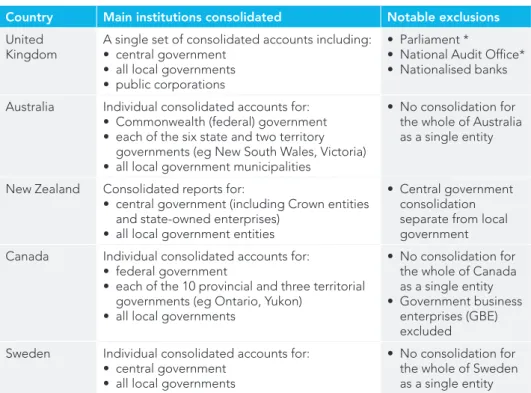
despite the very different meanings that each country attaches to the application of accruals-based consolidated government accounts. This confusion is symptomatic of a divergence between the use of commercial consolidated accounting techniques as a theoretical concept to represent boundaries of government accountability, versus the more established approach to defining what government does and/or is accountable for on a constitutional basis. Table 1 illustrates the main differences in reporting boundaries.
1.
Introduction
In the late 1990s, the UK
government made a number
of strong claims for Whole of
Government Accounts (UK):
namely that such a reform can aid
macroeconomic policymaking,
enhance parliamentary scrutiny
and accountability, and introduce
much-needed improvements to
accounting information systems
across all levels of government
(HM Treasury 1998).
Table 1: Comparing the consolidation boundaries and notable exclusions
Country Main institutions consolidated Notable exclusions
United
Kingdom A single set of consolidated accounts including:• central government • all local governments
• public corporations
• Parliament *
• National Audit Office* • Nationalised banks Australia Individual consolidated accounts for:
• Commonwealth (federal) government • each of the six state and two territory
governments (eg New South Wales, Victoria) • all local government municipalities
• No consolidation for the whole of Australia as a single entity
New Zealand Consolidated reports for:
• central government (including Crown entities and state-owned enterprises)
• all local government entities
• Central government consolidation separate from local government Canada Individual consolidated accounts for:
• federal government
• each of the 10 provincial and three territorial governments (eg Ontario, Yukon)
• all local governments
• No consolidation for the whole of Canada as a single entity • Government business
enterprises (GBE) excluded Sweden Individual consolidated accounts for:
• central government • all local governments
• No consolidation for the whole of Sweden as a single entity
*Excluded to emphasise the importance of Parliament’s role in holding government to account and hence it cannot be part of WGA-UK.
1 For clarity, this report uses country codes when referring to a specific programme (eg WGA-UK) but otherwise adopts the generic nomenclature of consolidated government accounts (eg Canada and Sweden)
Consolidated government accounts: How are they used?
1. Introduction 7
Such heterogeneity can and does have major implications for the practice of public sector accounting within these countries, as suggested by Aggestam et al (2014). Nonetheless, a common unifying theme is that consolidated accounting is seen as an important catalyst for driving reforms elsewhere in government. With any change programme, resistance is to be expected, both conceptually and/or at the implementation level. This is in part due to the very nature of consolidated government accounting reforms, which is explicitly about redefining the jurisdiction of government activity, lines of accountability and fiscal transparency. The objective of the current study, therefore, is to address some of the unanswered questions raised in the earlier literature review (Aggestam, et. al., 2014), by researching how consolidated government
accounts are actually used and developing a more nuanced understanding of the notion of ‘use’ and ‘users’ of such accounts. This study adopted an empirical approach: staff at key public sector and government institutions in all five countries were interviewed. Interviewees included those significantly involved in the development of the consolidated financial reporting system, as well as staff in the ministry of finance/ treasury, auditors, those responsible for parliamentary scrutiny, policymakers, and external users such as credit rating agencies. The next section elaborates on the methods used. Five chapters then follow, representing the case studies for each country. Finally, the penultimate chapter provides a comparative analysis of the common and divergent themes emerging from the country cases, and finally there is a conclusion.
Nonetheless, a common
unifying theme is that
consolidated accounting
is seen as an important
catalyst for driving
reforms elsewhere in
government.
This study of uses and
users is based on interviews
with key people with
knowledge of, or personally
involved in (past and
present), the development
of a global architecture for
consolidated government
accounts.
2.
Method
In addition, the interviews were supplemented with information from the academic literature and documentary analysis. Most interviews were conducted face to face, digitally recorded and professionally transcribed. The selection of participants was non-random, but based on their job function, role within government/ public sector or the wider parliamentary system of accountability. Many of our participants were also familiar with their counterparts based in other countries, so the numbering convention we use to identify participants is based on their location of work rather than their topic of discussion or nationality. Owing to guarantees of anonymity, some of which were particularly strict, only the broad functions in which participants were involved are specified rather than the names of the specific institutions where they work (or had worked).
In all five countries participants were people who worked in a treasury and/or ministry/department of finance function (in a standard-setting, compliance reporting or budgetary planning role), those with insights into how parliamentarians or politicians used accounting reports, those involved in audit of government accounts, statistics and/or macroeconomic policy, and for some countries, they also included external users such as those from credit rating agencies. In total, over the span of six months from September 2014 to March 2015, interviews were conducted with six participants in the UK, five in Australia, six in New Zealand, six in Canada and five in Sweden, making 28 in total. Three interviews contained more than one participant, with each interview generally lasting for about an hour on average (though some stretched to two hours). Two of our interviews in Sweden were conducted in English, whilst the other two were in Swedish, which were manually transcribed and translated by one of the authors.
9
3.1 INTRODUCTION
The UK focus was initially to bring together, via the WGA-UK consolidation programme, the various central government accounts along with those of local government and public corporations. The literature review also highlighted how the government programme was intended to be of a dual-purpose nature, with the consolidation useful for both macroeconomic policymaking and for enhancing public sector accountability. The focus of the programme on macroeconomic policy was seen as an attempt to deal with political concerns of the time: These included the supposed inadequacy of existing systems for providing a comprehensive picture on the maintenance of asset bases, unfunded pension liabilities, and the lack of integration between fiscal management of the accounting functions within Treasury and other areas within the public sector. This section revisits the UK part of the research agenda set out in the initial work (Aggestam et al. 2014), which argued for the need to improve understanding of how WGA-UK is being used. The findings have led to a broad picture of the use of consolidated government accounts, by:
• tracking the way in which use and users are often defined rhetorically
• identifying key users and how they interpret the use and usefulness of WGA-UK, and finally
• examining some consequences of WGA-UK development and publication on the practice of government accounting and accountability.
3.2 DEFINING USERS AND USES
In the scoping study for WGA-UK, it was said that the ‘main potential users of WGA are expected to be key government planners and managers, including Ministers, since WGA will help to underpin the new fiscal policy framework. Other potential user groups include a wider group of government planners and managers, and Parliamentary Select Committees as well as individual MPs, who should benefit from greater transparency of financial reporting and accounting by government’ (HM Treasury 1998: para.2.2).
The ‘new’ fiscal policy framework launched by the Labour government in 1998 under the Code for Fiscal Stability, was repealed under the subsequent coalition government’s legislation, the Budget Responsibility and National Audit Act 2011 (c.4, Part 1, Section 10). This formality reflects the observation of an participant (UK1) that WGA-UK had drifted from its original purpose of increasing the cohesion and transparency of fiscal (macroeconomic) and accountability (financial reporting) functions within the Treasury, to become an accounting exercise with a narrower focus, as the continual changes in scope over time had reduced its initial momentum as a fiscal tool. Although WGA-UK reforms are being driven by a small group of highly influential and capable individuals within HM Treasury, the Civil Service and the Cabinet, who have strong ideas on how WGA-UK should be used to enhance management and accountability in government, the relatively specialised nature of such reforms and their reliance on the continued patronage of influential individuals make the WGA-UK programme vulnerable to the latter’s departure or changes in political priorities. Other participants (UK4: two persons interviewed together) were in agreement with such insights on the driving force behind WGA-UK, and agreed that the current emphasis after the 2011 publication of WGA-UK is on getting the audit right and on extracting value from the audit process itself to move towards a qualification-free WGA-UK. The participants also concurred that WGA-UK is now seen as being concerned with improving accounting information systems and processes. Nevertheless, there was an acknowledgement that from inception, insufficient resources were given to dealing with the myriad challenges the WGA-UK project had faced during its developmental and subsequent post-publication phase. Within HM Treasury, the viability of the WGA-UK project was always dependent on the political priorities of the day. The early support for it fell away mid-way through the project, with the government subsequently also becoming distracted by the Global Financial Crisis in 2008–9 and failing to lavish sufficient resources on it to get it completed before the change of government in 2010.
3.
The UK
The UK focus was initially
to bring together, via the
WGA-UK consolidation
programme, the various
central government
accounts along with those
of local government and
public corporations.
Consolidated government accounts: How are they used?
3. The UK
Changing leadership and political priorities within government have meant that the current governmental focus hinders wider considerations of WGA-UK’s use, such as for macroeconomic-policy or value for money, towards the narrower issues of accounting compliance. As a result, one participant (UK1) observed that reviews by the Financial Reporting Advisory Board (FRAB) on the use of WGA-UK post-publication had struggled to identify a user within government who had made decisions on the basis of WGA-UK reports. Despite the accounting-centric focus of the early WGA-UK publications, however, there are signs that the UK’s Public Accounts Committee (PAC) is trying to revive WGA-UK as a focal point for the exercise of accountability over the way in which public finances are managed. The next section examines interpretations of WGA-UK’s uses and usefulness among the participants.
3.3 INTERPRETING THE USEFULNESS OF CONSOLIDATED GOVERNMENT ACCOUNTS
One participant (UK1) raised an important question about the value of WGA-UK by comparing it with existing systems already in place by raising the need to examine the source data from which it is constituted. Most governments already have statistical accounting systems in place under the UN’s or European Union’s requirements. As both WGA-UK and ESA2010 for National Accounts draw the bulk of their data from individual government departments submitted to HM Treasury, it was identified early on that one of the big achievements of the WGA-UK project was in highlighting the necessity of improving the data system.
Nonetheless, the continuously redeveloped IT system underpinning WGA-UK (Online System for Central Accounting and Reporting, or OSCAR, which had replaced the Combined Online Information System, COINS) remains unproven in that some of the lower-level data is still unreliable because it cannot be traced to its source, which reduces its transparency (UK1). The Comptroller and Auditor General’s qualification of all five WGA-UK reports (2009/10 to 2013/14), for example, highlights the vulnerability of the consolidation process to the long-running difficulties of a handful of government departments, such as the Ministry of Defence, which failed on numerous occasions to submit accounts of sufficient quality, as well as pointing out the inconsistencies in the way in which assets are treated between central and local government.
Nevertheless, despite overlaps with National Accounts functions and continued failings with the consolidation exercise, WGA-UK advocates (such as UK2) have pointed out that the reports have on balance managed to create value, in highlighting areas of concern to the wider public on issues such as the growth in liabilities such as clinical negligence claims, nuclear decommissioning and pensions. Moreover, WGA-UK have served as a catalyst for much-needed harmonisation of accounting policy across government, emphasising the need for better asset management, as senior managers previously had no useful measures available for dealing with the need to plan for asset replacement. The advocate (UK2) has also argued that WGA-UK consolidation is needed to highlight assets that have fallen between departmental boundaries and thus until now have remained unaccounted for, or at least not publicly visible. From the perspective of an MP (UK3) involved in scrutinising public accounts, however, there is a general belief that WGA-UK lacks the user-friendliness needed to encourage non-specialists or non-accountants to engage more fully with the published report and the parliamentary debates that ensue. As many or even most MPs are generalists, there is a general sentiment that WGA-UK has to be easier to use and more adapted for the MPs’ purpose (UK1, UK2 and UK3). For example, WGA-UK can still appear as if it were a large set of consolidations, with readers struggling to understand the often subtle differences between National Accounts, public sector net deficit and WGA-UK net liability (UK2). The rewards for getting it right, however, are potentially huge. The MP participant (UK3) was clearly able to articulate the value of WGA-UK as a stimulus for better financial planning within Parliament, as much planning and debate still operates on a cash basis rather than on accruals or consolidation. Nevertheless, the complexity of WGA-UK reports has meant that MPs are heavily reliant on the advice of the National Audit Office (NAO) on WGA-UK – but then again this is seen as the way in which things should and do work (UK3). Other obstacles for MPs are that the lack of timeliness in the WGA-UK reporting has been a hindrance to more effective scrutiny and that WGA-UK accounts are not widely known or communicated. This participant highlighted how the lack of accounting knowledge among MPs has meant that they often struggle to make the case, from a political standpoint, of the need for capital investment and borrowing as a way of funding it, rather than engaging in austerity politics or becoming over-reliant
2 At the time of writing, the UK Parliament and its committees were disbanded in early May 2015 owing to the general election. New committees are in the process of being formed.
Consolidated government accounts: How are they used?
3. The UK 11
on borrowing to plug short-term deficits that have been caused by the imprudent management of national assets. A less obvious, but nevertheless real, vulnerability is the over-reliance on expert and/or highly motivated MPs (such as the most recent, former, chair of the Public Accounts Committee, Margaret Hodge)2 to engage in
scrutinising WGA-UK, and that the UK has to put in place systems to ensure that there is a wider pool of expert MPs to draw upon, rather than relying either on good fortune to provide individual, motivated MPs or on the work of the NAO.
3.4 OUTCOMES AND CONSEQUENCES
The move to consolidation at the WGA-UK level has enabled HM Treasury to work better with finance teams within government, especially those with asset- and liability-heavy departments such as the Ministries of Defence and Health (UK2). The idea is that such novel ways of working between the WGA-UK team and finance teams will build on a repository of new trusted numbers (ie financial data derived from actual transactions rather than forecasts). It is hoped that working like this will start to break down institutional silos within government that used to (and still do) exist, where planning has been largely on a departmental basis, independent of the UK’s overall balance sheet position (UK3). It has also helped to quantify debates about long-run finances, such as on the future revenue stream that is already committed (UK2). It has been argued by a number of participants that there is evidence to suggest that Parliament is moving away from discussions over how numbers for WGA-UK are constructed to debates on the significance of WGA-UK information provided as a representation of government policy and management (UK2; UK4). Therefore, while the move back towards macroeconomic planning may still be a work in progress, there is evidence to suggest that, at least at some level of parliamentary committee debates and internal HM Treasury management, WGA-UK has managed to change internal thought processes.
Despite such emergent signs of use, however, it appears that from a comparative viewpoint WGA-UK is still very much country-specific. An interviewee from a UK credit rating agency (UK5) suggested that credit rating agency models are still reliant/based on National Accounts (ie ESA2010) data, which is deemed to be more universally comparable and relevant for the evaluation of debt default.
This is because such models focus on national/governmental policy and political risk, which determines default behaviour, and from a balance sheet perspective attention is directed mainly towards the total debt pile and only the most liquid of assets that can be used to pay off debt. To put it another way, credit rating models use Eurostat’s definition of total debt of various government levels (general government; local government; social security) for the liability side of the balance sheet. For the asset side, however, only assets liquid enough to be monetised and converted into cash (or that are already cash) to service debt are included on balance sheet. This is taken to mean cash plus liquid arm’s length financial assets: generally, equity. Wider considerations of assets are not taken into account, as the main concern of credit rating agencies is whether there is sufficient liquidity to meet debt payment obligations as they become due. The models’ focus is clearly specific, as it excludes from its calculations a country’s ability to restructure debt (which is non-default by definition) or the national ability to print money owing to a country’s reserve currency status (UK5).
3.5 SUMMARY
The position of WGA-UK reforms, as it currently stands, reflects internal battles between advocates for change and those more interested in sticking with established international conventions such as ESA10. Advocates are arguing that the catalytic effect of the government engaging more fully with WGA-UK can significantly improve accountability, but this requires significant realignment of the way in which the government works. There is a recognition that the flow of financial information that can aid decision making, but this issue is often overtaken by factors such as institutional inertia within other government departments (even within HM Treasury different teams have their own priorities, which can make WGA-UK less of an urgent issue). The project is led by a small coterie of accounting experts but still requires commitment from other senior managers within the Treasury; up-skilling accounting training and professionalisation within tiers of government is an issue; and there is a dilemma over allowing government tiers to have greater autonomy while wishing to keep a tight rein over finances and longer-term perspectives on financial-economic management through greater use of WGA-UK. It is hard to persuade other government tiers of the usefulness of WGA-UK because HM Treasury is the main beneficiary through the greater visibility such accounts afford.
Advocates are arguing
that the catalytic effect
of the government
engaging more fully with
WGA-UK can significantly
improve accountability,
but this requires
significant realignment
of the way in which the
government works.
4.1 INTRODUCTION
The comparative analysis in phase 1 of this study identified several country-specific issues that had a significant influence in determining the way in which commercial-sector notions of consolidation were adapted to fit the local development of Australian Whole of Government Reports (WGR-AU). Different pathways and approaches have been adopted because of different historical, constitutional, and legislative backgrounds that have led to different reporting frameworks, consolidation boundaries and accounting standards.
In Australia, several factors, other than users’ information needs, have tended to drive the form of consolidation and development of the WGR-AU. For example, historical and constitutional logics have strongly influenced the establishment of multiple consolidation boundaries based on political/geographical notions, rather than there being a single consolidation based on an economic notion of control for a sovereign nation. Another factor is that the Australian standard setters have adopted a sector-neutral accounting-standards policy since the late 1990s whereby private sector standards, including International Financial Reporting Standards (IFRS) adopted by the AASB since 2005, have been applied to both the private and public sector.
A significant influence on the development of budget and WGR-AU reporting in Australia was a contest for the choice of accrual reporting framework, which resulted in a ‘dual accrual reporting period’ from 1999–2009. This issue arose because the Charter of Budget Honesty Act enacted in 1998 required budget reports to be based on external reporting standards. The new reporting requirements mandated by the Act also coincided with the development of the Global Finance Statistics (GFS) reporting framework, which is based on the UN System of National Accounts (SNA 93). Although WGR-AU continued to be based on Generally Accepted Accounting Principles (GAAP), most jurisdictions presented their primary budget reports on a GFS basis, others continued to prefer GAAP, and some presented both as their primary reports (Wines and Scarborough 2006; Day 2011). As a result, users were confused (Challen and Jeffrey 2003) and this led the Financial Reporting Council to issue a directive to the AASB in 2002 to converge the two frameworks in an accounting standard for WGR-AU and GGS reporting (Ryan et al. 2007; Day 2009). Convergence was
mostly achieved in 2007 with the issue of AASB 1049 Whole of Government and General Government Sector Financial Reporting, which was fully operational in 2009 and now forms the basis for the annual WGR-AU, budget estimate and final budget outcome reports, although monthly budget reports are still based on GFS.
4.2 DEFINING USERS AND USES
A key issue in an Australian context is that the academic and practitioner literature mainly focuses on normative ideas of how WGR-AU should be used, with only limited and inadequate empirical research on the users and the actual use and usefulness of these reports (Walker 2009). For example, there are only limited references to users and uses in official legislative and government sources, owing partially to the adoption of a principles-based financial reporting framework. The Australian Conceptual Framework includes Statement of Accounting Concept 1 (AARF 1990a), which outlines the reporting entity concept to determine which entities are to prepare general-purpose financial reports (GPFRs) and apply AAS standards. A reporting entity in the private or public sector3 is defined as: ‘…an entity
(including an economic entity) in respect of which it is reasonable to assume the existence of users dependent on general purpose financial reports for information which will be useful to them for making or evaluating decisions about the allocation of scarce resources’ (AARF 1990b: para.5). The Australian National Audit Office: (ANAO 2009) provides a more specific list of actual and potential users of public sector entity and WGR-AU as a guide, but does not outline their specific expected or actual purpose (uses) of the reports for these users. The list includes ministers and the government, parliamentary committees and individual parliamentarians, taxpayers and the community generally, employees, external providers of goods and services, beneficiaries and other recipients of goods and services provided by government, industry and community groups, and the media. Other commentators, such as Micaleff et al. (1994), also include the public, analysts, credit rating agencies, lenders and creditors, and investors in government securities in their normative lists of users. They also provide specific examples of special interest groups such as consumer associations, trade unions, environmental groups, professional bodies, employee associations and lobbyists.
4.
Australia
In Australia, several
factors, other than users’
information needs, have
tended to drive the form
of consolidation and
development of the
WGR-AU.
3 SAC 2 para.9 (AARF, 1990b) states that this concept covers general-purpose financial reporting by all types of reporting entities, whether legal, administrative or economic entities. The concept therefore encompasses all types of government entities, including government departments, statutory authorities and, as a whole, Federal, State, Territorial and local governments.
Consolidated government accounts: How are they used?
4. Australia 13
4.3 INTERPRETING THE USEFULNESS OF CONSOLIDATED GOVERNMENT ACCOUNTS
In contrast to this, all the Australian participants were of the view that there is little evidence that Members of Parliament use WGR-AU, with the possible exception of where the reports were specific to their role on parliamentary public expenditure committees or work in a particular Ministry (AU1). Members of parliament would rely mainly on advice from official agencies such as Treasury, Department of Finance or the Auditor General’s report for the snippets of information they needed. In support of this, a Member of Parliament (AU5) stated that: ‘Having never served as a minister, I’ve virtually no exposure to drawing on WGR-AU for policy making...[and]...as far as I am aware, there’s no training for new MPs on using Whole of Government Reports, Budget Estimates and Final Budget Output financial reports.’ On other users, a Treasury official (AU1) noted, ‘there isn’t much visibility about whom the user community is [because] they’re certainly not loud in terms of making their presence felt’. The same official also stated that ‘the reports are tabled […] but there doesn’t appear to be any follow up’ and concluded, ‘I don’t feel...that the public are particularly engaged with any of it’. One explanation for the poor use of WGR-AU is because government ministers and parliamentarians lack confidence in the reliability of the reported information. For example, the NSW government had continually received qualified reports every year until 2013/14, and that this had become a such a big issue in 2012/13, after further qualifications, errors and variance between actual and forecast results, that it prompted the Auditor General of NSW to sarcastically say that the NSW Government couldn’t run a tuck shop.
Earlier academic literature (Challen and Jeffrey 2003) also suggests that some users, such as financial markets, credit rating agencies and other analysts generally made little use of WGR-AU , citing delays before they became publicly available and that ‘the reports were not comparable with the primary budget documents for the relevant year’. While these specific impediments have largely been eliminated, an Australian-based credit rating manager interviewed (AU3) stated that WGR-AU were used only in a relatively small part of the credit rating evaluation (about 20%) and then involving relatively few indicators, such as cash deficits, changes in debt over time, and net debt.
4.4 OUTCOMES AND CONSEQUENCES
The professional and government finance/ treasury documents have tended to emphasise that the purpose of WGR-AU is to enhance accountability and transparency (for example, see CPA Australia 2012), and suggest, along with the Australian participants, that it is less relevant for macroeconomic policy purposes. This is because Australian WGR-AU is highly fragmented, being organised along constitutional/geographical consolidation boundaries (ie. nine separate government jurisdictions and separate local governments), rather than one consolidated government accounts for the entire sovereign nation, or for all levels of the public sector as is the case for WGA-UK.
One participant, when asked about the Australian consolidation boundary, responded that ‘it goes to the heart of why you are doing this’. For example, is the purpose to take a broad approach to what the public understands to be the public sector as a whole, and produce a consolidated macroeconomic view of how resources are deployed across it? Alternatively, is the purpose to take a narrower approach and a more bounded geographic or constitutional view of the public sector and the levels of government it includes or excludes? The Australian approach is to prepare WGR-AU general-purpose financial reports for separate government jurisdictions to reflect the separate historical and constitutional boundaries of control and tiers of government. This limits the potential use and usefulness of WGR-AU because the macroeconomic picture for the whole of the public sector cannot be represented, reducing interest from politicians, media, and credit rating agencies.
In contrast, the development of an accrual Global Finance Statistics (GFS) framework in 1998 provided government jurisdictions with an alternative accruals reporting framework that was developed for use by government, and based on macroeconomic statistical concepts, categories and aggregates. This led to a multiplicity of uses of different frameworks and aggregates across the different government jurisdictions over the next decade (referred to as ‘the ‘dual accrual reporting period’), characterised by significant incomparability, inconsistency, and confusion for users. This problem was largely resolved by the operationalisation of AASB 1049 in 2009, which converged accrual GFS and GAAP into a single reporting framework for the purpose
The Australian approach
is to prepare
WGR-AU general-purpose
financial reports for
separate government
jurisdictions to reflect the
separate historical and
constitutional boundaries
of control and tiers of
government.
Consolidated government accounts: How are they used?
4. Australia
of preparing Whole of Government (WGR-AU) and General Government Sector financial reports (as well as Final Budget Outcome reports), for each of the nine Commonwealth/ State/Territory government reporting entities. The Treasury participants were supportive of this outcome. For example, AU2 argued that AASB 1049: ‘enables a set of financial statements to be prepared that broadly incorporate both statistical and accounting requirements along the two constitutional boundaries which ensures impact in the economy by the GGS sector, and the WGR-AU with the bigger boundary based on the control concept of the accounting Standards’ (AU2).
They also reported that they were not aware of any remaining tensions between supporters of GFS and supporters of GAAP. Therefore, the resolution of the long-standing issue of the use of two competing frameworks, coupled with the availability of an accounting standard prescribing a common set of reporting requirements, helps to explain the attitude that the Treasury participants had towards compliance, and their positive outlook following the creation of more certainty and comparability.
4.5 SUMMARY
Most participants were supportive of the potential benefits WGR-AU could bring from a financial reporting compliance perspective. For example, Treasury officials interviewed did not perceive any conflict between key institutions or actors on the GAAP or statistical framework. Participants AU2 and AU4 were positive about the convergence of GAAP and GFS in reports prepared under AASB 1049, as earlier attempts to publish both figures separately have caused confusion among parliamentarians and other users. Another potential tangible benefit is that WGR-AU can illuminate difficult debates on the effects of current public spending policies on intergenerational fairness (AU1). Nonetheless, all the participants were more circumspect in their assessment of the use of WGR-AU. A participant (AU2) contended that most Members of Parliament did not use
them, or even have the ability to understand them. In addition, there was a common view that the focus of parliamentarians and other interest groups was on the budget numbers, and in particular on the underlying cash balance, which was considered by the Commonwealth government to be the budget bottom line (AU2 and AU4). The credit rating agency manager (AU3) suggested that their main focus was on other measures, with only limited attention given to the GGS consolidated report, rather than the broader WGR-AU, and then only on a small number of indicators.4 Nevertheless, the
manager suggested that the audited status of WGR-AU does provide confidence in the government data being reported, which is then used to give benchmarks for comparison with the quality of other data feeding into credit rating models.
Compounding the lack of parliamentary interest is also the apathy shown by the general public towards WGR-AU, as reflected by the poor media coverage on WGR-AU numbers (AU4). A participant (AU2) was of the opinion that the media are more interested in the budget, partly because this is where the government announces things that have an impact on people, while journalists will not take note of WGR-AU. This difference in media attention in turn drives politicians to focus firmly on the budget (AU2 and AU4). Another common theme was that the participants perceived the WGR-AU as being difficult to use or inaccessible in their current form, and made several suggestions on how they could be improved. These included simplifying the presentation of the reports while retaining high-quality information (AU2), and including summary information (AU1 and AU2). There is also the more difficult task of demystifying WGR-AU, ‘if we really want to engage the public with it… and make it real to people so that they can engage with it’ (AU1). Others suggested including forward-looking information and making effective use of modern technology that allows summary information to be presented at one level, with the facility to drill down to WGR-AU information, and the possibility of drilling down further to more detailed information (AU2).
4 These included the level of income and economic outlook, budget flexibility, budget performance, liquidity, debt/revenue and contingent liabilities.
15
5.1 INTRODUCTION
From the time of the Financial Reporting Act in 1993, New Zealand adopted a sector-neutral approach to government financial reporting, and the financial reporting standards from 1993 to 2013 applied to both the public (government) and private (business and non-profit organisation) sectors. An anomaly in this sector-neutral position was that Whole of Government financial reports were exempted from the consolidation standard (SSAP-8) shortly after the Public Finance Act 1989 had introduced the requirement for Crown (ie central government) GAAP consolidated accounts. It was not until 2001 that the official approval by the Accounting Standards Board of the sector-neutral consolidation standard (FRS-37) led to the implementation of consolidated financial reports at the central government level in New Zealand (WGA-NZ).
For two decades, New Zealand implemented a sector-neutral approach to accounting standards, but the questions over the suitability of IFRS-based standards for the public sector, especially WGA-NZ, did not completely disappear. Following a 2009 discussion document from the Accounting Standards Board, submissions were invited to comment on the proposed change from sector-neutral NZ-IFRS to applying a specific set of International Public Sector Accounting Standards (IPSAS) for public benefit entities (PBEs) and not-for-profit entities in New Zealand. In the discussion document, the Board repeatedly cited the better service of ‘user-needs’ as part of the cost-benefit analysis that had led to its decision to move to sector-specific standards.
Partly as a result of this consultation, the key change in the prescribed GAAP for WGA-NZ was made for the financial year 2011–12: the newly constituted XRB (External Reporting Board) developed separate reporting frameworks for the public and not-for-profit sector, issuing a package of exposure drafts on new standards for ‘public benefit entities’. These over-arching PBE standards cover reporting for Tier 1 entities (defined as ‘large’, with total expenses over NZ$30m – this includes entities consolidated under WGA-NZ).
5.2 DEFINING USERS AND USES
Given the 12 years of consolidation being implemented for WGA-NZ, with the imminent switch to the introduction of IPSAS-based PBE standards, the question of whether or not to consolidate was not an issue for those interviewed for this project in New Zealand. New Zealand users and preparers with a long-term view may well consider the merits of consolidation as part and parcel of the evolution of WGA-NZ since 1990, from sector-neutral NZ GAAP to sector-neutral IFRS-based GAAP, and back to sector-specific New Zealand standards (based on IPSAS) for the WGA-NZ. As one participant noted: ‘The question is, has it actually added value and will it improve the quality of reporting in the sector? Again, I think, we can’t tell that. We need another decade of reporting before we can perhaps conclude on that. But I do think that we’ve chosen to go down a route, we need to stay with it long enough and we need to have real high-quality post implementation reviews with, again, the full spectrum of users, preparers and auditors of financial statements to see whether in fact this bifurcation that we have created is, just quoting “an unfortunate experiment”, or whether it has, in fact, been a contribution for going forward’ (NZ4).
From these interviews it emerged that there is a shared understanding about the users of WGA-NZ reports:
• the economists and financial-type institutions such as NZIER (NZ Institute for Economic Research), although they may have a slightly different focus from the financial institutions and the banks, which use government data in making judgements and decisions
• the markets, driven by economic considerations, and credit rating agencies • the academic community
• the two primary users within government, being the politicians as individuals, and the political parties, which are probably stronger users than individual politicians • the Treasury, using information about other
parts of government to inform its job • other parts of government, using the
information about themselves and others to formulate their own judgements on their strategy and approach and their work with their minister.
5.
New Zealand
For two decades, New
Zealand implemented a
sector-neutral approach
to accounting standards,
but the questions over the
suitability of IFRS-based
standards for the public
sector, especially
WGA-NZ, did not completely
disappear.
Consolidated government accounts: How are they used?
5. New Zealand
This is not an unusual profile for users. Nonetheless, one person thought that there was a particular use of the report by the credit rating agencies, to the extent that the International Public Sector Accounting Standards Board (IPSASB) may view the credit rating agencies as higher-profile users. ‘The view that’s expressed in the IPSAS conceptual framework [is] that financial statements are primarily for the benefit of resource providers and their agents and service recipients and their agents. “And their agents” is quite an important part of this. So we see probably the people that pore through [the WGA-NZ report] the most, and ask us the most detailed questions on the financial statements, are the rating agencies; because they’re providing – well we’re paying for it – they’re providing a service to lenders’ (NZ2). From the perspective of the credit rating agency representative, it is seen as important in order to achieve comparability between countries, as such agencies are required to work not only with WGA-NZ but also the IMF-based Government Finance Statistics (GFS). New Zealand has begun to produce a GFS series by the Department of Statistics, supported by the New Zealand Treasury. It may be observed that the use of the WGA-NZ by any credit rating agency worldwide needs to be complemented by data organised along the lines of the ‘Government Finance Statistics’ (IMF-based). Complexity is not so much an issue, but comparability is.
5.3 INTERPRETING THE USEFULNESS OF CONSOLIDATED GOVERNMENT ACCOUNTS
The XRB’s standards framework document recognises the key need for comparability as part of the consideration of any cost-benefit analysis, because of the global environment in which most large New Zealand entities now operate. Another qualitative characteristic of financial reporting, especially consolidated reports, is ‘understandability’, and this was referred to in these interviews as important. ‘It’s got to be understandable, and I think that is a benefit…that was the first big benefit we got from Whole of Government financial statements. Now, say what you will about them but people do actually understand a profit and loss account, and do understand a balance sheet because it tends to be taught at Stage One Accounting, and most business people have to understand that. We’re a nation of farmers…farmers actually understand accounts’ (NZ2).
Another participant referred to the reliability of the WGA-NZ: ‘in New Zealand this information is so widely accepted and trusted…So despite the fact that we’re a small – a relatively small number of people – but generally everyone trusts the information, considers it’s reliable and able to be used. I think there is probably a bit more scepticism in Australia and the UK about the information’ (NZ3).
So the perception of the WGA consolidated financial reports, as issued by the government in New Zealand, is that these are seen as needing to meet some core qualitative characteristics of financial reporting while retaining some cost-benefit efficiency. In the Accounting Standards Framework issued by the NZ XRB, there is a clear exposition of the ‘official’ policy on a cost-benefit approach to accounting standards implementation and policies, stipulating that costs and benefits can differ depending on the perspective brought to bear. Having said that, it is noted that establishing such costs is difficult and they often flow from the particular accounting standards’ measurement and recognition. There is also a realisation that the accounting-based institutional change within the New Zealand government is driven by a strong political will at the local level, but such favourable landscapes are highly situational and not always transferable to other countries. ‘I don’t think anybody would really seriously suggest that the United States government couldn’t afford to put in a good accounting system. If they can fight wars, in however many continents it is, I think they could probably afford an accounting system if they want. I think it has everything to do with political will, not feasibility or cost or any of those things and not size either’ (NZ1).
5.4 OUTCOMES AND CONSEQUENCES
Given the range of users – but in particular the uses of the WGA by the government itself and by credit rating agencies – the perceptions during these interviews were that the institutionalisation of consolidation may have led to some changes in behaviour and in the practice of accounting, but these were to the benefit of the operation of government. Specifically, participants were able to identify a clear link between the report and policymaking at the macroeconomic level, as well as improved planning for the capital maintenance of public sector assets. ‘Part of the way we get that knowledge is through
compiling together all of the information that goes into the accounts we know. And that enables us to give advice to the government on fiscal policy, aggregate fiscal targets, what would be achievable, what’s challenging, and that’s what we try and make our fiscal targets to be, both challenging and achievable…So we’re using these financial statements as the starting point for our forecasts’ (NZ2). ‘We are actually starting to look at the use that it’s made of assets, and the condition that those assets are in, and whether they will be fit for future demand. So we were driving our capital investment strategy again from the solid base that the financial statements provide’ (NZ2).
In practice, the extent to which local variations exist in public sector reporting ensures that each jurisdiction is developed and evolving its own financial reporting to meet users’ needs, albeit as perceived by a select small group of ‘movers and shakers’ in government and appointed to international forums. As far as WGA consolidated financial reports are concerned, comparability and ‘understandability’ have been clearly identified as worthy aims in this research report.
5.5 SUMMARY
The long history of consolidation in WGA-NZ reports has resulted in a changing focus in the current concerns of those involved in the preparation of these reports and their users. Attention has moved away from arguments about the sustainability of the sector-neutral approach, or consolidation issues. The municipal level of public-benefit entities reporting has also produced a custom of consolidation of local authority trading entities with local government public benefit entities. One benefit for New Zealand of the period of sector-neutral reporting that has now ended, was that it allowed individuals in the public sector to move into the private sector, and more particularly, it enabled the top executives from the private sector to move to the public sector and become heads of department and CFOs of multi-billion dollar government departments or local municipalities. It is now apparent that considerable attention in 2015 will be on the impact of IPSAS-based standards on WGA-NZ, and the success of the regulatory apparatus in responding to the stakeholder concerns with emerging issues in the new framework.
17
6.1 INTRODUCTION
Consolidated financial reporting in Canada occurs separately at each of the three major levels of government: federal, provincial, and municipal. With provincial and federal responsibilities established in the Constitution Act of 1867, each level is considered to be sovereign and thus relatively independent. The Chartered Professional Accountants Canada (CPA Canada), the authoritative accounting standard setter in Canada, and the Public Sector Accounting Board (PSAB) can only recommend, but not mandate, accounting standards for federal and provincial governments. Nonetheless, the federal government adopted full accrual accounting for its government-wide financial statements in the early 2000s and the provincial governments followed within a few years. The Canadian Institute of Chartered Accountants (CICA)5 revised the criteria for
a government consolidated reporting entity in 2005 (CPA Canada 2014). The 2011/12 federal government-wide financial statements were the first ones explicitly titled as
‘consolidated financial statements’ and that used the new entity definition. As of 2010, all provinces had also revised their definitions of reporting entities and consolidated schools, universities, colleges, and hospitals in provincial accounts (except for universities in Ontario), which were not previously consolidated (CICA 2011). Municipalities, which are under provincial jurisdiction, are required by provincial laws to follow the PSAB standards. They have been required to capitalise and amortise tangible capital assets fully and to report on a consolidated basis since 2009 (Beauchamp 2009; CICA 2004), but they were explicitly exempted from consolidation with provincial accounts. Only a few studies exist on Canadian public sector accounting, and they focus on accrual accounting adoption and implementation, rather than consolidated financial reporting. For example, Baker and Rennie (2006) examine the factors influencing the federal government’s decision to adopt accrual accounting and conclude that the Office of Auditor General of Canada (OACG) and the PSAB played important roles. In a comparative study, Buhr (2012) argues that the creation of the PSAB and separate public-sector accounting standards by the CICA was a major reason for a relatively slow and gradual adoption of accrual accounting in Canadian governments.6 Pollanen and
Loiselle-Lapointe (2012) conclude that the adoption of accrual accounting by the
Canadian federal government was motivated by a quest for legitimacy, in order to
demonstrate transparency, accountability and good governance to legislators and oversight agencies. Internally, many managers viewed accrual accounting as an added burden rather than a useful managerial tool.
6.2 DEFINING USERS AND USES
The Canada, Public Works and Government Services Canada (2014) defines the purpose of government-wide consolidated financial statements, which are a major component of the Public Accounts of Canada, as follows: ‘The fundamental purpose of these consolidated financial statements is to provide information to Parliament, and thus to the public, to facilitate an understanding and evaluation of the full nature and extent of the financial affairs and resources for which the Government is responsible’.
It is clear from this definition that the primary intended user is Parliament, and more broadly the general public whom the Members of Parliament represent, which the Canadian participants broadly confirmed.7
Participants (CA2, CA3) explained that the Financial Administration Act requires the tabling of audited financial statements in Parliament. The financial statements and the Auditor General’s report first go through a review by the Public Accounts Committee (PAC), which values these statements for the accountability that they provide (CA2, CA3). Another participant (CA1) also elaborated on this issue: ‘The first objective is just one of transparency…so providing to parliamentarians and also more broadly to the public, basic financial information with respect to where their tax dollars have actually gone…The second purpose ends up being accountability’ (CA1).
Nonetheless, it appears that consolidated government-wide financial statements are not the only financial documents on which the PAC relies. The Public Accounts of Canada consists of three volumes, and ‘consolidated financial statements are only a small portion of the three-volume Public Accounts of Canada containing over 2,500 pages’ (CA2). Consolidated financial statements (high-level overview version) and the Auditor General’s report are in Volume I; Volume II contains details of departmental revenues and spending on an expenditure basis compared with what was authorised; and Volume III provides further detailed information and analyses.
6.
Canada
Consolidated financial
reporting in Canada
occurs separately at each
of the three major levels
of government: federal,
provincial, and municipal.
5 The predecessor of CPA Canada before the three Canadian accounting bodies merged in 2013. 6 It is notable, however, that, like publicly listed companies, Canadian government business entities, eg Crown corporations, are required to use IFRS.
7 Other potential external users mentioned were: media (CA1), lenders (CA2, CA3), bond rating agencies, and credit rating agencies (CA5).