Refresh: Weak Privacy Model for RFID Systems
Li Lu
⋆, Yunhao Liu
†, and Xiang-Yang Li
‡Abstract—Privacy-Preserving Authentication (PPA) is crucial
for Radio Frequency Identifcation (RFID)-enabled applications. Without appropriate formal privacy models, it is difficult for existing PPA schemes to explicitly prove their privacy. Even worse, RFID systems cannot discover potential security flaws that are vulnerable to new attacking patterns. Recently, researchers propose a formal model, termed as Strong Privacy, which strictly requires tags randomly generate their output. Adopting the Strong Privacy model, PPA schemes have to employ brute-force search in tags’ authentications, which incurs unacceptable over-head and delay to large-scale RFID systems. Instead of adopting Strong Privacy, most PPA schemes improve the authentication efficiency at the cost of the privacy degradation. Due to the lack of proper formal models, it cannot be theoretically proven that the degraded PPA schemes can achieve acceptable privacy in practical RFID systems. To address these issues, we propose a weak privacy model, Refresh, for designing PPA schemes with high efficiency as well as acceptable privacy. Based on Refresh, we show that many well-known PPA schemes do not provide satisfied privacy protection, even though they achieve relatively high authentication efficiency. We further propose a Light-weight privAcy-preServing authenTication scheme, LAST, which can guarantee the privacy based on the Refresh model and realize O(1)authentication efficiency, simultaneously.
Index Terms—RFID, Privacy, Model, Authentication.
I. INTRODUCTION
D
UE to the low cost and easy deployment, Radio Fre-quency Identification (RFID) becomes a promising tech-nology in everyday’s applications, such as logistics, access control [11], and supply chain management systems [16], [12]. In RFID systems, the reader keeps interrogating the nearby tags via RF waves. The RFID tags, which are usually attached to people or objects, reply the queries with their IDs or other stored information. The interaction pattern, however, raises a security concern to RFID systems. Within the interrogating range, any reader can retrieve the information, sometimes sensitive and private data, from the tags. A malicious reader thereby is able to access the secret information stored in the tags, such as the personal information of customers, the items they purchased, the customers’ health condition inferred by the purchased pharmaceutical, and etc. Moreover, the tags can be located via their emitted information even semantic meaning has been encoded, so that they are subject to the tracking attack. All above drawbacks could be exploited by an adversary to violate users’ privacy significantly.To address the problems, Privacy-Preserving Authentica-tion (PPA) becomes an immediate need for protecting the
⋆School of Computer Science and Engineering, University of Electronic
Science and Technology of China, Chengdu, Email: [email protected] †Department of Computer Science and Engineering, Hong Kong University of Science and Technology, Hong Kong, P.R. China. Email: [email protected]
‡Dept. of Computer Science, TongJi University, China, and Dept. of Computer Science, Illinois Institute of Technology, Chicago, IL, USA. Email: [email protected]
interactive procedure between the RFID reader and tags [19]. Recently, many PPA schemes have been proposed [8], [6], [22], [17], [2], [14], [15], [20], [13], [5], [4]. Nevertheless, the research on RFID is still short of appropriate formal models that can explicitly define the privacy whereas maintain the authentication efficiency in a general way. Lacking such models, existing PPA schemes have to employ ad hoc notions of security and privacy [9], and then heuristically analyze the security and privacy via those notions. The heuristic analysis, however, only allows those PPA schemes examine the privacy under the known attacks using the ad hoc defined notations. It is difficult to explore the potential vulnerabilities and flaws that are vulnerable to newly emerging attacks. To our best knowledge, most existing works, if not all, suffers one or several attacks.
Juels proposes a privacy model [10], named “Strong Pri-vacy”, to meet the demands on privacy in RFID systems. Strong Privacy employs indistinguishability to represent the privacy. Indistinguishability means that RFID tags should not be distinguished from each other according to their output. To achieve indistinguishability, tags randomize their output such that adversaries cannot compromise their privacy. However, to authenticate a tag, the legitimate reader cannot be directly aware of which tag it is interrogating due to the random output of the tags. It has to search all tags in the system to identify the tag instead. Under the Strong Privacy model, such a brute-force search makes the authentication efficiency linear to the number of tags in the system. In other words, the PPA scheme might not be practical and applicable in large-scale RFID systems due to the linear-search authentication, although the Strong Privacy model can guarantee the privacy.
To meet the large-scale deployments, most PPA schemes focus on high authentication efficiency. Their privacy, however, surely degrades because of the trade-off between the privacy and authentication efficiency. They are often vague about that how much cost on the privacy degradation brings back how much improvement on the authentication efficiency.
In this paper, we propose a weak formal privacy model, termed as Refresh. Different from Strong Privacy, Refresh loosens the strict constrains on the output of tags, such as the randomization and unpredictability. Refresh allows a tag to contain a temporally constant field in the output for stating the tag’s identity. The field remains unchanged during the time interval between two consecutive interrogations from the legitimate reader. Thus, the field is predictable for the valid reader and used to accelerate authenticating the tag. After a successful authentication with the valid reader, this field will be refreshed (or updated) for next authentication procedure. The tag encrypts the field using the secret keys shared with the valid reader for preventing adversaries from identifying the tag. By this means, RFID systems can achieve accept-able privacy protection as well as highly efficient
authentica-tion. Based on Refresh, we propose a Light-weight privAcy-preServing authenTication scheme, LAST which showcases our exploration that a little privacy degradation can bring sig-nificant benefit on the authentication efficiency. We highlight our contributions as follows.
• We propose a new model, Refresh, which sets forth the concept “Refresh Privacy” for PPA schemes. This concept closes the gap between security model and practical PPA schemes.
• Based on Refresh, we present a methodology of formally analyzing privacy. With this methodology, we examine well-known PPA schemes and discover their potential security flaws.
• We also present a demonstrative PPA scheme LAST based on Refresh. The proposed scheme achieves pri-vacy and is highly efficient with anO(1)authentication complexity.
The rest of this paper is organized as follows. We review the related work in Section II. We discuss the Strong Privacy model in Section III and propose Refresh in Section IV. We examine the privacy of several existing well-known PPA schemes based on Refresh in Section V. In Section VI, we present a new PPA scheme, named LAST, to satisfy Refresh. We analyze the storage and authentication efficiency of LAST, and then prove that LAST achieves privacy. We conclude this work in Section VII.
II. RELATEDWORK
There are two categories of formal privacy models in RFID systems, non-cryptography based and cryptography based. The work in the non-cryptography based category is for low-cost tags that cannot perform some cryptographic operations, including symmetric-key encryption, pseudo-random number generation and hash computations. Without cryptographic op-erations, tags cannot share any secret with the legitimate reader. The knowledge about tags known by adversaries thereby is similar to that known by the legitimate reader. Therefore, the capability of adversaries is not less than that of the legitimate reader. Loosely speaking, adversaries can do anything that the legitimate reader can do. Two representative models, “Minimalist” [8] and “Universal Re-Encryption” [6], of this kind restrict adversaries’ capabilities. Minimalist sets bounds on the number of queries that an adversary can make when mounting a man-in-the-middle attack [10]. Universal Re-Encryption excludes certain forms of active attacks, such as the cloning and replay attack. Based on those non-cryptographic formal models, PPA schemes cannot defend against some attacks in practice such as the man-in-the-middle attack and cloning attack.
To enhance the security, the cryptography based work assumes: (1) an RFID tag is able to perform some crypto-graphic operations, such as symmetric-key encryption, hash computation, and pseudo-random number generation; (2) there are a number of distinct secret keys shared between each tag and the valid reader. It is believed that the next generation of RFID tags will be able to carry out those operations [10]. There are two representative and similar models in
this category, “Untraceability” [1] and “Strong Privacy” [10]. We choose Strong Privacy to introduce this kind of models. Strong Privacy employs indistinguishability to represent the privacy. That is, an adversary cannot distinguish two tags from each other in a given system according to their output. Hence, the adversary could not compromise the privacy of the two tags. To achieve indistinguishability, Strong Privacy requires tags to randomize their output. Moreover, the tags’ output should also be unpredictable for the adversary as well as the legitimate reader. By realizing Strong Privacy, RFID systems can achieve a strong privacy protection. The adversary cannot gain any useful information about tags according to the output. To authenticate a tag, however, the valid reader has to search all tags in the given system to determine which tag the reader is interrogating. Clearly, the authentication efficiency is linear to the number of tags in the system. In this way, satisfying Strong Privacy means a PPA scheme is not scalable in large-scale systems, due to the linear search complexity. For example, HashLock [22] is proven to fulfill Strong Privacy, its authentication efficiency, however, is O(n) (without loss of generality, we use n to denote the number of tags in a given system in this paper). Other schemes, although having higher efficiency than HashLock, are proven not to be private under Strong Privacy [10]. Basically, we find that there is an instinctive trade-off between the authentication efficiency and the privacy for RFID PPA schemes.
III. STRONGPRIVACYMODEL
In this section, we discuss the Strong Privacy model [10], in which the privacy of RFID systems is formally defined as indistinguishability among tags. Strong Privacy integrates three components: RFID Scheme, Adversaries, and Privacy Game. The RFID Scheme component depicts the different behaviors of different parties in RFID systems. The Adver-saries component characterizes the capability of adverAdver-saries. The Privacy Game component describes the stratagem of adversaries to attack the RFID Scheme. We briefly overview these components and then summarize the Strong Privacy model to educe our Refresh model in the next section.
A. Overview
Generally, an RFID system consists of two types of devices, tags and a reader. A tag T is a transponder with well-designed circuits that can respond the signals emitted from the RFID reader with its own unique ID. Since there is no battery available on a tag, the communication range is very limited, usually within a meter [18]. Although an RFID tag has constrained capability of computations and storage, it is believed that a tag of next generation is able to perform some cryptographic operations, such as symmetric-key encryption, hash computation, and pseudo-random number generation [21], [22]. Strong Privacy also assumed that a tagT shares a number of secret keys with the reader. In addition,T cannot defend against tag-compromising [10].
The RFID reader R in an RFID system has one or more transceivers. The reader interrogates a tag periodically or on
a user’s demand, and then reports responses of the tag to the back-end database of the system. The goal of the RFID system is to distinguish legitimate tags (tags which are registered in the back-end database) from unknown tags, and further authenticate them (infer their IDs). RFID system usually uses the back-end database to perform computations and store the information of tags in the system. Generally, the channel between the reader and back-end database is assumed to be secure. Hereafter in this paper, we take the reader device and the back-end database as a whole. Thus, we denote the reader device and back-end database by the “reader” for simplicity.
In an RFID scheme,T andRare initiated with a shared se-cret by the system. There is an interactive protocol describing the manner of message exchanges between T andR.
Adversaries in RFID systems can be specified by three characteristics: the actions that they can perform (i.e., the oracles they can query), the goal of their actions (i.e., the game they can play), and the manner in which they can access the system (i.e., the rules of the game).
The Privacy Game of Strong Privacy, which describes the methodology of an adversary used to attack an RFID scheme, is derived from the classic INDistinguishability under Chosen-Plaintext Attack (IND-CPA) and under Chosen-Ciphertext Attack (IND-CCA) cryptosystem security games. The idea is that an RFID protocol can be considered private for some parameters if no polynomial-time adversary can win the game with a overwhelming probability. The goal of the adversaryA
in the game is to distinguish between two different tags within his computational bounds (i.e., how many times he can query oracles). Due to the page limitation, we do not go through the details of the game, which can be found in Juels’s work [10]. The basic idea of Strong Privacy is that tags randomize their output such that adversaries cannot compromise their privacy. However, to authenticate a tag, the legitimate reader has to search all tags in the system to authenticate the tag. Such a brute-force search makes the authentication efficiency linear to the number of tags in the system.
B. Issues of Strong Privacy
In essence, the Strong Privacy model can achieve a strong sense of privacy with an implicate assumption that both adversaries and the legitimate reader perform algorithms in polynomial time. It is well known that the polynomial time algorithms are considered as being efficient in theory, but not really applicable to practice applications in many protocols due to large hidden constant, or large polynomial degree. For example, to preserve privacy, the output of a tag are encrypted or hashed with a key shared between the reader and the tag. Without the key, an adversary cannot determine which tag is interrogated by the reader. On the other hand, the reader has to search all tags’ keys to determine which tag can generate the similar output such that it can authenticate this tag. Obviously, authenticating the tag is a brute-force search with the efficiency of authentication beingO(n). For a large scale RFID system, the authentication efficiencyO(n) may not be acceptable.
Existing PPAs can be classified into two categories: (1) the variants of HashLock, and (2) tree-based approaches.
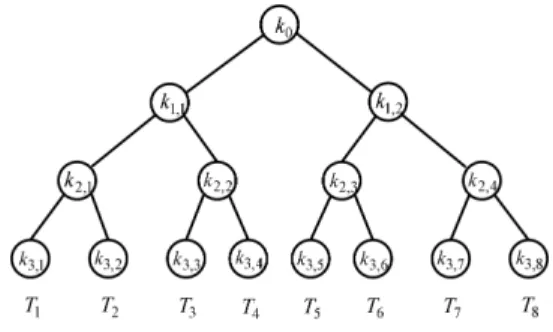
Fig. 1. A binary key tree with eight tags
HashLock is proven to be private under Strong Privacy, but its efficiency of authentication is O(n) [10]. Therefore, it is not practical for a large scale system. Although HashLock’s variants [17], [2], [14], [20], [4] employ some techniques to improve the identification efficiency, it has been proven that those schemes are not private under the Strong Privacy model. For example, they may suffer the de-synchronization attack [10]. Furthermore, their authentication complexity is still not less thanO(n2/3) [2], which is not very piratical.
In tree-based approaches [15], [14], [5], [13], each tag’s keys are correlated to those of other tags. These approaches usually employ a virtual balanced tree to organize keys. Each node in the tree is allocated a random key with each leaf node assigned to a tag. Hence, there is a unique path from the root to each leaf node in the tree, and the keys along this path will be distributed to the tag corresponding to the leaf node. When being interrogated, a tag will response a message containing a sequence of encrypted random numbers with its keys. At each level in the key tree, the reader performs a search and locates a node holding a key that can generate the same encrypted message as the one in the tag’s response sequence. For example, at the root level, the reader can determine whether a given tag is belonging to the left subtree or the right subtree (we assume that the key tree is a binary tree in this example). Repeating this binary search level by level until a leaf node is reached, the reader can identify and authenticate the tag.
Thus, tree-based approaches can improve the key search efficiency from linear complexity (HashLock and its variants) to logarithmic complexity. However, they are proven not to be private under the Strong Privacy model. The reason is that each tag’s keys can be correlated to other tags’ keys. If an adversary compromises a tag, the keys stored in the tag is exposed to the adversary. Indeed, part of those keys are still used by other tags. As the case depicted in Fig. 1, each pair of tags shares some inner nodes more or less in the tree. For example, T1 and T2 share k2,1, while T1, T2,
T3, and T4 share k1,1. If the adversary compromises some
tags, it obtains several paths from the root to the leaf nodes corresponding to the compromised tags, as well as the keys at those paths. As a result, the adversary captures the keys still used by uncompromised tags. With these keys, the adversary can identify uncompromised tags by eavesdropping on the output of these tags. The detail analysis of the compromising attack can be found in [13].
authentication efficiency and privacy of RFID systems. Gen-erally speaking, more secure privacy requires more compli-cated authentication algorithms. Thus, we attempt to improve the identification efficiency by slightly degrading the privacy protection of tags, which is still acceptable in real RFID applications. To this end, we propose a weak privacy model for explicitly defining the privacy.
IV. REFRESHMODEL
In this section, we propose a new model, named Refresh, for RFID systems. In this paper, we consider RFID systems with only one reader, which is the case in most real application scenarios.
The basic idea of Refresh is that a tag generates independent output each time when being interrogated by the legitimate reader, making adversaries very hard, if not impossible, to cor-relate the current output with previous ones. Refresh consists of three components: RFID Scheme, Adversaries, and Privacy Game.
A. RFID Scheme
In Refresh, an RFID scheme is defined as following: Definition 1 (RFID Scheme): An RFID scheme consists of
− a polynomial-time algorithm KeyGen(1s) which gen-erates all key materials k1, . . . , kn for the system
de-pending on a security parameters.
− a setup scheme SetupT ag(ID) which allocates a spe-cific secret key k and a distinct ID to a tag. Each legitimate tag should have a pair(ID, k)stored in the back-end database.
− a setup scheme SetupReader which stores all pairs
(ID, k)in the reader’s back-end database for all legiti-mate tagsID in the system.
− a polynomial-time interactive protocol P between the reader and a tag in which the reader owns the common inputs, the database and the secrets. If the reader fails, it outputs⊥; otherwise, outputs someIDand may update the database.
An RFID scheme has a correct output if the reader executes the protocolP honestly and then infers theIDof a legitimate tag except with a negligible probability (A function in terms of a security parameter sis called negligible if there exists a constantx >0such that it isO(x−s)). Otherwise, the reader outputs ⊥when the tag is not legitimate.
B. Adversaries
Similar to Strong Privacy, adversaries in Refresh have three characteristics: the oracles they can query, the goal of their actions, and the rules of their actions. According to those characteristics, we define adversaries in RFID systems below. Definition 2 (Adversaries): An adversary A in an RFID system is a polynomial-time algorithm which performs attack-ing behaviors by queryattack-ing five oracles.
− Launch → π: Execute a new protocol instance π between the reader and a tag.
− T agQuery(m, π,T) → m′: Send a message m to a given protocol sessionπon the tagT. The oracle returns a messagem′ as the output ofT.
− ReaderSend(m, π,R)→m′
: Send a message m to a given protocol session π on the reader R. The oracle returns a message m′
as the output of R.
− Corrupt(T): Compromise the tag T, and obtain the secret stored in T. The tag T is no longer used after this oracle call. In this case, we say that the tag T is destroyed.
− Result(π): When theπis complete, the oracle returns1
if the scheme has the correct output; otherwise, it returns
0.
The adversary starts a game by setting up the RFID system and feeding the adversary with the common parameters. The adversary uses the oracles above following a privacy game, which will be described in next subsection, and produces the output. Depending on the output, the adversary wins or loses the game.
C. Privacy Game
We introduce our “Privacy Game” in terms of the classic indistinguishability under chosen-plaintext attack (IND-CPA) cryptosystem security experiment. In IND-CPA experiment, a cryptosystem is considered to be secure if no adversary can distinguish the ciphertexts of two known plaintexts. In RFID system, due to the challenge-response communication model between a reader and tags, the output of tags can be considered as ciphertexts of challenge messages from the reader. Therefore, similar to IND-CPA, an RFID protocol may be considered private for some security parameters if no adversary has a noneligible advantage in this privacy experiment.
The goal of the adversary in this experiment is to distinguish between two different tags within the limits of its computa-tional power and funccomputa-tionality-call bounds.
The game experiences three phases: Learning, Challenging and Re-learning.
As shown in Fig. 2, in the Learning phase,Ais able to issue any message and perform any polynomial-time computation (i.e., query oracles in polynomial times). After the Learning phase,Aselects two uncorrupted tags as challenge candidates in the Challenge phase. One of these challenge candidates is then randomly chosen by the system (the Challenger C) and presented to the adversary (the oracles of this tag can be queried by the adversary except the Corrupt oracle). After that, similar to the Learning phase,Ais offered the oracles of all the tags in the RFID system byC except the two challenge candidates. This phase is named Re-learning. At the end of Re-learning, A outputs a guess about which candidate tag is selected by C. If the guess is correct, A wins the game; otherwise,Aloses.
In addition, there are two requirements for our privacy game to work properly. First, at the step (7) in the privacy game, the challengerC refreshes the private information of the two challenge candidatesT∗
0 andT
∗
1. Thus, the adversary cannot
correlate the output ofT∗
Gameref−priv
A (s, n, r, t, c): Setup:
(1)KeyGen(1s)→(
k0, . . . , kn).
(2) InitiateRbySetupReaderwith(k0, . . . , kn). (3) Initiate each tagTiby SetupT ag(Ti, ki)with
the keyki.
Learning:
(4)Amay perform the following actions in any interleaved order.
(a) QueryReaderSendoracle at mostrtimes. (b) QueryT agQueryoracle at mostttimes. (c) QueryCorruptoracles ofn−2tags arbitrarily
selected fromntags.
(d) Do computations without exceedingcoverall steps. Note thatAmay queryLaunchoracle to initiate an instance of the protocol in commu-nications and computations.
Challenge:
(5)Aselects two tagsTiand Tj to which he did not queryCorruptoracles, thenApresents these two tags to challengerC.
(6) LetT∗
0 =Ti andT1∗=Tj.
(7) ChallengerC queriesT agQueryoracles of T∗ 0 and T
∗ 1
for one time, respectively.
(8) ChallengerC picks up a bitbfrom{0,1}uniformly at random. Then provideAaccess toT∗
b.
Re-learning:
(9)Amay perform the following actions in any interleaved order.
(a) QueryReaderSendoracle without exceedingr overall queries. (b) QueryT agQueryoracle without
exceedingtoverall queries.
(c) QueryCorruptoracles of any tag exceptT∗
b. (d) Do computations without exceeding
coverall steps. Note thatAmay queryLaunch oracle to initiate an instance of the protocol in communications and computations.
(10)Aoutputs a guess bitb′. (11)Awins the game ifb′=b.
l
Fig. 2. Privacy game of Refresh
output of T∗
0 and T
∗
1 at the Learning phase. Second, if an
adversary can corrupt n−1 tags and get the keys of these tags, then he can retrieve the output of these corrupted tags. Therefore, any tag in the system can be definitely distinguished from others with the output of the tag. That is why at least two tags need to be uncorrupted.
We denote such a privacy game for an RFID system as Gameref−priv
A (s, n, r, t, c). Here s is a security parameter, for example, the length of keys, andn,r,tandc are respec-tive parameters for number of tags, number of ReaderSend queries, number ofT agQueryqueries, and computation steps. An adversary A with parameters r, t, and c is denoted by
A[r, t, c].
Based on above privacy game, we define the Refresh Privacy of an RFID scheme in Def. 3.
Definition 3 (RFID(r, t, c)−Ref resh−P rivacy): A protocol P of an RFID system achieves
(r, t, c) − Ref resh − P rivacy with parameter s, if for any polynomial-time A, the probability of A wining under Gameref−priv
A (s, n, r, t, c)satisfies:
∀A(r, t, c),Pr[A wins]≤ 1
2+ 1/ploy(s)
wherepoly(s)denotes any polynomial of parameters. For a given protocolP in an RFID system, we define the advantage of an adversary by:
AdvP(A) =Pr[A wins]−1
2
In Gameref−privA (s, n, r, t, c), the adversary A can win the game in a trivial way. That isApicks up a bitb′
from{0,1}
uniformly at random, i.e., Pr[b′ = b] = 1
2. In this case, A
attacks the system without any knowledge about the tags in the system, the successful attacking probability is the lower bound of all attacking activities. Therefore, we define the advantage of any polynomial-time adversary byPr[b′=b]−1
2.
Different with the Strong Privacy, Refresh Privacy only requires that tags change their output after being interrogated by the valid reader. Thus, between authentication sessions with the legitimate reader, the output value of a tag is static. Tags are therefore subject to tracking during such intervals of time. On the other hand, tags’ output are generated by secret keys shared with the legitimate reader. After a valid interrogation, the secret keys are refreshed. The output of tags therefore is changed accordingly. Without the secret keys, the adversary cannot predict the output of tags, and thus fail to track tags. The privacy degradation is acceptable in many applications, which requires that the valid reader interrogates tags frequently, such as access control and retailing. With limited privacy degradation, the efficiency of authentication can be improved significantly, since the legitimate reader need not perform brute-force search to authenticate each tag. D. Implications in Refresh
We have a set of important implications of the Refresh model.
First, theKeyGenfunction should not generate low-entropy or strongly correlated keys. Otherwise, a PPA scheme might suffer the compromising attack. As the adversaryAcan make Corrupt calls to some tags, A may infer some information of keys in uncorrupted tags from those corrupted tags. It may gain a significant advantage to win the Privacy Game. The detail of the compromising attack can be found in [13].
Second, whether or not R accepts a certain tag should not be history-dependent; otherwise, a PPA scheme will be vulnerable to the de-synchronization attack. For example, we assume that a tag only be interrogated for a maximum m times. After the adversaryA makes m legitimate queries to a certain tag in the Learning phase, A chooses this tag as one of the two candidates in the challenge phase. Then A
observes whether or notRaccepts the challenge tagT∗ b in the Challenge phase. Therefore, A can determine the challenge tag is the selected one or not. Hence, A can definitely win GamerefA −priv(s, n, r, t, c).
Third, the reader R should not differ significantly in its acceptance rate across tags; otherwise, A can just pick up one tag which R accepts frequently and one that R ac-cepts less frequently as its challenge candidates in the Chal-lenge phase. Thus, A might have a significant advantage in GamerefA −priv(s, n, r, t, c). This attack requires thatRmust treat all tags in the system equally.
V. CASESTUDY
In this section, we use our refresh privacy to examine several representative RFID schemes: (1) the OSK scheme [17] and its variant AO [2]; (2) the YA-TRAP scheme [20]; (3) and tree-based approaches [15], [14], [13], [5]. We choose these schemes based on following observations: first, they are well-known and efficient; second, they lack of formal privacy proofs. We show their vulnerabilities and present the methodology of the formal analysis on PPA schemes under Refresh.
A. OSK and AO Schemes
In OSK, a tag Ti is initiated by the reader R with a secret key ki. Let f1 and f2 be two independent
pseudo-random functions. The tag Ti outputs Mi,t = f2(f1(t)(ki))
when interrogated by the reader R, where f1(t) denotes the
functional powers off1 for naturalt. ThenTi updates its key ki as f1(ki).
Upon receiving Mi,t, R performs a brute-force search to authenticate Ti. Note that there is a predefined upper bound on the number of interrogations for each tag, denoted as m. After being accessed for m times, a tag will either yield no output or just output random nonce until the reader R re-initializes the tag, i.e., 1≤t≤m. To improve the efficiency of authentication, the readerRstores all pre-computed output in a giant table T = {Mi,t|1 ≤ i ≤ n,1 ≤ t ≤ m}. By looking up Mi,t in the table, the reader Rcan immediately authenticate the tag Ti.
Avoine et al propose a variant scheme AO to improve the storage efficiency of OSK by using Hellman tables [7]. The storage efficiency can be improved fromO(N) toO(N2/3), whereN =n×m.
The vulnerability of OSK or AO lies in the upper bound m. An adversary can launch the de-synchronization attack on a tag. Interrogating the tag for m times, the adversary can exhaust the valid output of the tag. As a result, the valid reader will reject the tag even though the tag is valid. Algorithm 1 shows the attack procedure. Based on the de-synchronization attack, the adversary can always distinguish a tag from others and win the privacy game with the probability one. Hence, OSK and AO schemes do not achieve Refresh Privacy.
Algorithm 1 De-synchronization attack to OSK/AO
1: In the Learning phase, the adversaryAselects two distinct tags
Tiand Tj uniformly at random.
2: Aqueries the oracleT agQueryofTi formtimes.
3: AsubmitsTi andTj as its challenge candidates.
4: In the Re-learning phase,Afirst queries the oracleT agQuery ofT∗
b and then relays the response toT
∗
b’sReaderSendoracle,
Afinally queriesResultoracle.
5: IfT∗
b is valid, theResultoracle ofTb∗returns 1, thenAguesses b= 1, i.e.,T∗
b =Ti; otherwise,Aguessesb= 0, i.e.,Tb∗=Tj.
B. YA-TRAP Scheme
In YA-TRAP, besides the secret keykiissued by the reader
R, a tagTi stores an internal timestampti to record the time of last interrogation ofR.
Fig. 3. A basic authentication procedure of tree-based approaches
During each interrogating,Rsends the current timestampt to a tagTi. Upon receivingt,Ti comparest with its internal timestamp ti. If t > ti, then Ti outputs M = h(t||ki) and sets ti = t, where h is a cryptographic hash function and ’k’ denotes concatenation; otherwise, Ti outputs a random response.
To authenticate the tag,Rconducts the brute-force search in its database to find a secret keykithat can generate a message h(t||ki)equal to M. If such a key exists, Raccepts the tag; otherwise,Rrejects the tag.
Similar to OSK/AO, YA-TRAP is also vulnerable to the de-synchronization attack. An adversary can query a tag with a certain future timestamp tmax that indicates an extremely distant future time. The tag thereby sets its internal timestamp as tmax, and outputs random responses in all subsequential interrogations. Consequently, this tag will always be rejected by the legitimate reader in the following sessions. We show the attack in Alg. 2. In this scenario, the adversary can win the Privacy Game with probability one. Thus, YA-TRAP is not private under Refresh.
We can see that OSK/AO and YA-TRAP are not private under Refresh because they violate the second and third im-plications described in Subsection IV-D. Hence, an adversary can mark a target tag by modifying its inner state (i.e., the upper boundmin OSK/AO, and the timestamp in YA-TRAP) to win the Privacy Game.
Algorithm 2 De-synchronization attack on YA-TRAP
1: In the Learning phase, the adversaryAselects two distinct tags
Ti andTj uniformly at random.
2: Aqueries the oracleT agQueryofTiwithtmax.
3: AsubmitsTiandTjas its challenge candidates.
4: In the Re-learning phase,Afirst queries the oracleT agQuery ofT∗
b, and then relays the response toT
∗
b’sReaderSendoracle, finally makes a query toResultoracle.
5: IfT∗
b is valid, theResultoracle ofT
∗
b returns 1, thenAguesses b= 1, i.e.,T∗
b =Ti; otherwiseAguessesb= 0, i.e.,Tb∗=Tj.
C. Tree-based Approaches
In tree-based approaches [15], [14], [5], [13], PPA schemes use a balanced tree to organize and store the keys for all tags. In the key tree structure, we find that each tag shares some inner nodes, more or less, with other tags in the key tree as we discussed in Subsection III-B. Therefore, the tree-based approaches are vulnerable to compromising. If the adversary deliberately corrupts some tags, it can obtain several paths related to the corrupt tags, as well as the keys along those paths. Since those keys are shared among tags, some secret keys of uncorrupted tags will be exposed to the adversary. Only via eavesdropping, the adversary may have significant advantages of distinguishing other uncorrupted tags. Lu et al
[13] shows that in a tree-based RFID system containing 220
tags, an adversary can identify any tag with the probability approximate to 90% by tampering with only 20 tags. We define the compromising attack in Alg. 3.
We can see that tree-based approaches are not private under Refresh due to the correlation between the keys of tags, which violate the first implication in Subsection IV-D.
Algorithm 3 Compromising attack on tree-based approaches
1: In the Learning phase, the adversaryAselects a number of tags, and queriesCorruptoracles of these tags.
2: Achooses two distinct tagsTiandTjarbitrarily from the set of uncompromised tags.
3: AsubmitsTi andTj as its challenge candidates.
4: In the Re-learning phase, A queries all oracles of T∗
b, except Corruptoracle.
5: Aanalyzes the output ofT∗
b, then guessesbaccordingly.
Through above formal analysis, we find that some well-known PPA schemes are not private under our Refresh model, since they do not satisfy the implications of Refresh (see Sub-section IV-D). Specifically, the output of tags in OSK/AO and YA-TRAP is history-dependent, they are thereby inevitably vulnerable to the de-synchronization attack. On the other hand, due to the correlation of tags’ keys, the tree based approaches fail to defend against the compromising attack. Therefore, a challenging issue emerges in designing PPA schemes: achieving the privacy as well as high authentication efficiency.
VI. LAST DESIGN
To address the issue raised in Section V, we propose a Light-weight privAcy-preServing authenTication scheme, LAST, based on the Refresh model. We not only analyze the efficiency of LAST, but also prove its privacy under Refresh. We show that LAST is Refresh Private with extremely high efficiency.
A. Scheme
Based on Def. 1, LAST consists of following components.
− KeyGen(1s): generates two sequences of keys, k1, . . . , kn and Index1, . . . , Indexn, depending on a
security parameter s. Each key is generated indepen-dently to all others, hereIndexi is the index of tagTi in the back-end database, andki is the key used in the authentication procedure.
− SetupT ag(T): returns a specific secret pair (Index, k)
for a particular tag T. The tuple(Ti, Indexi, ki)exists in the back-end database when the tagTi is legitimate.
− SetupReader: stores all tuples (Ti, Indexi, ki), 1 ≤
i≤n, in the back-end database.
− P is a polynomial-time interactive protocol between
R and Ti in which R uses common parameters and the secret tuples. If the reader failed, it outputs ⊥; otherwise,Routputs theID of tagTi and updates the corresponding tuple in database.
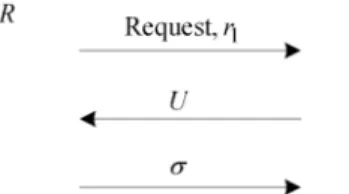
Fig. 4. Authentication Procedure in LAST. UponU,R’s operations are: 1. authenticatingTiand key-updating; 2. computingσand sending it toTi.Ti
also updates its keys after checkingσ.
The protocolP includes three rounds, as illustrated in Fig. 4. In the first round, R generates a random number r1 (a
nonce), and then sendsr1 with the “Request” message toTi. In the second round, Ti generates a random numberr2 and
computesh(r1, r2, ki), where h(r1, r2, k) denotes the output
of a cryptographic hash function h on three inputs: a key k of T and two random numbers r1 and r2. Ti computes V = h(r1, r2, ki), and then replies R with a message
U = (r2, Indexi, V).RauthenticatesTi according toU. Upon U, R searches for an Indexi in the back-end database, and then output⊥if Indexi does not exist; other-wise,Rpicks up thekibelonging to the tuple(Ti, Indexi, ki), and computes V′
=h(r1, r2, ki). If V′ =V, Raccepts the
tag and identifies it asTi; otherwise,Routputs⊥.
After authenticating Ti, R will update the keys of
Ti. R computes Index′i = h(r1, r2, Indexi, ki) and
k′
i = h(r1, r2, ki), respectively, and then replaces the tuple
(Ti, Indexi, ki) in the database with (Ti, Index′ i, k
′ i). After the key-updating procedure, R replies Ti the message σ = h(r1, r2, ki′).
Upon receiving σ, Ti first computes ki′ = h(r1, r2, ki)
and σ′
= h(r1, r2, ki′). Then Ti checks whether σ′ equals σ. If yes, Ti updates original ki and Indexi to k′i and Index′
i = h(r1, r2, Indexi, ki), respectively; otherwise, Ti discardsσand keepsIndexi andki unchange.
B. Efficiency
We first investigate the storage efficiency of LAST, and then analyze the authentication efficiency by estimating the number of hash computations in each authentication.
An RFID tag normally has very tiny memory to store user’s information as well as keys. The storage efficiency thereby is critical in designing PPA schemes. LAST is efficient in key storage. Specifically, LAST only allocates two keys for each tag, the index and authentication key. On the reader side, the storage is 2n. The storage efficiency is similar to that of HashLock (one key stored on tag side and nkeys on reader side), whereas higher than that of tree-based approaches (O(logn)on tag side andO(nlogn)on reader side [13]).
The basic operation in LAST is hash computation. There-fore, we can use the number of hash computations to eval-uate the authentication efficiency of LAST. According to the authentication procedure, R just needs four hash computa-tions: one for authentication, three for key-updating. Thus, the authentication of LAST has the complexity O(1) on the authentication efficiency, which is much more efficient than previous schemes.
C. Privacy
Based on the Refresh model, we formally prove that LAST can achieve Refresh Privacy.
Theorem 1: LAST achieves(r, t, c)−Ref resh−P rivacy in random oracle model, for any polynomial-time adversaryA, i.e., for any r, t, and c polynomial in the security parameter s.
Proof: In this proof, we employ the random orale (RO) model [3], in which cryptographic hash functions are treated as arbitrary random functions. We denote the game Gameref−privA (depicted in Fig. 2) between the challengerC
and the polynomial adversaryAas G0.
We specify a simulatorSim, who plays a gameG1withA, to simulate the real challengerC. HereG1is derived fromG0 by replacing the hash function and some oracles in G0 with an RO and random functions, respectively.Simdoes not have any knowledge about the value of b or any pair (Indexi and ki) (according toG0, these values are hold byC). Hence,A’s advantage inG1is zero. In other word,Agains no knowledge from Sim inG1. Based on the random oracle model, if we can constructSimthat is indistinguishable with the challenger
C, we can safely claim that A will not gain any knowledge about tags in G0. Thus, the privacy of tags in the real RFID systems is preserved.
According to G0, A chooses two tags Ti and Tj from uncorrupted tags. Let H be the random oracle for the hash function h. H is a list of hash values, H list, maintained by Sim. H listis initialized as empty. The format of each entry in H list is (u, v). For a query u to H, Sim first checks whether u exists in H list. If yes, Sim returns the corresponding v as the hash value of h(u); otherwise, Sim generates avuniformly at random, then returnsv as the value ofh(u), and appends(u, v)intoH list.
InG1,Simsimulates the result ofT agQuerycall toT∗ b : After receiving the “Request” and r1, Sim simulates the
T agQueryoracle as follows: • In the Learning phase,
– ifT agQueryis queried for the first time, Sim
∗ generates r2 uniformly at random, and then
queriesHto getIndex andV;
∗ returnsU = (r2, Index, V);
– otherwise,
∗ generatesr2 uniformly at random and queriesH
to getV;
∗ returnsU =r2, Index, V.
• In the Re-learning phase, – forT∗
b ,
∗ if T agQueryis queried for the first time in the Learning and Re-learning phases,Sim
· generates r2 uniformly at random, and then
queriesHto getIndexb andV;
· returnsU = (r2, Indexb, V), whereIndexb is
the existing index key ofT∗ b ;
∗ otherwise,
· generates r2 uniformly at random and queries
Hto getV;
· returns U = r2, Indexb, V, where Indexb is
the existing index key ofT∗ b .
– For other tags: same operations as those in the
Learning phase.
Sim simulates the ReaderSend oracle by generating a randomσ, and returning it toA.
G1 is similar to G0 except the random oracle and the constructions of theT agQueryandReaderSendoracles. In G1, from the view point of A, Sim simulates C perfectly except following events happens:
1) Collisions in the input of the hash function h. For example, inG0, the hash functionhwill treat(r1, r2,·)
and (r2, r1,·) as same input, therefore the output of h
should be identical. However, in G1, according to the definition of random oracle,Hconsiders that (r1, r2,·)
and(r2, r1,·)are different, the output ofHof course is
different. Thus,Simcannot answerA’s query correctly. We denote this event as Event1.
2) Collisions in the output ofH. SinceAperforms at most c computations, the number of H is not more than c. We denote this event as Event2.
3) A guesses the correct key of ki or kj. In this case, A
owns the correct keys ofTi orTj. Thus,Acan find that the output from Sim are not correct. We denote this event as Event3.
The probabilities of Event1 and Event2 are bounded by
the birthday paradox:
Pr[Event1∨Event2]≤ (r+t)
2+c2
2·2s
ForEvent3, given thatHis a random oracle, its output reveals
no information about the secret keys. Hence, the probability thatAcan successfully guesski orkj is at most 22cs.
As discussed at the beginning of the proof, the advantage ofAinG1is zero. Considering the probabilities of any event happening, the advantage ofAinG0 is bounded by:
AdvLAST(A) =Pr[Event1∨Event2∨Event3]
≤ (r+t) 2+c2 2·2s + 2c 2s = (r+t)2+c2+ 4c 2s+1
Obviously, the advantage ofAis negligible. Based on the Def. 3, LAST is(r, t, c)-Refresh-Privacy.
D. Other Security Objects
In this subsection, we show that LAST also achieves other security objectives, which are required in the PPA scheme design [13], [5].
Cloning Resistance: An adversary may impersonate a valid
tag via repeatedly forwarding valid responses to the reader, which is termed as the cloning attack [13]. In LAST, two random numbersr1andr2are exchanged in the authentication
procedure to defend against the cloning attack. Since the random numbersr1andr2are generated uniformly at random
and varied in every authentication procedure, it is infeasible for an adversary to predicate. In addition, if the length ofr1
the probability that the adversary can successfully guess the random numbers is negligible. Thus, LAST is not subject to the cloning attack.
Forward Secrecy: The Forward Secrecy guarantees thatA
cannot reveal the previous messages sent from the tags even if A obtains the current keys used by those tags. In LAST, the keys stored in a tag are updated after each interrogation from the legitimate reader. By this means, LAST prevents the adversary, even it obtains the current keys used by a tag, from retrieving any useful information through the previous output sent by the tag. The only way that the adversary can recover the past messages is to successfully invert the one-way cryp-tographic hash function, which is computationally infeasible. On the contrary, many balanced tree based protocols [5], [15] cannot update the keys of tags, the adversary can easily reveal all past authentication messages sent by a corrupted tag.
VII. CONCLUSIONS ANDFUTUREWORK
In this paper, we propose a weak privacy model, Refresh, which meets the privacy requirements of RFID systems in practice. We also examine several popular PPA schemes and show that they are not private under our model. We further propose a secure PPA scheme, LAST, and prove its privacy. LAST achieves extremely high authentication efficiency with acceptable privacy.
Following the current work, there are still much room to make our model more robust. First, we now consider an RFID system with only one reader. In the case of multiple readers in the system, there may exist several problems. For example, if different readers have different acceptance rates for some tags, an adversary can mark a tag with the acceptance rate of a certain reader. Thus, the adversary can distinguish this tag from others and compromise the tag’s privacy. In the future, we will take multiple readers into consideration. Second, as we mentioned in Subsection IV-D, Refresh is a weak model suitable for those applications in which tags are interrogated frequently. For those applications focusing on the location privacy, for example logistics, tags may be tracked in a short time. In the future, we will extend Refresh to fit such applications.
ACKNOWLEDGMENT
This work is supported in part by the NSF CNS-0832120, National Natural Science Foundation of China un-der Grant No.60903155, and No. 60828003, NSFC/RGC N HKUST602/08, National High Technology Research and Development Program of China (863 Program) under grant No.2007AA01Z180, National Basic Research Program of China (973 Program) under Grant No.2006CB303000, and No. 2010CB328100, Hong Kong ITF GHP /044/07LP and NSF China Key Project 60736016.
REFERENCES
[1] G. Avoine. Adversary Model for Radio Frequency Identification. Technical Report, LASEC-REPORT-2005-001, EPFL, 2005.
[2] G. Avoine and P. Oechslin. A Scalable and Provably Secure Hash Based RFID Protocol. In IEEE PerCom, Workshop Security, 2005.
[3] M. Bellare and P. Rogaway. Random Oracles are Practical: A Paradigm for Designing Efficient Protocols. In ACM Conference on Computer and
Communications Security – CCS, 1993.
[4] T. Dimitriou. A Lightweight RFID Protocol to Protect against Trace-ability and Cloning attacks. In Conference on Security and Privacy for
Emerging Areas in Communication Networks – SecureComm, 2005.
[5] T. Dimitriou. A Secure and Efficient RFID Protocol that Could make Big Brother (partially) Obsolete. In International Conference on Pervasive
Computing and Communications – PerCom, 2006.
[6] P. Golle, M. Jakobsson, A. Juels, and P. Syverson. Universal Re-Encryption for Mixnets. In The Cryptographers’ Track at the RSA
Conference – CT-RSA, 2004.
[7] M. Hellman. A Cryptanalytic Time-Memory Trade-off. IEEE
Transac-tions on Information Theory, 26(4):401–406, July 2006.
[8] A. Juels. Minimalist Cryptography for Low-Cost RFID Tags. In
International Conference on Security in Communication Networks – SCN, 2004.
[9] A. Juels. RFID Security and Privacy: A Research Survey. IEEE Journal
on Selected Areas in Communications, 24(2):381–394, 2006.
[10] A. Juels and S. Weis. Defining Strong Privacy for RFID. In IEEE
PerCom, Workshop Security, 2007.
[11] T. Kriplean, E. Welbourne, N. Khoussainova, V. Rastogi, M. Balazinska, G. Borriello, T. Kohno, and D. Suciu. Physical Access Control for Captured RFID Data. IEEE Pervasive Computing, 6(4):48–55, 2007. [12] Y. Li and X. Ding. Protecting RFID Communications in Supply Chains.
In ACM Symposium on Information, Computer and Communications
Security – AsiaCCS, 2007.
[13] L. Lu, J. Han, Y. Liu, L. Hu, and L. M. Ni. Dynamic Key-updating: Privacy-Preserving Authentication for RFID Systems. In IEEE PerCom, 2007.
[14] D. Molnar, A. Soppera, and D. Wagner. A Scalable, Delegatable Pseudonym Protocol Enabling Ownership Transfer of RFID Tags. In
Selected Areas in Cryptography – SAC, 2005.
[15] D. Molnar and D. Wagner. Privacy and Security in Library RFID: Issues, Practices, and Architectures. In ACM CCS, 2004.
[16] L. M. Ni, Y. Liu, Y. Lau, and A. P. Patil. LANDMARC: Indoor Location Sensing Using Active RFID. In IEEE PerCom, 2003.
[17] M. Ohkubo, K. Suzuki, and S. Kinoshita. Efficient Hash-Chain Based RFID Privacy Protection Scheme. In International Conference on
Ubiquitous Computing – Ubicomp, Workshop Privacy, 2004.
[18] R. Paise and S. Vaudenay. Mutual Authentication in RFID: Security and Privacy. In ACM Symposium on Information, Computer and
Communications Security – ASIACCS, 2008.
[19] P. Robinson and M. Beigl. Trust Context Spaces: An Infrastructure for Pervasive Security in Context-Aware Environments.
[20] G. Tsudik. YA-TRAP: Yet Another Trivial RFID Authentication Protocol. In IEEE PerCom, 2006.
[21] S. Vaudenay. On Privacy Models for RFID. In Advances in Cryptology
– Asiacrypt, 2007.
[22] S. Weis, S. Sarma, R. Rivest, and D. Engels. Security and Privacy Aspects of Low-Cost Radio Frequency Identification Systems. In
International Conference on Security in Pervasive Computing – SPC,