Learning text representation using recurrent convolutional
neural network with highway layers
Ying Wen
1,2, Weinan Zhang
1, Rui Luo
1, and Jun Wang
1,2 1University College London,2
MediaGamma Limited London, UK
{ying.wen, w.zhang, r.luo, j.wang}@cs.ucl.ac.uk
ABSTRACT
Recently, the rapid development of word embedding and neural networks has brought new inspiration to various NLP and IR tasks. In this paper, we describe a staged hybrid model combining Recurrent Convolutional Neural Networks (RCNN) with highway layers. The highway network module is incorporated in the middle takes the output of the bidi-rectional Recurrent Neural Network (Bi-RNN) module in the first stage and provides the Convolutional Neural Net-work (CNN) module in the last stage with the input. The experiment shows that our model outperforms common neu-ral network models (CNN, RNN, Bi-RNN) on a sentiment analysis task. Besides, the analysis of how sequence length influences the RCNN with highway layers shows that our model could learn good representation for the long text.
Keywords
Neural Networks, Highway Networks, Sentiment Analysis
1.
INTRODUCTION
Learning good representations for text, such as words, sen-tences and documents, is essential for information retrieval (IR) and natural language processing (NLP) tasks like text classification and sentiment analysis, which has attracted considerable attention from both academic and industrial communities [2].
It is common to use bag-of-words or bag-of-ngram to rep-resent text [6] and train the models based on such represen-tation. However, each word or n-gram is a unique feature and their interactions and the whole word order in the text are not preserved in the text representation, which limits the functionality of the learning models based on such rep-resentation.
In recent years, the word embedding and neural network models have brought new solutions to learn better repre-sentations for NLP and IR tasks. The simplest one is Bag-of-Word-Vectors (BOW vector) model. But Landauer et al. [13] estimates that 20% of the meaning of a text comes
Permission to make digital or hard copies of part or all of this work for personal or classroom use is granted without fee provided that copies are not made or distributed for profit or commercial advantage and that copies bear this notice and the full citation on the first page. Copyrights for third-party components of this work must be honored. For all other uses, contact the owner/author(s).
Neu-IR ’16 SIGIR Workshop on Neural Information Retrieval, July 21, 2016, Pisa, Italy
c
2016 Copyright held by the owner/author(s). ACM ISBN 978-1-4503-2138-9.
DOI:10.1145/1235
from the word order. Therefore, these models are still over-simplified because of the loss of order information. Neural language model [3] was then proposed to leverage word em-bedding representation to infer the next-word distribution, but it still fails to fully utilize the sequence of the context words.
Recurrent Neural Networks (RNN) can take word order into account, but it suffers from the problem that later words make more influence on the final text representation than former words. However, for sentiment analysis tasks, which is the studied problem of this work, the important words indicating the right sentiment may occur anywhere in the document.
Convolutional Neural Networks (CNN) are naturally ca-pable of solving this problem. CNN treats each words fairly by using the max-pooling layer [9]. Besides, comparing with RNN, which is more natural to process sequence informa-tion and get fixed length output, CNN uses sliding windows with different width and filters to perform the feature map-ping, then pooling is used to get fixed length output. In addition, CNN is comparatively simple, efficient and has achieved strong empirical performance on the text classifi-cation jobs [10]. But CNN also has problems, such as deter-mining the window width and too many filter parameters.
To combine the advantages from Recurrent Neural Net-work and Convolutional Neural NetNet-work, Lai et al. 2015 proposed Recurrent Convolutional Neural Network (RCNN) [12]. This model applies bi-directional recurrent from the be-ginning to the end of the document to capture the contexts around each word. Then, combine a word and its context to present a word, where concatenate the around contexts and word embedding and filter will be used to calculate the latent semantic vectors. Finally, max-pooling is used to capture the most important factor and make fixed length sentence representation.
In this work, we propose a Recurrent Convolutional Neu-ral Network with Highway Network (RCNN-HW), which in-corporates Highway Networks with Recurrent Convolutional Neural Networks. In RCNN-HW model, one highway layer is introduced as intermediate layer between bidirectional RNN and the CNN, which helps to select features individually for each word representation. Therefore, our model further op-timises the original RCNN model and achieves better per-formance.
To summarize, the contributions of our work as follows:
• We first propose the new architecture that incorpo-rates Highway Networks with Recurrent Convolutional Neural Networks.
great
…
fish and chips
…
…
…
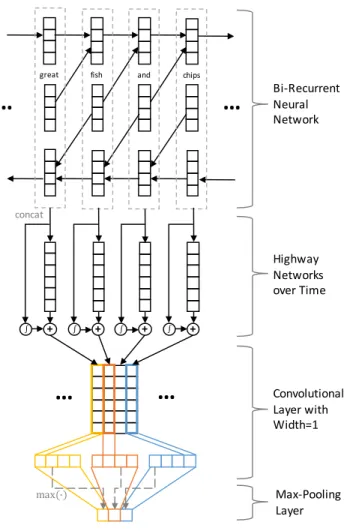
Bi-Recurrent Neural Network Highway Networks over Time Convolutional Layer with Width=1 Max-Pooling Layer concat ∫ ∫ ∫ ∫ max (') + + + +Figure 1: Architecture of Recurrent Convolutional Neural Network with Highway Layers.
• We apply the proposed model on the sentiment analy-sis task and achieved superior performance over strong baselines.
• We investigate how sequence length influences the per-formance of different neural network models, and find RCNN and RCNN-HW models have better performance on longer text.
2.
MODEL
In this section, we propose a staged hybrid model com-bining RCNN with highway layers, which is illustrated in Figure1. As is shown, the highway network module in the middle takes the output of the bidirectional RNN module in the first stage and provides the CNN module in the last stage with the input.
2.1
Recurrent Neural Networks
It is quite intuitive and straightforward to adopt RNN for learning sequential data due to its nature: RNN is able to process current data instances while taking into account preserved historical information as if it has memory. Among those approaches for enhancement of the long-term memory, Long Short-Term Memory (LSTM) [7] and its variants are
of particular interest due to the great success in practice. Thus we use as the building block of our network a newly proposed variant, Gated Recurrent Unit (GRU) [4], for its simplicity and competitive performance. The expressions of GRU is given as follows:
rt=σ(Wrxt+Urht−1+br) zt=σ(Wzxt+Uzht−1+bz) ˜ ht= tanh(Whxt+Uh(rtht−1) +bh) ht=ztht−1+ (1−zt)˜ht (1)
whererepresents element-wise multiplication andW,U,b
are input weights, recurrent weights and biases, respectively. We exploit the struture of bidirectional RNN in order to extract both forward-passing and backward-passing infor-mation: the context information from the left and right hand side of a particular word. Hence a new context-containing representationx˜t of a word is obtained by simply
concate-nating the output of the bidirectional RNN (h←t ,h → t ) with
the word embeddingxt:
˜
xt= [h←t kxtkh →
t ] (2)
2.2
Highway Networks
A one-layer highway network is introduced as the inter-mediate layer between the bidirectional RNN and the CNN to select features individually for each word representation. The highway layer is expressed as follows:
yt=τg(WHx˜t+bH) + (1−τ)x˜t (3)
where gis nonlinear function andτ =σ(Wτxt+bτ)
rep-resents “transform gate”. Note that the design of highway connection is quite similar with that of GRU’s “update gate”
z, which is essentially a variant of “leaky integration” [1]. It allows part of the input information to be carried unchanged to the output while the rest to go through some (nonlinear) transformations. The experiments indicate that this kind of structure will help to extract substantial information.
2.3
Convolutional Neural Networks
In recent years, CNN has achieved great success in CV and has been proved to be effective in various NLP and IR tasks. A CNN architecture is generally composed by a stack of distinct layers mapping input to output via some piece-wise differentiable function. In order to extract new features from the input (phrases/sentences in our case), a convolu-tional layer essentially applies a set of learnable filters to the input, which have small receptive fields: they are in fact a set of masks with different window sizes h, i.e. they se-lect h consecutive words for the neurons in the layer. For instance, featureciis extracted from a window of word
rep-resentations with sizeh: yi:i+h−1 according to the following
expression:
ci=f(wconv·yi:i+h−1+bconv) (4)
where f is a nonlinear function which in our case is the “Rectified Linear Unit” (ReLU),wconv, bconvare the weight
and bias.
The filterf will be applied to the word representations of the whole text with lengthnvia a sliding window of sizeh
to establish the feature map:
Next to the convolution layer, a max-pooling layer is ap-plied to the feature map, which extracts the most significant featurebc= max{c}.
The proposed model utilises multiple filters with window sizeh= 1 to extract features for establishing the represen-tation of the whole text. Note that although it is a common practice to exploit different window sizes, we fix the size to 1 since the bidirectional RNN and highway layer in the earlier layers have already obtained the context information around each word and thus we are free from applying filters in different window sizes.
3.
EXPERIMENT
To demonstrate the effectiveness of the proposed model, we perform the experiment on IMDB dataset [14] which con-tains 25,000 movie reviews for training. Each review is la-belled by human with 1 represents positive sentiment and 0 represents negative sentiment. The review in the dataset has 267.9 words in average and standard deviation of review length is 198.8. To test the performance of learned text presenation of models, we run sentiment prediction on this dataset and report the accuracy evaluation metric. Besides, we are particularly interested in the relationship between in-put sequence length and performance of the model, and set up the experiment to test the performance of the model over different input sequence lengths.
We compare our model RCNN with highway layers (RCNN-HW) with the following baseline neural network models for document level sentiment prediction:
• Sum-of-Word-Vector (COW): simply sums up all the word embeddings as text representation.
• LSTM: takes the average of the LSTM’s hidden states of all words is used as text representation [7].
• Bi-LSTM: similar to LSTM but exploits bidirectional LSTM [16] on the sequence to get text representation.
• CNN: performs 1-demensional convolution followed by 1-demensional max-pooling with multiple filters on the sequence [9,10].
• CNN+LSTM: combines CNN and RNN (LSTM) by using CNN’s output as LSTM’s input.
• RCNN: uses bidirectional RNN’s output as CNN’s input [12].
We use neural network models above to learn the text representation and adopt softmax output to make predic-tion. For the neural network models, hyperparameter tuning has great influence on its performance. For all the models we have done grid search with reasonable hyperparameters and tried different stochastic gradient descent training meth-ods (e.g. adam, RMSprop, adadelta) [11]. For our model, RCNN with highway layers1, we choose ‘RMSprop’ as
train-ing method with batch size of 32, the hidden layer dimension of 32, and the filter number of 256. Besides, we also tested the the performance of different neural network models with multiple input sequence lengthes, the RCNN based models get better performance with longer sequence length, in our
1The code is avaliable in https://github.com/wenying45/ deep learning tutorial/tree/master/rcnn-hw
Table 1: Accuracy for different neural models on IMDB dataset Model Accuracy COW 0.890 LSTM 0.885 Bi-LSTM 0.881 CNN+LSTM 0.890 CNN 0.895 RCNN 0.900 RCNN-HW 0.903
Table 2: Accuracy for RCNN models with/without highway layers
RCNN based model Accuracy Without Highway Layers 0.900 One Highway Layers 0.903
Two Highway Layers 0.903
One MLP Layer 0.899
experiment, we choose the best performance of the model over different sequence lengthes. Note, we did not apply pre-training methods like using pre-trained word2vec [15], and regularizer such as Dropout [17] which may bring fur-ther improvement [10].
4.
RESULTS AND DISCUSSION
The experiment results can be found in Table1. We com-pare our RCNN with highway layers with orginal RCNN model and find that the performance with highway layers are always better than those without. To quantitatively in-vestigate the effect of highway network, we set up an experi-ment with RCNN based models. We train the RCNN model without highway layers, with one layer highway, two lay-ers highway and one layer MLP respectively with the same parameters, then compare their accuracy. The results are shown in Table2. We can find that having one to two high-way layers is important, but more highhigh-way layers do not improve the performance. Besides, one MLP layer does not gain more improvement than higway layers. We think the reason why the highway layer works is because the highway layer helps select the features of word representation.
Besides, we also compare with CNN, RNN and COW models. Empirical experiments show that CNN models usu-ally yield better performance than RNNs which include LSTM and Bi-LSTM. It may be caused by RNN based models, es-pecially the LSTMs, are hard to be trained, these models are really sensitive to the hyperparameters and latter words make more influence on the final text representation than former words in RNN models. CNN models usually per-form remarkably well on many NLP and IR tasks [8,9,10,
18]. CNN based models use a fixed window of words as contextual information and the performance of a CNN is in-fluenced by the window size. A small window may result in a loss of some long-distance patterns, whereas large win-dows will lead to data sparsity [5, 12]. However, RCNNs outperform the CNN and the CNN-LSTM model, we know that convolution structure can capture local context infor-mation, and recurrent can capture global information. We consider that in CNN-LSTM model, it does not make sense to use convolution layer and max-pooling layer before
recur-rent layer. Such architecture means using local information features extracted from CNN as RNN’s input, but local in-formation features do not have sequence relationship. As for why RCNN based models outperform CNN, we think our context-containing representation of a word obtained by simply concatenating the output of the bidirectional RNN with the word embedding which has encoded context infor-mation would be a better input to the CNN comparing with original word embedding.
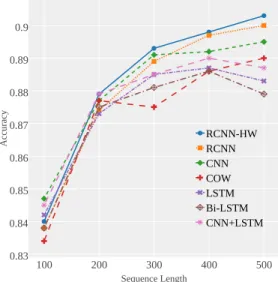
Figure 2: Accuracy curve for how sequence length influences the performance of different neural net-work models
We further investigate how the input sequence length in-fluences the performance of different neural network models. The average text length in our experiment distaste is 267 and the standard deviation of the text length is around 200. Therefore, we consider the input sequence length from 100 to 500 with step 100 to train the neural network models. The prediction accuracy for different neural network models with various input sequence length are shown in Figure 2. In the figure, we can observe that when the sequence length is less than 200, all models get bad performance since the short input length results in information loss. As the input sequence length increases, models receive longer input se-quence which may bring more useful information as well as more noise information. From the figure, we can find that RCNN based models, especially our RCNN-HW model, ob-tain much higher improvement from longer input sequences. Meanwhile, the other models get lower improvement and even get worse performance than shorter input sequence length. We think this is because RCNN based models can preserve longer contextual information thanks to their recur-rent structure and introduce less noise for their convolution structure with max-pooling. And our RCNN-HW can fur-ther reduce the noise with a highway layer to perform feature selection, which brings the best performance in longer input sequence lengthes.
We can take an example to illustrate why our RCNN-HW model outperformS than others. There is a positive review “I borrowed this movie despite its extremely low rating, be-cause I wanted to see how the crew manages to animate the presence of multiple worlds. As a matter of fact, they didn’t
- at least, so its seems ... But I closed my eyes. When I opened them again - he was gone.” in the dataset, and it’s length is 498. This review can be easily classified as negav-tive thus the double neganegav-tive and the long length. Simple model can hard to capture this type of structure and handle the long-term denpendecy, so as COW, CNN, RNN mod-els, they predict this sample as a negative review. But our RCNN-HW model can deal with this siuation and makes right predictbbbbion.
5.
CONCLUSION
We have introduced a recurrent convolutional neural net-work with highway layers to learn text representation for sentiment analysis. The experiment demonstrates that our model RCNN-HW not only outperforms CNN and RNN models, but also works better than the RCNN without high-way layer. Besides, since our model yield better performance on longer text, it would be interesting to see if the model introduced in this paper works well in learning the text rep-resentation for the other NLP and IR tasks with relatively long documents.
6.
ACKNOWLEDGMENTS
The authors would like to thank the anonymous reviewers for their helpful feedback and suggestions.
7.
REFERENCES
[1] Y. Bengio, N. Boulanger-Lewandowski, and R. Pascanu. Advances in optimizing recurrent networks. InAcoustics, Speech and Signal Processing (ICASSP), 2013 IEEE International Conference on, pages 8624–8628. IEEE, 2013.
[2] Y. Bengio, A. Courville, and P. Vincent. Representation learning: A review and new perspectives.Pattern Analysis and Machine
Intelligence, IEEE Transactions on, 35(8):1798–1828, 2013.
[3] Y. Bengio, H. Schwenk, J.-S. Sen´ecal, F. Morin, and J.-L. Gauvain. Neural probabilistic language models. InInnovations in Machine Learning, pages 137–186. Springer, 2006.
[4] K. Cho, B. Van Merri¨enboer, C. Gulcehre, D. Bahdanau, F. Bougares, H. Schwenk, and
Y. Bengio. Learning phrase representations using rnn encoder-decoder for statistical machine translation.
arXiv preprint arXiv:1406.1078, 2014.
[5] J. Chung, C. Gulcehre, K. Cho, and Y. Bengio. Empirical evaluation of gated recurrent neural networks on sequence modeling.arXiv preprint arXiv:1412.3555, 2014.
[6] W. B. Croft, D. Metzler, and T. Strohman.Search engines: Information retrieval in practice, volume 283. Addison-Wesley Reading, 2010.
[7] S. Hochreiter and J. Schmidhuber. Long short-term memory.Neural computation, 9(8):1735–1780, 1997. [8] B. Hu, Z. Lu, H. Li, and Q. Chen. Convolutional
neural network architectures for matching natural language sentences. InAdvances in Neural Information Processing Systems, pages 2042–2050, 2014.
[9] N. Kalchbrenner, E. Grefenstette, and P. Blunsom. A convolutional neural network for modelling sentences. InACL, 2014.
[10] Y. Kim. Convolutional neural networks for sentence classification.arXiv preprint arXiv:1408.5882, 2014. [11] D. Kingma and J. Ba. Adam: A method for stochastic
optimization.arXiv preprint arXiv:1412.6980, 2014. [12] S. Lai, L. Xu, K. Liu, and J. Zhao. Recurrent
convolutional neural networks for text classification. In
AAAI, pages 2267–2273, 2015.
[13] T. K. Landauer. On the computational basis of learning and cognition: Arguments from lsa.
Psychology of learning and motivation, 41:43–84, 2002. [14] A. L. Maas, R. E. Daly, P. T. Pham, D. Huang, A. Y. Ng, and C. Potts. Learning word vectors for sentiment analysis. InProceedings of the 49th Annual Meeting of the Association for Computational Linguistics: Human Language Technologies-Volume 1, pages 142–150. Association for Computational Linguistics, 2011. [15] T. Mikolov, I. Sutskever, K. Chen, G. S. Corrado, and
J. Dean. Distributed representations of words and phrases and their compositionality. In C. J. C. Burges, L. Bottou, M. Welling, Z. Ghahramani, and K. Q. Weinberger, editors,Advances in Neural Information Processing Systems 26, pages 3111–3119. Curran Associates, Inc., 2013.
[16] M. Schuster and K. K. Paliwal. Bidirectional recurrent neural networks.Signal Processing, IEEE
Transactions on, 45(11):2673–2681, 1997.
[17] N. Srivastava, G. Hinton, A. Krizhevsky, I. Sutskever, and R. Salakhutdinov. Dropout: A simple way to prevent neural networks from overfitting.The Journal of Machine Learning Research, 15(1):1929–1958, 2014. [18] Y. Zhang and B. Wallace. A sensitivity analysis of
(and practitioners’ guide to) convolutional neural networks for sentence classification.arXiv preprint arXiv:1510.03820, 2015.