POUR L'OBTENTION DU GRADE DE DOCTEUR ÈS SCIENCES
acceptée sur proposition du jury: Dr D. Gillet, président du jury
Prof. D. Gatica-Perez, Dr J.-M. Odobez, directeurs de thèse Prof. A. del Bimbo, rapporteur
Prof. R. Ingold, rapporteur Prof. J.-Ph. Thiran, rapporteur
Visual Analysis of Maya Glyphs via Crowdsourcing
and Deep Learning
THÈSE N
O8058 (2017)
ÉCOLE POLYTECHNIQUE FÉDÉRALE DE LAUSANNE
PRÉSENTÉE LE 27 NOVEMBRE 2017À LA FACULTÉ DES SCIENCES ET TECHNIQUES DE L'INGÉNIEUR LABORATOIRE DE L'IDIAP
PROGRAMME DOCTORAL EN GÉNIE ÉLECTRIQUE
Suisse PAR
Gülcan CAN
Abstract
In this dissertation, we study visual analysis methods for complex ancient Maya writings. The
unit sign of a Maya text is calledglyph, and may have either semantic or syllabic significance.
There are over 800 identified glyph categories, and over 1400 variations across these categories. To enable fast manipulation of data by scholars in Humanities, it is desirable to have automatic visual analysis tools such as glyph categorization, localization, and visualization.
Analysis and recognition of glyphs are challenging problems. The same patterns may be observed in different signs but with different compositions. The inter-class variance can thus be significantly low. On the opposite, the intra-class variance can be high, as the visual variants within the same semantic category may differ to a large extent except for some patterns specific to the category. Another related challenge of Maya writings is the lack of a large dataset to study the glyph patterns.
Consequently, we studylocal shape representations, both knowledge-driven and data-driven,
over a set of frequent syllabic glyphs as well as other binary shapes, i.e. sketches. This comparative study indicates that a large data corpus and a deep network architecture are needed to learn data-driven representations that can capture the complex compositions of local patterns.
To build a large glyph dataset in a short period of time, we study acrowdsourcingapproach
as an alternative to time-consuming data preparation of experts. Specifically, we work on individual glyph segmentation out of glyph-blocks from the three remaining codices (i.e. folded bark pages painted with a brush). With gradual steps in our crowdsourcing approach, we observe that providing supervision and careful task design are key aspects for non-experts to generate high-quality annotations. This way, we obtain a large dataset (over 9000) of individual Maya glyphs.
We analyze this crowdsourced glyph dataset with both knowledge-driven and data-driven visual representations. First, we evaluate two competitive knowledge-driven representations, namely Histogram of Oriented Shape Context and Histogram of Oriented Gradients. Secondly,
thanks to the large size of the crowdsourced dataset, we studyvisual representation learning
with deep Convolutional Neural Networks. We adopt three data-driven approaches: assess-ing representations from pretrained networks, fine-tunassess-ing the last convolutional block of a pretrained network, and training a network from scratch.
Finally, we investigate differentglyph visualizationtasks based on the studied
representa-tions. First, we explore the visual structure of several glyph corpora by applying a non-linear dimensionality reduction method, namely t-distributed Stochastic Neighborhood Embedding,
Mapping method and highlight the network activations as a heatmap visualization over an input image. We assess whether the highlighted parts correspond to distinguishing parts of glyphs in a perceptual crowdsourcing study.
Overall, this thesis presents a promising crowdsourcing approach, competitive data-driven visual representations, and interpretable visualization methods that can be applied to explore various other Digital Humanities datasets.
Keywords:Maya civilization, hieroglyphs, cultural heritage, crowdsourcing, shape classifica-tion, local shape representations, convolutional neural networks, visualization
Résumé
Cette thèse aborde des méthodes d’analyse visuelle d’écrits mayas anciens. L’écriture maya, à
base dehiéroglyphes, est complexe d’un point de vue visuel. L’unité de base du texte maya est
appelée unglyphe, et peut avoir une signification spécifique ou être liée à la prononciation
(syllabique). Avec plus de 800 catégories et plus de 1400 variations à l’intérieur de ces caté-gories, il est appréciable pour les chercheurs en sciences sociales d’avoir à disposition des outils automatiques d’analyse visuelle, comme la classification, la localisation, ou encore la visualisation.
L’analyse et la reconnaissance de glyphes sont des problèmes difficiles : au sein des différentes catégories, certains motifs peuvent généralement être observés dans des compositions
dif-férentes (faible varianceinter-classes). De plus, il est possible d’observer des variantes très
différentes dans une même catégorie (varianceintra-classe large), qui n’inclue cependant pas
les motifs caractéristiques de la catégorie en question. Un autre défi posé par l’écriture maya est l’absence de base de données suffisamment grosse pour examiner les motifs des glyphes.
Basé sur ces observations, nous nous intéressons dans un premier temps auxreprésentations
des formes locales, en appliquant des méthodes basées sur des connaissances et des méthodes exploitant les données. Cette analyse est conduite sur un ensemble de glyphes syllabiques fréquents, ainsi que sur d’autres formes binaires, en l’occurrence des sketches. Cette étude comparative indique que pour apprendre des représentations à partir de données capables
de capturer les compositions complexes de motifs locaux, un large corpus de donnéesetune
architecture profonde de réseau sont essentiels.
Afin de construire une base de données de taille importante rapidement, nous proposons une
approche à base decrowdsourcing(production participative) qui exploite les trois dernières
codices dont l’existence est connue. Notre approche est une alternative viable à la procé-dure standard qui consiste à préparer les données par des experts et s’avère chronophage. Une succession d’étapes nous mène à la conclusion qu’un design minutieux de la tâche à accomplir ainsi qu’une supervision adéquate sont les pierres angulaires dans la construction d’annotations de haute qualité par des non experts. Il en résulte une large base de données de glyphes mayas individuels (plus de 9000).
Nous analysons ce corpus à l’aide de représentations visuelles basées sur les connaissances dans un premier temps, et basées sur les données ensuite. En premier lieu, nous évaluons deux méthodes compétitives basées sur les connaissances, à savoir l’Histogramme de Contexte de Formes Orientées (HOOSC), et l’Histogramme de Gradients Orientés (HOG). Dans un second temps, grâce à la taille du corpus, nous sommes en mesure d’étudier
l’apprentis-seaux pré-entraînés, l’ajustement des paramètres du dernier bloc convolutionnel d’un réseau pré-entraîné, et l’entraînement complet d’un réseau.
Enfin, nous nous intéressons à lavisualisation de glyphesbasée sur les représentations
évo-quées précédemment. Dans un premier temps, pour comprendre la structure visuelle de plusieurs corpus de glyphes, nous appliquons une réduction dimensionnelle non-linéaire, nommée t-distributed Stochastic Neighborhood Embedding (t-SNE). Dans un second temps, nous proposons un moyen d’examiner les segments discriminatifs de glyphes individuels, selon les réseaux entraînés. Pour cela, nous utilisons le Mapping d’Activation de Classes pondéré par des Gradients (Grad-CAM), et mettons en évidence les activations du réseau en superposant leur visualisation (en utilisant une carte d’intensité) à une image donnée en entrée du système. Nous évaluons la correspondance entre ces segments sélectionnés et les segments distinctifs de glyphes à travers une étude perceptive de crowdsourcing.
De manière générale, cette thèse propose une approche de crowdsourcing, des représentations visuelles compétitives basée sur les données, et des méthodes de visualisation interprétables. Ces contributions obtiennent des résultats prometteurs qui permettent d’envisager leur appli-cation à d’autres corpus d’Humanités Numériques.
Mots clefs :Civilisation maya, hiéroglyphes, héritage culturel, crowdsourcing, classification de formes, représentations de formes locales, réseaux de neurones convolutionnels, visualisation
Acknowledgements
First, I would like to thank Daniel Gatica-Perez and Jean-Marc Odobez for their supervision and the opportunity they provided for me to pursue my doctoral studies in Idiap and EPFL. I sincerely appreciate their guidance, valuable feedback, and professional attitude that helped me grow as a researcher.
Secondly, I would like to acknowledge the Swiss National Science Fundation that had funded our work through the MAAYA project. Furthermore, I would like to thank all the project partners, collaborators, and colleagues that made it possible to accomplish the work presented in this thesis. Specifically, I am very grateful to Carlos Pallán Gayol, Guido Krempel, and Jacub Spotak for sharing their knowledge on the Maya sources, generating the glyph-block dataset, and providing the glyph annotations; Gabrielle Vail and Christine Hernández for their collaboration; Edgar Roman-Rangel, Stephane Marchand-Maillet, and Rui Hu (Idiap) for fruitful discussions.
I would like to thank to my thesis committee, Prof. Alberto del Bimbo, Prof. Rolf Ingold, Prof. Jean-Philippe Thiran and Dr. Denis Gilet for their constructive comments that helped me to polish my thesis.
I would like to thank the system team and the administration team in Idiap for their help on various matters all these years.
I appreciate all the fun times that I got to spend with many great people in Idiap and EPFL. Thanks to some of these people, I got to learn skiing, and got motivated to do long hikes in the weekend. That is how I started to enjoy the breathtaking sceneries around Martigny. All these outings, other social gatherings, and the fun trips around Europe would be as memorable and significant to me as my work in this thesis. I would like to thank you all for your friendship and support.
Finally, I am very grateful to my family who has always been there for me, and supporting me on my endless way to discover myself and life.
Contents
Abstract (English/Français) i Acknowledgements v List of figures xi List of tables xv 1 Introduction 1 1.1 Motivation . . . 11.2 Scope of the Thesis . . . 3
1.3 Main Contributions . . . 4
1.4 Outline . . . 6
1.5 List of Publications . . . 6
1.5.1 Journals . . . 6
1.5.2 Conferences and Workshops . . . 7
1.5.3 Reports . . . 7
2 The Maya Writing System 9 2.1 The Maya Civilization . . . 9
2.2 The Maya Writing System . . . 11
2.2.1 Variations in Glyph Signs . . . 11
2.3 Catalog Sources . . . 14
2.4 Monument Data . . . 16
2.5 Codices Data . . . 18
2.6 Conclusion . . . 20
3 Local Shape Representations 23 3.1 Introduction . . . 23
3.2 Related Work . . . 25
3.3 Methodology . . . 28
3.3.1 Shape Classification Method . . . 28
3.3.2 Handcrafted Features: Histogram of Orientation Shape Context . . . 31
3.3.3 Feature Learning: Sparse Autoencoder . . . 31
3.4.1 Datasets . . . 35
3.4.2 Classifier . . . 36
3.4.3 Performance Measure . . . 36
3.4.4 Evaluation Protocol . . . 37
3.4.5 Parameter Setting . . . 37
3.5 Results and Discussion . . . 41
3.5.1 10-class Experiments . . . 41
3.5.2 Generalizing the Results: 250-class Experiments . . . 46
3.6 Conclusion . . . 49
4 Crowdsourcing 51 4.1 Introduction . . . 52
4.2 Related Work . . . 54
4.3 First Task: Segmenting Maya Blocks with Minimal Supervision . . . 56
4.3.1 Overview of Our Approach . . . 56
4.3.2 Data Description . . . 56
4.3.3 Crowdsourcing Task . . . 57
4.3.4 Results and Discussion . . . 58
4.3.5 Conclusions of First Task . . . 62
4.4 Second Task: Generating Individual Glyphs For the Three Ancient Codices . . . 62
4.4.1 Crowdsourcing Task . . . 64
4.4.2 Experimental Protocol . . . 68
4.4.3 Crowdsourced Annotation Analysis . . . 73
4.4.4 Conclusions of Second Task . . . 81
4.5 Conclusion . . . 81
5 Learning Shape Representations with CNNs 83 5.1 Related Work . . . 85
5.2 Methodology . . . 87
5.2.1 Traditional Shape Descriptors . . . 89
5.2.2 Pretrained CNN Features . . . 90
5.2.3 Network Adaptation . . . 92
5.2.4 CNN Training from Scratch . . . 93
5.3 Settings and Results . . . 93
5.3.1 Experimental Settings . . . 93
5.3.2 Classification Results . . . 95
5.4 Conclusion . . . 99
6 Glyph Visualization 101 6.1 Related Work . . . 102
6.2 Glyph Visualization Using t-SNE . . . 103
6.2.1 Datasets . . . 104
Contents
6.2.3 Dimensionality Reduction: t-SNE . . . 105
6.2.4 Results and Discussion . . . 105
6.2.5 Conclusion . . . 116
6.3 Visualization of Diagnostic Parts and Interpretability . . . 118
6.3.1 Grad-CAM as Visualization of Diagnostic Parts . . . 118
6.3.2 Qualitative Crowdsourcing Analysis on CNN Visualizations . . . 120
6.4 Conclusion . . . 130
7 Conclusions and Perspectives 133 7.1 Contributions . . . 133
7.2 Limitations and Perspectives . . . 135
A Exploring HOOSC Shape Descriptor 139 A.1 Methodology . . . 139
A.2 Experimental Results . . . 140
A.2.1 Dataset . . . 140
A.2.2 Experimental Setting . . . 140
A.2.3 Results and Discussion . . . 141
Bibliography 143
List of Figures
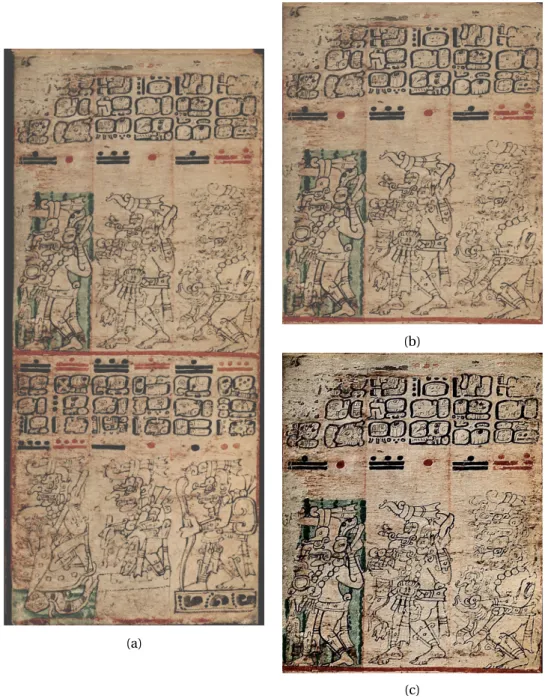
1.1 Maya cultural heritage materials. . . 2
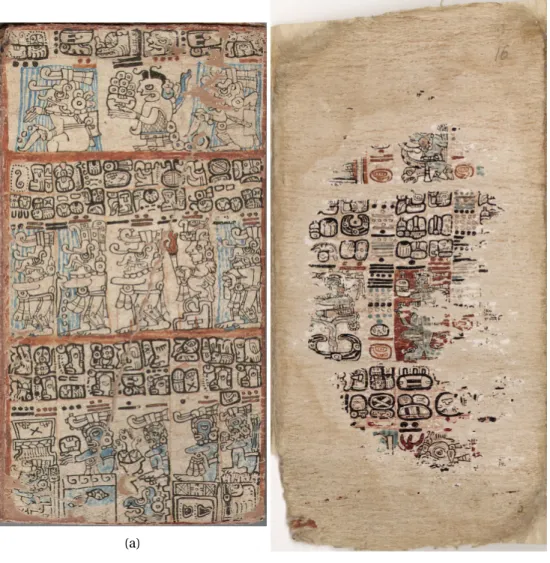
2.1 Samples pages from two Maya codices. . . 10
2.2 The main elements in Maya writing illustrated on the stone inscription. . . 12
2.3 Example variations in glyph signs. . . 13
2.4 Example variations in the codical “Chaa’k” (Rain God) glyph sign. . . 13
2.5 Main categorization in the Thompson and Macri-Vail catalogs. . . 15
2.6 Example to different categorizations of glyph variants. . . 15
2.7 Sample glyphs from 24-class syllabic Maya glyph dataset . . . 16
2.8 A sample page from the MAAYA database maintained by University of Geneva . 17 2.9 Preprocessing steps of the codices glyph dataset (I). . . 19
2.10 Preprocessing steps of the codices glyph dataset (II). . . 20
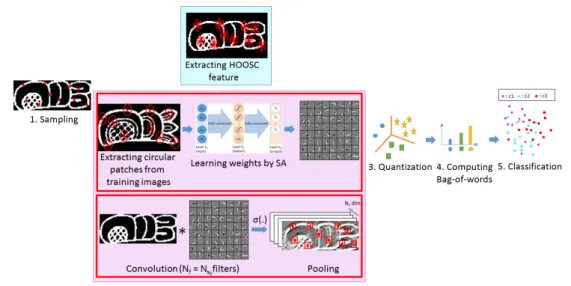
3.1 Steps of the overall classification system . . . 29
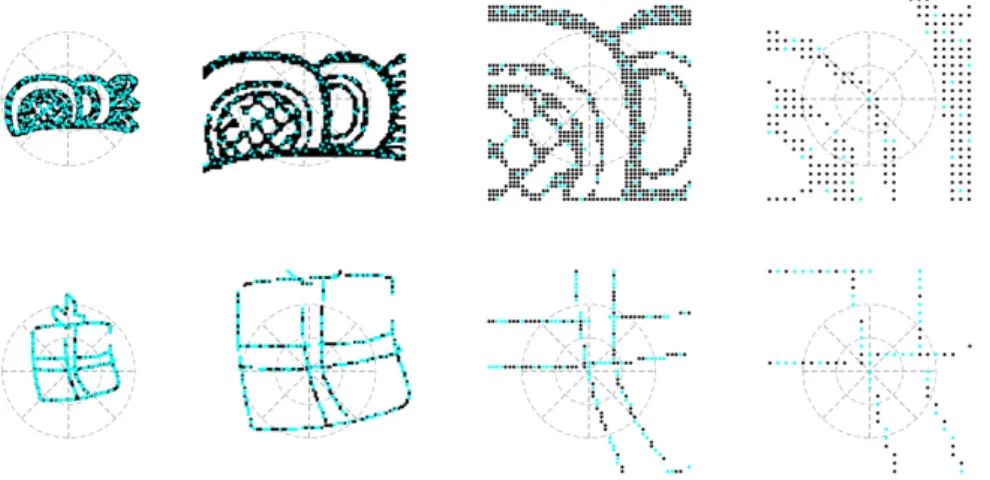
3.2 HOOSC computation . . . 29
3.3 Sparse autoencoder model . . . 31
3.4 Applying SA for shape classification . . . 34
3.5 Samples from the selected 10 sketch classes . . . 36
3.6 Regions used in the computation of the local descriptors for the four different spatial context levels . . . 38
3.7 Patch samples used in the computation of the local descriptors . . . 39
3.8 Impact of the SA parameters on the learned filters . . . 39
3.9 Tied weights learned by SA in four different spatial contexts . . . 41
3.10 10-class classification results . . . 42
3.11 10-class classification results of the SA representation with different pooling . . 44
3.12 10-class classification results for different vocabulary sizes . . . 45
3.13 10-class classification results with different k values in kNN classification . . . . 46
3.14 250-class sketch classification results . . . 47
3.15 250-class sketch classification results with different k values in kNN classification 47 3.16 250-class sketch classification results with pivot and dense sampling . . . 48
4.1 Illustration of the segmentation of individual glyphs out of a glyph-block. . . . 52
4.2 Task difficulty ratings from the first crowdsourcing task . . . 58
4.4 Percentage of bounding boxes from the first crowdsourcing task . . . 59
4.5 Block-based annotation accuracy and purity from the first crowdsourcing task 61 4.6 Example annotations from the first crowdsourcing task . . . 61
4.7 Worker-based results from the first crowdsourcing task . . . 63
4.8 An articulated hand sign showing the requirement of polygon segmentation . . 65
4.9 Initial block-based task design in the second crowdsourcing study . . . 69
4.10 Final task design in the second crowdsourcing task . . . 70
4.11 Final instructions in the second crowdsourcing task . . . 71
4.12 Small-scale stage results in the second crowdsourcing study . . . 74
4.13 Usage of convex-hulls in the second crowdsourcing study . . . 75
4.14 Segmentation (f-measure) results in the second crowdsourcing study . . . 76
4.15 Small-scale class-based segmentation results in the second crowdsourcing study 77 4.16 Sensitivity to the number of annotators in the second crowdsourcing study . . 77
4.17 Large-scale ratings in the second crowdsourcing study . . . 79
4.18 Confused segmentations in the second crowdsourcing study . . . 80
5.1 Segmented glyph samples from the 10-class experiment. . . 83
5.2 Three data-driven methods for supervised glyph classification. In each method, only the highlighted part of a CNN model was trained. . . 88
5.3 Shallow CNN model used in Section 5.2.2. . . 90
5.4 Considered pretrained CNN models in Section 5.2.2. After a single forward-pass of a glyph image through a network, activations from a highlighted layer are used as pretrained CNN features. . . 91
5.5 Effect of training data size on classification performance . . . 97
6.1 Overall flow for visualization with t-SNE. . . 104
6.2 Visualization of monument data using t-SNE (I) . . . 106
6.3 Visualization of monument data using t-SNE (II) . . . 107
6.4 Visualization of monument data using t-SNE (III) . . . 108
6.5 Visualization of monument data using t-SNE (IV) . . . 108
6.6 Visualization of catalog data using t-SNE (I) . . . 109
6.7 Visualization of catalog data using t-SNE (II) . . . 109
6.8 t-SNE plots of codical glyph-blocks . . . 111
6.9 Visualization of codical glyph-blocks using t-SNE (I) . . . 112
6.10 Visualization of codical glyph-blocks using t-SNE (II) . . . 113
6.11 Visualization of codical glyph-blocks using t-SNE (III) . . . 114
6.12 Visualization of crowdsourced codical individual glyphs using t-SNE (I) . . . 115
6.13 Visualization of crowdsourced codical individual glyphs using t-SNE (II) . . . . 116
6.14 Grad-CAM for analyzing glyph discriminative parts (I) . . . 117
6.15 Grad-CAM for analyzing glyph discriminative parts (II) . . . 117
6.16 Illustration of the GradCAM method. . . 119
6.17 Instructions of the crowdsourcing task on CNN interpretability (I) . . . 122
List of Figures
6.19 Crowdsourcing task design for analyzing CNN interpretability . . . 124
6.20 Analysis of crowdsourcing task on CNN interpretability . . . 129
A.1 Classification results with different descriptor settings . . . 140
List of Tables
2.1 Number of elements in the three codices. . . 17
2.2 Number of individual glyphs with different quality rating . . . 18
3.1 Notations used in this chapter. . . 30
3.2 Receptive field (patch) sizes while learning weights in SA. . . 38
3.3 Selected parameters for learning weights in SA. . . 40
3.4 Correlation values of the weights learned with different parameters . . . 40
3.5 Number of parameters while learning weights in SA. . . 41
4.1 Block-based annotation performance in the first crowdsourcing study . . . 62
4.2 Preliminary stage results from the second crowdsourcing study . . . 66
4.3 Experimental settings of the second crowdsourcing task . . . 68
4.4 Average aggregated segmentations in the small-scale stage of the second crowd-sourcing study . . . 76
5.1 Number of glyphs for the classification tasks. . . 94
5.2 Classification results with two knowledge-driven and four CNN-based data-driven representations . . . 96
5.3 Classification results with different sampling strategies . . . 96
5.4 Classification results with four CNNs and three conditions . . . 96
6.1 Expert comments on the diagnostic features of five Maya signs . . . 121
6.2 Aggregated results of interpretability crowdsourcing analysis (I) . . . 126
6.3 Aggregated results of interpretability crowdsourcing analysis (II) . . . 127
1
Introduction
1.1 Motivation
Object recognition is an inherent talent of humans. For generations, humans observed their surroundings to survive and interact. This talent extended to recognition of abstract symbols with the invention of writing. Thanks to writing, humans were able to communicate on a common ground (in limited localities) and leave their cultural heritage to the next generations.
Without a doubt, the cultural heritage materials available to us today cannot make a complete picture. Natural disasters, wars, and degradation over time destructed a large amount of such materials. To prevent the further loss of cultural heritage materials, digitization, restoration, and other preservation techniques are essential. In the case of tangible heritage materials such as monuments or bark, this step can correspond to acquiring an image or a scan of the material, or reproduction. Usually, this step suffices for pure archival purposes or exhibitions in the museums. The next step is quest of understanding the context in which cultural heritage materials used, and their significance for the society.
Besides preservation and archiving, to pass the knowledge across generations, scholars face a challenging quest of understanding ancient writings from the available, incomplete data sources. To enable analysis of such cultural data sources, experts spend a significant amount of time for further processing after acquiring an image, e.g. cleaning raw images manually on available software, vectorizing, and annotating by checking available catalog sources. Since all the processing steps are repetitive and monotonous for experts, it is desirable to have alternative methods.
On the other hand, from the organization to the understanding of digitized cultural heritage materials, content-based analysis plays an important role. To analyze a historical piece, experts need to identify each element on the piece by mapping them to existing catalog sources, and to assess the relationship among the pieces (e.g. the reading order, the specific semantic, syllabic, or artistic roles, etc.). In the absence of catalog sources, experts may need to build a categorization system from scratch with the available data samples. Besides, analyzing the
(a)
(b) (c)
Figure 1.1 – (a) A stone inscription found in Pomona, Tabasco (Mexico), Panel 1 from 771 AD, by courtesy of ©Carlos Pallán Gayol for AJIMAYA/INAH Project, 2006, Instituto Nacional de
Antropología de Historia, Mexico. (b) A dynastic codex-style Maya vase1(K6751), by courtesy
of ©Justin Kerr. (c) A high-resolution scan of page 65 from Dresden Codex2[The Saxon State
and University Library, 1975] by courtesy of SLUB.
variations of the content might reveal important traces of the evolution of the language used across time periods and places, or differences in the artistic styles. In all the cases above, i.e. annotating signs (mapping to a category in a catalog), designing new catalogs, and observing
the degree of sign variations in different sources,quantitative assessment of the contentis
crucial.
While the points mentioned above are generic in Digital Humanities, the focus of this thesis is on Maya hieroglyphs. The ancient Maya is one of the great civilizations in history, which has
1http://research.mayavase.com/kerrmaya_hires.php?vase=6751 2http://digital.slub-dresden.de/en/workview/?id=5363&tx_dlf
1.2. Scope of the Thesis
intrigued scholars worldwide, and produced a complex visual writing system. Maya writing is found on stone monuments, codex pages, and ceramic items (see Fig. 1.1). Maya writing contains glyphs that are grouped together in rectangular blocks. These glyph blocks are usually organized in a grid structure, and follow a “zigzag” (left to right, top to bottom) reading order. Apart from the text areas that contain glyphs, the writings may contain artistic elements such as icons.
With today’s know-how about the ancient Maya civilization, 80 percent of the glyphs are reported to be deciphered for their phonetic values. However, only around 60 percent of the glyphs are verified with respect to their meaning [Kettunen and Helmke, 2008]. The source of this difference comes from the cases where the phonetic value is known but the meaning is vague or not known and vice versa. Therefore, there is a strong driving force to invest in developing computer vision and multimedia techniques in order to help archaeologists to digitize, explore, and understand the ancient Maya writings.
1.2 Scope of the Thesis
One main research goal in this thesis is to design a crowdsourcing task to enable the contri-bution of non-experts to the above-mentioned, time-consuming preprocessing steps of data sources. The question is how much guidance is required during the task for non-experts to perform well. Even though expert knowledge cannot be replaced with few hints offered as part of a task design, for a well-defined task with enough guidance, we posit that it is possible to obtain an aggregated outcome of acceptable quality from the crowd. This thesis demonstrates this point in two crowd tasks with different amount of guidance, for the segmentation of glyphs out of blocks which is a task that to our knowledge was thought to be an endeavour that only experts could take on.
The second main research goal of the thesis is quantitative assessment of the content, in particular Maya glyphs. This thesis analyzes several knowledge-driven shape descriptors and investigates data-driven neural representations. Knowledge-driven descriptors are strong baselines in many computer vision and multimedia applications [Battiato et al., 2010; Belongie et al., 2002; Dalal and Triggs, 2005b; Del Bimbo and Pala, 1997; Eitz et al., 2010; Hu and Collomosse, 2013; Kazmi et al., 2013; Lowe, 1999; Mori et al., 2005; Yang et al., 2008]. The general idea of such descriptors is to design a filter bank and to represent an image, either globally or locally, as a composition of the frequencies of each filter. Such representations are pre-defined and fixed. Previously, a variety of global and local knowledge-driven shape descriptors were analyzed for Maya glyph retrieval for a limited amount of syllabic signs from monuments [Roman-Rangel et al., 2009, 2011a,b, 2013]. In this thesis, some of these shape descriptors are evaluated in different settings and at a larger-scale (both a larger number of categories and a larger overall dataset) for the Maya glyphs from the three known authentic codices (Dresden, Madrid, and Paris).
from the data. One important point about the data-driven approach is the necessity of a considerable amount of data so that the algorithms can capture the patterns in the data. This point also emphasizes the necessity of the crowdsourcing tasks that are conducted in this thesis. Thanks to the second crowdsourcing task, a large-scale Maya codical glyph dataset is constructed and exploited via data-driven approaches such as convolutional neural networks. Furthermore, we study the characteristic parts of glyphs that enable archaeologists to deter-mine the glyph category. We analyze whether such diagnostic parts of glyphs correspond to the discriminative regions according to the trained convolutional neural networks. In order to assess the strength of the learned neural representations qualitatively, and to observe the degree of correspondence between which regions experts find as diagnostic and what the networks learn as discriminative, we designed a crowdsourcing task. In this perspective, we analyze non-experts’ perception on the performance of the trained networks.
1.3 Main Contributions
The contributions of the thesis, presented in the following chapters, can be summarized as follows:
1. Exploring Local Shape Descriptors.We investigated the local Histogram of Oriented Shape Context (HOOSC) shape descriptor [Roman-Rangel et al., 2011a] for the task of individual glyph classification. Specifically, we studied the descriptor in different settings, i.e. in a voting scheme rather than using a bag-of-words representation, with different spatial context, and with additional relative location information.
Furthermore, we proposed a data-driven local shape representation based on Sparse Au-toencoders (SA) [Hinton and Zemel, 1994]. We systematically evaluated the knowledge-driven HOOSC descriptor and our proposed SA representation on both Maya monument glyphs and a reference dataset of generic sketches. In this case, we also evaluated the HOOSC and SA with respect to different spatial contexts, and experimented with dense sampling of pivots for descriptor computation. The experiments show that the scale of data is important while learning neural representations, since the SA-based repre-sentation outperforms the HOOSC descriptor on the whole sketch dataset, however it stays behind the HOOSC’s performance in the small amount of glyph data. Further-more, we conclude that exploiting a large spatial context around descriptors is essential for shape data. Learning shape representations from raw data within a large spatial context requires a deeper network structure than the proposed single-layer SA-based representation so that shapes can be encoded more robustly and hierarchically. 2. Crowdsourcing. We collaborated with scholars in archaeology and epigraphy, in the
context of the multi-disciplinary MAAYA SNSF project. Thanks to this collaboration, we had access to high-quality digital scans of the pages from the three authentic Maya codices. These scans were pre-processed, then segmented into blocks, and annotated by the collaborators. Thanks to this digitization and annotation process, we obtained a
1.3. Main Contributions
glyph block dataset of around 7000 block images for automatic shape analysis.
For further processing, we proposed the use of crowdsourcing to generate a large-scale
segmentations ofindividualMaya glyphs within blocks. The resulting unique dataset is
composed of aggregated segmentations for over 9000 individual glyphs from the three authentic Maya codices. We experimented with different choices in the task design, and demonstrated that non-experts can produce segmentation of high-quality.
3. Deep Neural Representations.For the task of single glyph classification, we compared two knowledge-driven representations, namely HOOSC within a bag-of-words approach and Histogram of Gradients (HOG) [Dalal and Triggs, 2005b], as well as three data-driven representations by deep Convolutional Neural Networks (CNN), namely using the features from pretrained networks, transfer learning via fine-tuning of the last block of pretrained networks, and training networks from scratch with our crowdsourced individual Maya codical glyph dataset. The results show that the data-driven approaches outperform the traditional shape descriptors by a large margin on our individual Maya codical glyph dataset. Among the data-driven approaches, transfer learning approach improves over exploiting the pretrained CNN features; and training networks from scratch yields the best results. Furthermore, we observed that training a sequential sketch- specific network with few parameters from scratch with batch normalization [Ioffe and Szegedy, 2015], balanced oversampling, and dropout regularization [Hinton et al., 2012] performed slightly better than the recent residual models [He et al., 2016].
4. Visualization.We demonstrated the potential of locating the most discriminative/di-agnostic parts of a glyph via Gradient-based Class Activation Map (GradCAM) method [Selvaraju et al., 2016]. This method is applied on the CNN models trained from scratch with our Maya codical glyph dataset. Furthermore, we applied this GradCAM method to detect candidate regions of individual glyphs from weakly-labeled glyph blocks. The results show that the trained model is mostly paying attention to diagnostic parts of the glyphs, and give clues on the candidate regions in the blocks even though visually-similar regions might also be marked.
In order to assess the interpretability of the CNN visualizations, we conducted a crowd-sourcing experiment to compare the expressivity of GradCAM method with two different trained models (a sketch-specific sequential convolutional network and a residual net-work). The results show that the sketch-specific network produces more appealing visualizations on the glyph diagnostic parts more often compared to the residual net-work.
To index and visualize glyph shapes, we mapped a 10-class subset of the monument glyphs, the sign variants from the existing catalogs, a subset of the codical glyph-block images, and the crowd-segmented individual codical glyphs from high-dimensional feature space to two dimensional space via t-distributed Stochastic Neighborhood Embedding (t-SNE) [Van der Maaten and Hinton, 2008]. In the first case, we created the mapping on a traditional shape descriptor (the HOOSC-bag-of-words representation),
whereas for the other cases, we focused on the representations from the pretrained CNNs. We discuss that this kind of indexing is valuable to understand the data clusters (that may correspond to different glyph variants in existing catalogs), to highlight the trends in the glyph shapes (i.e. gradual change in the style), and to investigate the similarity of unknown/vague glyph samples to other samples with known categories.
1.4 Outline
The thesis has 7 chapters. Chapter 2 introduces the Maya writing system, as well as the two catalog sources and the databases used in the thesis.
Chapter 3 presents the work on classification of Maya monumental glyphs with the HOOSC descriptor in different settings. This chapter also describes the comparative study between the knowledge-driven HOOSC descriptor and data-driven Sparse Autoencoders for glyph and sketch classification.
In Chapter 4, two crowdsourcing experiments are presented for glyph localization and segmen-tation tasks with differing amount of guidance provided to non-expert observers. Through the second crowdsourcing task, a large-scale Maya codical individual glyph corpus was curated.
In Chapter 5, for Maya codical glyph classification, several CNNs are systematically assessed in three settings: leveraging knowledge from pretrained networks, transferring knowledge from pretrained networks, and training a CNN from scratch. Furthermore, the CNNs trained with the glyphs were used to reveal the discriminative parts of the glyphs.
In Chapter 6, a crowdsourcing-based comparison of the visual activations from two CNNs is presented, which sheds some light on the interpretability of the deep networks. This chapter also includes indexing of glyph shapes that allows visual investigation and interpretations.
Finally, Chapter 7 concludes the thesis by reflecting upon this dissertation’s contributions, limitations, and possible further research directions.
1.5 List of Publications
This section presents the related publications that are outcomes of our research.
1.5.1 Journals
– Gulcan Can, Jean-Marc Odobez, and Daniel Gatica-Perez. Maya codical glyph segmen-tation: A crowdsourcing approach. Research Report Idiap-RR-01-2017, Idiap, January 2017c (accepted for IEEE Transactions on Multimedia)
1.5. List of Publications
– Gulcan Can, Jean-Marc Odobez, and Daniel Gatica-Perez. Evaluating shape
representa-tions for Maya glyph classification.ACM Journal on Computing and Cultural Heritage, 9
(3), Sep 2016a
– Rui Hu, Gulcan Can, Carlos Pallan Gayol, Guido Krempel, Jakub Spotak, Gabrielle Vail, Stephane Marchand-Maillet, Jean-Marc Odobez, and Daniel Gatica-Perez. Multimedia
Analysis and Access of Ancient Maya Epigraphy.IEEE Signal Processing Magazine, 32(4):
75–84, July 2015
1.5.2 Conferences and Workshops
– Gülcan Can, Jean-Marc Odobez, and Daniel Gatica-Perez. Shape representations for
maya codical glyphs: Knowledge-driven or deep? InProceedings of the 15th International
Workshop on Content-Based Multimedia Indexing, CBMI ’17, pages 32:1–32:6, New York, NY, USA, 2017a. ACM. ISBN 978-1-4503-5333-5. doi: 10.1145/3095713.3095746. URL http://bib-ezproxy.epfl.ch:2512/10.1145/3095713.3095746
– Edgar Roman-Rangel, Gulcan Can, Stephane Marchand-Maillet, Rui Hu, Carlos Pal-lan Gayol, Guido Krempel, Jakub Spotak, Jean-Marc Odobez, and Daniel Gatica-Perez. Transferring neural representations for low-dimensional indexing of Maya hieroglyphic
art. InECCV Workshop on Computer Vision for Art Analysis, October 2016
– Gulcan Can, Jean-Marc Odobez, Carlos Pallan Gayol, and Daniel Gatica-Perez.
An-cient Maya writings as high-dimensional data: a visualization approach. InDigital
Humanities, 2016b
– Gulcan Can, Jean-Marc Odobez, and Daniel Gatica-Perez. Is that a jaguar? Segmenting
ancient Maya glyphs via crowdsourcing. InACM International Workshop on
Crowd-sourcing for Multimedia, pages 37–40. ACM New York, November 2014. doi: 10.1145/ 2660114.2660117
1.5.3 Reports
– Gulcan Can, Jean-Marc Odobez, and Daniel Gatica-Perez. How to tell ancient signs apart? Recognizing Maya glyphs with CNNs. Idiap-RR Idiap-Internal-RR-26-2017, Idiap, April 2017b (planned to be submitted to ACM Journal on Computing and Cultural Heritage)
2
The Maya Writing System
Humankind started to leave traces of their lifestyle, beliefs, and philosophy thanks to writing systems. Writing can be seen as an act of drawing certain shapes in a predefined order. In some ancient semanto-phonetic systems, e.g. Egyptian, Luwian, and Maya writings, these shapes were sketch-like and resembled natural objects, scenes, events (astronomical, royal or religious), and encounters with animals and humans. Among these writing systems, the Maya writing is still under a decipherment phase and intrigues many scholars.
This chapter gives a brief introduction to the Maya civilization, the Maya writing system, existing catalog resources, and the Maya data that is used throughout this thesis.
2.1 The Maya Civilization
The ancient Maya civilization flourished between 2000 BC to 1600 AD in Mesoamerica, more specifically in Mexico, Guatemala, Belize, and Honduras.
Among all the civilizations in Mesoamerica, such as the Olmecs, Teotihuacans, Aztecs, and many others, the specific writing system of the Maya made this civilization distinct [Miller and Taube, 1993]. Thanks to their writing system, Maya people were able to leave their mark across places and time periods. The prominent Maya cities had been populated across the preclassic (2000 BC – 250 AD), classic (250 – 900 AD), and postclassic periods (950 – 1539 AD). The period between 1511 and 1697 AD is referred as contact period. During this period, many cultural heritage materials were destroyed by Spanish conquerors.
The Mayas left a great amount of cultural heritage materials, such as stone inscriptions
(Fig. 1.1a), carved wood monuments, folded bark pages (called ascodex, e.g. Fig. 1.1c and
Fig. 2.1), or ceramic items (Fig. 1.1b). The common ground of all these materials are the
(a)
(b)
Figure 2.1 – High resolution scans of sample pages from two genuine Maya codices (see Fig. 1.1c for a sample page from Dresden Codex). (a) Page 11 from Madrid Codex [Museo de América, 1967]. (b) Page 16 from Paris Codex [Bibliotheque Nationale].
2.2. The Maya Writing System
2.2 The Maya Writing System
Aglyphis a unit sign of the Maya writing. Aglyph-blockis composed of several glyphs. Aglyph text areacomprises of many glyph-blocks that are structured as a grid (see Fig. 2.2b), and has a specific reading order in general (top to bottom, and left to right in double columns). A typical Maya artifact (a stone inscription, a codex page, or a ceramic item) is composed of text areas,
and some other pictorial elements such as icons or calendrical signs (see Fig. 2.2a). At’olis a
chapter-like unit that is separated by colored lines in a codex page. Acodexis composed of
several pages with the sub-elements described above.
The Japanese language has Hiragana alphabet for syllabic (pronunciation) and Kanji alphabet for logograhic (semantic) significance. Similar to the Japanese language, the Maya language also has a syllabo-logographic or semanto-phonetic writing system. Fig. 2.2a illustrates examples of syllabic and logograhic glyphs. Logograhic glyphs may have syllabic forms, and due to space limitations or aesthetic reasons, they might be used interchangeably. For instance, the logographic version of glyph T229 (Thompson code, see Section 2.3) in the second row of Fig. 2.3 is an impersonated form (resembling a head) of the syllabic versions next to it. Furthermore, in a Maya text, some syllabic glyphs with the same pronunciation may be used in place of each other. These observations enabled the decipherment of the frequently-occurring Maya glyphs [Kettunen and Helmke, 2008].
2.2.1 Variations in Glyph Signs
A writing system evolves throughout time like a living being. Besides the changing nature of languages due to abandoned or nontransferable knowledge to next generations, encounters and interactions with different cultures impact a language and its writing system.
Furthermore, written texts may also vary due to artistic reasons, space limitations, and differ-ent materials and means that are used, i.e. carving stones with a metal tool, or painting on ceramic/bark with a brush. These variations might be observed as the differing amount of details, deformations on the general form of the signs, size variations, and compound signs that contain only the characteristic parts of several signs (see Fig. 2.3).
Fig. 1.1c and Fig. 2.1 illustrate the stylistic differences in the three existing Maya codices.
Although all the codices are thought to be reproduced from their older versions in the 15t h
century (post-classical period) [Kettunen and Helmke, 2008], the glyphs in the Madrid Codex are larger and more rectangular than the instances in the two other codices.
Maya glyphs from one category may look relatively different to the exception of some char-acteristic parts [Houston et al., 2000]. Fig.2.4 shows several variations of the “Chaa’k” Rain God (T0668, MZ9) glyph in the codices. These examples illustrate the deformations in the general form (outer contour) as well as missing or extra inner elements, such as the “thumb”
(a)
(b)
Figure 2.2 – (a) The main elements in Maya writing illustrated on the stone inscription from Fig. 1.1a. (b) A digitized drawing of the stone inscription Schele et al. [1986] by courtesy of
©Schele. This partial drawing is adopted from the FAMSI website2. The glyph-blocks in the
2.2. The Maya Writing System
Figure 2.3 – Selected Maya glyph samples from several categories that illustrate the within-class variety (first two rows) and between-within-class similarity (last row). The first two rows show samples from the same category in each box. The last row shows visually similar samples from different categories. See the text for details.
on the top right or the two circular elements (one inside the other) on the bottom right of the glyphs in top row. Please notice that the “nose” or the “teeth on the mouth” may not be visible in some samples. The hollow “T-eye” shape (or “ik” sign) enables the experts to label these samples as belonging to the same category. In the following chapters, such characteristic parts
of glyphs are referred asdiagnosticparts.
2.3 Catalog Sources
The documentation of Maya writing started during the Spanish conquest of Yucatan in the
X V It hcentury. Bishop Diego de Landa’s first incomplete alphabet, in his book titled “Relación de las cosas de Yucatán” [de Bourbourg, 1864; Tozzer, 1941], was created by asking two locals how to write Spanish characters in Maya language [Wikipedia, 2016]. Later on, for several centuries, few attempts were made to understand Mayan writings. [Evrenov et al., 1961]’s and [Thompson and Stuart, 1962]’s sign catalogs became important sources, suggesting syllabic readings rather than character correspondences of the signs. For historical reasons, Thomp-son’s taxonomy (main and affix syllabic signs) became more influential than Evrenov’s for several decades. With the advancement of the understanding of the semantics of the signs, more modern catalogs emerged [Macri and Looper, 2003; Macri and Vail, 2008].
As illustrated in Fig. 2.5, the Thompson catalog has three main categories: affix, main, and portrait signs. The Macri-Vail taxonomy has 13 main categories [Macri and Vail, 2008] which is encoded in the first digit of three-digit encoding of categories. Six of them, i.e. animals, birds, body parts, hands, human faces, and supernatural faces, are grouped semantically (according to. the visual elements of the most-frequent first-listed variant). There is a main category for numerical signs that are composed of dots and bars. The rest are grouped based on visual elements (square signs divided based on symmetry, and elongated signs divided based on the number of components). The second digit in the Macri-Vail is based on the defined visual cues, and the third digit is simply for numbering. Macri and Looper discuss that some semantic signs (e.g. hand signs) are spread over different categories in the Thompson catalog [Macri and Looper, 2003] (see Fig. 2.6). Furthermore, the ordering or the distinction of some Thompson signs is argued not to follow a clear rule.
Since Thompson’s catalog was highly adopted for a long time and Macri-Vail’s catalog has a modern taxonomy with a focus on Codices signs, we use these two resources. The funda-mental difference between them is the emphasis given to visual appearance and to semantics. Thompson is known to categorize the glyphs with respect to similarity based on hand-prepared graphic cards. Macri-Vail consider co-occurrences of the signs and modern knowledge of the semantics and usage of some signs rather than visual cues only. This leads to a higher within-class visual dissimilarity of Macri-Vail signs. For instance, as shown in Fig. 2.6, the variants in the AMB category are spread over three Thompson categories (T534 main sign, T140 and T178 affix signs).
2.3. Catalog Sources
Figure 2.5 – (a) Examples for affix, main, and portrait categories in Thompson and Stuart [1962]. Last two rows illustrates examples for main categories in Macri and Vail [2008]: (b) semantic (animals, body parts, and faces); (c) square (symmetric, asymmetric, and with irregular shapes); (d) elongated (with 1, 2, and 3 components); and (e) numeric categories.
Figure 2.6 – (a) Variants of AMB category in Macri and Vail [2008] catalog; (b-d) occurrences of these variants in 3 different categories in the Thompson and Stuart [1962] catalog.
Figure 2.7 – Sample glyph images, corresponding Thompson annotations and syllabic values (sounds) from 24-class syllabic Maya glyph dataset, by courtesy of Carlos Pallán Gayol for the ©INAH/CODICES project. The selected 10 classes (used in Chapter 2 and 6.2.4) are outlined with red.
2.4 Monument Data
Experts in archaeology and epigraphy digitize monument inscriptions by taking the pho-tographs under special lighting conditions. In this way, the details of the carvings are captured. Then, experts produce a binary drawing based on the photographs. It is non-trivial to pro-duce this type of data. Epigraphers follow strict quality and fidelity standards to generate hand-drawn glyphs from the original sources.
The experiments in Chapter 3 is based on this kind of monument glyph data. The monument dataset [Roman-Rangel et al., 2011a] contains 24 classes of frequent syllabic glyphs inscripted on monuments, which were collected from four subregions of the Maya area, i.e., Petén, Usumacinta, Motagua, and Yucatán.
As an additional source, around 300 glyph samples are taken from existing catalogs like Macri and Looper [2003], and Thompson and Stuart [1962]. Since this dataset is not balanced (i.e. several glyph categories have very few examples), we only kept the 10 classes with the largest number of examples (marked with red in Fig. 2.7) for the classification experiments in Chapter 3.
2.4. Monument Data
Table 2.1 – Number of elements in the three codices.
# pages # blocks # glyphs
# glyphs with annotation and source image Dresden 72 2924 6932 6439 Madrid 100 3254 7429 6910 Paris 18 774 1620 1373 All 190 6952 15981 14722
Figure 2.8 – A sample metadata page for a glyph-block in the first t’ol of 65t hpage in Dresden
Codex. This page is part of the database that is organized and stored by our project partners in University of Geneva for the MAAYA project. http://maaya.unige.ch/codices/1/pages/44/tols/ 148/glyphblocks/330
Table 2.2 – Number of individual glyphs with different quality rating (0-4). 0 1 2 3 4 Dresden 304 184 493 2680 3229 Madrid 223 505 924 1974 3766 Paris 261 20 222 371 667 All 788 709 1639 5025 7662
2.5 Codices Data
A key source used in this thesis is the high-resolution digital images from the three existing Codices (Dresden [The Saxon State and University Library, 1975], Madrid [Museo de América, 1967], and Paris [Bibliotheque Nationale]), cropped to smaller units (pages, t’ols, and glyph-blocks), and annotated with metadata. Images and annotations were all provided by project partners in epigraphy. Specifically, Carlos Pallán Gayol (Uni. of Bonn), Guido Krempel (Uni. of Bonn), and Jacub Spotak (Comenius Uni. in Bratislava) produced the data from Dresden Codex, Madrid Codex, and Paris Codex respectively. Our project partners in University of Geneva organized and stored all the information (i.e. images, annotations, and metadata) in a database. Fig. 2.8 illustrates a sample page from the database. We obtained the data to use in our experiments through this database.
Table 2.1 summarizes the number of elements available from the three Codices. Some pages of the Codices are highly damaged. Even though there are, respectively, 76, 112, and 22 pages in our database, we only list the number of pages that have at least one recognizable glyph in Table 2.1. Similarly, we have the records of 7047 glyph-blocks in total, however only 6952 of them have at least one recognizable glyph. In total, 14722 glyphs have known catalog annotations with cropped glyph-block images.
The metadata of each glyph-block contains the name of the codex, page number, t’ol number, reading order, and relative location (row and column order in the t’ol). The metadata of each glyph in each glyph-block contains its reading order, its sign code from various catalogs ([Thompson and Stuart, 1962], [Macri and Vail, 2008], [Evrenov et al., 1961], and [Zimmerman, 1956]), its phonetic value, and its damage level. The damage level is rating by the expert in a range from 0 (undecipherable) to 4 (high quality), and indicates how identifiable the glyph is. This is not decided only based on visual degradation, but also based on the semantics and co-occurrence with neighboring glyphs. For instance, a glyph with a damage rating 2 is degraded and misses certain parts, but it is still identifiable based on the remaining strokes/parts and the context of the usage. Table 2.2 indicates the number of glyphs from each codex according to their damage level. This table shows that 80 % of the glyphs are good or very good conditions (rated 3 or 4). In Chapter 4 and 5, we based our experiments on such glyphs that are in good conditions.
2.5. Codices Data
(a)
(b)
(c)
Figure 2.9 – (a) Color correction of the full page (page 65 in the Dresden Codex), (b) cropping
and upsampling thet’ol a(top chapter-unit that is separated by a red line on the page), (c)
unsharpening the upsampled t’ol. These images were produced by Carlos Pallán Gayol for the ©MAAYA project.
(a) (b) (c) (d)
Figure 2.10 – (a) Cropping a glyph-block, (b) binarization of the glyph-block, (c-d) cropping the first and second glyphs. These images were produced by Carlos Pallán Gayol for the ©MAAYA project.
preprocessing with commercial tools. The details of these preprocessing steps are as follows:
1. A color correction was applied on a full codex page (Fig. 2.9a).
2. Each t’ol (chapter-like unit separated by a colored line) on the page were cropped and upscaled to four time of its actual size (Fig. 2.9b).
3. An unsharpening process was applied on each t’ol (Fig. 2.9c). 4. Each glyph-block in the text area of the t’ol was cropped (Fig. 2.10a).
5. Each cropped block was binarized and cleaned to eliminate the background color and the strokes from the neighboring blocks (Fig. 2.10b).
6. Finally, each glyph in the block was cropped, i.e., the strokes belonging to the other glyphs were eliminated (Fig. 2.10c-2.10d).
Note that the epigraphy experts have not provided the clean block images and the individual glyph images for all the instances, as cleaning the blocks and the segmentation of blocks into individual glyphs is demanding in terms of time and effort. Furthermore, deciding annotations of glyphs for several catalogs, assigning identifiability rating, and providing spellings are quite time-consuming. As the experts’ focus is on decipherment, only a very small proportion of individual glyph segmentations (341 from the Dresden Codex, 302 from the Madrid Codex, and 116 from the Paris Codex) were previously produced by them as in [Hu et al., 2015]. At the large scale, the experts provided only the cropped block images (as in Fig. 2.10a) without binarization or cleaning. Therefore, in order to obtain the individual glyph regions in the blocks, we designed a segmentation-oriented crowdsourcing task. This process is presented in detail in Chapter 4.
2.6 Conclusion
In this chapter, we briefly introduced the Maya writing system, the challenges that are inher-ent in the Maya data such as the glyph variations. Then, we explained the structure of the existing prominent Maya glyph catalogs. Finally, we described the data sources that are used
2.6. Conclusion
throughout this thesis. Specifically, the syllabic glyph data from monument inscriptions was studied in Chapter 3, whereas all the remaining chapters focus on the codices data.
3
Local Shape Representations
In this chapter, we describe a study of local shape representations on binary shape data. We investigate both a knowledge-driven traditional shape descriptor (HOOSC) and a data-driven representation based on Sparse Autoencoders (SA). After reminding the motivation for the shape classification task, we introduce the methodology, give the specific information about the datasets used in this chapter, present and discuss the results, and draw conclusions.
The contributions presented in this chapter was originally published in the following journal
paper1:
– Gulcan Can, Jean-Marc Odobez, and Daniel Gatica-Perez. Evaluating shape
representa-tions for Maya glyph classification.ACM Journal on Computing and Cultural Heritage, 9
(3), Sep 2016a
3.1 Introduction
In this thesis, we collaborate with archaeologists and epigraphers to define potential use cases and work towards glyph classification tools. For instance, for training purposes, when a novice archaeologist sketches a glyph, the system could provide the most likely categories that this glyph would belong to. Another potential use case is that the archaeologist could take a photograph of a glyph instance from a stone monument or folded codex and ask the system to categorize this instance. If the visual categorization system is reliable, the archaeologist would not need to search through the whole existing catalog to annotate the glyph instance. For damaged glyph instances, even though the opinions of archaeologists may differ due to the subjectivity of visual appearance, the system could be utilized by the archaeologists to get an additional quantitative assessment of visual similarity. Furthermore, for archaeologists, visual details at different scales are important to recognize a glyph instance. This points towards the necessity to study visual representations at different spatial contexts. Moreover, the glyph 1A related study (presented in Appendix A) about the settings of the traditional HOOSC descriptor was published as a part of a journal paper [Hu et al., 2015].
instances in a category may exhibit many variations, as shown in Fig. 2.3 in Section 2.2.1, yet be consistent with respect to certain diagnostic details. In our methodology, a bag-of-words representation is a possible way to address this issue, as the shared diagnostic details of the glyph instances from the same category may correspond to specific bins in the histogram representation after clustering the patch-based local representations. Our study contributes to an essential component of visual categorization systems, namely how to represent the visual appearance of the glyphs.
This motivates the study of visual representations that accurately discriminate glyph cat-egories, and in general arbitrary shapes. The focus within this chapter is the systematic comparative analysis of knowledge-driven visual descriptors and data-driven representations for binary shape datasets. Specifically, the knowledge-driven representation is the previously proposed HOOSC descriptor for Maya glyphs [Roman-Rangel et al., 2011a] and the data-driven shape representation is learned by a single-hidden-layer sparse autoencoder [Hinton and Zemel, 1994]. The comparison is conducted through the impact of representations on classification performance.
On the one hand, HOOSC is a local descriptor that summarizes the shape regions as frequency histograms of line orientations. HOOSC is similar to SIFT [Lowe, 1999] and HOG [Dalal and Triggs, 2005b], which are commonly-applied in the object recognition literature. HOOSC is preferred in this study due to its competitive performance in hieroglyphic representation tasks [Franken and van Gemert, 2013; Roman-Rangel, 2012].
On the other hand, sparse autoencoder representations have attracted attention in computer vision due to their ability to capture hidden structures in the data in an unsupervised manner. The learned representation is expected to be a non-linear mapping that would cover edges in different angles and translations. Such data-driven representations may be more beneficial to capture data-specific patterns. Key research questions are how generic these representa-tions are, and how well such representarepresenta-tions perform compared to established handcrafted descriptors in the shape representation task.
Note that we focus on single-hidden-layer sparse autoencoders, since it is worth understand-ing the limits of representation learnunderstand-ing with “shallow” networks in comparison to hand-designed descriptors. Alternative “deep” networks such as Convolutional Neural Networks (CNN) with many layers are investigated in Chapter 5.
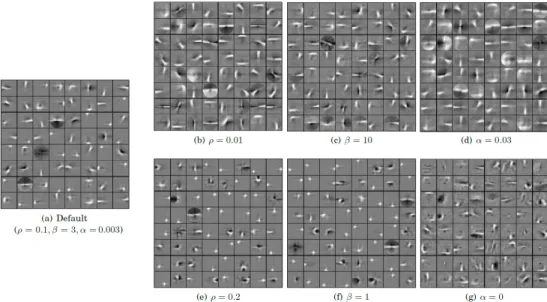
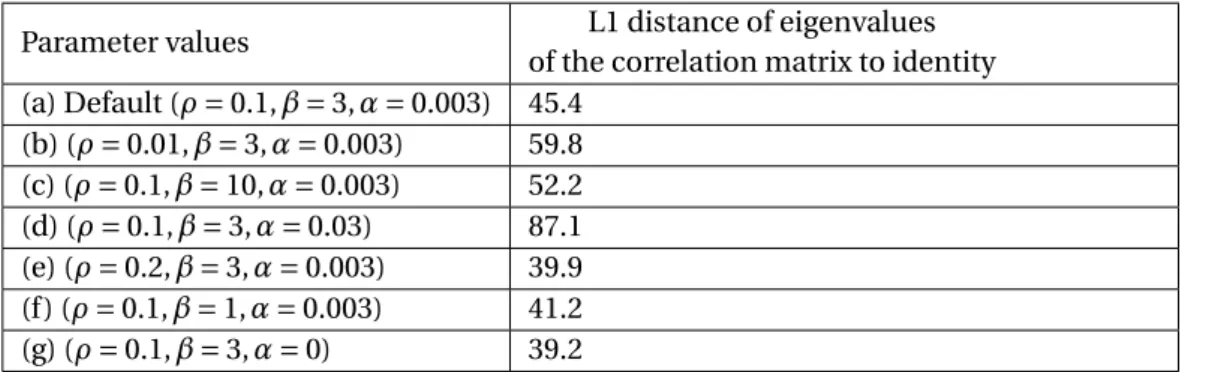
In this chapter, we investigate the effects of model parameters of single-hidden-layer sparse autoencoders (including regularization parameters, number of hidden units), and the scale of the dataset on the classification results, and whether they are able to give comparable results to traditional descriptors. In this respect, we quantify how effective and generic each of these representations are on a Maya monument dataset as well as on a much larger human sketch dataset.
3.2. Related Work
1. the evaluation of the performance of a data-driven auto-encoder approach for shape representation;
2. a comparative study of hand-designed HOOSC and data-driven SA, which to our knowl-edge has not been conducted previously;
3. an experimental protocol to assess the effect of the different parameters of both repre-sentations;
4. the creation of a bridge between computer vision and machine learning and Maya studies, specifically for visual analysis of glyphs.
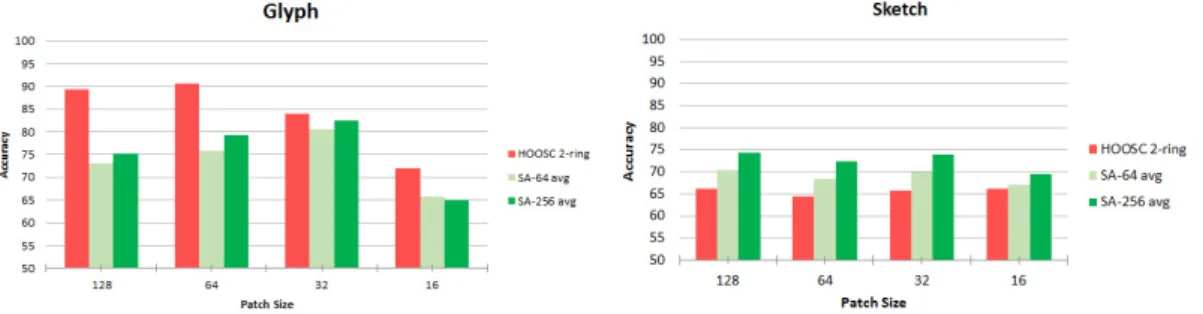
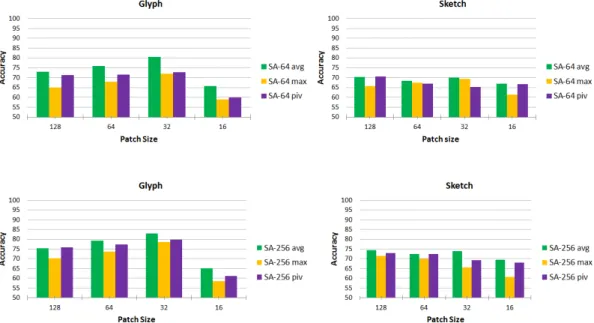
From our experiments, the main conclusions are that the data-driven representation performs overall in par with the hand-designed representation for similar locality sizes on which the descriptor is computed. We also observe that a larger number of hidden units, the use of average pooling, and a larger training data size in the SA representation all improved the descriptor performance. Additionally, the characteristics of the data and stroke size plays an important role in the learned representation.
The rest of the chapter is organized in five sections. Section 3.2 presents the related work on object recognition and discusses some of the representations in computer vision for this task. Section 3.3 explains the classification pipeline used in this chapter, and describes the two studied representations. Section 3.4 summarizes the experimental setup, dataset details, and parameter settings. In Section 3.5, the results are discussed with respect to certain aspects and parameters of the pipeline. Finally, Section 3.6 concludes the chapter by pointing out the potential and limitations of both representations.
3.2 Related Work
This section presents the related work under the three main points: visual representations for object recognition, knowledge-driven representations for shapes, and data-driven representa-tions.
Object representation and pooling.Object recognition architectures are generally composed of three steps: low-level feature extraction, coding, and pooling. Low-level features of an image, such as color, intensity values, or orientation of the edges, can be extracted locally over windows sliding through the image or over a defined region. The coding step relies on the availability of a dictionary. It is often obtained by clustering low-level feature vectors of all images. The dictionary is a more abstract representation, aiming to group and characterize repetitive patterns in the features across images. Given a dictionary, low-level local features of each image are coded, for instance, by quantizing them to their nearest element in the dictionary or by extracting their sparse decomposition with respect to the dictionary vectors. Finally, in the pooling step, the coded features are combined spatially (e.g. through averaging or by taking the maximum value) and a global representation is obtained for the whole image.
In the last decades, different modules of this common pipeline have been investigated. Boureau et al. [2010] use the Caltech-101 object recognition and 15-scene recognition datasets as benchmarks. They utilize dense SIFT [Lowe, 1999] as basic image features and propose “macro-features” in which neighboring features are encoded jointly. Macro-features improve only the object recognition results. In another similar study, Chatfield et al. [2011] analyzes feature encoding methods for bag-of-words image representations (BoW) [Sivic and Zisser-man, 2003b] in object classification tasks for the PASCAL VOC and Caltech-101 datasets. The selected methods are locality-constrained linear encoding (LCL) [Wang et al., 2010], improved Fisher vector (FV) [Perronnin et al., 2010], super vector (SV) encoding [Zhou et al., 2010] and kernel codebook (KC) encoding [van Gemert et al., 2008]. Compared to the traditional hard quantization, the above methods keep more information about the original feature vector. Fisher vector coding is reported to give superior results. Furthermore, in the empirical analysis, both larger vocabulary size and higher sampling density are noted as critical aspects for good performance.
There are several common practices in the literature for pooling local descriptors and obtaining a global image representation. Spatial pyramid matching (SPM) [Lazebnik et al., 2006] is a popular approach to incorporate spatial information into BoW representations. This approach treats the image on several spatial levels. For each level, it divides the image into a grid of different granularity, i.e. level-0 (whole image), level-1 (2x2 grid), and level-2 (4x4 grid). Then, the BoWs in each grid cell of each level are normalized according to the cell area and stacked together. The SPM approach might not be optimal for some object classes. Thus, instead of pre-defined regular grids, it has been proposed to learn the spatial cells from an over-complete set of arbitrary rectangles over the image and call these cells receptive fields [Jia et al., 2012]. In a similar study, Battiato et al. [2010] analyzes hierarchical bag-of-words for scene classification. Each scene is partitioned into subregions hierarchically and described via texton distributions, which yields good performance for this task.
However, in general, the basic way to operate pooling is by taking the sum or max of the features in the defined spatial neighborhood. In the case of deep neural networks, the spatial neighborhoods for pooling can be densely and regularly sampled over the image. As an alternative, the spatial neighborhoods can be simply defined around specific points of interest. Since the main interest of this chapter is shape data, we use the latter and sample features around pivot points, which are points from the shape.
Knowledge-driven representations for shapes.In the literature, gradient-based handcrafted features such as SIFT [Lowe, 1999] and HOG [Dalal and Triggs, 2005b], and their variants [Eitz et al., 2012b; Roman-Rangel et al., 2011a] are popular and have been shown to work well in image recognition tasks. Roman-Rangel [2012] proposed the HOOSC shape descriptor, which is a combination of the HOG and Shape Context (SC) features, for shape retrieval tasks applied to Maya glyphs, ancient Chinese writing, and MPEG-7 shape dataset. In a more recent study, we showed that the performance can be boosted by adding the relative position of the pivot points where the HOOSC descriptors are computed [Hu et al., 2015]. Note that the details of
3.2. Related Work
this study are presented in the Appendix A. Furthermore, Roman-Rangel et al. [2012] evaluated hard vector quantization and sparse coding methods and reported that hard quantization
is superior to sparse coding approach withl1norm on a specific Maya glyph dataset from
monuments. In a similar hieroglyph recognition task for Egyptian writing, Franken and van Gemert [2013] evaluated HOG, SC [Belongie et al., 2000], and HOOSC [Roman-Rangel et al., 2011a]. All three descriptors were used with a bag-of-words representation, and performed similarly. By introducing spatial matching of the interest points, the results using HOG and HOOSC are further improved.
Recently, a sketch benchmark for 250-objects was released and analyzed in a similar recog-nition pipeline [Eitz et al., 2012b]. The authors proposed a gradient-based fast histogram feature, similar to the SIFT feature, based on fast Fourier transform. It is reported that soft quantization and SVM outperforms hard quantization and k-nearest neighbor approach. As with traditional image recognition tasks, gradient-based shape descriptors work fine for shape recognition tasks. Another study about symbol classification examines the role of local and global shape descriptors [Battiato et al., 2015], where local SC features are clustered to obtain a BoW representation for aligning the shapes, and the Circular Blurred Shape Model (CBSM) [Escalera et al., 2011] is utilized to describe the shapes globally. The CBSM descriptor is defined via correlograms on radial sectors, and rings. The distances of each sampled point on the contour to the center of these radial regions are computed and normalized. The inverse of these distances compose the correlogram distribution. In [Battiato et al., 2015], this approach is applied on the 70-class MPEG-7 silhouette dataset, 17-class symbol dataset [Escalera et al., 2011], and the aforementioned sketch dataset. Their approach, which includes local align-ing of the shapes before describalign-ing them globally, is reported as superior compared to the approach in [Eitz et al., 2012b], which does not include an aligning step.
Data-driven representations.Recently, an important trend in machine learning argues that features should be learned from the data rather than designed by hand [Bengio et al., 2013]. This has led to a development of methods that can leverage and enforce sparsity in the rep-resentation. The sparse autoencoder (SA), which is an unsupervised neural network, is one such approach. This includes several variants such as denoising autoencoder, contractive autoencoder, and their regularized stacked versions [Bengio et al., 2013]. There have been several promising applications of convolutional and stacked autoencoders to object recogni-tion [Ranzato et al., 2007; Xie et al., 2015], 3D object retrieval [Leng et al., 2015], handwritten Chinese character recognition [Wang et al., 2014], and multiple organ detection [Shin et al., 2013]. A thorough study about single-layer sparse autoencoders was conducted in which SA is used to extract the representation of local patches in an image on the most often used natural image benchmarks [Coates et al., 2011]. This work suggests to use dense sampling, small stride (the distances between sampled patches), and small input patch size (so that the number of features can increase) for performance improvement. In [Chen et al., 2015], the authors discuss convolutional SA-based features for image matching task and compare them with SIFT features. The main finding is that even though SIFT performs better for the given