Title:
Measuring the size and development of the
informal economy in the countries of the Balkan
peninsula using structural equation modelling approach
Name: Alban Asllani
This is a digitised version of a dissertation submitted to the University of
Bedfordshire.
It is available to view only.
This item is subject to copyright.
First Cover
Title: Measuring the Size and Development of
the Informal Economy in the Countries of the
Balkan Peninsula using Structural Equation
Modelling approach
Thesis Cover
Measuring the Size and Development of the Informal Economy in
the Countries of the Balkan Peninsula using Structural Equation
Modelling approach
Alban ASLLANI
PhD
January 2018
Measuring the Size and Development of the Informal Economy in
the Countries of the Balkan Peninsula using Structural Equation
Modelling approach
By
Alban Asllani
BSc, MSc
A thesis submitted to the University of Bedfordshire in partial
fulfilment of the requirements for the degree of Doctor of
Philosophy
i
Author’s Declaration
I, Alban Asllani declare that this thesis and the work presented in it are my own and have been generated by myself as the result of my own original research. The title of the research is:
Measuring the Size and Development of the Informal Economy in the Countries of the Balkan Peninsula using Structural Equation Modelling approach
I confirm that:
1. This work was done wholly while in candidature for a research degree at this University; 2. Where any part of this thesis has previously been submitted for a degree or any other
qualification at this University or any other institution, this has been clearly stated; 3. Where I have cited the published work of others, this is always clearly attributed;
4. Where I have quoted from the work of others, the source is always given. With the exception of such quotations, this thesis is entirely my own work;
5. I have acknowledged all primary sources of help;
6. Where the thesis is based on work done by myself jointly with others, I have made clear exactly what was done by others and what I have contributed myself;
ii
Measuring the Size and Development of the Informal Economy in
the Countries of the Balkan Peninsula using Structural Equation
Modelling approach
Abstract
This thesis presents estimates and analysis of the informal economy for ten countries in the Balkan Peninsula region. It is the first attempt to study the size and development of the informal economy in these southeastern European countries from 1996 to 2014 using a special case of the Structural Equation modelling, which is the MIMIC model. There is currently a gap in the literature focusing on measuring the size of the informal economy in the Balkan countries especially after social, economic, political and judiciary reforms that the region has undergone. Such reforms are likely to influence the trend of the informal economy, and hence it is important to study the development of the informal economy. Different from existing literature, this research uses policy-driven indicators as well as macroeconomic variables in the model to estimate the size of the informal economy in this part of the world. The estimates indicate that there is a declining trend in the size of the informal economy in most of these countries. The yearly average size of the informal economy in these ten countries started from around 31 percent in 1996 and dropped to around 26 percent in 2014. However, the overall average size of the informal economy in these Balkan countries remains high relative to GDP, and it is just over 30 percent. The results indicate that countries, where the overall average size of the informal economy is found to be the highest as a proportion to their GDP, are FYR Macedonia, Bosnia and Herzegovina, Albania and Turkey with 38.4 percent, 33.3 percent, 33.0 percent, and 32.1 percent, respectively. Countries with the lowest informal economy, on the other hand, are Slovenia and Greece, with 25 percent and 26.9 percent, respectively. The average size of the informal economy in Serbia, Romania, Bulgaria, and Croatia approximates to slightly under or slightly over 30 percent. The analysis also reveals that the key driving causes of the informal economy in these countries are the regulation burden, level of corruption, the dominance of the agriculture sector, degree of urbanisation, macroeconomic developments and the size of the government. This research concludes with some recommendations.
Keywords: Informal economy, MIMIC model, Balkan countries, Structural Equation Modelling, policy indicators, government effectiveness, regulation burden, the rule of law, policy recommendations
iii
Dedication
This dissertation is dedicated to my family – my wife, my son Albert, my parents, my brothers and my sister. Their support, constant encouragement, and unconditional love have sustained me throughout my life and have helped me stay focused on completing and submitting this PhD.
iv
Acknowledgements
I am most grateful to the members of my committee, for their time, encouragement, and expertise throughout this project. Special thanks to the chairman of my committee, for their exquisite attention to detail and his demand for excellence.
For two consecutive years, my first supervisor has been Dr Socrates Karidis who has guided me throughout completion of this PhD. On my final year of studies, Dr Eleftherios Goulas has been my first supervisor while Dr Ourania Dimitraki has been my second supervisor. Both have been very helpful and have given me essential guidance and support throughout the completion of this PhD. In particular, I would like to thank Dr Goulas and Dr Ourania for their supervision that has been the key to the completion of my PhD. All my supervisors’ help and support have been constant throughout the three years taken to complete the PhD.
A special thank you goes to prof. Dr Friedrich Schneider for his expert advice and direction, and for his feedback throughout my PhD work and upcoming publications. It has been a great honour and a great privilege to work and to be able to publish with prof. Dr Schneider. He is currently the most quoted researcher on the topic of the informal economy, who has published numerous important works on this field for many years. We are currently working on a paper together to measure the size of the informal economy in the countries of Europe and Balkan Peninsula as well as another paper with almost all countries worldwide. I would also like to thank him for arranging time for my visit to his office at the Johannes Kepler, the University of Linz in Austria, and for numerous Skype meetings in validating and discussing the results.
There are people in everyone’s lives who make success both possible and rewarding. My wife and family (my parents, my two brothers and my sister) steadfastly supported and encouraged me throughout. Without their encouragement, the pursuit of this advanced degree would never have been started.
v
Publications to Date
Working Papers:
Currently working on the following studies for publications on the first and second quarter of 2018:
1. Alban Asllani, Friedrich Schneider, Ourania Dimitraki and Socrates Karidis (2018), The Size and Development of the Informal Economy from 1996 to 2014 in the Countries of the Balkan Peninsula using Structural Equation Modelling approach
2. Alban Asllani, Ourania Dimitraki and Friedrich Schneider (2018), The Size and Development of the Informal Economy in ten Balkan countries between 1996 to 2014 using Structural Equation Modelling approach: A comparative analysis 3. Alban Asllani and Friedrich Schneider (2018), The Size and Development of the
Informal Economy in Europe between 1996 to 2014 using Structural Equation Modelling approach
4. Alban Asllani and Friedrich Schneider (2018), Measuring the size of the informal economy worldwide using MIMIC model
vi
Table of contents
First Cover ... Thesis Cover ... Author’s Declaration ... i Abstract ... ii Dedication ... iii Acknowledgements ... iv Publications to Date ... v Table of contents ... vi List of tables ... x List of figures ... xiList of appendixes ... xiv
Glossary ... xv
Chapter 1: Introduction ... 1
1.1. Introduction ... 1
1.2. Context and Aim of the research ... 4
1.3. Objectives of the study ... 9
1.4. Research Questions ... 9
1.5. Contribution to knowledge and rationale for this research ... 11
1.6. Rationale for choosing Balkan countries for this research ... 18
1.7. Outline of the thesis ... 21
1.8. Conclusion ... 25
Chapter 2: Theoretical background ... 27
2.1. Introduction ... 27
2.2. Defining the informal economy ... 29
2.3. Theory of the informal economy ... 32
How the Informal Economy arises? ... 33
The relationship between formal and informal economy ... 33
Factors driving informality ... 35
Main agents involved in informal economy ... 37
Impact of the informal economy ... 39
vii
2.5. Causes of the Informal Economy ... 46
Fiscal Policies ... 46
Public Sector Services ... 47
Overall Economic wellbeing ... 48
Administrative Bureaucracies and Regulation burden ... 49
Effects of the informal economy ... 49
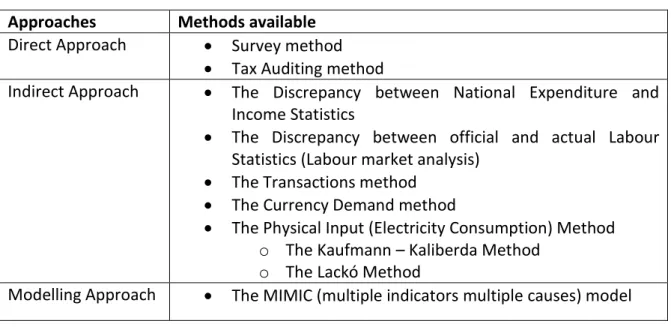
2.6. Measuring the informal economy ... 50
2.6.1. Direct Approach and methods available ... 51
2.6.2. Indirect Approach and methods available ... 53
2.6.3. Modelling Approach ... 60
2.7. Conclusion ... 61
Chapter 3: Literature Review ... 63
3.1. Introduction ... 63
3.2. The informal economy around the world ... 63
3.3. The informal economy in the Balkan countries ... 67
3.4. Economic Informality and Development ... 89
3.5. Estimation of the informal economy using different approaches ... 96
The use of the MIMIC Model ... 98
Empirical studies with MIMIC models ... 104
The use of CDA model ... 114
Empirical studies with CDA models ... 119
Empirical studies with other models and approaches ... 123
3.6. Conclusion ... 124
Chapter 4: Political, Social and Economic developments in the Balkan countries ... 126
4.1. Introduction ... 126
4.2. Political developments and reforms in the Balkan countries... 126
4.3. Social and Economic Reforms in Balkan countries ... 132
4.4. Economic developments in the Balkan countries ... 142
4.5. Conclusion ... 149
Chapter 5: Methodology and Data ... 151
5.1. Introduction ... 151
5.2. Research Philosophy ... 151
5.3. Rationale for model selection ... 153
viii
5.5. Rationale for the use of Panel data ... 157
5.6. Causes and Indicators for the MIMIC model ... 160
5.6.1. Causes ... 160
5.6.2. Indicators ... 164
5.7. Description of Variables and Data sources... 167
5.8. Econometric Model ... 172
5.9. Graphical presentation of the MIMIC Model ... 176
5.10. Benchmarking procedures for the MIMIC model... 181
5.11. MIMIC post-estimation analysis: Testing parameters and model fit statistics ... 186
5.12. Running robust analysis for SEM ... 190
5.13. Fixing a reference variable... 192
5.14. Potential Endogeneity Problem ... 194
5.15. Excepted results and hypothesis for each variable ... 196
5.16. Ethical considerations ... 197
5.17. Conclusion ... 198
Chapter 6: Results and Analysis ... 199
6.1. Introduction ... 199
6.2. Summary of data collection ... 199
6.3. Descriptive Statistics ... 201
6.3.1. Multicollinearity ... 203
6.3.2. Unit root tests ... 204
6.4. Running the model and analysis ... 207
6.5. Model fit statistics and evaluation of results ... 218
6.6. Robust analysis and discussion of the regression ... 221
6.6.1. MIMIC Specification 1 ... 222
6.6.2. MIMIC Specification 2 ... 227
6.6.3. MIMIC specification 3... 232
6.6.4. MIMIC specifications using Europe data sample ... 237
6.7. The Benchmarking procedure ... 239
6.8. Estimation results for the size of the informal economy ... 240
6.9. Confirmation of hypotheses ... 249
6.10. Country-specific analysis ... 255
6.11. Impact of informality on Government Revenues ... 279
ix
6.13. Conclusion ... 304
Chapter 7: Conclusions and Discussions ... 306
7.1. A review of main findings and conclusions ... 306
7.2. Policy Recommendations ... 310
7.3. Recommendations for Future Research ... 316
References and Bibliography ... 318
x
List of tables
Table 2.2. 1 - A Taxonomy of Types of Underground Economic Activities, Source: Lippert and Walker (1997, p. 5)
... 31
Table 2.5. 1 - Main approaches and their methods for measuring the Informal Economy ... 51
Table 5.7. 1 - Description of variables and data sources ... 167
Table 5.11. 1 - Selected Goodness of Fit indices for model assessment (Source: Hu & Bentler, 1999; Bollen & Long, 1993) ... 189
Table 5.14. 1 - Expected results and hypothesis for each variable ... 196
Table 6.3. 1 - Descriptive Statistics for all variables ... 202
Table 6.4. 1 - Selected MIMIC Specifications for benchmarking procedure ... 208
Table 6.4. 2 - All MIMIC Specifications with best Model fit statistics. ... 210
Table 6.4. 3 - Regression results for all MIMIC specifications. ... 211
Table 6.5. 1 - Selected Satorra-Bentler Model Fit Statistics for MIMIC Spec 1, 2 and 3. ... 219
Table 6.5. 2 - Reasons for not using other model fit parameters ... 219
Table 6.5. 3 - Full set of model fit statistics for all MIMIC specifications shown in table 6.4.2. ... 220
Table 6.6.1. 1 - Robust Checks for MIMIC Spec 1 – Changing causes and indicators used in the MIMIC regression ... 223
Table 6.6.1. 2 - Robust Checks for MIMIC Spec 1 – Regression results ... 224
Table 6.6.1. 3 - Robust Checks for MIMIC Spec 1 – Model fit statistics ... 226
Table 6.6.2. 1 - Robust Checks for MIMIC Spec 2 – Changing causes and variables for MIMIC regression ... 228
Table 6.6.2. 2 - Robust Checks for MIMIC Spec 2 – Regression results ... 229
Table 6.6.2. 3 - Robust Checks for MIMIC Spec 2 – Model fit statistics ... 231
Table 6.6.3. 1 - Robust Checks for MIMIC Spec 3 – Changing causes and variables for MIMIC regression ... 232
Table 6.6.3. 2 - Robust Checks for MIMIC Spec 3 – Regression results ... 234
Table 6.6.3. 3 - Robust Checks for MIMIC Spec 3 – Model fit statistics ... 235
Table 6.6.4. 1 - Robust Checks for MIMIC Specifications using another data sample – Regression Results ... 238
Table 6.6.4. 2 - Robust Checks for MIMIC Specifications using another data sample – Model fit statistics ... 239
Table 6.8. 1 - Descriptive statistics for the size of the informal economy for each MIMIC specification. ... 243
Table 6.8. 2 - Average size of the informal economy in Balkan countries from three MIMIC specifications ... 248
Table 6.9. 1 - Confirmation of the hypothesis ... 249
Table 6.9. 2 - Correlation matrix between the size of the informal economy and other variables ... 252
xi
List of figures
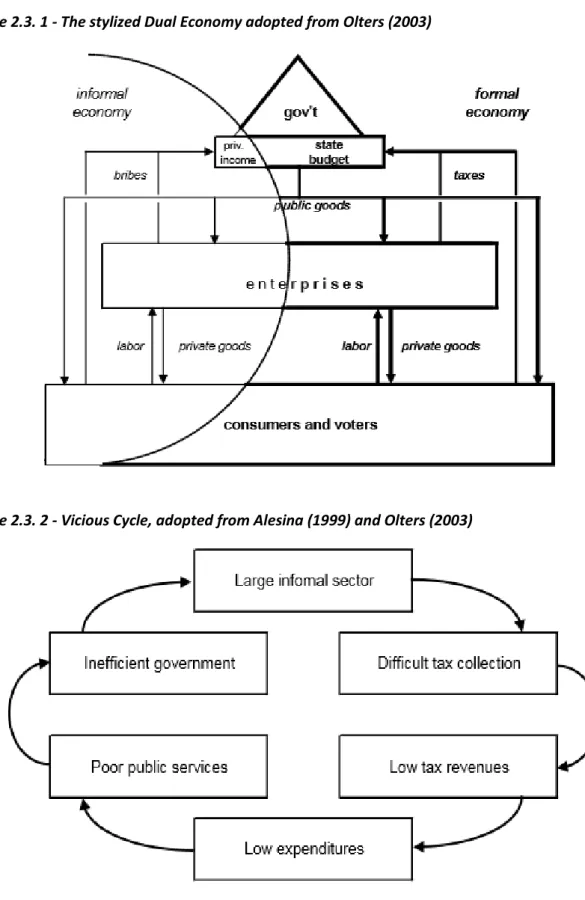
Figure 2.3. 1 - The stylized Dual Economy adopted from Olters (2003) ... 42
Figure 2.3. 2 - Vicious Cycle, adopted from Alesina (1999) and Olters (2003) ... 43
Figure 3.3. 1 - The size and development of the informal economy measured by various studies using the MIMIC, CDA or other methods. ... 70
Figure 3.3. 2 – Empirical studies and the size of the informal economy in Romania from various sources... 73
Figure 3.3. 3 – Empirical studies and the size of the informal economy in Serbia from various sources ... 75
Figure 3.3. 4 – Empirical studies and the size of the informal economy in FYR Macedonia from various sources ... 77
Figure 3.3. 5 – Empirical studies and the size of the informal economy in Albania from various sources ... 79
Figure 3.3. 6 – Empirical studies and the size of the informal economy in Bosnia and Herzegovina from various sources ... 81
Figure 3.3. 7 – Empirical studies and the size of the informal economy in Turkey from various sources ... 83
Figure 3.3. 8 – Empirical studies and the size of the informal economy in Bulgaria from various sources ... 84
Figure 3.3. 9 – Empirical studies and the size of the informal economy in Croatia from various sources ... 87
Figure 3.3. 10 – Empirical studies and the size of the informal economy in Greece from various sources ... 87
Figure 3.3. 11 – Empirical studies and the size of the informal economy in Slovenia from various sources... 88
Figure 3.4. 1 – Kuznets Curve of Informal Economy. Source: Biau (2011, p.8) adopted from Environment degradation Kuznets curve, and Inequality Kuznets curve as suggested by Kuznets (1955) ... 94
Figure 3.4. 2 - Views on the relationship between the informal economy and economic growth, Source: Nikopour et al. (2008, p.6) ... 96
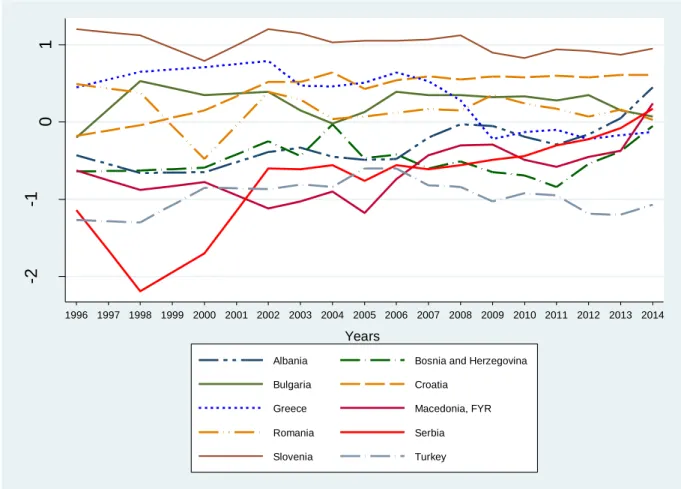
Figure 4.2. 1 - Political Stability Index for the 10 Balkan countries. Source: World Bank Governance Indicators. ... 131
Figure 4.3. 1 - Rule of Law Index. Source: World Bank Governance Indicators. ... 134
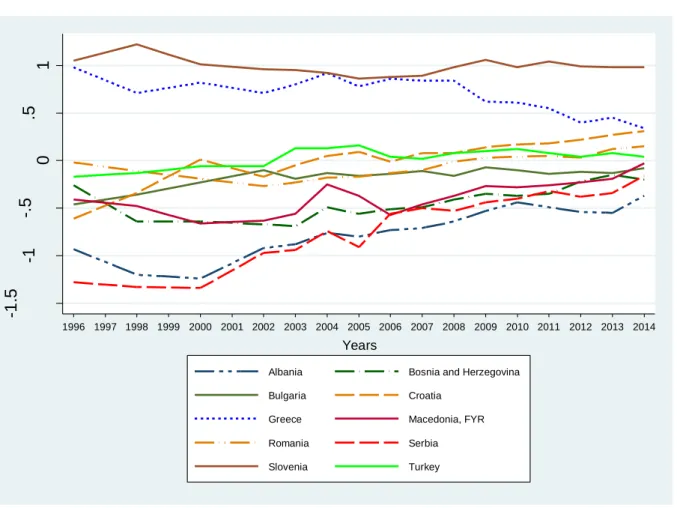
Figure 4.3. 2 - Government Effectiveness Index. Source: World Bank Governance Indicators. ... 136
Figure 4.3. 3 - Control of Corruption. Source: World Bank Governance Indicators. ... 137
Figure 4.3. 4 - Regulatory Quality. Source: World Bank Governance Indicators... 138
Figure 4.3. 5 - Business Freedom Index. Source: The Heritage Foundation ... 140
Figure 4.3. 6 - Monetary Freedom Index. Source: The Heritage Foundation ... 141
Figure 4.3. 7 - Government Spending Index. Source: The Heritage Foundation ... 142
Figure 4.4. 1 - Economic Growth in the region from 1996 to 2014, Source: World Bank Data ... 144
Figure 4.4. 2 - Unemployment, total (percentage of the total labour force) (modelled ILO estimate), from 1996 to 2014. Source: World Bank Data. ... 145
Figure 4.4. 3 - Foreign direct investment, net inflows (BoP, current US$), Source: World Bank Databank 2005-2013. ... 146
Figure 4.4. 4 - Personal remittances, received (percentage of GDP), from 1996 to 2014. Source: World Bank Databank ... 148
Figure 5.9. 1 - Generalised graphical presentation of the MIMIC Model with one latent variable, Source: Author’s presentation ... 177
Figure 5.9. 2 - Graphical presentation of the 6-1-2 MIMIC Model, Source: Author’s presentation ... 178
Figure 5.9. 3- Graphical presentation of the 5-1-2 MIMIC Model, Source: Author’s presentation ... 179
Figure 5.9. 4 - Graphical presentation of the 4-1-2 MIMIC Model, Source: Author’s presentation ... 180
Figure 5.10. 1 - A generalised process for the MIMIC model. Source: Own work ... 186
Figure 6.4. 1 - Graphical presentation of the MIMIC Spec 1 (a 6-1-2 MIMIC Model) ... 215
Figure 6.4. 2 - Graphical presentation of the MIMIC Spec 2 (a 6-1-2 MIMIC Model) ... 216
xii
Figure 6.8. 1 - Development on the size of the informal economy for Balkan countries, using MIMIC spec 1 ... 243
Figure 6.8. 2 - Average size of the informal economy in ten Balkan countries between 1996 and 2014. ... 244
Figure 6.8. 3 - Development on the size of the informal economy for Balkan countries, using MIMIC spec 2 ... 245
Figure 6.8. 4 - Average size of the informal economy in ten Balkan countries between 1996 and 2014. ... 246
Figure 6.8. 5 - Development on the size of the informal economy for Balkan countries, using MIMIC spec 3 ... 247
Figure 6.8. 6 - Average size of the informal economy in ten Balkan countries between 1996 and 2014. ... 247
Figure 6.8. 7 - Map of the Balkan countries and the range of the average size of the informal economy. ... 249
Figure 6.10. 1 - The development of the informal economy in Albania with estimates from three MIMIC models and their descriptive statistics. ... 257
Figure 6.10. 2 - The development of the informal economy in Bosnia and Herzegovina with estimates from three MIMIC models and their descriptive statistics. ... 260
Figure 6.10. 3 - The development of the informal economy in Bulgaria with estimates from three MIMIC models and their descriptive statistics. ... 262
Figure 6.10. 4 - The development of the informal economy in Croatia with estimates from three MIMIC models and their descriptive statistics. ... 265
Figure 6.10. 5 - The development of the informal economy in Greece with estimates from three MIMIC models and their descriptive statistics. ... 267
Figure 6.10. 6 - The development of the informal economy in FYR Macedonia with estimates from three MIMIC models and their descriptive statistics. ... 270
Figure 6.10. 7 - The development of the informal economy in Romania with estimates from three MIMIC models and their descriptive statistics. ... 272
Figure 6.10. 8 - The development of the informal economy in Serbia with estimates from three MIMIC models and their descriptive statistics. ... 274
Figure 6.10. 9 - The development of the informal economy in Slovenia with estimates from three MIMIC models and their descriptive statistics. ... 276
Figure 6.10. 10 - The development of the informal economy in Turkey with estimates from three MIMIC models and their descriptive statistics. ... 278
Figure 6.11. 1 – Impact of informality on Government Revenues – Albania ... 281
Figure 6.11. 2 – Impact of informality on Government Revenues – Bosnia and Herzegovina ... 282
Figure 6.11. 3 – Impact of informality on Government Revenues – Bulgaria ... 283
Figure 6.11. 4 – Impact of informality on Government Revenues – Croatia ... 284
Figure 6.11. 5 – Impact of informality on Government Revenues – Greece ... 285
Figure 6.11. 6 – Impact of informality on Government Revenues – FYR Macedonia ... 286
Figure 6.11. 7 – Impact of informality on Government Revenues – Romania ... 287
Figure 6.11. 8 – Impact of informality on Government Revenues – Serbia... 288
Figure 6.11. 9 – Impact of informality on Government Revenues – Slovenia ... 289
Figure 6.11. 10 – Impact of informality on Government Revenues – Turkey ... 290
Figure 6.12. 1 - Comparisons on the size of the informal economy between MIMIC specifications of this study and other empirical studies – Albania ... 294
Figure 6.12. 2 - Comparisons on the size of the informal economy between MIMIC specifications of this study and other empirical studies – B&H ... 295
Figure 6.12. 3 - Comparisons on the size of the informal economy between MIMIC specifications of this study and other empirical studies – Bulgaria ... 296
Figure 6.12. 4 - Comparisons on the size of the informal economy between MIMIC specifications of this study and other empirical studies – Croatia ... 297
Figure 6.12. 5 - Comparisons on the size of the informal economy between MIMIC specifications of this study and other empirical studies – Greece ... 298
Figure 6.12. 6 - Comparisons on the size of the informal economy between MIMIC specifications of this study and other empirical studies – FYR Macedonia ... 299
xiii Figure 6.12. 7 - Comparisons on the size of the informal economy between MIMIC specifications of this study and other empirical studies – Romania ... 300 Figure 6.12. 8 - Comparisons on the size of the informal economy between MIMIC specifications of this study and other empirical studies – Serbia ... 301 Figure 6.12. 9 - Comparisons on the size of the informal economy between MIMIC specifications of this study and other empirical studies – Slovenia ... 302 Figure 6.12. 10 - Comparisons on the size of the informal economy between MIMIC specifications of this study and other empirical studies – Turkey ... 303
xiv
List of appendixes
Appendix 2.2. 1 - Advantages and Disadvantages of the informal economy from three main perspectives ... 346
Appendix 3.4. 1 - Software and Data ... 347
Appendix 3.5. 1 - Table with previous research and methodologies applied ... 350
Appendix 5.4. 1 – Countries part of this research ... 364
Appendix 6.3. 1 - Descriptive Statistics for each country separately ... 365
Appendix 6.3. 2 - Histograms of all the variables ... 369
Appendix 6.3. 3 - Correlation Matrix ... 372
Appendix 6.3. 4 - Panel Unit root tests ... 374
Appendix 6.7. 1 - MIMIC Model Indexes for three chosen specifications ... 377
Appendix 6.8. 1 - Size of the informal economy in ten Balkan countries using MIMIC Spec 1, 2 and 3 (in % of GDP) ... 382
Appendix 6.8. 2 - Map of Balkan countries in Europe and the level of the informal economy. ... 385
Appendix 6.8. 3 - Comparing the Size of the informal economy from MIMIC Spec 1, 2 and 3 (in % of GDP) ... 386
Appendix 6.8. 4 - Averages from the three MIMIC Specs ... 390
Appendix 6.12. 1 - Mean comparisons with other empirical studies ... 391
Appendix 6.12. 2 - Correlation of estimates between three chosen MIMIC specifications ... 393
Appendix 6.12. 3 - Correlation of estimates between the MIMIC specifications and other empirical studies .... 395
Appendix 6.12. 4 - Correlation of estimates from the MIMIC specifications and other variables ... 395
xv
Glossary
AGFI – Adjusted Goodness of Fit Index ALMP – Active Labour Market Policies B&H – Bosnia and Herzegovina CD – Coefficient of Determination CDA – Currency Demand Approach CFI – Comparative Fit Index
CPI – Consumer Price Index
EBRD – European Bank for Reconstruction and Development EC – European Commission
ECB – European Central Bank EU – European Union
FDI – Foreign Direct Investment FYR – Former Yugoslav Republic
FYROM – Former Yugoslav Republic of Macedonia GDP – Gross Domestic Product
GFI – Goodness of Fit Index
GMM – Generalised Method of Moments HFD – The Heritage Foundation Data ILO – International Labour Organisation IMF – International Monetary Fund
LISREL – Linear Independent Structural Relationship MC – McDonald's Centrality Index
MIMIC – Multiple Indicators, Multiple Causes ML – Maximum Likelihood
NFI – Normed Fit Index
OECD – The Organisation for Economic Co-operation and Development PPP – Purchasing Power Parity
RMSEA – Root Mean Square Error of Approximation SEM – Structural Equation Modelling
Spec – Specification
SRMR – Standardised Root Mean Square Residual TLI – Tucker-Lewis Index
UN – United Nations WB – World Bank
WBDI – World Bank Development Indicators
WIEGO – Women in Informal Employment, Globalising and Organising WGI – World Governance Indicators
xvi
Word Count:
Chapter 1: 7,988 words Chapter 2: 10,077 words Chapter 3: 16,916 words Chapter 4: 5,468 words Chapter 5: 12,818 words Chapter 6: 22,776 words Chapter 7: 3,373 wordsTotal from all chapters: 79,416 words*
*The word count commences from the first word in the first chapter of the thesis through to the last word preceding the Bibliography and includes all words in Tables and Figure legends.
1
Chapter 1: Introduction
1.1. Introduction
The subject of informal economy has been of great interest to many scholars, regarding its development, causes and the impact it has on the overall economy of a country. The concept of informal economy is defined in some ways, from a broader definition to a narrower one. This thesis will adopt the narrower definition of the informal economy which is mainly about tax evasion. The broader definition of the informal economy is described as an economic sector that does not comply with any of the government regulations, norms or laws in the country (Hart, 2008a; Ihrig & Moe, 2004). It can involve illegal and legal activities from a monetary and non-monetary transactions point of view. The illegal activities involve those activities from trading of goods that were stolen, the production smuggling and dealing of drugs, as well as from prostitution to trafficking (Mirus & Smith, 1997). The legal but informal activities, according to Mirus & Smith (1997), can be characterised by tax evasion and tax avoidance categories from a monetary and non-monetary perspective. Tax evasion refers to the unreported income from different sources, while tax avoidance can refer to different employee discounts and fringe benefits from a monetary perspective, to all do-it-yourself and neighbour help activities from the non-monetary perspective1.
The narrower definition of the informal economy that this thesis will follow is that suggested by Pedersen (2003) and Kazemier (2003). They refer to the informal economy as “…all market-based legal production of goods and services that are deliberately concealed from public
2 authorities…” for tax evasion and avoidance reasons (Smith, 1994; p. 18). The informal economy is a fact of life in almost all countries worldwide (Schneider, 2000). It is an integral part of the economy and it does affect the development of a country in different ways dependant on their level of economic development (Nikopour et al., 2008).
Measuring the size of the informal economy in a country can be a challenging task since the very agents involved in informal economic activities are purposefully hiding from being identified (Gerxhani, 2004a, 2004b; Buehn & Schneider, 2011). Agents engaged in informal economic activities try to stay undetected from authorities to avoid paying taxes and operating by the rules and regulations imposed by governments (Medina & Schneider 2017). The existence of the informal economy, however, is known. The main evidence of the existence of the informal economy in a country in most cases comes from surveys of leading international organisations, such as the World Bank and International Labour Organisation. Their accuracy, however, is questionable, because surveys tend to produce biased results. Those engaged in informal economic activities will not be willing to answer all the questions that the survey may want to ask (Gerxhani, 2004b).
Since the size of the informal economy can distort the true state of the overall economy or the formal economy2, their inaccurate statistics could potentially lead to inappropriate
policies being implemented which may lead to misallocation and misuse of resources (Arby et al., 2012). Therefore, many indirect, direct and model approaches have been developed by economists to measure the size of the informal economy (Schneider & Enste 2000; Dell’Anno
& Schneider, 2003)3.
2 Terms of Overall, Formal or Official Economy are used interchangeably throughout this thesis. This is the
economy its economic agents fully operate within the norms, rules and government regulations.
3
Controlling economic informality is also a challenging task (Schneider & Enste, 2000). Most countries attempt to control economic informality through punitive measures rather than reforms in their tax systems, regulation, the rule of law and other bureaucracies involved with operating in the formal economy. Agents involved in the informal economy consider it as an opportunity cost in operating in the formal economy as opposed to the informal economy. Punitive measures such as punishments and prosecution may not be the appropriate measures to control informal economic activities (Frey & Schneider, 2000). Some countries try to use education to educate people not to engage in the informal economy, highlighting the punitive measures involved (la Porta & Schleifer, 2014).
Effective policies to control the informal economy in a country are essential. Such effective policies can be achieved if governments have consistent and reliable statistics to control and reduce the size of the informal economy. A growing size of the informal economy can be seen as a reaction of popular mistrust on the institutions and the government, as individuals may feel overburdened and may decide to engage in the informal economy, rather than raise their voices against the system which could result in reforms (Schneider & Enste, 2000). A sizeable informal economy may also compete with the formal economy. Firms who operate in the formal economy may find themselves in the unfair competitive environment (la Portes et al., 1989, p.11). However, according to Schneider & Enste (2000), the existence of the informal economy can have positive effects on the formal economy as most of the income earned from informal economic activities is spent immediately on the formal or official economy4.
Effective government policies to control the size of the informal economy are particularly important for the countries of the Balkan Peninsula for the reasons discussed above. The size
4
of the informal economy in the Balkan countries is high (Schneider et al., 2013). Providing estimates for the size and development of the informal economy in this region accompanied with some analytical discussion and policy recommendations are, in a nutshell, the contribution of this thesis.
1.2. Context and Aim of the research
This thesis will contribute to the literature of informal economy by providing estimates for the size and development of the informal economy in ten countries of the Balkan Peninsula. It will also provide analysis and discussion on the main drivers of economic informality in these countries. The main aim of this research is to explore the impact of the informal economy in the countries of the Balkan Peninsula5 and analyse the main causes and
consequences leading to relatively large informal economies relative to real GDP in these countries. In doing this, the primary objective is to provide some estimates of the informal economy in these countries using the model approach and a sample with only Balkan countries. In estimating the size of the informal economy in this region, this research will make use of the model approach (Multiple Indicators Multiple Causes (MIMIC) model6), which
is a particular case of the Structural Equation Modelling (SEM hereafter).
The economies of the Balkan countries are characterised by informal activities typically in the form of tax evasion, unreported income and informal employment. Some other important factors drive economic informality in this region such as the level of regulation and bureaucracies for running a business, the cost of running a business formally, the rule of law,
5 These are countries whose geographical territory is entirely within the Balkan Peninsula and those that are
mostly or partially located within this region. Please refer to section 1.6 in chapter one of this document.
5
size of the government, high levels of corruption, the level of unemployment and inflation and the level of government integrity and effectiveness.
Data was gathered on the basis of the methodology that will be used in estimating the size of the informal economy. Panel data spanning from 1996 to the latest available data7 for ten
Balkan countries will be used to generate results for this part of the region. Earlier set of data for this part of the world is either incomplete, not found, or does not exist, as most of the countries part of this region have experienced severe political conflicts, wars and political turmoil in the past, and as such, data is unavailable8 or unofficial.
Countries which are geographically part of the Balkan Peninsula include Serbia, Romania, Slovenia, Croatia, Bosnia and Herzegovina, Bulgaria, Montenegro, Kosovo, Albania, FYR of Macedonia, Greece, and Turkey. Part of this research will be all the countries indicated above except Kosovo and Montenegro9, where most data does not exist as these two countries
became independent in the last decade. Including all these countries, the data to be used is heterogeneous due to the differing characteristics of each of the above countries, yet with similarities regarding culture, ways in conducting economic activities, past conflicts and aspirations for European Union integration.
The economic informality in these ten Balkan countries is significant, often reaching levels of over 30 percent of their GDP (Gerxhani, 2004b; Schneider et al., 2010; Alm & Embaye, 2013; Hassan & Schneider, 2016a). The growth of the informal, underground, shadow or the illegal
7 Currently full data without any missing values is available up to 2014. There are some missing values for some
countries after 2014.
8 In cases where data is available, there are many missing values.
9 Kosovo and Montenegro are newly created countries from former Yugoslavia. Montenegro declared
6
economy or any other name10 that is used, is a global phenomenon. Recent studies
(Schneider, 2006, 2007a; Dell’Anno 2007; Torgler & Schneider, 2007; Schneider et al., 2010; Alm & Embaye, 2013; Hassan & Schneider, 2016a,) indicate that the size of the informal economy is higher than many economists thought. These studies, however, do not look into one particular region of the world and include the factors that are specifically relevant to those regions, but instead, they look at a large number of countries, often without any connections and at different stages of development. However, for countries at different levels of development different drivers can be attributed to the large size of the informal economy. This raises the question as to what would happen to the estimates of the size of the informal economy if we were to take one region or different countries but at a similar level of development at a time and estimate the size of the informal economy. Would the same drivers be as significant in this case or would different drivers of economic informality be more important? Furthermore, most studies concentrate on the use of Tax Rates as the main causal variable influencing informality. Balkan countries tend to have low tax rates in the first place. So this raises the question of what are some of the other factors, other than tax, as main causes of the large informal sector in this region. Thus, this research will concentrate on the ten Balkan countries, as most of them are found in similar levels of development11.
The informal economy was not the centre of the attention of economists for research purposes until early seventies. In 1972, the International Labour Organization (ILO, hereafter) published a study12 which draw the attention of researchers to the subject. The informal
10 Other terminologies for the informal economies are discussed in detail in chapter two.
11 A rationale for choosing Balkan countries for this research is provided below in section 1.6 of this chapter. 12 This is the study by ILO on “Employment, incomes and equality: A strategy for increasing productive
employment in Kenya” (published in Geneva, 1972). This as per ILO’s website available at
https://www.ilo.org/global/topics/dw4sd/themes/informal-economy/lang--en/index.htm (last accessed 16/12/2018)
7
economy is considered being of larger magnitude and size in developing and transitioning countries (Dell’Anno & Schneider, 2003; Schneider, 2007a, 2007b; Schneider et al., 2010; Buehn and Schneider 2012; Alm and Embaye, 2013; Hassan & Schneider, 2016a; Schneider & Buehn, 2016). The majority of countries, part of this research, are considered to be either in transition, developing or new EU countries (with the exception of Greece) (Bartlett, 2009; Penev, 2012), who are also considered countries with large informal economic sectors when compared to other European countries (Novkovska, 2008; Macias & Cazzavillan, 2009; Garvanlieva et al., 2012; Krstić & Stanišić, 2013; Boka & Torluccio, 2013; Manolas et al., 2013).
The size of a country’s informal economy is strongly correlated with low levels of economic
development and low GDP per capita (Schneider, 2002, 2007a). Many studies suggest that the informal economy is associated with less development and transition economies
(Schneider & Enste, 2000; Gërxhani, 2004; Williams, 2005; Dell’Anno, 2007; Andrei et al., 2010; Schneider et al., 2010; Schneider, 2014; la Porta & Shleifer, 2014).
This region too has been hit by the last global financial crisis and the subsequent Eurozone debt crisis13. Their formal economy indicators highlight the impact of this financial crisis on
the levels of output, increased unemployment and worsening of the balance of payments. While in some countries the impact was felt mildly (Albania, Kosovo, FYR Macedonia, Montenegro), other Balkan countries experienced greater negative impacts on their economy (Greece, Croatia, and Serbia) (Bartlett, 2009; Micevska, 2004; Penev, 2012). It is recognised that economic crisis in general (and financial crisis in particular) can lead to a slowdown in the economic activity of a country, thus exacerbating poverty levels and income distribution. Moreover, labour market theories suggest that there will be an increase in informal activities
13 Past financial crisis since 1996 have also had an impact on the region (Bartlett, 2009; Micevska, 2004; Penev,
8
as a result of economic crisis and hence increase the levels of informal economy (Hassan & Schneider, 2016a). As a consequence of economic crisis (particularly the financial crisis), it is expected that the unemployment rate in a country will increase as jobs will be lost during a recession or an economic downturn. The informal employment, on the other hand, is expected to increase as there will be new entrants into the informal economy for various economic, survival and social reasons (Finnegan & Singh 2004). It is assumed that the informal economy can act as a refuge in coping with the economic crisis which affects the formal economy directly (Cunningham & Maloney 2000; Cling et al. 2010).
If the informal economy was of significant size before the financial crisis of 2008, it is interesting to estimate the size of the informal economy some years after this crisis in an attempt to see the development of such economy in the ten Balkan countries. Different studies mentioned above and reviewed thoroughly in the literature review, have indicated a declining trend in the level of informal economy for some Balkan countries, due to a strengthening of the formal economy and reforms. However, with the severe impact of the financial crisis of 2008 on the formal economies of the Balkan countries, it would be interesting to see if this declining trend has continued after the crisis.
In general, the above aim can be divided into three main areas of research. The first aim is to explore the leading causes and consequences of the informal economy in Balkan countries by reviewing the existing literature on the field and by assessing and critically examining the theories of the informal economy. The second aim is to estimate the size and the development of the informal economy in the ten Balkan countries using a Structural Equation Modelling approach (MIMIC Model) for the period from 1996 to 2014 and evaluating the primary drivers of informality in these countries. Finally, the third aim is to analyse the impact
9
of such informality for the formal or official economies of these countries and provide some policy recommendations for their governments.
1.3. Objectives of the study
This research intends to address a number of objectives triggering some research questions. The first of these objectives is to critically review the existing theoretical and empirical literature on the relationship between the informal economy, the formal economy and economic development from 1996 to 2014 for the ten Balkan countries. The second objective is to obtain a clear understanding of how informality is present in the economies of these countries in question. The analysis will indicate the main causes or drivers of economic informality in these Balkan countries and will provide estimates of the size of their informal economies. The third objective is to assess the significance of informality and the significance of the causes and effects of such informality in these Balkan countries.
The next objective is to propose ways of reducing informality in these countries, considering the effects of that reduction in their national economies. Most of these countries have mainly concentrated on the use of punitive measures to control the size of the informal economy. Recommending effective policy measures to control the development of the informal economy in these countries may benefit these governments to be more efficient in controlling economic informality. Moreover, the final objective is to understand the different dynamics of the Balkan economies based on their economic and political trajectory (such as European Union Integrations and Post conflicts).
1.4. Research Questions
The above aims and objectives of this thesis introduce a number of research questions. This thesis will seek to answer the following research questions:
10 • What is the size of the informal economy in the ten countries of the Balkan Peninsula?
Typically, the size of the informal economy is given as a percentage of the official or formal real GDP. In the methodology chapter, the model used for the estimation procedure will be outlined along with a rationale for its use. The model used for estimating the size of the informal economy is the MIMIC model followed by a benchmarking procedure to calibrate the size of the informal economy and visualise its trend and development (Schneider, 2000; Schneider & Enste, 2000; Dell’Anno &
Schneider, 2003).
• What are the main drivers contributing to the size of the informal economy in the countries of the Balkans?
Based on the causes, we will be able to measure the size of the informal economy and analyse the primary drivers behind informality. The model analysis using the MIMIC will be able to indicate how significant each of the causes of the informal economy is. The literature reviewed empirically showed and analysed a number of causes as the primary drivers of the informal economy. These main drivers tend to vary depending on the level of development a country finds itself. The main drivers of economic informality are often noted to be the level of taxation rate, government regulation and effectiveness, the rule of law, ease of doing business formally, the dominance of the agriculture sector, the strength of the formal economy or the macroeconomic indicators, and the overall regulatory quality in the country (Schneider, 2000;
Dell’Anno, 2007; Schneider et al., 2010; Schneider & Enste, 2013; Alm & Embaye, 2013; Hassan & Schneider, 2016a).
• How has the size of the informal economy developed since 1996 to 2014 in the ten Balkan countries? To my knowledge, there has not been any research to estimate the
11
size of the informal economy in the ten Balkan countries from the period of 1996. After estimating the size of the informal economy for each of the ten countries, we will be able to see the trend and development of the informal economy over the years. Given the recent social, political and economic developments and reforms in this region, as a result of European integration (Anastasakis, 2013), and given the impact of the financial crisis of 2008 (Arvai et al., 2009; Bartlett & Monastiriotis, 2010; Stamatović & Zakić, 2010; Bartlett & Prica, 2013; Geshkov, 2014; Sadiku et al. 2014), this makes the region and interesting area for research and an important contribution to see how the trend and development of the informal economy has evolved from 1996 to 2014. Some studies that have attempted to estimate the size of the informal economy in the ten Balkan countries will be analysed and compared with the results of this study.
1.5. Contribution to knowledge and rationale for this research
For a long time, economic researchers condemned the existence of a significant informal economic sector, and have viewed it as a deterrent to investment, economic growth and development. However, this view has been confronted with strong criticism particularly in developing countries where formal unemployment is rapidly growing and poverty widely spreading. This, in turn, is leading to an expanding informal economy. Hence, alternative schools of thought that view the informal economy as a source of livelihood for people unemployed and from poorer background have subsequently been developed (Misati, 2007).
The concept of the informal economy worldwide has been widely researched by many scholars (such as Frey & Pommerehne, 1984; Feige, 1989a, 1989b; Thomas, 1999; Fleming et al., 2000; Pedersen, 2003; Del’Anno & Schneider, 2004; Ihrig & Moe 2004; Dell’Anno 2006,
12
2007; Feige, 2007; Schneider, 2007a, 2007b; Hart, 2008a; Buehn & Schneider, 2007; Schneider et al., 2010, Schneider, 2014). The above authors have also offered ways in measuring the informal economy in a country using the three main methodologies such as the direct, indirect and model approaches – discussed in more details in the theoretical background chapter. Studies have also tried to analyse empirically and theoretically the impact of the informal economy on economic growth and development of a country (such as Becker, 2004; Levy, 2010; Schneider et al., 2010; Chen, 2012).
Contribution to the literature on the size of the informal economy has been given by a number of studies on individual country basis, such as Schneider & Enste (2000), Pommerehne & Schneider (1985), Chen (2004) and more recent studies of Breusch (2005a, 2006), Andersdale
et al. (2006), Dell’Anno et al. (2007), Buehn et al. (2009), Amendola & Dell’Anno (2010),
Heinemann & Schneider (2011), Buehn & Schneider (2012), Hassan & Schneider (2016a, 2016b) and Medina & Schneider (2017).
There is a widespread assumption that informal economy has low productivity and, therefore, contributes to low growth and development (Levy 2007, 2008). Many studies suggest that the informal economy is associated with less development and transition economies (Schneider
& Enste 2000; Gërxhani, 2004; Williams, 2005; Dell’Anno, 2007; Andrei et al., 2010; Schneider,
2014; la Porta & Shleifer, 2014). Furthermore, as a consequence of financial crisis, it is expected that the level of unemployment will increase, as jobs are lost in the formal economy, and at the same time the informal employment will increase as there will be new entrants into the informal economy for various economic, survival and social reasons (Cunningham & Maloney, 2000).
13
Other studies have looked at the relationship between the financial crises and the informal economy (such as Finnegan & Singh, 2004; Jutting & Laiglesia, 2009; Mehrotra, 2009; Cling et al., 2010; Horn, 2011; Garvanlieva et al., 2012; Blunch, 2015; Colombo et al., 2016). They suggest that at times of financial crisis and economic downturns people tend to turn to informal employment. However, informal employment is one factor of the overall informal economic activities. Other factors such as the level of public sector spending, equity and quality in the services provided by government at times of financial crisis and downturns as well as increasing trend of the informal economy are just as important. A study by Colombo et al. (2016) investigates the response of the informal economy to banking crises14 suggesting
that the informal sector is a powerful buffer, expanding at times of banking crises and absorbing a large proportion of the fall in the official output.
From the existing literature, it is evident that there has been much research about the informal economy. Research has been carried out in many areas relating to the informal economy, but with a special focus on the methods, the informal economy can be measured or estimated. The existing literature has also focused on the theory of informal economy, analysing the key drivers of economic informality and the leading indicators where that informality is manifested. However, having said this, there has not been any research regarding the informal economy of the countries of Balkan Peninsula. Balkan countries are characterised by a high degree of informality and as such more research and empirical analysis needs to be carried out. There is no literature which tries to estimate and critically examine the size and development, as well as the main driving forces behind the level of
14 While crisis in general can be characterized into either economic or financial crisis, according to Reinhart &
Rogoff (2009), Claessens & Kose (2013) and Carlin & Soskice (2015) there are four broad verities of financial crisis; inflation crisis, currency crisis, sovereign debt crisis and banking crisis.
14
economic informality in the Balkan countries. Different studies investigate the estimation of
the informal economy worldwide using ‘one size fits all’ causes and indicators for the informal
economy. However, it is difficult to measure the size and analyse the development of the informal economy for many countries especially if they are in different stages of development and in different parts of the world where cultures can play a role in their economic activities. The focus should be to estimate the size of the informal economy for a region at a time, in an attempt to capture the most important and key drivers of economic informality which are relevant to a particular region. To date, there is no research for the ten countries of Balkan Peninsula using a panel data and a MIMIC methodology.
The lack of such research has been the main rationale for the undertaking of this research, with emphasis on this region. Such analysis is also lacking for other parts of the world as well; but, the main contribution of this research would be for the region of the Balkan Peninsula. However, the methodologies applied in this research can contribute to other studies being undertaken for other parts of the world, or another block of countries worldwide. Indeed, in order to check the robustness of the results, this study will apply similar MIMIC model for another block of countries.
A further rationale for undertaking this research relates to the methodologies being applied to measure the size and development of the informal economy in the countries of the Balkans. There seems to be a lack of appropriate indirect methodologies for measuring the informal economy, such as the use of MIMIC model from the Structural Equation Modelling approach (SEM hereafter). In this research, the MIMIC model will be applied and the results generated will be analysed and tested for robustness. The use of MIMIC model rather than other models is as a result of the disadvantages that the other models have and the advantages that the
15
MIMIC model has. A rationale for using MIMIC model has been provided in the methodology chapter. A thorough discussion of all the methods to measure the informal economy has been provided in the theoretical background chapter.
With this rationale, this research will make a number of contributions to the existing literature on the informal economy. The contribution of this research is linked with the research questions identified above in this chapter. Even though the contribution of this research will be highlighted throughout this thesis, and more so in the Results and Analysis chapter, typically contributions to knowledge from research can be generalised to be conceptual, empirical and methodological. This research encompasses all three contributions to knowledge in the field of informal economy.
The first contribution of this research is a conceptual or theoretical one. This research contributes to the growing literature on informal economy for the countries of the Balkan Peninsula. Previous research that investigated all Balkan countries as a sample within one dataset has not been done to date. Furthermore, a critical and extensive review of all the literature referring to the informal economy and Balkan countries has also not been done to date. Therefore, this research will contribute to the literature by providing some insight into the level of the economic informality in these ten Balkan countries and will analyse in detail the main drivers of such informality for the Balkan countries. A further rationale and contribution for choosing Balkan countries as an area of research for this thesis has been provided in section 1.6.
The second contribution of this thesis is a methodological one. It has been argued several times that when it comes to measuring the informal economy is a complicated process (Schneider, 2002, 2014) and that estimating the size of the informal economy one has to
16
consider many factors (Dell’Anno, 2007; Schneider, 2007a, 2007b; Buehn & Schneider, 2012). The use of the model approach is justified in the literature, and this is the MIMIC model15.
However, in the existing literature, the use of the model has mainly focused on macroeconomic indicators rather than policy indicators. The MIMIC model applied in this research uses both macroeconomic and policy variables to derive an estimate for the informal economy. From the literature review and the methodology chapter, it is evident to notice the difference between the model applied in this research (albeit with rationale and justification) and the models applied in other existing literature. The use of government effectiveness, the rule of law, level of corruption, regulatory quality and the ease of doing business variables are just as important as the macroeconomic variables in acting as causes of the informal economy.
This is a region that has a particular problem with policy indicators and the rule of law (Balfour & Stratulat, 2011; Anastasakis, 2013; Bartlett & Uvalic, 2013), which are considered to be the roots of the problems caused in the overall economy from which the macroeconomic indicators suffer as well. Furthermore, there seems to be a popular mistrust in the government institutions in these countries due to a high level of corruption (Bartlett, 2009; Penev, 2012; Anastasakis, 2013). This popular mistrust on the state coupled with high level of corruption, weak government effectiveness and the rule of law, can lead to a high level of informality. Thus, it is important to consider policy indicators as key causes to be used in the MIMIC model rather than relying only on macroeconomic indicators.
15 The MIMIC model has been used extensively by Giles (1999a, 1999b, 1999c), Giles et al. (2002), Breusch
(2005a, 2005b), Bajada & Schneider (2005a), (2005b), Dell’Anno (2003, 2007), Schneider (2005, 2006, 2007), Pickhardt & Sarda-Pous (2006), and by Pickhardt & Sarda-Pous (2006).
17
The empirical contribution of this thesis is to provide estimates on the size of the informal economy for the ten Balkan countries for the most prolonged period compared with existing literature. This study will provide estimates on the size of the informal economy over a period of 19 years – which has not been done before. The estimates from this study will be analysed with specific reference for each country, and compared with the estimates provided by Schneider (2007b, 2009), Schneider et al. (2010), Buehn and Schneider (2012), Schneider et al. (2013), Alm and Embaye (2013), Boka and Torluccio (2013), Hassan and Schneider (2016a) and Bitzenis et al. (2016)16.
The final contribution of this thesis is to provide some policy recommendation to the governments of the ten Balkan countries considering the research carried out. Even though most of these ten Balkan countries have undergone some reforms influenced mainly by the European Union (as discussed in chapter 5), there is still much more to be done regarding reduction in corruption, level of economic informality and other reforms in the economy and judiciary sectors.
The research will be divided into several chapters as presented in section 1.7, and each of these chapters will have its rationale and subsections. In general, the study intends to understand and analyse the size and development of the informal economy in the Balkan countries. In doing so, this research will provide analysis of the leading causes and effects of economic informality in this region and provide some policy recommendations that might potentially be suitable and effective in controlling the level of the informal economy.
16 Majority of these studies, however, uses a worldwide sample, not a sample which is specific to the region of
18 1.6. Rationale for choosing Balkan countries for this research
The Balkan Peninsula is an interesting area of the world for research, with its unique cultural development and ethnic diversity, which may have contributed to a series of conflicts and political unrest for decades. The countries of Balkan Peninsula experienced a dramatic shift from a region of wars, conflicts and continuous social and political unrest (Micevska, 2004). This is a region that has a history of bloodshed and conflicts, perhaps due to its cultural diversity with fundamental differences in culture, religion, political theories, and social structures that have often been the cause of armed conflicts. In this, both the ethnic and cultural diversity of the region and the geographical location have contributed to long periods of destabilised governments that have served poorly to protect innocent people residing in this region. Often this can lead to mistrust of citizens in their governments and often leads to people trying to avoid dealing with the state (Bartlett, 2009; Penev, 2012).
This is a region that recently started to understand the benefits of cooperation in ensuring economic prosperity for their citizens. This political and economic cooperation between the countries was essential in ensuring that the region could escape the levels of poverty, collapsed infrastructure from the wars and conflicts as well as ruined economies (Bartlett, 2009; Penev, 2012). Since the early 1990s, the region of South East Europe (SEE hereafter) and in particular countries in the Balkan Peninsula (including Turkey), have experienced dramatic transformation in their economies. The transformation from command to market economy produced remarkable changes in the social, political and economic infrastructure of SEE countries (Micevska, 2004).
This political and necessary change in the region was followed by increases in their GDP growth, and almost all other macroeconomic indicators were heading towards a direction
19
which benefited the people and economies of the Balkan countries. However, this momentum of growth and prosperity was interfered by the financial crises and the subsequent Eurozone debt crisis. Since 1996 this prosperity and economic growth were also interrupted by internal political conflicts and political instabilities. It was no coincidence that during early-2009 (albeit with delay), all of a sudden almost all the countries in the Balkan region experienced reduction in GDP growth, reduction in inward FDI reduction in incoming remittances, further disequilibrium of their balance of payments, less international trade, increases in the non-performing loans and other misbalances in the banking sector, etc. (World Bank Data, last accessed 20.06.2017).
Literature also classifies this region with a high degree of economic informality. The informal economy tends to be of more critical relevance to the countries in transition and developing or less developing economies. This is because of its size relative to the GDP (de Soto, 1989, 2000; Heintz & Pollin 2003; Williams, 2005; Ishengoma & Kappel, 2006; Levy, 2007, 2008; la Porta & Shleifer, 2014). Most of the Balkan countries are considered as either transition, emerging or peripheral economies in comparison to the rest of the European continent. Countries of the Balkan Peninsula are characterised by a high degree of informality – partly due to the lack of economic and development policies, lack of reforms, and cultural attributes. In almost all countries of the Balkan Peninsula, such as Bosnia and Herzegovina, FYR Macedonia, Albania, Bulgaria, Serbia, Romania, Turkey, and less for Slovenia, Greece and Croatia - tax evasion, market distortion, large number of bureaucracies, regulation burden, unfair competition, high level corruption and informal employment are some of the factors that constitute the informal economy (Novkovska, 2008; Macias & Cazzavillan, 2009; Garvanlieva et al., 2012; Krstić & Stanišić, 2013; Boka & Torluccio, 2013; Manolas et al., 2013).
20
Therefore, the main justification or reasons for choosing this part of the world for this research are many. One of the reasons, which are also discussed in the above paragraphs, is that this is a region where the informal economy is considered to be of significant size, but yet studies produce different results as indicated in the literature review chapter. Majority of these studies also use direct, indirect or model approaches usually with time series data. The lack of historical data for this part of the world creates problems in measuring or estimating the informal economy with a small number of observations and thus can lead to biased results.
According to Pichler & Wallace (2004), most of the post-communist and transition household economies rely on more than one form of economic activity. The households tend to develop
a “portfolio of economies” at the micro-level, combining either formal economic activities with informal activities or combining different informal economic activities to get by. This makes the informal economic activities as a norm for survival reasons in these countries and therefore an important region to study and understand the size and development of the informal economy.
The other reason is that most of the Balkan countries and their economies are in the process of EU integration and they can be classified as part of the EU (Greece, Croatia, Slovenia, Bulgaria, and Romania), EU candidate or potential candidate members (all other countries part of the investigation). In the process of EU integrations, these countries are continually reforming policies to combat corruption and informality in an attempt to fulfil the joining criteria set out by the European Commission. Understanding the primary drivers of the economic informality in most of these countries could help draft policy recommendations in tackling it.