(IJSBAR)
ISSN 2307-4531
(Print & Online)
http://gssrr.org/index.php?journal=JournalOfBasicAndApplied
---
147
Strategic and Implementation Issues Regarding ECB
Monetary Policy
Shkendije Nahi
a*, Gazmend Luboteni
baPhD Candidate of Economic Faculty at University of Prishtina, Prishtina, Kosovo b
Professor, Economic Faculty at University of Prishtina, Prishtina, Kosovo a
Email: [email protected] bEmail: [email protected]
Abstract
This paper identifies the impact of the most important ECB‟s non-standard monetary policy measures in the
euro area. The global recession has been reflected in the slowdown of the U.S. economy and the largest
economies of Europe and Asia. The 2008 and 2014 financial crisis hit the European financial system, whereas during 2010 and early 2011 Eurozone faced the hardest time in the so-called debt crisis coupled with a drop in market confidence. Financial markets faced some problems of solvency of countries with higher debt and fiscal deficits, such as the sovereign debt crisis bubbles in Spain and Italy. The European Central Bank reacted by imposing strategic and technical measures to fuel the banks' liquidity needs, to fight a risky credit crisis and to restore investor‟s confidence within a heterogeneous Eurozone countries environment. The ECB implemented the unconventional measures, which aimed at lowering and flattening the yield curve by reducing the interest rate level and shrinking the gap between long- and short-term interest rates. The study can be applied to improve
the monetary policy measures and reduce risks in the financial sector. The questions, which need to be
addressed, relate to whether unconventional monetary policy works and what are the challenges in the long run.
Keywords: Financial crisis; monetary policy measures; interest rates; asset purchase program (APP); European
Central Bank (ECB); Euro system; Governing Council; Central Banks.
--- * Corresponding author.
148
1.Introduction
The 2008 financial crisis had worldwide effects on the global economy and on the financial system. In such circumstances, central banks found different strategies to stimulate economies and their alternative monetary policies. The nominal interest rate has been among the instruments utilized to achieve monetary policy goals. More specifically, non-traditional monetary policy ideas rely on the fact that an economy is influenced by interest rates beyond the nominal rate. Reducing interest rates through central bank operations may further stimulate the economy, which represents the balance sheet channel of the monetary policy. This policy is based on one of the fundamental principles of the financial economy, which states that the price and the interest rate for a given instrument, have an opposite relationship. Whenever the price of instruments increases, its interest rate is decreased. Short-term bond rates have generally followed the interest rate cut, as it has been the case in almost all crisis-affected economies. However, this measure is not reflected in other interest rates at the same pace and magnitude. Central bank's monetary policy may target other interest rates of the market based on the purchase of instruments, which lead to price increase and nominal interest rates reduction. In an economy, several instruments can be used, so that the monetary policy would not be limited to the amount of acquisitions. Given this economic justification, central banks of some of the developed economies began the extensive use of non-traditional monetary policies after the 2008 financial crisis. Trading instruments mainly focused on two main directions: i) buying term government bonds, which would reduce term rates and affect
long-term investment; and ii) purchasing corporate financial instruments as securities based on mortgage loans issued
by the corporate sector.
2.Literature Review
Literature on this topic shows that many authors have studied and analyzed the ECB monetary policy measures
in response to the financial crisis. The depth of the recession in many countries meant that Taylor rulea would
recommend negative nominal interest rates. However, market interest rates were effectively close to zero and negative because agents could always hold non-interest bearing cash. Many authors have also studied the issue of monetary policy from different perspectives. The ECB has provided monetary policy stimulus by applying negative rate on deposit facility rate, by undertaking a large scale asset purchase programme (APP), or by using forward guidance. Monetary policy measures are discussed during the economic crisis in Japan in the 1990s and in the US during the 2008 financial crisis. The consequences of such crisis should teach the policymakers and critics lessons learned from past crises to establish adequate frameworks and procedures [1]. The Outright Monetary Transactions (OMTs) were used as new monetary policy mechanisms, which have limited transactions in secondary markets for sovereign bonds based on European Financial Stability Facility (EFSF)/European Stability Mechanism (ESM). The ECB Governing Council guarantees that the purpose of OMTs is in line with the monetary policy goal to maintain the inflation rate below, but close to 2 percent over the medium term [2]. The focus on ECB liquidity injections was to restore frozen interbank activity and then on targeted purchase of sovereign bonds to address the erupting sovereign debt crisis in Greece, Ireland, and Portugal in 2010. Only in mid-2014, in the context of anemic growth and below-target inflation, the ECB adopted its own large-scale asset purchase program. In the United Kingdom, the response to the crisis by the
a
149
Bank of England was quite similar to the US Federal Reserve in timing and style, consisting mostly in large-scale purchases of government debt. The Bank of Japan entered the crisis with more experience due to the combination of slow growth and near-zero policy interest rates which characterized Japan‟s financial crisis since 1990s. After small initial purchases of government bonds after 2012, Bank of Japan became willing to purchase a much wider and larger set of public and private securities while adopting a numerical inflation target at the same time [3]. The ECB key policy rates changed from 2012 to 2019. Central banks in Switzerland, Sweden, Denmark, Japan and the euro area reduced key policy rates below zero, for the first time in the ECB history. This key policy rate proportion increased to about 20 percent in 2018, when the ECB started to move into negative territory from June 2014 onwards [4].
3.The ECB monetary policy strategy
The primary objective of the Euro system is to maintain price stability and inflation rates at levels below, but close to, 2 percent over the medium term. ECB‟s monetary policy strategy has the quantitative definition of price stability and the medium-term orientation of economic and monetary analysis. The year-on-year increase in the Harmonized Index of Consumer Prices for the euro area of below 2 percent over the medium-term rules out deflation being in line with price stability [5]. The Governing Council now expects the key ECB interest rates to remain at their present or lower levels until the inflation outlook robustly converges to a level sufficiently close to, but below, 2 percent within its projection horizon, and such convergence has been consistently reflected in underlying inflation dynamics [6]. On the other hand, there are also some important questions on the horizon that need to be addressed by monetary policy. First, though the impact of unconventional policies continues to be net positive, the ECB need to be mindful of the negative effects and the potential side effects of those policies and to take into account people‟s concerns. Second, the global environment characterized by low inflation and low interest rates poses strategy questions for all central banks, not just for the ECB [7].
4.The ECB measures from 2008-2019
The ECB changed the maturity structure by providing collateralized loans over long-term horizons than usual, by introducing three-month term horizon refinancing operations (LTROs/SLTROs) in March 2008. The Security Markets Program (SMP) was announced on May 10, 2010, while the IMF board approved the first Greek program on May 9, 2010. Over these years, we witnessed a constant overlap of changes in the ECB policy, national policy, and IMF policy, which all happened against an evolving backdrop of economic and market events. Actions provided by the ECB are Supplementary Long Term Refinancing Operations (SLTROs), with maturity between six months and one year; and “Very” Long Term Refinancing Operations (VLTROs), with maturity of three years [8]. In December 2011, as the sovereign crisis intensified and bank-funding conditions further deteriorated, the ECB announced long-term refinancing operations (VLTROs) of three-year maturity. The liquidity created by bond purchases under the SMP was sterilized by the ECB via weekly liquidity absorbing operations. From May 2010, purchases were limited to Greek, Portuguese and Irish Government bonds until the market conditions improved during the early 2012. When the ECB stopped purchasing bonds, it was the end of SMP and the ECB introduced the new instrument called Outright Monetary Transactions
150
(OMTs) aiming to stabilize the markets. This instrument consisted in unlimited purchases of three-year maturity government bonds issued by countries under a European Stability Mechanism (ESM). In June 2014, a package
of new measures was introduced [9].On 10th of March 2016, the ECB adds corporate sector purchase program
(CSPP) to the Asset Purchase Programme [10].
5.The Asset Purchase Programme as open ended programme (APP)
The APP had a significant impact on government securities across Eurozone issuers. In January 2015, the Euro system extended its APP to euro-denominated investment-grade securities issued by euro-area governments and institutions in the secondary market. The implementation of APP and the imposition of the negative rates contributed to improving euro area macroeconomic conditions and a sustained adjustment in inflation. The APP lowers long-term yields and stimulates restricted households‟ consumption and investment. In December 2016, the ECB started the non-standard monetary policy measures particularly APP. The ECB chose to maintain the price stability objective. Moreover, in its announcements, the ECB has connected the end of the forward guidance to the end of the APP by explicitly communicating that the monetary policy rates are expected to remain at their present levels for an extended period of time and past the horizon of net asset purchases. In October 2017, ECB announced the pace and amount of future purchases [11]. The APP lowers long-term yields, stimulates restricted households‟ consumption and investment and helps an accommodative stance of the monetary policy. On June 2016, the Euro system started the corporate sector purchase programme (CSPP).The macroeconomic effects of CSPP consist in stimulating a new large-scale new Keynesian model calibrated to the euro area and the rest of the world. Higher demand from the central bank increases corporate bond prices and reduces its interest rates. Extension of the CSPP as announced on December 8, 2016 began in the first quarter of 2017, when additional purchases started after March 2017 and lasted for three quarters until the end of 2017. CSPP stimulates banking activity by using the higher price of the real estate as collateral and stimulates banking loans. Early exit from CSPP negatively affected its macroeconomic effectiveness [12]. The Euro system fully reinvests the principal payments from maturing securities held in the APP portfolios. Given this non-standard approach, it is still uncertain when APP will end [13]. Net APP purchases have proved to be effective. ECB applied the instrument to ease monetary and financial conditions, foster the recovery and support a sustained adjustment in the path of inflation towards price stability. After the Government Council decision to end net purchases in December 2018, monetary policy stimulus continued to be provided in association with forward guidance on the key ECB interest rates and to be reinforced by the reinvestments of the sizeable stock of acquired assets. In September 2019, the Government Council decided to resume net purchases of 20bn euro per month starting on 1st November 2019, in order to reinforce monetary policy stimulus.
6.The Term Structure of Interest Rates
Under normal circumstances, Central Banks signal the monetary policy stance by announcing their decision on official policy rates. Such decisions on the policy rates are transmitted to the real economy. During a financial crisis, conventional monetary policy was not effective by lowering official interest rates, which could have prevented a more expansionary monetary policy stance through interest rate cut. Disruptions in financial markets can cause impairment of the monetary policy transmission mechanism. The supply and maturity
151
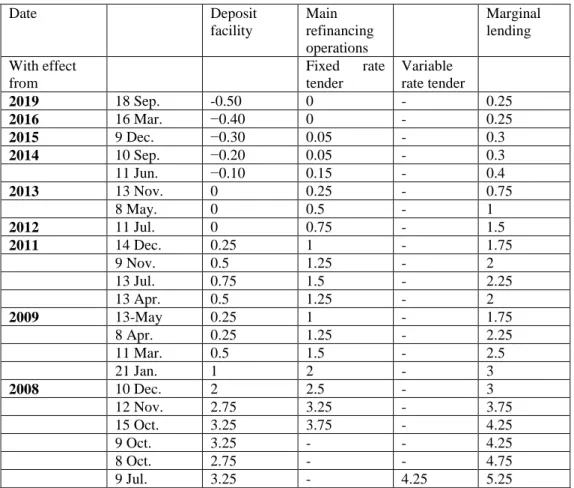
structure of government debt affect the term structure of interest rates, especially given the conflicting predictions. During the recent financial crisis, central banks around the world conducted unprecedented open-market purchases of medium and long-term government bonds. Drawing on the portfolio balance, the central banks hoped that their purchases known as quantitative easing would lower long-term interest rates and stimulate private investment [14]. The main factors, which supported the price competitiveness on both foreign and domestic markets, were the recovery in the foreign demand, the end of the fiscal consolidation and a weakening exchange rate. The exchange rate floor affected inflation in the intended way accompanied by some positive effects on the real economy [15]. For the first time in the modern history of European central banks, there was a significant decline in market interest rate below zero at the end of 2014. The ECB interest rates decision was announced on September 2019 to lower the interest rate on the deposit facility by 10 basis points, from minus 0.40 percent to minus 0.50 percent. The Governing Council expects them to remain at their present level at least through the first half of 2020. The Governing Council intends to continue reinvesting the principal payments from maturing securities purchased under the asset purchase programme for an extended period. The Governing Council decided to restart net purchases under its APP at a monthly pace of 20 mil euro as of November 2019 [16].
Table 1: ECB Interest rate veils in percentage per anumb
Date Deposit facility Main refinancing operations Marginal lending With effect from Fixed rate tender Variable rate tender 2019 18 Sep. -0.50 0 - 0.25 2016 16 Mar. −0.40 0 - 0.25 2015 9 Dec. −0.30 0.05 - 0.3 2014 10 Sep. −0.20 0.05 - 0.3 11 Jun. −0.10 0.15 - 0.4 2013 13 Nov. 0 0.25 - 0.75 8 May. 0 0.5 - 1 2012 11 Jul. 0 0.75 - 1.5 2011 14 Dec. 0.25 1 - 1.75 9 Nov. 0.5 1.25 - 2 13 Jul. 0.75 1.5 - 2.25 13 Apr. 0.5 1.25 - 2 2009 13-May 0.25 1 - 1.75 8 Apr. 0.25 1.25 - 2.25 11 Mar. 0.5 1.5 - 2.5 21 Jan. 1 2 - 3 2008 10 Dec. 2 2.5 - 3 12 Nov. 2.75 3.25 - 3.75 15 Oct. 3.25 3.75 - 4.25 9 Oct. 3.25 - - 4.25 8 Oct. 2.75 - - 4.75 9 Jul. 3.25 - 4.25 5.25
Source: European Central Bank
152
7.The effectiveness of unconventional monetary policy measures
Central banks have swiftly adjusted their interest rates in order to bring the inflation back to target. The Central Bank of the Czech Republic introduced an exchange rate commitment to boost inflation, although this measure has not succeeded so far in bringing inflation back to target. Hungary provides an interesting example of what it takes to get inflation expectations anchored. Inflation expectations in Hungary used to be higher than those in other countries in the region were and were predominantly backward- looking. This reflected persistent upward
pressure on inflation stemming mainly from the large fiscal deficit and tax increases [17]. Prior to the financial
crisis, central banks of advanced economies followed a standard monetary policy where the short-term interest rate was the main instrument of monetary policy. Unconventional monetary policies took a different turn when Denmark and Sweden introduced the use of negative interest rates [18]. As in the case of conventional interest rate cuts, unconventional monetary policies can also support external demand by depreciating the exchange rate [19]. Unconventional monetary policies have been quite effective in preventing financial distress by restoring the functioning of financial markets and providing additional monetary accommodation by compressing long-term interest rates. Furthermore, these policies had beneficial effects on macroeconomic variables such as real GDP growth and price stability. Despite the reduction of interest rates by central banks, lending continued to be very weak. These problems deepened when interest rates approached negative territory so this major monetary policy instrument, lost its traditional function.
8.The ECB monetary policy’s main challenge in the long run
Changes in the financial market environment have increased banking system resilience to shocks and contributed to an efficient use of cash and collateral pools as an impact on market functioning and market players behavior. The ECB's reaction is aiming to maintain price stability and desired interest rate .The ECB monetary decisions provides a sustained path towards levels below, but close to, 2 percent over the medium term. Moreover, they ensure financial conditions will remain favorable, supporting the euro area expansion, and the ongoing build-up of domestic price pressures. The euro area is connected to improper compliance, banking policy framework and the big divergence between northern and southern European countries such as Greece, Portugal, Spain and Italy. This divergence is structural, mainly consisting in Italy‟s high public debt second highest after Greece. Addressing such divergence would requires the legislation to be compatible with the treaties and the Statute of the European System of Central Banks and the transparency of the monetary financing of governments [20].
9.Conclusion
Main issues highlighted during the financial crisis identified include the lack of monetary policy transmission through interest rates and some markets uncertainties. The ECB Governing Council is determined to ensure that inflation continues to move towards the Governing Council‟s inflation aim in a sustained manner. The ECB key interest rates are expected to remain at their present level at least through the first half of 2020. The Governing Council intends to continue reinvesting the principal payments from maturing securities purchased under the asset purchase programme for an extended period. Compared to the FED and non-Eurozone countries, the
153
and monetary policy as key duties of ECB but also in the recovery of financial sector and economy of member states. ECB interventions proved that a lender of last resort existed in the Eurozone by limiting the purchase of government bonds of so-called "peripheral" countries during the 2011-12. The main lessons learned during the financial crises are the independence of the Central Bank and flexibility of the operational framework. Central banks must inform the public about their intentions regarding the future evolution of short-term interest rates, the purchase of financial assets and the implementation of other measures targeted during the periods of market dysfunctions. The credibility and independence of the central bank provide the extent to which private expectations affect macroeconomic and financial market conditions. Central banks acted through non-trivial policies to address mainly two objectives: return to good functioning of financial markets and provide a major stimulation to monetary policy. These objectives are different form each other, but at the same time they are very interlinked, as they both aim to support the country's macroeconomic stability, and to reduce the risks posed by the crisis emerging from the financial system's collapse coupled with deflation. The ECB policies proved beneficial on the international financial markets in the short-term by lifting global asset prices and by lowering the global price of risks in periods of elevated uncertainty. Assessing the longer-term implications of policies for the pricing of financial assets and quantifying the macroeconomic impact of policies can be addressed in future research attempts.
References
[1] E. M.Truman, „‟ Asian and European Financial Crises Compared „‟ Working paper no.13-19 pp.1-5, Oct 2013.Available at: https://www.piie.com/sites/default/files/publications/wp/wp13-9.pdf
[2] C. Th. Philippine, B. Winkler, „‟The ECB‟s non-standard monetary policy measures the role of institutional factors and financial structure‟‟ Working paper no. 1528 pp. 1-2, Apr 2013. Available at: https://www.ecb.europa.eu/pub/pdf/scpwps/ecbwp1528.pdf
[3] G. Ariccia, P. Rabanal, D. Sandri. „‟Unconventional Monetary Policies in the Euro Area, Japan, and the United Kingdom‟‟ Hutchins Center Working Paper no. 48 pp.3-4, Oct 2018. Available at: https://www.brookings.edu/wp-content/uploads/2018/10/WP48-DellAriccia-et-al.pdf
[4] C. Altavilla, L, Burlon, M. Giannetti et al. „‟Is there a zero lower bound? The effects of negative policy rates on banks and firms „‟ European Central Bank No. 2289, p. 12.,Jun 2019 Available at https://www.ecb.europa.eu/pub/pdf/scpwps/ecb.wp2289~1a3c04db25.en.pdf
[5] ECB „‟ Economic and monetary developments „‟Economic Bulletin Issue no.4, pp. 2-10, 2019 Available at: https://www.ecb.europa.eu/pub/pdf/ecbu/eb201904.en.pdf .
[6] Governing Council of the ECB. „‟Monetary policy decisions‟‟Frankfurt, 12 Sep 2019, Available at: https://www.ecb.europa.eu/press/pr/date/2019/html/ecb.mp190912~08de50b4d2.en.html
[7] ECON committee of the European Parliament. „‟Hearing at the Committee on Economic and Monetary Affairs of the European Parliament‟‟. Introductory statement by Christine Lagarde, President of the
154
ECB. Brussels, Dec 2019. Available at:
https://www.ecb.europa.eu/press/key/date/2019/html/ecb.sp191202~8d8d9feef5.en.html
[8] E. Ghysels, J. Idier, S. Manganelli.et.al. „‟A high Frequency assessment of the ECB Securities markets
programme‟‟ Working paper no. 1642, pp. 4-6, Feb 2014. Available at:
https://www.ecb.europa.eu/pub/pdf/scpwps/ecbwp1642.pdf.
[9] M. Fratzscher, DIW Berlin, Humboldt-University Berlin and CEPR. „‟ ECB and Unconventional Monetary Policy Actions: Market Impact, international Spillovers and Transmission Channels „‟ 15th Jacques Polak Annual Research Conference Hosted by the International Monetary Fund Washington,
DC, pp. 1-8, Nov 13-14,2014 Available at:
https://www.imf.org/external/np/res/seminars/2014/arc/pdf/fratzscher_loluca_straub.pdf
[10] Ch. Trebesch, J. Zettelmeyer,‟‟ECB Interventions in Distressed Sovereign Debt Markets: The Case of
Greek Bonds „‟Working paper no. 18-1, pp. 4-10, Jan 2018. Available at:
https://www.piie.com/system/files/documents/wp18-1.pdf.
[11] L.Burlon, A. Notarpietro, M. Pisani, „‟The macroeconomic effects of an open-ended asset purchase programme „‟ Banca D‟Italia Eurosostema Temi di Discussione no.1185 pp. 2-5, July 2018. Available at: https://www.bancaditalia.it/pubblicazioni/temi-discussione/2018/2018-1185/en_tema_1185.pdf
[12] A.Bartocci, L. Burlon, A.Notarpietro, M. Pisani.‟‟Macroeconomic effects of non-standard monetary policy measures in the euro area: the role of corporate bond purchases ‟‟, Banca D‟Italia Eurosostema
Temi di Discussione, no.1136, pp.5-8, Sep 2017. Available at:
https://www.bancaditalia.it/pubblicazioni/temi-discussione/2017/2017-1136/en_tema_1136.pdf .
[13] F. Eser, W. Lemke, K. Nyholm, S. Radde, et.al. ‟‟ Tracing the impact of the ECB‟s asset purchase programme on the yield curve‟‟ Working paper no.2293, pp.4-10, July 2019.Available at: https://www.ecb.europa.eu/pub/pdf/scpwps/ecb.wp2293~41f7613883.en.pdf
[14] R. Greenwood, Harvard Business School, D. Vayanos, LSE, CEPR and NBER. „‟ Bond Supply and
Excess Bond Returns‟‟ pp. 2-4, 13 Oct 2013.Available at:
https://personal.lse.ac.uk/vayanos/Papers/BSEBR_RFS14.pdf
[15] J.Brůha, J. Tonner, „‟An Exchange Rate Floor as an Instrument of Monetary Policy: An Ex-post Assessment of the Czech Experience‟‟ Working paper series 4, pp.1-10, 4/2017 Available at:
https://www.cnb.cz/export/sites/cnb/en/economic-research/.galleries/research_publications/cnb_wp/cnbwp_2017_04.pdf
[16] ECB„‟Economic and monetary developments „‟Economic Bulletin Issue no. 4, pp. 1-2, 2019 Available at: https://www.ecb.europa.eu/pub/pdf/ecbu/eb201904.en.pdf
155
[17] BIS „‟ Inflation mechanisms, expectations and monetary policy „‟Monetary and Economic
Department Working Paper no.89 pp. 1-8, Nov 2016 .Available at:
https://www.bis.org/publ/bppdf/bispap89.pdf .
[18] J.C. Berganza, P. Del Río, and F. Borrallo,‟‟ Determinants and implications of low global inflation
rates‟'. Working paper series no.1608, 1-10, and 2016.Available at:
https://www.bde.es/f/webpi/SES/staff/delriolopezpedro/files/do1608e.pdf.
[19] A. Filardo, J. Nakajima. „‟ Effectiveness of unconventional monetary policies in a low interest rate environment‟‟. BIS Working Papers no. 691, pp. 2-5, Jan 2018 .Available at: https://www.bis.org/publ/work691.pdf.
[20] J. L.D. del Hoyo, E. Dorrucci, F. F. Heinz, et.al. „‟ Real convergence in the euro area: a long-term
perspective „‟ Working paper no. 203, pp. 10-11, Dec 2017.Available at:
https://www.ecb.europa.eu/pub/pdf/scpops/ecb.op203.en.pdf
.