RESEARCH ARTICLE
Copyright © 2016 American Scientific Publishers
Advanced Science Letters
All rights reserved Vol. 23, No. 11, November 2017, pp. 11257-11261(5)
Printed in the United States of America
Enhancement of Under-Exposed Image for
Object Tracking Algorithm through
Homomorphic Filtering and Mean Histogram
Matching
Mohd Fauzi Abu Hassan1,2, Ahmad Shahrizan Abdul Ghani3, Dhanesh Ramachandram4, Abduljalil Radman1, Shahrel Azmin Suandi1,*
1 Intelligent Biometric Group, School of Electrical and Electronic Engineering, USM Engineering Campus, Universiti Sains Malaysia, Seri Ampangan, 14300 Nibong Tebal, Pulau Pinang, Malaysia
2Universiti Kuala Lumpur Malaysia Spanish Institute, Kulim Hi-Tech Park, 09000 Kulim, Kedah, Malaysia
3 Faculty of Manufacturing Engineering, Universiti Malaysia Pahang, 26600 Pekan, Pahang, Malaysia 4 School of Computer Sciences, Universiti Sains Malaysia, 11800 USM, Pulau Pinang, Malaysia
Object tracking through video or image becomes more popular in recent years. Indeed, clear and high contrast images are essential to attain good tracking results. The problem arises when the object in an image or video is under-exposed, resulting it to be hardly visible and differentiated from the background. Existing methods are able to solve some of the aforementioned problems, but produce other problems such as over-enhanced effect and color distortion. Thus, the object of interest may become untraceable due to these distortions. This paper proposes an image enhancement method to improve under-exposed images or videos through homomorphic filtering and mean histogram matching, in order to produce more visible and traceable objects. This method integrates homomorphic filtering method and histogram modification technique which consists of histogram matching and dual-histogram stretching. The proposed method is designed to reduce non-uniform illumination while increasing image/video contrast and visibility. The experiment results show that the proposed method outperforms some state-of-the-art methods in terms of visibility and contrast level on some standard benchmark database.
Keywords: Object tracking, under-exposed images, homomorphic filtering, mean histogram matching.
1. INTRODUCTION
Object tracking in a video sequence is one of the important computer vision branches. It has wide applications such as motion analysis [1], surveillance [2], sports medicine [3], and autonomous robots [4]. Promising results have been obtained for various proposed methods in this area [3][5][5][7][8]. The tracking is the task of finding the object states from the observed image sequence. In tracking algorithms, the object position is selected in the first image and the tracker must detect the object position in upcoming image sequence. In fact, the existing algorithms are normally structured and restrictive. If the light source is low, such algorithms may fail in differentiating the object and background of image sequence. As a result, object may not be well traced.
This paper proposes a pre-processing method of image enhancement for object tracking to reduce non-uniform illumination while increasing image / video contrast and visibility. This method aims to make the contrast level of targeted images neither too dark nor too bright through merging homomorphic filtering and mean histogram matching techniques.
The remainder of this paper is organized as follows: Section 2 covers the related works. Section 3 elaborates the proposed method. Qualitative and quantitative results of the proposed method in comparison with state-of-the-art methods are shown in Section 4. This paper ends with conclusion which is presented in Section 5.
RESEARCH ARTICLE
Image enhancement is a challenging problem due to the dynamic range and high noise levels especially for dark image sequences. It is becoming main challenge in video surveillance system. Undurraga et al. [9] proposed a method of improving a tracking algorithm using saliency through the quantification of a pixel’s information. Covariance descriptor has been used to establish the variances of different pixel features, the areas that contain the greatest amount of information were then determined. These areas increased the tracker precision. In [10], Cortez et al. developed an approach for object tracking based on covariance descriptor and On-line Naive Bayes Nearest Neighbor (ONBNN) classifier. Singh, et al. [11] proposed recursive histogram equalization technique for enhancing low exposure images where the decomposition histogram based on exposure based thresholds and individual sub histogram equalization were used to enhance low exposure imaging. The authors claimed that their technique is effective for contrast images enhancement acquired in dim light conditions such those taken night vision or underwater. Morin et al. [12] designed a framework for image enhancement of ultrasound images based on a set of low resolution ultrasound frames. Zhou et al. [13] studied low illumination image enhancement issue in Hue, Saturation and Value (HSV) color space by using Overall Brightness and Local Contrast Adaptive Enhancement (OBLCAE) algorithm. Unfortunately, it is found that the algorithm is not suitable for very low illumination image enhancement because of inherent defects caused by the brightness nonlinear mapping function. In a different approach, Huang et al. [2] proposed an object detection and tracking algorithm for night surveillance based on inter-frame differences which more conventional algorithms fail. The disadvantage of this algorithm is that pixel noises still occur. Object outlines may appear in the mask depending on frame rates / object speeds. It is also sensitive and requires manual threshold selection (chosen by hand). All these techniques can be used on static background (camera) with slowly moving objects of interest.
Santhi et al. [14] proposed adapted enhancement controlled contrast using adjusted histogram. This method minimizes the problems of over enhancement, saturation artifacts and change in mean brightness with conventional histogram equalization. A contrast enhancement rate was devised in order to achieve the varying contrast for output images. The algorithm has proven its superiority in producing better enhanced images than those obtained by contemporary techniques in terms of contrast per pixel and structural similarity index. Likun Hou et al. [15] developed a wavelet tight frame-based approach to reconstruct a well-exposed image with better visibility on details from the one with over/under-exposed regions. The experiments showed that this method can fairly repair over/under-exposed regions, and performs well on real photographs.
Shahamat et al. [16] proposed an illumination normalization method for face recognition systems. This method used homomorphic filter to extract the reflectance component of face images.
Shapira et al. [17] proposed a new algorithm, termed Generalized Histogram Matching (GHM), to find a monotonic mapping between two sets of images using their histograms. It extended Histogram Matching in three ways: (1) it handles multiple histograms; (2) it works with any additive distance metric (3) it works either with probability distribution functions (PDF) or cumulative distribution functions (CDF). The idea is to map the input image's intensities in such a way that the output image's intensities cover the entire range of intensities. This is
achieved by using the CDF of the input image as the mapping function.
3. METHODOLOGY
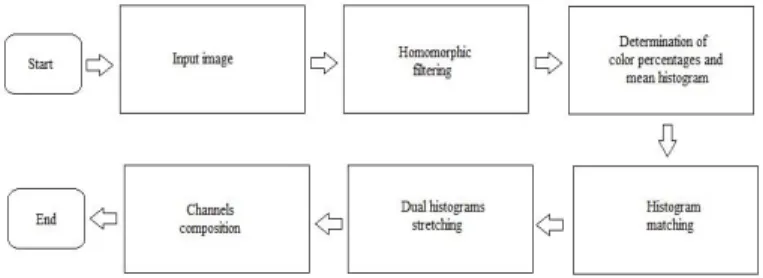
Figure 1 illustrates the proposed homomorphic filtering and mean histogram matching (HF-MHM) method. The proposed HF-MHM method consists of two main steps which are homomorphic filtering and mean-histogram matching. HF-MHM begins with applying the image with homomorphic filtering. The image in RGB color space is first decomposed into respective channels. Then, the color percentages of each color channel are determined by dividing the sum of the intensity value for each channel with the sum of intensity value for all channels. Based on the computed channel percentage, the intermediate color channel which lies between the maximum and minimum value is obtained. This intermediate color channel will be used as a reference channel, as the histogram of this color channel will be matched with the other two histograms of other color channels.
The color percentages and mean histogram of the image are determined. Based on mean histogram, image histograms are then applied with histogram matching, in where the other two color channels are matched with the mean histogram. After the histogram matching process, the image is applied with global contrast correction which applies dual histogram stretching to the image histograms. Finally, image channels are composed and an enhanced resultant image is produced. The detail of the process is explained in the following subsections.
Fig.1. Illustration of the proposed HF-MHM method
3.1 HOMOMORPHIC FILTERING
Homomorphic is designed to reduce the effect of non-uniform illumination. Images with the effects of under- and over-exposed normally have non-uniform illumination affection [16]. In illumination-reflectance model, illumination is regarded as low frequency signal. Thus, to remove the low frequency signal (illumination), the image is first converted into logarithm domain to separate the reflectance and illumination components. To this end, the image is first filtered by high-pass filter using Fast Fourier Transformation (FFT) before applying a Gaussian filter. Then, inverse FFT and inverse logarithm are applied on the image to obtain more uniform illuminated image Figure 2 shows the process steps of homomorphic filtering.
RESEARCH ARTICLE
3.2 DETERMINATION OF COLOR
PERCENTAGES AND MEAN HISTOGRAM
As a pre-processing for histogram matching, the color percentages and mean histogram of the image are determined. The image histograms are matched with the mean histogram between red, green, or blue. The reason of applying histogram matching with the mean histogram is to avoid the image from having the effect of dominant color channel which results the final output. Mean histogram is chosen to reduce the extreme effect of dominant color channel and increase the influence of inferior color channel. The following formula is used to calculate the color percentage. x refers to red, green, or blue color channel and IR(i,j), IG(i,j), and IB(i,j) refer to intensity value of
respective color channels.
𝐶𝑜𝑙𝑜𝑟 𝑝𝑒𝑟𝑐𝑒𝑛𝑡𝑎𝑔𝑒 = ∑ 𝐼𝑥(𝑖,𝑗)
∑ 𝐼𝑅(𝑖,𝑗)+∑ 𝐼𝐺(𝑖,𝑗)+∑ 𝐼𝐵(𝑖,𝑗) (1) Mean histogram is obtained by determination of the middle value (in ascending or descending order) between these color percentages (red, green, and blue).
3.3 HISTOGRAM MATCHING
Histogram matching refers to mapping one histogram (source histogram) in accordance with other histogram (reference histogram) [17][18]. Histogram matching is used to map the source histogram which is normally from low quality image towards the reference histogram which has better quality and is more appropriate to a required application. However, in this proposed method, the implementation of histogram matching is used to increase the percentage of inferior color channel and reduces the percentage of dominant color channel. As a result, the output histogram becomes more balance between all three channels. To match the histogram, the PDF and CDF of both source and target histograms are required [19]. Figure 3 illustrates the process of histogram matching.
𝑃𝐷𝐹(𝑖) =𝑛𝑖
𝑛 (0 ≤ 𝑖 ≤ 𝐿) (2)
where ni is defined as the number of pixels with intensity i,
divided by the total number of image pixels, n. [19].
𝐶𝐷𝐹(𝑖) = ∑𝐿−1𝑖=0𝑃𝐷𝐹(𝑖) (3)
3.4 DUAL-HISTOGRAM STRETCHING
As mentioned by Abdul Ghani and Mat Isa [19][20], dual-histogram stretching could improve low contrast image. Dual-histogram stretching divides a Dual-histogram into two regions at its mid-point. These upper and lower regions are then stretched individually to the entire dynamic range. The produced under- and over-enhanced images are then combined by means of mean values. The method has been proven to enhance the image contrast to a certain degree. As mentioned in [19], by dividing and stretching the histogram, the intensity values of the original histogram will be spread out to the higher intensity values.
Fig.3. The process of histogram matching [21]
Consequences, the low intensity values (i.e. dark areas) of the original image will be assigned to new values which are higher intensity value (i.e. brighter areas). Thus, the stretching effect could improve the contrast by increasing the intensity values of dark areas. The detailed explanation of this step could be obtained from [19][20]. Figure 4 shows original histogram divided into two separate histograms at its mid-point.
Fig.4. Original histogram is divided into two separate histograms at its mid-point [22]
4. RESULTS AND DISCUSSION
The resultant images are evaluated both qualitative and quantitatively. To evaluate the proposed method, the resultant images obtained are compared with those obtained by state-of-the-art methods namely histogram equalization (HE) [21][14][11][22], pixel distribution shifted color correction (PDSCC)[23], unsupervised color correction method (UCM)[24] and contrast limited adaptive histogram equalization (CLAHE)[25], on visual tracker benchmark database [26] and other images. In quantitative analysis, measurements used are peak signal to noise ratio (PSNR), measurement of enhancement by entropy (EMEE), entropy and natural image quality evaluator (NIQE) [19] [21] [27]. Entropy is a measure of image information content, which is interpreted as the average uncertainty of information source [28]. In an image, entropy is defined as corresponding states of intensity level which individual pixels can adopt. EMEE is an extension of EME. As mentioned in [29], for a certain circumstances, EME shows a characteristic of range dependent which changing itself based on the maximum and minimum range. This is thus not being ideal for measuring the image enhancement in all circumstances. Therefore, the measure of enhancement which is based on the concept of entropy is introduced. NIQE [30] is no-reference image quality assessment (NR-IQA) model that only makes use
RESEARCH ARTICLE
of measurable deviations from statistical regularities observed in natural image without training on human-rated distorted images.
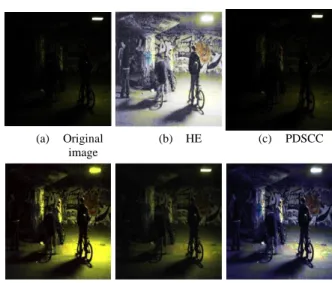
As shown in Figures 5 to 7, all original images are suffered from under-exposed problem where the images are seen dark. Generally, HE increases the image contrast excessively which results in producing of over-enhanced. The resultant images are too bright, causing the image details in some areas are reduced and not visible. PDSCC could not improve the image contrast significantly as the output images are almost identical to the original images. On the other hand, UCM improves the images better than PDSCC as the output images are seen clearer. However, the method intends to turn the image into yellow or brown illumination. In some cases, as in Figures 6 and 7, the improvement is very limited as parts of the images are still under-exposed. CLAHE improves image better in some cases as the visibility of the image is increased. Nevertheless, in some cases such as in Figure 6, the contrast improvement is limited as some parts of the image are still dark. The proposed HF-MHM method improves the image contrast and visibility as there are no over-enhanced areas or excessive induced color.
The resultant images are also compared through quantitative evaluation as presented in Table 1. The boldface values indicate the best value in the comparison.
(a) Original
image
(b) HE (c) PDSCC
(d) UCM (e) CLAHE (f)
HF-MHM Fig.5. Image car. (a) Original image and the rest are the resultant images of the following methods: (b) HE, (c) PDSCC, (d) UCM, (e) CLAHE, (f)
HF-MHM
(a) Original
image
(b) HE (c) PDSCC
(d) UCM (e) CLAHE (f)
HF-MHM Fig.6. Image room. (a) Original image and the rest are the resultant images of the following methods: (b) HE, (c) PDSCC, (d) UCM, (e)
CLAHE, (f) HF-MHM
(a) Original
image
(b) HE (c) PDSCC
(d) UCM (e) CLAHE (f)
HF-MHM Fig.7. Image people. (a) Original image and the rest are the resultant
images of the following methods: (b) HE, (c) PDSCC, (d) UCM, (e) CLAHE, (f) HF-MHM
5. CONCLUSION
In this paper, Homomorphic Filtering with Mean-Histogram Matching (HF-MHM) method has been proposed to enhance images contrast. It implements homomorphic filtering and histogram modification techniques to improve image contrast and produces more visible objects in the image. Homomorphic filtering is integrated in the proposed method to reduce the effect of non-uniform illumination, while histogram modification contributes toward the improvement of image contrast and visibility. Qualitative and quantitative results show that the proposed HF-MHM outperforms state-of-the-art methods in terms of contrast and visibility.
Table 1. Quantitative evaluation of sample images in Figs. 5 to
7.
Image Method PSNR Entropy NIQE EMEE
car Original - 6.961 2.725 1.129 HE 12.01 5.976 2.651 2.238 PDSCC 45.27 6.983 2.776 1.139 UCM 19.41 7.068 2.648 5.837 CLAHE 17.90 7.581 1.775 5.246 HF-MHM 19.87 7.575 1.829 13.007 room Original - 5.361 6.295 5.642 HE 6.22 5.540 3.973 5.798 PDSCC 49.90 5.376 6.005 5.864 UCM 29.11 5.603 5.462 6.926 CLAHE 18.16 6.522 4.352 7.212 HF-MHM 18.12 6.501 4.209 8.525 people Original - 3.901 4.236 2.547 HE 5.22 4.446 6.173 3.475 PDSCC 50.95 3.699 4.440 1.630 UCM 13.01 5.084 4.972 1.387 CLAHE 21.72 4.604 4.479 4.512 HF-MHM 11.76 6.513 4.467 10.427
ACKNOWLEDGMENTS:
This research has been fully supported by the Malaysia Ministry of Science, Innovation and Technology (MOSTI) eScience Fund (No. 305/PELECT/613147).
REFERENCES
[1] Jamal Hussain Shah, Muhammad Sharif, Mudassar Raza, and Marryam Murtaza. Robust Face Recognition Technique under
RESEARCH ARTICLE
Varying Illumination. Journal of Applied Research and Technology, 13(1):97-105, 2015.
[2] Kaiqi Huang, Liangsheng Wang, Tieniu Tan, and Steve Maybank. A Real-Time Object Detecting and Tracking System for Outdoor Night Surveillance. Pattern Recognition, 41(1):432-444, 2008. [3] M. Archana and M. Kalaisevi Geetha. Object Detection and
Tracking based on Trajectory in Broadcast Tennis Video. Procedia Computer Science, 58:225-232, 2015.
[4] Gregor Klancar, Matej Kristan, and Rihard Karba. Wide-Angle Camera Distortions and Non-Uniform Illumination in Mobile Robot Tracking. Robotics and Autonomous Systems, 46(2):125-133, 2004.
[5] Victor H. Diaz-Ramirez, Kenia Picos, and VitalyKober. Target Tracking in Non Uniform Illumination Conditions using Locally Adaptive Correlation Filters. Optics Communications, 323:32-43, 2014.
[6] Vasileios Karavasilis, Christophoros Nikou, and Aristidis Likas. Visual Tracking using the Earth Mover's Distance between Gaussian Mixtures and Kalman Filtering. Image and Vision Computing, 29(5):295-305, 2011.
[7] Xiaoyan Qian, Lei Han, and Yuyu Cheng. An Object Tracking Method Based on Local Matting for Night Fusion Image. Infrared Physics & Technology, 67:455-461, 2014.
[8] Jun Wang, Hanzi Wang, and Yan Yan. Robust Visual Tracking by Metric Learning with weighted Histogram Representations. Neurocomputing, 153:77-88, 2015.
[9] Cristobal Undurraga and Domingo Mery. Improving Tracking Algorithms using Saliency. Lecture Notes in Computer Science (including subseries Lecture Notes in ArtificialIntelligence and Lecture Notes in Bioinformatics), 7042 LNCS: 141-148, 2011. [10] Pedro Cortez Cargill, Cristobal UndurragaRius, Domingo Mery
Quiroz, and AlvaroSoto. Performance Evaluation of the Covariance Descriptor for Target Detection. Proceedings - International Conference of the Chilean Computer Science Society, SCCC,pages 133-141, 2010.
[11] Kuldeep Singh, Rajiv Kapoor, and Sanjeev Kr. Sinha. Enhancement of Low Exposure Images via Recursive Histogram Equalization Algorithms. Optik - International Journalfor Light and Electron Optics, pages 1-7, 2015.
[12] Renaud Morin, Adrian Basarab, Stephanie Bidon, and Denis Kouame. Motion Estimation-Based Image Enhancement in Ultrasound Imaging. Ultrasonics, 60:19-26, July 2015.
[13] Zhigang Zhou, Lihong Chen, and Xinrong Hu. Color Images Enhancement for Edge information Protection based on Second Order Taylor Series Expansion Approximation. Optik - International Journal for Light and Electron Optics, 126(3):368-372, 2015.
[14] K. Santhi and R.S.D. WahidaBanu. Adaptive Contrast Enhancement using Modified Histogram Equalization. Optik - International Journal for Light and Electron Optics, 2015. [15] LikunHou, Hui Ji, and Zuowei Shen. Recovering
Over-/Underexposed Regions in Photographs. SIAM Journal on Imaging Sciences, 6(4):2213-2235, 2013.
[16] Hossein Shahamat and Ali a. Pouyan. Face Recognition under Large Illumination Variations using Homomorphic Filtering in Spatial Domain. Journal of Visual Communicationand Image Representation, 25(5):970-977, 2014.
[17] Dori Shapira, Shai Avidan, and Yacov Hel-Or. Multiple Histogram Matching. ImageProcessing (ICIP), 2013 20th IEEE International Conference on, pages 2269-2273, 2013.
[18] Histogram match. (2009, April 29). Retrieved from http://www.silent9.com/blog/archives/162-Gimp-Script Histogram-Match.html.
[19] Ahmad Shahrizan Abdul Ghani and Nor Ashidi Mat Isa. Underwater Image Quality Enhancement through Rayleigh-Stretching and Averaging Image Planes. Int. J. Nav.Archit. Ocean Eng., 27:219-230, 2014.
[20] Ahmad Shahrizan Abdul Ghani and Nor Ashidi Mat Isa. Underwater Image Quality Enhancement through Integrated Color Model with Rayleigh Distribution. Applied Soft Computing, 27:219-230, 2015.
[21] S. Anand and S. Gayathri. Mammogram Image Enhancement by Two-Stage Adaptivehistogram Equalization. Optik - International Journal for Light and Electron Optics, 2015.
[22] Jing Rui Tang and Nor Ashidi Mat Isa. Adaptive Image Enhancement based on Bi-Histogram Equalization with a Clipping Limit. Computers and Electrical Engineering,40(8):86-103, 2014.
[23] Mohd Jain Noordin Mohd Naim and Nor Ashidi Mat Isa. Pixel Distribution Shiftingcolor Correction for Digital Color Images. Applied Soft Computing Journal, 12(9):2948-2962, 2012. [24] Kashif Iqbal, Michael Odetayo, Anne James, Rosalina Abdul
Salam, and Abdullah ZawawiHjTalib. Enhancing the Low Quality Images using Unsupervised Colour Correction Method. Conference Proceedings - IEEE International Conference on Systems, Manand Cybernetics, pages 1703-1709, 2010.
[25] Byong Seok Min, Dong Kyun Lim, Seung Jong Kim, and Joo Heung Lee. A Novel Method of Determining Parameters of Clahe based on Image Entropy. International Journal of Software Engineering and its Applications, 7(5):113-120, 2013.t tracking [26] Visual Tracker Benchmark. Retrieved from:
http://cvlab.hanyang.ac.kr.
[27] Alexander Tanchenko. Visual-PSNR measure of image quality. Journal of Visual Communication and Image Representation, 25(5):874-878, 2014.
[28] Ye, Z. 2009. Objective Assessment of Nonlinear Segmentation Approaches to Gray Level Underwater Images. International Journal on graphics, Vision, and Image Processing (GVIP), Vol. 9, Issue (II), pp. 39-46.
[29] Agaian, S. S., Silver, B., Panetta, K. A. 2007. Transform coefficient histogram-based image enhancement algorithms using contrast entropy. IEEE Transaction on Image Processing, March 2007, 16(3), pp. 741-758.
[30] Mittal, A., Soundararajan, R. and Bovik, A. C. 2012. NIQE Software Release. Retrieved from: