Probabilistic Sequence Models for Image Sequence
Processing and Recognition
Von der Fakultät für
Mathematik, Informatik und Naturwissenschaften der
RWTH A
ACHENU
NIVERSITYzur Erlangung des akademischen Grades eines
Doktors der Naturwissenschaften
genehmigte Dissertation
vorgelegt von
Dipl.-Inform. Philippe Dreuw
aus Eupen, Belgien
Berichter: Univ.-Prof. Dr.-Ing. Hermann Ney Univ.-Prof. Dr.-Ing. Gerhard Rigoll
Tag der mündlichen Prüfung: 27. April 2012
Dipl.-Inform. Philippe Dreuw
Human Language Technology and Pattern Recognition Group RWTH Aachen University
Erklärung
Hiermit versichere ich, dass ich die vorliegende Doktorarbeit selbstständig verfasst und keine anderen als die angegebenen Hilfsmittel verwendet habe. Alle Textauszüge und Grafiken, die sinngemäß oder wörtlich aus veröffentlichten Schriften entnommen wurden, sind durch Refe-renzen gekennzeichnet.
Aachen, im Frühling 2012
Abstract
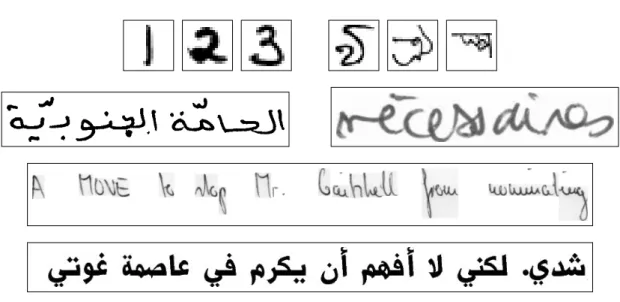
This PhD thesis investigates the image sequence labeling problems optical character recognition (OCR), object tracking, and automatic sign language recognition (ASLR). To address these problems we investigate which concepts and ideas can be adopted from speech recognition to these problems. For each of these tasks we propose an approach that is centered around the approaches known from speech recognition and adapted to the problem at hand. In particular, we describe our hidden Markov model (HMM) based image sequence recognition system which has been adopted from a large vocabulary continuous speech recognition (LVCSR) framework and extended for tasks.
For OCR, we present our RWTH Aachen University Optical Character Recognition (RWTH OCR) system, which has been developed within the scope of this thesis work. We analyze simple appearance-based features in combination with complex training algorithms. Detailed discussions about discriminative features, discriminative training, and a novel discriminative confidence-based unsupervised adaption approach are presented.
In automatic sign language recognition (ASLR), we adapt the RWTH Aachen University Speech Recognition (RWTH ASR) framework to account for multiple modalities important in sign language communication, e.g. hand configuration, place of articulation, hand movement, and hand orientation. Additionally, non-manual components like facial expression and body posture are analyzed.
Most sign language relevant features require a robust tracking method. We propose a multi purpose model-free object tracking framework which is based on dynamic programming (DP), and which is applied to hand and head tracking tasks in automatic sign language recognition (ASLR). In particular, a context-dependent tracking decision optimization over time allows to robustly track occluded objects. The algorithm is inspired by the time alignment algorithm in speech recognition, which guarantees to find the optimal path w.r.t. a given criterion and prevents taking possibly wrong local decisions.
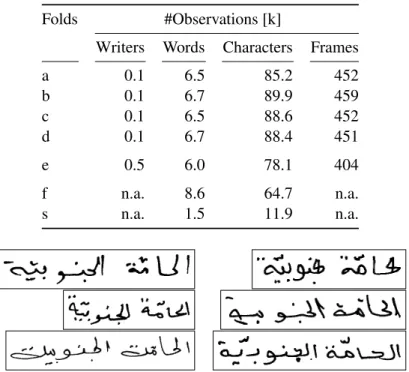
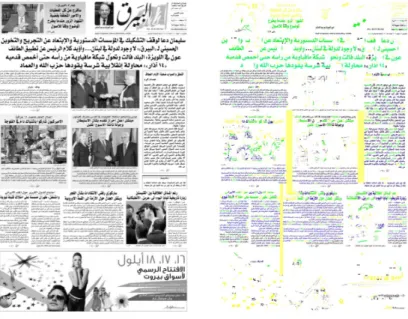
All results in this work are either evaluated on standard benchmark databases, or on novel publicly available databases generated within the scope of this thesis work. Our optical charac-ter recognition (OCR) system is evaluated on various handwritten benchmark databases and for multiple languages. Additionally, a novel Arabic machine printed newspaper database is pre-sented and used for evaluation. Our dynamic programming tracking (DPT) framework and its different algorithms are evaluated for head and hand tracking in sign languages on more than 120,000 frames of annotated ground-truth data. The ASLR system is evaluated for multiple sign languages, such as American Sign Language (ASL), Deutsche Gebärdensprache (DGS), and Nederlandse Gebaren Taal (NGT), on databases of different visual complexity. In all cases highly competitive results can be achieved, partly outperforming all other approaches known from literature.
Zusammenfassung
Diese Arbeit untersucht Verfahren zur Erkennung handgeschriebener und maschinengedruck-ter Texte, zum Verfolgen von sich bewegenden Objekten in Bildsequenzen, als auch zur au-tomatischen Erkennung von kontinuierlicher Gebärdensprache. Um die entsprechenden Prob-leme zu bearbeiten, untersucht diese Arbeit, welche Konzepte und Ideen aus der automatischen Spracherkennung übernommen und auf Problemstellungen in der Bildsequenzverarbeitung an-gewendet werden können. Insbesondere wird ein hidden Markov model (HMM) basiertes Sys-tem zur Bildsequenzerkennung beschrieben, das auf einem SysSys-tem zur Erkennung natürlich gesprochener Sprache auf großem Vokabular basiert.
Im Bereich der hand- und maschinengeschriebenen Texterkennung wird das RWTH OCR System präsentiert, das im Rahmen dieser Arbeit neu entwickelt wurde. Es werden einfache erscheinungsbasierte Bildmerkmale in Kombination mit komplexeren Trainingsalgorithmen analysiert. Detaillierte Diskussionen bezüglich diskriminativer Merkmale, diskriminativem Training, als auch bezüglich einem neuen konfidenzbasierten diskriminativen Verfahren zur unüberwachten Modellanpassung werden präsentiert.
Ferner erweitern wir das Spracherkennungssystem, um damit kontinuierliche Gebärdenspra-che zu erkennen. Hierzu bedarf es zusätzliGebärdenspra-cher Erweiterungen, die es ermögliGebärdenspra-chen, wichtige Handmerkmale wie Stellung, Bewegung, Ausführungsort, sowie Erscheinungsbild zu model-lieren, als auch nicht-manuelle Merkmale, wie Gesichtsausdruck, zu berücksichtigen, da diese elementar in allen betrachteten Gebärdensprachen sind.
Zu diesem Zweck präsentieren wir ein vielseitig einsetzbares und modellfreies Verfahren zur Verfolgung von Objekten. Der Algorithmus basiert auf dem Verfahren der dynamischen Pro-grammierung und wird in dieser Arbeit zum Kopf und Hand Verfolgen im Bereich der automa-tischen Erkennung von Gebärden eingesetzt. Insbesondere ermöglicht eine kontextabhängige Optimierung über Bildsequenzen hinweg das robuste Verfolgen von teilweise verdeckten Ob-jekten.
Alle in dieser Arbeit vorgestellten Verfahren werden entweder anhand von Standarddaten-banken evaluiert, oder auf im Rahmen dieser Arbeit neu erstellen und frei verfügbaren Daten-banken. Unser optical character recognition (OCR) System wird auf zahlreichen handgeschrie-benen Texten in verschiedenen Sprachen evaluiert. Zusätzlich wurde eine neue Datenbank mit maschinengedruckten arabischen Texten erstellt. Die Methoden zur Objektverfolgung werden auf mehr als 120.000 handannotierten Bildern evaluiert, das Gebärdenspracherkennungssys-tem wird ebenfalls auf mehreren Datenbanken in unterschiedlichen Sprachen evaluiert. In allen Fällen werden sehr gute Ergebnisse erzielt, die teilweise besser sind, als die bisher in der Liter-atur bekannter Verfahren.
Acknowledgment
Yeeeehaa, here comes my PhD thesis! In case you are reading this thesis because I’m a famous politician you can skip the next six chapters.
First, I would like to thank Prof. Dr.-Ing. Hermann Ney for the interesting possibilities at the Chair of Computer Science 6 of the RWTH Aachen University of Technology where I have been a research assistant since April 2005.
I would like to thank my former colleagues and office mates Thomas Deselaers (served also as a conference dive-buddy) and Georg Heigold, which allowed me to develop great ideas and with whom I had a lot of fun.
Furthermore, I would like to thank my new office colleagues Jens Forster and Yannick Gweth, with whom I had many interesting discussions about sign language, software, music, and differ-ences between Germany and Africa, as well as Daniel Stein, Tobias Gass, Christoph Schmidt, and Mahdi Hamdani.
Special thanks also go to my colleagues and friends Oliver Bender, Saša Hasan, Christian Gollan, Björn Hoffmeister, David Rybach, Stephan Hahn, Arne Mauser, Christian Plahl, Si-mon Wiesler, Carmen Heger, Morteza Zahedi, and all the guys from the Kaffee-Sofa. Further-more, all the people with whom I collaborated in the SignSpeak project, especially Gregorio Martínez for teaching me "la conga", and my Belgian fellows Alexander Zimmermann (LATEX)
and Philippe Cerfontaine.
I would like to thank my students and student workers who worked under my supervision, and which have contributed to this work: David Rybach, Jens Forster, Stephan Jonas, Pascal Steingrube, Harald Hanselmann (2x), Patrick Röder, Christian Oberdörfer, Leonid Pishchulin, Robert Pyttel, Patrick Doetsch, and Hendrik Pesch.
From the bottom of my heart I would like to thank my parents for supporting me during my studies and giving me this unique chance - and they should have a look at Figure 1.
Finally, I would like to thank my wife Susanne for"Schluss jetzt, schlafen!"and my son Nico for being there and any sort of distraction ... and many many more.
This work was partly realized as part of the Quaero Programme, funded by OSEO, French State agency for innovation, this work received funding from the European Community’s Sev-enth Framework Programme under grant agreement number 231424 (FP7-ICT-2007-3), and this work was partly realized as part of the Google Research Award “Robust Recognition of Machine Printed Text”.
Outline
1 Introduction 1
2 Scientific Goals 3
3 Related Work 7
3.1 Hidden Markov Model based Image Text Recognition . . . 7
3.2 Object Tracking in Image Sequences . . . 10
3.3 Sign Language Recognition . . . 11
4 Optical Character Recognition 15 4.1 HMM-Based Image Text Recognition . . . 15
4.1.1 Feature Extraction . . . 15
4.1.2 Visual Modeling . . . 16
4.1.3 Lexica and Language Models . . . 18
4.1.4 Decoding . . . 20
4.2 Feature Extraction Architecture . . . 20
4.2.1 Preprocessing . . . 20 4.2.2 Image Features . . . 21 4.2.2.1 Appearance-Based . . . 21 4.2.2.2 Sobel . . . 21 4.2.2.3 Geometric Features . . . 21 4.2.2.4 Local Features . . . 21 4.2.3 MLP Features . . . 23
4.2.4 Spatio-Temporal Context Windowing . . . 23
4.3 Training Architecture . . . 24
4.3.1 Gaussian HMMs . . . 25
4.3.2 Glyph Dependent Length Estimation . . . 25
4.3.3 Writing Variant Modeling . . . 28
4.3.4 Discriminative Training . . . 30
4.3.4.1 Margin-Based Maximum Mutual Information (M-MMI) . . . 32
4.3.4.2 Margin-Based Minimum Phone Error (M-MPE) . . . 33
4.3.4.3 Optimization . . . 33
4.3.4.4 Incorporation of Confidence Weights . . . 34
4.3.5 Writer Adaptive Training . . . 35
4.4 Decoding Architecture . . . 36
4.4.1 Multi-Pass Decoding . . . 36
4.4.1.1 Writer Adaptation . . . 36
4.4.1.2 Discriminative Model Adaptation . . . 37
4.4.2 Hybrid Decoding . . . 38
4.5 Databases for Optical Character Recognition . . . 39
4.5.1 Isolated Characters . . . 39 4.5.1.1 USPS . . . 40 4.5.2 Isolated Words . . . 40 4.5.2.1 IfN/ENIT . . . 40 4.5.2.2 RIMES . . . 40 4.5.3 Continuous Sentences . . . 41 4.5.3.1 IAM . . . 42
4.5.3.2 The RWTH Arabic Machine-Print Newspaper Corpus . . . . 43
4.6 Experimental Results . . . 46 4.6.1 Isolated Characters . . . 47 4.6.1.1 Latin Digits . . . 47 4.6.2 Isolated Words . . . 47 4.6.2.1 Arabic Handwriting . . . 47 4.6.2.2 French Handwriting . . . 62 4.6.3 Continuous Sentences . . . 65 4.6.3.1 English Handwriting . . . 65
4.6.3.2 Machine-Printed Arabic Text Recognition . . . 71
4.7 Conclusions . . . 75
4.7.1 Outlook . . . 77
5 Tracking 79 5.1 Dynamic-Programming Based Tracking . . . 80
5.1.1 Overview and Optimization Problem . . . 80
5.1.2 Local Relevance Scoring . . . 82
5.1.3 Feature Combinations for Complex Objects . . . 83
5.1.4 Dynamic Programming Based Search of the Optimal Tracking Path . . 83
5.1.4.1 Step 1: Accumulation of Scores . . . 84
5.1.4.2 Step 2: Tracing Back the Optimal Path . . . 84
5.2 Scoring Functions for Visual Object Tracking . . . 84
5.2.1 Motion-Based Scoring Functions . . . 85
5.2.2 Saliency-Based Scoring Functions . . . 86
5.2.3 Optical-Flow Scoring Functions . . . 87
5.2.4 Object-Flow Scoring Functions . . . 87
5.2.5 Eigenfaces and Skin Color Scoring Functions . . . 89
5.2.6 Stereo-Based Scoring Functions . . . 90
5.3 Extensions and Practical Aspects . . . 93
Outline
5.3.2 Early Tracebacks . . . 94
5.3.3 Tracking Window Size Optimization . . . 94
5.3.4 Local Features, Object Models, and Robust Distance Functions . . . . 95
5.3.5 Spatial Pruning and Distance Scoring . . . 96
5.4 Databases . . . 97
5.4.1 Corpus-NGT Database . . . 97
5.4.2 Boston Corpora . . . 98
5.4.3 Phoenix Weather Forecast Corpora . . . 99
5.4.4 The ATIS Irish Sign Language Corpus . . . 99
5.4.5 SIGNUM Corpus . . . 100
5.4.6 OXFORD Corpus . . . 100
5.5 Experimental Results . . . 100
5.5.1 Tracking Error Rate . . . 100
5.5.2 Hand Tracking . . . 101
5.5.3 Head Tracking . . . 104
5.6 Conclusions . . . 109
5.6.1 Outlook . . . 110
6 Gesture and Sign Language Recognition 111 6.1 Introduction . . . 113
6.2 Overview . . . 115
6.2.1 Preprocessing . . . 115
6.2.1.1 Visual Speaker Alignment . . . 116
6.2.1.2 Virtual Training Data . . . 117
6.2.2 Feature Extraction and Combination . . . 118
6.2.2.1 Manual Features . . . 118
6.2.2.2 Non-Manual Features . . . 119
6.2.2.3 Windowing . . . 121
6.2.3 Visual Modeling . . . 122
6.2.4 Lexica and Language Models . . . 122
6.2.5 Decoding . . . 123
6.3 Training Architecture . . . 123
6.4 Decoding Architecture . . . 124
6.4.1 Model-Based Tracking Path Adaptation . . . 124
6.4.1.1 Integrated Tracking and Recognition . . . 124
6.4.1.2 Rescoring and Path Adaptation . . . 126
6.4.2 Multi-Pass Decoding . . . 127
6.5 Databases . . . 128
6.5.1 Isolated Sign Language Words . . . 128
6.5.1.1 RWTH-BOSTON-50 . . . 128
6.5.1.2 Corpus NGT . . . 128
6.5.2 Continuous Sign Language Sentences . . . 129
6.5.2.2 SIGNUM . . . 130
6.6 Experimental Results . . . 130
6.6.1 Isolated Signs and Gestures . . . 131
6.6.2 Continuous Sign Language Sentences . . . 131
6.6.2.1 Feature Combinations and Reductions . . . 131
6.6.2.2 Signer Adaptive Training (SAT) . . . 134
6.6.2.3 Tracking-Based Features . . . 135
6.6.2.4 Model-Based Tracking Path Distortion . . . 136
6.6.2.5 Discriminative Features and Models . . . 137
6.7 Conclusions . . . 138
6.7.1 Outlook . . . 139
7 Conclusions 143 7.1 Optical Character Recognition . . . 143
7.2 Object Tracking . . . 144
7.3 Automatic Sign Language Recognition . . . 144
7.4 Outlook . . . 145
8 Scientific Contributions 147 A Software Documentation 149 A.1 RWTH-OCR . . . 149
A.2 DP Tracking for Vidzoom . . . 149
A.3 SURF-Face . . . 150 A.4 W2D . . . 150 List of Figures 151 List of Tables 153 Glossary 155 Bibliography 159
Chapter 1
Introduction
In this work, we describe our hidden Markov model (HMM) based image sequence recogni-tion system which has been adopted from a large vocabulary continuous speech recognirecogni-tion (LVCSR) framework and extended for optical character recognition (OCR) tasks, object track-ing, and automatic sign language recognition (ASLR) tasks.
Hidden Markov model (HMM) based approaches are probably the method of choice if con-tinuous symbol streams, such as character strings, gesture sequences, or signed words have to be recognized. Such symbols and their corresponding appearance typically vary over time and are realized within an important spatio-temporal context:
• In handwritten texts, the appearance of characters depends on the position within a word, the appearance of its neighboring characters, and the writer’s handwriting style.
• In tracking applications, the appearance of an object to be tracked can change over time and can be temporarily occluded.
• In continuous sign language recognition, we have to deal with dialects and strong coartic-ulation effects, i.e. the appearance of a sign depends on preceding and succeeding signs, resulting in large inter- and intra-personal variability.
Many approaches try to cope with these modalities by normalizing the input images or ex-tracting features being robust against such variations. In OCR, after a previous physical layout analysis has been performed, combinations of artificial neural networks (ANNs) or HMMs based approaches can be considered as the state-of-the-art for handwriting recognition sys-tems [Bertolami & Bunke 08b,Dreuw & Rybach+09,Fink & Plötz 06,Natarajan 09]. In action recognition, bag of visual words (BOVW) models or support vector machines (SVMs) in com-bination with an interest point (IP) based local feature (LF) extraction are often used [Laptev & Marszalek+ 08], whereas in gesture or sign language recognition tasks mainly Markov chain based systems have been used [Braffort 96,Bowden & Windridge+ 04,Dreuw & Stein+ 08,Yang & Sclaroff+ 09]. Most state-of-the-art HMM based image sequence recognition sys-tems for OCR and gesture or sign language recognition have in common that they are trained using the maximum likelihood (ML) criterion.
We propose to adapt a large vocabulary continuous speech recognition (LVCSR) framework to account for all these modalities within a common framework. One fundamental principle of this work is to avoid error prone early and local decisions. Instead, dense features, dis-criminative features in combination with disdis-criminative training, and late fusions with external
knowledge sources such as language models (LMs) or feature rescoring during decoding are investigated in this work.
All investigations have been realized within a unique large vocabulary continuous speech recognition (LVCSR) framework and applied to several application scenarios:
• OCR, in particular handwritten text recognition (also known as intelligent character recognition (ICR) and intelligent word recognition (IWR)), and machine-printed text recognition,
• model-free object tracking, in particular head and hand tracking for feature extraction in gesture and sign language recognition,
• continuous gesture and sign language recognition,
• and partly face recognition tasks.
A main question of this work is: What can we adopt from automatic speech recognition (ASR) for computer vision (CV), e.g. image sequence recognition problems, and vice-versa? Novel in this work are among others the comparison of robust and dense features across multi-ple application scenarios, the comparison of generatively and discriminatively trained HMMs, a confidence-based discriminative training approach for unsupervised model adaptation, and a comparison of neural network based hybrid and tandem based HMM approaches. Furthermore, a general purpose dynamic programming tracking (DPT) framework is presented and evaluated on various sign language recognition tasks. For this purpose, large benchmark databases have been created which allow for an evaluation within a unique feature extraction and recognition framework.
Experimental results are provided for OCR, object tracking, and sign language recognition on standardized benchmark sets and evaluation metrics. Various databases have been used for handwriting recognition tasks, such as the Arabic IfN/ENIT database, the French RIMES, or the English IAM databases. For tracking evaluation, more than 120,000 image have been ground-truth labeled.
Structure of This Document
This work is organized as follows: Chapter 2 briefly summarizes the goals and fundamentals of this work. In Chapter 3 the state-of-the-art related to the three main research areas of this thesis work, optical character recognition (OCR), dynamic programming tracking (DPT), and automatic sign language recognition (ASLR), is presented. Next, the three main parts of this work are described: optical character recognition (cf. Chapter 4), appearance-based tracking (cf. Chapter 5), and automatic sign language recognition (cf. Chapter 6). Finally, Chapter 7 gives a short summary and conclusion of the entire work, while Chapter 8 summarizes the scientific contributions of this work.
Chapter 2
Scientific Goals
In this chapter, we summarize the goals, the underlying principles, and the main contributions of this work.
Goals
The main goals which were set up at the beginning of this work and which were adjusted during the process of this work are:
• extend and adapt a large vocabulary speech recognition system towards an image se-quence recognition system which can be used for OCR, images, gestures, and signed languages
• analyze and improve the individual components of an image sequence recognition system in order to create the best possible system, in particular the effect of using different image descriptors, sequence modeling, and training criterions
• which concepts can be adopted from automatic speech recognition (ASR) to computer vision (CV) problems, especially to image sequences?
• are the observed effects comparable to those observed in ASR?
• what is the relationship between the targeted CV fields OCR, images, and gestures - do they behave similarly?
• novel theoretical approaches and extensions in general for OCR, image, and gesture recognition problems
This work provides answers to the above mentioned questions by analyzing the transferabil-ity and robustness of ASR approaches for image sequence processing in three different domains: optical character recognition (cf. Chapter 4), face- and hand-tracking (cf. Chapter 5), and ges-ture and sign language recognition (cf. Chapter 6).
All extensions and evaluations have been made by the usage of a single framework. In par-ticular, an HMM based large vocabulary continuous speech recognition (LVCSR) framework has been extended and adapted to process image and video sequences. Due to the nature of the chosen framework and databases, it can be assumed that most results can be transferred back
to ASR domain. Similar usage of features, lexica, and language models on smaller corpora allow for a more detailed analysis of algorithms and parameters known to be successful in ASR domains.
The proposed comparisons between ASR and CV approaches have not yet been investigated in this form. The following topics will be analyzed and described in detail in the work.
Visual Modeling
The visual modeling of image sequences consists of several steps, as the visual realisation of an individual observation is highly dependent on the individual creator (e.g. signer or writer) and the environment. The recognition systems must be able to handle such time-varying contextual effects. For the recognition of image and video sequences, the HMM based state-of-the-art RWTH ASR system of the RWTH Aachen University (RWTH) has been significantly extended during this work, by e.g. new image-based distance measures and visual inspection tools allow-ing for a detailed analysis of temporal image alignments.
Multi-modal Visual Feature Extraction and Analysis
Succeeding feature vectors are commonly concatenated in ASR before the linear discriminant analysis (LDA) transformation is applied to account for temporal dependencies. An analysis of spatio-temporal feature context, different feature extraction, reduction and combination tech-niques to model spatio-temporal effects are presented for OCR (cf. Chapter 4) and ASLR (cf. Chapter 6).
Multi-layer perceptron (MLP) based features for hybrid or tandem based HMM approaches, which combine the advantages of large and non-linear context modeling via neural networks while profiting from the Markovian sequence modeling, are analyzed. Additionally, we com-bine discriminative Gaussian HMMs (GHMMs) training using MLP based discriminative fea-tures.
Comparison of Training Criteria
Most current approaches for optical character recognition (OCR) or automatic sign language recognition (ASLR) are maximum likelihood (ML) trained HMM systems, but state-of-the-art speech recognition systems are based on discriminative GHMMs. Typical discriminative train-ing criteria for strtrain-ing recognition like for example minimum phone error (MPE) and maximum mutual information (MMI) in ASR are based on a (regularized) loss function. In contrast, large margin classifiers - the de-facto standard in machine learning - maximize the separation margin. An additional loss term penalizes misclassified samples. This work analyzes and compares the performance of MPE and MMI training criteria and margin-modified versions in image recognition problems.
In order to adapt visual models to e.g. speaker styles, speaker adaptive training (SAT), unsu-pervised clustering, or additional speaker specific data is used. This work proposes a confidence-based discriminative training approach confidence-based on the MPE and MMI criteria in order to adapt
models in an unsupervised manner to different handwriting styles in OCR or signer dialects in ASLR.
Tracking
Under realistic-world circumstances, the performance of many current tracking approaches decreases dramatically as it heavily depends upon possibly wrong local decisions if no model or online-learning is involved during tracking. To tackle these problems we avoid preliminary decisions and propose to use the same techniques that are successfully applied in ASR for nonlinear time alignment to implement a novel dynamic programming (DP) based tracking algorithm. We focus on hand and face-tracking for gesture and sign language recognition and provide an analysis of various appearance-based and model-based scoring functions.
Underlying Principles
These goals were planned within the context of the following principles, which are the fun-dament to most of the works at the Human Language Technology and Pattern Recognition (HLTPR) Group at RWTH Aachen University (RWTH):
• Decisions in a classification system are made according to the Bayes’ decision rule
• Avoid early and local decisions, such as segmentation of the image object, wherever possible.
• Use the appearance-based approach and use features directly derived from the pixel in-tensities of the images.
• Learn from the experience gained in ASR and machine translation (MT), in particular regarding modeling and training.
Chapter 3
Related Work
This chapter describes the current state-of-the-art and works which are related to the three main research areas of this thesis work, optical character recognition, tracking, and sign language recognition. These different tasks are interpreted in this work as image sequence recognition problems and tackled by adopting concepts from ASR and evaluated mainly by HMM based approaches.
3.1 Hidden Markov Model based Image Text Recognition
From a system point of view, many approaches for Arabic handwriting recognition [Abed & Märgner 10] in the past were HMM based systems using the Hidden Markov Model Toolkit (HTK) [Young & Evermann+ 06]. BBN’s Glyph HMM system “Byblos” [Lu & Bazzi+ 98,
Natarajan & Saleem+ 08,Prasad & Saleem+ 08], has been extended to “PLATO” [Natarajan 09] within the MADCAT [Olive 07] project, and is used for handwriting and machine-printed OCR tasks. SIEMENS showed in [Schambach & Rottland+ 08] how to convert a Latin OCR system to Arabic handwritings. Other projects like OCRopus1 or Tesseract2 currently do not support the recognition of Arabic scripts, and apparently only a few commercial applications like Readiris3and NovoDynamics VERUS4can support those cursive scripts.
Many commercial machine-printed OCR products or systems described in the published literature developed their recognition algorithms on isolated characters [Lu 95]. These systems usually assumed that characters can be segmented accurately as a first step, and made hard decisions at each stage which resulted in an accumulation of errors. Thus broken and touching characters were responsible for the majority of errors. Obviously, those assumptions are too strong for degraded or handwritten documents, or font-free approaches [Kae & Learned-Miller 09].
Such approaches were surpassed by late-decision systems, e.g. tools developed by the speech recognition community, such as HMMs. In these systems, multiple hypotheses about both segmentations and identities are maintained, and the final decisions are made at the end of an observation sequence by tracing back the local decisions which led to the best global hypothesis
1http://code.google.com/p/ocropus/ 2http://code.google.com/p/tesseract-ocr/ 3http://www.irislink.com/readiris/ 4http://www.novodynamics.com/
[Jacobs & Simard+ 05]. In [Prasad & Saleem+ 08,Natarajan & Saleem+ 08], a framework which is able to recognize Arabic handwritten and machine printed text is presented.
In the past, many interesting works related to isolated digit or character recognition [Simard & LeCun+ 98,Nopsuwanchai & Povey 03,Keysers & Deselaers+ 07] have been presented, where HMM based approaches [Lu & Bazzi+ 98,Bazzi & Schwartz+ 99,Juan & Toselli+ 01,Schambach & Rottland+ 08,Bertolami & Bunke 08a,Espana-Boquera & Castro-Bleda+ 11] have been especially successful in recognizing continuous handwriting, also known as in-telligent character recognition (ICR) and inin-telligent word recognition (IWR).
HMM based approaches for offline and online handwriting recognition have been mostly presented for Arabic [Lorigo & Govindaraju 06,Natarajan & Saleem+08,Abed & Märgner 10,
Dreuw & Heigold+11], English [Marti & Bunke 02,Bertolami & Bunke 08a,Espana-Boquera & Castro-Bleda+ 11], and French [Grosicki & Abed 09], which also led to successful hand-writing competitions at International Conference on Document Analysis and Recognition (IC-DAR) and International Conference on Frontiers in Handwriting Recognition (ICFHR) confer-ences. Other works e.g. focus on the recognition of white-board notes [Schenk & Schwärzler+ 08,Geiger & Schenk+ 10]. [Plötz & Fink 09] provides a survey of HMM based offline hand-writing recognition systems.
One of the underlying principles of this work is to avoid early and local decisions, such as segmentation and preprocessing of the image text, wherever possible. Therefore, we focus in Chapter 4 on character modeling and model adaptation, and describe how we convert and extend a state-of-the-art large vocabulary continuous speech recognition (LVCSR) system for text recognition, while using very simple appearance-based features to represent the images.
Discriminative GHMMs.State-of-the-art speech recognition systems are based on
discrimina-tively trained GHMMs, where major points of criticism of this conventional approach are the indirect parameterization of the posterior model, the non-convexity of the conventional training criteria, and the insufficient flexibility of the HMMs to incorporate additional dependencies and knowledge sources [Heigold & Wiesler+10].
Most state-of-the-art single-pass [Märgner & Abed 07] and multi-pass [Bertolami & Bunke 08b,Dreuw & Rybach+09,Fink & Plötz 06] HMM based handwriting recognition systems are trained using the ML criterion.
The MMI training criterion has been used in [Nopsuwanchai & Biem+ 06] to improve the performance of an HMM based offline Thai handwriting recognition system for isolated charac-ters. They propose a feature extraction based on a block-based principal components analysis (PCA) and composite image features, which are reported to do better at discriminating Thai confusable characters. In [Biem 06], the authors apply the minimum classification error (MCE) criterion to the problem of recognizing online unconstrained-style characters and words, and report large improvements on a writer-independent character recognition task when compared to a ML trained baseline system.
Similar to the system presented in [Nopsuwanchai & Povey 03], we apply discriminative training using the MMI criterion which is modified by a margin term. This margin term can be interpreted as an additional observation-dependent prior weakening the true prior [Jebara 02], and is identical with the SVM optimization problem of log-linear models [Heigold & Deselaers+08].
Unsupervised Model Adaptation.The most common way for unsupervised adaptation is the use of the automatic transcription of a previous recognition pass without the application of con-fidence scores. Many publications have shown that the application of concon-fidence scores for adaptation can improve recognition results. However, only small improvements are reported for confidence based constrained MLLR (C-MLLR) adaptation [Anastasakos & Balakrishnan 98] or maximum likelihood linear regression (MLLR) adaptation [Gollan & Bacchiani 08, Pad-manabhan & Saon+00,Pitz & Wessel+00]. In this thesis, we present in Section 4.3.4 a novel unsupervised confidence-based discriminative model adaptation approach by extending the pro-posed modified MMI training criterion [Heigold & Deselaers+08] by an additional confidence term [Dreuw & Heigold+09].
Due to ligatures and diacritics in Arabic handwriting, the same Arabic word can be written in several writing variants, depending on the writer’s handwriting style. Similar to dictionary learning in ASR [Sloboda & Waibel 96], where a-priori knowledge about specific pronuncia-tion variants can be used for acoustic model refinement, the a-priori probability of observing a specific writing variant can be used in handwriting recognition for writing variant model re-finement during training and decoding. Additionally, during training, the writing variants can be used in a supervised manner, which would correspond to a phoneme transcribed corpora in ASR.
Writing Style Adaptation.A character based clustering of writing styles with a self-organizing map is presented in [Vuori 02]. Unsupervised clustering that estimates Gaussian mixture mod-els for writing styles in combination with a maximum likelihood linear regression (MLLR) based adaptation of the models is presented in [Fink & Plötz 06,Vinciarelli & Vinciarelli+ 02]. In [Bensefia & Paquet+ 05], a writer identification and verification approach using local features is presented.
In this thesis we analyze in Section 4.3.5 a writer adaptive training (WAT) method using a constrained MLLR (C-MLLR) based writer dependent adaptation of the features instead of the models to train writer specific models. During recognition, in a first pass, we estimate in an unsupervised writer clustering step with Bayesian information criterion (BIC) based stopping condition [Gales 98] clusters for the unknown writers and their writing styles. In the second pass, we use these clusters for a writer dependent estimation of the C-MLLR based feature adaptation.
Hybrid NN/HMM Approaches. State-of-the-art handwritten text recognition system are
usu-ally based on GHMMs too [Bertolami & Bunke 08a], with hybrid neural network / HMM ( [Graves & Liwicki+09] RNN/CTC, [Espana-Boquera & Castro-Bleda+11] MLP/HMM), or tandem based approaches ( [Schenk & Rigoll 06] MLP-HMM) being recently very successful in online and offline handwriting recognition. However, most of the tandem based approaches use an ML based training criterion to retrain the GHMMs. In this work we describe in Section 4.3.6 how we combine both approaches, discriminative GHMMs using MLP based features, and com-pare it to hybrid MLP/HMM based approaches (cf. Section 4.4.2).
3.2 Object Tracking in Image Sequences
Tracking is especially important if motion trajectories have to be recognized, e.g. for collision detection, gait analysis [Sarkar & Phillips+05,Hofmann & Sural+11], marker-less motion cap-turing [Cheung & Baker+ 05], or vision-based gesture or sign language recognition [Bowden & Windridge+04,Dreuw & Rybach+07]. Numerous tracking models of different complexity have been discussed in the literature [Gavrila 99,Yilmaz & Javed+06], such as Kanade-Lukas-Tomasi (KLT) based feature trackers [Baker & Matthews 04], graph-based local feature track-ers [Lehment & Arsic+09], particle filtering [Arulampalam & Maskell+02,Perez & Vermaak+ 04], Level-Set trackers [Cremers & Rousson+ 07], or even Body-Pose Estimation based track-ers [Buehler & Everingham+08].
Many of these approaches are typically very task and environment dependent, or require special hardware. Under more realistic circumstances, the performance of current approaches can decrease dramatically as it heavily depends upon possibly wrong local decisions [Grabner & Roth+07].
Furthermore, tracking frameworks often require a robust background estimation, consider only preceding tracking decisions, or track objects by a high-level model-based detection [Stalder & Grabner+09]. This can result in a tracking loss of the target object if the object is occluded, changing its appearance, or moving in an unexpected way [Yilmaz & Javed+ 06], if the ob-ject’s visual context is not learned and exploited during tracking [Grabner & Matas+10,Kalal & Matas+ 10].
Model-Free Tracking. A common assumption in ASLR is that the target object is moving
most over time. Opposed to a relatively rough bounding-box based tracking of e.g. persons or cars for tracking-only tasks, usually special devices such as colored gloves or blue-boxing environments are used to accurately track the regions-of-interest (such as the head, the hands, etc.) for trackingandrecognition tasks in sign language processing.
Similar to the work of [Schiele 06], the head and hand tracking tracking algorithm proposed in this work (cf. Chapter 5) is based on dynamic programming (DP) and is inspired by the time alignment algorithm in speech recognition. It guarantees to find the optimal path w.r.t. a given criterion and prevents taking possibly wrong local decisions [Dreuw & Deselaers+ 06b,Deselaers & Dreuw+ 08].
Model-Based Tracking and Path Adaptation. Tracking adaptation by learning has been
ad-dressed based on e.g. a spatial-color mixture appearance model for particle filters [Isard & Blake 98,Wang & Suter+07], or tracking by model-building and detection as presented in [ Ra-manan & Forsyth+ 07,Grabner & Matas+ 10,Kalal & Matas+ 10,Breitenstein & Reichlin+ 10]. Many of the proposed tracking methods fail if hands are moving abruptly such that the transformations between two frames fall out of the learned or assumed range. Furthermore, the model-based approaches incorporate detection-based methods, i.e. the resulting path is partly optimized on a frame-level, which can result in non-smooth trajectories.
Here, we propose in Chapter 6 a global and model-based tracking path optimization approach w.r.t. a word sequence, as presented in [Dreuw & Forster+ 08]. Our tracking and recognition framework allows for fully integrated recognition and tracking [Forster 08] where the tracking decision is withheld until the recognition phase and explicitly optimized according to
recogniz-ing a sentence rather than to optimize some heuristic trackrecogniz-ing criterion first.
3.3 Sign Language Recognition
We call the conversion of a video signal (images) into a sequence of written words (text) auto-matic sign language recognition (ASLR) (see Chapter 6). We propose to use the knowledge ob-tained in speech recognition research over the last decades to create a sign language recognition system. In particular, we use a state-of-the-art large vocabulary continuous speech recognition (LVCSR) system as a basis [Lööf & Bisani+ 06,Rybach & Gollan+ 09], since the similari-ties between both tasks are great: Similar to spoken languages we have to process temporal sequences of input data. However, in sign language recognition we have to deal with visual observations instead of acoustic observations.
Only few studies consider the recognition of continuous sign language. Most of the current sign language recognition systems use specialized hardware [Fang & Gao+ 07,Yao & Yao+ 06] and are person dependent [Vogler & Metaxas 01,Bowden & Windridge+04], i.e. can only recognize the signers they were designed for, or require specialized person-dependent models [Buehler & Everingham+08].
Furthermore, most approaches focus on the recognition of isolated signs or on the even sim-pler case of recognizing isolated gestures [Wang & Quattoni+ 06], which can often be char-acterized just by their movement direction. The recognition of continuous sign language is usually performed by HMM based systems. An HMM-based approach for French Sign Lan-guage recognition has been proposed in [Braffort 96], where a data glove was used to obtain hand appearance and position. Starner et al. presented an American Sign Language (ASL) recognition system [Starner & Weaver+ 98], Holden et al. proposed an Australian Sign Lan-guage recognition system based on HMMs [Holden & Lee+ 05], and e.g. Bauer and Kraiss proposed a German Sign Language recognition system based on HMMs [Bauer & Kraiss 02] in which the signer wore simple colored gloves to obtain data.
In [Wu & Huang 99,Ong & Ranganath 05] reviews on research in sign language and gesture recognition are presented. Certainly some of the best reference resources in the growing field of sign language research are related to the workshop proceedings on the representation and processing of sign languages [Streiter & Vettori 04,Vettori 06,Crasborn & Efthimiou+ 08,
Dreuw & Efthimiou+10].
In the following we briefly discuss the most important topics to build up a large vocabulary sign language recognition system. The most important of these problems reported below are related to the lack of generalization and overfitting systems [von Agris & Kraiss 07], poor scal-ing [Buehler & Everingham+09,Cooper & Bowden 09], and unsuitable databases for mostly data driven approaches [Dreuw & Neidle+08].
Languages and Available Resources. Almost all publicly available resources, which have
been recorded under lab conditions for linguistic research purposes, have in common that the vocabulary size, the types/token ratio (TTR), and signer/speaker dependency are closely related to the recording and annotation costs. Data-driven approaches with systems being automatically trained on these corpora do not generalize very well, as the structure of the signed sentences
has often been designed in advance [von Agris & Kraiss 07], or offer small variations only [Dreuw & Neidle+ 08,Bungeroth & Stein+ 08], resulting in probably over-fitted language models. Additionally, most self-recorded corpora consists only of a limited number of signers [Vogler & Metaxas 01,Bowden & Windridge+04]. Most research has been probably conducted on American Sign Language (ASL) in the past [Starner & Weaver+98,Bowden & Windridge+ 04,Farhadi & Forsyth 06,Nayak & Sarkar+ 09]. Other corpora have been created for e.g. Arabic [Almohimeed & Wald+ 10], British [Bowden & Windridge+ 04], Chinese [Fang & Gao+ 07], Czech [Campr & Hrúz+ 08], French [Balvet & Courtin+ 10], German [Stein & Forster+10], Greek [Efthimiou & Fotinea 07], or Irish [Bungeroth & Stein+08] sign language. Surveys for corpora that can be used for analysis, processing and evaluation of sign languages are presented in [Dreuw & Neidle+ 08,Dreuw & Ney+ 10,Braffort & Bolot+ 10,Forster & Stein+ 10]. The lack of available data [Forsyth & Farhadi+ 07,Wang & Chen+ 06] is partly addressed in Chapter 6 by using virtual training samples from the existing data by cropping several regions-of-interest for each frame of a video sequence.
In the recently very active research area of sign language recognition, with e.g. Dicta-Sign [Efthimiou & Fotinea+ 10] and SignSpeak [Dreuw & Ney+ 10] being two research projects funded within the FP7 framework of the EU, a new trend towards broadcast news or weather forecast news can be observed. The problem of aligning an American sign language sign with an English text subtitle is considered in [Farhadi & Forsyth 06]. In [Buehler & Everingham+ 09,Cooper & Bowden 09], the goal is to automatically learn a large number of British Sign Language (BSL) signs from TV broadcasts. Due to limited preparation time of the interpreters, the grammatical differences between “real-life” sign language and the sign language used in TV broadcast (being more close to signed exact English (SEE)) are often significant.
Environment Conditions and Feature Extraction.Further difficulties for such sign language
recognition frameworks arise due to different environment assumptions. Most of the methods developed assume closed-world scenarios, e.g. simple backgrounds, special hardware like data gloves [Yao & Yao+ 06], limited sets of actions, and a limited number of signers [Vogler & Metaxas 01,Bowden & Windridge+ 04], resulting in different problems in sign language fea-ture extraction or modeling. Depending on these assumptions and hardware conditions, e.g. a person-independent 3D sign language recognition [Lichtenauer & Holt+09] can become possi-ble. Due to only small changes of hand configuration but large depth changes, stereo-vision and the extraction of depth information is a helpful knowledge cue for sign language recognition, e.g. for the (simpler) recognition of isolated sign language words [Fujimara & Liu 06, Lichte-nauer & ten Holt+07].
Modeling of the Signs.Most approaches focus on the recognition of isolated signs only [Vogler & Metaxas 01,Bowden & Windridge+04], or on the simpler case of gesture recognition [Wang & Quattoni+ 06] for small vocabularies. However, in continuous sign language recognition, as well as in speech recognition, coarticulation effects have to be considered [Yang & Sarkar+ 07].
A crucial ingredient for the performance of speech recognition systems are the phonetic transcriptions, which has not been practical for signed languages due to the huge level of effort required for creating detailed structured phonetic annotations [Pitsikalis & Theodorakis+ 11], unlike the case of automatic speech recognition [Bisani & Ney 08]. In ASR, words are modelled
as a concatenated sub-word units. These sub-word units are shared among the different word-models and thus the available training material is distributed over all word-word-models. On the one hand, this leads to better statistical models for the sub-word units, and on the other hand it allows to recognize words which have never been seen in the training procedure using lexica.
According to thelinguisticwork on sign language by Stokoe [Stokoe & Casterline+ 60], a phonological model for sign language can be defined, dividing signs into their four constituent "visemes" (nowadays, the terminology "phonemes" is more common), such as the hand shapes, hand orientations, types of hand movements, and body locations at which signs are executed. Additionally, non-manual components like facial expression and body posture are used. How-ever, no suitable decomposition of words into sub-word units is currently known for the pur-poses of a large vocabulary sign language recognitionsystem (e.g. a grapheme-to-phoneme like conversion [Bisani & Ney 08] and use of a pronunciation lexicon as in ASR).
One of the challenges in the recognition of continuous sign language on large corpora re-mains the definition and modeling of the basic building blocks of sign language [Bauer & Kraiss 02,Roussos & Theodorakis+ 10]. The use of whole-word models for the recognition of sign language with a large vocabulary is unsuitable, as there is usually not enough training material available to robustly train the parameters of the individual word models [Forster & Stein+10]. There have been even attempts doing transfer learning from synthetically rendered sequences in sign language recognition [Forsyth & Farhadi+ 07]. A suitable definition of sub-word units for sign language recognition would probably alleviate the burden of insufficient data for model creation. So one cause is the lack of appropriate phonetic models in the area of sign language linguistics, which is changing now [Dreuw & Ney+ 10,Pitsikalis & Theodorakis+ 11]. Thus, data-driven methods have prevailed in recent years [Bauer & Kraiss 02,Bowden & Windridge+ 04,Fang & Gao+07,Pitsikalis & Theodorakis+10].
Recognition Approaches. HMM based approaches are probably the method of choice for
isolated and continuous sign language recognition [Braffort 96,Vogler & Metaxas 01,Bauer & Kraiss 02,Agris & Schneider+ 06,Dreuw & Rybach+ 07]. Other approaches e.g. try to model the signs as Markov chains [Bowden & Windridge+ 04], by means of latent-dynamic discriminative models [Morency & Quattoni+07] for gesture recognition, focus only on an au-tomated extraction of signs from continuous sign language sentences using iterated conditional modes [Nayak & Sarkar+ 09], or simply try to spot specific sign language words from a con-tinuous stream with a threshold model based on conditional random fields [Yang & Sclaroff+ 09].
Chapter 4
Optical Character Recognition
In this chapter we discuss and analyze the different parts of the image text recognition system named RWTH Aachen University Optical Character Recognition (RWTH OCR), which was developed and improved during the course of this work. The task of recognizing text in images is generally described by optical character recognition (OCR). In this work we mainly focus on off-line handwritten text recognition, and partly on machine printed Arabic text recognition.
The remainder of this chapter is structured as follows: First, Section 4.1 gives a general overview of the different modules necessary in an HMM based image text recognition frame-work. Then a detailed description of the feature extraction framework and features for OCR is given in Section 4.2. The generative and discriminative training criteria such as M-MMI/M-MPE or tandem based MLP-GHMM frameworks are described in Section 4.3. Additionally, writer adaptive training (WAT) frameworks offered by the novel RWTH OCR system are de-scribed too. In Section 4.4, details of the decoding framework are presented. Section 4.5 gives an overview of the databases that we used in Section 4.6 for evaluating the proposed framework. Finally, the chapter is concluded in Section 4.7.
4.1 HMM-Based Image Text Recognition
In off-line handwriting recognition, we are searching for an unknown word sequencewN1 :=
w1, . . . ,wN, for which the sequence of featuresx1T :=x1, . . . ,xT fits best to the trained models.
We maximize the posterior probability p(wN1|xT1) over all possible word sequences wN1 with unknown number of wordsN. This is described by Bayes’ decision rule:
xT1 →wˆN1(xT1) =arg max wN 1 pκ(wN 1)p(x T 1|w N 1) (4.1)
withκ being a scaling exponent of the LM.
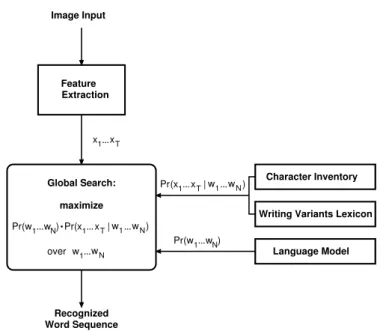
A system overview of our statistically based LVCSR system is described in Figure 4.1. In the following, we briefly describe in Section 4.1.1 our feature extraction framework and the visual modeling of the glyphs in Section 4.1.2. In Section 4.1.3, we describe our lexica and language modeling, and finally the decoding process is described in Section 4.1.4.
4.1.1 Feature Extraction
For our baseline systems, we use appearance-based image slice features concatenated with overlapping sliding windows, with a large spatio-temporal context, which can either be used
Image Input
Feature Extraction
Character Inventory Writing Variants Lexicon
Language Model Global Search: maximize x1...xT Pr(w1...wN) Pr(x1...xT| w1...wN) w1...wN Recognized Word Sequence over Pr(x1...xT| w1...wN) Pr(w1...wN)
Figure 4.1 System overview of our HMM-based large-vocabulary continuous text recognition framework.
directly as features [Keysers & Deselaers+07], or reduced by linear feature reduction methods like PCA [El-Hajj & Likforman-Sulem+05] or LDA [Lu & Bazzi+ 98].
As the maim focus of this work is on character modeling, only few preprocessing steps com-monly applied in handwriting recognition will be used. A detailed description of our feature extraction framework is given in Section 4.2.
4.1.2 Visual Modeling
A glyph is an individual mark on a written medium that contributes to the meaning of what is written. However, in typography and computing, the termglyphis used to describe a particular physical appearance of a character, and represents agraphical unit. A ligature occurs where two or more characters are joined as a single glyph. Additionally, Unicode maintains that ligaturing is a presentation issue rather than a character definition issue, i.e. the use of special Unicode ligature characters is discouraged [Wikipedia 11].
Each glyph is modeled by a multi-state left-to-right HMM with skip transitions and a separate Gaussian mixture models (GMMs). The white-space model itself is always modelled by a single GMM in all systems.
The parameters of all GMMs are estimated with the ML principle using an expectation max-imization (EM) algorithm, and to increase the number of densities in the mixture models, suc-cessive splitting of the mixture densities is applied.
State Topology. Different HMM topologies and transition probabilities are used for character models (cf. Figure 4.2 (a)) and white-space models (cf. Figure 4.2 (b)) in Arabic and Latin handwriting recognition: e.g. elongation of characters occurs often in Arabic handwriting (see Figure 4.8 (b)). Therefore, we use very low loop penalties but higher skip penalties for our
si 2 1 0 si p(si|si) p(0|0) p(1|0) p(2|0) p(1|1) p(2|1) p(2|2) p(si|si) next si prev p(si|si) (a) (b)
Figure 4.2 Different HMM state topologies and transition probabilities are used for character models (a) and
white-space models (b) in Arabic and Latin handwriting recognition.
HMM state transitions (see Figure 4.2 (a)) in Arabic handwriting recognition.
The impact of state transition penalties is limited and mainly important in combination with 3-1 models, i.e. 3 states per glyph without any repetition of the corresponding mixture models. Informal experiments and comparisons with Hidden Markov Model Toolkit (HTK), where a full state-transition matrix can be learned from training data, showed no significant differences to our RWTH OCR system. In combination with 3-2 models, i.e. 6 states per glyph with two repetitions of the corresponding mixture models, the default state transition penaltiesT(1) =0 andT(0) =T(2) =3 as used in ASR, which are shared among all classes, typically allow for good alignments and are used in our experiments in Section 4.6 if not explicitly stated.
Glyph Models.The Latin handwriting is one of the most common handwriting systems
world-wide. As each letter can be written in lower- and uppercase, and capitalized or cursive writing, and additionally symbols for punctuations are used in the databases (see Section 4.6), e.g. 78 character models and one blank model have to be estimated in our ML trained baseline system for English handwriting.
In Arabic handwriting, depending on the position of the character in an Arabic word, most of the 28 characters can have up to 4 different shapes in handwriting recognition [Lorigo & Govindaraju 06]. The blog1by [Zoghbi 07] provides another excellent survey over the history of Arabic type evolution from the 1930’s till present.
As for Arabic handwriting, there are no distinct upper and lower case letter forms in machine-printed texts. Both machine-printed and written Arabic are cursive. Unlike cursive writing based on the Latin alphabet, the standard Arabic style has substantially different shapes depending on the glyph context. Standard Arabic Unicode character encodings do typically not indicate the form each character should take in context, so it is left to the rendering engine to select the proper glyph to display for each character.
The basic Arabic range encodes mainly the standard letters and diacritics. For our novel large vocabulary Arabic machine-printed text database described in Section 4.5.3.2, about 200 position dependent glyph models have to be trained.
Context Models. Other approaches try to model characters within their visual context
us-ing syllable, piece of Arabic word (PAW), or classification and regression tree (CART) based lexica and LMs (cf. Section 4.1.3). The effect of different context-dependent glyph model-ing approaches has been analyzed e.g. in [Fink & Plotz 07,Jonas 09,Natarajan 09], here, we
focus mainly on isolated character based glyph models but in combination with a large spatio-temporal sliding window as described in [Dreuw & Jonas+08], incorporating context informa-tion at the feature-level.
Model Lengths. In an HMM based text recognition system, the number of states per glyph
have to be adapted to the resolution used for the feature extraction and the topology of the HMMs. By using a topology without skips, the calculated number of states represents the minimum width of a character, i.e. shorter characters are not modeled adequately. Depending on the image preprocessing, a glyph-dependent length modeling of the HMM states (e.g., by [Bazzi & Schwartz+99,Zimmermann & Bunke 02,Geiger & Schenk+10]) instead of the most commonly used HMMs with a fixed number of states for all glyphs is reasonable, in order to model more complex or larger glyphs with more states (cf. Section 4.3.2). Thus every state of a length adapted glyph model has to cover less pixels. A non-linear HMM model is proposed by [Schambach 03], allowing for several writing variants within one model. In this thesis work, we simply learn the number of states per glyph, based on an initial alignment, as explained in Section 4.3.2.
4.1.3 Lexica and Language Models
In LVCSR, lexica usually contain only a small number of most frequent words but are able to cover most of the testing data. As new words may occur at any time, out of vocabulary (OOV) words cannot be recognized. In continuous handwriting or machine printed text recognition using word-based lexica, the same OOV problem is still present e.g. due to names, hyphenated, misspelled and crossed out words. Additionally, a large lexicon increases the recognition com-plexity. Therefore, the recognition lexicon as well as the recognition LM have to be treated with special care.
In an HMM based handwriting recognition system, small white-spaces within words usually are modeled implicitly within the character models. Especially in Arabic handwriting with its position-dependent shapes [Lorigo & Govindaraju 06], large white-spaces can occur between isolated-, beginning-, and end-shaped characters (see Figure 4.8 (b)). As some characters are only connectable from the right side, such words have to be cut into pieces (piece of Arabic word (PAW)). In previous Arabic handwriting recognition competitions [Märgner & Pechwitz+ 05,Märgner & Abed 07] it turned out that the relative error of most systems in general follows the frequency of the PAWs. Similar to silence modeling in ASR, we propose to explicitly model these white-spaces in Arabic handwriting by different writing variants in our lexicon (see Section 4.3.3).
Due to ligatures and diacritics in Arabic handwriting, the same Arabic word can be written in several writing variants, depending on the writer’s handwriting style. Therefore we use a lexicon with multiple writing variants per lexicon word entry.
Since handwriting has several syntactic levels (in descending order regarding their informa-tion content: words, hyphens, characters or glyphs in general), recogniinforma-tion can be applied on any of these levels and can be refined on a higher level of information. A hybrid character-and word-level recognition is illustrated in [Bazzi & Schwartz+99]. The system uses character recognition and then applies a word based LM for the recombination of the words from the
recognized characters.
A stochastic model is used to provide an a-priori probability p(wW1N)of a word sequence w1, . . . ,wN, which is independent of the visual model. In ASR, especially large and very large
vocabulary speech recognition, the language model (LM) gives a significant contribution to the recognition performance, and is usually higher than the acoustic models (cf. Equation 4.1).
The language model (LM) gives a probability distribution over text strings, e.g. characters, words, phrases, or documents. Almost every natural language processing approach uses LMs. Some examples are:
• large-vocabulary speech recognition [Rybach & Gollan+09]
• statistical machine translation [Brants & Popat+07]
• document mining [Uszkoreit & Ponte+10]
• handwriting recognition [Bertolami & Bunke 08a]
• machine printed text recognition [Natarajan & Saleem+08]
• sign language recognition [Dreuw & Rybach+07]
A word sequence is assumed to follow a(m−1)-th order Markov process. Thus a wordwn
depends only on its(m−1)predecessorshn:=wnn−−m1+1, referred to as the history of wordWn.
Them-gram LM probability [Bahl & Jelinek+83] is then described byp(wN1) =∏Nn=1p(wn|hn).
For the evaluation of language models the perplexity (PP) is commonly used. The perplexity of a language model, a vocabulary, and a test corpuswN1 is defined as:
PP=p(wN1)−N1 = N
∏
n=1 p(wn|hn) −1 N (4.2)As the perplexity is an inverse probability, it can be interpreted as the average number of possible words at each position in the text. The logarithm of the perplexity
log PP=−1 N N
∑
n=1 p(wn|hn) (4.3)is equal to the to the entropy of the text, i.e. the redundancy of words in the test corpus, w.r.t. this language model [Rybach 06].
In most of the above mentioned tasks and approaches, typically word language models are build. Some of the problems of using word LMs for OCR are related to OOV words. If one wants to minimize or eliminate OOV words due to proper names, misspellings, digit sequences, etc., letter or glyph sequences instead of word sequences can be used for LM training in image text recognition. Typically, higher-order m-gram (e.g. 5≤m≤15) [Jonas 09,Natarajan 09,
Pyttel 11] are estimated to learn a similar string context as usually learned by 3-gram word LMs.
As in ASR, were typically a weak unigram language model is used for discriminative training [Schlüter & Müller+99,Schlüter 00], we always use a unigram language model in our proposed discriminative training criteria (cf. Section 4.3.4). If not stated otherwise, Kneser-Ney [Kneser & Ney 95] smoothed trigram language models are used in this work. For isolated character or word recognition, we use a simple finite state automaton (FSA).
4.1.4 Decoding
The aim of the decoding or recognition process is to find a word sequence[wN1]optwhich
maxi-mizes the posterior probability given a sequence of feature vectorsxT1 according to Equation 4.1. As depicted in Figure 4.1, the search module of the recognition system combines several knowl-edge sources, such as the visual model and the language model.
In our approach the maximum Viterbi approximation is applied to the HMM decoding, which significantly reduces the complexity of the optimization problem. The breadth-first search de-sign is used by the Viterbi search where all state hypotheses are expanded time-synchronously [Ney 84], where an efficient pruning is necessary as the number of possible word sequences with maximum lengthNgrows exponentially withN[Zolnay 06].
In this work, we additionally use a writing variant model refinement [Dreuw & Rybach+09] of our visual model
p(xT1|wN1) =max vN 1|wN1 pα Λv(v N 1|w N 1)p β Λe,t(x T 1|v N 1,w N 1) (4.4)
withvN1 a sequence of unknown writing variants, α a scaling exponent of the writing variant
probability depending on a parameter setΛpm, and β a scaling exponent of the visual
char-acter model depending on a parameter setΛem,tp for emission and transition model (see
Sec-tion 4.3.3).
The recognition can be performed in multiple passes, where e.g. a first system performs an initial and independent recognition pass to create transcriptions of test data in an unsuper-vised manner. The automatic transcriptions are required either for the text dependent writer adaptation (cf. Section 4.4.1.1) or an unsupervised text dependent model adaptation (cf. Sec-tion 4.4.1.2) in the next step.
4.2 Feature Extraction Architecture
For our baseline systems, we use appearance-based image slice features concatenated with over-lapping sliding windows which can either be used directly as features [Keysers & Deselaers+ 07], or reduced by linear feature reduction methods like PCA [El-Hajj & Likforman-Sulem+ 05] or LDA [Lu & Bazzi+ 98]. Other preprocessing and feature extraction methods are de-scribed in the following sections.
4.2.1 Preprocessing
One goal of this work is to analyze the effect of e.g. discriminative training and the incorpora-tion of a margin and a confidence term into the criteria. Therefore only few preprocessing steps
commonly applied in handwriting recognition will be used: brightness, deslanting, as well as a size normalization are used to compensate for variations in Latin writing style as proposed by [Juan & Toselli+01], named "Universidad Politécnica de Valencia (UPV) preprocessing" in this work. Note that no preprocessing is applied to Arabic handwritten or machine printed data.
4.2.2 Image Features
After an optional preprocessing of the input images, the images are always scaled down to unique height while keeping their aspect ratio. Multiple features can be extracted in sparse or dense way as briefly described in the following sections.
4.2.2.1 Appearance-Based
We extract simple appearance-based image slice features xt at every time step t =1,···,T
which can be augmented e.g. by their spatial derivatives in horizontal direction∆=xt−xt−1or
any other feature described in this section.
4.2.2.2 Sobel
Sobel filtered images have successfully been used for isolated handwritten digit recognition by [Keysers & Deselaers+ 07]. The Sobel feature set contains the original and Sobel filtered intensity values. The Sobel edge filters are two filters that expose horizontal or vertical borders. Both the horizontal and vertical Sobel filtered values and the absolute values of the filtered image are used for the feature set. The absolute values are used to add values that are linear independent of the original intensity values [Jonas 09].
4.2.2.3 Geometric Features
In contrast to appearance-based features, geometric features make no use of the pixel intensities or color values, but of their relationships to each other. A possible feature set, introduced by [Marti & Bunke 02], makes use of nine geometrical features, extracted on binarized images with a one pixel wide window.
4.2.2.4 Local Features
In general, local feature (LF) descriptors describe a pixel (or a position) in an image through its local content. They are typically extracted in a sparse way at interest points, another approach is a dense descriptor a regular image grid coordinates.
Local features (LFs) are supposed to be robust to small deformations or localization errors, and give us the possibility to find the corresponding pixel locations in images which capture the same amount of information about the spatial intensity patterns under different conditions. However, in OCR an interest point detection based feature extraction could fail, so that only a few descriptors per image are extracted. Instead of extracting descriptors around interest points only, LF descriptors are extracted at regular image grid points who give us a dense description of the image content for a fixed scale [Dreuw & Steingrube+09b,Kae & Huang+ 10].
SIFT
The scale invariant feature transformation (SIFT) descriptor is a 128 dimensional vector which stores the gradients of 4×4 locations around a pixel in a histogram of 8 main orientations [Lowe 04]. The gradients are aligned to the main direction resulting in a rotation invariant descriptor. Through computation of the vector in different Gaussian scale spaces (of a specific position) it becomes also scale invariant. There exists a closed source implementation of the inventor Lowe2and an open source implementation3which is used in our experiments.
In certain applications such as face recognition, rotation invariant descriptors can lead to false matching correspondences [Dreuw & Steingrube+ 09b]. If invariance w.r.t. rotation is not necessary, e.g. in handwriting or machine printed text recognition, the gradients of the descriptor can be aligned to a fixed direction, i.e. an upright version of the SIFT descriptor (i.e. U-SIFT). These features, which have been successfully applied within the scope of this thesis to face recognition tasks [Dreuw & Steingrube+09b,Pishchulin & Gass+11,Gass & Pishchulin+ 11] are currently being investigated for OCR.
Another interesting SIFT-based descriptor used in OCR is the character-SIFT descriptor as proposed in [Zhang & Jin+ 09] or as proposed in [Kae & Huang+ 10,Kae & Learned-Miller 09].
SURF
Conceptually similar to the SIFT descriptor, the 64-dimensional speeded-up robust features (SURF) descriptor [Bay & Ess+08] also focusses on the spatial distribution of gradient infor-mation within the interest point neighborhood, where the interest points itself can be localized by interest point detection approaches or in a regular grid.
The SURF descriptor is invariant to rotation, scale, brightness and, after reduction to unit length, contrast. Due to the global integration of SURF descriptors, the authors [Bay & Ess+ 08] claim that it stays more robust to various image perturbations than the more locally operat-ing SIFT descriptor, which we could not fully confirm in [Dreuw & Steingrube+ 09b]. These features, which have been successfully applied within the scope of this thesis to face recognition tasks [Dreuw & Steingrube+09b] are currently being investigated for OCR. For the application of OCR, invariance w.r.t. rotation is often not necessary or unwanted. Therefore, we also ana-lyze the upright version of the SURF descriptor (i.e. U-SURF). The upright versions are faster to compute and can increase distinctivity [Bay & Ess+ 08], while maintaining a robustness to rotation of about±15◦, which is typical for most OCR tasks.
For the extraction of SURF-64, SURF-128, U-SURF-64, and U-SURF-128 descriptors, we use the reference implementation4described in [Bay & Ess+08]. Additionally, another detailed overview and implementation5is provided in [Evans 09].
2http://www.cs.ubc.ca/~lowe/keypoints/
3http://www.vlfeat.org/~vedaldi/code/siftpp.html 4http://www.vision.ee.ethz.ch/~surf/