STATEWIDE ELECTION DAY IS
Tuesday, November 2, 2010
Polling places open from 7 a.m. to 7 p.m.
(Early Voting Begins October 18, 2010)
Contact inform ation for county election offices appears insidethe back cover of this booklet
2010 STATE BALLOT
INFORMATION BOOKLET
and
Recommendations on
Retention of Judges
Legislative Council of the Colorado General Assembly Research Publication No. 599-1
COLORADO GENERAL ASSEMBLY
EXEC U TIVE C O M M ITTEE R ep. Terrance C arroll, C hairm an Sen. Brandon Shaffer, Vice C hairm an Sen. John M orse
Sen. M ike Kopp R ep. Paul W eissm ann R ep. M ike M ay
STAFF M ike M auer, D irector Am y Zook, D eputy D irector
C O M M ITTEE Sen. Betty Boyd Sen. Bill C adm an Sen. D an G ibbs Sen. M ary H odge Sen. M ark Scheffel Sen. N ancy Spence R ep. D avid Balm er R ep. M ark Ferrandino R ep. Andy Kerr R ep. Frank M cN ulty R ep. C hristine Scanlan R ep. Am y Stephens
LEGISLATIVE COUNCIL
ROOM 029 STATE CAPITOL DENVER, COLORADO 80203-1784
E-m ail: lcs.ga@ state.co.us
303-866-3521 FAX: 303-866-3855 TDD: 303-866-3472
September 13, 2010
This booklet provides information on the nine statewide measures on the November 2, 2010, ballot and on the judges that are on the ballot for retention in your area. The information is presented in three sections.
Section One — Analyses of Measures
The first section contains an analysis of each proposed change to the state constitution and state statute. Each analysis includes a description of the measure and major arguments for and against. Careful consideration has been given to the arguments in an effort to fairly represent both sides of the issue. It also includes an estimate of the fiscal im pact of the measure. More information on the fiscal impact of measures can be found at www.coloradobluebook.com. The state constitution requires that the nonpartisan research staff of the General Assembly prepare these analyses and distribute them in a ballot information booklet to registered voter households.
Amendments and Propositions
A measure placed on the ballot by the state legislature that amends the state constitution is labeled an "Amendment," followed by a letter. A measure placed on the ballot by the state legislature that amends the state statutes is labeled a "Proposition," followed by a double letter.
A measure placed on the ballot through the signature-collection process that amends the state constitution is labeled an "Amendment," followed by a number. A measure placed on the ballot through the signature-collection process that amends the state statutes is labeled a "Proposition," followed by a number.
Constitutional vs. Statutory Changes
The first line of the analysis of each measure indicates whether the measure is a change to the constitution or to statute. Seven of the measures on the ballot propose changes to the state constitution. Voter approval is required in the future to change any constitutional measure adopted by the voters, although the legislature may adopt statutes that clarify or implement these constitutional measures as long as they do not conflict with the constitution. The remaining two measures propose changes to state statute. The state legislature, with the approval of the governor, may change any of these measures in the future without voter approval.
Section Tw o — Titles and Text
The second section provides the title that appears on the ballot and the legal language of each measure, including whether the measure changes the constitution or statute. The legal language of the measures shows new laws in capitalized letters and laws that are being eliminated in strikeout type, with the exception of Amendments 60 and 61, and Proposition 101. These measures are new laws but are not in capitalized letters.
Section Three — Recommendations on Retaining Judges
The third section contains information about the performance of Colorado Supreme Court, Court of Appeals, and trial court judges who are on your ballot. The information was prepared by the state commission and district commissions on judicial performance. The narrative for each
judge includes a recommendation stated as "RETAIN,""DO NOT RETAIN,"or"NO OPINION."
Information on Local Election Officials
The booklet concludes with addresses and telephone numbers of local election officials. Your local election official can provide you with information on polling places, absentee ballots, and early voting.
TABLE OF CONTENTS
Am endm ent P: Regulation of Gam es of Chance. . . 1
Title and Text of Measure. . . 33
Am endm ent Q: Tem porary Location for the State Seat of Governm ent.. . . 2
Title and Text of Measure. . . 34
Am endm ent R: Exem pt Possessory Interests in Real Property. . . 3
Title and Text of Measure. . . 35
Am endm ent 60: Property Taxes. . . 5
Title and Text of Measure. . . 37
Am endm ent 61: Lim its on State and Local Governm ent Borrow ing. . . 10
Title and Text of Measure. . . 38
Am endm ent 62: Application of the Term Person. . . 16
Title and Text of Measure. . . 39
Am endm ent 63: Health Care Choice. . . 18
Title and Text of Measure. . . 39
Proposition 101: Incom e, Vehicle, and Telecom m unication Taxes and Fees. . . 21
Title and Text of Measure. . . 41
Proposition 102: Criteria for Release to Pretrial Services Program s. . . 30
Title and Text of Measure. . . 42
Recom m endations on Retention of Judges
Local Election Offices
(Click here)
ANALYSIS
Am endm ent P
Regulation of Gam es of Chance
Amendm ent P proposes am ending the Colorado Constitution to:
transfer the licensing of gam es of chance, such as bingo and raffles, from the Departm ent of State to the Departm ent of Revenue; and
allow the state legislature to change the departm ent of oversight and the requirem ent that an organization exist for five years with a dues-paying m em bership to qualify for a license.
Sum m ary and Analysis
Colorado law allows certain nonprofit organizations to use bingo and raffles to raise m oney for charity. Bingo and raffles are gam es in which prizes are won based on random ly picked num bers. Since 1958, the Departm ent of State has regulated these gam es by issuing licenses, collecting fees, conducting inspections, addressing com plaints, and im posing penalties. Currently, organizations m ust have been in existence for five years with a dues-paying m em bership to qualify for a license.
Am endm ent P allows the state legislature to choose a state agency to regulate bingo and raffles. The legislature m ay also change the requirem ent that an organization m ust have operated for five years with a dues-paying m em bership to qualify for a license. During the 2010 session, the state legislature passed a bill selecting the Departm ent of Revenue to regulate bingo and raffles if Am endm ent P is adopted.
The Departm ent of Revenue currently regulates casino gam bling, licenses casinos and casino em ployees, conducts com pliance audits, and approves casino gam bling devices. The departm ent also operates the Colorado Lottery.
Argum ent For
1) The Departm ent of Revenue currently regulates m ost gam ing in the state and has established a fram ework to m onitor financial resources and transactions. In a 2008 report to the state legislature, both the departm ents of Revenue and State found that it would be m ore practical and efficient to consolidate the regulation of these gam es in the Departm ent of Revenue.
Argum ent Against
1) For over 50 years, the Departm ent of State has regulated bingo and raffles, and there is no need to m ove this oversight to another state agency. A 2007 state regulatory agency report concluded that the Departm ent of State has adequately perform ed bingo licensing and enforcem ent functions, and found no com pelling reason to m ove bingo regulation to the Departm ent of Revenue. During an econom ic downturn, the state should not spend an estim ated $116,000 to m ove the regulation of bingo and raffles.
Estim ate of Fiscal Im pact
Under Am endm ent P, the state will have estim ated one-tim e costs of $116,000 in budget year 2010-11 to m ove regulation of bingo and raffles to the Departm ent of Revenue. The departm ent requires com puter software and other item s to bring bingo and raffle licensing into its current gam ing operations. These costs will be paid with existing revenue from bingo and raffle licenses.
A
N
A
L
Y
S
IS
Am endm ent Q
Tem porary Location for the State Seat of Governm ent
Amendm ent Q proposes amending the Colorado Constitution to:
establish a process for m oving the state seat of governm ent to a tem porary location during a declared disaster em ergency.
Sum m ary and Analysis
Since statehood, the Colorado Constitution has designated Denver as the state seat of governm ent. The legislature is prohibited from m oving the seat of governm ent out of Denver unless it refers a constitutional am endm ent to the voters at a general election. The state constitution requires that an am endm ent to m ove the state seat of governm ent be approved by at least two-thirds of those voting on the issue.
Am endm ent Q creates a process for tem porarily m oving the seat of governm ent if a disaster em ergency affects the ability of state governm ent to operate in Denver. It defines a disaster em ergency as the occurrence or im m inent threat of widespread or severe dam age, injury, illness, or loss of life or property resulting from an
epidem ic or a natural, m an-m ade, or technological event. For the purpose of addressing such em ergencies, it also defines the seat of governm ent as the location of the legislative, executive, and judicial branches of the state of Colorado.
After declaring a disaster em ergency, and after consulting with the Chief Justice of the Colorado Suprem e Court, the President of the Senate, and the Speaker of the House of Representatives, the Governor m ay designate a tem porary m eeting location for the state legislature. The legislature m ust m eet at that location and decide whether to pass a bill designating a tem porary location for the seat of governm ent outside of Denver. Such legislation m ust include a date when the tem porary location of the seat of governm ent expires. Am endm ent Q does not change the process for perm anently m oving the state seat of governm ent. Currently, 36 other states have created a legal process to tem porarily m ove the state seat of governm ent in an em ergency.
Argum ent For
1) The state constitution does not provide a process to tem porarily relocate the state seat of governm ent — even during a disaster em ergency. Am endm ent Q provides the legal authority for the tem porary m ovem ent of state governm ent in the event of a declared disaster em ergency. It also enables state governm ent officials to plan for and respond to a disaster em ergency and continue essential governm ent services without requiring a statewide vote on whether to m ove the state seat.
Argum ent Against
1) The m easure m ay be unnecessary because all three branches of state governm ent have powers under current law and rules to independently m anage their operations and address disaster em ergencies. For exam ple, legislative rules allow the legislature to m eet tem porarily in another location in Denver or elsewhere in the state during a Governor-declared disaster em ergency. The Governor also has powers to address disasters including ordering evacuations and reassigning state em ployees.
Estim ate of Fiscal Im pact
Am endm ent Q is not expected to affect state or local governm ent revenue or spending.
Am endm ent R
Exem pt Possessory Interests in Real Property
Amendm ent R proposes amending the Colorado Constitution to:
elim inate property taxes for individuals or businesses that use governm ent-owned property for a private benefit worth $6,000 or less in m arket value.
Sum m ary and Analysis
Property taxes and possessory interests. Property taxes are prim arily based on the value of land, houses, other buildings, and business equipm ent. Individuals and businesses pay property taxes to various local
governm ents, such as cities, counties, school districts, and special districts, each of which im poses its own tax rate on property. Property taxes pay for a variety of local governm ent services, including public education, police and fire services, roads and bridges, parks and recreation facilities, hospitals, and libraries.
W hen an individual or business uses governm ent-owned land or equipm ent for private purposes, a possessory interest is created. Although governm ent-owned property is exem pt from taxes, the benefit that a business or individual obtains from using that land or equipm ent is not. For exam ple, som e ranchers lease land from the federal governm ent for cattle grazing. Other businesses lease land to provide a recreational activity, such as skiing or river rafting, or are given a contract to provide a specific service on public land, such as operating a snack bar at a national park. Under current law, the value of a private benefit is considered a possessory interest and is subject to property taxes.
The m arket value of all possessory interests in Colorado is about $300 m illion, which is less than 0.1 percent of the total m arket value of all property in the state. At this value, total property tax paym ents for possessory interests are approxim ately $6 m illion annually. There are about 7,000 possessory interests in the state, which pay an average of $850 in property taxes annually.
How does Am endm ent R change the taxation of possessory interests? Starting in 2012, Am endm ent R exem pts a possessory interest from property taxation if the m arket value of the interest is $6,000 or less, which equates to a m axim um tax paym ent of $120 annually, depending on local tax rates. For exam ple, m ost cattle grazing leases with the federal governm ent have a m arket value below $6,000, and therefore this private benefit would not be taxed. In contrast, the value of private benefits obtained by ski areas exceed the $6,000 threshold and will continue to be taxed at the full value. In budget year 2012-13, the m easure is expected to reduce property taxes statewide by $160,000. Every two years, the $6,000 threshold is increased to account for inflation.
Argum ent For
1) Am endm ent R reduces the adm inistrative burden of collecting a tax that in m any cases costs m ore m oney to collect than it brings in to local governm ents. For exam ple, the m ajority of possessory interests in the state are for agricultural leases, m any of which owe less than $10 in property taxes. The cost of adm inistering this tax — m ailing notices, m aintaining tax rolls, and collecting and enforcing the tax — often exceeds this am ount.
Argum ent Against
1) Am endm ent R provides an unfair tax break for businesses and individuals who use governm ent-owned land and puts a greater tax burden on others to pay for local governm ent services. The state constitution requires that taxes be charged uniform ly for all taxpayers. A sm all tax bill does not justify exem pting a business or
individual from paying the tax on the private benefit they enjoy on governm ent land. Sim ple fairness dem ands that all businesses and individuals pay taxes, no m atter how sm all.
A
N
A
L
Y
S
IS
Estim ate of Fiscal Im pact
State expenditures. Public schools are funded from a com bination of state and local revenue. Since Am endm ent R reduces the am ount of local revenue for schools, the state's portion of school funding will increase by approxim ately $46,000 beginning in budget year 2012-13.
Local governm ent im pact. Am endm ent R is expected to reduce property taxes for local governm ents by up to $160,000 per year, beginning in budget year 2012-13. Of this am ount, property taxes for school districts are expected to decrease by approxim ately $46,000. In addition, m inor cost savings m ay occur in som e counties because of a reduced num ber of m ailings and fewer properties to process and value.
Am endm ent 60
Property Taxes
Amendm ent 60 proposes am ending the Colorado Constitution to:
repeal the current voter-approved authority of local governm ents to keep property taxes above their constitutional lim its;
establish expiration dates for future voter-approved property tax increases;
cut local property tax rates for public schools' operating expenses in half over ten years and replace this m oney with state funding each year;
require publicly owned enterprises to pay property taxes and reduce local property tax rates to offset the new revenue; and
provide new voting rights to certain property owners in Colorado and perm it citizens to petition all local governm ents to reduce property taxes.
Sum m ary and Analysis
Am endm ent 60 changes several aspects of Colorado's property tax system to reduce the am ount of property taxes paid by individuals and businesses to school districts, counties, special districts, cities, and towns. The m easure phases in a reduction in school district property taxes over ten years and requires that the reduced property taxes be replaced with state funding. Table 1 shows the projected im pact of the am endm ent in today's dollars on an average hom eowner and com m ercial business, school districts, and state governm ent, in both the first year and when the m easure is fully im plem ented. The fully im plem ented im pacts provide the best projections of the m easure's final effects.
In the first year, property taxes for school districts are expected to fall by $337 m illion, which the m easure requires the state to replace. This represents a property tax reduction of the sam e am ount for individuals and businesses. An average hom eowner's property tax bill is projected to fall by $87 and the property taxes for an average com m ercial business are estim ated to fall by $1,181.
W hen the m easure is fully im plem ented, the property tax reduction for school districts is estim ated to increase the state's obligation for kindergarten through twelfth grade education (K-12) by $1.5 billion, which represents a property tax decrease of the sam e am ount for individuals and businesses. An average hom eowner will pay $376 less and an average com m ercial business will pay $5,106 less in property taxes annually. In future years, the actual am ounts will differ as inflation and growth increase the size of the econom y, but the com parable budget im pacts on taxpayers and governm ents are expected to rem ain consistent over tim e. Cities, towns, counties, and special districts will also lose property taxes, but the am ount will vary by locality.
A
N
A
L
Y
S
IS
Table 1. Selected Im pacts of Am endm ent 60 Impacted Group Current Law Amendment 60 Difference First Year Fully Implemented First Year Fully Implemented
Impacts on Average Taxpayers
Property Tax Paym ent for Average H om eowner ($295,000 hom e)
$1,638 $1,551 $1,262 -$87 -$376
Property Tax Paym ent for Average C om m ercial Business O wner with a Value of $1.1 m illion
$22,254 $21,073 $17,148 -$1,181 -$5,106
K-12 Education Funding Shift
Property Tax C ollections for School D istricts
$3.3 billion $3.0 billion $1.8 billion -$0.3 billion -$1.5 billion State Expenditures for K-12 Education $3.7 billion $4.0 billion $5.2 billion $0.3 billion $1.5 billion
Background and current law. Property taxes are based prim arily on the value of land, houses, other buildings, and business equipm ent. Individuals and businesses pay property taxes to various local governm ents, such as cities, counties, school districts, and special districts, each of which im poses its own tax rate on property. School districts and counties receive approxim ately 77 percent of all property taxes collected. Publicly owned enterprises, such as city water and sewer system s, m unicipal airports, and m ost state universities, are exem pt from paying property tax.
Property taxes are spent on a variety of local governm ent services, including public education, police and fire services, roads and bridges, public water and sewer system s, parks and recreation facilities, hospitals, and libraries. The degree to which local governm ents rely on property taxes to pay for services varies. Som e special districts, such as fire protection districts, get alm ost all of their revenue from property taxes, while m any city governm ents get less than 5 percent of their funding from property taxes.
Constitutional lim its on property taxes. The state constitution currently restricts both the am ount of total revenue and property tax revenue that a local governm ent can collect each year. Annual increases for each are capped at the rate of inflation plus a m easure of local growth, such as student enrollm ent in the case of a school district. The constitution also requires voter approval for a local governm ent to increase property tax rates or to keep and spend total revenue or property tax revenue above the governm ent's constitutional lim it.
How does Am endm ent 60 change how public schools are funded? Public schools in Colorado are funded from a com bination of federal, state, and local sources. Voters in som e school districts have approved additional property taxes to repay loans used to build schools or other buildings. In these districts, there is a property tax for operating schools and a separate property tax to repay loans. Am endm ent 60 requires all districts to cut their 2011 property tax rates for operating schools in half by 2020. Property tax rates for repaying loans are unchanged. The required reduction in tax rates m ust be done in equal yearly am ounts over ten years.
Am endm ent 60 requires the local school district funding elim inated by this rate reduction to be replaced each year with state funding.
How does Am endm ent 60 affect the state budget? Currently, the state spends m ost of its general
operating budget on: preschool through higher education; health care; prisons; the courts; and program s that help low-incom e, elderly, and disabled people. K-12 education funding accounts for 46 percent of this budget, which is prim arily funded by sales and incom e taxes. Because Am endm ent 60 requires that the reduction in local property tax revenue be replaced with state funding, the obligation for public schools will increase to an estim ated
67 percent of the state's general operating budget, once the m easure is fully im plem ented. To m eet this increased
obligation to schools, the state will have to decrease spending and services in other areas, increase fees for services, or som e com bination of both.
How does Am endm ent 60 affect property taxes for all local governments? Like school districts, cities, counties, and special districts are also funded from a com bination of federal, state, and local sources. Under current law, taxpayers in m any com m unities have voted to broadly exem pt their local governm ents from the constitutional lim it related to total revenue and spending. Currently, voters in 76 percent of m unicipalities, 81 percent of counties, and 98 percent of school districts have voted to allow governm ent to keep and spend revenue above the constitutional lim it, either tem porarily or perm anently. This m easure would reim pose a property tax lim it for those governm ents, leaving the broader revenue exem ption unchanged.
Beginning in 2011, Am endm ent 60 repeals the current voter-approved authority of local governm ents to perm anently keep property taxes above their constitutional lim its. Local governm ents are not required to refund the property taxes that were retained in the past. However, local governm ents that collect property taxes above their property tax lim it in the future will have to refund m oney. A new election m ust be held to allow a local
governm ent to keep future property taxes above its constitutional lim it for up to four years at a tim e. The m easure will also reduce the property tax collections of m ost local governm ents by reducing property tax rates, and lim iting the duration of future property tax increases.
How does Am endm ent 60 affect publicly owned enterprises? Am endm ent 60 requires publicly owned enterprises to pay property taxes. Under current law, state enterprises, such as m ost public universities, do not pay property taxes on cam pus buildings or equipm ent. Sim ilarly, local enterprises, such as Denver International Airport, pay no property taxes. The new property taxes collected from these publicly owned enterprises m ust be offset by lower property tax rates for hom eowners, businesses, and other property taxpayers. For exam ple, if the University of Colorado had to pay property taxes in Boulder County, its property tax bill is estim ated to range from $11 m illion to $20 m illion per year, depending on how the property is valued. This new revenue would be offset by lower tax rates in Boulder County, providing property owners in the county with tax reductions of the sam e am ount. The am endm ent prohibits publicly owned enterprises from charging either a m andatory fee or a tax on property.
How does Am endm ent 60 change property tax elections? Am endm ent 60 proposes changing several aspects of the way property tax issues are addressed in local elections. Under current law, a property owner who is a registered Colorado voter m ay vote on ballot questions in his or her prim ary place of residence and in special district elections wherever he or she owns property in Colorado. Am endm ent 60 allows Colorado property owners to vote on city, county, and school district property tax issues in any Colorado location where they own property, regardless of their prim ary place of residence in the state.
Under current law, citizens m ay petition cities to increase or decrease property taxes, but m ay not petition counties, schools, or special districts. Under this m easure, all local governm ents m ust perm it petitions to lower property taxes.
Typically, when a local com m unity has voted to perm anently exem pt its local governm ent from the
constitutional lim it on property tax collections, that voter-approved decision is not autom atically repealed at a future date. Under Am endm ent 60, any future vote to allow a local governm ent to retain revenue above its constitutional lim it is repealed within four years after passage. Any future vote to increase property tax rates is repealed within ten years. Any extension of an expiring property tax is considered to be a tax increase under the m easure, and as such, m ust be presented as a tax increase on the ballot.
Currently, a single ballot question m ay ask voters if a local governm ent m ay borrow m oney, and if property tax rates m ay be increased to repay that loan. Under this m easure, ballot questions that allow a governm ent to borrow m oney m ust be separate from ballot questions that raise property taxes.
How is Am endm ent 60 enforced? The am endm ent requires the state to annually audit all cities, counties, school districts, and other types of local governm ents to ensure com pliance with all requirem ents of the
am endm ent. Citizens are also allowed to file lawsuits to enforce com pliance.
A
N
A
L
Y
S
IS
How does Am endm ent 60 interact with two other m easures on the ballot? Am endm ent 60 along with
Am endm ent 61 (see page 10) and Proposition 101 (see page 21) contain provisions that affect state and local governm ent finances by decreasing taxes paid by households and businesses and restricting governm ent borrowing. How these m easures work together m ay require clarification from the state legislature or the courts.
Am endm ent 60 reduces local property taxes, while requiring state expenditures for K-12 education to increase by an am ount that offsets the property tax loss for school districts. Am endm ent 61 requires state and local governm ents to decrease tax rates when debt is repaid, which is assum ed in this analysis to apply to the existing debt of state and local governm ents, and it prohibits any borrowing by state governm ent. Proposition 101 reduces state and local governm ent taxes and fees.
Since portions of these m easures are phased in over tim e, the actual im pacts to taxpayers and governm ents will be less in the initial years of im plem entation and grow over tim e. Assum ing that all three m easures are approved by voters, the first-year im pact will be to reduce state taxes and fees by $744 m illion and increase state spending for K-12 education by $385 m illion. Once fully im plem ented, the m easures are estim ated to reduce state taxes and fees by $2.1 billion and increase state spending for K-12 education by $1.6 billion in today's dollars. This would com m it alm ost all of the state's general operating budget to paying for the constitutional and statutory requirem ents of K-12 education, leaving little for other governm ent services. In addition, the prohibition on borrowing will increase budget pressures for the state if it chooses to pay for capital projects from its general operating budget. This would further reduce the am ount of m oney available for other governm ent services.
Tax and fee collections for local governm ents are expected to fall by at least $966 m illion in the first year of im plem entation and by $3.4 billion when the m easures are fully im plem ented. However, after the state reim burses school districts, the net im pact on local governm ent budgets would be at least $581 m illion in the first year and $1.8 billion when fully im plem ented.
Total taxes and fees paid by households and businesses are estim ated to decrease by $1.7 billion in the first year and $5.5 billion per year in today's dollars when the m easures are fully im plem ented. The m easures reduce the taxes and fees owed by an average household m aking $55,000 per year that owns a $295,000 house by an estim ated $400 in the first year and $1,360 per year when fully im plem ented.
Argum ents For
1) Am endm ent 60 provides property tax relief for Coloradans in a tough econom ic clim ate without reducing K-12 education funding. For exam ple, the m easure will provide seniors who recently lost a property tax exem ption with additional tax relief. Allowing business owners to keep m ore of their incom e m ay spur investm ent and help the econom y recover m ore quickly. School funding is unchanged because the state is required to replace the local property taxes phased out by the am endm ent with state funding.
2) Am endm ent 60 strengthens citizen control over local governm ent taxes by setting tax expiration dates and requiring that an extension of an expiring tax be presented to the voters as a tax increase. The am endm ent also allows citizens to petition local governm ents to lower taxes, and it prevents unelected boards, such as the Denver W ater Board, from im posing m andatory fees or taxes on property. In addition, lim iting votes on property taxes to Novem ber elections, when voter turnout is typically higher, m ay lead to greater citizen awareness and
participation.
3) Am endm ent 60 rem oves a com petitive advantage that publicly owned enterprises have over private businesses. Unlike private facilities, publicly owned enterprises, such as parking lots and golf courses, do not currently pay property taxes. The additional revenue will lower the local property tax rate, providing further relief for property owners in the district.
Argum ents Against
1) Am endm ent 60 overturns nearly two decades of voter-approved tax decisions that fund im portant services provided by counties, cities, school districts, and special districts. The am endm ent enables voters statewide, in this election, to reverse hundreds of decisions of local voters to fund services like fire and police protection, roads, parks and recreational facilities, water and sewer system s, and libraries. Local voters are best equipped to choose the level and type of services needed in their com m unities and the m eans to pay for those services.
2) Am endm ent 60 will require the state to cut funding for m any im portant services, which m ay result
in job losses throughout Colorado. Because the state constitution requires that the state have a balanced budget and lim its the ability of the legislature to raise taxes, every new dollar spent on education will be taken away from other services. The $1.5 billion increase in state K-12 education spending nearly equals the am ount the state currently spends on courts, prisons, and hum an services. This am endm ent requires the state to spend so m uch m ore on public schools that these or other state functions will have to be cut or elim inated in order to keep the state budget balanced.
3) Am endm ent 60 m ay leave m any citizens worse off financially, depending on where they live. People who live in areas with few publicly owned enterprises, such as the eastern plains, will receive som e property tax reductions, but m ay pay m ore in fees to use the services of public enterprises located elsewhere. For exam ple, if the University of Colorado m ust pay property taxes, students statewide m ay pay m ore in tuition, but property owners in Boulder County will get m ost of the tax savings. Sim ilarly, if Denver International Airport m ust pay property taxes, airline custom ers statewide m ay pay m ore in fees, but only property owners in Denver will get the property tax reduction.
Estim ate of Fiscal Im pact
Local revenue. Am endm ent 60 reduces property taxes for individuals and businesses in several ways. This reduces the am ount of tax revenue that cities, counties, school districts, and special districts will receive. The m easure phases in a reduction in school district property taxes over ten years. In the first year, school district property taxes are projected to fall by $337 m illion, reducing property taxes paid by an average hom eowner and an average business owner by $87 and $1,181, respectively. Once the m easure is fully im plem ented, property taxes are estim ated to fall by $1.5 billion annually in today's dollars, reducing property taxes paid by an average
hom eowner and an average business owner by approxim ately $376 per year and $5,106 per year, respectively. Additionally, local governm ents currently authorized to keep property tax revenue in excess of the constitutional lim it, will have their property tax revenue reduced by an indeterm inate am ount.
State expenditures. By reducing the am ount of local property taxes collected for school districts, statewide expenditures for public schools will increase by an estim ated $337 m illion in the first year of im plem entation and by $1.5 billion per year in today's dollars once the m easure is fully im plem ented. To m eet this increased obligation to schools, the state will have to decrease spending and services in other areas, increase fees for services, or enact som e com bination of both.
The state m ust m ake a yearly audit of com pliance with the property tax provisions and strictly enforce all requirem ents in the am endm ent. The Office of the State Auditor is responsible for reporting the financial and operational perform ance of agencies of state governm ent; however, the office does not have a process for auditing local governm ent com pliance with property tax laws. Am endm ent 60 expands the obligations of the State
Auditor's Office. It is estim ated that this provision will require the addition of 1.5 new staff to coordinate year-round auditing of local governm ent and to m anage contracting with independent certified public accounting (CPA) firm s. The cost for these new staff and CPA contracts is estim ated to be $800,000 each year.
A
N
A
L
Y
S
IS
Am endm ent 61
Lim its on State and Local Governm ent Borrow ing
Amendm ent 61 proposes am ending the Colorado Constitution to:
prohibit all new state governm ent borrowing after 2010;
prohibit new local governm ent borrowing after 2010, unless approved by voters; lim it the am ount and length of tim e of local governm ent borrowing; and
require that tax rates be reduced after borrowing is fully repaid.
Sum m ary and Analysis
Am endm ent 61 places new restrictions on governm ent borrowing. Currently, the state and local governm ents borrow m oney to build or im prove public facilities like roads, buildings, and airports and repay the m oney over m ultiple years. Borrowing is also used for other purposes, such as financing loans for sm all businesses.
Beginning in 2011, Am endm ent 61 prohibits all future borrowing by state governm ent and lim its future borrowing by local governm ents, including cities, counties, school districts, special districts, and enterprises. The m easure also requires that governm ents lower tax rates after borrowed m oney is fully repaid, even if the borrowing was repaid from a source other than taxes. In certain cases, governm ents borrow m oney on behalf of private entities. Because the private entities are solely responsible for repaym ent, it is unclear if this borrowing is covered by the provisions of Am endm ent 61.
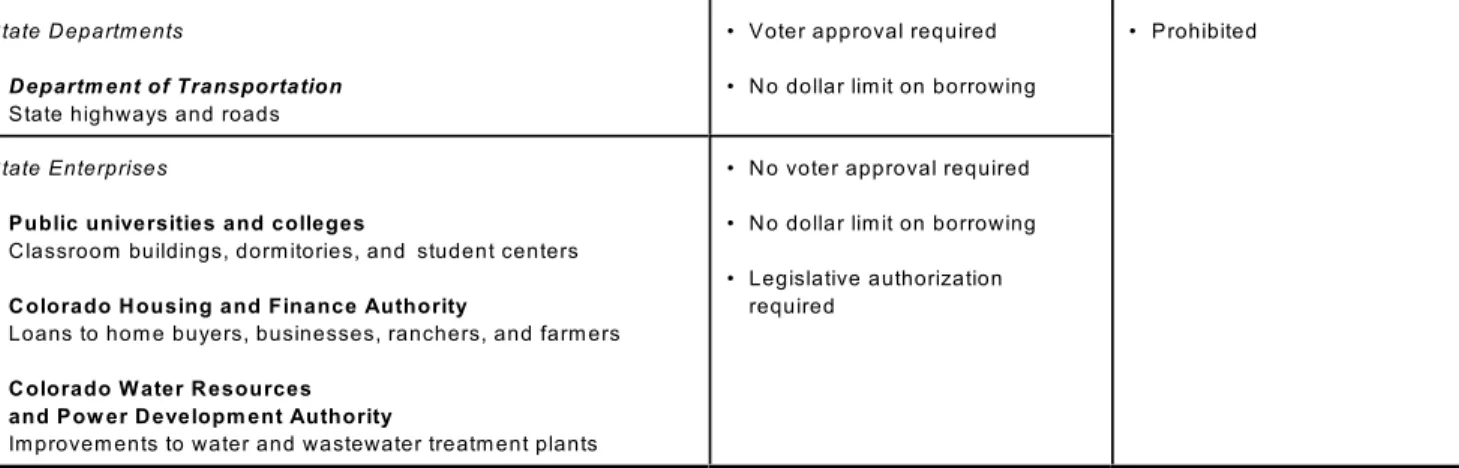
Im pact of Am endm ent 61 on state governm ent. Am endm ent 61 affects Colorado's state governm ent by prohibiting any future borrowing and requiring a tax cut when certain borrowing is fully repaid. Current borrowing will be unaffected, but future projects, program s, and services that would have otherwise been financed through borrowing will have to be elim inated or paid for by increasing fees or using m oney currently budgeted for other purposes. Table 1 provides exam ples of projects funded through state governm ent borrowing and the
requirem ents and restrictions under current law com pared to Am endm ent 61.
The state and all of its enterprises issue an average of $2.9 billion in new borrowing annually and spend about $2 billion annually to repay borrowing. State agencies, excluding enterprises, m ake annual paym ents of about $200 m illion on borrowing. At the end of 2010, the state and all of its enterprises will owe about $17 billion for assets financed through borrowing.
Under current law, the state borrows m oney in the following ways, which will no longer be perm itted by Am endm ent 61:
• Long-term borrowing — Long-term borrowing is m oney borrowed for a period of m ore than one year that is repaid from a specific source of m oney like dedicated taxes or fees over a fixed period of tim e. Voters m ust approve non-enterprise borrowing. For exam ple, in 1999 voters approved borrowing for state highway projects. The m oney that was borrowed for the projects is repaid with state and federal highway funds.
• Short-term borrowing — In Colorado, the state som etim es borrows m oney early in the year to cover costs for its day-to-day operations and repays the m oney later in the year, as revenues are collected.
• Lease-to-own agreements — Lease-to-own agreem ents allow the state to m ake annual paym ents for new buildings or equipm ent over a num ber of years until the cost is repaid. The state legislature authorizes lease-to-own agreem ents and approves paym ents every year during its annual budget process. Once the cost is paid, ownership is typically transferred to the state. The state is currently using lease-to-own agreem ents to build a prison, a m useum , a court building, and several academ ic buildings at state colleges and universities. The state is also using these types of agreem ents for K-12 school construction and renovation.
• Enterprise borrowing — Publicly owned enterprises are currently perm itted to borrow for projects and program s without voter approval. Generally, enterprises generate their own revenue through fees charged for the services they offer. Enterprises usually borrow with long-term borrowing repaid from grants or fees for services. Enterprises do not have a defined voter base, and do not hold public elections.
Most public colleges and universities are enterprises and have recently borrowed m oney to build classroom buildings and other facilities. This borrowing is repaid from sources such as tuition m oney, student fees, donations, and federal grants. Other state-level enterprises, such as the Colorado Housing and Finance Authority, act as financing authorities to borrow m oney that is lent to local governm ents, private businesses, and individuals.
Table 1. State Governm ent Borrow ing Requirem ents and Restrictions Under Current Law and Am endm ent 61
Examples of Existing Projects Funded Through Borrowing
Restrictions and Requirements
Current Law Amendment 61
Long-term borrow ing — m oney borrowed for a period of m ore than one year that is repaid from a specific source of m oney like dedicated taxes or fees over a fixed period of tim e.
State D epartm ents
D epartm ent of Transportation State highways and roads
• Voter approval required • N o dollar lim it on borrowing
• Prohibited
State Enterprises
Public universities and colleges
C lassroom buildings, dorm itories, and student centers C olorado H ousing and Finance Authority
Loans to hom e buyers, businesses, ranchers, and farm ers C olorado W ater R esources
and Pow er D evelopm ent Authority
Im provem ents to water and wastewater treatm ent plants
• N o voter approval required • N o dollar lim it on borrowing • Legislative authorization
required
O ther borrowing — including short-term (repaid within one year) borrowing, and lease-to-own agreem ents where authorized by state law and the state legislature approves paym ents annually.
State D epartm ents and Enterprises D epartm ent of C orrections Prisons
D epartm ent of H igher Education Academ ic facilities
State Treasurer
Short-term borrowing and K-12 school construction and renovation
• N o voter approval required • N o dollar lim it on borrowing • Legislative authorization
required
• Prohibited
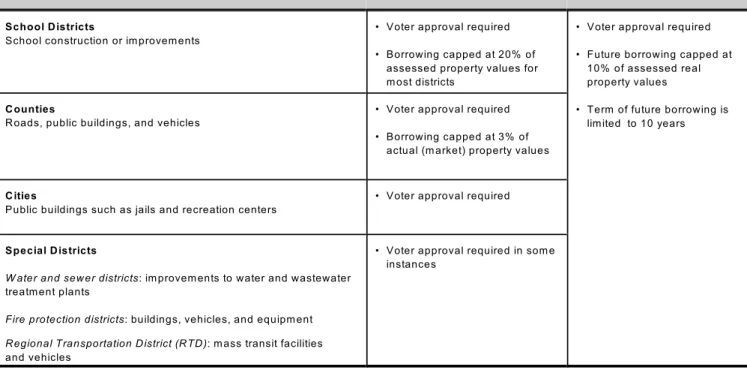
Im pact of Am endm ent 61 on local governm ents. Am endm ent 61 applies new borrowing lim its to all local governm ents and requires that all future borrowing be subm itted for voter approval. Sim ilar to the im pact on state governm ent, Am endm ent 61 will require local governm ents to either increase fees, reduce construction, or reduce program s and services. Table 2 provides exam ples of projects funded through local governm ent borrowing and the requirem ents and restrictions under current law com pared to Am endm ent 61.
Local governm ents and their enterprises issue an average of $4.9 billion in new borrowing annually, and spend about $4.3 billion annually to repay borrowing. Local governm ents, excluding enterprises, m ake annual paym ents of about $2.2 billion on borrowing. Currently, local governm ents and their enterprises owe about
A
N
A
L
Y
S
IS
$36 billion for assets financed through borrowing. Som e local governm ent borrowing is repaid from
voter-approved tax increases. After this borrowing is fully repaid, tax rates will be reduced, regardless of the outcom e of Am endm ent 61.
Am endm ent 61 lim its allowable local governm ent borrowing in the following ways:
• Borrowing is limited to bonded debt. Bonded debt is m oney that is borrowed through the sale of
governm ent bonds for a period of m ore than one year. Under current law, local governm ents m ay borrow m oney through bonded debt as well as other form s of borrowing, such as short-term borrowing or
lease-to-own agreem ents. Am endm ent 61 prohibits all form s of local governm ent borrowing except bonded debt.
• Voter approval is required for all borrowing. Under current law, not all borrowing requires voter approval, and elections for bonded debt occur at various tim es throughout the year depending on the type of local governm ent. Am endm ent 61 requires that all future borrowing first be subm itted for approval by voters at a Novem ber election. In addition, enterprises, which were not previously required to seek voter approval for borrowing, will be required to hold elections.
• For all local governments, except enterprises, borrowing is limited to 10 percent of the assessed real property value within their borders. Generally speaking, this cap is less than what is allowed under current law. A local governm ent that has already borrowed an am ount m ore than the 10 percent cap would be prohibited from additional borrowing until it repays enough of its borrowing or real property values increase enough to drop its total borrowing below the 10 percent cap.
• Borrowing must be repaid within 10 years and may be repaid early without penalty. The typical term of current borrowing is 20 to 30 years. Borrowing for a shorter length of tim e requires higher annual paym ents because the loan is spread over fewer years; however, total interest costs over the term of the loan are lower.
Table 2. Local Governm ent Borrow ing Requirem ents and Restrictions Under Current Law and Am endm ent 61
Examples of Existing Projects Funded Through Borrowing
Restrictions and Requirements
Current Law Amendment 61
B onded debt — m oney borrowed for a period of m ore than one year that is repaid from a specific source of m oney like dedicated taxes or fees over a fixed period of tim e.
School D istricts
School construction or im provem ents
• Voter approval required • Borrowing capped at 20% of
assessed property values for m ost districts
• Voter approval required • Future borrowing capped at
10% of assessed real property values
• Term of future borrowing is lim ited to 10 years C ounties
R oads, public buildings, and vehicles
• Voter approval required • Borrowing capped at 3% of
actual (m arket) property values
C ities
Public buildings such as jails and recreation centers
• Voter approval required
Special D istricts
W ater and sew er districts: im provem ents to water and wastewater treatm ent plants
Fire protection districts: buildings, vehicles, and equipm ent R egional Transportation D istrict (R TD ): m ass transit facilities and vehicles
• Voter approval required in som e instances
N ote: Table continued on next page
Table 2. Local Governm ent Borrow ing Requirem ents and Restrictions Under Current Law and Am endm ent 61 (Cont.)
Examples of Existing Projects Funded Through Borrowing
Restrictions and Requirements
Current Law Amendment 61
B onded debt — m oney borrowed for a period of m ore than one year that is repaid from a specific source of m oney like dedicated taxes or fees over a fixed period of tim e.
Enterprises
D enver International Airport: airport facilities and runways
• N o voter approval required • N o dollar lim it on borrowing
• Voter approval required • N o dollar lim it on borrowing • Term of borrowing is lim ited
to 10 years
O ther borrowing — including short-term (repaid within one year) borrowing, and lease-to-own agreem ents where authorized by a local board and the local board approves paym ents annually.
Local G overnm ents and Enterprises Short-term borrowing, lease-to-own agreem ents
• N o voter approval required • N o dollar lim it on borrowing • Subject to local board approval
• Prohibited, unless in the form of bonded debt
Im pact of Am endm ent 61 on taxpayers. Am endm ent 61 requires that after borrowed m oney is fully repaid by a governm ent, taxes m ust be reduced in the am ount of the average annual paym ent. Assum ing this
requirem ent applies to current borrowing, and once the m easure is fully im plem ented, state taxes will be reduced by about $200 m illion. Local governm ent taxes are estim ated to be reduced by about $940 m illion. Som e tax reductions will occur in the first few years after the m easure takes effect, but the full reduction will not occur until all borrowed m oney is repaid, which could take up to 40 years.
If the entire state tax reduction is applied to the state incom e tax, an average household earning $55,000 annually will pay about $49 less per year in today's dollars once the m easure is fully im plem ented. If the entire local tax reduction is applied to property taxes, the owners of a hom e valued at $295,000 will pay about $225 less per year in today's dollars. The im pact of the local tax reduction will vary based on the location of a taxpayer's residence.
How does Am endm ent 61 interact with two other m easures on the ballot? Am endm ent 61 along with
Am endm ent 60 (see page 5) and Proposition 101 (see page 21) contain provisions that affect state and local governm ent finances by decreasing taxes paid by households and businesses and restricting governm ent borrowing. How these m easures work together m ay require clarification from the state legislature or the courts.
Am endm ent 61 requires state and local governm ents to decrease tax rates when debt is repaid, which is assum ed in this analysis to apply to the existing debt of state and local governm ents, and it prohibits any
borrowing by state governm ent. Am endm ent 60 reduces local property taxes, while requiring state expenditures for K-12 education to increase by an am ount that offsets the property tax loss for school districts. Proposition 101 reduces state and local governm ent taxes and fees.
Since portions of these m easures are phased in over tim e, the actual im pacts to taxpayers and governm ents will be less in the initial years of im plem entation and grow over tim e. Assum ing that all three m easures are approved by voters, the first-year im pact will be to reduce state taxes and fees by $744 m illion and increase state spending for K-12 education by $385 m illion. Once fully im plem ented, the m easures are estim ated to reduce state taxes and fees by $2.1 billion and increase state spending for K-12 education by $1.6 billion in today's dollars. This would com m it alm ost all of the state's general operating budget to paying for the constitutional and statutory requirem ents of K-12 education, leaving little for other governm ent services. In addition, the prohibition on borrowing will increase budget pressures for the state if it chooses to pay for capital projects from its general operating budget. This would further reduce the am ount of m oney available for other governm ent services.
Tax and fee collections for local governm ents are expected to fall by at least $966 m illion in the first year of im plem entation and by $3.4 billion when the m easures are fully im plem ented. However, after the state reim burses school districts, the net im pact on local governm ent budgets would be at least $581 m illion in the first year and $1.8 billion when fully im plem ented.
Total taxes and fees paid by households and businesses are estim ated to decrease by $1.7 billion in the first year and $5.5 billion per year in today's dollars when the m easures are fully im plem ented. The m easures reduce the taxes and fees owed by an average household m aking $55,000 per year that owns a $295,000 house by an estim ated $400 in the first year and $1,360 per year when fully im plem ented.
Argum ents For
1) Borrowing is expensive because it includes interest paym ents and fees. Lim its are needed to help ensure that borrowing costs do not reduce m oney for public services in the future.
2) Am endm ent 61 encourages fiscal restraint through a pay-as-you-go approach to governm ent spending. This approach lim its governm ent from passing on debt to future generations.
3) Because the public is responsible for repaying governm ent borrowing through taxes and fees, voters should be asked before m oney is borrowed. The existing lim its on governm ent borrowing are not strict enough because the governm ent can still borrow large am ounts without voter approval. Am endm ent 61 requires any future local governm ent borrowing to be subm itted to voters for consideration at a Novem ber election.
4) Am endm ent 61 reduces taxes when borrowing is fully repaid, giving individuals and businesses m ore m oney to spend. Tax rates should go down when borrowing is repaid because the governm ent no longer needs m oney for the annual paym ents.
Argum ents Against
1) Borrowing is a crucial tool for financing large public investm ents such as prisons, schools, and water projects. Sim ilar to private citizens using a loan to buy a hom e or car, borrowing is often the only way
governm ents can afford to build and m aintain safe bridges, roads, and other public infrastructure. Am endm ent 61 m akes it harder to m anage public finances and to respond in a tim ely m anner to the needs of citizens.
2) Am endm ent 61 lim its the ability of com m unities to m eet the dem ands of a growing econom y. Colorado's population has grown alm ost 20 percent in the last decade, requiring new roads, schools, hospitals, and water treatm ent plants. These public investm ents are needed by com m unities to operate and to attract residents and businesses. In addition, the m easure m ay reduce private sector jobs, for instance businesses m ay be awarded fewer construction contracts.
3) Am endm ent 61 places the full burden of paying for public buildings built to last 30 years or m ore on today's taxpayers. Also, Am endm ent 61 m ay force governm ents to set aside m oney for several years before construction can begin on a new facility. As a result, current taxpayers m ay never benefit from a facility they paid to construct. Taxpayers m ay realize a greater benefit from borrowing than from a tax-rate reduction.
4) Som e governm ents will face serious financial disruptions as a result of Am endm ent 61. For exam ple, the Colorado unem ploym ent fund m ay be unable to pay unem ploym ent benefits for a period of tim e if the state is no longer able to borrow to pay for benefits. Also, starting in 2011, school districts that rely on short-term borrowing m ay have cash flow disruptions until spring tax collections are received. These districts will have to consider options such as reducing or suspending teacher pay, selling buildings, or closing schools.
Estim ate of Fiscal Im pact
The m easure contains provisions that reduce the am ount of taxes paid by m ost taxpayers over tim e, while reducing future construction of publicly owned facilities and restricting the ability of the state and local
governm ents to provide other program s and services.
Im pact on the state and local governm ents. The m easure will im pact the state and local governm ents in the following ways.
• Borrowing restrictions will require that the state and local governm ents either raise fees, reduce construction, or reduce program s and services. Additionally, the m easure affects cash flow m anagem ent for the state and school districts, which in the past have borrowed m oney to finance current operations in anticipation of taxes collected later in the year.
• Assum ing the tax reduction applies to current borrowing, the m easure requires state and local governm ents to cut spending. The state will gradually cut spending after each borrowing is fully
repaid by about $200 m illion over the course of the next 40 years beginning in 2018. Local governm ents will also cut spending after each borrowing is fully repaid by about $940 m illion over the course of the next 20 or 30 years. These am ounts reflect the estim ated average annual repaym ent for m oney currently borrowed by the state and local governm ents.
• Like governm ent agencies, publicly owned enterprises will have to either raise fees, reduce construction, or reduce program s and services. Current borrowing by state-level enterprises accounts for an estim ated $15 billion; borrowing by local enterprises accounts for about $11 billion.
• The cost of future local governm ent borrowing will likely be affected by the new 10-year m axim um term on borrowing, as well as the early repaym ent provisions. However, the im pact will vary by locality.
Taxpayer im pact. The m easure will im pact taxpayers in the following ways.
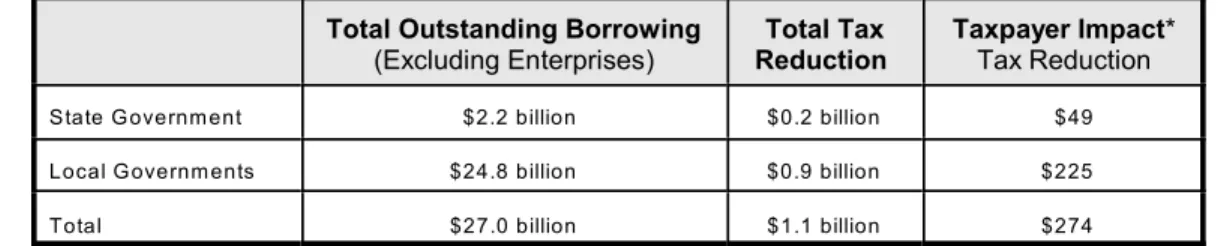
• Based on the average annual repaym ent am ount and assum ing the tax reduction provision applies to current borrowing, Am endm ent 61 is expected to reduce taxes by about $1.1 billion per year when fully im plem ented over the next 40 years. This estim ate includes about $940 m illion in local taxes and about $200 m illion in state taxes. The actual reduction for individuals, businesses, and others will depend on which taxes are reduced by the state and local governm ents and where the taxpayer lives. To illustrate the reduction, if the state reduced incom e taxes and local governm ents reduced property taxes,
Am endm ent 61 is estim ated to reduce the total taxes paid by an average household earning $55,000 per year and living in a $295,000 hom e by about $274 per year in today's dollars.
• Am endm ent 61 could m ake it difficult for Colorado to pay unem ploym ent benefits, which could cause the state to be in violation of federal law. Unusually high unem ploym ent has forced the Colorado
Unem ploym ent Insurance Fund to borrow m oney from the federal governm ent to pay unem ploym ent insurance benefits. Am endm ent 61 could prohibit this borrowing. As a result, the federal governm ent could choose to increase federal unem ploym ent insurance taxes on businesses in the state.
Table 3 sum m arizes the im pact of the tax reductions required by Am endm ent 61 once all current borrowing is repaid.
Table 3. Annual Estim ated Tax Im pacts Based on Current Borrow ing, Once Am endm ent 61 is Fully Im plem ented
Total Outstanding Borrowing
(Excluding Enterprises)
Total Tax Reduction
Taxpayer Impact* Tax Reduction State G overnm ent $2.2 billion $0.2 billion $49 Local G overnm ents $24.8 billion $0.9 billion $225
Total $27.0 billion $1.1 billion $274
*Based on a household earning $55,000 per year living in a $295,000 home.
A
N
A
L
Y
S
IS
Am endm ent 62
Application of the Term Person
Amendm ent 62 proposes am ending the Colorado Constitution to:
apply the term "person," as used in the sections of the Colorado bill of rights concerning inalienable rights, equality of justice, and due process of law, to every hum an being from the beginning of the biological developm ent of that hum an being.
Sum m ary and Analysis
Like the U.S. Constitution, the Colorado Constitution has a bill of rights. The Colorado bill of rights contains the rights of the people of Colorado and outlines the principles of state governm ent. Am endm ent 62 addresses the application of the term "person" for sections 3, 6, and 25 of the Colorado bill of rights. These sections concern inalienable rights, equality of justice, and due process of law.
Inalienable rights. Section 3 asserts that all persons have natural, essential, and inalienable rights to enjoy life and liberty, to acquire, possess, and protect property, and to seek and obtain safety and happiness. These rights include the right to survive, the right to defend against threats to safety, the freedom to m ake independent decisions, and the right to work and obtain econom ic goods. Inalienable rights are fundam ental to all persons and are not created by laws and governm ent. The constitution requires that the governm ent protect these rights, although the governm ent is perm itted to lim it the exercise of rights as necessary for the welfare and general security of the public.
The constitutional provision regarding inalienable rights has been applied by courts, for exam ple, to guarantee the right of an individual to pursue a legitim ate trade or business, to acquire property without fear of discrim ination, and to travel freely around the state.
Equality of justice. Section 6 requires the courts in Colorado to be open to all persons. If a person's legal rights are violated, this section guarantees that a judicial rem edy is available.
Courts have determ ined that this section applies to a variety of circum stances. For instance, individuals are denied equal access to justice if juries are chosen in a discrim inatory m anner. Additionally, all persons have the sam e right to use the courts regardless of their financial resources.
Due process of law. Section 25 ensures that no person is deprived of life, liberty, or property without due process of law. Due process of law requires the governm ent to follow consistent procedures before a person's fundam ental rights are taken away. The courts have determ ined, for exam ple, that due process requires the governm ent to provide notice and a fair hearing before detaining a person, taking a person's property, or sentencing a person to death.
Application of the term "person." Sections 3, 6, and 25 of the Colorado bill of rights do not currently address the application of the term "person." Am endm ent 62 applies the term "person" in a m anner that extends inalienable rights, equal access to justice, and due process of law from the beginning of biological developm ent. The m easure does not define the phrase "the beginning of biological developm ent."
Argum ents For
1) Am endm ent 62 ensures that all hum an life is afforded equal protection under the law. Currently, this right is not recognized until birth. Am endm ent 62 acknowledges that a new hum an life is created at the beginning of biological developm ent and gives all hum an life, whether born or unborn, equal rights and protections.
2) The m easure m ay establish the legal foundation to end the practice of abortion in Colorado. The U.S. Suprem e Court decision that legalized abortion in the United States found that the unborn were not included in the word "person" as used in the U.S. Constitution. If each hum an life, from the beginning of biological developm ent, is recognized as a person under Colorado's bill of rights, Am endm ent 62 m ay provide support for legal challenges to prohibit abortions in Colorado.
3) Am endm ent 62 establishes a legal definition of the term "person" as used in sections 3, 6, and 25 of the Colorado bill of rights. Because these sections do not currently contain a definition of the term "person," interpretation of the word is subjective, which m ay lead to the rights granted by sections 3, 6, and 25 of the Colorado bill of rights being inconsistently applied.
Argum ents Against
1) Am endm ent 62 m ay lim it the ability of individuals and fam ilies to m ake im portant health care decisions. The m easure could be used to prohibit or lim it access to m edical care, including abortions for victim s of rape or incest, and even when a wom an's life is in danger. Am endm ent 62 m ay also lim it access to em ergency contraception, com m only used form s of birth control, and treatm ent for m iscarriages, tubal pregnancies, cancer, and infertility. The m easure m ay restrict som e stem cell research that could lead to life-saving therapies for a variety of disabilities and illnesses.
2) Am endm ent 62 allows governm ent intrusion in the privacy of the doctor-patient relationship and could lim it the exercise of independent m edical judgm ent. The m easure could restrict a doctor from using certain m edical procedures and treatm ents. Further, "the beginning of biological developm ent" cannot be easily and conclusively pinpointed. Therefore, the m easure m ay subject doctors and nurses to legal action for providing m edical care to a wom an of child-bearing age if that care could affect a "person" other than the identified patient.
3) The effects of Am endm ent 62's change to the constitution are unclear. The m easure applies certain rights from "the beginning of biological developm ent," a term which is not defined within the m easure, has no established legal m eaning, and is not an accepted m edical or scientific term . The legislature and the courts will have to decide how a wide variety of laws, including property rights and crim inal laws, will apply from "the beginning of biological developm ent."
Estim ate of Fiscal Im pact
No im m ediate im pact to state revenue or expenditures is expected because Am endm ent 62 does not require that any specific actions be taken or services provided. If legislation is adopted, or the courts determ ine that the m easure requires the state to provide new services, state spending m ay increase.
A
N
A
L
Y
S
IS
Am endm ent 63 Health Care Choice
Amendm ent 63 proposes am ending the Colorado Constitution to:
add health care choice as a constitutional right;
prohibit the state from requiring or enforcing any requirem ent that a person participate in a public or private health coverage plan; and
restrict the state from lim iting a person's ability to m ake or receive direct paym ents for lawful health care services.
Sum m ary and Analysis
Am endm ent 63 adds health care choice as a right listed in the bill of rights in the Colorado Constitution. The m easure specifies that the right to health care choice lim its the ability of state governm ent to either require health insurance or any other type of health care coverage, or to restrict direct paym ents for health care services.
Health care coverage requirem ents. Colorado law does not require a person to have any type of health care coverage. A person m ay purchase coverage from a private insurer; participate in an em ployer-provided health plan; choose to enroll in a public program such as Medicaid and Medicare, if eligible; or have no coverage. If a person does not have health care coverage, or if his or her plan does not cover a specific service, services m ay be paid for out-of-pocket.
In March 2010, a package of federal health care laws was adopted by the United States Congress and signed by the President. Beginning in 2014, m ost people are required to provide proof of acceptable health care
coverage to the Internal Revenue Service. Persons without coverage are subject to a federal tax penalty. Payments for health care services. Currently, health care services can be paid for by health insurance com panies, the governm ent, patients, or som e com bination of these sources. W hen an individual has coverage, a third party, such as an insurance com pany or the governm ent, negotiates with the provider to establish a price for health care services. Direct paym ents refer to when a person pays a provider directly, without seeking approval or reim bursem ent from a third party. No state or federal law prohibits a person from seeking services outside of a health care plan and paying a provider directly.
Effects of Am endm ent 63. Am endm ent 63 does not change current health care coverage requirem ents, but it places restrictions on what the state m ay require in the future. For exam ple, the state m ay offer new health coverage plans but, under Am endm ent 63, could not require a person to join a plan. The m easure prohibits the state from : requiring a person to obtain health care coverage, regulating direct paym ents, or penalizing a person for either participating or not participating in any particular plan. The m easure does not apply to workers' com pensation insurance or m andatory em ergency m edical care.
Am endm ent 63 also prohibits the state from enforcing health care coverage requirem ents at the direction of the federal governm ent. However, the m easure does not im pact the federal governm ent's ability to enforce the coverage requirem ents created by federal health care laws. Coloradans are still required to have acceptable coverage under federal law beginning in 2014.
Argum ents For
1) Making decisions about health care is a basic right. Decisions about how to pay for health care, and what health care to pay for, are better left to individuals rather than to the governm ent. Any
governm ent requirem ent to have health care coverage interferes with a person's ability to m anage his or her own health care and spending. Am endm ent 63 m aintains a person's right to choose the m ost appropriate coverage for his or her situation and prevents the state from requiring a person to join any specific health care plan.
2) Am endm ent 63 protects the ability of each person to determ ine how to pay for health care
services, including m aking direct paym ents to providers. This m easure prevents the state from requiring that only the governm ent or health insurance com panies control paym ents and approval for all services. Preserving the ability to pay for services directly allows a person to receive care at his or her choosing, even if the governm ent or insurance com panies place lim its on health care services.
3) This m easure is a statem ent in opposition to governm ent-controlled health care. It reinforces the pending lawsuits challenging the federal governm ent over the new health care laws and is in line with the actions of six states that have adopted m easures sim ilar to Am endm ent 63. The m easure affirm s Colorado as a state that values freedom of choice in health care services.
Argum ents Against
1) Am endm ent 63 lim its the state's options to im prove access to health care coverage, which could hurt the people who need it the m ost and increase costs for everyone. In Colorado, over 750,000 people, or approxim ately 15 percent of the population, do not have health insurance. Expanding health insurance coverage prevents the insured population from having to cover the costs of the uninsured, increases access to health care, and decreases the rate of m edical bankruptcy. Society benefits when m ore people have health care coverage.
2) Health care is a vital service and the delivery of these services m ay be further com plicated by the effects of the m easure. By establishing an undefined right in the constitution, the state will have to spend tim e and
resources interpreting the m eaning. Current and future health care laws and regulations could also be challenged if they conflict with the m easure. Ultim ately, the courts will interpret what the right to "health care choice" m eans.
3) A state constitutional am endm ent cannot overturn federal law. Am endm ent 63 m ay m islead voters into thinking they can opt out of federal health care coverage requirem ents. Regardless of whether this m easure passes, federal law still requires Coloradans to have coverage beginning in 2014. This m easure is prim arily a statem ent in opposition to federal health care reform . Further, this m easure is unnecessary because people can already pay doctors directly for health care services, and no law restricts this practice.
Estim ate of Fiscal Im pact
Am endm ent 63 is not expected to affect state or local governm ent revenue or spending.