Guidelines for Network Planning Tools
for Developing Countries and Countries
with economies in transition
Reference Document
Final draft version 1.1
August2005
ITU, Geneva, 2005
Document GNPT 17 August 2005 TELECOMMUNICATION DEVELOPMENT BUREAUITU-D
Guidelines for Network Planning Tools
for Developing Countries and
Countries with economies in transition
Reference Document
Final draft version 1.1
Disclaim:
These Guidelines have been prepared with the contribution of many volunteers from different Administrations and Companies. The mention of specific Companies or products doesn’t imply any endorsement or recommendation by ITU. Opinions expressed in this document are
Note: This Document is an internal ITU Document intended only for use by the Member States of the ITU and by its
PREFACE
These Guidelines for Network Planning Tools (GNPT) have been prepared with the contribution of many volunteers from different Administrations and Companies to provide assistance to Countries to plan their Telecommunication Networks.
Revision Status:
Chapter Title Revision Status
1 Introduction and scope 17 – August 2005
2 Needs for network planning by ITU
members 17 – August 2005
3 Network planning problems to be
addressed by planning tools 17 – August 2005 4 Technical requirements per planning
domain 17 – August 2005
Annex Example of request for proposals for
Guidelines for Network Planning Tools for Developing
Countries and Countries with economies in transition
Table of ContentsPREFACE ... 3
CHAPTER 1 – INTRODUCTION AND SCOPE... 7
1.1. ITU Vision on Network Planning ... 7
1.2. Scope and use of this Reference Document... 7
1.3. Content of the Reference Document... 9
1.4. Relation to other ITU documents ... 9
CHAPTER 2 – NEEDS FOR NETWORK PLANNING BY ITU MEMBERS ...10
2.1. Needs for assessment on proper tools and tool combinations ... 10
2.2. Main Characteristics and Features of planning tools... 11
2.2.1. Capability to model modern technologies and technical requirements... 12
2.2.2. Commercial availability ... 13
2.2.3. Capability to interrelate different planning tools ... 14
2.2.4. Explicit documentation of models, inputs and results... 15
2.2.5. Commitment for periodical updates and maintenance... 16
2.2.6. Training program with reference cases ... 17
2.2.7. Validation process for a range of cases... 18
2.2.8. Being well proven in the field... 19
2.3 Procedures to follow in tool application and acquisition... 20
2.3.1. Planning problem identification and Tool mapping... 21
2.3.2. Request for application and conditions ... 22
CHAPTER 3 – NETWORK PLANNING PROBLEMS TO BE ADDRESSED BY PLANNING TOOLS ...27
3.1. Network planning problems and activities ... 28
3.2. Network planning types and domains ... 29
CHAPTER 4 – TECHNICAL REQUIREMENTS PER PLANNING DOMAIN ...30
4.1. BUSINESS PLANNING ... 31
Note: This Document is an internal ITU Document intended only for use by the Member States of the ITU and by its
4.1.3. Forecasting - services, traffic matrix, users distribution and user segments... 33
4.1.4. Calculation modules - network dimensioning and optimisation... 33
4.1.5. Input/output data - GUI, maps, reports ... 34
4.1.6. Platform - tool architecture and system requirements... 34
4.1.7. NGN - requirements related to NGN and corresponding new technologies... 34
4.2. FIXED SWITCHING AND ROUTING PLANNING ... 35
4.2.1 Tool scope - main characteristics... 35
4.2.2 Network model - network architecture, customers, services, traffic, etc. ... 35
4.2.3 Forecasting - services, traffic matrix, users distribution and user segments... 37
4.2.4 Calculation modules - network dimensioning and optimisation... 37
4.2.5 Input/output data - GUI, maps, reports ... 38
4.2.6 Platform - tool architecture and system requirements... 38
4.2.7 NGN - requirements related to NGN and corresponding new technologies... 39
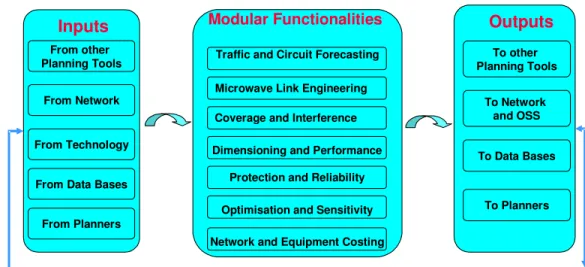
4.3. TRANSMISSION PLANNING... 41
4.3.1. Tool scope - main characteristics... 41
4.3.2. Network model - network architecture, customers, services, traffic, etc. ... 41
4.3.3. Forecasting - services, traffic matrix, users distribution and user segments... 43
4.3.4. Calculation modules - network dimensioning and optimisation... 43
4.3.5. Input/output data - GUI, maps, reports ... 44
4.3.6. Platform - tool architecture and system requirements... 44
4.3.7. NGN - requirements related to NGN and corresponding new technologies... 44
4.4. FIXED ACCESS PLANNING ... 46
4.4.1. Tool scope - main characteristics... 46
4.4.2. Network model - network architecture, customers, services, traffic, etc. ... 47
4.4.3. Forecasting - services, traffic matrix, users distribution and user segments... 49
4.4.4. Calculation modules - network dimensioning and optimisation... 50
4.4.5. Input/output data - GUI, maps, reports ... 53
4.4.6. Platform - tool architecture and system requirements... 54
4.4.7. NGN - requirements related to NGN and corresponding new technologies... 54
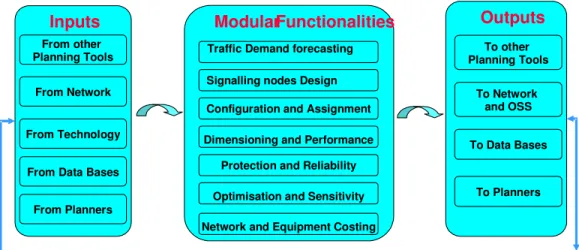
4.5. SIGNALLING, CONTROL AND NM PLANNING ... 56
4.5.1. Tool scope - main characteristics... 56
4.5.2. Network model - network architecture, customers, services, traffic, etc. ... 56
4.5.3. Forecasting - services, traffic matrix, users distribution and user segments... 57
4.5.4. Calculation modules - network dimensioning and optimisation... 57
4.5.5. Input/output data - GUI, maps, reports ... 58
4.5.6. Platform - tool architecture and system requirements... 60
4.5.7. NGN - requirements related to NGN and corresponding new technologies... 60
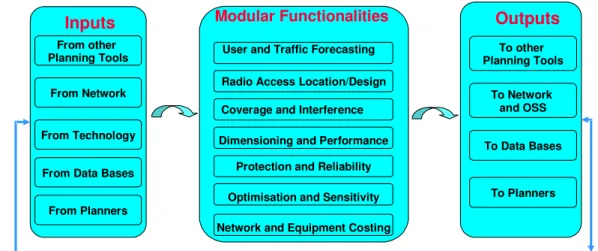
4.6. RADIO ACCESS PLANNING ... 61
4.6.1. Tool scope - main characteristics... 61
4.6.2. Network model - network architecture, customers, services, traffic, etc. ... 62
4.6.3. Forecasting - services, traffic matrix, users distribution and user segments... 64
4.6.4. Calculation modules - network dimensioning and optimisation... 64
4.6.5. Input/output data - GUI, maps, reports ... 68
4.6.6. Platform - tool architecture and system requirements... 69
4.7. CORE RADIO PLANNING... 72
4.7.1. Tool scope - main characteristics... 72
4.7.2. Network model - network architecture, customers, services, traffic, etc. ... 72
4.7.3. Forecasting - services, traffic matrix, users distribution and user segments... 73
4.7.4. Calculation modules - network dimensioning and optimisation... 73
4.7.5. Input/output data - GUI, maps, reports ... 75
4.7.6. Platform - tool architecture and system requirements... 76
4.7.7. NGN - requirements related to NGN and corresponding new technologies... 76
4.8. IT ARCHITECTURE, OSS AND APPLICATIONS PLANNING ... 78
4.8.1. Tool scope - main characteristics... 78
4.8.2. Network model - network architecture, customers, services, traffic, etc. ... 79
4.8.3. Forecasting - services, traffic matrix, users distribution and user segments... 79
4.8.4. Calculation modules - network dimensioning and optimisation... 79
4.8.5. Input/output data - GUI, maps, reports ... 80
4.8.6. Platform - tool architecture and system requirements... 80
4.8.7. NGN - requirements related to NGN and corresponding new technologies... 81
ANNEX – EXAMPLE OF REQUEST FOR PROPOSALS FOR SUPPLY OF A NETWORK PLANNING TOOL ...82
Note: This Document is an internal ITU Document intended only for use by the Member States of the ITU and by its
Chapter 1 – Introduction and scope
1.1. ITU Vision on Network Planning Background
Telecommunication networks architectures are changing to meet new requirements for a number of services/applications (Broadband, IP, Multimedia, mobile, etc.).
New generation equipment (soft switches, databases, service controllers, new protocols and interfaces, etc.) and new call/mix traffic cases are going to be introduced in the networks. In this document such networks will be referenced with the name Next Generation Networks (NGN), as it is presently popular to call them within the telecommunications community. Different solutions/network architectures can be taken into account for a smooth transition from existing network infrastructures (PSTN/PLMN) towards NGN as a result of the
convergence process leading to different applications/services sharing network infrastructures.
Planning Strategy
Considering the different solutions/network architectures that exist and the continuing
evolution of telecommunication networks, each Network Planning case has to be analysed and dealt with by using more than just one planning tool. It means that maintaining and updating a unique tool is not the correct strategy to be applied for Network Planning.
Therefore, any real Network Planning case should be dealt with by using different powerful and modern tools available on the market.
Taking into consideration the continuing evolution of telecommunication networks, adequate strategies have to be chosen by all stakeholder using Planning Tools if update and maintain planning tools inside or to rely on specialized companies capable of maintaining and updating such tools on regular basis and upon specific requests of customers. The major concerned telecommunication Companies normally use different tools (or different packages integrated on a unique platform) for network Planning. They usually rely on the services of software companies who are in a position to provide quick updates as soon as required.
1.2. Scope and use of this Reference Document
The Reference Document GNPT is intended to be used by network planning experts and managers from telecom operators, policy makers and regulators of developing countries and countries with economies in transition to facilitate the selection and the choice of appropriate Network Planning Tools needed for the development of their respective strategies for evolution of the present network architectures and transition to the next generation networks - NGN.
The Reference Document GNPT is to provide recommended features and evaluation criteria of NGN planning software packages with the following objectives:
• To meet a large scale of view points and user-oriented requirements from regulators, network operators, and telecommunications equipment vendors when operating in deregulated and global telecommunications market.
• To meet the requirements in development of next generation networks of domestic and international network operators and service providers.
o Forecast of voice and non-voice service demands and market shares. o Forecast of voice and non-voice traffic on converged networks.
o Transport technologies: Ethernet/RPR/IP/NGI/MPLS/NGN & NG-SDH/ WDM/DWDM/Optical switching
o Mobile technologies: 2G/2.5G/3G/4G and converged networks
o Access technologies: copper cables, x-DSL, PON, power lines, CATV cables & WLAN, WMAN, WLL,
• To specify functional requirements
o Describe functionality or system services.
o Depend on the type of software, expected users (regulators/planners/designers) and the type of system where the software is used.
o Functional user requirements may be high-level statements of what the system should do but functional system requirements should describe the system services in detail.
• To specify non-functional requirements
o Product requirements which specify that the delivered product must behave in a particular way e.g. execution speed, reliability, etc.
o Organisational requirements which are a consequence of organisational policies and procedures e.g. process standards used, implementation requirements, etc.
o External requirements which arise from factors which are external to the system and its development process e.g. interoperability requirements, legislative requirements, etc.
• To specify domain requirements
o Derived from the application domain and describe system characteristics and features that reflect the domain.
o Domain requirements be new functional requirements, constraints on existing requirements or define specific computations.
Note: This Document is an internal ITU Document intended only for use by the Member States of the ITU and by its The Reference Document Guidelines for Network Planning Tools for Developing Countries and Countries with economies in transition (GNPT) intends to present an objective and tool neutral view of the issues to be addressed in the selection and acquisition of
computer tools needed for planning of the telecommunications networks, including the transition to NGN.
1.3. Content of the Reference Document
This Reference Document Guidelines for Network Planning Tools for Developing Countries and Countries with economies in transition (GNPT) comprises 4 chapters and one annex.
Chapter 1 provides the objectives of the Reference Document and the context for planning at ITU members as well as the content of the different chapters of the Reference Document and relation to other ITU activities and documents.
Chapter 2 will review the needs for assessment on proper tools and tool combination, the needs for training on tool applicability and capabilities, the needs for documentation and the needs for tool support, updates and maintenance. The Main Characteristics and Features of planning tools are presented and common procedures to be followed in the process of a tool application and acquisition are described.
Chapter 3 identifies the most typical planning problems and activities as well as the network planning types and domains to which those activities have to be applied.
Chapter 4 gives requirements to the planning tools, organised by 8 planning domains, derived from planner needs and networking problems in order to group the different needs by affinity, minimise the number of tools to be applied and facilitate their interrelations.
In the Annex, example of request for proposals (RFP) for supply of particular network planning tool is presented. Purpose of the example is to clarify the structure of such document and to outline the different items in the RFP
1.4. Relation to other ITU documents
Additional information related to the topic of this reference document could be found in the following ITU documents:
- Reference Manual on Telecom Network Planning for Evolving Network Architectures Version 02, ITU, Geneva, 2005
Chapter 2 – Needs for network planning by ITU members
2.1. Needs for assessment on proper tools and tool combinations
Network planning activities evolve with the proper evolution of the network, the services, the technologies, the market and the regulatory environment. These evolutions imply a wider set of options to implement a network than in the past and as a consequence, the importance of careful planning and analysis for alternatives have larger impact on the network capabilities today in order to assure the needed capacities, the associated quality of service and the required investments.
Considering the initial status of the operator’s network and the different solutions/network architectures that exist for the network evolution, each Network Planning case has to be analysed and dealt with by using proper planning tools and tool combinations.
Therefore proper planning tools and tool combinations need to be assessed and a portfolio of planning tools supporting different planning activities needs to be selected.
The main Characteristics and Features to be taken into consideration in choosing and selecting planning tools are:
- capability to model modern technologies and technical requirements - commercial availability,
- capability to interrelate different planning tools among themselves and with the Operational Support Systems
- explicit documentation of models, inputs and results, - commitment for periodical updates and maintenance, - training program with reference cases,
- validation process for a range of cases - and being well proven in the field.
Note: This Document is an internal ITU Document intended only for use by the Member States of the ITU and by its 2.2. Main Characteristics and Features of planning tools
In this subchapter the main requirements and characteristics to be taken into consideration in selecting and choosing the planning tools for any specific Network Planning case are
2.2.1. Capability to model modern technologies and technical requirements
The tool should model current systems and new technologies for all network layers, taking into account NGN and convergent solutions based on IP protocols and standards. The modeling and capabilities for the following subsystems have to be explicit:
- Networks and sub networks - Systems, nodes and links
- Routing procedures within a network and inter-networks - Protocols for the carrying flows
- System Interfaces
- Capacities in the proper units of the network resource (Mbps, Packets per second, calls per second, erlangs, etc.) for each system
- Costs as a function of main drivers in fixed and incremental units - Cost /revenue analysis
The tool shall be totally vendor independent and allow to conduct network planning for network elements of any system vendor. It shall also allow to model networks consisting of network elements from different vendors (mixed networks).
Past history of the tool or current state has to be known as well as the planned future development of the package, i.e. Road map for the evolution of the proposed solution with features incorporation.
Note: This Document is an internal ITU Document intended only for use by the Member States of the ITU and by its 2.2.2. Commercial availability
The tool should be commercially available under clear and defined commercial conditions and should include the context and type for the tool license, timing, number of users, prices and discount factors by volume when several tools of the supplier are licensed to the customer or multiple users are allowed
2.2.3. Capability to interrelate different planning tools
The tool should have the capability to interrelate with other planning tools in order to facilitate an overall planning coordinating the different network domains as well as with the Operational Support Systems implemented in the operational networks.
In particular, the following interrelations need to be available:
- Common information to the different network layers like geographical position, distances, physical media, etc.
- Information transfer for communication resources demand from each layer to the underlying layer and mainly between adjacent network layers like transmission and switching, transmission and physical paths, etc.
- Information transfer for network resources availability at each layer for the upper layers like fiber capacities, transmission capacities, point to point paths, etc. - Network status and traffic demands obtained from Operational Support Systems
applications at historical stages towards inputs definition modules at the corresponding network layer
- Performance measurements and QoS parameters for traffic flows from the
corresponding Operational Support Systems to the quality design related planning programs
Note: This Document is an internal ITU Document intended only for use by the Member States of the ITU and by its 2.2.4. Explicit documentation of models, inputs and results
The tool content should be available with enough accuracy for the inputs, network models, algorithms, technologies and results in order to facilitate the applicability to the pretended solutions as follows:
- Model features with the functionalities related to the planning problem to be solved
- Level of description of the technologies represented - Inputs required to run the tool end expected results
- User guide for a user that has to install, maintain and run the tool with the corresponding list of known error messages
- Range of tool validity in the network sizes and optimization degree - Exchange of information with other applications and tools
- Editorial procedures for maps and tables associated to the network, nodes and paths
2.2.5. Commitment for periodical updates and maintenance
Support and maintenance should be provided to the tools in their life cycle according to the specified Service Level Agreement as summarized:
- Timeframe for the generation of new tool versions
- Periodicity in the tools update either due to the regular upgrades or to the corrections of detected bugs
- Reaction time to solutions and/or corrections for the issues detected by the customer subject to the contract
Note: This Document is an internal ITU Document intended only for use by the Member States of the ITU and by its 2.2.6. Training program with reference cases
The tool should have available training program including the following: - Training Packages on tool application and capabilities - Training on reference cases with data from real networks
- Duration of each training block and the recommended number of participants - Total time period that is necessary to conduct all training blocks and the training
language
- Training Documentation to be delivered for each training module - Training Logistics
2.2.7. Validation process for a range of cases
Acceptance test procedures to verify that the tool guarantees compliance with all technical requirements specified by the customer during the acquisition process should be available. In particular, the following validation process needs to be available:
- Validation process for network routing procedures, system functionality, capacity and costing models as described in Chapter 4.
- Validation process on the performance of the planning tool in terms of size of the network (number of nodes, links, cells, etc.)
- Validation process on the performance of the planning tool in terms of time to execute one typical planning case
Set of reference networks for the performance evaluation should also be available.
Note: This Document is an internal ITU Document intended only for use by the Member States of the ITU and by its 2.2.8. Being well proven in the field
Reference information for the planning tool, showing that the tool has been well proven in the field, should be available:
- Reference list of customers who have obtained that tool
- Reference list of cases (networks) that have been planned with that tool - Past history of the product and planned future development of the package - References for the tool in publications (technical and scientific journals or
magazines, etc.)
2.3 Procedures to follow in tool application and acquisition
Common procedures to be followed in the process of a tool application and acquisition consists of:
- Planning problem identification and tool mapping
- Preparation of request for application and corresponding conditions
In the Annex, an example of typical request for proposals (RFP) for supply of network planning tool is presented.
Purpose of the example is to clarify the structure of such document and to outline the different items in the RFP
The particular planning tool, in this case fixed access planning tool, is not of main
importance. Rather the example could be used as model for preparation of the related RFP document for a real case.
Note: This Document is an internal ITU Document intended only for use by the Member States of the ITU and by its 2.3.1. Planning problem identification and Tool mapping
Evolution of the network, the services, the technologies, the market and the regulatory environment imply set of options to implement a network which assures the needed capacities, the associated quality of service and the required investments.
Different planning problems have to be identified and solved in appropriate sequence, so that investments and services are planned in a manner which makes sure there is no costly over-investment nor bad utilisation of already made over-investments and at the same time ensures fluent migration of the services for the large amount of existing subscribers.
Considering the different solutions/network architectures that exist, each network planning problem has to be analysed and dealt with by using proper planning tools or tool
combinations.
2.3.2. Request for application and conditions
The standard procedure for supply of a network planning tool is through preparation of request for proposals (RFP).
Main topics in RFP for supply of a network planning tool cover: • General conditions
• Technical specifications
• Support issues, documentation, training and maintenance • Acceptance test procedures
• Commercial conditions
General conditions describe the common requirements, notations and purpose of the request for proposals.
The technical specifications include requirements to the software platform, system requirements (minimum configuration), recommended network connections, GUI, import/export of data, network models, forecasting methods, technology definition, dimensioning/optimization algorithms, network synthesis, reporting.
Conditions for the tool architecture.
If separate tools cover different planning domains, modular organisation of integrated suite of tools is preferable. All modules shall be of Windows type application including help features. They shall be easily upgraded
Common Data Repository is an advantage. All tools shall store and retrieve their data on a common data repository. This common data repository is accessible by all users who have the appropriate access rights.
Client/Server Solutions and stand-alone version.
The software shall be available in stand-alone version and/or supported in a client /server environment.
Wrapping of legacy tools
In order to interface to the legacy tools that are already used , the software platform should facilitate exchange of required information with that legacy tools.
Optional interface to an Inventory Management System (IMS) could be provided. The vendor shall explain details of this interface and the synchronisation mechanism.
Note: This Document is an internal ITU Document intended only for use by the Member States of the ITU and by its Support issues, documentation, training and maintenance consist of update/upgrade strategy and pricing, defect categories and the response times to fix them, technical support and assistance available during system warrantee period and there after, proposed training package and time period that is necessary to conduct all training blocks, desired set of user and installation manuals.
Accurate user manuals related to the particular planning tools, clarifying not only the tools utilization but also the planning principles, network models, planning methods, margin of tool applicability range (such as network sizes and optimization degree) and list of error messages, are really needed.
Reliable support and maintenance need to be offered and provided by the tools manufacturer with a Service Level Agreement and timing for problem solution.
Organization of the training includes specification of: - Training Package
The proposed training packages that will ensure staff familiarity for all planning tools. The description of the training package shall include the duration of each training block and the recommended number of participants
- Time Schedule and Language
The total time period that is necessary to conduct all training blocks and the training language, e.g. English, etc.
- Training Documentation
Necessary training manuals to be delivered for each training module organized at least in two classes of documents:
-Tool and model description explaining the methodologies, capabilities and validity ranges
-User guide illustrating the tool usage from installation procedures and updating up to the sequence of usage for every module.
- Training Logistics
If training is in-house at Telecommunications Company’s premises, specification of training rooms, presentation facilities, PCs necessary to conduct the training, etc. should be provided Important part of the training is example pilot case on real data delivered by the concerned Telecommunications Company.
Pilot case should be performed by the trainees under the guidance of the tools instructor and should develop and test capabilities of the planning team to continue on its own.
Pilot case should serve also as a model of repeatedly performed network planning activates, e.g. planning of a local network.
- Maintenance
Tools should have included updates and upgrades due to new functionalities within the tool and/or new equipment types incorporated in the network solutions. Typically upgrade period is around 6 month for quick evolution functionalities and one year for stable application. Clear indication of update/upgrade strategy and related pricing should be clearly indicated,. Different defect categories and time to fix them should be clearly indicated.
Type of technical support and assistance available during system warrantee period and after should be clearly indicated.
Acceptance test procedures are to verify that the tool guarantees compliance with all technical requirements specified and all products’ specifications (parameters and functionality), as indicated in the process referenced in 2.2.7.
Commercial conditions include the context for the tool license, timing, number of users, prices and discount factors by volume when several tools of the supplier are licensed to the customer or multiple users are allowed.
Different types of licenses could be applied: - Perpetual license:
For the perpetual license the total amount of each tool is paid in the first year.
From the second year onwards, if support/maintenance/updates is needed, annual amount, usually calculated as percentage from the acquisition cost, has to be paid (e.g. 18% is typical case).
Depending on the tool installations, licenses are for: - tool installed only on one PC (end node user) - tool installed on several PCs
- non-simultaneous use of tool installed on several PCs in a network(floating license)
- License for simultaneous use of tools :
Conventional software licensing schemes typically require one floating license payment for every application the planning team may need.
The result is multiple license purchases for tools that address a broad range of technologies. Practical option is one license for simultaneously used tools, e.g. the Annual Tokens license scheme.
Note: This Document is an internal ITU Document intended only for use by the Member States of the ITU and by its Under the token license system, the value of each tool is represented by a prescribed number of tokens for each tool use. If a user wants to start a tool, he will search for free tokens, the required number of tokens will then be blocked for the duration of tool use. When the user closes an application, the tokens required for its use are released.
For the annual tokens, the annual amount may remain the same every year.
Note: Individual tools are obtained with perpetual license, while annual tokens could be used for set of tools (price is multiple of token).
Preferential Licensing conditions
The preferential conditions of tool acquisition for Developing Countries and Countries with economies in transition, negotiated with the tool vendor, could include one or more of the following:
- Special price with considerable discount from the standard tool cost - Extended training included in the standard tool cost
- Support of a pilot project with real data from the country included in the standard tool cost
Information required from the bidder
The Bidder should include for evaluation purposes the following: • Experience in the telecommunications industry and list of customers;
• Partnerships with other industrial companies in technologies, methodologies or applications • Company ownership, time in the business, financial status;
• Past history of the product and planned future development of the package, i.e. Road map for the evolution of the proposed solution;
• Tools availability and capability to deliver at the different worldwide regions within ITU with central or distributed structure
The proposed tool should be a proven solution, i.e. solution which is operational in other operator’s network planning units;
Note: This Document is an internal ITU Document intended only for use by the Member States of the ITU and by its
Chapter 3 – Network planning problems to be addressed by
planning tools
Most problems a network planner has to solve, require support by informatic planning tools either due to the volume of information to handle, the complexity of the task, the strong interrelations among variables or the high computation capacity needed like in the optimisation algorithms.
Within this chapter, the most typical planning problems and activities are identified as well as the network planning types and domains to which those activities have to be applied.
3.1. Network planning problems and activities
- First problem the planner faces is the knowledge of the initial situation for the economy, the market, the customers, the services and the network. In this case, the high volume on information and the need for correlation among the data for a given time and space implies the use of data bases with both text and graphical tools to analyse, process, interpolate and extrapolate data. Those tools will be applied at different planning phases and need to be compatible with the other tools and to be used independently or also commonly with them. - Data gathering is the immediate next task of the planner and most frequently a high time consuming one. Due to the high variety of information: social, economical, technical and operational, data has to be gathered from many sources at country level, so relational data bases are needed as well as procedures to allow information to be consolidated.
- Due to the complexity of a full network planning, activities have to be splitted in tractable problems and the planner task is the partitioning into modules, grouping and further
interrelation. This impose a global requirement for all tools and associated platform that need to be modular in order to focus on specific technology issues and allow interrelation among them for the further integration of results.
- For all planning tasks, it is necessary to be able to forecast demands for the customers, services, traffic and equipment. This is one of the most difficult tasks for the planner and tools should have different projection methodologies for short, medium and long term forecasting.
- With the high variety of technologies available, a new planner problem is to perform the mapping of feasible solutions for that problem and evaluate best technology with techno-economical criteria. Tools that allow a number of iterations and what-if analysis are fundamental to perform this function and select the appropriate solution for each planning domain.
- Once that the planner is focussed on a specific problem and solution, the central activity for a planner is the future network design, equipment geographical location, dimensioning and costing. This set of functions are the more technical ones and require a set of tools which model correctly the architectures, technologies, network paths, systems, capacities and costs in order to ensure to carry the services demand which was predicted with the appropriate Quality of Service.
- In those networking issues in which a very high number of alternatives appear, the high combinatory complexity do not allow manual evaluation and it is required the implementation of optimisation algorithms which work frequently at the limit of the computational capacity for high size networks (i.e.: larger that 200 nodes). These are the key engines in the
capacity/cost optimisation that generate high economical savings and require special attention when selecting most powerful tools.
- After all design and optimisation process, a strategic evaluation has to be performed with all external implications and a specific plan is selected with the consolidation and reporting. All
Note: This Document is an internal ITU Document intended only for use by the Member States of the ITU and by its internal company departments. That reporting functions have to be available in the tools with enough flexibility to be applicable at all network segments and planning domains.
- High dynamic behaviour of current technological solutions generates the problem of high rate on information actualisation within the actual network and between the network and the plans. Tools require to perform the linking of plans and OSSapplications by powerful relations that ensure information flow in the two directions: from network plans to OSS configurations and from OSS updated results to the input provision to the design of plans. 3.2. Network planning types and domains
The high complexities of the telecom networks imply the need to organise their analysis in many dimensions either by network type, segment, layer and time scale.
- From the network type dimension, we may address public or private networks, fixed or mobile, terrestrial or satellite, etc. and specific problems and requirements are a function of those characteristics
- From the network segment we consider, basically focussing may be given to the access, local, metropolitan, core national, core international and end-to-end segments. Again, planning activities, solutions and required tools are dependent on the segment type
- At the network layer side, most frequent splitting of the problems is done at the following ones: physical, transmission, switching/routing, control-NM, IT-OSS- Applications. Network evolution may be performed at all layers or at a given subset, being planning functionalities substantially different from the low physical layer with long time standing heavy
infrastructure, to the upper layer with very flexible and dynamic evolution.
- Considering the planning types as a function of the time scale, most typical issues may be analysed at :
- Short term (less than 2 years), for the current telecommunications demands and services that have to satisfied with the already installed capacities without additional capital investments.
-Medium term (between 2 and 5 years), for the capacity upgrading of the network nodes and links, telecommunications systems to be installed or uninstalled location and routing that guarantee the specified quality of service
- Long term (5 or more years) to define the architecture to be used in each domain, physical nodes and paths as well as the topology and location of the network parts which are
characterised by a long lifetime and large investments for their deployment.
- Strategic focussing within long term when a specific selection of the key issues are summarised as a master guide.
When observing the network planning problems, all the identified activities within 3.1 have to be characterised and customised to all planning types and domains in 3.2. This allows to organise the technical requirements as in the following chapter.
Chapter 4 – Technical requirements per planning domain
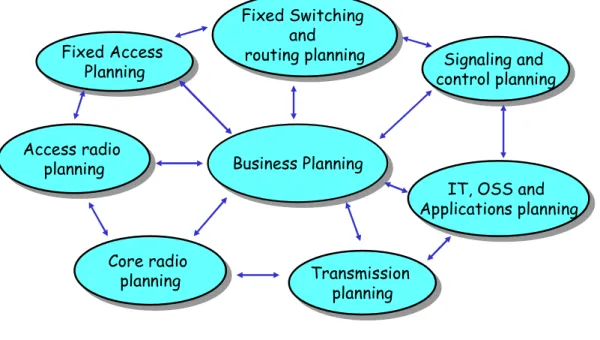
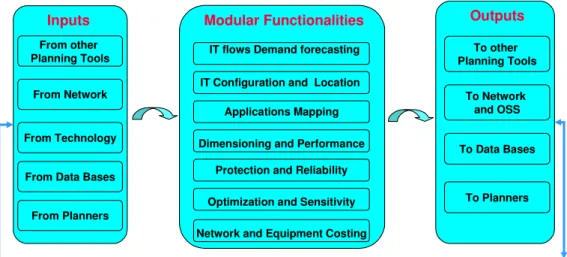
In this chapter, requirements are organised by 8 planning domains, as in the figure, derived from previous planner needs and networking problems in order to group the different needs by affinity, minimise the number of tools to be applied and facilitate their interrelations.
Note: This Document is an internal ITU Document intended only for use by the Member States of the ITU and by its 4.1. BUSINESS PLANNING
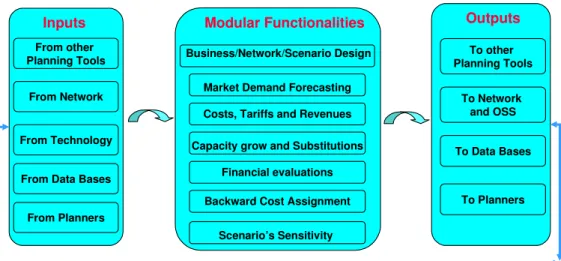
Business planning refers to all business related projections, analysis and evaluations either for a full network and market or for any subset of them. It has a strategic orientation and pursues the evaluation of feasible and most profitable solutions. This activity receives inputs from social and techno-economical databases while provides results to all the technical planning domains as summarised in fig 4.1.
4.1.1. Tool scope - main characteristics
Main objective of the tools for business planning is the support to the business decision-making that enables the analysis of business models and cost assignment for
telecommunication networks and services over a period of time. Business planning has to be based on a service demand model organised by market segments, service types and geo-scenarios, which will establish direct relations between demands, CAPEX and OPEX. That demands should drive the resource dimensioning, replacements, costing and revenue generation as well as the calculation of all standard and frequent financial parameters and ratios.
According to the different problems and degrees of detail identified in chapter 3, the tools should be able to analyse a business model with different degrees of detail, either at macroscopic level for a global network and large customer classes as well as at microscopic level for sub-networks, systems and services. Also it has to take capabilities for backward cost assignments in order to know causes of costs per service type and calculate profitability for service or group of services.
Modular Functionalities
Market Demand Forecasting Costs, Tariffs and Revenues Capacity grow and Substitutions
Financial evaluations Backward Cost Assignment Inputs
From other Planning Tools
From Network From Technology From Data Bases From Planners Outputs To other Planning Tools To Network and OSS To Data Bases To Planners
Fig 4.1 Functional modular requirements for the business planning domain
Scenario’s Sensitivity Business/Network/Scenario Design
Due to the high number of alternatives to analyse in short periods of time, a fundamental requirement is the capability to perform many what-if analysis for variation of scenarios, services, technologies, costs, economies of scale, tariffs, elasticity, revenues and grade of service with the easy evaluation and comparison of all of them.
4.1.2. Network model - network architecture, customers, services, traffic, etc. Tools should provide modelling capabilities with the following characteristics:
- All network layers: physical, transmission, switching/routing, control/NM, IT/OSS/ Applications and technologies including voice, data, multimedia and NGN for any network type and size.
- Network resources modelling with several degrees of detail according to planning objectives: from full sub-networks to each individual element like fibers or line cards.
- Modelling multiple resource lifetimes per type of resource - Modelling multiple time periods: months, quarters, years - Typical customer classes as residential, business, SOHO, etc. - Parametric definition of new customer classes
- Service of voice, data, video or multimedia type - Service Demand Projection per customer class
- Modelling of the churn rates for customers or technologies
- Evaluation of network resources and associated investment (CAPEX) - Representation of service tariffs for connections, rental and usage - Modelling of demand elasticity to tariffs
- Evaluation of revenues per service and customer classes for given tariffs and installation rate
- Equipment substitution and terminal cost - Operational and maintenance costs
- Interrelation between network growth and operational cost (OPEX) - Cost assignment as a function of resource utilisation rates
Note: This Document is an internal ITU Document intended only for use by the Member States of the ITU and by its - Standard financial results like Cash Flow, Profit & Loss, Balance Sheet and all
typical business related parameters
- Financial evaluators and ratios as: NPV, IRR, ROI, ROE, ROA, ROCE, etc. 4.1.3. Forecasting - services, traffic matrix, users distribution and user segments Forecasting models should be given for application at customers, customer segments or services levels with at least the following models:
- Linear projection,
- Interpolation and extrapolation - Logistic,
- Dual logistic - Exponential, - Time series - Predefined curves
4.1.4. Calculation modules - network dimensioning and optimisation Calculations within the tool need to have the following capabilities:
- All forecasting models identified above
- Traffic evaluation and dimensioning with classical erlang models for a given GoS - Traffic evaluation and dimensioning with occupancy models
- Traffic evaluation models for equivalent sustained bit rate in multi-service environments
- Capability for traffic evaluation and dimensioning based on additional given predefined rules
- Annual traffic to busy hour and busy period traffic conversion
- Dimensioning formulas for equipment dimensioning and rounding to modularity - Cost trends projections for technologies
- Financial formulas for interests, tax, dividends, working capital, cash-flow, operating profit, future value, past value, NPV, depreciation, amortisation, terminal values, etc.
4.1.5. Input/output data - GUI, maps, reports Tools should provide:
- Import and export functions from/to other network layer planning - Interface to Excel for input and output data
- Interface to word for results reporting
- Financial diagrams for all results in linear, bar or cake formats
- Customisation of diagrams to add new results in table or graphical formats 4.1.6. Platform - tool architecture and system requirements
Tools must work in a PC running Windows 98, Windows 2000, Windows NT or Windows XP. Platform should have object-oriented capability with an editing interface that associates data directly with modelling resources and links between modelling elements.
Audit and checking functions have to be provided to know explicit track of precedence, hierarchies, interrelations and causes for intermediate or derived final results.
Processing and editing functions should be available for graphical, table and text handling. Internal handling of graphical functional network structures should provide explicit correspondence to associated parameters per modelled network resource.
4.1.7. NGN - requirements related to NGN and corresponding new technologies
Tools should have the capability to model new NGN networks, Convergence and intermediate migration steps for:
- NGN systems like Softswitches (SSWs ) and Gateways (GWs) with their corresponding capacities, capital costs, operational costs, lifetimes, etc. - Interrelations among NGN network subsystems, nodes and links
- Service demands characterisation and traffics for VoIP and NGN multi-service flows including constant rates, guaranteed flows and elastic traffics.
Note: This Document is an internal ITU Document intended only for use by the Member States of the ITU and by its - Network and systems dimensioning with the multi-service NGN criteria based on
equivalent data bandwidth methods for the aggregation of service flows 4.2. FIXED SWITCHING AND ROUTING PLANNING
The domain of fixed switching and routing planning includes all traffic demand flows
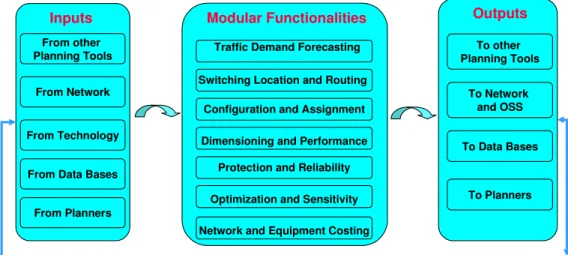
projections and the design, location, flow routing, dimensioning, costing and optimisation for any fixed network at local, metropolitan or transit level. It has a major technical focus and receives inputs from current network, business planning and transmission planning while provides results to transmission planning and control planning as summarised in fig. 4.2.
4.2.1 Tool scope - main characteristics
Main objective of the tools for the fixed switching and routing planning is the support to the planner in the technical network design, definition of architecture and dimensioning in order to ensure that functional network carries the origin/destination traffic demands with the agreed quality of service for a given period of time.
According to the different network segments of application and the technologies used, a variety of functionalities is required that may be customised to each scenario either for voice, data or multimedia services types.
The strong interrelation with the other adjacent network layers imply the need to use
information from the business planning, use and pass information to the transmission network layer as well as to the control and signalling layer.
4.2.2 Network model - network architecture, customers, services, traffic, etc.
Modular Functionalities Traffic Demand Forecasting Switching Location and Routing
Configuration and Assignment Dimensioning and Performance
Protection and Reliability Optimization and Sensitivity Inputs
From other Planning Tools
From Network From Technology From Data Bases From Planners Outputs To other Planning Tools To Network and OSS To Data Bases To Planners
Fig 4.2 Functional modular requirements for the swictching and routing domain
Tools should provide modelling capabilities with the following characteristics:
- Traffic Planning with pre-processing of traffic measurement data and integration with projected demands for the planning period
- Forecast of traffic matrices for origin destination sources with different traffic units: erlangs, bandwidth, calls, packets or circuits
- Conceptual Network Design and Capacity Planning
- Analysis of network consolidation with reduction of hierarchical levels and increasing sizes for nodes and links
- Consideration of hierarchical and non-hierarchical architectures with fixed, load sharing and dynamic routing
- Consideration of network topologies with different degrees of connectivity: mesh or partially meshed
- Capability for network sizes of at least 256 nodes and pre-processing with partitioning methods for larger networks
- Finding locations of transit switches for hierarchical networks - Differentiation of customers by main residential and business classes
- Calculation of loads and capacities including dimensioning taking into account load sharing and traffic overflows
- Optimisation of trunk groups in an overflow structure
- Optimisation of locations and connections of network gateways
- Finding out the demand for transmission channels for the underlying transmission network
- Cost, Performance and Reliability Analysis
- Analysis of utilisation of network capacities and finding out the bottlenecks - Estimation of the end-to-end traffic quality of service at global level and point to
point
- Estimation of investment costs for the rollout and the extension of the investigated circuit-switched network
Note: This Document is an internal ITU Document intended only for use by the Member States of the ITU and by its - Allocation of the 64kbit/s channels (with payload, signalling traffic, semi
permanent connections)
4.2.3 Forecasting - services, traffic matrix, users distribution and user segments Tools should provide:
Forecasting of traffic at network sources with linear, exponential and logistic procedures for typical customer types and service traffic flows (voice or data). Availability of aggregation and desegregation functions for the different traffic flow types of the customer classes. Forecast of traffic NxN matrices for origin destination sources with typical methods like Kruithof, affinity and correlation for network scenarios with equal or different service areas between initial and final year. N should be at least 256 and pre-processing with partitioning methods when larger networks are needed.
4.2.4 Calculation modules - network dimensioning and optimisation Tools should provide modelling capabilities with the following characteristics:
Dimensioning methods for loss based systems including Erlang-B formula, overflow routing, and equivalent random method. Application of the methods to circuit-switched networks including hierarchical alternative routing and non-hierarchical routing. Multi-hour dimensioning methods.
Dimensioning methods for delay based systems including Erlang-C, Erlang multi-rate, hyper-exponential models and processor sharing models. Application of the methods to packet-switched networks.
Traffic evaluation models for equivalent sustained bit rate in multi-service environments. Capability for traffic evaluation and dimensioning based on additional given predefined rules. Annual traffic to busy hour and busy period traffic conversion.
Evaluation methods for calculating link, path and route GoS, at the designed network and utilisation factors at nodes and links.
Evaluation methods for reliability of network, sub-networks and systems based on individual reliability parameters
Calculation of protection levels for end-to-end routes and diversity paths with single node, single link and combined failure survivability.
Evaluation of costs with polynomial models based on fixed and marginal costs per cost driver such as systems, cabinets, modules, racks, cards, ports, erlangs, Mbytes, Mbps, etc.
Optimisation algorithms for network topology and routing, including minimal connectivity, connectivity of level "n", flow optimisation, GoS objective functions, disjoint paths and
protection. Associated dimensioning methods for resilient circuit-switched networks and packet-switched networks with single node, single link and combined failure survivability. Calculation models for circuit switching and packet switching are applicable in an NGN in which subnetworks and Network Elements need both type of models such as the Gateways and Application Servers. It is preferred to have all models available in the tools with an integrated view of NGN and have the planner to decide were to apply each, as many hybrid situations appear both in the networks and the systems.
4.2.5 Input/output data - GUI, maps, reports Tools should provide:
- Import and Export Functions from/to other Network layer planning - Import/export from/to text files and Excel
- Device catalogue and configuration view for the network nodes - Output of routing tables for switches
- Configuration of switching nodes with modules and ports - Generation of reports about the allocation of devices
- Display of the routing of traffic relations and semi-permanent connections - Inspector for the routing tables in the switching nodes
- Capability for customised import and export filters as a function of formats in other related tools
- Interfaces with existing databases using Microsoft ODBC and capability to extend it with further database modules under demand
4.2.6 Platform - tool architecture and system requirements
Tools must work in a PC running Windows 98, Windows 2000, Windows NT or Windows XP. Monitor with a minimum resolution of 1024 x 768 pixels, 256 colours
Modular architecture for the main functionalities of inputs, traffic demands, configuration, functional routing, circuit routing, costing and outputs.
Note: This Document is an internal ITU Document intended only for use by the Member States of the ITU and by its Internal handling of a GIS both for functional and geographical network structures as well as extraction and conversion capabilities from external GIS
Assignment and resource mapping capabilities with other network layers and planning domains
4.2.7 NGN - requirements related to NGN and corresponding new technologies In addition to the capabilities for conventional networks, tools should provide explicit modelling capabilities for NGN technologies and Convergence such as:
- Service demands characterisation and traffics for VoIP and NGN multi-service flows
- Device catalogue covering most typical NGN technologies
- Routing and dimensioning taking into consideration protocol overheads and reservations mechanisms for QoS requirements (RSVP) and Call Acceptance Control procedures (CAC) based on conditions at origin, destination or combined. - Routing flows for most typical cases including OSPF, shortest path, widest path
and weighted cost functions.
- Optimising locations and connections of network gateways - Formation of virtual networks
- Routing over ATM links or PDH/SDH systems or tunnelling via other IP links - Routing methods for Labelled Switched Paths (LSP)
- Analysis of utilisation of network capacities and finding out the bottlenecks - Handling and output IP routing tables
- Estimation of end-to-end delays
- Allocation of network cost to the bandwidth demands of carried services - Exact allocation of the IP or MPLS links
- Sub networking and addressing
- Configuring the network elements (IP router)
- Standard import and export formats for the complex data structures required for the management of routes in IP/MPLS networks, which you can support from your network database quite easily
- Estimation of investment costs for the rollout and the extension of the investigated multi-service network
Note: This Document is an internal ITU Document intended only for use by the Member States of the ITU and by its 4.3. TRANSMISSION PLANNING
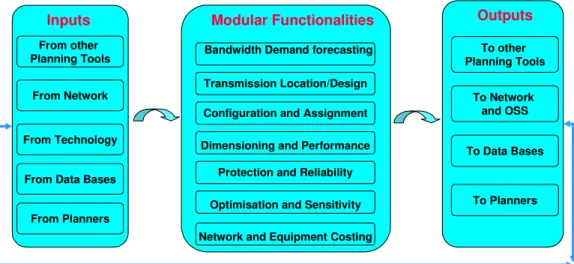
The domain of transmission planning includes all circuit and link demand flows projections and the design, location, path routing, dimensioning, costing and optimisation for any network at local, metropolitan or transit level. It has a major technical focus and receives inputs from current network, business planning and switching and routing planning while provides results to switching and routing planning as summarised in fig. 4.3.
4.3.1. Tool scope - main characteristics
Main objective of the tools for the fixed switching and routing planning is the support to the planner in the technical network design, definition of architecture and dimensioning in order to ensure that functional network carries the origin/destination bandwidth or circuit demands with the agreed quality of service for a given period of time.
According to the different network segments of application and the technologies used, a variety of functionalities is required that may be customised to each scenario either for voice, data, multimedia services types as well as for or external sub-networks.
The strong interrelation with the other adjacent network layers imply the need to use and pass information to the switching and routing planning as well as to the business planning
4.3.2. Network model - network architecture, customers, services, traffic, etc. Tools should provide modelling capabilities with the following characteristics:
Modular Functionalities Bandwidth Demand forecasting Transmission Location/Design Configuration and Assignment Dimensioning and Performance
Protection and Reliability Optimisation and Sensitivity Inputs
From other Planning Tools
From Network From Technology From Data Bases From Planners Outputs To other Planning Tools To Network and OSS To Data Bases To Planners
Fig 4.3 Functional modular requirements for the transmission domain Network and Equipment Costing
- Conceptual Network Design and Capacity Planning for SDH/SONET and WDM systems
- Consideration of a given infrastructure (e.g. fiber-optic cables, microwave systems, ducts)
- Comparison of different network structures (e.g. partly-meshed and ring-like network structures)
- Recommendation on sub-networks design and splitting by affinity criteria with derived ring formation
- Detailed allocation and grouping of containers
- Configuration of devices (multiplexers, cross-connectors, etc.) in the network nodes
- Definition of the transport medium for the systems (e.g. fiber-optic cable, DWDM system, microwave)
- Analyse alternatives for the wavelength conversion
- Routing of end-to-end connections by various criteria over disjoint paths and the possible protections
- Restoration systems including unprotected, dedicated restoration and shared restoration
- Calculation of loads and capacities, including dimensioning of rings - Cost, Performance and Reliability Analysis
- Analysis of utilisation of network capacities and finding out the bottlenecks - Calculation of end-to-end availability’s and comparison with the requirements - Estimation of investment costs for the rollout and the extension of the investigated
transport network
- Allocation of network cost to the bandwidth demands - Estimation of signal delay times
- Generating reports on routing and dimensioning
- Generation of reports about allocation of physical systems and allocation of devices
Note: This Document is an internal ITU Document intended only for use by the Member States of the ITU and by its 4.3.3. Forecasting - services, traffic matrix, users distribution and user segments
Tools should be able to perform:
Forecasting of bandwidths and circuits at network sources with linear, exponential and logistic procedures for typical customer types. Processing and aggregation of bandwidth demands coming from upper network layers with the corresponding interpolation and/or extrapolation when needed.
Forecast of traffic NxN matrices for origin destination sources with typical methods like Kruithof, affinity and correlation for network scenarios with equal or different service areas between initial and final year. N should be at least 256 and pre-processing with partitioning methods when larger network needed. Handling capability of both real numbers (for bandwidth) and integer numbers (for circuits) in the transmission matrix calculation and alignment.
4.3.4. Calculation modules - network dimensioning and optimisation Tools should provide modelling capabilities with the following characteristics:
Configuration models for the nodes of PDH, SDH, NG-SDH and WDM types, including multi-layer modelling.
Optimisation of routing, flows and capacity in the PDH, SDH and WDM transport networks, in particular including Flexible Multiplex Hierarchy.
Traffic evaluation models with bandwidth rate, needed for NG-SDH, Ethernet, and corresponding I/F equipments.
Provide capability for self-defined multiplex levels, for instance, to consider special types of microwave systems or concatenated containers.
Evaluation methods for reliability of network, sub-networks and systems based on individual reliability parameters.
Calculation of protection levels for end-to-end routes and diversity paths with single node, single link and combined failure survivability.
Evaluation of costs with polynomial models based on fixed and marginal costs per cost driver such as systems, cabinets, modules, racks, cards, ports, Mbytes, Mbps, etc.
Optimisation algorithms for network topology and routing, including minimal connectivity, connectivity of level "n", flow optimisation, QoS objective functions, disjoint paths and protection. Associated dimensioning methods for resilient transmission networks with single-node, single-link, and combined failure survivability, including the wavelength (lambda) routing.
4.3.5. Input/output data - GUI, maps, reports Tools should provide:
- Import and Export Functions from/to other network layer planning - Import/export from/to text files and Excel
- Device catalogue and configuration view for the network nodes - Generation of reports about the allocation of devices
- Displaying and tracing the routing in the cable or duct network - Manual input of rings and ring inspector
- Finding out the routing of demand units through locations in the node inspector - Tracing the allocation of containers in the inspectors of nodes, edges and paths - Capability for customised import and export filters as a function of formats in
other related tools
- Interface with existing databases using Microsoft ODBC and capability to extend it with further database modules under demand.
4.3.6. Platform - tool architecture and system requirements
Tools must work in a PC running Windows 98, Windows 2000, Windows NT or Windows XP. [in the following chapters only the requirements for Operation System are mentioned]. Modular architecture for the main functionalities of inputs, demand projection, network configuration, routing, protection, equipment assignment, costing and outputs.
Editing and checking functions for intermediate and final results.
Internal handling of a GIS both for functional and geographical network structures as well as extraction and conversion capabilities from external GIS.
Assignment and resource mapping capabilities with other network layers and planning domains.
4.3.7. NGN - requirements related to NGN and corresponding new technologies In addition to the capabilities for conventional networks, tools should provide explicit modelling capabilities for new generation SDH and Convergence, such as:
Note: This Document is an internal ITU Document intended only for use by the Member States of the ITU and by its - Device catalogue covering Next Generation SDH technologies
- Formation of optical networks
- Capability to model IP over SDH and IP over WDM
- Modelling architecture and capabilities of Ethernet mesh topology with Spanning Tree Protocol (STP) and Ethernet ring topology with Resilient Packet Ring protocol (RPR)
- Modelling traffic adaptation procedures like the Generic Framing Procedure (GFP), Virtual Concatenation (VC) procedures and Link Capacity Adjustment Scheme (LCAS)
- Allocation of network cost to the bandwidth, circuit or fiber demands of carried services
- Estimation of investment costs for the rollout and the extension of the investigated multi-service network through the intermediate migration steps
4.4. FIXED ACCESS PLANNING
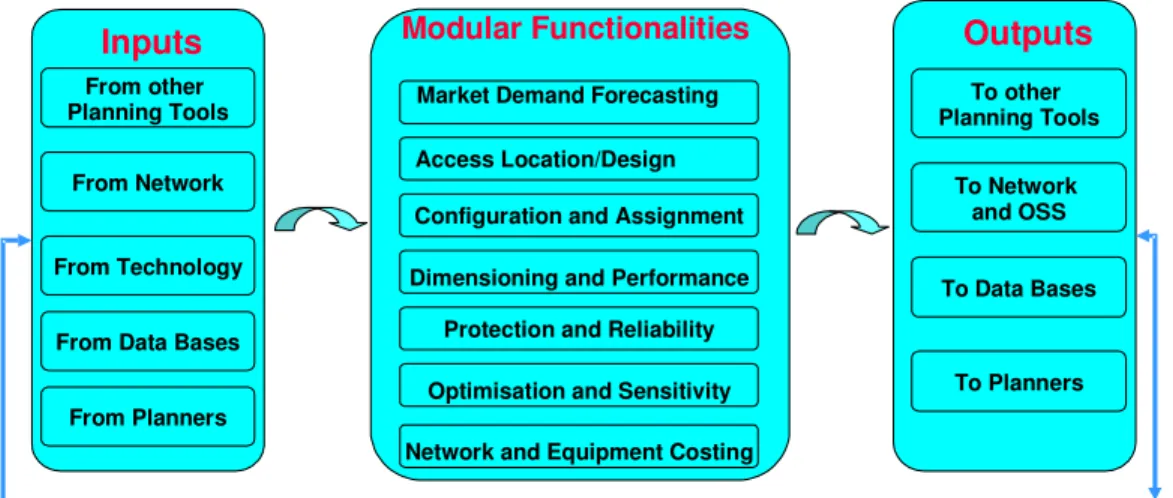
The domain of fixed access planning includes optimization and dimensioning of access nodes numbers, capacities, locations, service areas, etc., for any local network as well as calculation of costs per network elements, considering both the capital (CAPEX) and the operational (OPEX) cost components. Different access modes and technologies, e.g. POTS / ISDN, xDSL, fixed wireless access, PON, etc., need to be considered. Market and service definition and forecasting are also important fixed access planning activities. It has a major technical focus and receives inputs from current network and business planning while provides results to switching and routing planning, as summarised in fig. 4.4.
4.4.1. Tool scope - main characteristics
Fixed access planning tools should aid network planning experts in planning of the access network and selection of the most appropriate technology solution for a particular network through market modeling and forecasting, access network optimization for each technology solution and cost analysis of the resulting network.
The main characteristics of fixed access planning tools are:
- modeling of the market ascustomer segmentation with respect to customer classes and service mixes, presenting of the different services with bandwidth and the nature of traffic (permanent/switched or packet)
- forecasting of customers as numbers and geographical distribution, as well as forecasting of the penetration of different services
- modeling of different access modes and technologies (POTS / ISDN, xDSL, Fixed wireless access, PON, etc.)
- optimization and dimensioning of particular access network in terms of access nodes numbers, capacities, locations, service areas, etc.
- network cost modeling and calculation of costs per network elements, considering
Market Demand Forecasting Access Location/Design Configuration and Assignment Dimensioning and Performance
Protection and Reliability Optimisation and Sensitivity Inputs
From other Planning Tools
From Network From Technology From Data Bases From Planners Outputs To other Planning Tools To Network and OSS To Data Bases To Planners
Fig 4.4 Functional modular requirements for the fixed access domain
Network and Equipment Costing