Quannan Li1, Xinggang Wang2, Wei Wang3, Yuan Jiang3, Zhi-Hua Zhou3, Zhuowen Tu1
1
Lab of Neuro Imaging, University of California, Los Angeles 2Huazhong University of Science and Technology 3
National Key Laboratory for Novel Software Technology, Nanjing University
Abstract. In this paper, we tackle the tracking problem from a fusion angle and propose a disagreement-based approach. While most existing fusion-based tracking algorithms work on different features or parts, our approach can be built on top of nearly any existing tracking systems by exploiting their disagreements. In contrast to assuming multi-view features or different training samples, we utilize existing well-developed tracking algorithms, which themselves demonstrate intrinsic variations due to their design differences. We present encouraging experimental results as well as theoretical justification of our approach. On a set of benchmark videos, large improvements (20%∼40%) over the state-of-the-art techniques have been observed.
1
Introduction
Object tracking has been a long standing problem in vision. Once a tracker gets initialized, it starts to track the target in a video by performing two steps: (1) making a prediction about the location of the target, and (2) updating its object model (location, appearance, and shape) based on the prediction. This is in spirit very similar to the bootstrapping and learning procedure in a learning algorithm. With the recent success in detection-based tracking approaches, an increasing amount of work has treated the tracking problem as a semi-supervised learning problem [1–5]. Picking a target to track at the beginning provides supervised data; the remaining of the frames for the tracker to explore do not contain label information and thus is unsupervised. Due to the errors introduced in both the prediction and model updating stage, nearly any tracker will eventually fail with the errors being accumulated over the time.
Disagreement-based semi-supervised learning approaches [6], such as co-training or tri-training [7, 8], provide a mechanism to allow classifiers trained on different views or data samples to exploit unlabeled data. The learning process is a type of ensemble learning [9–11]. It involves multiple classifiers which label the unla-beled data to update and improve each other [12]. From a different angle, the use of multiple classifiers can be viewed as a fusion problem and it has been shown that fusing complementary features in a tracking system often leads to enhanced performances [13–15]. However, less efforts have been made in learning to fuse well-developed existing algorithms through semi-supervised learning; we will see
later (in both theory and experiments) that a disagreement-based fusion signif-icantly improves the performance over direct combination of features/systems [14, 16, 17].
In this disagreement-based multi-system tracking approach, we seek a bal-ance between the current tracker and the level of agreements among other track-ers. Our intuition is to find the location where the current tracker is confident but disagrees with other trackers, while other trackers reach a high degree of agreement. We provide both theoretical and experimental evidence to our ap-proach and show much improved results over the state-of-the-art techniques on benchmark videos.
2
Related Work
A number of tracking methods have been proposed to perform fusion[13, 14, 18, 19, 16, 15, 17]. Different from [13, 17] where multiple parts were tracked and cor-related, we deal with a single target. In [14, 16] multiple trackers were fused but these trackers represent different features and they were directly combined. In [18] the tracking approach was combined via the weighted combination of the PDFs. Different from [18], our method does not perform direct multiplication but seeks a balance between the PDF of one tracker and the degree of agreement by the other trackers; also, in our method, each tracker performs prediction sep-arately maintaining certain independence and patches at the agreed positions can be recommended to update the other trackers. In [20], the tracking combi-nation method is trained for specific scenarios. Different from [20], our method is based on the disagreement-based semi-supervised learning and do not require an off-line training process; also, it can be applied to general videos, and per-forms very well on a fairly large benchmark dataset. In [21], mutual information was used for the fusion. Here, the proposed fusion approach is based on the disagreements among the trackers. The most related work to our approach is [2], where the co-training idea was used to retrain classification-based trackers. However, [2] followed the standard co-training implementation using one spe-cific type of classifier, SVM. In [19] several tracking algorithms were combined in a Bayesian framework whereas we here emphasize disagreement-based fusion through semi-supervised learning.
In disagreement-based semi-supervised learning, much of the work has been focused on using multi-view features [7] or different data samples [8]. The spirit of all such kind of approaches [7, 22, 8, 23] is to train multiple classifiers with disagreements, and then label the unlabeled instances for each other to up-date/improve the model. [24] provided PAC bounds with multi-view features, while [12] provided a sufficient condition for multi-view as well as single-view fea-tures. Recently, a sufficient and necessary condition was proved for based semi-supervised learning, by establishing a connection between disagreement-based and graph-disagreement-based approaches [25].
In this paper, we emphasize taking advantages of having various well-developed tracking algorithms. In the democratic co-learning framework [26], different
al-gorithms are also used; however, their approach is for classification and a direct voting of all the methods is used. A main difference between tracking and clas-sification is that there is no labeling information provided once the tracking process starts (it is a dynamic system), whereas most disagreement-based semi-supervised learning algorithms can still use labeled data in retraining. Notice that the existence of large disagreements among the classifiers is a premise for the learning or tracking process to continue [12], while the prediction is made by seeking the agreements among the classifiers. For example, in [22, 23], classifiers are learned so that they not only fit the supervised data well, but also themselves reach a high degree of agreement; the tri-training algorithm [8] uses confident and agreed data from two classifiers to help the third classifier. Our agreement is used in the prediction stage like the bootstrapping stage in [26], and we further emphasize the consistency with the information provided by the current tracker. Our work is also related to the active learning literature [27] but we do not have humans in the loop.
3
Disagreement-Based Tracking
The problem of making predictions in a tracking system has its own unique characteristic, and directly applying the standard co-training formulation [2] may not necessarily yield a good solution. Instead, we take advantages of having well-developed existing algorithms,experts, and combine them by exploiting the disagreements among the experts. The differences in the intrinsic design of the existing systems will naturally lead to a certain amount of biases/variations, a property the disagreement-based approaches requires [12].
3.1 Prediction of Single Tracker
In this section, we first clarify our notations for a single tracker. A tracker can be viewed as a learner denoted byht= (A, ft, Xt) since it always updates itself.
Here, A is a specific tracking method e.g. mean-shift tracker [28], or particle filtering [29];ftis the underlying appearance model about the target at timet
which can be represented by a discriminative model [5], generative model [4], or template matching [28];Xtis the position of the target at time stampt. Given a
new imageIt+1 at time stampt+ 1, trackerhtmakes a prediction,Xt+1, about the position of the target and updates its underlying appearance model toft+1. We can view tracking a target of a trackerAas computing
qAt+1(x) ≡ pA(yx= +1|It +1 (x), ft)·p(Xt+1=x, Xt) and X x qAt+1(x) = 1 (1)
Hereyx= +1 indicates the occurrence of target at locationxandIt+1(x) is
an image patch centered atx. Motion coherence is assumed that the prediction on the time stamp t+ 1 is smooth w.r.t. to the prediction on the time stampt,
for example, p(Xt+1 =x, Xt) can be a constant within a neighborhood ofX t
and zero outside. This corresponds to the local search strategy adopted by most of the trackers.
Now that qt+1
A (x) ∈ [0,1] indicates how likely xt+1 is the correct position for the target. For an existing tracking algorithm, it may not strictly follow the formulation as in Eq. (1), but we still can use it so long as it outputs a probability map for the prediction.
3.2 Disagreement of Trackers
Suppose we have a set of existing trackers (experts) for making a prediction in a tracking system S ={hi, i= 1..n} with n≥3 being the number of trackers
and eachhi is a tracker trained by tracking algorithmAi. Given an inputIt+1
at a time stampt+ 1, each trackerhi computes aqti+1(x) to make a prediction
of random variable X. Let pt+1(x) denote the ground probability map which indicates how likelyxis the correct position, our general objective is to combine the probability maps by different trackers to obtain high probability modes in the “ground-truth”pt+1(x).
A direct way to fuse the multiple trackers is by linearly combining the prob-ability maps together [15]. Here, we call it direct tracker fusion (DTF), which serves as a baseline algorithm:
¯ qt+1 (x) = 1 n n X i=1 qt+1 i (x) (2)
with the hope that ¯qt+1
(x)→pt+1
(x) as each tracker being unbiased and inde-pendent. Algorithms like [15] perform in this way with an adaption in the weight-ing parameters. The target location is retrieved by ˇxt+1 = arg max
xq¯t+1(x). In
DTF, at each time, all trackers use the same prediction, ˇxt+1, and each tracker updates its appearance model to ft+1
i based on ˇxt
+1 separately and continues the tracking process. Fusing trackers leads to improvement over the original ones (see Section 3.2 and Section 4 for theoretical and empirical justification respectively).
However, predicting the position for the target w.r.t. Eq. (2) has a big draw-back, i.e., the average performanceqt+1
(x) of thentrackers may be degenerated by one bad tracker in the group. Here we give an example to illustrate this: sup-pose there are four trackersf1, f2, f3, f4and two candidate positionsx∗andx
′
at t+1, wherex∗is the correct position for the target. The outputs of the four
track-ers on the two candidate positions are q1(x
′ ) = 0.9,q2(x ′ ) = 0.4, q3(x ′ ) = 0.4, q4(x ′ ) = 0.4 and q1(x∗) = 0.1, q2(x∗) = 0.6, q3(x∗) = 0.6,q4(x∗) = 0.6. The trackerf1is very confident but disagrees with other trackers and makes a wrong prediction. To some extent, this kind of tracker which is confident but disagrees with other trackers can be thought of as a outlier tracker. If we fuse the four trackers with direct tracker fusion (DTF), the position x′ will be predicted as the position for the target according to x = arg maxxqt+1(x). Unfortunately,
we get a wrong positionx′
due to the outlier trackerf1 att+ 1 although three trackers make correct prediction with confidence larger than 0.5.
Let ζt+1 denote the probability mass on such an event that the average performance qt+1
(x) is degenerated by some outlier tracker fi, i.e., the other
n−1 trackers agree with each other and predict the correct position with high confidence while the DTF in Eq. (2) predict the position wrongly due to the outlier tracker fi at t + 1. Next, we give the formulation for combining the
multiple trackers based on their disagreement to avoid this kind of event for the purpose of robustness. Given n trackers, we still let each tracker perform prediction separately. If the current tracker is confident but disagrees with other trackers while other trackers reach a high degree of agreement, the current tracker is prone to be drifted to the agreed position of other trackers to reach more robust predictions. Our intuition is that we seek a balance between the generated distributionqt+1
i (x) of the current tracker and the degree of agreement by the
other trackers as Qt+1 i (x) = (1−α)qt +1 i (x) + α n−1[ n X j=1,j6=i qt+1 j (x)]· δ(∀j6=i, qt+1 j (x)≥T H) (3) and the specific location by thei-th tracker is ˜xt+1
i = arg maxxQti+1(x).T H is a
threshold corresponding to a confidence zone.αbalances the importance of each tracker’s own prediction and the influence from other trackers. The derivation ofT H andαwill be given in Section 3.2.
Note that the second term is non-zero only when all the other trackers have a high-degree agreement; this is different from the traditional fusion-based track-ing [15] where weighted sum is performed; in addition, we emphasize that Eq. (3) focuses mainly on the places with high probability and it is not necessary to fit pt+1(x) at allxs as in the general statistical learning; our disagreement formu-lation in Eq. (3) can take advantage of this property.
Eq. (3) can be understood as the following: if the current tracker disagree with the other trackers while the other trackers are confident and agree with each other, the prediction of the current tracker will be influenced towards the agreed location (depending upon the overall probability map); otherwise, tracker hi gives out a prediction as if there were no other trackers. In such a way, the
trackers can keep relative independence and also enable confident interactions between each other. This makes our approach robust to outlier trackers. In addi-tion, using the agreement of other trackers gives the overall system an ability to be self-aware of when the system starts to drift. This happens when all trackers have high entropy ofqt+1
i (x) with large disagreement.
The overall output is then given byxt+1∗= arg max
xQt+1(x) and Qt+1(x) = 1 n n X i=1 Qti+1(x) (4)
Note thatxt+1∗ is the output of the overall system but it does not participate
in the retraining of the individual trackers. The pseudo code of disagreement-based tracking is shown in Fig. 1. Tracking disagreement-based on the disagreements among the trackers shows advantage over using a direct combination and we justify this point both theoretically and empirically in the following sections.
Givenntrackers{hi, i= 1..n}, each trackerhi= (Ai, f t i, X
t
i) adopts a specific track-ing method Ai. At the time stamp t= 0, a target is manually identified located at
X0
. All trackers start with the sameX0
and obtain their appearance modelf0 i. Given a new imageIt+1at time stampt+ 1,
• Each trackerhisearches a local neighborhood aroundX t
i and generate a proba-bility mapqt+1 i using Eq. (1). • Find modes of ˜xt+1 i for Q t+1 i (x) as in Eq. (3). ˜x t+1
i keeps a balance between the estimation of the current tracker and the level of agreements among other trackers.
• AssignXt+1 i = ˜x
t+1
i , sample patches around X t+1
i and update the appearance model of each tracker toft+1
i using the embedded model updating/learning rule inAi
• Based onxt+1∗= arg max
xPiQ t+1
i (x), report thex
t+1∗as the tracking result
for disagreement-based tracking (DBT).
Fig. 1.Pseudo code of disagreement-based tracking.
Theoretical Justification We first show that a linear combination of multiple trackers as in Eq. (2), direct tracker fusion (DTF), gains improvement over the individual systems. Let pt+1(x) denote the ground truth which indicates how likelyxis the correct position, and letqt+1
i (x)∈[0,1] be the output of algorithm
Ai.
Lemma 1. If we take an average of the predictions from all the experts:q¯t+1 (x) = 1 n Pn i=1q t+1
i (x) as in Eq. (2), then the average is bounded in a PAC sense.
We suppose that the n trackers are independent and unbiased: then qt+1(x)→ pt+1(x) asn→+∞.
Proof. For any smallǫ >0, with Hoeffding inequality, we get thatP(|qt+1 (x)−
pt+1(x)| ≥ǫ)≤2 exp(−2nǫ2). ⊓⊔
Lemma 1 shows that qt+1
(x) can converge to the ground truth pt+1 (x) exponentially. Let errort+1
i denote the error rate of the tracker fi at t+ 1,
i.e., the probability that fi predicts a wrong position for the target at t+ 1,
errort+1
min = mini{errorit+1} and errort
+1
max = maxi{errorit+1}, we give the
fol-lowing theorem to show that fusing the multiple trackers according to Eq. (3) and Eq. (4) will improve the performance at leastζt+1−n(errortmax+1)n−1, contrasting to the direct tracker fusion (ζt+1 was defined in the previous section).
Theorem 1. If we fuse the multiple trackers according to Eq. (3) and Eq. (4) whereα≥ 2
3 andT H ≥ 1
2, contrasting to the direct tracker fusion in Eq. (2), the performance att+ 1can be improved at leastζt+1−n(errormaxt+1)n−1, whereζt+1 is the probability of the event that the average performanceqt+1(x)is degenerated by some outlier tracker.
Proof. LetXt+1 denote the set of candidate positions att+ 1. If there is some x∗ ∈ Xt+1, at which qt+1
i (x∗) ≥ T H for all i ∈ {1, . . . , n}, it is easy to find
that such x∗ is unique, since T H ≥ 0.5 (Here we neglect the probability mass
on the event that at t+ 1 there are two positions xandx′ at which qt+1
i (x) =
qt+1
i (x
′
) = 1
2). Considering Eq. (3) we get Q
t+1(x∗) = 1 n Pn k=1q t+1 k (x∗), and
x∗ will be selected as the tracking result, no matter whether arg maxQt+1(x) or arg maxqt+1
is used. If for any x ∈ Xt+1
there are less than n−1 track-ers with qti+1(x) ≥ T H, then the second term of Eq. (3) is zero. So for any x∈ Xt+1 ,Qt+1 (x) =1−α n Pn k=1q t+1
k (x). Predicting the tracing result according
to arg maxQt+1(x) is equal to predicting according to arg maxqt+1. Next we analyze the situation when there is somebx∈ Xt+1, at whichqt+1
i (x)b < T H and
qt+1
j (x)b ≥T H for allj 6=i. Obviously, suchxb is also unique, sinceT H ≥0.5
andn≥3.
Case 1:bxis the correct position for the target att+ 1. We will show that even ifqt+1
i (bx) is very close to 0, i.e., trackerfi is an outlier att+ 1, it will not
degenerate the fusion of the multiple trackers due to Eq. (3). We obtain Qti+1(x) = (1b −α)qit+1(x) +b α n−1 X j6=i qt+1 j (bx)≥(1−α)qt +1 i (x) +b α·T H (5) Qt+1 j,j6=i(bx) = (1−α)q t+1 j (x)b ≥(1−α)·T H Thus, n X k=1 Qt+1 k (x)b ≥ (1−α)q t+1 i (x) +b α·T H+ (1−α)(n−1)T H (6)
For an incorrect position x′ 6= b x, since Px∈Xt+1qt +1 k (x) = 1, it is easy to see that Qt+1 i (x′) = (1−α)qt +1 i (x′)≤(1−α)(1−qt +1 i (x))b Qtj,j+16=i(x ′) = (1−α)qt+1 j (x′)≤(1−α)(1−qt +1 i (bx)) ≤(1−α)(1−T H) (7) Therefore, n X k=1 Qtk+1(x′)≤ (1−α)(1−qti+1(x))b + (1−α)(n−1)(1−T H) (8)
We see that in generalPnk=1Q t+1 k (bx)≥ Pn k=1Q t+1 k (x ′ ) forα≥ 2 3 andT H≥ 1 2. This makes the correct position more robust, i.e., the prediction of the disagreement-based tracking will never be influenced even if fi is a outlier tracker. So the
improvement is at leastζt+1.
Case 2:xbis not the correct position for the target att+ 1. Sinceqt+1
j (bx)≥
T H for all j 6=i andT H ≥ 1
2, n−1 trackers predict the wrong positionxb as the tracking result att+ 1. Now we bound the probability of such event. Since errort+1
j ≤errort
+1
max and the multiple trackers are assumed to be independent,
the probability mass on the event thatn−1 trackers predict the position mistak-enly is at mostn(errort+1
max)n−
1. The worst situation is that the fusion according to Eq. (3) performs worse than the direct tracker fusion in case 2completely.
We get Theorem 1 proved. ⊓⊔
From Theorem 1 we know that the fusion will get benefit from Eq. (3) under the situation that one bad tracker degenerates the direct tracker fusion. Whenn (the number of the trackers) is large, it would be difficult for the remainingn−1 trackers to achieve some agreement (See the experiment “Non-Relax” in Section 4). In practice, we can relax this constraint, e.g., when two or more trackers achieve agreement, the agreement term would take effect.
Note that the performance of Eq. (2) and Eq. (3) depends on the correlation between the trackers. The correlation depends on two factors: (1) the intrinsic design of the trackers; (2) the training samples used to train the trackers. Two trackers with the same design trained on the same set of samples are highly correlated, and two different types of trackers trained on the same set of samples are more correlated than those trained on different set of samples. If the n trackers are the same, then using Eq. (3) shows no advantage over Eq. (2).
In summary, Lemma 1 suggests that fusing the multiple experts directly might gain exponential improvement, contrasting to the single tracker; Theorem 1 shows that our disagreement-based fusion method can provide more robustness to the tracking system, which motivates the use of Eq. (3) by keeping a balance between the current expertfi and the agreement from the other experts.
4
Experiments
In the experiments, we make a comprehensive comparison between the perfor-mance of disagreement-based tracking, direct tracker fusion, and the individual trackers. Four trackers are used and the experiment is conducted on 11 commonly tested videos (listed in Table 1). The trackers used are MilTracker [5], the semi-supervised on-line boosting tracker (semiBoost)[3], Incremental Visual Tracker (IVT)[4], and Incremental Visual Tracker using edge information (IVTE).
Since the individual trackers perform prediction separately, the computa-tional complexity of the proposed method only adds slight overhead over the individual ones with the multi-core processor and parallel computing. Compared with the large performance gain, this computational overhead is tolerable.
From the experiments, we observe that, statistically, each individual tracker gets significantly improved by using Eq. (3): the average center location error
has been reduced by more than 12 pixels and the success rate has increased by 20%∼40%. The result of DBT (Disagreement-Based Tracking) also outperforms the system by directly combining the original trackers, i.e., DTF, with 3.3 pixels reduction in center location error and 4.4% improvement in success rate. DBT also significantly outperforms PROST [30].
4.1 Implementation details
While a wealthy body of tracking papers/systems have been reported, we found a few systems (with available source code) having decent performance on gen-eral videos. Here, we provide brief descriptions for these trackers we used with necessary changes made to them.
MilTracker adopts an online multiple instance learning algorithm to train a discriminative classifier. In order to handle the ambiguity of sampled patches, a bag of potentially positive image patches are extracted. MilTracker maintains a pool of Haar features and the online boosting mechanism is adopted.
SemiBoostTracker also adopts an online boosting mechanism and it formu-lates the update process in a semi-supervised fashion combined with a given prior. This helps to alleviate the drifting problem.
The IVT incrementally learns a low dimensional eigenspace representation to model the appearance changes of the object. In IVT model, the target is represented as a vector of gray-scale value, and the motion is modeled by an affine image warping. To propagate sample distributions over time, a particle filter framework is adopted. Since both MILTracker and SemiBoostTracker do not support affine transformation, we disabled the scaling and rotating ability of IVT. IVTE is similar to IVT, except that it uses level set as the feature.
The forms of the 4 tracking systems’ outputs are rather different. MILTracker and SemiBoostTracker produce scores on local search regions; IVT and IVTE propagate probabilities via particles. In the experiment, we map the scores of MILTracker and SemiBoostTracker to the range [0,1] to produce probability maps qM IL andqSBT (The probability maps are normalized to make sure that
P
xq t+1
A (x) = 1). For IVT and IVTE, we keep the position entries (ai, bi) of
the particle and use a parzen window approach to estimate the probability for prediction. For a point x= (a, b) on the image, its probability is calculated as qIV T(x) =
PM
i=1wi∗max{0,1−
p
(a−ai)2+ (b−bi)2/L}. In our experiment,
Lis set to 15. A mapqIV T E is produced similarly asqIV T for IVTE.
Based onqM IL,qSBT,qIV T, andqIV T E we respectively compute the
corre-spondingQM IL, QSBT, QIV T, and QIV T E using Eq. (3) (Since 4 trackers are
used, we relaxed Eq. (3) that when 2 trackers achieve confident agreement, the agreement term will take effect) and thus, each tracker makes its own prediction separately. As we have mentioned before, ˜xt+1
i found by mean shift algorithm
[28] can represent multiple points (modes). For each tracker, e.g., MILTracker, the one mode with the maximum value is reported as its prediction, significant modes found are used to retrain the tracker and as the seeds for further search at the next time stamp. For the results reported in our experiment, αis set to be 0.67 as suggested by the theoretical section. The thresholdT H in Eq. (3) is
set as 0.8/(Λ/3) (Λis the size of the search window). For each tracker, 2 modes are kept.
4.2 Quantitative Results
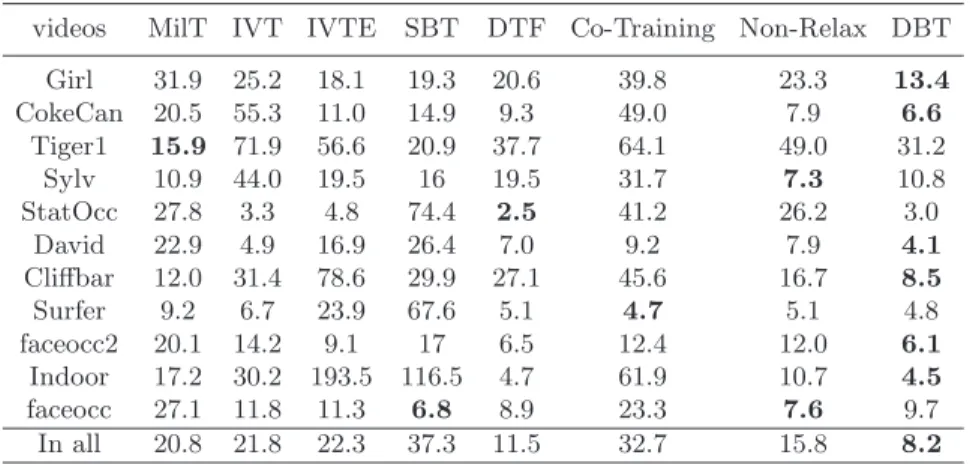
The average center location error The average center location error is a commonly used metric to measure the performance of tracking and is defined as the average error between the predicted locations to the ground truth. In Table 1, we summarize the results of the average center location error on all the 11 videos. It’s clear that our disagreement based tracker outperforms the individual trackers, Direct tracker fusion, and the co-training scheme. For non-relax (using Eq. (3) directly without non-relaxation), it’s less possible for the trackers to achieve some agreements, and the chance of interaction between trackers is reduced. Still the result is better than the individual trackers.
Table 1. Comparison of Average Center Location Error. Non-Relax indicates to use Eq. (3) directly without relaxation;Co-Training stands for the results using co-training method.
videos MilT IVT IVTE SBT DTF Co-Training Non-Relax DBT Girl 31.9 25.2 18.1 19.3 20.6 39.8 23.3 13.4 CokeCan 20.5 55.3 11.0 14.9 9.3 49.0 7.9 6.6 Tiger1 15.9 71.9 56.6 20.9 37.7 64.1 49.0 31.2 Sylv 10.9 44.0 19.5 16 19.5 31.7 7.3 10.8 StatOcc 27.8 3.3 4.8 74.4 2.5 41.2 26.2 3.0 David 22.9 4.9 16.9 26.4 7.0 9.2 7.9 4.1 Cliffbar 12.0 31.4 78.6 29.9 27.1 45.6 16.7 8.5 Surfer 9.2 6.7 23.9 67.6 5.1 4.7 5.1 4.8 faceocc2 20.1 14.2 9.1 17 6.5 12.4 12.0 6.1 Indoor 17.2 30.2 193.5 116.5 4.7 61.9 10.7 4.5 faceocc 27.1 11.8 11.3 6.8 8.9 23.3 7.6 9.7 In all 20.8 21.8 22.3 37.3 11.5 32.7 15.8 8.2
The success rate If the location error on one frame is less than a pre-specified threshold, the prediction is regarded as a successful prediction. The success rate is defined as the ratio of successful predictions over all the predic-tions. To compute the success rate, we setT as certain ratio of the average width of the target, i.e.,T =β∗(w+h)/4, where, wandhare the width and height of the target respectively. Conceptually, this is similar to the overlap score eval-uation used in [30] and thus, success rate is conceptually similar to the tracked percentile in [30]. We observe that, the trackers can not track the target precisely at all times, if there is no overlap but the prediction of the tracker is not far from the target or within the search area of the tracker, it’s often possible for the tracking process to recover. Our evaluation measurement can reflect such a phenomenon. We compare the success rate in Table 2 and from Table 2, the DBT achieves the highest success rate.
Table 2.Comparison of success rate whenβ= 0.5. MilT IVT IVTE SBT DTF Non-Relax DBT 0.596 0.733 0.753 0.592 0.862 0.84 0.900
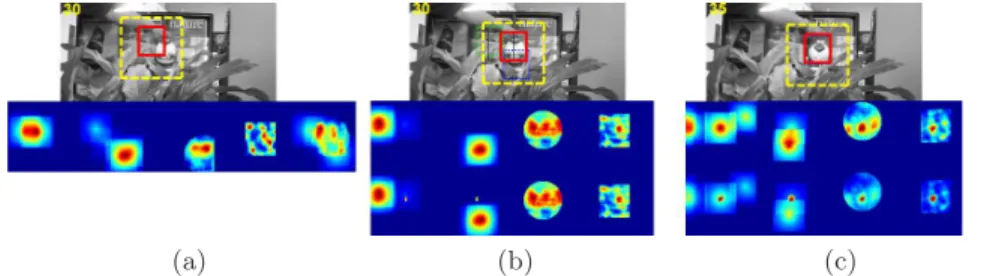
Comparison of probability mapsIn Fig. 2, we show how the probability maps are generated in Eq. (2) and Eq. (3) on a testing video, Tiger1. DTF drifts from the 30th frame; on this frame, the predictions of the trackers are rather diverse. In DTF, however, the individual tracker’s prediction is not fully respected and it has to comply with the voted prediction; this is the primary reason for drifting and getting trapped; using Eq. (3) however leads to a more robust prediction. As we can see from the second figure, on the 30th frame, MILTracker and Semiboost tracker achieves certain agreement, but IVT and IVTE still complies with its own prediction since the agreement is weak. On the 35th frame, when MILTracker, IVT and Semiboost tracker achieve confident agreement, IVTE is pulled back to the agreed position and the four trackers merge again. The benefit of our disagreement-based tracking is obvious: the trackers then keep their relatively different traces and the risk of getting trapped is reduced.
(a) (b) (c)
Fig. 2.Illustration of the probability maps where four trackers (experts) are adopted (the figures have been scaled for visualization). (a) shows the results by DTF. (b) and (c) display the probability maps generated by disagreement-based tracking. The probability maps inside the dashed yellow rectangle are shown below the screen shots. Underneath each figure, from left to right, the probability maps are IVT, IVTE, MIL-Tracker, Semiboost tracker respectively (see the discussions about these trackers in the experiments). For DTF in (a), the fifth probability map is the combined map. For disagreement-based tracking in (b) and (c), the first rows shows the original probability maps, and the second row shows theQt+1
i computed by Eq. (3).
Comparison with other methods PROST [30] is another fusion based tracking algorithm that adopts 3 trackers (a template model, an optical-flow based mean-shift tracker and an online random forest tracker). Table 3 and Ta-ble 4 compare the average location errors and the tracked percentage (computed using the overlap score in [30]) with PROST. From the two tables, we can ob-serve that, our disagreement-based tracking outperforms PROST and achieves better tracked percentages on most of the videos.
The best experimental performance of Democratic Integration in [15] was achieved by using uniform qualities, which assigned equal weights to all the
Table 3.Comparison of average center location error with [30]
Method Girl tiger1 sylv David faceocc faceocc2 [30] 19.0 7.2 10.6 15.3 7.0 17.2 Ours 13.4 31.2 10.8 4.1 9.7 6.1 Table 4.Comparison of tracked percentage with [30] Method Girl tiger1 sylv David faceocc faceocc2
[30] 89 79 73 80 100 82
Ours 97 30 83 100 100 100
clues, and corresponded directly with DTF. In addition, we implemented the quality measure of normalized saliency and the performance was not as good as DBT: their average center location error is 13.8 with success rate 0.87.
We did not get the implementation of [2]. Nevertheless, we did experiment on some videos used in [2] and the results of DBT are better than [2] qualitatively (skipped here due to page limit). Moreover, we indeed implemented co-training and reported the result in Table 1 (average center location error 32.7), which is much worse than DBT.
Table 5.Performance by varyingαandT H(T H=R/(Λ/3))
R/α 0.8/0.3 0.8/0.67 0.8/0.85 0.7/0.67 0.9/0.67 Average Error 10.0 8.2 9.8 9.95 9.8
Success Rate 0.875 0.90 0.895 0.87 0.89
Robustness by varying the parameters In table 5, we summarize the performance of disagreement-based tracking by varying the parameters α and T H, which are the two key parameters in Eq. (3). We can see from this table, by varyingT Handα, the results (especially the success rate) do not change too much. This demonstrates the robustness of disagreement-based tracking. The average center location error has relatively larger change because on portions of the videos Tiger1 and Indoor, disagreement-based tracking gets distracted to positions distant from the targets. In such cases, the success rate does not vary too much, but the center location error is increased.
Screenshots of the resultsIn Fig. 3, we compare the tracking results on the video Girl. This video undergoes several challenges: fast appearance change and occlusion. Although both MILTracker and IVTE can track the face of the girl successfully, the tracking process is not very stable. IVT drifts from the face at the 20th frame. From the 391th frame, direct tracker fusion also drifts and get trapped at the background of the images. As can be seen from both the screen shots and the error plot on the right of Fig. 3, we find that disagreement-based tracking tracks most robustly and accurately. In Fig. 3, we can also find
Fig. 3.Comparison of tracking results on the video Girl. The first row on the left shows the results of disagreement-based tracking; the second row on the left shows the results of 4 individual trackers and direct tracker fusion; the right plot shows the comparison of center location error (the number of the x axis denotes the number of predictions). The coloring scheme is: dotted green: IVT, dotted black: MILTracker, dotted blue: IVTE, dotted yellow: Semiboost tracker, solid Red: disagreement-based tracking, and solid magenta: Direct tracker fusion.
a very nice property of democratic tracking that, the traces of the four trackers are similar but not exactly the same, thus, they can explore different spaces, recommend confident samples to other trackers, and thus avoid to be trapped at an incorrect position.
5
Conclusion
In this paper, we have introduced a disagreement-based tracking method which fuses multiple existing tracking systems in the following way that seeks a bal-ance between the coherence of the current tracker and the degree of agreements among other trackers. In such a way, it enables the interaction between track-ers and keeps the appealing characteristics of the tracktrack-ers at the same time. As illustrated in the experiments, the balance complies with the characteristic of tracking. Disagreement-based tracking can be built on top of various existing well-developed tracking systems utilizing their intrinsic biases. Adopting several state-of-the-art tracking algorithms, our approach is able to improve each of them by a large margin on widely used benchmark videos in the literature
Acknowledgement. Zhuowen Tu and Quannan Li are supported by Office of Naval Research Award N000140910099 and NSF CAREER award IIS-0844566; Wei Wang, Yuan Jiang and Zhi-Hua Zhou are supported by National Natural Science Fund of China 60975043.
References
1. Avidan, S.: Ensemble tracking. In: CVPR. (2005)
2. Tang, F., Brennan, S., Zhao, Q., Tao, H.: Co-tracking using semi-supervised sup-port vector machines. In: ICCV. (2007)
3. Grabner, H., Leistner, C., Bischof, H.: Semi-supervised on-line boosting for robust tracking. In: ECCV. (2008)
4. Lim, J., Ross, D., Lin, R.S., Yang, M.H.: Incremental learning for visual tracking. Int’l J. of Comp. Vis. (2008)
5. Babenko, B., Yang, M.H., Belongie, S.: Visual tracking with online multiple in-stance learning. In: CVPR. (2009)
6. Zhou, Z.H., Li, M.: Semi-supervised learning by disagreement. Knowledge and Information Systems24(2010) 415–439
7. Blum, A., Mitchell, T.: Combining labeled and unlabeled data with co-training. In: COLT. (1998) 92–100
8. Zhou, Z.H., Li, M.: Tri-training: Exploiting unlabeled data using three classifiers. IEEE Trans. on Know. and Data Eng. (2005)
9. Dietterich, T.G.: Ensemble methods in machine learning. In: INTERNATIONAL WORKSHOP ON MULTIPLE CLASSIFIER SYSTEMS, Springer-Verlag (2000) 1–15
10. Kuncheva, L.I.: A theoretical study on six classifier fusion strategies. IEEE Tran. on PAMI24(2002) 281–286
11. Bennett, K.P., Demiriz, A., Maclin, R.: Exploiting Unlabeled Data in Ensemble Methods. In: ACM SIGKDD ’02 Edmonton, Alberta CA. (2002)
12. Wang, W., Zhou, Z.H.: Analyzing co-training style algorithms. In: ECML. (2007) 13. Wu, Y., Huang, T.: Robust visual tracking by integrating multiple cues based on
co-inference learning. In’l J. of Comp. Vis (2004)
14. Siebel, N., Maybank, S.: Fusion of multiple tracking algorithms for robust people tracking. In: ECCV. (2002)
15. Triesch, J., von der Naksvyrg, C.: Democratic integration: Self-organized integra-tion of adaptive visual cues. In: Neuroal Computaintegra-tion. (2001)
16. Spengler, M., Schiele, B.: Towards robust multi-cue integration of visual tracking. In: MVA. (2003)
17. Kwon, J., Lee, K.M.: Visual tracking decomposition. In: CVPR. (2010)
18. I Leichter, M Lindenbaum, E.R.: A general framework for combining visual track-ersthe ’black boxes’ approach. It’l J. of Comp. Vis (2006)
19. Zhong, B., Yao, H., Chen, S., Ji, R.R., Yuan, X., Liu, S., Gao, W.: Visual tracking via weakly supervised learning from multiple imperfect oracles. In: CVPR. (2010) 20. Stenger, B., Woodley, T., Cipolla, R.: Learning to track with multiple observers.
In: CVPR. (2009)
21. Mundy, J.L., Chang, C.F.: Fusion of intensity, texture, and color in video tracking based on mutual information. In: AIPR. (2010)
22. Collins, M., Singer, Y.: Unsupervised models for named entity classification. In: EMNLP. (1999)
23. Leskes, B., Torenvliet, L.: The value of agreement a new boosting algorithm. J. of Comp. and Sys. Sci. (2008)
24. Dasgupta, S., Littman, M.L., McAllester, D.: Pac generalization bounds for co-training. In: NIPS. (1999)
25. Wang, W., Zhou, Z.H.: A new analysis of co-training. In: ICML, Haifa, Israel (2010) 1135–1142
26. Zhou, Y., Goldman, S.: Democratic co-learning. In: Inte’l Conf. on Tools with Art. Intell. (2004)
27. Dasgupta, S.: Coarse sample complexity bounds for active learning. In: NIPS. (2005)
28. Comaniciu, D., Ramesh, V., Meer, P.: Real-time tracking of non-rigid objects using mean shift. In: CVPR. (2000)
29. Isard, M., Blake, A.: Condensation - conditional density propagation for visual tracking. Int’l J. on Comp. Vis. (1998)
30. Santner, J., Leistner, C., Saffari, A., Pock, T., Bischof, H.: Prost: Parallel robust online simple tracking. In: CVPR. (2010)