On the role of simulation
in the robot development process
Gerhard K. Kraetzschmar, Azamat Shakhimardanov, Michael Reckhaus, Jan Paulus, and Nico Hochgeschwender
Bonn-Rhein-Sieg University of Applied Sciences, Computer Science Department, 53757 Sankt Augustin, Germany
<FirstName>.<LastName>@h-brs.de
Abstract. Simulation has not been popular in robotics research for
more than two decades. Advances in computing and in simulation tech-nology now makes simulation more attractive for robotics research and development. In this paper, we claim that simulation is an essential, indispensable ingredient for any professional robot application develop-ment process. The paper presents a proposal for a robot developdevelop-ment process and explains the role of simulation in this process.
Keywords: simulation, software development process, robot
applica-tion development
1
Motivation
In the early days of cognition-oriented robotics research simulation was almost the only instrument available to researchers for testing their theories. In about the mid-eighties and early nineties, a few robot research platforms, notably the NOMAD by Nomadics, the B21 by RWI, and the Pioneer series by ActivMedia, were becoming commercially available, and simulation went totally out of fashion in almost all areas of robotics except for a few, like evolutionary robotics. Papers on new theories and methods became hard to publish unless these theories and methods were implemented and evaluated on a real robot platform. Simulations at that time were so abstract and slow, that results derived from simulations alone were routinely questioned for being of little practical value.
Recent advances in both simulation technology and computing in general have initiated a slow revival of simulation in robotics research and development. We believe that this revival needs to be stimulated further, that simulation is an essential and indispensable ingredient in future robot application development, both in research and in industrial settings. This paper first clarifies a few issues on simulation, then presents a proposal for a professional, holistic robot application development process and illustrates the role of simulation in major steps of the process.
2
On Simulation
Simulation can be viewed as a scientific tool that is of interest whenever ex-periments need to be performed, but performing them in the real world or on the real system is not feasible for some reason. These reasons can be manifold: sometimes the real system is not available yet (a skyscraper or a robot to be built), is too costly to use (testing alternative production schedules in car man-ufacturing), would take too much time (longitudinal studies of social behavior like reproduction of species under varying environmental conditions), or is not accessible at all (stellar systems in the universe).
Simulation uses a model of a real system or the real world instead. The extent and grain of the model depends on which studies are supposed to be performed on it; this dependency can cause quite a bit of problems. The model usually includes describing the behavior of all relevant objects and subjects for the study planned. When doing modeling, the only thing we know at this time may be a question to be answered.
At the very beginning of a scientific experiment we should have a question which we wish to answer. In robotics, we can identify at least four different categories of questions:
– a binary test whether a function or a behavior has a desired effect – exploring the behavior of a complex system under various conditions – assessing properties of a system, like the accuracy of placing an object – and comparative studies of several methods/algorithms in order to identify
the most suitable one for a specific purpose.
It should be clearly stated for each experiment, what the question is. Unfortu-nately, this is often not the case.
Once we built a model, we need to design an experiment. Rather than a question, we must formulate a concrete hypothesis now, for which we design an experiment that allows to accept or refute the hypothesis. While the model may describe behavior in general terms, we must fix things like parameters, distributions, scheduled and randomized events in an experiment design. Fur-thermore, independent, controlled, extraneous and observed variables need to be defined in the experiment design. During experiment execution, data for the aforementioned variables are recorded. Analysis of the data then allows to draw conclusions, to accept/refute the hypothesis, and to answer the initial question.
3
On Robot Application Development
The Robot Application Development Process in BRICS (BRICS RAP or simply RAP) is a holistic process model for developing robotics applications in both academic and industrial settings. An initial model has been proposed by our group during the preparation phase of the BRICS project. The current proposal includes revisions accounting for feedback from project partners and experts of the field. It combines ideas from traditional software engineering, agile software
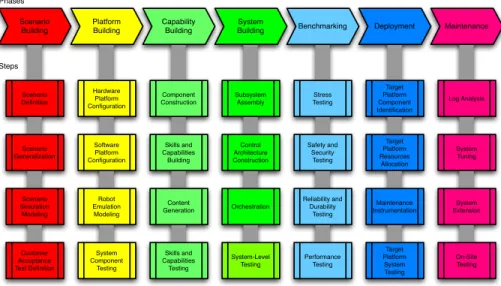
development, model-based engineering, and industrial project management. A survey illustration of the process is given in Figure 1. BRICS RAP foresees seven different phases, each of which requires several steps to complete the task. The process phases and steps are briefly explained in the subsections following.
Scenario Building
Platform
Building Benchmarking Maintenance
System Building Deployment Capability Building Scenario Definition Scenario Generalization Scenario Simulation Modeling Customer Acceptance Test Definition Phases Steps Hardware Platform Configuration Software Platform Configuration Robot Emulation Modeling System Component Testing Component Construction Skills and Capabilities Building Content Generation Skills and Capabilities Testing Subsystem Assembly Control Architecture Construction Orchestration System-Level Testing Stress Testing Safety and Security Testing Reliability and Durability Testing Performance Testing Target Platform Component Identification Target Platform Resources Allocation Maintenance Instrumentation Target Platform System Testing Log Analysis System Tuning System Extension On-Site Testing
Fig. 1: The BRICS Robot Application Development Process.
In order to fully understand the holistic nature of BRICS RAP, we assume that a customer, who is interested in acquiring a service robot application, either for an industrial or a residential setting, is meeting a representative of a company offering such products. This company will be referred to as system integrator. The system integrator may have a small set of generic products in its product portfolio, which will usually be customized to meet customer needs. The process is similar to how one can order a car: The customer has certain choices of drive systems, optional equipment to be configured into the system, and the overall software controlling the application needs to be adapted to reflect the choices of the configuration process and extended to meet the functional needs of the customer.
In the following sections, we will describe in more detail only those, where simulation and simulation tools are expected to play a major role.
3.1 Phase 1: Scenario Building
When customer and system integrator meet at the beginning of a project, the most important issue is to make sure the system integrator gets a good under-standing of the problem. This is in complete analogy to starting a (non-trivial) software project. As is the case in classical software engineering, the customer
often does not really know himself, what he wants. In robotics in particular, customers often have naive assumptions about what is possible with the current state of the art and what is not, and it is especially difficult to judge where the limits are precisely.
Step 1-1: Scenario Definition Some typical scenarios for the target applica-tion are described. The descripapplica-tion must include the environment, in which the application is supposed to operate, the relevant objects, the relevant subjects and their behavior, and the dynamics of the overall environment.
Step 1-2: Scenario Generalization In order to avoid development of brittle applications that break down as soon as one of the tacit underlying assump-tions is violated, this step focuses on the generalization of the scenarios. This means that the variability of scenario elements (environments, objects, subjects, behaviors, dynamics) must be discussed and described.
Step 1-3: Scenario Simulation Modeling A simulation model for the sce-narios is build here. This step can be done simultaneously with steps 1 and 2, especially if the visualization possible with the developing simulation model can be of great help in the scenario acquisition process.
Step 1-4: Customer Acceptance Test Definition The range of possible combinations of specific scenarios and expected services by the target robot application can quickly grow to dimensions prohibitive for the exhaustive test-ing. The definition of a reasonable number of customer acceptance tests allows the customer to express relative importance of different functionalities and gives developers directions for devoting attention to particular functionalities. We sug-gest that once a set of acceptance tests is defined and made available to devel-opers, the customer defines for each test one or more variations, which will not be made available to developers, in order to test the robustness and variability of the developed solutions.
3.2 Phase 2: Platform Building
The platform building phase foresees steps necessary to prepare the actual soft-ware development of the target application. The hardsoft-ware platform needs to be configured, from which the software platform can be derived, which provides the necessary device drivers and various utilities. Furthermore, a robot emulation model is derived to complement the simulation model defined during scenario building. The purpose of this step is to allow software development independently of the actual availability of the hardware platform, which due to manufacturing scheduling constraints often may take several months to build. As in all steps, testing procedures are foreseen as well.
Step 2-1: Hardware Platform Configuration Once a good understanding exists of which tasks the target robot application needs to solve and how the environment and task execution context looks like, a hardware platform can be and should be configured. Currently, it seems unlikely that much sensible software development can take place without knowing what the target platform will be.
For the configuration process itself, several approaches are possible. The most viable within the BRICS project seems to assume a small set of generic robot hardware platforms, for which a limited number of components can be config-ured. For an industrial mobile manipulator from KUKA, for example, one might choose between two base variants consisting of the KUKA OmniRob mobile platform with either one or two KUKU LWR lightweight arms mounted on it. Other configuration choices may pertain to the computational hardware to be integrated, and the number of sensors (laser range finders, cameras, etc.) to be mounted and their placement on the robot.
At least the vast majority of hardware requirements should be inferable from the information acquired in the scenario building phase. It should be no problem, however, to modify the hardware configuration later on, e.g. if the need for an additional sensor arises or an initially selected hardware component needs to be replaced by another one.
Step 2-2: Software Platform Configuration The software platform is the complete software foundation on which the actual robot application software will be built. The software platform consist of
– the operating systems and/or any required firmware for the computational devices configured into the hardware (embedded PCs, laptops, microcon-troller boards, etc.),
– the device drivers for all relevant hardware devices, including those for all sensor and actuator devices,
– configuration information that can be derived from the hardware config-uration, e.g. coordinate translations from a camera or laser range finder coordinate system to the coordinate system of the mobile base,
– utilities and tools for configuring, calibrating, operating, monitoring, logging, and analysing all hardware components,
– software technologies components required for operating the robot applica-tion software, such as communicaapplica-tion middleware, user interface toolkits, or libraries supporting the integration and use of particular hardware devices, – all the tools and facilities that come with or are necessary for an integrated development environment, including editors, compilers, debuggers, profilers, etc., and providing support for both model-driven development and agile development,
– libraries of best practice algorithms that could potentially be reused in build-ing the application, and
– libraries of reusable software components of all of the above, usually the result of a componentification process,
The suite of software packages that will make up the software platform is deter-mined by information from three different sources:
1. Information directly inferred from the hardware configuration. Example: de-vice drivers for sensor components.
2. Information representing customer choices. Example: operating systems to be run on computational hardware, or a particular environment for building the user interface
3. Information following from application developer decisions. Example: a mid-dleware package selected for distributed programming support.
Step 2-3: Robot Emulation Model Definition Simulation plays an impor-tant role in BRICS RAP. It not only allows for software development without actual access to the robot hardware (e.g. because the hardware requires time to build, or access to the hardware is restricted or constrained due to resource limitations), but also provides a means to safely test a design in simulated ex-treme situations or to assess new designs with unknown safety properties. The simulation model built in the scenario building phase needs to be complemented by a robot emulation model to allow for such simulation runs. We prefer the use of robot emulation model vs robot simulation model to emphasize that the simulation should allow to test the targeted robot application software without changes, i.e.only the interfaces to hardware components should be replaced by emulated versions of these components.
Step 2-4: System Component Testing At the end of the platform building phase it should be possible to perform tests on all hardware devices, software components, and development tools that were selected.
3.3 Phase 3: Capability Building
After completing phases 1 and 2, the stage is set for the actual core software development, which will happen in phases 3 and 4. The BRICS project has decided to adopt the idea of component-based software development. It seems to best foster software re-use, and supports both ideas from model-driven and agile software development.
The focus of Phase 3 is on building functional capabilities. It includes all ac-tivities necessary to make hardware devices and algorithms available as re-usable components, as well as composing components to create particular capabilities such as recognizing people, perceiving objects, understanding speech, produc-ing speech, explorproduc-ing and mappproduc-ing the environment, plannproduc-ing paths, executproduc-ing trajectories, grasping objects, making gestures, etc. The focus of Phase 4 is on composing complete systems/applications from such component capabilities and ensuring that the work together correctly and interact in the desired ways. As components play a central role in both phases, there seems to be significant overlap between them. Although this may be true in terms of the technologies and tool sets used, the difference can be characterized as follows:
– The capability building phases concentrates on developing isolated function-ality. It takes a component perspective and provides a piece of software that is designed for integration into larger systems. If the capability component itself is composed of components, these components usually interact in rel-atively simple ways. Usually, there are no or few resource conflicts on the component level. Any kind of user interaction is considered in an isolated way without assuming a particular context.
– The system building phase focuses on developing integrated, system-level functionality. It takes a system perspective and provides a complete system or application, which can run standalone and does not depend upon inte-gration into a larger system. The system building phase will usually have to integrate a multitude of capabilities, and this integration may produce many and serious resource conflicts. Resolving these may imply non-trivial mod-ifications to the components or the introduction of specific components for conflict resolution. Particular care must be taken to integrate and consoli-date user interaction such that the overall system behavior is understandable and predictable for the human users and operators.
Step 3-4: Skills and Capabilities Testing This step should be quite straight-forward: for all intermediate steps and final outcomes of the activities in this phase tests need to be defined and executed. These tests will be particularly helpful in situations, where the complete system exhibits overall some strange behavior. With all the tests so far, developers can check system functionality bottom up from simple hardware devices to simple or advanced skills and capa-bilities.
3.4 Phase 4: System Building
The fourth phase of the development process is concerned with both the func-tional and software integration of several skills and capabilities into more com-plex functionality and the building of complete systems. It is probably the least consolidated phase in terms of methods that are well established and agreed upon in the community. This problem was previously coined into the term “1001 ar-chitectures for 1000 robots”, in order to express the fact, that there are no com-monly agreed upon approaches for designing a good functional robot control architecture and its implementation in a software architecture.
We assume that a general functional robot control architecture that is suit-able for a wide range of applications does not exist. Such a functional architecture can possible be designed for a particular domain, or a particular type of robot ap-plication, but may require at least modifications and tuning for each application. Any software engineering process for robotics can only be successful if it allows developers to build customized functional robot control architectures. However, the software development process can be significantly improved, if there are es-tablished means to implement these functional robot control architectures in software architectures. Component-based development has the potential to pro-vide such means. A complete robot application can be viewed as a (potentially
very complex) composite component. It must be executable as a standalone ap-plication, of course, and additional constraint may be defined that distinguish a system from arbitrary other composite components.
This phase is therefore primarily concerned with the development of (non-trivial) composite components. The steps in this phase focus on particular as-pects that arise in the composition process, in particular
– structural composition of a composite component from simpler components (in the following called elements),
– defining component-level control, and
– orchestration of component-level with element-level activities, including pri-oritization and conflict resolution.
These steps are closely related with each other; it may not always be possible or sensible in practice to clearly delineate from each other, but as at least the first three steps in this phase are expected to be performed by the same developers, this is currently not considered a problem. At the very least, the steps already identified clearly point to particular activities that need to be performed during the composition process. It is currently difficult to assess, to which extent these steps can be supported and/or automated by appropriate tools, and how much effort developers need to devote to them. We can foresee situations, where a particular way of structural composition can imply almost automatic generation of control structures with little or no need for orchestration. On the other hand, one could imagine compositions that raise difficult control problems and conflicts which may be very hard to resolve. Practice will show over time, what is really needed.
Step 4-4: System-Level Testing This step tests complex subsystems or the overall robot aplication. The customer acceptance tests should be successfully run.
3.5 Phase 5: Benchmarking
A robot is a potentially dangerous product, and special care must be taken to ensure it is complete, safe, reliable, and performant. Each of the benchmarking steps focuses on a different aspect.
Step 5-1: Components, Skills, and System Stress Testing This step focuses on functionality. Tests should ensure that the components provide the requested functionality, including producing the correct results under typical and extreme operating conditions (e.g. variations of system load, co-occurrence of events, difficult environment conditions like heat, sun, darkness, water, etc.). Step 5-2: Safety and Security Checks The focus of this step is on safety and security. Safety is concerned with ensuring that the robot does not harm to subjects or objects. Security is concerned with ensuring that the robot cannot be accessed and abused by malevolent users or other systems.
Step 5-3: Reliability and Durability Assessment Any product must be ensured to be sufficiently reliable and durable before it can be marketed.1 Once
the robot application has reached a state where it provides the necessary func-tionality, developers must also assure its reliability and durability by running long experiments, under potentially extreme conditions.2
Step 5-4: Performance Benchmarking Last but not least, this step checks maximum operation rates for each component, skill, subsystem. This step tests what is classically associated with (performance) benchmarking.
3.6 Phase 6: Deployment
So far, we have developed the application, and tested it on a development pro-totype in the lab. It is now time to deploy the robot software application onto the actual target system, and to make sure we can operate and maintain the application later on when it has been delivered to the customer.
Step 6-4: Target Platform System Testing As the steps in the deployment phase may incur various modifications to the system, it must undergo another testing phase. This testing phase may include re-running tests defined in various previous phases, but especially if hardware modifications have been performed, the definition of additional tests for particularly the final hardware platform may be warranted.
3.7 Phase 7: Maintenance
Little is so far known about this phase, as there are so few successful applications out there. The steps suggested here are inferred from experience in other indus-trial projects, such as maintenance of a production line, or comparably complex products, such as an upper-class automobile.
Step 7-4: On-Site Testing Last but not least, the modified system needs to be tested before normal operation can continue. Due to a variety of constraints (time, space, and equipment available, environment usable, safety and security), the full range of tests that can be performed during development, especially the benchmarking phase, will normally not be executable during maintenance. The range of runnable tests (determined during the deployment phase) should
1
For example, some researchers who use Hokuyo laser scanners very intensively in somewhat rough operating conditions have recently reported serious wearout issues rendering the sensor defect after just a few months.
2 Willow Garage continuously runs tests of their prototypes over several days in a
non- air-conditioned container exposed to the California sun. Temperatures inside the container are usually well over 40 degrees Celsius, often more.
be rich enough to ensure at least safety, security, and reliability. the tests ac-tually executed during this step may be determined by the type and extent of maintenance work performed in the previous steps. For example, if log analy-sis indicated that the system seemed to have been working well and no serious failures were recorded, and no system tuning and system extensions have been performed, minimal or or even none on-site testing at all may be required. If the maintenance work required modifications involving mounting additional sensors and/or mounting existing sensors at different places on the mobile platform, and significant modifications of the software were necessary, then a suitable range of tests should be run to ensure safe and reliable operation of the system.
4
Conclusions
A brief review of BRICS RAP shows that every phase has a step where extensive testing is performed. As in agile, iterative development processes these tests should run frequently, doing them in simulation would be very helpful.
The phases 1, 2, and 5 have particular uses of simulation technology. Building a simulation model of the environment in which the target robot application is supposed to operate is an integral step of Phase 1. If a simulation tool offers visualization-based design of constructing environment models, they can be used to help in steps 1.1. and 1.2 as well. In Phase 2, an emulation model of the robot needs to be developed, which allows to combine the actual robot control software with the simulation model of the environment (and other actors). Simulation is surely indispensable for Phase 5, Benchmarking, as many of critical tests, e.g. in steps 5.2 and 5.3 would not be sensibly executed on real systems.
Current simulation technology and tools do not fully support the require-ments posed by BRICS RAP. In future work, we want to develop methods and technology to better and easier integrate existing simulation tools into the pro-cess, and start initiatives to develop tools and technology that covers the cur-rently missing links.s
Acknowledgements
The research leading to these results has received funding from the European Community’s Seventh Framework Programme (FP7/2007-2013) under Grant Agreement No. 231940.