Standard:
PCI Data Security Standard (PCI DSS)
Version:
3.0
Date:
August 2014
Author:
Third-Party Security Assurance
Special Interest Group
PCI Security Standards Council
Information Supplement:
i This document is provided solely for informational purposes as a convenience to its readers. Information provided here i does not replace or supersede the requirements of any PCI SSC Standard or the need for proper due diligence and
appropriately qualified legal counsel.
Table of Contents
1 Introduction ... 1
1.1 Intended Use ... 2
1.2 Terminology... 2
1.3 Audience ... 2
2 Examples of Third-Party Service Providers ... 4
3 Third-Party Service Provider Due Diligence ... 5
3.1 Determining the Scope of the Services Provided ... 6
3.2 Due Diligence Research of the Third-Party Service Provider ... 6
3.2.1 Acquirer/Payment Card Brands ... 8
3.2.2 Third-Party Service Provider Validation Documentation ... 8
3.2.3 Payment Card Brand Validated Providers Lists and Websites ... 11
3.3 Perform Risk Assessment ... 11
3.4 Documenting Results ... 14
4 Engaging the Third-Party Service Provider ... 15
4.1 Set Expectations ... 15
4.2 Gain Transparency ... 15
4.3 Establish Communications ... 16
4.4 Request Evidence ... 16
4.5 Obtain Information about PCI DSS Compliance ... 16
4.6 Frequency of Review ... 17
4.7 Mapping of Third-Party Services to Applicable PCI DSS Requirements ... 17
5 Written Agreements, Policies, and Procedures ... 19
5.1 Agreements between PCI DSS Compliant Third-Party Service Providers versus non-PCI DSS Compliant Third-Party Service Providers ... 19
5.2 Considerations when Building Agreements, Policies, and Procedures ... 20
5.3 Additional Considerations ... 22
5.3.1 Responsibility Matrix ... 22
5.3.2 Data Breaches ... 22
5.3.3 Post-termination Considerations Regarding TPSPs and Their Employees ... 23
5.3.4 Outsourcing of Provided Functionality (Nested TPSPs) ... 23
5.3.5 Loss of Compliance Status ... 24
6 Maintaining Relationships with and Monitoring Third-Party Service Providers ... 25
6.1 Developing a Third-Party Service Provider Monitoring Program ... 25
6.1.1 Cardholder Data Environment (CDE) Scope Definition ... 25
6.1.2 List of Third-Party Service Providers ... 26
6.1.3 Third-Party Service Provider Monitoring Procedure... 26
6.2 Other Considerations ... 27
6.2.1 Third-Party Service Provider Does Not Provide Requested Information ... 27
i i This document is provided solely for informational purposes as a convenience to its readers. Information provided here ii does not replace or supersede the requirements of any PCI SSC Standard or the need for proper due diligence and
appropriately qualified legal counsel.
6.2.3 Third-Party Service Provider Validates PCI DSS Compliance via Inclusion within the Entity’s PCI
DSS Assessment ... 29
6.2.4 Existing or New Service or Process is not PCI DSS Compliant or will make the Entity or TPSP non-PCI DSS Compliant ... 30
Appendix A: High-Level Discussion Points for Determining Responsibility ... 31
Appendix B: Sample PCI DSS Responsibility Matrix ... 40
Acknowledgement ... 42
This document is provided solely for informational purposes as a convenience to its readers. Information provided here 1 does not replace or supersede the requirements of any PCI SSC Standard or the need for proper due diligence and
appropriately qualified legal counsel.
1
Introduction
As entities work toward the goal of achieving and maintaining ongoing PCI DSS compliance, they may choose to leverage third-party service providers (TPSPs) to achieve their objectives. Entities can use a TPSP to store, process, or transmit cardholder data on the entity’s behalf, or to manage components of the entity’s cardholder data environment (CDE), such as routers, firewalls, databases, physical security, and/or servers. These TPSPs can become an integral part of the entity’s cardholder data environment and impact an entity’s PCI DSS compliance, as well as the security of the cardholder data environment.
The use of a TPSP, however, does not relieve the entity of ultimate responsibility for its own PCI DSS compliance, or exempt the entity from accountability and obligation for ensuring that its cardholder data (CHD) and CDE are secure. Clear policies and procedures should therefore be established between the entity and its TPSP(s) for all applicable security requirements, and proper measures should be developed to manage and report on the requirements.
A robust and properly implemented third-party assurance program assists an entity in ensuring that the data and systems it entrusts to TPSPs are maintained in a secure and compliant manner. Proper due diligence and risk analysis are critical components in the selection of any TPSP.
This guidance focuses primarily on the following:
Third-Party Service Provider Due Diligence: Thorough vetting of candidates through careful due diligence, prior to establishing a relationship, assists entities in reviewing and selecting TPSPs with skills and
experience appropriate for the engagement.
Service Correlation to PCI DSS Requirements: Understanding how the services provided by TPSPs correspond to the applicable PCI DSS requirements assists the entity in determining the potential security impact of utilizing TPSPs on the entity’s cardholder data environment. This information can also be used to determine and understand which of the PCI DSS requirements will apply to and be satisfied by the TPSP, and which will apply to and be met by the entity.
Note: Ultimate responsibility for compliance resides with the entity, regardless of how specific responsibilities may be allocated between an entity and its TPSP(s).
Written Agreements and Policies and Procedures: Detailed written agreements promote consistency and mutual understanding between the organization and its TPSP(s) concerning their respective responsibilities and obligations with respect to PCI DSS compliance requirements.
Monitor Third-Party Service Provider Compliance Status: Knowing the TPSP’s PCI DSS compliance status helps to provide the organization engaging a TPSP with assurance and awareness about whether the TPSP complies with the applicable requirements for the services provided. If the TPSP offers a variety of services, this knowledge will assist the entity in determining which TPSP services will be in scope for the entity’s PCI DSS assessment.
This document is provided solely for informational purposes as a convenience to its readers. Information provided here 2 does not replace or supersede the requirements of any PCI SSC Standard or the need for proper due diligence and
appropriately qualified legal counsel.
1.1 Intended Use
The intent of this information supplement is to provide guidance to entities engaging TPSPs with whom CHD is shared or that could impact the security of CHD, as required by PCI DSS Requirement 12.8. This additional guidance for PCI DSS Requirement 12.8 is intended to assist entities and TPSPs better understand their respective roles in meeting this requirement.
The information in this document is intended as supplemental guidance and does not supersede, replace, or extend PCI DSS requirements. Ultimately, the entity is responsible for ensuring its own PCI DSS compliance, whether or not a TPSP is involved. How responsibilities are allocated between an entity and its TPSP(s) often depends on the specific relationship and services being provided. This guidance does not replace proper risk assessment, and compliance with the guidance does not guarantee compliance with Requirement 12.8, etc. For purposes of this document, all references made are to PCI DSS v3.0.
1.2 Terminology
The following terms are used throughout this document:
Entity – An entity is any organization that has the responsibility to protect card data and may leverage a third-party service provider to support them in card-processing activities or to secure card data. TPSP (Third-Party Service Provider) – As defined in the PCI DSS and PA-DSS Glossary of Terms,
Abbreviations, and Acronyms, a service provider is a business entity that is not a payment brand, directly involved in the processing, storage, or transmission of cardholder data on behalf of another entity. This also includes companies that provide services that control or could impact the security of cardholder data. There are many types of businesses that could fall into the category of “service provider,” dependent on the services provided.
Nested or Chained TPSP – A nested or chained TPSP is any entity that is contracted for its services by another third-party service provider for the purposes of providing a service.
1.3 Audience
Entities Engaging a Third-Party Service Provider (for example, issuers, merchants, acquirers, or other service providers) – Entities that engage TPSPs for the storage, transmission, processing of cardholder data, or otherwise provision of services that control or may impact the security of cardholder data may benefit from these guidelines. The recommendations provided in this document are intended to assist entities in
developing an increased understanding regarding utilization of TPSPs and the subsequent impact to the entity’s cardholder data environment, the impact to the entity’s own PCI DSS compliance responsibilities, as well as provide guidance on how to meet the intent of PCI DSS Requirement 12.8 governing TPSPs. Third-Party Service Providers – This guidance document may also provide useful information for TPSPs in understanding the responsibilities of TPSPs to the entities for which the TPSPs are providing services. In addition, a TPSP may be dependent on the compliance of a nested or chained TPSP to achieve overall compliance of a service. The TPSP should understand how best to engage with its partner(s) to ensure PCI DSS compliance of the services being offered. PCI DSS Requirement 12.9 also requires service providers to acknowledge in writing to the TPSP’s customers its responsibilities for securing the customers’ cardholder data or the customers’ cardholder data environment.
This document is provided solely for informational purposes as a convenience to its readers. Information provided here 3 does not replace or supersede the requirements of any PCI SSC Standard or the need for proper due diligence and
appropriately qualified legal counsel.
Acquirers (also known as “acquiring banks,” “merchant banks,” or “acquiring financial institutions”) – Asan entity that initiates and maintains relationships with merchants for the acceptance of payment cards, an acquirer is responsible for ensuring that the merchants in its portfolio are using secure TPSPs.
This document is provided solely for informational purposes as a convenience to its readers. Information provided here 4 does not replace or supersede the requirements of any PCI SSC Standard or the need for proper due diligence and
appropriately qualified legal counsel.
2
Examples of Third-Party Service Providers
Below are examples of types of services and providers with which an entity may work:
Organizations involved in the storage, processing, and/or transmission of cardholder data (CHD). Third-party service providers in this category may include:
Call centers
E-commerce payment providers
Organizations that process payments on behalf of the entity, such as a partner or reseller Fraud verification services, credit reporting services, collection agencies
Third-party processors
Entities offering processing-gateway services
Organizations involved in securing cardholder data. TPSPs in this category may include: Companies providing secure destruction of electronic and physical media
Secure storage facilities for electronic and physical media
Companies that transform cardholder data with tokenization or encryption E-commerce or mobile-application third parties that provide software as a service
Key-management providers such as key-injection services or encryption-support organizations (ESO)
Organizations involved in the protection of the cardholder data environment (CDE). TPSPs in this category may include:
Infrastructure service providers Managed firewall/router providers Secure data-center hosting providers
Monitoring services for critical security alerts such as intrusion-detection systems (IDS), anti-virus, change-detection, compliance monitoring, audit-log monitoring, etc.
Organizations that may have incidental access to CHD or the CDE. Incidental access is access that may happen as a consequence of the activity or job. TPSPs in this category may include:
Providers of managed IT delivery channels and services
Companies providing software development, such as web applications Providers of maintenance services
3
Third-Party Service Provider Due Diligence
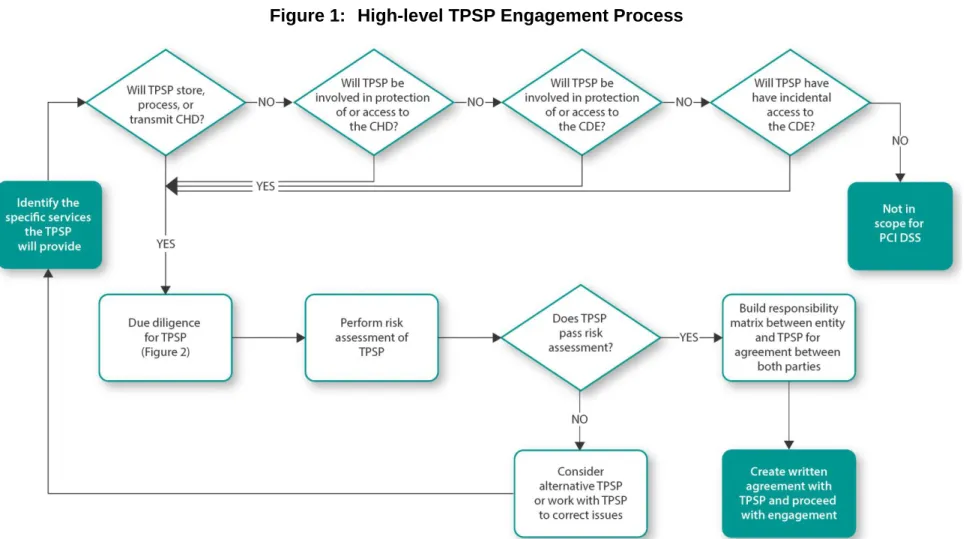
The process of engaging a TPSP can be challenging. Each organization should consider creating a process aligning with its own policies, procedures, and constraints. Below is an example of a high-level process flow that an entity may include as part of its due diligence when engaging TPSPs. Please note this process is not exhaustive. It is meant as a guideline to assist organizations seeking to engage TPSPs in creating an appropriate due diligence program.
This document is provided solely for informational purposes as a convenience to its readers. Information provided here 6 does not replace or supersede the requirements of any PCI SSC Standard or the need for proper due diligence and
appropriately qualified legal counsel.
3.1 Determining the Scope of the Services Provided
When engaging a TPSP, initially, the entity should consider determining the scope of the TPSP's involvement with regard to storing, processing, or transmission of cardholder data and the resulting effect on the security of the CDE. Because TPSP involvement and services may impact the level of risk assumed by the entity when processing payment transactions, thorough due diligence is critical in determining which TPSP is appropriate and which third-party services may be needed.
Defining the level of involvement of a TPSP is crucial to understanding the overall risk assumed by the entity related to PCI DSS compliance. The entity may elect to engage an outside party to assist with the
assessment of the scope of services to be provided by the TPSP and the applicability of those services to the entity’s PCI DSS compliance. Questions that may help with this process may include:
Given the current payment ecosystem and payment channels, what services (security, access, etc.) would affect or impact the CDE and/or CHD? How the services are structured within the TPSP facilities?
What technology and system components are used by the TPSP for the services provided? Are additional third parties used by the TPSP in the delivery of the services provided?
What other core processes/services are housed in the TPSP facilities that may impact the services provided? What technology is used for those core processes/services?
How many facilities does the TPSP have where CHD is or will be located?
Note: The scope and services to be provided by a TPSP will depend on the specific facts and circumstances and services provided. Although the foregoing list of questions may be useful in determining scope and services, this list is not exhaustive. Each organization seeking to engage a TPSP must determine what is relevant in light of the circumstances, the organization’s payment environment, the proposed TPSP’s role, and other factors determined to be important through thorough due diligence.
3.2 Due Diligence Research of the Third-Party Service Provider
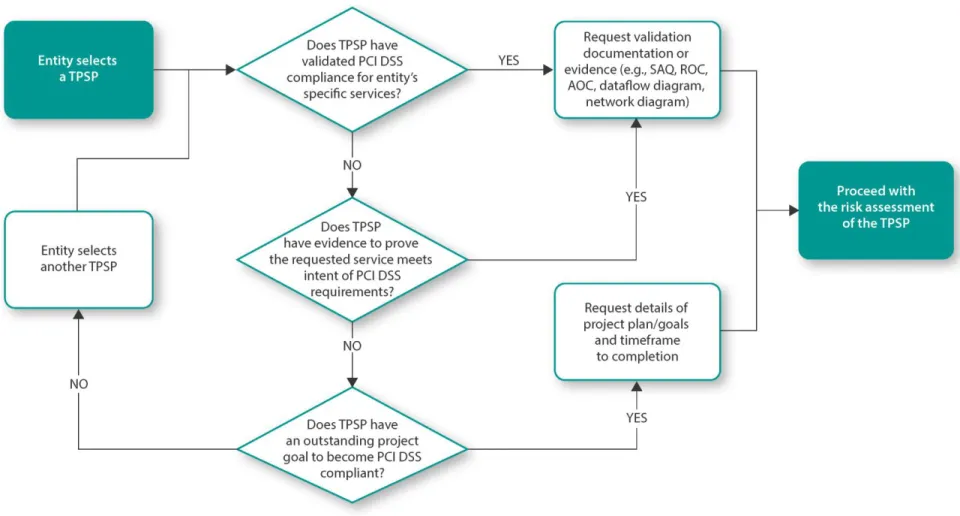
Based on services provided by the TPSP, the entity will need to determine a due diligence path to identify the impact a TPSP has on the entity’s PCI DSS scope. The entity should consider beginning with a preliminary review of the TPSP to ensure that the engagement does not negatively impact the entity’s PCI DSS compliance. This research may include precautions such as consulting with the acquirer, reviewing the participating payment card brand service-provider listings and websites, and requesting PCI DSS validation documentation. Please note not all payment card brands have service-provider listings; however, some payment card brand rules require certain types of service providers to be registered with the payment card brand. The workflow diagram in Figure 2 below details one potential high-level flow for an organization to follow when performing due diligence research on potential TPSPs. As noted above, however, each organization must determine the appropriate due diligence process in light of its own CDE.
This document is provided solely for informational purposes as a convenience to its readers. Information provided here 7 does not replace or supersede the requirements of any PCI SSC Standard or the need for proper due diligence and
appropriately qualified legal counsel.
This document is provided solely for informational purposes as a convenience to its readers. Information provided here 8 does not replace or supersede the requirements of any PCI SSC Standard or the need for proper due diligence and
appropriately qualified legal counsel.
3.2.1
Acquirer/Payment Card Brands
As part of the due diligence process and prior to continuing with the research, an entity may also wish to inquire with its acquirer or payment card brand1 to ensure the TPSP services are approved for use by the acquirer or payment card brand and that there are no restrictions regarding which TPSPs can be used. In some cases an acquirer or payment card brand may disallow the engagement of TPSPs due to risk that has already been previously identifed
3.2.2
Third-Party Service Provider Validation Documentation
The entity may also consider requesting validation documentation from the TPSP that demonstrates the TPSP has achieved PCI DSS compliance. How and whether a TPSP must validate PCI DSS compliance is defined by the payment card brands, and required validation documentation may vary. This, in turn, impacts the types of compliance documentation an entity can expect to receive from the TPSP. Refer to the payment card brands’ websites for more information about specific brand compliance programs, or contact the payment card brands directly.
The level of documentation should be commensurate with the level of risk and impact the TPSP presents to the entity’s PCI DSS compliance. The documentation should be sufficient to confirm that the services provided are covered by the TPSP’s PCI DSS assessment, and identify the PCI DSS requirements that were assessed to be in place. The documentation should also include information related to any services provided by the TPSP in other countries.
As part of the due diligence process, the following documentation, as applicable, may be obtained from TPSPs that have been validated as PCI DSS compliant. The list also contains recommendations for reviewing validation documentation that may be provided to the entity. Validation documentation being provided to the entity should cover the service(s) being delivered by the TPSP to the entity to help ensure the services provided are covered by the TPSP’s compliance validation:
Report on Compliance (ROC): Completed by either an Internal Security Assessor (ISA) or by an external Qualified Security Assessor (QSA). Relevant sections of the ROC may be sufficient to demonstrate the scope of a PCI DSS assessment and compliance status. This may be unnecessary if the AOC covers the required services.
If compensating controls are used, determine why the original requirement could not be met; understand what the control is, how it is meeting the intent and rigor of the original requirement, and how the control is being maintained.
Note: It is possible that a TPSP may choose not to share certain aspects or any portion of its ROC if sensitive information is included or where releasing the document may compromise confidentiality. Alternative information may include a redacted ROC to protect any confidential information, a remote session where sensitive information can be reviewed when required, or a face-to face meeting to allow for viewing of the documentation. Additionally, many QSAs provide a letter on company letterhead, which may be used if the TPSP does not want to share potentially confidential information contained in its ROC.
1
Payment card brand contact information can be found on the PCI SSC website:
This document is provided solely for informational purposes as a convenience to its readers. Information provided here 9 does not replace or supersede the requirements of any PCI SSC Standard or the need for proper due diligence and
appropriately qualified legal counsel.
Attestation of Compliance (AOC): Fully executed “Attestation of Compliance for Onsite Assessments – Service Providers” may be provided to the entity upon request. Template and information to complete the document can be found on the PCI SSC website.
Examine the name and type of services assessed found in Section 2A, “Scope Verification,” to validate the services provided by the TPSP are covered. Examples are “Hosting Provider” and “Payment Processing.”
Review relationships with other TPSPs to understand whether there are any additional services that may need evaluation or inclusion.
Review the AOC to determine whether the TPSP has requirements that are non-compliant that should be covered by the services provided.
Careful review of Part 2G, ”Summary of Requirements Tested,” is warranted as it contains those PCI DSS requirements the TPSP has fully tested, partially tested, or not tested for each service provided. For any “Partial” or “None” responses, the entity should review to ensure the services provided are covered. If the service provided was not covered by this assessment, the entity may wish to include this in its PCI DSS assessment.
Self-Assessment Questionnaire (SAQ) D and Attestation of Compliance for Service Providers (AOC): Completed by TPSP if completing a self-assessment. These documents can be found on the PCI SSC website.
Careful review of Part 2G, ”Summary of Requirements Tested,” is warranted as it contains those PCI DSS requirements the TPSP has fully tested, partially tested, or not tested for each service provided. For any “Partial” or “None” responses, the entity should review to ensure the services provided are covered. If the service provided was not covered by this assessment, the entity may wish to include this in its PCI DSS assessment.
If compensating controls are used, determine why the original requirement could not be met; understand what the control is, how it is meeting the intent and rigor of the original requirement, and how the control is being maintained.
Appendix D of the SAQ, if provided, may be reviewed to understand which requirements are marked as non-applicable or not tested to know whether they are acceptable and clearly explained.
If provided, review Part 2E, “Description of Environment”, and Part 2D, “Payment Application”, to determine whether they are included in the assessment for the services provided.
Review Section 3, “Validation and Attestation Details”, to confirm the results of the assessment. ASV Scan Report Attestation of Scan Compliance (AOSC): Provided by the TPSP’s Approved
Scanning Vendor if the TPSP is providing services that are delivered via systems required to meet PCI DSS Requirement 11.2.2. Information about the AOSC is provided within the PCI DSS ASV Program Guide, available on the PCI SSC website. As with the ROC, the AOSC may be redacted to remove sensitive or confidential information.
This document is provided solely for informational purposes as a convenience to its readers. Information provided here 10 does not replace or supersede the requirements of any PCI SSC Standard or the need for proper due diligence and
appropriately qualified legal counsel.
identified failing vulnerabilities in order to determine whether the particular services are covered in these scans and have passed the scan.
All previous documentation may also have the validation dates tracked with periodic updates from the TPSP. The entity should also ensure all prior non-compliant issues with the TPSP have been remediated, if the remediation timeline has passed.
As these various documents are requested from compliant TPSPs, the entity should also consider requesting written verification that the services being provided to the organization fall within the scope of the services covered by the AOC, ROC, SAQ, and AOSC. This provides an additional measure of assurance that the TPSP’s PCI DSS assessment is aligned with the agreed-upon services. Developing validation checklists may ensure key fields of the AOC, SAQ, ROC, or AOSC are reviewed by the management team.
If the TPSP has not attained PCI DSS compliance due to an outstanding gap in its environment, it is the responsibility of the entity to determine whether or not to accept the risk of engaging that TPSP. It is recommended the entity first understand what gap the TPSP must address in order to establish
compliance and the impact of that gap to its own environment. If it is determined there is an impact, the entity should establish a clear and effective plan to remediate the issues. Among other things, this may include requesting project timelines and goal milestones from the TPSP to determine whether compliance can be achieved for the services offered, within a timeframe acceptable to the entity. Once the scope and gap have been identified, an entity may need to consult with its acquirer to ensure there is no conflict with the engagement.
Note: Some payment card brands require certain types of service providers to validate PCI DSS
compliance. Per payment card brand rules, for certain types of services, only those service providers who are listed and deemed PCI DSS compliant may be used.
If the TPSP does not intend to validate PCI DSS compliance or is not required to validate PCI DSS compliance and the entity still elects to engage the TPSP, the entity will be required to cover the
applicable TPSP systems and processes under its own PCI DSS compliance assessment. The following are examples of documentation the TPSP may provide during a PCI DSS assessment, whenever significant changes occur, and/or annually, as applicable:
A high-level dataflow diagram showing how the TPSP’s services interface with the entity’s environment
Network diagrams
Evidence of system-patching methodology and, if applicable, secure coding methodology
List of the entity’s TPSPs and how each TPSP is connected to the entity’s environment, along with the role the TPSPs play—specifically, any chained/nested relationships
Results of the TPSP’s internal and external vulnerability scans, if available Security policies and operational procedures
If the TPSP is not yet compliant, it may provide its own project plan for their PCI DSS compliance path project plan or a copy of its Prioritized Approach for the service(s) provided, if available. The Prioritized
This document is provided solely for informational purposes as a convenience to its readers. Information provided here 11 does not replace or supersede the requirements of any PCI SSC Standard or the need for proper due diligence and
appropriately qualified legal counsel.
Approach is a tool produced by PCI SSC to help entities implement PCI DSS requirements in a prioritized order that effectively addresses the respective risks. The tool may be downloaded from the PCI SSC’s Document Library at https://www.pcisecuritystandards.org/security_standards/documents.php.
The entity may also wish to consider the risk associated with engaging with a TPSP and how to limit the exposure to the entity’s PCI DSS scope. In addition, the entity may wish to consider the additional effort associated with validating and potentially remediating the applicable system components and processes that fall into scope. For example, the entity may weigh its risk and time impact to perform an internal assessment of the TPSP’s systems and processes versus hiring an external resource to audit the TPSP system on behalf of the entity. Ultimately, because the TPSP has not validated its compliance, the services provided may be in scope for the entity’s PCI DSS assessment and subsequently may result in a delay to the entity’s compliance validation.
3.2.3
Payment Card Brand Validated Providers Lists and Websites
Payment card brands may maintain lists of validated TPSPs that satisfy specific brand enrollment
programs, which typically include requirements to attain and maintain PCI DSS compliance. It is important for an entity to understand the scope of such validation and the services listed. Please note that absence of a TPSP from a list does not preclude an engagement of the service provider, since some TPSPs choose not to be listed, although they have attained PCI DSS compliance. Similarly, the inclusion of a service provider on a published list does not by itself provide assurance that the services applicable to the entity’s engagement are included in the compliance validation, or that all PCI DSS requirements that an entity wishes the TPSP to manage on its behalf are included in the validated service. Depending on the services provided by the TPSP to the entity, the information found on the payment card brand service provider listings may not provide the necessary assurance. Additional information may be needed from the TPSP for the services provided.
3.3 Perform Risk Assessment
It is recommended an entity perform a thorough risk assessment on its TPSP based on an industry-accepted methodology. Understanding the level of risk associated with engaging a TPSP will help the entity in its decision-making process. An entity may need to create a tiered due diligence program with decision trees to handle different levels of risk, depending upon various factors such as:
The magnitude and type of the TPSP services provided (e.g., single contractor, cloud provider, etc.) The level of exposure to a CHD or CDE compromise
The probability and frequency of threats to the organization or its assets Whether the TPSP has ever been involved in a compromise of cardholder data
The PCI DSS Risk Assessment Guidelines provide further information for conducting a risk assessment and can be referenced by entities looking for more detailed guidance in this process.
Below is a high-level list of some of the questions and topics that may be appropriate to consider as part of the risk assessment. The list is not exhaustive and is meant as a starting point for an organization to use when creating its own risk-assessment process:
This document is provided solely for informational purposes as a convenience to its readers. Information provided here 12 does not replace or supersede the requirements of any PCI SSC Standard or the need for proper due diligence and
appropriately qualified legal counsel.
Security Governance and Risk Management
Does the TPSP have an information security program in place that includes documented policies and procedures?
What types of internal or external audits, if any, are performed at the TPSP’s location(s)? Are there other PCI or other industry standards that are applicable to the environment or TPSP? Does the TPSP conduct periodic vulnerability scans and penetration tests on assets, applications, and
systems containing customer data?
Does the TPSP formally reassess and re-evaluate its information security threats and risks at regular intervals, based on the frequency of emerging threats to its systems and processes? Is the assessment process based on a standardized risk-assessment methodology (referenced in PCI DSS Requirement 12.2)?
Has the TPSP ever had a data breach? Human Resources Practices
How are background checks performed on resources that may have access to TPSP customer information? Are the background checks repeated at predetermined intervals?
How are terminations handled?
Are non-disclosure policies in place to protect both the TPSP and its customer information from disclosure?
Does the TPSP have policies concerning transmitting, storing, and processing of sensitive data, as well as customer data?
Physical Security
Is there a physical security program in place at the TPSP locations where applicable systems or services are provided?
Third-Party External Entities
Do any external entities engaged by the TPSP have access to the TPSP’s data processing facilities, systems, or applications?
Does the TPSP perform due diligence on external entities with which it engages?
This document is provided solely for informational purposes as a convenience to its readers. Information provided here 13 does not replace or supersede the requirements of any PCI SSC Standard or the need for proper due diligence and
appropriately qualified legal counsel. Configuration Management
Is there a formal change control and configuration management process in place at the TPSP? Does the TPSP update critical patches within a specified timeframe? Does it have a policy concerning
patch management?
Does the TPSP have any hardware or software that is no longer supported by the manufacturer (beyond its end-of-life)?
Are systems and applications hardened according to a documented standard?
Does the TPSP have secure configuration baselines for all of the platforms comprising its common service infrastructure?
Access Authorization
How is logical and physical access to customer data and assets authorized?
If systems-access processes are shared, are the roles and responsibilities clearly documented? How are rights for physical and logical access reviewed?
Does the TPSP always use a unique authentication credential (such as a password/phrase) for each customer?
Incident Response
Does the TPSP have an incident response plan?
Does the TPSP have procedures for reporting logical and physical security, and privacy incidents to customers?
Do the TPSP procedures include contact information for authorities or forensic investigators? Malware Controls
What controls does the TPSP have in place to detect, contain, and eradicate viruses, worms, spyware, and malicious code?
Are these controls implemented on all TPSP assets that transmit, store, or process the entity’s cardholder data?
What types of change-detection mechanisms are present on the TPSP’s systems?
Has the TPSP invested in any security products or services other than those required by PCI (anti-virus, FIM) that improve its ability to detect malware?
Segregation and Security Controls
What controls are in place to keep customer systems, applications, and data segregated from other customer assets and inaccessible to other customers or the TPSP’s internal network?
This document is provided solely for informational purposes as a convenience to its readers. Information provided here 14 does not replace or supersede the requirements of any PCI SSC Standard or the need for proper due diligence and
appropriately qualified legal counsel.
3.4 Documenting Results
An organization should also consider fully documenting the results of its research regarding the TPSP and review of the TPSP’s compliance status. In addition to any other information and materials deemed necessary or appropriate through the due diligence process, each entity should strongly consider capturing and including the following pieces of critical data, as each will be invaluable in the future:
Anniversary date – What is the date on which compliance documentation expires, requiring revalidation to have taken place?
Compliance validation vendors – With what security and compliance vendors and assessors does the TPSP work? This may include QSAs, ASVs performing scans, etc.
Acquiring bank – If applicable, with what acquiring bank does the TPSP work?
Sponsor bank – Identify if the TPSP uses a sponsor bank for access to the payment card networks. Area audited – What specific service areas have been validated and how do they align with the services
being provided to the entity?
Nested service providers – Are there other TPSPs nested within the TPSP’s compliance? What services do the nested TPSPs provide?
This document is provided solely for informational purposes as a convenience to its readers. Information provided here 15 does not replace or supersede the requirements of any PCI SSC Standard or the need for proper due diligence and
appropriately qualified legal counsel.
4
Engaging the Third-Party Service Provider
After successfully researching a TPSP and completing due diligence, the entity will seek to engage the TPSP. The following sections describe the important steps to consider when engaging a TPSP.
4.1 Set Expectations
As with any project, setting the expectations of all parties involved leads to a higher chance of success. Setting expectations is critical to achieve a consistent and agreed-upon mode of operation.
In addition to the other matters determined to be important by the parties, it is important to define, agree upon, and document each of the following expectations at the start of the engagement, and to review these
expectations—at a minimum, annually and after a change in services—to ensure consensus is still maintained.
The entity’s fundamental goal is to clearly understand the TPSP’s PCI DSS compliance status and as a result, enable itself to achieve and maintain its own PCI DSS compliance and gain assurance that the TPSP is sufficiently safeguarding the entity’s CHD in the TPSP’s possession.
TPSP responsibility to sufficiently safeguard the entity’s CHD in its possession, in an agreed-upon manner.
The specific services provided by the TPSP to the entity.
The primary points of contact at both the entity and the TPSP. In this regard, it may be important to identify specific individuals, along with back-up personnel in case the primary point of contact (POC) is not available. Contact information including e-mail, office phone, and cell phone are also important to document. These (or other specified) individuals should be held accountable for the due diligence activities, in addition to assuming communication responsibilities, addressing incidents, and providing compliance-related information.
4.2 Gain Transparency
Correctly assessing the scope of the TPSP’s responsibility in safeguarding the entity’s CHD or CDE is critical, as the opinions of individuals and organizations regarding scope may differ. In order for this to occur, the entity may wish to consider requesting to view evidence proving the scope is accurate based upon what the TPSP has claimed. As detailed in section 3.2.2, “Third-Party Service Provider Validation Documentation,” this information may be proprietary or confidential and may require redaction, remote viewing, in-person viewing, or phone discussions. Ideally, an ISA or a QSA should review the evidence provided to verify the scope is indeed applicable, appropriate, and accurate. An individual who is well-versed and experienced in network design and segmentation may also provide this expertise if an ISA or QSA is not available.
Entities may also wish to consider the use of appropriate contractual provisions with TPSPs that enable and require appropriate evidence sharing, to avoid situations where the TPSP is not obligated to facilitate the evidence-sharing process. If all attempts fail to gain required evidence from the TPSP, the entity may consider requesting that the TPSP document its scope definition in writing and include a provision for the
This document is provided solely for informational purposes as a convenience to its readers. Information provided here 16 does not replace or supersede the requirements of any PCI SSC Standard or the need for proper due diligence and
appropriately qualified legal counsel.
TPSP to retain the documentation for the agreed-upon duration. Additional information can be found in Section 5, “Written Agreements, Policies, and Procedures.”
4.3 Establish Communications
One of the keys to the success of the entity–TPSP relationship is effective communication. Without effective communication, changes may be made by the TPSP without the entity’s awareness or agreement that may negatively impact the entity’s overall PCI DSS compliance status. Determination of a significant change will vary from entity to entity, depending on the type of change and its impact.
Communications may be promoted and enhanced by establishing a communication schedule as part of the onboarding process for the monitoring program, assigning the primary points of contact at the entity and the TPSP as the responsible parties for proactively communicating on important matters. If appropriate, these points of contact may also be responsible for distributing the information appropriately within the relevant organizations in a timely manner so that risk may be mitigated.
The communication schedule should be reviewed and updated on an annual basis or as needed, depending on the type and impact of changes. The following topics (non-exhaustive list) may need to be communicated whenever changes occur and/or annually, as applicable.
Changes to the CDE
Changes to the entity’s or TPSP’s payment processing structure
Changes in personnel responsible for maintaining operations with the TPSP and entity Changes in personnel involved with the due diligence initiative
Changes in processes, procedures, and methodologies that impact the CDE All other instances where an activity will impact the scope of the entity
4.4 Request Evidence
In addition to the evidence requested to support the services and scoping provided by the TPSP, the entity may need to verify that appropriate procedures were followed and controls deployed to support changes. To that end, the entity may determine that it is appropriate to request supporting evidence whenever it receives a communication from the TPSP and assesses the risk to be applicable. See Section 4.2, “Gain Transparency,” above for applicable materials and methods of communication.
If the entity itself will assess the PCI DSS compliance status of the TPSP—i.e., the entity will employ the services of one of its own ISAs or an external QSA to determine the TPSP’s compliance—requesting evidence annually may be appropriate to support the PCI DSS assessment.
4.5 Obtain Information about PCI DSS Compliance
Section 3.2.2, “Third-Party Service Provider Validation Documentation,” provides examples of the information that may be obtained from a TPSP regarding its compliance status, whether the TPSP has been validated or is not required to validate. It is an option for entities to perform a PCI DSS compliance assessment of the applicable services provided by the TPSP by either employing the services of one of its own ISAs or an
This document is provided solely for informational purposes as a convenience to its readers. Information provided here 17 does not replace or supersede the requirements of any PCI SSC Standard or the need for proper due diligence and
appropriately qualified legal counsel.
external QSA. This PCI DSS assessment should ideally be performed upon the start of the engagement. However, performing the assessment after the engagement has begun can still provide insight and a baseline to work from; and then annual assessments may be performed preferably ending a few months before the entity’s own PCI DSS assessment date to allow for any remediation necessary.
As with the pitfalls detailed in Section 4.2, “Gain Transparency,” above, the effectiveness of performing this type of assessment depends on the TPSP’s willingness to provide the necessary information. Depending on the legal agreements between the parties, there may be many instances where the TPSP declines to provide proprietary and confidential information. As detailed in “Gain Transparency,” the entity may wish to request that the TPSP document its refusal to provide the information in writing, if appropriate.
4.6 Frequency of Review
The following table shows the suggested frequency of review for the engagement steps: Engaging Third-party Service Providers
Steps Initially As Changes Occur* Annually
Set Expectations X X X
Gain Transparency X X X
Establish Communications X X X
Request Evidence X X X
Obtain Information about
PCI DSS Compliance X X
* Note: Depending on the type of change introduced, this step may or may not be required. For example, a significant infrastructure change may initiate all steps, whereas a change that does not impact the CDE or PCI DSS compliance—for example, changes in primary point of contact—may only trigger a few steps. The result of risk assessments performed during the due diligence process will help determine how often these steps need to be repeated.
4.7 Mapping of Third-Party Services to Applicable PCI DSS Requirements
It is critical that the entity fully understands how the services and products provided by the TPSP map to the PCI DSS requirements, so the entity can determine the security impact to its cardholder data environment. The requirements that are applicable to a TPSP will vary depending on a number of factors, including the nature of services provided, the level of access it has to CDE, and so on. For example, a TPSP that provides firewall management services may have to meet PCI DSS Requirement 1; a TPSP providing maintenance services that include incidental access to the CDE may require background checks and/or escorts while in sensitive areas.
Appendix A to this document provides a table showing suggestions and discussion points that may help clarify and determine how responsibilities for maintaining PCI DSS requirements may be shared between the entity and the TPSP. Appendix B is a sample PCI DSS Responsibility Matrix to help an entity start building
This document is provided solely for informational purposes as a convenience to its readers. Information provided here 18 does not replace or supersede the requirements of any PCI SSC Standard or the need for proper due diligence and
appropriately qualified legal counsel.
an understanding of how PCI DSS requirements could map to the services that an entity outsources to a TPSP and the related accountability for each.
This document is provided solely for informational purposes as a convenience to its readers. Information provided here 19 does not replace or supersede the requirements of any PCI SSC Standard or the need for proper due diligence and
appropriately qualified legal counsel.
5
Written Agreements, Policies, and Procedures
Note: The information and guidance provided in this section and generally throughout this Information Supplement do not constitute legal advice and, accordingly, should not be relied upon or construed as such. Entities seeking to engage a TPSP to perform services are strongly encouraged to seek legal advice from an appropriately qualified professional to ensure that each party fully understands its rights and obligations, and that the parties’ expectations are in alignment. Entities with specific questions about legal matters should consult an appropriately qualified legal professional.The information and guidance provided in this section do not supersede local or regional laws, government regulations, or other legal requirements. Ultimately, the specific terms of the agreement between an entity and a TPSP should reflect all of the details of the services being provided and the relevant rights and responsibilities of both parties.
Once an appropriate risk-assessment process has been completed and a TPSP has been selected for an engagement, best practice suggests that the entity and TPSP should document their agreement in writing. The discussion below is intended to highlight certain issues specific to a typical entity–TPSP relationship that an entity may want to consider when seeking to engage a TPSP. Entities with existing agreements with TPSPs may also wish to consider the following when reviewing those agreements. The following is not intended to be an exhaustive list and is provided as a convenience in order to help familiarize entities seeking TPSP engagements with the kinds of issues that commonly arise in this context. Other issues may arise and may be equally or more important, and entities are strongly encouraged to seek appropriately qualified legal counsel in connection with all business agreements.
5.1 Agreements between PCI DSS Compliant Third-Party Service Providers versus
non-PCI DSS Compliant Third-Party Service Providers
TPSPs that have undergone PCI DSS compliance assessment and are validated as compliant:
When engaging a TPSP that claims its services are PCI DSS compliant, entities should consider documenting such compliance. The specific documentation that may be provided will ultimately depend on the situation and agreement between the parties, and may include provision of an AOC, SAQ, and/or relevant sections from the ROC (redacted to protect any confidential information), including:
Date of compliance assessment
System components, services, and environments that were included in the third-party PCI DSS assessment
System components and services that were excluded from the PCI DSS assessment, as applicable to the service(s) provided
Having the TPSP resources available (including ISA or QSA if required) to answer any clarification questions may be useful in validating that the services provided by the TPSP are covered. Similarly, provisions acknowledging the respective responsibilities of the parties for handling and securing the CHD in their possession in a PCI DSS compliant manner may assist in validation. Tracking the frequency of the compliance validation may also assist in managing and monitoring the TPSP as required by PCI DSS Requirement 12.8.
This document is provided solely for informational purposes as a convenience to its readers. Information provided here 20 does not replace or supersede the requirements of any PCI SSC Standard or the need for proper due diligence and
appropriately qualified legal counsel.
TPSPs that have not undergone an assessment or are not required to validate PCI DSS compliance: An entity that is required to establish PCI DSS compliance and that utilize the services of a TPSP that has not affirmatively established its own PCI DSS compliance may need to cover some or all of the TPSP’s
environment as a part of its own PCI DSS assessments. More specifically, such an entity’s PCI DSS
assessment will need to cover any TPSP service that requires (or may enable or permit) the TPSP to handle CHD or can impact the security of the CDE. As a result, entities seeking to engage TPSPs in this context may wish to consider mechanisms (such as the ability to audit the TPSP) intended to help promote transparency and assist in the PCI DSS compliance validation process, such as:
Access to systems, facilities, and appropriate personnel for on-site reviews, interviews, physical walk-throughs, etc.
Review of TPSP policies, procedures, process documentation, configuration standards, training records, incident response plans, etc. that evidence satisfaction of applicable PCI DSS requirements and/or requirements that the TPSP adhere to the entity’s policy.
Review of evidence (such as configurations, screen shots, process reviews, etc.) to assist in validating that all applicable PCI DSS requirements are being met for the in-scope system components of the TPSP environment.
Clarity regarding portions of the merchant environment managed by the TPSP that are in scope for the entity/merchant PCI DSS assessment.
Retention of evidence collected because of non-compliance
Allocation of responsibility for handling and securing cardholder data in a PCI DSS compliant manner. Frequency of PCI DSS compliance validation/assessment (e.g., annually, quarterly, etc.).
5.2 Considerations when Building Agreements, Policies, and Procedures
Regional Regulatory RequirementsIt is recommended that an entity evaluate all regional (e.g., country, state, provincial, municipal) requirements that may apply. For example, some merchants, such as state agencies or public universities, may be required to comply with state-specific requirements regarding specific issues (such as budget-cycle dependence for payment) or selection of a TPSP. An entity should consult appropriate federal, regional, state (e.g., state controller), local, and foreign agencies to determine applicable limitations and guidelines.
Legislative Considerations
An entity may want to consult applicable laws that may contain additional provisions regarding: Definitions of sensitive or protected information
Breach-notification thresholds
Specific identity-theft protection requirements
This document is provided solely for informational purposes as a convenience to its readers. Information provided here 21 does not replace or supersede the requirements of any PCI SSC Standard or the need for proper due diligence and
appropriately qualified legal counsel.
These provisions may vary from an entity’s typical policy or agreement. The entity should seek legal
consultation regarding all applicable legal, regulatory, and other requirements for each jurisdiction, area, and region in which it will be operating. The value of understanding and allocating responsibility for meeting all such requirements cannot be understated, especially in the location(s) where physical and virtual payment environments reside.
Acquirer Considerations
Each acquirer may have its own requirements related to engaging a TPSP. An entity may want to review its agreements with acquirers to ensure its TPSPs (or the acquirers’ TPSP(s)) are meeting any additional acquirer-specific responsibilities that flow through to TPSPs.
Payment Card Brand Considerations
Each payment card brand has created its own compliance programs. Entities seeking to engage TPSPs should consider reviewing these compliance-program requirements with the TPSP(s) in order to identify and appropriately allocate corresponding responsibilities, and to ensure that each understands and complies with all applicable payment card brand mandates.
Industry-Specific Considerations
In various industries and verticals there are specific industry regulations and requirements that entities might consider, as they may be important to the relationship and the allocation of rights and responsibilities between an entity and a TPSP. Specific issues to consider may include the handling of equipment that is part of the CDE, data-destruction requirements, and levels of protection required to meet compliance requirements. An entity and TPSP should discuss any industry-specific requirements that may be pertinent.
Internal Policy-Specific (Subsidiary Relationships) Considerations
In the event that a parent company and its subsidiary establish a relationship where one is a TPSP and the other is utilizing the TPSP services, additional issues to consider may include:
Is the TPSP incorporating subsidiaries into its PCI DSS assessment or performing separate PCI DSS assessments among those subsidiaries?
Is the TPSP considered a different level merchant/service provider than the entity? Does that affect the type of validation that either of them must perform?
What does the TPSP actually provide to the entity?
What other aspects of the relationships may be relevant (e.g., independent franchisee vs. corporate franchisee)?
Note: There is a high degree of variability in the formality of contractual arrangements between parent and subsidiary companies. Such arrangements range from unwritten agreements, to informal internal service-level agreements, to sophisticated arm’s length contracts. Nonetheless, the issues and concerns likely to arise between unrelated entities and TPSPs are also likely in the parent-subsidiary context.
This document is provided solely for informational purposes as a convenience to its readers. Information provided here 22 does not replace or supersede the requirements of any PCI SSC Standard or the need for proper due diligence and
appropriately qualified legal counsel.
5.3 Additional Considerations
Entities seeking to engage TPSPs may also wish to consider the following.
5.3.1
Responsibility Matrix
A responsibility matrix is typically a schedule or appendix that details specific responsibilities of the parties to an agreement, in an easy-to-understand, tabular format. A responsibility matrix in the entity– TPSP context may be useful in helping to identify a variety of issues, including but not limited to responsibilities, procedures, and notice periods for the following:
Technology
Purchasing of system components Building of system components Testing/Deployment
Sustainment/maintenance (i.e., patching, vulnerability, and penetration testing)
Product or technology life cycle Processes Operational procedures Notification requirements
Superseding policy (in the event of a discrepancy, which policy will be considered valid) Reporting
Audit procedures that include systems and facilities as required PCI DSS validation activities
Access to systems/data for periodic validation if required (account reconciliation, logs, etc.) Access to systems/data for forensic investigation
Data/evidence retention and destruction Business recovery and continuity
5.3.2
Data Breaches
As outlined in PCI DSS Requirement 12.10 regarding the incident response plan, numerous specific actions may be required in connection with suspected data breaches, within a very short time of such breach. Entities may wish to consider how best to ensure that the TPSP is aware of these requirements and develop a workflow establishing when, how, and who a TPSP must notify in case of a suspected data breach. In addition to the incident response plan required by PCI DSS, payment card brands and national or regional laws may require breach notification. Entities should consider each of these issues with relevant TPSPs, and how best to allocate responsibility for all applicable notification requirements and all requisite follow up actions.
This document is provided solely for informational purposes as a convenience to its readers. Information provided here 23 does not replace or supersede the requirements of any PCI SSC Standard or the need for proper due diligence and
appropriately qualified legal counsel.
Additional considerations may include issues such as:
Steps expected of entities and/or TPSPs if data loss has occurred Use of tools such as file recovery
Applicability and adequacy of insurance coverage Responsibility for making notifications
Financial responsibility for notification costs Notification timelines
Engagement of forensic investigators and responsibility for investigation costs
5.3.3
Post-termination Considerations Regarding TPSPs and Their Employees
Entities that (a) are subject to requirements regarding CHD or any CDE (whether driven by the PCI DSS, legal considerations, or otherwise) and (b) outsource related responsibilities to a TPSP, may also wish to consider how those requirements and responsibilities may apply to the TPSP after the entity–TPSP engagement has formally ended. For example, if a TPSP continues to store an entity’s CHD as part of an archival backup system, the TPSP’s corresponding obligations regarding such CHD may continue as well. As a result, the entity may wish to consider whether post-termination reporting, notice, data retention, or related requirements are appropriate and/or whether notice should be provided (even after the entity–TPSP relationship has ended) if and when the TPSP destroys or irreversibly removes data from its facilities and/or devices.
Similar considerations arise in connection with terminated TPSP employees. If an individual may have access to the entity’s confidential information (including CHD or the CDE) while employed by the TPSP, entities and TPSPs may wish to consider mechanisms to help ensure that such information is protected after the employment relationship ceases, such as:
Ongoing post-termination confidentiality obligations
Appropriate allocation of responsibility for ensuring compliance by TPSP employees with their ongoing confidentiality obligations
Appropriate allocation of responsibility for enforcement of confidentiality obligations, and for costs associated with enforcement and related legal proceeding in the event of a breach of those obligations
Termination of TPSP-employee access to buildings or systems immediately upon termination of employment
5.3.4
Outsourcing of Provided Functionality (Nested TPSPs)
If the TPSP outsources to a separate contractor a portion of the services the TPSP has agreed to provide to the entity, all of the issues and concerns raised above would potentially also apply to the relationship between the TPSP and the outsourced contractor. This, in turn, may impact the scope of the entity’s CDE and ultimately the scope of the entity’s PCI DSS validation. As a result, to help manage these
This document is provided solely for informational purposes as a convenience to its readers. Information provided here 24 does not replace or supersede the requirements of any PCI SSC Standard or the need for proper due diligence and
appropriately qualified legal counsel.
complexities and related risks, entities may wish to consider whether mechanisms such as the following may be appropriate:
Notification to the entity that outsourcing has occurred
Appropriate limitations regarding outsourcing of functionality, such as regional exclusions due to jurisdictional concerns
Appropriate allocation of liability, responsibility and costs relating to actions of outsourced contractors and/or notifying the entity regarding incidents
5.3.5
Loss of Compliance Status
Loss of a TPSP’s PCI DSS compliance status can have significant ramifications for an entity relying on the TPSP’s services. Accordingly, entities may wish to consider mechanisms intended to keep the entity apprised of changes in PCI DSS compliance status, and to appropriately allocate responsibility for loss of compliance status among the parties. Such mechanisms may include:
Disclosure/notice of changes in compliance status to the impacted entity Remediation plans and procedures to re-establish compliance by set dates Regular status meetings to advise on remediation efforts
Other appropriate measures intended to help ensure accountability and responsibility for non-compliance
This document is provided solely for informational purposes as a convenience to its readers. Information provided here 25 does not replace or supersede the requirements of any PCI SSC Standard or the need for proper due diligence and
appropriately qualified legal counsel.
6
Maintaining Relationships with and Monitoring Third-Party
Service Providers
Establishing and maintaining a program to monitor TPSP compliance with PCI DSS Requirement 12.8.4 is a critical requirement for any entity. A monitoring program will allow an entity to monitor the compliance status of TPSP(s) and determine whether a change in status requires a change in the relationship. Validation of compliance takes place at a single point in time, and unfortunately it is quite easy for an entity to allow processes to relax and for compliance to lapse. Relying on other parties for services—including outsourcing critical functions—does not relieve an entity of responsibility for the security of their cardholder data, and TPSP compliance must be monitored continuously and diligently.
Investing the time and effort to develop and implement a strong TPSP monitoring program provides numerous benefits to the entity. First, and most importantly, the monitoring program will improve the entity’s security posture and help ensure the protection of cardholder data for which the organization is responsible by providing assurance and awareness about whether the TPSP continues to share the same level of
commitment in handling CHD. A monitoring program will also ensure there is regular communication between the TPSP and the entity regarding changes to the environment including processes and procedures. This allows the entity to be in a proactive—instead of reactive—position. Second, the monitoring program will provide a consistent process to simplify the ongoing monitoring and management of TPSPs. Finally, the monitoring program will enable an entity to demonstrate compliance with a key section of the PCI DSS, should proof be requested from a party performing an assessment.
As part of an entity’s monitoring program, an onboarding process for new TPSPs should be developed and maintained, including providing new TPSPs with information attained through the various stages of
engagement (i.e., risk analysis, contract details, responsibility matrix, etc.) This additional information should be incorporated into the monitoring program to create the framework for monitoring a TPSP.
6.1 Developing a Third-Party Service Provider Monitoring Program
A TPSP monitoring program should be fully documented. This ensures there is a common understanding of its elements across the organization, facilitates delegating portions of the process if required, and allows review of the process by outside parties when necessary. The elements of the program should include processes, policies, and procedures, and assignment of responsibility for those elements to specific people within the organization. The program documentation should be revisited on a regular basis in order to make corrections and improvements as the business processes and TPSP relationships evolve. It is recommended that program documentation be reviewed at least on an annual basis and is approved by management. The program documentation should cover the following areas, including guidance on the intent and importance:
6.1.1
Cardholder Data Environment (CDE) Scope Definition
Ensuring the CDE scope is correctly defined and verified is pivotal in determining the level of effort required to achieve compliance. The entity needs to ensure that all resources involved in the monitoring of TPSPs understand the concept of CDE scope, and specify what is needed in order to fully define
This document is provided solely for informational purposes as a convenience to its readers. Information provided here 26 does not replace or supersede the requirements of any PCI SSC Standard or the need for proper due diligence and
appropriately qualified legal counsel.
scope (e.g., a high-level network diagram with applications and network components clearly labeled, out-of-scope validation activities, etc.). Once scope has been confirmed, the program should include a deliverable that explains the CDE scope and indicates the role of each TPSP and how it impacts the entity’s PCI DSS scope.
6.1.2
List of Third-Party Service Providers
Define the procedure to maintain the TPSP list, including the information elements required. Following are suggested elements that may be included in the list:
Name and primary points of contact at the TPSP Specific service(s) being provided
If cardholder data is shared, what elements are shared (sensitive authentication data, PAN, expiry, etc.)
What system components are included in the review TPSP risk-assessment results
Frequency of monitoring cycle Last date of review
Contract renewal/expiry
Documentation/evidence required
Any nested TPSPs leveraged to provide the services
Any third-party payment applications used to provide the services
Volume of cardholder data that is stored/processed/transmitted/impacted by the TPSP Logical access to the entity’s network
Any designations the TPSP holds that support its PCI DSS compliance attestation (ISO, PCI QIR, PCI PTS, FIPS140, etc.)
6.1.3
Third-Party Service Provider Monitoring Procedure
Below is a high-level description of the components an entity may wish to consider including in its TPSP monitoring procedure. The list is not exhaustive and is not intended to define the only method to monitor TPSPs’ PCI DSS compliance status; however, the list describes some recommended components that may be included in the procedure.
6.1.3.1 Documentation/Evidence
Define the evidence and supporting documentation that will be collected from TPSPs for analysis and retention. As specified earlier, a key piece of information to be gathered is the role of the TPSP in the CDE. This information may be available from the applicable sections of the ROC or Part 2E,
Description of Environment in the AOC. See Section 3.2.2, “Third-Party Service Provider Validation Documentation,” for additional information.