Some pages of this thesis may have been removed for copyright restrictions.
If you have discovered material in Aston Research Explorer which is unlawful e.g. breaches
copyright, (either yours or that of a third party) or any other law, including but not limited to
those relating to patent, trademark, confidentiality, data protection, obscenity, defamation,
libel, then please read our Takedown policy and contact the service immediately
The Equity Analyst Rating Decision:
A Strong Structuration Analysis
Kenneth Lee
Doctor of Business Administration
Aston University
September, 2018
©
Kenneth Lee, 2018. Kenneth Lee asserts his moral right to be identified as the
author of this thesis.
This copy of the thesis has been supplied on condition that anyone who consults it is understood to recognise that its copyright rests with its author and that no quotation from the thesis and no information derived from it may be published without appropriate permission or acknowledgement.
THESIS SUMMARY
THE EQUITY ANALYST RATING DECISION: A STRONG STRUCTURATION ANALYSIS Kenneth Lee, Aston University, Doctor of Business Administration, 2018
Sell-side analysts represent something of an enigma; the literature suggests they are optimistic and conflicted in their stock recommendations, yet these same stock recommendations impact share prices and so are clearly important for capital markets. To unlock and explore this conundrum, this study conceptualises stock recommendation decisions as primarily social in nature. Consequently, this situates the research outside of the predominantly neo-classical economic model reflected in the mainstream analyst literature.
Giving voice to the sell-side analyst participants was central to the study. It explored their experiences of making decisions in the midst of a complex, changing social environment. Based on a field study, the empirical evidence was collected from focus groups and semi-structured interviews with sell-side analysts. Semi-semi-structured interviews were extended into the analysts’ network to include internal clients, external investment managers and corporate officials. Strong structuration theory was drawn upon extensively through every stage of the research as a revealing lens to sensitise the researcher to the structural and agential aspects of analyst practices, with a specific focus on rating decisions.
The findings suggest that regulatory tightening over the last decade has created an independent causal external structure that materially constrains and transforms the practices of sell-side analysts. Power dynamics, the levying of sanctions, a diverse analyst habitus and the exercise of resistance all remain integral to understanding company-analyst relations and action. Fieldwork evidence reveals that the sales force, largely ignored in the mainstream literature, represents a powerful agent cluster in close time-space proximity to analysts. By viewing the conduct of analysts as the outcome of cycles of structuration, further light can be shed on the low level of sell recommendations in the market, the use of calculative routines to legitimise ratings and the capitulation point, whereby an analyst abandons a poorly performing stock call.
Keywords/Phrases: sell-side analysts; strong structuration theory; analyst stock recommendations;qualitative inquiry; social theory
ACKNOWLEDGEMENTS
Every doctorate is a significant endeavour. Front and centre with me on this journey has been my supervisory team, Dr Melina Manochin and Dr Carlene Wynter. Their positive attitude, openness and commitment has enriched the doctorate experience immensely and I wish to thank them for all of their advice and support. The very first person I met at Aston was Ranjit Judge who has been a delightful, friendly and positive source of support which I could not have done without. Huge thanks also to all of the RDP team, and, in particular, to the excellent faculty in the accounting department at Aston Business School.
During my doctorate studies, I switched careers from banking to academia, and I wish to acknowledge those who helped me on that journey. I have found the academic community very supportive with many people happy to share ideas, offer invitations to specialist theory conferences or simply give their time to discussion and debate. This has been both welcoming and inspiring, and for this I express my sincere appreciation. Lastly, I wish to thank Professor Ken D’Silva for all his time and guidance over many years, in particular his advice to do a doctorate!
There would have been no thesis if it had not been for the analysts and other professionals who participated in this study. They gave of their time freely, spoke honestly and put their trust in the ethical commitments I gave them. I want to express my gratitude for their investment of time and effort.
Over the years working on the doctorate, I sadly lost two dear friends. Mathias Jost was an inspirational colleague whom I met in South Africa whilst working for Barclays, and Michael Bent, a very close friend from Ireland since my early years working in Dublin. I have a picture of them both in my study which reminded me, even as I toiled away, to make the most of every opportunity. I will never forget them.
As a mature student undertaking such a large task, it is inevitable that sacrifices have to be made at home. The principal sacrifice is time. In particular, as a father and husband, the sacrifice has been time away from my children, Jake, Ewan, Nathan and Annabel and my dear wife, Rachel. It was often impossible to find time for family activities and I want to thank you all for your patience and encouragement. The fact that you have now all heard of structuration theory will no doubt put you in good stead for the future! I promise a great celebration when all is done and that we will get our weekends back!
I dedicate this thesis to my mother, Veronica. She passed away many years ago and so never got to see nor, more importantly, enjoy, the achievements of her children. She is with me in
TABLE OF CONTENTS THESIS SUMMARY ... 2 ACKNOWLEDGEMENTS ... 3 TABLE OF CONTENTS ... 4 LIST OF FIGURES... 10 LIST OF TABLES ... 11
CHAPTER 1. INTRODUCTION AND OVERVIEW ... 12
1.1 INTRODUCTION AND OVERVIEW ... 13
1.2 THE CONTEXTUAL NATURE OF ANALYST WORK ... 14
1.2.1 The stock rating decision... 18
1.3 THE ANALYST LITERATURE ... 18
1.4 THE THEORETICAL CONTEXT ... 20
1.5 RESEARCH PROBLEM, OBJECTIVES AND QUESTIONS ... 21
1.5.1 Bracketing and sub-questions ... 22
1.6 OVERVIEW OF ONTOLOGY, EPISTEMOLOGY AND METHODOLOGY ... 23
1.6.1 Methodology ... 23
1.7 KEY CONTRIBUTIONS... 24
1.8 THESIS STRUCTURE ... 26
1.9 CONCLUSION ... 27
CHAPTER 2. EQUITY SELL-SIDE ANALYSTS’ RATING DECISIONS: A LITERATURE REVIEW ... 29
2.1 INTRODUCTION ... 30
2.2 APPROACH TO THE LITERATURE SEARCH ... 31
2.3 WHAT ARE THE MAIN ACTIVITIES OF ANALYSTS AND HOW IMPORTANT IS THE STOCK RATING DECISION? ... 32
2.3.1 Information gathering ... 33
2.3.2 Information processing ... 34
2.3.3 Client servicing ... 35
2.3.4 The nature and importance of stock rating decisions ... 35
2.3.5 Analyst incentives ... 37
2.3.6 What have we learned from this section? ... 38
2.4 WHAT IS THE NATURE OF ANALYSTS’ DECISION PROCESSES ON STOCK RECOMMENDATIONS? ... 38
2.4.1 Which valuation models do analysts use? ... 40
2.4.2 Ratings systems used by analysts ... 41
2.4.3 What have we learned from this section? ... 42
2.5 HOW INFORMATIVE ARE ANALYSTS’ STOCK RECOMMENDATIONS? ... 43
2.5.1 The impact of stock recommendations on share prices ... 43
2.5.2 Investor implementation of stock calls ... 46
2.5.3 Combining other information with recommendations ... 47
2.5.4 Type of analyst and reaction to recommendation changes ... 52
2.5.5 What have we learned from this section? ... 53
2.6 HOW DO CONFLICTS OF INTEREST AND RELATED BIASES AFFECT THE PRACTICES OF ANALYSTS? ... 54
2.6.2 Institutional investors ... 56
2.6.3 Corporations ... 57
2.6.4 Peer analysts ... 59
2.6.5 What have we learned from this section? ... 60
2.7 HOW DOES A CHANGING REGULATORY ENVIRONMENT AFFECT THE PRACTICES OF ANALYSTS AND THEIR ROLE IN CAPITAL MARKETS? ... 61
2.7.1 What have we learned from this section? ... 65
2.8 HOW DOES THE SOCIAL TERRAIN AFFECT THE WORK OF ANALYSTS? ... 65
2.8.1 Social perspectives of the analyst role ... 66
2.8.2 Specific use of social theory on sell-side analyst work ... 66
2.9 CONCLUSION ... 68
CHAPTER 3. THEORETICAL FOUNDATIONS ... 70
3.1 INTRODUCTION ... 71
3.2 THE GENESIS OF STRUCTURATION THEORY ... 71
3.3 WHY STRONG STRUCTURATION THEORY? ... 72
3.4 GIDDENS AND STRUCTURATION THEORY ... 74
3.4.1 The duality of structure and agency ... 75
3.4.2 The structural dimensions of signification, legitimation and domination ... 75
3.4.3 The stratification model of human action ... 78
3.4.4 Agency and the dialectic of control ... 81
3.4.5 Time-space ... 81
3.4.6 Criticisms of structuration theory ... 82
3.4.6.1 Abstract and challenging to apply in practice ... 83
3.4.6.2 Bracketing reintroduced a dualism ... 83
3.4.6.3 Inadequate attention to structural boundaries ... 83
3.4.6.4 External structures not adequately addressed ... 84
3.5 USE OF STRUCTURATION THEORY IN ACCOUNTING RESEARCH ... 85
3.6 THE DEVELOPMENT OF STRONG STRUCTURATION THEORY AND ITS KEY CONCEPTS ... 87
3.6.1 Differences between structuration theory and strong structuration theory . 89 3.6.1.1 A move to ontology in situ ... 89
3.6.1.2 Meso level of ontological scale ... 89
3.6.1.3 The quadripartite cycle of structuration ... 91
3.6.1.4 The centrality of epistemology and methodology ... 98
3.6.1.5 Systematic research process ... 100
3.7 RESEARCH USING STRONG STRUCTURATION THEORY ... 100
3.8 CRITIQUES OF STRONG STRUCTURATION THEORY ... 112
3.9 CONCLUSION ... 112
CHAPTER 4. RESEARCH PHILOSOPHY, THEORETICAL FRAMEWORK AND METHODOLOGY ... 115
4.1 INTRODUCTION & OVERVIEW ... 116
4.2 RESEARCH PHILOSOPHY ... 117
4.2.1 Key elements of a philosophical stance ... 117
4.2.1.1 Ontology ... 118
4.2.1.2 Epistemology ... 118
4.2.1.3 Human nature ... 119
4.2.1.4 Methodology and methods ... 119
4.3.3 Methodology ... 122
4.3.4 Methods ... 123
4.4 THEORETICAL FOUNDATION AND CIRCULAR DESIGN ... 123
4.5 REFLEXIVITY ON THE ROLE OF THE RESEARCHER IN THIS STUDY... 124
4.6 DATA COLLECTION METHODS ... 126
4.6.1 Overview of design and data collection ... 126
4.6.1.1 Preliminary stage - Interviews and a focus group ... 127
4.6.1.2 First main stage - focus groups ... 127
4.6.1.3 Second main stage - semi-structured interviews ... 127
4.7 CRITICAL DESIGN DECISIONS ... 128
4.7.1 Use of multiple methods ... 128
4.7.2 Documentary analysis ... 129 4.7.3 Epistemology ... 129 4.7.4 Participant recruitment ... 130 4.7.4.1 Work experience ... 130 4.7.4.2 Organisation ... 131 4.7.4.3 Division ... 131
4.7.5 Approach to recording and transcription ... 132
4.8 DATA COLLECTION PHASES ... 133
4.8.1 Pilot phase ... 133
4.8.2 Focus group phase ... 134
4.8.2.1 Number of groups & group size ... 134
4.8.2.2 Participant recruitment ... 134
4.8.2.3 Moderation... 135
4.8.2.4 Use of a topic guide ... 135
4.8.3 Semi-structured interview phase and interview guide ... 135
4.8.3.1 Number of interviews ... 136
4.8.3.2 Interview conduct and guide design ... 136
4.9 EMBEDDING ANALYSIS IN DATA COLLECTION ... 137
4.10 DATA ANALYSIS ... 138
4.10.1 Data collection ... 138
4.10.2 Data condensation ... 138
4.10.3 Data display ... 139
4.10.4 Drawing and verifying conclusions ... 139
4.11 ETHICAL ISSUES ... 139
4.12 VALIDITY ... 140
4.13 CONCLUSION ... 142
CHAPTER 5. FINDINGS I: AGENT’S CONTEXT ANALYSIS ... 144
5.1 INTRODUCTION ... 145
5.2 METHODOLOGICAL BRACKETING IN STRONG STRUCTURATION THEORY145 5.3 AGENT’S CONTEXT ANALYSIS ... 146
5.4 POSITIONING WITHIN THE SELL-SIDE ANALYST FIELD ... 148
5.4.1 Time-space ... 149
5.4.2 Agents in context ... 150
5.4.2.1 Sales Force ... 152
5.4.2.2 External clients ... 153
5.4.2.3 Companies ... 154
5.4.3 The fixed nature of the analyst field ... 154
5.5.1 Prerogatives ... 156
5.5.1.1 Unique position ... 156
5.5.1.2 Freedom and flexibility (agency) ... 157
5.5.2 Obligations ... 157
5.5.2.1 Regulation ... 157
5.5.2.2 Independence ... 160
5.5.2.3 Process ... 161
5.6 POSITION-PRACTICE RELATIONS – DEPENDENCIES AND POWER... 164
5.6.1 Company-analyst relations ... 165 5.6.2 Client-analyst relations ... 169 5.6.3 Internal clients ... 169 5.6.4 External clients ... 170 5.7 TRUST ... 171 5.8 CONCLUSION ... 173
CHAPTER 6. FINDINGS II: AGENT’S CONDUCT ANALYSIS ... 175
6.1 INTRODUCTION ... 176
6.2 AGENT’S CONDUCT ANALYSIS ... 177
6.2.1 General-dispositional ... 177
6.2.2 Conjuncturally-specific ... 178
6.3 EMPIRICAL EVIDENCE ON INTERNAL STRUCTURES - GENERAL- DISPOSITIONAL ... 179
6.3.1 Informal and diversified field entry points ... 180
6.3.2 General-dispositional themes ... 182
6.3.2.1 Theme 1: A diverse view of the nature of the analyst position ... 182
6.3.2.2 Theme 2: High value placed on professional freedoms ... 183
6.3.2.3 Theme 3: The key measure of success is client votes ... 184
6.3.2.4 Theme 4: Avoidance of conflict and sensitivity to criticism ... 186
6.3.2.5 Theme 5: Low tolerance for failures ... 187
6.3.2.6 Theme 6: Competitive habitus ... 188
6.4 INTERNAL STRUCTURES - EMPIRICAL EVIDENCE OF CONJUNCTURALLY-SPECIFIC STRUCTURES ... 189
6.4.1 Theme 1: Ordering of concerns and the rating decision ... 190
6.4.2 Theme 2: Calculative routines and process as legitimating structures .... 192
6.4.3 Theme 3: Stocks of knowledge on specific rating choices ... 194
6.4.4 Theme 4: Analyst conduct and practices when ratings go wrong ... 197
6.5 CONCLUSION ... 198
CHAPTER 7. ACTIVE AGENCY, OUTCOMES AND OVERALL DISCUSSION ... 201
7.1 INTRODUCTION ... 202
7.2 REVISITING THE RESEARCH QUESTIONS ... 202
7.2.1 Main findings from context analysis ... 203
7.2.1.1 Regulation is an independent causal influence ... 203
7.2.1.2 Sales force represents a meaningful and neglected agent cluster ... 204
7.2.1.3 Corporate-analyst power dynamics pervade the field ... 204
7.2.1.4 The durable nature of the analyst field ... 204
7.2.1.5 The importance of trust ... 204
7.2.2 Main findings from conduct analysis ... 204
7.2.2.5 The norms of the field are implicated in the paucity of sell ratings ... 205
7.2.2.6 Success is measured by positive feedback especially as client votes .... 206
7.3 ACTIVE AGENCY AND RATING DECISIONS ... 206
7.3.1 Degree of critical distance and reflection ... 207
7.3.2 Rationalisation of action including ordering of concerns ... 208
7.3.3 Motivations ... 208
7.3.4 Shifting horizons of action ... 209
7.3.5 Confidence as a basis for action ... 209
7.3.6 Unacknowledged conditions and unintended consequences ... 211
7.3.7 Conclusions ... 211
7.4 OUTCOMES AND STRUCTURATION CYCLES ... 212
7.4.1 Structural reproduction: The scarcity of sell ratings ... 213
7.4.2 Structural reproduction: The Importance of the sales force cluster ... 215
7.4.3 Structural transformation: Regulatory tightening and internal structures .. 215
7.4.4 Structural transformation or reproduction: Habitus and feedback ... 216
7.4.5 Structural reproduction: Calculative routines as legitimation structures ... 217
7.4.6 Structural learning: The capitulation point ... 217
7.4.7 Structural transformation: The constitution of trust in the analyst field ... 218
7.5 CONCLUSION ... 219
CHAPTER 8. CONCLUSIONS AND CONTRIBUTIONS ... 220
8.1 INTRODUCTION ... 221
8.2 EMPIRICAL CONTRIBUTION ... 221
8.2.1 The rating decision is a socio-economic endeavour ... 221
8.2.2 Rating decisions occur as part of a continuous flow ... 222
8.2.3 Regulation as an independent causal external structure ... 222
8.2.4 Sales force as a critical agent in context emboldened by time-space ... 222
8.2.5 Power – resistance interplay with companies ... 223
8.2.6 Diverse habitus and conflicting dispositions ... 223
8.2.7 Trust pervades the field ... 223
8.2.8 Confidence forms a basis for action among analysts ... 224
8.2.9 Structuration processes aid understanding of the scarcity of sell ratings . 224 8.2.10 Structuration processes aid understanding of the capitulation point ... 224
8.3 THEORETICAL CONTRIBUTION ... 224
8.3.1 Application of strong structuration theory in a complex scenario ... 224
8.3.2 Extension of interviews to agents in context ... 225
8.3.3 Integrating ‘confidence’ into the stratification model ... 225
8.4 METHODOLOGICAL CONTRIBUTION ... 226
8.4.1 Combining focus groups and semi-structured interviews ... 226
8.4.2 Post research impact interviews ... 226
8.4.3 Employing a circular design to enhance theoretical impact ... 226
8.5 PRACTICAL CONTRIBUTION ... 227
8.5.1 Assist managers of research departments ... 227
8.5.1.1 Provide managers with a deeper insight into analysts’ decision making . 227 8.5.1.2 Anticipate areas of risk and vulnerability ... 227
8.5.1.3 Personal support for analysts ... 228
8.5.1.4 Design more effective training and development initiatives ... 228
8.5.2 Assist policy makers – regulators ... 228
8.5.2.1 Regulators see the impact of regulation on practices ... 228
8.5.2.2 Aid regulators to anticipate areas of required regulatory development ... 229
8.5.3.1 Assist analysts in seeing different perspectives on their role ... 229
8.5.3.2 Assist analysts in understanding their ratings and the capitulation point . 229 8.5.4 Assist investors who use analyst research ... 230
8.6 LIMITATIONS ... 230
8.7 FUTURE RESEARCH ... 231
8.7.1 Further research within a social paradigm ... 231
8.7.2 Further research within mainstream literature ... 231
8.8 PERSONAL REFLECTION ... 232
8.9 CONCLUSION ... 233
REFERENCES ... 235
APPENDICES ... 249
APPENDIX 1: LITERATURE SEARCH PROCESS ... 250
APPENDIX 2: REGULATIONS FACING ANALYSTS ... 251
APPENDIX 3: FOCUS GROUP - TOPIC GUIDE ... 253
APPENDIX 4: INTERVIEW PROTOCOLS ... 255
Interview phase 1: Internal structures – general dispositions & habitus ... 255
Interview phase 2: Internal structures – conjuncturally-specific ... 256
Interview phase 3: External structures and position-practices ... 257
Interview phase 4: Outcomes ... 259
APPENDIX 5: VALIDATION ‘MEMBER-CHECKING’ INTERVIEWS ... 261
The rating decision is a socio-economic endeavour ... 261
Rating decisions as a continuous flow ... 261
Regulation as an independent causal external structure ... 261
Sales force as a critical agent in context emboldened by time-space... 261
Power – resistance interplay with companies ... 262
Diverse habitus and conflicting dispositions ... 262
Trust pervades the field ... 262
Confidence forms a basis for action among analysts ... 262
Structuration processes and understanding the scarcity of sell ratings ... 262
Structuration processes aid in understanding the capitulation point ... 262
APPENDIX 6: SAMPLE FIELD NOTE FOR ANALYST INTERVIEW ... 266
APPENDIX 7: SAMPLE RESEARCH PLANNING/PROCESS NOTE ... 267
LIST OF FIGURES
FIGURE 1.1. SELL-SIDE ANALYST HEADCOUNT ... 15
FIGURE 1.2. A TYPICAL DAY FOR A SELL-SIDE ANALYST ... 16
FIGURE 2.1. LITERATURE REVIEW STRUCTURE ... 31
FIGURE 2.2. SIMPLE SCHEMATIC OF ANALYST INFORMATION PROCESSING ... 39
FIGURE 2.3. IMPACT OF EARNINGS AND NON-EARNINGS BASED RATING CHANGES ... 50
FIGURE 3.1. THE DIMENSIONS OF THE DUALITY OF STRUCTURE AND AGENCY ... 76
FIGURE 3.2. THE STRATIFICATION MODEL ... 79
FIGURE 3.3. THREE ABSTRACT-CONCRETE LEVELS OF ONTOLOGY... 90
FIGURE 3.4. QUADRIPARTITE MODEL OF STRUCTURATION ... 91
FIGURE 3.5. NETWORK OF POSITION-PRACTICE RELATIONS ... 94
FIGURE 3.6. SKELETAL MODEL OF STRUCTURATION ... 98
FIGURE 4.1. PHILOSOPHICAL POSITIONS ... 117
FIGURE 4.2. RESEARCH DESIGN FOR FIELD STUDY ... 128
FIGURE 5.1. QUADRIPARTITE MODEL OF STRUCTURATION ... 146
FIGURE 5.2. MAPPING OF AGENTS IN CONTEXT IN THE SELL-SIDE ANALYST FIELD... 149
FIGURE 6.1. QUADRIPARTITE MODEL OF STRUCTURATION ... 176
FIGURE 6.2. DISTRIBUTION OF BUY-SELL-HOLD STOCK RATINGS ACROSS EUROPE ... 195
FIGURE 7.1. QUADRIPARTITE MODEL OF STRUCTURATION ... 202
FIGURE 7.2. THE STRATIFICATION MODEL ... 207
LIST OF TABLES
TABLE 2.1. ANALYSTS’ INPUTS FOR EARNINGS FORECASTING AND STOCK
RATINGS ... 34
TABLE 2.2. ANALYSTS’ USE OF VALUATION MODELS ... 40
TABLE 3.1. DIMENSIONS OF COARSE GRAINED SOCIAL STRUCTURING ... 78
TABLE 3.2. MAJOR PAPERS ON STRONG STRUCTURATION THEORY ... 102
TABLE 4.1. ANALYST SEMI-STRUCTURED INTERVIEW SCHEDULE ... 132
TABLE 4.2. VALIDITY MATRIX... 141
TABLE 5.1. EVIDENCE OF CALCULATIVE ROUTINE OBLIGATIONS ... 162
TABLE 5.2. EVIDENCE OF INDUSTRY EXPERTISE ROLE ... 163
TABLE 5.3. EVIDENCE OF THE CLIENT SERVICING ROLE ... 164
TABLE A. 1. SUMMARY OF MAJOR REGULATIONS ... 251
TABLE A. 2. INTERVIEW PROTOCOLS ... 255
CHAPTER 1.
1.1 INTRODUCTION AND OVERVIEW
“In the field of investment advice, sell-side analysts occupy centre court”.
(Abhayawansa, Aleksanyan and Cuganesan, 2018, p.951) This opening chapter introduces the field of analyst research and situates this thesis in the sociology of finance literature, theoretically informed by strong structuration theory. After this opening contextualisation, the subsequent sections provide an overview of the analyst literature and the theoretical framework. The remaining sections cover the research questions, a summary of the research design, contributions and, finally, an outline of the overall chapter structure of the thesis.
Equity sell-side analysts1 occupy a pivotal and highly influential position in contemporary
capital markets, providing investment research services to a diverse range of market participants (Abhayawansa et al, 2018; Bradley, Gokkaya and Liu, 2017; Brown et al,2015). Such services encompass, amongst other things, information filtering, earnings forecasting and stock rating2 (Leins, 2018; Groysberg and Healy, 2013). Despite not being directly involved in investing or trading, understanding their work provides important insights into “the determinants of value in the capital markets” (Beunza and Garud, 2007 p.13). And yet, there is substantial evidence that analysts’ outputs are overly optimistic, that investment firms routinely ignore their advice and that they are exposed to a multitude of conflicts of interest (for example, Chen, Danbolt and Holland, 2018; Green, Markov and Subasi, 2014; Cowen, Groysberg and Healy 2011; Cliff 2007). This study seeks to contribute to understanding why, despite the alleged deficiencies above, the investment community pays over $1.3bn for their services in Europe (Greenwich, 2017). In attempting to reconcile this incongruity, the focal point of this study is on analyst stock rating practices observed through a social theory lens.
The mainstream analyst literature is predominantly positivist, quantitative and largely characterised by a focus on the numerical outputs they produce, such as earnings forecasts. The perspective adopted tends to be based on the fundamental assumptions of neo-classical economics with the efficient market hypothesis as the central framework. In this thesis, the analysis is reframed through the adoption of an interpretive approach. The research combines social theory and empirical investigation, underpinned by a social constructionism philosophy, with the objective of better understanding the lived experiences of analysts. This position enables an exploration of the complex suite of interrelationships that can permeate analyst
practices and decision making. It ascribes the outcomes of analysts’ work to the messy process of “interaction, negotiation, consensus and dissent”(Harris et al, 2016, p.1196) rather than to rational economic deliberation alone. The restriction, in the mainstream literature, to purely quantitative measures, only provides a partial understanding of analyst conduct. Indeed, Bradshaw (2009) describes how future research on analysts needs to infiltrate the ‘black-box’ of their processing activities to reveal more about analyst practices.
Recent works by, among others, Imam and Spence (2016) and Chen et al (2018) assert that, when studying the economic activities of analysts, the social context is of critical importance. This leads to a much smaller but highly relevant body of work on analysts situated in the sociology of finance literature. This literature goes beyond the disciplines of economics or finance and examines the social and cultural contexts within which financial systems operate (Knorr-Cetina and Preda, 2012). It exploits theories from sociology and elsewhere to develop deeper insights into the workings of capital markets. It is here that we find explicit support for more novel approaches to the study of analysts:
“Future research on both analysts and financial intermediaries more generally would do well to...look at how people actually behave and interact with each other in practice rather than inferring behaviour and interaction from databases or analyst reports.”
Imam and Spence (2016, p.243)
This research study was operationalised as a comprehensive focus group and interview-based field study. The participants were experienced professional analysts and other stakeholders with the potential to contribute rich evidence of analysts’ work. Particular attention was paid to the recruitment of participants who could help explore the networks across the field and to examine the role structures and agency play in analyst practices.
Two key components of the study are addressed in this chapter. The first is an overview of the work of analysts, the nature of the mainstream literature and where this study is situated. The second component of this chapter outlines the genre of theory adopted, and the consequent research questions and design.
1.2 THE CONTEXTUAL NATURE OF ANALYST WORK
Rather confusingly, the term ‘analyst’ encapsulates a diverse range of professionals working in financial institutions for example, investment banks, investment management firms, independent specialist research houses and hedge funds. The most important categorisation of analysts is between those that specialise in one of the major asset classes. So there are equity analysts, debt analysts and foreign currency analysts amongst others. A further
sub-division exists between those analysts concentrating on the entire market for a region (strategy analysts) and those that cover a specific list of companies in a particular industry (stock-covering analysts). Finally, there are analysts who produce research and advice for investment management firms (sell-side analysts) and those that work at these investment firms (buy-side analysts). In this thesis, the term ‘analyst’ is employed in a precise way. The focus is on sell-side analysts working in equity markets who cover stocks within a particular industry. This ‘industry specialisation’ is a key feature of most equity analysts (Tan, 2014). Although this study focuses on sell-side analysts, their relationships with other actors in the field, such as the buy-side analysts mentioned above, is an important feature of their world and one of central interest in this study.
Equity sell-side analysts predominantly work in investment banks (Cascino et al, 2014) although a significant minority work in independent research houses. Over time the number of sell-side analysts employed has fallen, however, based on 2016 data (Figure 1.1 below), there remains close to 6,000 across the largest banks alone.
FIGURE 1.1. SELL-SIDE ANALYST HEADCOUNT 3
There has been long-standing support in the literature for researching sell-side analysts stretching over many decades (Chen et al, 2018). They are widely accepted to be the primary users of financial information (for example, Schipper, 1991; Hirst & Hopkins, 1998; Hopkins,
1996). Brown et al (2015, p.2) view sell-side analysts as being of “significant interest to academic researchers because of their prominent role in analysing, interpreting and disseminating information”. They represent a central feature of financial markets and their activities are “important and enduring” (Lo, 2012, p.642). It is, therefore, no surprise that their activities and decisions are of ongoing interest to a number of parties: investors who use their reports and decisions to underpin their own work; managers of research departments in establishing internal controls and procedures; regulatory bodies who develop relevant financial market policy such as the Financial Conduct Authority (FCA), European Union (EU) and the Securities and Exchange Commission (SEC).
Analysts undertake various roles including acting as information intermediaries between corporates and investors (Chen et al, 2018). Arguably, their most high-profile activities are the production of earnings forecasts and stock recommendations. Given the wide variety of activities analysts become involved in, there is no ‘typical’ day. However, to provide some tangible context, Figure 1.2 provides a ‘representative’ day for an analyst who is publishing a report on a company they cover in Europe. This representation has been loosely adapted from the work of Groysberg and Healy (2013), which was drafted with US analysts in mind.
FIGURE 1.2. A TYPICAL DAY FOR A SELL-SIDE ANALYST 4
The analyst’s day starts early, arriving at the office between 06.30-0.700. On the journey into work, the analyst would be expected to review the overnight news. In addition to broader news flow, analysts would also check specialist data sources for their particular industry specialism for price relevant developments. On a day when an analyst has published a new report, it will have been released overnight and will already have landed in the inboxes of clients. The analyst will have prepared a simple and succinct summary statement about the report in advance.
On arrival, unless there are some very early morning client enquiries, the first formal business of the day is the morning meeting. Such meetings take place at virtually all financial institutions, but they take on elevated importance for analysts and salespeople on the sell-side. In Europe, these meetings happen well before the market opens at 8 am (GMT5), so typically at 07.10-07.20 and last for up to 40 minutes. They are comprised of a series of speakers (normally analysts) making highly summarised contributions about reports that have been published. They are normally held on the trading floor or nearby to
4 Adapted from Groysberg and Healy, (2013, p.21)
5 As equity markets outside of the UK open at 9am (CET), the morning meeting takes place later across
this. The sales force has the opportunity to question the analyst on their report and follow up with further queries as needed.
After the morning meeting the analyst returns to the research floor. In most cases the analyst will prioritise placing a call to the company addressed in the report to provide them with a ‘heads-up’ on the research published. Note that regulation precludes any pre-publication ‘heads-up’. After this, the analyst will return to the research department and is expected to reach out to all major clients of the firm. Some clients will have a predictable interest in the report, for example those with the stock in their portfolio, while others may have little interest. Clients may want to meet the analyst face-to-face to discuss the report, and through a combination of salespeople and the analyst themselves, a series of meetings will be set up to facilitate this. If clients are overseas, then specific trips will be organised over the forthcoming weeks and months6.
The sales force will also be making client calls. The extent of this calling effort will depend on how committed they are to the particular report. A research report with a clear message, original analysis and an active stock call is likely to garner more support than a product with no clear buy/sell recommendation or which is lacking in originality.
After the publication of the report, feedback will be received from clients and salespeople and this will be used as an initial judgement about the strength of the research. This will impact upon how the analyst will market the report further. A strong initial reaction will likely provide momentum and the analyst would start to plan follow up reports addressing specific points in the research. A muted reaction might mean the report makes little impact.
The rest of the day would be spent planning future research reports, returning incoming calls from clients, responding to emails and Bloomberg chat messages. An important part of the analyst role is as an information intermediary, filtering information to discern what is important. Therefore, if there is news flow relevant to the sector, this may also interrupt the day and, if urgent, require action. Drafting a note to express an opinion on the news flow is increasingly common given stricter rules regarding the dissemination of analyst opinion. The day draws to a close anytime from 18.30 onwards but the analyst is expected to be contactable in case there are relevant developments, especially in markets overseas.
1.2.1 The stock rating decision
This study focuses on the stock recommendation, or rating, decision. The provenance of these decisions is in the information intermediary role referred to above. Analysts expend significant effort gathering information from a number of sources about the equities in their coverage universe. They then undergo an evaluative process “to form their beliefs about the intrinsic stock values relative to their current market prices, and finally rate the investment potential of each stock” (Jegadeesh, Kim, Krische and Lee, 2004, p.1084). In formal terms, this rating process results in a stock recommendation. The rating decision is one of the most prominent decisions an analyst makes and attracts significant client and corporate attention as well as media scrutiny. It also affords a unique opportunity to study analyst judgment given that it represents the culmination of their analytical and valuation efforts (Jagedeesh et al, 2004).
1.3 THE ANALYST LITERATURE
Examining the work of analysts has proven to be fertile ground for researchers with a significant literature spanning many hundreds of papers over decades. The literature can be described as predominantly positivist, quantitative and US orientated, as explored further in Chapter 2. It embraces the assumptions and models of neo-classical economics including the unbounded rationality of economic actors and an overarching belief in the efficient market hypothesis (Leins, 2018). Consequently, within this body of literature, share price movements are typically used as the determinant of ‘impact’ given the assumption that they impound all, or almost all, information instantly. For example, consistent with this ideology, if an analyst made a recommendation to buy a stock, then the efficacy of this decision would depend on whether the shares in that stock moved up in price (success) or prices fell (failure).
From this extensive body of work, the focus for this thesis is on the stock recommendation literature. This in itself remains a large area of knowledge, with hundreds of papers. It can be sub-divided into four identifiable streams. The first stream examines the importance of the rating decision, both to the analyst concerned and to other stakeholders. The evidence here is mixed. Some argue that the rating decision is the ultimate objective of an analyst’s work (for example, Kecske, Michaely and Womack, 2017) and others purport that it is industry expertise and management access that are the most important analyst services (Brown et al, 2016). The second stream addresses the share price impact of recommendations. The seminal paper in the stock recommendation literature is by Womack (1996), who found that stock price reactions to recommendation changes were significant. These stock price impacts did not necessarily conform to a pattern of short-term reversal. Instead they exhibit what is referred to as a drift. For example, a drift for a sell (buy) recommendation would be an ongoing fall
(rise) in the share price after the initial recommendation is published. Downgrades are followed by negative returns and upgrades by positive returns.
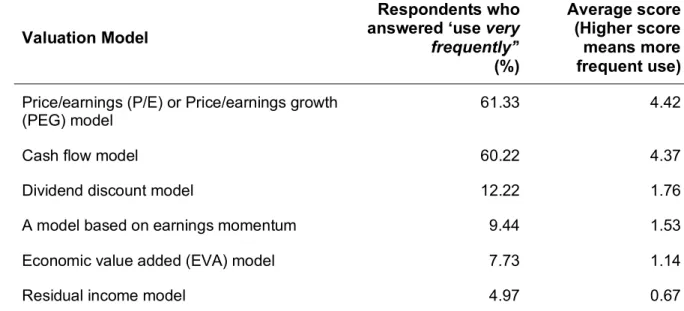
The third stream examines the processing activities of analysts in an attempt to penetrate the ‘black-box’ of their thinking (Bradshaw, 2009). An example of this type of research is Imam, Chan and Shah (2013) who explored what valuation models are used and found an increased use of more sophisticated multi-stage discounted cash flow models.
The final stream of research relates to conflicts of interest and biases which can surround analysts. There is robust evidence of over-optimism amongst analysts and interference from the banking sector. The work of Barber, Lehavy and Trueman (2007) is representative of this research. They found that independent house analyst buy ratings outperformed those analysts employed within investment banking. In a reaction to these perceived biases, there have been, and continue to be, a number of regulatory initiatives. There is evidence to support these regulatory responses. For example, Wu, Wilson and Wu (2017) found that their measure of bias fell dramatically for those US analysts employed by investment banks involved in M&A post regulation.
As mentioned previously, there is a small but important sociological literature on the work of analysts. Wansleben (2012, p.251) identifies two major strands within this body of work. The first perceives analysts as agents of institutions and organisations, occupying multifaceted roles. In these positions, they act as intermediaries whilst at the same time being immersed in unavoidable conflicts of interest. Metaphors can further such conceptualisations, and this literature has embraced analysts as imitators of their peers and as critics such that, “like film reviewers, food experts or wine connoisseurs, analysts bring a social dimension back into decision making” (Beunza and Gerund, 2007, p.14).
A second strand focuses on analysts’ practices and how they draw on calculative frames (Beunza and Gerund, 2007). This would include exploring situations of conflicts of interest, herding and over/under reaction to news flow. Wansleben (2012, p.264) commented, with some understatement, that the sociological literature so far ‘had hardly exhausted’ the potential of what could be done. In fact, there have only been a very small number of studies embracing social theory specifically addressing sell-side analysts. Fogarty and Rogers (2005) adopted an institutional theory perspective in their content analysis of analysts’ reports finding, amongst other matters, evidence of a pro-management tendency. Imam and Spence (2016), using pre-crisis interview data, pointed to the importance of social capital in the analyst field, in contrast to the hegemony given to technical capital in the mainstream literature. Tan (2014)
acquired a leading role in governance and related research. In recent, but as yet unpublished work, Abhayawansa et al (2017) adopt an approach that interprets sell-side analyst work as a political and positional struggle, with interactions with other actors being central to how analysts add value. In recently published work, Chen et al (2018) use a Bourdesian framework to develop an analyst intermediation model which reflects the important information filtering task performed by sell-side analysts.
1.4 THE THEORETICAL CONTEXT
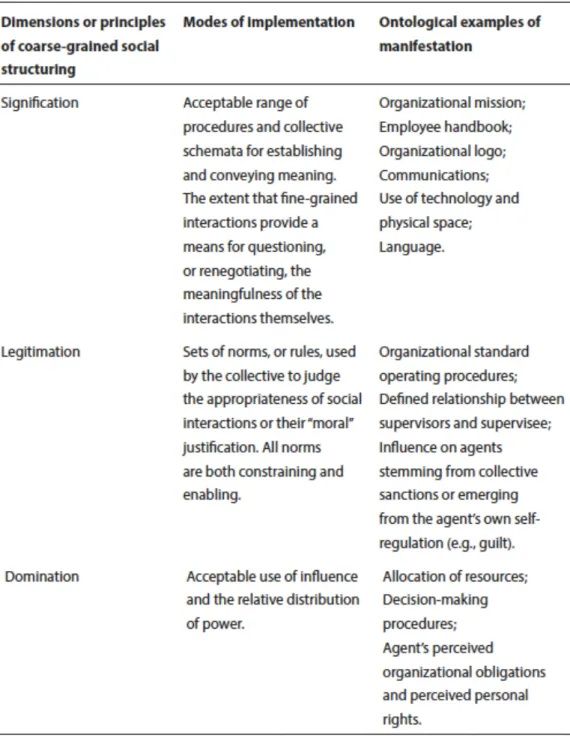
The overarching theory used for the study is based on strong structuration theory (Stones, 2005). This is a development of the well-known theory of structuration developed by Anthony Giddens over thirty years ago (Giddens, 1984). Structuration theory holds that there is an inherent interdependency between structures (rules and resources drawn upon by agents) and human agency or action (essentially ‘what people do’). Human action is made possible by social structures, but such action, in turn, sustains or alters the social structure itself, such that structure and agency are ‘mutually constitutive’ (Coad, Jack and Kholief, 2015, p.156), forming a duality. Stones (2005) published one of the most important developments of structuration theory since Giddens himself ‘turned his hand to other things’ (Stones 2005, p.2). Now widely called strong structuration theory, it moves away from the relatively abstract ontology in which Giddens was interested and encourages researchers to explore empirical case studies of particular agents and structures arguing that, “the full potential of Structuration Theory cannot be fulfilled whilst it remains in the clouds” Stones (2005, p.76). Despite Stone’s view that major developments were needed to strengthen structuration theory, he remained convinced of its potential and retained and embellished many aspects of the original theory including the duality of structure and the dialectic of control.
The interest in applying social theory to understand how analysts behave around critical decisions is the fundamental motivation behind this research. Structuration theory and strong structuration theory both offer attractive theoretical lenses for the research. Firstly, the theory provides the researcher with significant flexibility in its application as ”it is, at the same time, both a grand theory and a theory of everyday life” (Coad et al, 2015, p.166). This is significant as, consistent with interpretive, qualitative work, it is important to avoid theoretical ‘straight-jacketing’ in the analysis process. However, since there is flexibility inherent in the theory, this was unlikely to be a significant issue. Secondly, the importance the theory gives to the centrality of agency in the formulation of structures very much aligns itself with the study of the position-practices of individual analysts in this research. It also accords with Stones’ (2005, p.117) view of when the theory is most applicable:
“Strong Structuration’s objects of study are by definition those that involve in-situ questions about the hermeneutics of agents in combination with structural diagnostics.”
In a comment made regarding their choice of a Bourdesian framework over actor network theory, Imam et al (2016) posit that, in sociological terms, agency is embedded in individuals and structures and the study of these facilitates a deeper understanding of it. Such a comment is also clearly germane to the choice of strong structuration theory as the major theoretical lens for this thesis.
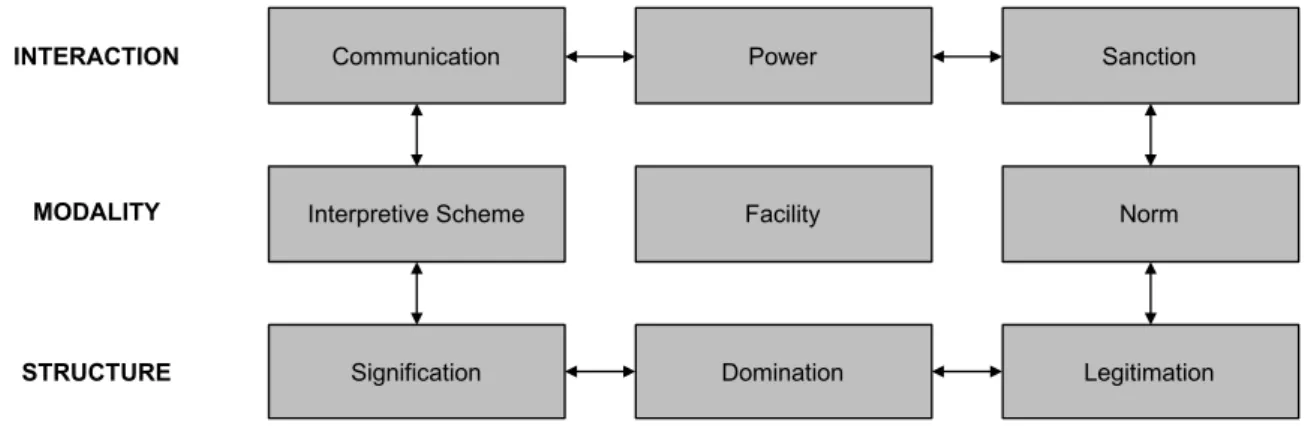
In applying the theory, the study embraces two levels of analysis, consistent with that recommended by Stones, to embrace “the general and the particular” (Stones, 2015, p.28). At a meso, more general level, the evidence is collected to enrich our understanding of the terrain facing analysts, and a position-practices perspective has been adopted (Coad and Herbert, 2009; Cohen, 1989). Much of this data was collected in the focus group phase. At a micro, more individual level of analysis, the study occupies the ontic position on the ontological scaling framework (Stone, 2005). This facilitates the examination of the four analytically distinct dimensions of the quadripartite cycle allowing the reach to extend to the duality of structure in action for individual analysts (Stones, 2005).
1.5 RESEARCH PROBLEM, OBJECTIVES AND QUESTIONS
The overarching motivation behind this research was to explore why analysts remain in demand despite the supposed flaws in their work, and their vulnerability to influence, highlighted in the introduction to this chapter and explored further below. Although a complete resolution of this contradiction is beyond the scope of any single study, the strategy employed in this research aimed to enhance understanding of how analysts are impacted by the social world and the arrangements embedded therein. This enables an appreciation of the value analysts provide beyond a more limited ‘numerical’ picture.
The particular conjuncture for this exploration is the stock rating decision. Consequentially, the research problem emerged from the enigmatic nature of these rating decisions. On the one hand, there is evidence in the literature that these decisions are important and represent a major objective of the analyst role (see for example, Schipper, 1991; Womack, 1996; Bradshaw, 2012; Groysberg and Healy, 2013; Kecske et al, 2017). Contemporaneously, investing clients assert that they do not follow these ratings (for example, Brown et al, 2016) and that analysts, in making rating decisions, suffer from a variety of conflicts and biases (see for example, Corwin, Larocque and Stegemoller, 2017).
Investigating this paradox is central to this study. The objective is to develop an understanding of why analysts act as they do by rethinking the rating decision as essentially social, in contrast to the narrower economic lens in the existing literature. More specifically, examining the interaction between social structures and agency and the structuration cycles implicated in rating decision making. This leads us to the formal overall research question:
How do social structures and agency interact and influence sell-side analysts making stock rating decisions?
1.5.1 Bracketing and sub-questions
Bracketing is fundamental to the methodology employed in this thesis and to the application of strong structuration theory (Stones, 2005). Methodological bracketing refers to blinkering out, or de-emphasising, certain aspects of a phenomenon under investigation or study so that the researcher can focus intensely on one aspect of the question at hand. The researcher can then return to the de-emphasised area in the next phase of bracketing. Stones (2005) refers to two main forms of methodological bracketing in strong structuration-based studies. The first is agent’s context analysis. Here, it is the researcher’s interpretation of the perspective and understanding of the agent in focus regarding the contextual field. In strong structuration terminology, this involves a careful mapping out and examination of the ‘position-practice relations’ of the agent. The other form of bracketing is agent’s conduct analysis. This entails looking ‘inwards’ at the process by which the agent in focus tries to reconcile their habitus and specific situated knowledge with their understanding of the contextual field (Stones, 2005). Reflecting this bracketing process, separate sub-questions are needed to embrace both phases.
The first relates to the shape of the external terrain that presents the action horizon facing the analyst, the constraints and opportunities the analyst faces and the conscious and unconscious nature of these. These form the network of position-practice relations or the contextual field as referenced above. Stones (2005, p.84) argues that the substantive characteristics of a network of positional configurations have significant implications for structuration processes. This leads to the first research sub-question aimed at mapping out a detailed understanding of this contextual terrain:
RQ 1: How are the practices of sell-side analysts shaped by, and in turn, how do they shape, the position-practice relations network in which they are embedded?
Details of how the position-practice framework was applied are included in Chapter 5 of this thesis.
Investigating and mapping out these ‘objective’ features of the contextual field does not require the researcher to refer to the actor’s internal structures. However, this is an essential component of structuration-based studies and leads to the next methodological bracket. This bracket, referred to as conduct analysis, involves an examination of the internal structures of agents as they attempt to navigate their way through the contextual field (Stones, 2005). In other words, to complete the analysis, there is a need to look, not only at the structural terrain facing an analyst, but also a more specific, situated microanalysis at the ontic level (Stones, 2015) which leads to the second research sub-question:
RQ 2: How is the process of reconciliation between the internal structures of the analyst (habitus and conjuncturally-specific knowledge) and the contextual field implicated in practices around rating decisions?
This second sub-question essentially addresses structuration. It takes various components of the quadripartite process, the external terrain and the internalised knowledge of the agent and draws them together. The reconciliation referred to in the question is the essence of action, or active agency, that will have led to the reproduction, elaboration or transformation of structures as outcomes.
1.6 OVERVIEW OF ONTOLOGY, EPISTEMOLOGY AND METHODOLOGY
This thesis has been constructed around giving voice to analysts. It is through these interactions that an understanding is gained of how social structures and agency interact in the unfolding sequence of their professional work. Such a stance leads, quite naturally, to a constructionalist epistemology and a nominalist ontology. In other words, the exploration of structures and agency will emerge, and be constructed by the interaction between the researcher and analyst. Rather than pursue an ‘objective single external reality’, the research embraces multiple perspectives suffused as they are with historical and cultural specificity (Burr, 2015, p.4). Furthermore, the research is interpretive with a hermeneutic interest in understanding the lived experiences of the participants included in the study. Such a research philosophy has provided the anchor to determine numerous choices made throughout the project.
1.6.1 Methodology
The study has been approached by viewing rating decisions as very much part art and part science, with significant human judgement involved. Therefore, in this thesis, it is asserted
The research was based around a field study employing a qualitative methodology. Two methods of data collection were used, focus groups and semi-structured in-depth interviews. These methods were complemented by other sources and documents.
A pilot stage, consisting of a small series of interviews and a focus group, was undertaken to aid the design and successful implementation of interview protocols and focus group plans. After a period of reflection and further planning, the second stage (focus groups) and third stage (in-depth semi-structured interviews) were conducted. In total, 54 professionals were involved in the research project, 23 in the pilot stage and focus groups (all analysts) and 30 in the interviews (14 analysts, 6 salespeople, 5 investor relations officers and 5 buy-side clients). A further 3 analysts, including 1 analyst who had not been involved in the core study, participated in the final validation process of the major empirical findings of the study in June 2018. All the analyst participants were experienced sell-side analysts, falling into an age range of mid-twenties to mid-fifties, recruited purposively from work-related contacts.
1.7 KEY CONTRIBUTIONS
A summary of the main contributions across scholarly, empirical, practical and theoretical matters is included below and covered in more detail in Chapter 8.
In empirical terms, the first major contribution relates to the impact of regulation on the practices of analysts. This independent external structure, has transformed much of what analysts do to such an extent that previously routine analyst practices are now prohibited.
A second important outcome from the study is the identification and exploration of sales as a major agent cluster in the analyst’s network. This is an important empirical finding as the sales force, almost entirely absent from the existing literature, is heavily implicated in the ongoing actions of analysts.
In relation to the analysts themselves, the evidence points to a highly committed group of professionals, fiercely competitive, but also, and somewhat incongruously, sensitive to criticism. Their measure of success is the feedback they receive in the main from clients and they are openly in need of positive affirmation.
Finally, employing a structuration cycle lens enabled a more nuanced understanding of the scarcity of sell ratings, a persistent feature in the sell-side analyst field. Instead of explaining this feature of the analyst field as simply trying to ‘keep management happy’, this study has explored how complex aspects of power structures, habitus, resistance and the anticipation
of future position taking and making of agents in context, are all operating to sustain this outcome.
A number of interesting contributions arose directly from the social starting point of the research. The study provided evidence that rating decisions are substantially social in nature, as opposed to a predominantly rational economic exercise. Furthermore, fieldwork evidence suggests that it is this social dimension, downplayed in much of the mainstream research, that helps us understand the paradoxical use of research services central to this study. The results support the view that clients extract valuable information from a rating decision that extends beyond the basic buy-sell-hold type classification.
Methodologically, the combination of focus groups and interviews is a relatively unique aspect of the study. The coupling of both data collection methods was an especially effective structure for dealing with context and conduct analysis. Context analysis in general terms does not necessarily address highly sensitive, personal matters and so focus groups provide an efficient way of collecting such data and also identifying areas of disagreement and consensus. Following up with interviews allowed the researcher to probe areas of a deeper personal and sensitive nature that would be unsuitable for group-based discussion. Additionally, some triangulation of the focus group findings was possible in areas of overlap.
Theoretically, our use of structuration theory in a large complex organisation follows the encouragement to do so in Feeney and Pierce (2016). Organisations, such as investment banks, expose the research to a myriad of contextual and conduct matters. Strong structuration theory is well suited to cope with this range of issues. In particular, the disaggregation of the duality of structure into four elements can aid the researcher to achieve a more nuanced analytical outcome. To achieve the quality of evidence needed, structuration theory was embedded directly into the research design for this thesis, building on the encouragement suggested by Makrygiannakis and Jack (2018) to deploy theory at an early stage.
In this thesis, confidence was integrated as an emotional element in the stratification model which enhanced its use for understanding active agency. In particular, how confidence provides a basis for action and how its source, in the form of legacy acceptance and recognition, can help the understanding of analyst conduct. Finally, the extension of interviews beyond agents in focus to the critical agents in context greatly enhanced the quality of ‘direct’ evidence that could be brought to the project.
making rating decisions, such as the need to resist undue influence from corporates. This should allow managers to anticipate risks and vulnerability in staff and improve periodic appraisals through deeper understanding. Policymakers can see how high-level regulation permeates the practices of analysts and presents challenges as they try to comply with the spirit of the regulation. For analysts themselves, the fieldwork evidence allows them to see how other analysts understand the analyst role and, in particular, the emotions experienced where decisions about ratings do not go as planned. Finally, for clients who consume analyst reports, the empirical evidence on relationships with companies would be concerning. Analysts remain vulnerable to sanction if they publish a negative report on a company and so clients need to interpret research carefully. In addition, clients would have a much better understanding of the impact of regulation in analyst practices. They would therefore be in a better position to appreciate why analysts have become so cautious in their interactions and it would also provide reassurance to clients that analysts take their regulatory responsibilities seriously.
1.8 THESIS STRUCTURE
The thesis is organised into eight chapters. This chapter has introduced key aspects of the research problem and developed them into a number of research questions. The study seeks to enrich our understanding of critical decision making by sell-side analysts working in financial markets. Social theory was employed to facilitate the analysis of structures and agency through the lens of strong structuration theory. The design, qualitative in nature, is appropriate for such an endeavour given the inherent complexity and multifaceted nature of the social setting and the professionals involved.
Chapter 2 explores and synthesises relevant aspects of the extensive analyst literature and consists of three key strands. The first sets out the practicalities of the financial analyst position, both as information intermediaries and stock pickers, including which parts of the role appear most important and problematic. The second strand examines the rating decision in detail, including the impact such decisions have on share prices, the regulatory environment and the conflicts of interest that analysts face. The final section looks at the limited but important sociological literature on analysts. The chapter closes by situating this study within the context of this literature.
Chapter 3 provides detail on the theoretical lens applied in the study. In particular, social theory is used to advance our understanding of what analysts do and why they do it. The rationale for choosing strong structuration theory is explained as well as the opportunities and limitations that such a choice imposes on the research.
Chapter 4 addresses the philosophical basis of the study that leads to the research design. This includes the data gathering techniques employed and the analytical processes applied.
Chapters 5 and 6 examine the results in specific terms. Chapter 5 presents a comprehensive mapping of the position-practice relations of sell-side analysts and how this shapes the contours of the external structures facing these individuals. Chapter 6 focuses on understanding the analysis of conduct. It entails looking inwards at habitus and conjuncturally-specific stocks of knowledge. This conduct bracket explores the particular practices arising when analysts are making stock rating decisions.
Chapter 7, the penultimate chapter, brings the context and conduct analysis together to address active agency and outcomes. It explores the most important structuration processes at play in the analyst field.
The final chapter sets out the main conclusions and contributions which can be drawn from the study, and their relationship within the context of the original aims and questions raised, as well as relevant limitations. Suggestions for further research are also addressed.
1.9 CONCLUSION
This chapter introduces the major aspects of the study. The first of these being the focus on analysts and their rating decisions. This study is deliberately restricted to sell-side analysts working in equity markets, and this focus facilitates a deeper investigation into a sophisticated group of market professionals. Other analysts, in particular those on the buy-side, form part of this study by nature of their role as agents in context. The literature on analysts, identified as predominantly quantitative and positivist, was also presented in this chapter.
Social constructionism has been proposed as the appropriate epistemological perspective for the study. Consistent with this philosophy, the study is approached through the lens of social theory. In particular, the study of analysts is undertaken from a structure-agency perspective using Stones’ (2005) strong structuration theory. This provides a range of tools to investigate both the context and conduct of analyst rating decisions. The dearth of socially infused studies of financial market participants has provided abundant scope for addressing new areas of interest. In this study, an alternative conceptualisation of analysts is adopted, which does not see them dominated by rational economic thought, but instead as social actors operating in complex environments.
the mainstream analyst literature. The design of the project around a focus group and interview-based field study further differentiates it from the more typical quantitative point of origin for most analyst related studies.
CHAPTER 2.
EQUITY SELL-SIDE ANALYSTS’ RATING
DECISIONS:
2.1 INTRODUCTION
Chapter one set out the two ingredients which constitute the essence of this thesis; the focus on sell-side analysts and their stock rating decisions, and the adoption of an approach infused with social theory. This leaves two areas of literature of significance to this study. The first is the exploration of the strong structuration theoretical framework, which is covered in Chapter 3. The second, the body of research on analyst stock rating decisions, is covered in this chapter. It is important to review this literature to situate the thesis against the broader mainstream body of research on analysts and to extract the important themes and lessons embedded therein. Whilst remaining critical of the restricted methodological and philosophical stance in the mainstream literature, there are many important studies that have contributed to enhancing the appreciation of analysts’ work and their practices. In this study, a research strategy was adopted that would give voice to the analysts to enable a deep understanding of their opinions, thoughts and experiences as human agents. Their voices are rarely heard in mainstream literature, since archival methods, by methodological necessity, privilege databases and numerical correlations. This thesis has provided opportunity to combining the empirics from mainstream literature with evidence of the lived experiences of analysts.
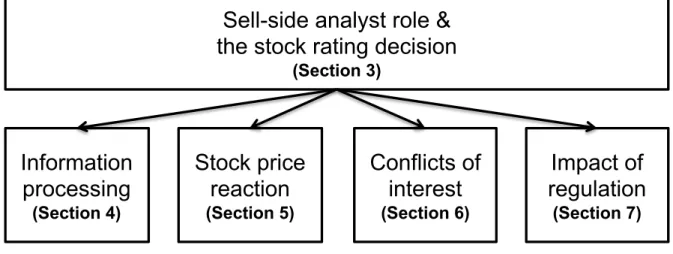
Given the large volume of literature on analysts, a structured approach was employed to facilitate the most important and relevant research. The literature review was therefore narrowed to focus on analyst stock rating decisions rather than, for example, earnings forecasting. A thematic approach was adopted to help organise the review and establish a logical path through the large number of papers. This chapter is structured to first place the stock rating decision in the context of the overall analyst role. The two sections that follow concentrate on detailed aspects of making stock recommendations, namely the processes analysts go through to determine their rating and, secondly, how informative analysts’ recommendations are to investors making decisions. After this, the research on important contextual matters, conflicts of interest and the impact of regulation, is reviewed. This chapter structure is depicted in Figure 2.1 below. Finally, the literature on utilising social theory to understand the practices of analysts is explored. The chapter ends with a summary of the conclusions that can be drawn from the review into the next phase of the study.
FIGURE 2.1. LITERATURE REVIEW STRUCTURE
2.2 APPROACH TO THE LITERATURE SEARCH
As previously mentioned there is an extensive literature on sell-side analysts. Bradshaw (2011) found over five hundred papers on SSRN.com covering some aspect of analysts’ work. A review by Ramnath, Rock and Shane (2008) found that over 250 papers were published across just eleven leading journals in the sixteen-year period from 1992 to when the review was published. Exploring this literature reveals three important characteristics. First, it is primarily included in accounting journals. Given that analysts predominantly work in investment banks, it might be more natural to expect the related research to be in finance journals. The role that analysts undertake as primary consumers of accounting information (for example, Schipper 1991) might account for this. Therefore, this research focussed on searching the leading accounting journals. Secondly, the literature was, almost without exception, positivistic and quantitative in nature with almost no qualitative based studies (Abhayawansa et al, 2017). Thirdly, the literature was found to be regionally unbalanced with a high concentration of papers on US analysts and US data. There were only a handful of studies conducted in other jurisdictions.
In order to cope with such voluminous literature, a structured approach was adopted to the literature searches. This consisted of two main elements. The first element involved extensive searching of the mainstream literature for relevant papers on analyst rating decisions. The second process, a much smaller exercise, was searching for research that had employed social theories to examine analysts. The details of the searching processes are included in Appendix 1.
In terms of structuring the analysis in this chapter, the approach was influenced by Ramnath
Stock price
reaction
(Section 5)
Sell-side analyst role &
the stock rating decision
(Section 3)
Information
processing
(Section 4)Conflicts of
interest
(Section 6)Impact of
regulation
(Section 7)into seven general topic areas. Some of these are outside the scope of this study, such as those examining details about information sources used by analysts, methodological issues around databases used for archival work and other matters more pertinent to earnings forecasting rather than stock recommendations. This left four areas most relevant to this study to which two sections were added. The first, a contextual section to describe the overall nature of analyst work, allowing the placement of the rating decision within context. Second, a section on analysts and social theory, a topic arguably too niche to have been included in Ramnath et al (1998), but germane to this study.
This approach led to the broad structure of the literature review, in the remaining parts of this chapter, as follows:
1. What are the main activities of analysts and how important is the stock rating decision? (Section 2.3)
2. What is the nature of analysts' decision processes on stock recommendations? (Section 2.4)
3. How informative are analyst stock recommendations? (Section 2.5)
4. How do conflicts of interest and related biases affect the practices of analysts? (Section 2.6)
5. How does a changing regulatory environment affect the practices of analysts and their role in capital markets? (Section 2.7)
6. How does the social terrain affect the work of analysts? (Section 2.8)
2.3 WHAT ARE THE MAIN ACTIVITIES OF ANALYSTS AND HOW IMPORTANT IS THE STOCK RATING DECISION?
Sell-side analysts are typically employed in investment banks and brokerage houses (Cascino, et al, 2014), covering companies in a specific industry (Tan, 2014; Boni and Womack, 2006). Successful analysts expect to be seen as industry experts drawing attention to critical and detailed information of relevance to investors on their specialist sector, companies and industries (Imam & Spence, 2016). Their role is often characterised as information intermediaries involved in producing earnings forecasts and valuations of stocks and they are seen as key players in financial markets (Tan, 2014). In an overall sense, analysts can be seen as playing a key role in the market for information (Barker, 1998).
There are various ways of disaggregating the analyst role or position. A simple starting point is to consider three activities embedded in the analyst position; information gathering, information processing and client servicing. These are considered below.
2.3.1 Information gathering
The first aspect, termed ‘information gathering’ by Michaely and Womack (1999), essentially entails taking a diverse range of information inputs, applying appropriate filters, and then choosing which data points to give particular weight to. Jegadeesh et al (2004) saw the potential for analysts to add value to investors by gathering information that is not readily available to the buy side, and also a data sifting role to highlight data of particular value relevance.
The emphasis on information gathering and processing is context specific. For example, Chen, Cheng and Lo (2010) examined gathering and processing activities around earnings announcements. They found that, prior to earnings announcements, discovery (information gathering) dominates. However, after the release of earnings data, the emphasis shifts to processing. The extent of processing is a function of the complexity of the accounting information.
Brown et al (2015) surveyed analysts to ascertain what information sources were most important to their work and a summary of the results is presented in Table 2.1 below. Based on their evidence, analysts clearly attribute significant weight to their industry expertise, a conclusion supported by the recent work of Bradley, Gokkaya and Liu (2017). In that study biographical data was collected about ‘pre-analyst’ industry expertise. Bradley et al (2017) showed that analysts with such expertise produced more accurate earnings forecasts, better performing stock recommendations and were more likely to be designated as leading analysts in external surveys.