CEP Discussion Paper No 881
July 2008
Organizational Commitment:
Do Workplace Practices Matter?
Abstract
Using nationally-representative linked employer-employee data for Britain this paper considers whether employers are able to influence the organizational commitment (OC) of their employees through the practices they deploy. We examine the association between OC and two broad groups of HRM practices emphasised in two different strands of the literature, namely “High-Performance Workplace Practices” (HPWPs) and practices associated with “Perceived Organizational Support” (POS). We consider their associations with mean workplace-level OC and individual employees’ OC. Although employers may be able to engender greater OC on the part of their employees, the practices that do so are not those emphasized in the HPWP literature, with the exception of consultation and the involvement of employees in decision-taking. POS practices fare a little better but, again, the findings are far from unequivocal. Furthermore, those practices that are ‘effective’ in engendering higher OC such as tolerance of absence, recruiting on ‘values’ and allowing employees to make decisions, tend to have a fairly low incidence in British workplaces. There is, however, one finding which chimes with the ideas underpinning the HPWP literature, namely that there are returns to the use of practices in combination. Analyses of both mean workplace-level OC and individual employee OC find an independent positive association between OC and the deployment of multiple practices in combination. This evidence is consistent with practices having synergies, as emphasised in some of the HPWP literature.
JEL Classification: J28
Key Words: high performance; organizational commitment; perceived organizational support
This paper was produced as part of the Centre’s Labour Markets Programme. The Centre for Economic Performance is financed by the Economic and Social Research Council.
Acknowledgements
We thank the WERS sponsors (Department for Business, Enterprise and Regulatory Reform; Acas; ESRC and Policy Studies Institute) for the data. We thank participants at the Manpower HR Data Lab seminar on Organizational Commitment for their comments.
Alex Bryson is a Visiting Research Fellow at the Centre for Economic Performance, London School of Economics. He is also a Research Director at the Policy Studies Institute (PSI), London. Michael White is Emeritus Fellow at PSI, London.
Published by
Centre for Economic Performance
London School of Economics and Political Science Houghton Street
London WC2A 2AE
All rights reserved. No part of this publication may be reproduced, stored in a retrieval system or transmitted in any form or by any means without the prior permission in writing of the publisher nor be issued to the public or circulated in any form other than that in which it is published.
Requests for permission to reproduce any article or part of the Working Paper should be sent to the editor at the above address.
© A. Bryson and M. White, submitted 2008 ISBN 978-0-85328-288-4
1. Introduction
Since the mid-1980s there has been considerable interest in the idea that firms can improve their performance by harnessing the commitment of their employees through human resource management (HRM) practices (Walton, 1985; Pfeffer, 1998). A number of studies have identified links between specific practices and individual workers’ organizational commitment (OC) (Appelbaum et al., 2000; Ogilvie, 1986; Gaertner and Nollen, 1989). Others have linked HRM practices to better organizational performance (Arthur, 1994; MacDuffie, 1995; Huselid, 1995).
However, at the end of the 1990s, Mowday (1998: 395) maintains that “what remains to be demonstrated... is whether employee affective commitment is a critical intervening variable linking human resource management systems and organizational performance.” Ramsay et al. (2000) was, to our knowledge, the first study to consider this linkage. Using the 1998 Workplace Employment Relations Survey (WERS) they found that “high employee commitment did explain some of the relationship between (HRM) and high workplace productivity....although the effect...was notably small” (op. cit., p. 516). We return to the HRM-OC linkage by analysing the hitherto largely unexplored question of whether firms can generate higher average worker OC through HRM practices. If they cannot, then they will be unable to leverage that additional OC to bring about improved performance.
To tackle this question we use nationally representative linked employer-employee data for Britain. This has two advantages over the employee-level questionnaire data that is commonly used to explore OC. First, we have multiple employee observations per workplace. These permit us to calculate the mean and the variance of employee OC at workplace-level. They also allow us to establish the association between practices and the OC of different workers in the same workplace. Whether it is optimal for an employer to invest in raising all employees’ OC, or the OC of a sub-set of workers is an open question. For this reason, HRM practices may be unevenly applied across workers in the same workplace. This may enhance the OC of ‘covered’ workers, but may have no effect, or even a negative spill-over effect on the OC of those who are ‘uncspill-overed’. It is therefore worthwhile investigating both workplace-level mean OC and individual-level OC of workers in the same workplace. Second, with few exceptions such as Ramsay et al. (2000) studies rely on a single respondent for data on OC and management practices. The danger is that such studies will suffer from a common variance bias that upwardly biases the positive association between HRM and OC. This may occur if workers with high (low) OC are more (less) likely to report the presence of good managerial practices simply because they feel they are treated well (badly) by their employer. We minimise this response bias by using information from the workplace’s HR manager on the HRM policies and practices that employees are exposed to.
We examine the association between workplace-level OC and two broad groups of HRM practices emphasised in two different strands of the literature. The first set is the “High-Performance Workplace Practices” (HPWPs) appearing in the work of Appelbaum et al. (2000) and others. The second set are a group of practices which organizational psychologists maintain are capable of generating OC by demonstrating the organization’s support for employees, generating what is known as “Perceived Organizational Support” (POS). Although the HRM practices in both HPWP and POS are somewhat distinct, some are common to both groupings.1
We find mean workplace-level OC varies a great deal across British workplaces. We are able to explain around one-quarter to four-tenths of this variance depending on our model specification. Much of the variance is associated with structural features of the workplace such as size, ownership and industry. HPWP’s tend not to be positively associated with workplace OC, with the exception of methods for consulting with employees – a sub-set of practices that also features in the POS literature. Some HPWP practices, such as new employee induction programmes, are negatively associated with OC. Some POS practices are significantly associated with OC. Employer preparedness to tolerate sickness and absence, an emphasis on rewarding rather than punishing employees, permitting working at home and employer assurances regarding long-term employment security are all positively associated with OC. Traditional paternalistic occupational benefits, on the other hand, are negatively associated with workplace-level OC. Turning to practices associated with individual employees’ OC we find a similar story, though some of the particulars differ – for example, there are positive associations between individual OC and financial incentives.
It would appear that, although employers may be able to engender greater OC on the part of their employees, the practices that do so are not those emphasized in the HPWP literature, with the exception of consultation and the involvement of employees in decision-taking. POS practices are a little better but, again, the findings are far from unequivocal. Furthermore, those practices that are ‘effective’ in engendering higher OC such as tolerance of absence, recruiting on ‘values’ and allowing employees to make decisions, tend to have a fairly low incidence in British workplaces. It may be that HRM practices are sufficiently widely used to have become too ‘ordinary’ now to impact on employees? The alternative explanation is that, despite the rhetoric, these policies have never really affected employee OC suggesting that, if they have any impact on workplace performance, it is through routes other than employee OC.
There is one final finding that emerges from the analysis of both mean workplace-level OC and individual employee OC that is worthy of emphasis, namely the positive association between OC and the deployment of multiple practices in combination. This evidence is consistent with practices having synergies, as emphasised in some of the HPWP literature. The remainder of the paper is structured as follows. Section Two introduces the concept of organizational commitment. Section Three describes and evaluates the measure of OC in WERS. Section Four introduces key aspects of the WERS survey. Section Five explores variation in OC across workplace and workforce characteristics in WERS. Section Six introduces the HPWP and POS practices. Section Seven explains the regression methodology used to isolate independent associations between OC and the HPWS and POS practices. Section Eight discusses the regression results and Section Nine concludes.
2. The Concept of Organizational Commitment
Commitment is a term in wide use in conversational English. The Concise Oxford Dictionary defines it as ‘engagement or involvement that restricts freedom of action’. Frequently the term is applied to voluntarily chosen relationships with persons, institutions, or ideas, but it usually retains some sense of excluding or restricting freedom of choice. A committed relationship of a sexual type implies (for many people) not having similar relationships with others than the partner. Or again, a commitment to a certain religion (political party) excludes
participation in and advocacy of other religions (political parties). This leads one to ask why most people apparently limit their freedom by making commitments. One answer to this question (Anderson 1993) is that commitments are a means by which individuals shape their personal identity and self-esteem.
The potential importance of commitment within working life was initially recognized and conceptualized by sociologists, notably Selznick (1957) and Etzioni (1975; 1961). Selznick argued that commitment was fostered by values of service and that the task of leadership was to give shape to these values. Etzioni somewhat similarly argued that high levels of commitment were only possible when individuals and organizations had an altruistic mission, as in the case of religious, educational or healthcare institutions. These ideas suggest that commitment will be distributed unequally across different branches of employment, and this provides much of the motivation for the first part of the empirical analysis in this paper. From the 1970s on, however, there was an increasing focus on organizational commitment (OC) as something relevant to all types of organizations. This was largely as a result of two related developments that spanned research and managerial practice. One was the development of a widely used measure of OC, often referred to as the Mowday (or Mowday-Porter) Organizational Commitment Questionnaire (OCQ). The other was the rise of human resource management (HRM) theory and practice. Within this, commitment was re-conceptualized as an asset that could and should be harnessed to achieve higher organizational performance.
The measurement of OC within organizational research developed initially (during the 1970s) as part of a search for attitudinal measures that were more predictive of employees’ behaviour than job satisfaction (e.g., Porter and Steers 1973; Porter et al. 1974; Mowday and Steers 1979). OC was hypothesized to achieve this because it constituted a relatively stable state of the individual, whereas job satisfaction was more affected by short-term conditions (Porter et al. 1974: 604).2 Porter et al. (1974) ‘characterized’ OC in terms of individual identification with organizational goals and values, willingness to exert effort for the organization, and desire to remain in the organization. Taken as a set, these three characteristics reveal one reason why OC has been of such interest in organizational research: it bridges what is of value to the employee with what is of value to the employer. Despite the pioneering efforts of Porter and colleagues to bring these two sides of commitment together, subsequent research has split into two main streams, one conducted by organizational psychologists and treating OC as an aspect of employee well-being, the other conducted in the economics and management literatures around HRM, with the focus on performance.
OC has been incorporated as a key intervening variable in the theorization of HRM and related managerial practice. Commitment, including to task, team or leader as well as to organization, is conceived as a productive asset since it leads to individuals volunteering extra-contractual effort. Additionally, commitment (as conceived) assists with the formation and utilisation of other assets. Committed employees not only are likely to remain with the organization, they are also likely to be actively engaged in developing firm-specific skills and knowledge, and to contribute creatively to improved work methods and other forms of innovative change (e.g., Beer et al. 1984; Walton 1985, 1987; Kochan and Osterman 1994). This conceptualization stimulates the search for organizational policies and practices that are likely to foster commitment. Systemic policies and practices of this type have, in the recent
2
organizational literature, often been referred to as ‘high commitment management’, ‘high involvement management’, ‘high performance work systems’, or more generally as ‘best practice’ HRM, the terms being used more or less interchangeably (see Wood 1999, Guest 2002, and Edwards and Wright 2004 for reviews). Much of the research in this area has used commitment merely as a hypothetical explanatory construct, but some large studies have explicitly estimated the effects of certain work practices on OC as well as on aspects of performance (e.g., Lincoln and Kelleberg 1990; Appelbaum et al. 2000; Ramsey et al. 2000).
3. The WERS OC Measure
As already noted, the source of much empirical research involving the measurement of commitment is the Organizational Commitment Questionnaire (OCQ) developed during the 1970s (Price 1997 provides further details). This is a 15-item set of statements, with answers scored through a 7-point Likert agreement scale and averaged to give an overall measure. The OCQ was claimed to measure a single concept of OC, but this has been criticized both empirically and conceptually. Meyer and Allen (1984) argued that the OC concept was not in fact unidimensional, but could be divided into three components: affective, continuance, and normative, and that at least the first two were present in the OCQ. Subsequently, research has tended to focus more explicitly on OC as affective commitment. This focus is clearly expressed by Kalleberg and Berg (1987), who re-defined OC as an employee’s identification with the goals and values of her employer, leading to her willingness to exert effort on its behalf. Lincoln and Kalleberg (1990) used a six item scale that followed this more focused concept, using questions adapted from the OCQ. The same instrument was also used in the US General Social Survey of 1991 and the linked National Organizations Study (Kalleberg et al. 1996); in the influential US study of ‘high performance work systems’ by Appelbaum et al. (2000); in the1992 Employment in Britain survey (Gallie et al. 1998); and in further British surveys with national probability samples: the Working in Britain 2000 survey (White et al. 2003; McGovern et al. 2007), and the national Skills Surveys of 1997 and 2001 (Gallie, Felstead and Green 2001; Felstead, Gallie and Green 2002).3
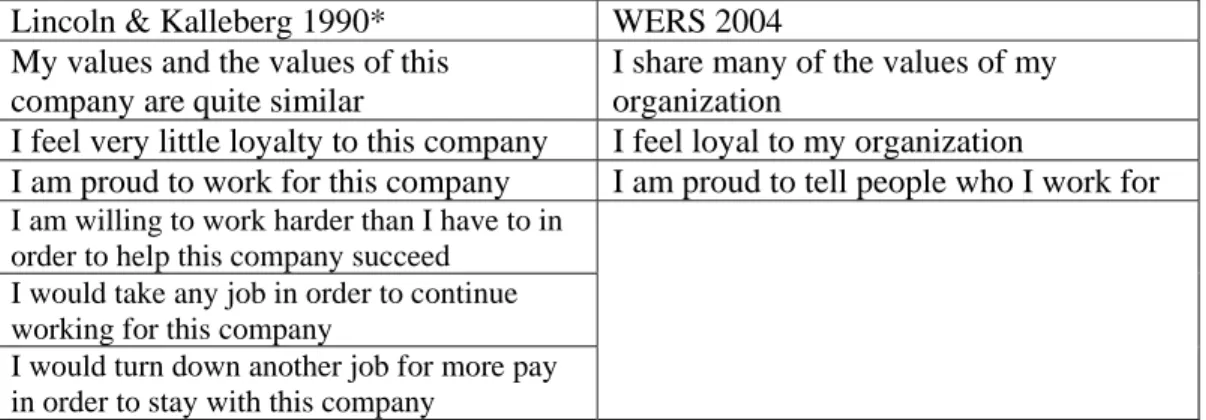
When in 1998 the WERS series introduced a survey of employees (see later for details), a measure of OC was included in the employee questionnaire. This WERS measure of OC (WERS-OC) consists of three items, which are based on three counterparts in the Lincoln-Kalleberg instrument. The wording has been altered in all three, and the response scale has been changed from 4-point to 5-point, but the meaning is clearly the same (see Table 1). WERS-OC therefore has a respectable pedigree, being based on questions that have evolved from the influential OCQ and have been used in large and/or nationally representative sample surveys in both the USA and Britain. WERS-OC has been incorporated in an extensive analysis of WERS 1998 by Ramsey et al. (2000) and has also been adopted in a multi-company study of HRM by Kinnie et al. (2006).
An initial anxiety about WERS-OC is that it has omitted three of the Lincoln-Kalleberg items that strongly convey the sense that OC involves willingness to put the organization ahead of oneself (see Table 1 again). The three retained items by comparison seem somewhat weaker in their meaning. However, the development of questionnaire measuring instruments usually follows a path of progressive simplification. Even if this involves (as in the present case)
3
The measure is also present in the Skills Survey of 2004 but at the time of writing this dataset is not in the UK Data Archive.
some apparent loss of face validity, it is often the case that the simpler measure continues to ‘do the job’ in terms of its reliability, distinctiveness, and predictive power. How does WERS-OC perform in these terms?
In WERS 2004, WERS-OC has a reliability (Cronbach alpha) estimated as 0.85. Alternatively, if each item is recoded as a binary variable (with agree or strongly agree=1, otherwise=0), the Kuder-Richardson reliability measure for the three items is 0.76. Both measures indicate a high level of reliability. The WERS 2004 survey of employees also includes sets of questions relating to job facet satisfaction (seven items) and personal well-being (six items),4 and this permits some assessment of convergent and discriminant validity. As shown in Table 2, the summative score of the WERS-OC items correlated positively with both total facet satisfaction and total well-being, which is evidence of convergent validity (since all three measures are assumed to relate to positive experience of current employment, they should correlate positively). A principal components analysis was then conducted of all 16 items, and orthogonal rotation was performed on the first three, then the first four, then the first five, components.5 In each of these analyses (not shown: available from authors on request), WERS-OC had distinctive loadings: between 0.5 and 0.6 on one component, but near-zero6 on the other components. Loadings of any of the facet satisfaction items and well-being items on the main WERS-OC component were never as high as 0.3, and in the five-component rotation were never as high as 0.12. This analysis therefore provides strong evidence of discriminant validity.
WERS 2004 does not include measures of employee behavioural outcomes that have been frequently used to assess the criterion validity of OC and related measures (e.g., leaving intentions or attendance/absence). However, Gallie et al. (1998) report results from the Employment in Britain survey for a very similar three-item measure, which they call ‘value commitment’. This was negatively and significantly related to absence frequency for women employees (though not for men), and was negatively and significantly related to leaving intentions for both women and men. There is therefore pre-existing evidence for the criterion validity of the three-item subscale of the Lincoln-Kalleberg measure. An eventual aim of the present research is to extend the assessment of the effects of OC by considering associated performance outcomes at the workplace level rather than the individual employee level, although this is not pursued in the present paper.
4. The WERS Dataset and its Analysis
WERS is a nationally representative survey of workplaces with 5 or more employees covering most sectors of the economy consisting of face-to-face interviews with the most senior workplace manager responsible for employee relations, and a self-completion survey of employees in the same workplaces. The management survey was conducted in 2,295 workplaces with a response rate of 64 per cent. The employee survey was conducted in the 1,967 workplaces where management interviews were obtained and where management
4 The facet satisfaction measures have a reliability in WERS 2004 of 0.83 and the well-being measures have a reliability of 0.85 (Cronbach alpha).
5
The first three components accounted for 49 per cent of total variation, the first four for 67 per cent, and the first five 73 per cent. Rotation with different numbers of components is recommended by Jolliffe (2002) since results can be sensitive to this choice.
agreed to allow for a survey of workers.7 Self-completion questionnaires were distributed to a random sample of 25 employees in workplaces with 25 or more workers and to all employees in workplaces with 5-24. Some 22,451 were completed and returned, representing a fieldwork response rate of 60 per cent. The mean number of completed questionnaires returned in each workplace was 13, covering a mean of 29 per cent of the total workforce in each establishment.
The public-use database for WERS 2004 includes weights to account for survey design, and these are available on either an establishment-weighted or employment-weighted basis for analysis of the management interviews, and with further adjustment for within-workplace sampling for analysis at individual employee level. For the analysis at workplace level, that is when we are taking the workplace mean of OC as the dependent variable, we have used the establishment weights with a minor adjustment to take account of sample attrition from employee non-response. In principle we would also wish to include a square-root-N adjustment to take account of the fact that workplace means are derived from varying numbers of individual responses per workplace. However, we have yet to find a method of doing so that yields technically satisfactory results, so leave this as an issue for further work. Our interpretation of the relevant statistical theory is that the present estimates of standard errors may be upwardly biased. For the analyses at individual employee level, we have used the public-domain employee weights. Further details of the establishment and employee weights are provided in the WERS documentation.8
5. How Workplace OC Varies: An Initial Mapping
As explained in the introduction, the main focus of this investigation is workplace OC (although consideration will also be given to the commitment of individual employees). Later we will be considering how far the employer can influence workplace OC through choice of workplace practices (‘what can management do about OC?’). This section is preliminary to that task. Here we describe how workplace OC varies according to various characteristics of the workplace that are ‘structural’, that is, they are part of the context within which management operates. An obvious example, in the light of the early contributions by Selznick (1957) and Etzioni (1975), is the type of industry to which the workplace’s products or services belong. Each industry has particular market structures, skill requirements, types of customers, and norms of conduct (with respect to either clients or employees), and these industry characteristics may affect the amount or type of commitment that employees spontaneously display. By mapping OC across industries, size groups, forms of ownership, and structures of employment, this preliminary mapping exercise aims to clarify the task facing managements who seek to influence OC in different circumstances. Our results are presented in chart form: see Appendix Three.
7
The probability of worker selection is the product of the probability of the workplace being selected and the probability of an employee being selected from within that workplace.
8
A fact-sheet can be found at: http://www.wers2004.info/FAQ.php#5 and the technical report can be downloaded at:
5.1 Size of workplace
To quote Lincoln and Kalleberg (1990: 216) ‘structural differentiation, formalization, decentralization and QC [quality circle] activity, plus a high level of employee services generally characterize large plants’. In summarising their study of small and medium sized enterprises from WERS 2004, Forth, Bewley and Bryson (2006: xii) state that ‘Employees of smaller firms were … more likely to believe that they had job autonomy, influence and security, and reported lower work intensity and higher general well-being than employees who worked for larger firms. In addition, they were more likely to feel committed to the organization.’ These are just two of the many studies that have found innumerable differences between workplaces associated with their size (see also Pugh et al. 1968).
Figure 1 shows how OC, at workplace level, varied across seven size-groups. The chart suggests that the smallest workplaces (5-9 employees) had the highest OC, with an average score a little above 2.5, on a scale with its minimum at -6 and its maximum at 6 (see Section Seven for a description of how this scale was derived). Those with 200 or more employees had the lowest OC, with average around 1.7. These however are crude averages and do not take account of the fact that size of workplace is itself associated with other structural characteristics, such as industry and ownership. To obtain a clearer view of the separate
association of OC with size, we use regression analysis of OC with a range of structural variables. These are industry (or, in alternative models, ownership), structure of parent organization, skill composition (proportions in managerial and professional jobs, proportions in intermediate administrative, technical and skilled manual jobs), proportion of women employees, proportion of employees aged over 50, proportion of part-time employees, and proportion of employees on temporary contracts.
Figure 2 shows how OC varies by workplace size, after adjusting for these other structural variables. Workplaces with 500 or more employees are treated as the reference group, and the results for the other size-groups are expressed as percentage differences on the OC scale that ranges from -6 to +6. The chart summarizes results from two different models, one containing an industry variable and the other containing an ownership variable: these could not sensibly appear in a combined linear model, because industry and ownership are so closely linked. After adjustment for the other characteristics, the size differences in OC reduce to a contrast between the smallest workplaces in WERS 2004 (5-9 employees) and the rest. This result is visually clearer in the model that includes ownership, but in both models the significant differences are the same. Very small workplaces tend to have an inbuilt advantage in terms of committed employees, but across an extremely wide range – from 10 employees to 10,000 – size in itself matters much less than might have been expected.
5.2 Industry groups
To analyse variation in OC across industries, we use a classification into 12 industry groups. This is fairly coarse (for instance, the whole of manufacturing is collapsed into one group), and there could well be variations within some of these groupings that a larger sample would reveal. The simple overall, or unadjusted, means of workplace OC are shown in Figure 3, and the regression-adjusted percentage differences, using manufacturing as the reference point, are shown in Figure 4.
The picture given by both these charts is broadly the same. Manufacturing, utilities, and financial services have relatively low average levels of workplace OC, around 7-10 per cent
below the average levels in construction, distribution, hotels and catering, and business services other than finance. However, a much higher level of workplace OC is found in education, and health and other community services also have relatively high OC. However, it is clear from Figures 3 and 4 that there is a particularly low level of workplace OC in public administration. There is therefore an important distinction between public administration and ‘front line’ services to society.
5.3 Ownership
The variations of OC by industry suggest that ownership may also be a relevant contextual variable for commitment. Figure 5 shows how OC differs between workplaces in PLCs (the reference group), non-PLC privately-owned workplaces, workplaces in public ownership, and workplaces that are part of non-profit organizations such as charities, churches, or trade unions. Industry is not included in the regression analysis from which this chart comes (as the classifications are partly dependent), so each category is averaged across the industries in which it occurs.
The chart indicates that the main difference, in terms of OC, is between the non-profit workplaces, representing about five per cent of all workplaces on a weighted basis, and the other categories. Differences in mean workplace OC between PLCs, the rest of the market sector, and the public sector, were slight and non-significant.
The small overall difference in workplace OC between the market sector and the public sector comes as a surprise after seeing the particularly high levels in education and health, large industries where the public sector is dominant. However, the high OC levels in these public services (especially health) are partly accounted for by the non-profit sector, rather than the public sector as such, and there are also some market sector organizations that provide public services: these also tend to have high levels of OC. Public sector workplaces in education have high OC, but the levels of OC are considerably lower in public sector health and community service workplaces. This is shown in Table 3 (appended in Appendix Four), which reports average workplace OC for the front-line public service industries, cross-classified by ownership.
5.4 Further exploration of ownership: family firms, and foreign ownership
Two further distinctions that are often used in discussing ownership or control are family businesses, and firms under foreign ownership. These might be relevant to workplace OC. Family firms may retain ‘paternalistic’ relations to a greater extent, and employees may respond to these either positively or negatively. Foreign-owned firms may introduce innovative workplace practices (witness the extensive literature on Japanese transplants) and these too may generate distinctive employee responses.
Figure 6 shows how workplace OC varies by ownership when both the PLC and the private non-PLC categories are subdivided by family or non-family control. The apparent differences between the market sector sub-categories are not statistically significant, and overall the differences remain slight, except that the non-profit workplaces continue to have substantially higher average OC. A similar breakdown, this time by foreign or domestic control of ownership, is summarized in Figure 7. Here it is still more obvious that foreign or domestic ownership makes no difference to average levels of OC. Overall, then, the same conclusion
as before applies: the only significant distinction by ownership is between non-profit workplaces outside public ownership, and all other categories.
5.5 Organizational structure: single and multiple sites
It is well established from previous research on the WIRS/WERS series (Forth et al., 2006) that characteristics of the wider organization can be important over and above the workplace’s own characteristics. In 2004, approximately two thirds of workplaces covered by WERS formed part of multi-site organizations, with one third independent single sites. What difference did this distinction make to workplace OC? In considering this, we divided the multi-site organizations into those with less than 1000 employees across all sites, those with 1000-9999 employees, and those with 10,000 or more employees. The regression analyses containing the organizational variable also of course included workplace size, which equals the total size of single-site organizations.
The variation across these categories is summarized in Figure 8, using single site organizations as the reference point and, as usual, showing differences along the OC scale in percentages. Workplace OC was considerably lower in workplaces within multi-site organizations than in the single independent sites, and this applied whatever the size of the multi-site organization. The apparent differences between different size-bands of multi-site organizations were not statistically significant at conventional levels. The results suggest that commitment tends to be higher when the workplace is autonomous.
5.6 The skill composition of workplaces
Employers’ choice of current skill-mix is partly constrained by prior market and technological strategies and by the labour market in which they operate. Accordingly, skill composition can in part be considered a structural characteristic of the workplace. Also, it is reasonable to suppose that the skill-level of an employee’s job will have some implications for commitment, with higher skill requirements offering greater opportunities for involvement but also imposing greater work pressures (Gallie et al., 1998).
Skill composition was taken account of through two variables, one representing the proportion of the workforce in managerial or professional occupations, the other representing the proportion in ‘intermediate’ (administrative, lower technical, or skilled manual) occupations. Figures 9 and 10 show how these two measures were related to OC in the WERS 2004 sample; these charts are derived from locally smoothed (lowess) regressions, and are unadjusted for other structural circumstances. The relationships were markedly non-linear in both cases, with OC initially rather flat as intermediate skills rise, then falling progressively once the proportion reaches about 60 per cent, but initially rising with higher-skilled jobs, then levelling off at around 60 per cent. The patterns for the two types of occupational skill were therefore almost a mirror image of one another.
The results shown in Figures 9 and 10 were used to recode the skill variables into bands for the regression analyses, and so estimate their associations with workplace OC net of the other structural characteristics. The adjusted results for both the intermediate and higher skill-levels are summarized in Figure 11. Workplaces with very high proportions of intermediate skills on average had low levels of OC, but high proportions of managerial and professional occupations were associated with enhanced levels of workplace OC.
5.7 ‘Flexibility’ and OC: part-time and temporary employment contracts
Issues around flexible employment systems have been a focus of attention in labour market research for more than two decades. We consider two of the major categories of flexible employment, part-time and temporary (or fixed-period) jobs.
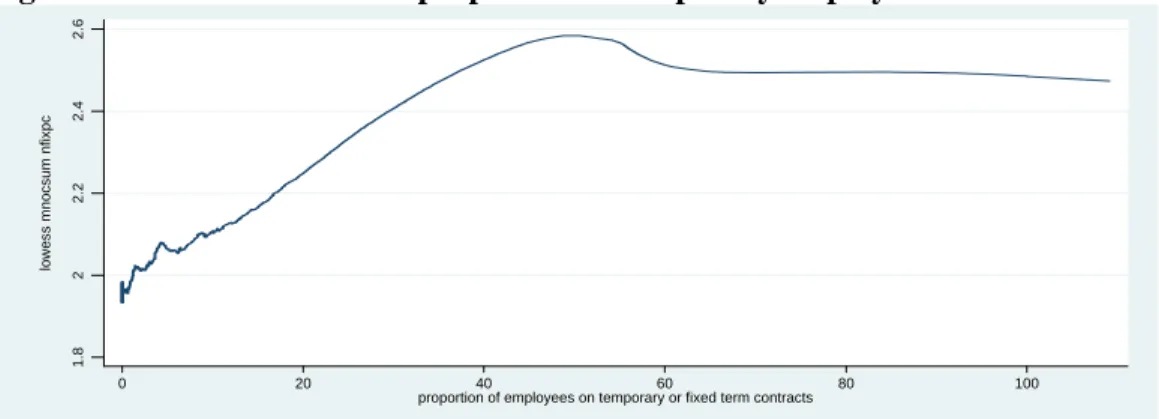
Locally smoothed regressions similar to those already presented for skill composition were run for these types of employment, and were used to guide the construction of banded variables. As before, the main inflections in the relationships with OC were observed when the proportion in these employment types was around 50-60 per cent. Figures 12-13 show the bivariate relations.
The OC associations for the two variables in their banded form, after adjustment for other structural characteristics, are shown in Figure 14, and this reveals a marked contrast in the relationship of OC between time and temporary employment. The proportion of part-time employment at the workplace made very little difference to OC, once other structural characteristics were taken into account: differences are not statistically significant. On the other hand, OC tends to rise with the proportion in temporary jobs, and the OC level for those workplaces with 50-100 per cent temporary staffing is significantly higher than for workplaces making no use of temporary contracts. Note, however, that only 3 per cent of WERS 2004 workplaces (n=52) in fact had these very high levels of temporary staffing. This cautions against over-interpreting the result. Certainly though there is no evidence that the use of temporary staff reduces average OC in the workplace.
5.8 Other workforce characteristics: women employees and over-50s
Two further workforce characteristics were included in the regression analyses: the proportion of women employed, and the proportion of employees aged over 50. Their bivariate relationships with workplace OC are approximately linear and positive (Figures 15-16). After adjusting for the other structural variables, the proportion of over-50 employees no longer had any association with workplace OC. The proportion of women employed, however, continued to be positively and significantly associated with workplace OC (chart not shown).
5.9 Summary of mapping of variations in mean workplace OC
The main features of the mapping analyses can be summarized as follows.
o Workplace OC is higher in very small workplaces (5-9 employees) relative to all others.
o Workplace OC is higher in industries providing services to society, especially education services.
o Workplace OC is higher in the non-profit sector than in either the market sector or the public sector. Levels of OC do not vary between the market and public sectors, once other characteristics of workplaces are taken into account.
o Within the market sector, there are no clear differences in OC between workplaces in family and non-family ownership or between those in foreign and domestic
ownership.
o OC is higher in single independent workplaces than in workplaces that are part of multi-site organizations.
o Workplaces with very high proportions of employees at intermediate skill-levels have somewhat reduced levels of OC, whereas workplace OC appears to rise progressively with increasing proportions of managers or professionally-skilled employees.
o The proportion of part-time employees at a workplace is unrelated to average OC. There is also no evidence that employment of temporary staff reduces average OC.
o OC varies positively with the proportion of women employed.
6. HPWS and POS Practices
How far do employers affect levels of OC in their workplaces through the HRM practices they implement? As stated in the introductory section, we focus on two conceptualizations of practice, ‘HPWS’ and ‘POS’. Much of the previous literature linking HPWS and OC has relied on rather limited sets of practices, primarily because information about practices is taken from employee respondents as part of a wide-ranging survey. There are notable exceptions which use custom-made survey instruments (eg. Godard, 2007), or use linked employer-employee data as we do in this paper (eg. Ramsey et al., 2000; Appelbaum et al., 2000). Whereas the HPWS literature considers the role of workplace practices directly, the POS literature is not primarily concerned with workplace practices, as such, but with employee perceptions of their working environment. However, there is a strand of the POS literature that identifies certain workplace practices as positively related to POS since they entail “investment in employees and show recognition of employee contributions...that signal that the organization is supportive of the employee and is seeking to establish or continue a social exchange relationship with employees” (Allen et al., 2003: 100). Thus Rhoades et al. (2001), for example, find favourable working conditions operate via POS to increase employees’ affective commitment to the organization and reduce employee quits.
Our paper aims to cover as wide a range of HPWPs as WERS permits, subject to the usual considerations such as clarity of meaning and statistical reliability (coherence); and we’ve also tried to operationalize POS in terms of practices since that further extends the perspective.
We used a total of 90 practices available in WERS to capture aspects of HPWS and POS (see Appendix One). There are a number of ways in which HPWS and POS variables can be entered in to the regression analyses (discussed below). One might argue that certain practices are complementary and, as such, can simply be counted to establish the intensity with which an employer deploys them. This approach implies a single HPWS count and a single POS count. However, the relationship between OC and a score may be linear or non-linear. For instance, non-linear effects may be present where employees only respond to the intensive deployment of practices. Alternatively, there may be diminishing returns to practice
usage above certain thresholds as some have argued in relation to the performance returns to high-involvement management practices (Godard, 2004).
A second possibility is that different practices have different functions and, as such, they may either be complements or substitutes for one another. This makes counting all practices into one overall measure potentially problematic. Instead, analysts have deployed various means to group practices, including statistical methods for identifying inter-correlations in practices (e.g. principal components and factor analysis) or by assessing the role of practices according to theoretical precepts.
Based on our reading of the HPWS and POS literatures we identified fourteen sets of workplace practices, or domains, which theory suggests may be associated with employees’ affective commitment to their organization. Five of these domains are loosely labelled HPWS, seven belong to POS, and two are common. The Consultation domain is emphasized in both literatures, as is management concern with employee attitudes and opinions. We produced summary additive scales from the individual practices for each HWPS and POS domain having explored inter-item correlations and the statistical reliability of scales. Some practices were not highly correlated with others in the same domain, so they were entered separately as isolated items in the analysis, rather than as part of an additive score. Further details of the variables and scales are presented in Appendix One.
Some analysts argue that some “bundles” are synergistic in the sense that they are mutually reinforcing (Appelbaum et al., 2000). For example, Huselid (1995) argued that firms only reap the rewards of devolving decision-making to employees where this type of job redesign is accompanied by financial rewards for undertaking the initial responsibilities that devolving responsibilities entails. Accordingly we explore interactions between some of the domains identified above.
7. Methodology for Isolating Independent Associations between OC and
HPWS and POS Practices
It is clear from the bivariate analyses presented above that workplace OC is associated with a number of features of the workplace and its workforce. To investigate the independent association between workplace practices and OC we undertook multivariate analyses of OC which net out the associations with structural features of the workplace. The dependent variable is the 13-point scale used above where -6 represents the lowest OC score and +6 the highest.9 First we present analyses of mean workplace-level OC using Ordinary Least Squares (OLS) estimation with workplace-level co-variates as regressors. These controls are as follows:
- log number of employees employed at the workplace plus its squared term; - number of employees employed in the whole organization (four dummies); - industry (12 dummies) or, in variants of the model, ownership type (PLC, other
private company, public, non-profit); - region (10 dummies);
9
The scale is based on the three items presented in Table 1 with the 5-point Likert scales recoded into scales running from (-2,2), resulting in a composite score running from (-6,6).
- unemployment rank of the workplace’s travel-to-work area10 - union recognition;
- percentage of employees in managerial and professional occupations;
- percentage of employees in intermediate occupations (associate professionals and technical workers, administrative and secretarial staff and skilled trades) and its squared term;
- percentage of employees who are female and its squared term.
The analysis is weighted with the survey weights discussed earlier so that the results can be extrapolated to the population of workplaces in Britain with 5 or more employees.
In addition, similar analyses were conducted at the level of the individual worker. This time the dependent variable is the individual-level equivalent of the OC scale. The analyses contain all those variables present in the workplace-level analysis, together with additional individual-level regressors as controls. These are:
- gender (dummy for male) - age (9 dummies)
- academic qualifications (9 dummies) - vocational qualifications (3 dummies)
- long-term illness, health problem or disability (dummy) - ethnicity (dummy for white British)
- household type (4 dummies) - union member dummy
- single or 3-digit occupation (depending on specification) - permanent contract dummy
- full-time employee dummy - workplace tenure (5 dummies) - days training in last year (4 dummies) - gender segregation in the job (6 dummies).
The individual-level OC regressions are run on 18,618 to 18,261 employees – depending on the model specification – having removed respondents with missing data. They are located in 1,717 workplaces so that, on average, there are almost 11 employees per workplace.
8. Discussion of Regression Results
In this section we report results relating to the links between OC and HWPS and POS practices. We begin with the workplace-level analysis of mean OC then turn our attention to practices associated with individual employees’ OC. An overview of the main substantive results is provided in Appendix Two: Box 1, for workplace-level analyses, and Box 2, for individual-level analyses.
8.1 Mean workplace-level OC
As we show in this section, there was no robust relationship between mean workplace OC and either HPWS or POS practices in general. Although some additive scales capturing practice
10
domains were positively and significantly associated with workplace OC, others were negatively associated with OC, but most had no significant association with OC. The same was true for isolated practices.
When entered alone, without controls for the structure and ownership of the workplace and its workforce, individual HPWS and POS practices account for 27 percent of the variance in mean workplace OC. When workplace controls are added the model accounts for 40 percent of the variance in mean workplace OC. Furthermore, the workplace controls weaken the effects of some of the HPWS and POS practices, indicating that the link between practices and workplace OC is partly accounted for by the non-random distribution of these practices across workplaces. Nevertheless, having accounted for observable differences across workplaces, the HPWS and POS variables remain jointly statistically significant.11
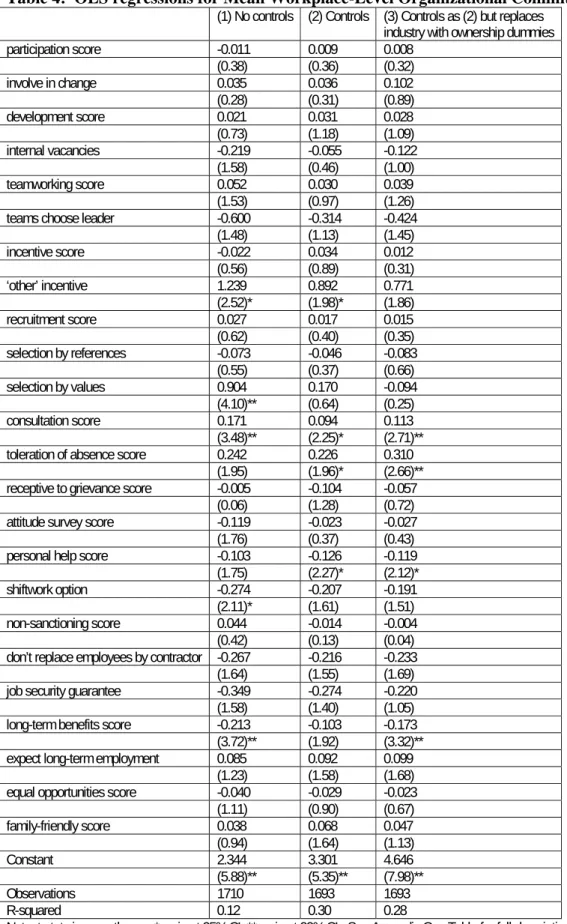
The advantage of replacing individual practices with additive scales is that they capture, albeit imperfectly, the underlying concepts emphasized in the HPWS and POS literatures. The disadvantage is that in summarizing the data we lose some information. Thus, when the domain scales are regressed on mean workplace OC they explain less than half the variance (12 per cent) explained by the individual practices (Table 4, Model (1)). Nevertheless, they remain jointly significant controlling for other workplace characteristics (Table 4 Models (2) and (3)).12 In the discussion of results below we draw on the models in Table 4 which contain the domain scales (together with the practices that are theoretically relevant but are not correlated with other practices – see Appendix One for details) and the model of all practices entered separately.13
“Consultation” is clearly linked to higher workplace-level OC. The finding is robust to the introduction of workplace controls (Table 4, Model (2)). OC rises with the degree of consultation as measured by our seven-point scale of the latter. The scale is based on two items: the managerial respondent’s perception that employees are consulted prior to managerial decision-making and the actual way in which employees were involved in implementing managerial changes in the previous two years. Both were significantly associated with workplace mean OC. Workplace OC was significantly higher when managers ‘disagreed’ or ‘strongly disagreed’ with the statement “most decisions at this workplace are made without consulting employees”. However, what really mattered in terms of employee involvement in workplace change was the fact that those employees affected had actually jointly made decisions with management. A decision-making role for employees was associated with significantly higher mean workplace-level OC than involvement in negotiation, consultation or simply being informed about change. Indeed, negotiating over change or being consulted about it made no significant difference to workplace-level mean OC relative to simply being informed or not being involved at all. Joint decision-making was rare, occurring in only 4 percent of workplaces.
The fact that employees’ ability to make decisions was associated with higher OC, whereas negotiating change or being consulted about it were not, suggests that employees’ ability to control their working environment directly is of considerable importance in eliciting OC. In this context it is interesting that our additive scores for “Participation” and “Team-working”, two domains emphasized in the HPWS literature, had no statistically significant association 11 F(100, 1607) = 2.16 Prob > F = 0.0000. 12 F( 24, 1669) = 2.00 Prob > F = 0.0028. 13
with workplace-level OC. Our “Participation” scale focuses on two-way communication mechanisms, such as joint consultative committees, meetings with senior management, team briefings and the matters discussed in those settings. In addition, we included the “introduction of initiatives to involve employees” in the last two years as a separate item (labelled “involve in change” in the tables). The only one of these practices that was statistically significant when all practices were entered separately was discussing pay in briefing meetings with managers, an occurrence that was negatively associated with workplace OC. Our “Team-working” score contains data on the incidence of problem-solving groups at the workplace, the incidence of team-working for the core occupation at the workplace relative to workplaces with the same core occupation, and the degree of autonomy that those teams have in organizing the team and the work they do. Although both the presence of problem-solving groups and teams capable of deciding how their work is done were positively associated with OC, they were not significant once observable workplace differences were accounted for. Giving teams “responsibility for specific products or services” was negatively associated with OC and robust to the inclusion of workplace controls. One possible interpretation of these findings is that, contrary to the HPWS literature’s focus on the link between OC and opportunities for workers to participate, participation and team-working do not usually entail the actual experience of joint decision-making that engenders higher mean workplace OC.
Employers who value organizationally committed employees can, in principle, identify applicants with a propensity for OC through recruitment screening. If they can hold onto those workers, one would expect to see a link between the use of sophisticated recruitment and selection procedures and higher mean workplace OC in our cross-sectional data. There was some prima facie evidence in favour of this proposition: where the employer spontaneously cited “commitment to the values of the organization” as a selection criterion, mean workplace OC was higher (3.52 versus 2.28). However, there were only 15 such cases and, with workplace controls introduced, the effect was only on the margins of statistical significance. Our “Recruitment and Selection” score combines information on employers’ use of human capital factors in recruitment, the use of personality/attitude and competency tests, and the methods used to recruit from particular groups of applicants. The scale’s effect on OC was not statistically significant. However, in the model containing individual practices, using special recruitment methods to attract older workers was positively associated with mean workplace OC, whereas using special methods to attract disabled applicants was negatively associated with mean workplace OC.
Others have shown that opportunities for growth and development, often emphasised in the HPWS literature, can increase employees’ POS and lower quit rates (Allen et al., 2003), suggesting that they have the potential to enhance employee OC. Yet our “Skills and Development” score, which focuses on employees’ induction, appraisal and training, was not significantly associated with mean workplace OC. What is more, separating the score into its constituent parts revealed a strong, negative statistically significant correlation between the use of standard induction programmes for new core employees and mean workplace-OC. This association was robust to the inclusion of workplace controls.14
The final HPWS domain was financial incentives. Since incentive theories focus on motivating employees via instrumentalist considerations, it seems unlikely that they will influence affective commitment. This proved to be the case: there was no significant
association between the “Incentives” scale, or its components, and OC. However, “other” payments-by-results were associated with higher OC, a result that is difficult to interpret given the unspecified nature of the link between performance and payment.
Summarizing the results for HPWS, it would appear that there is very little relationship between practices emphasised in this literature and mean workplace-level OC. Where there are statistical associations they are as likely to be negative as they are positive. The clear exception is “Consultation”, a domain also emphasized in the POS literature.
Turning to the POS practices, the domain that is most strongly associated with higher mean workplace OC is the employer’s tolerance of sickness absence. The employer is said to be tolerant of sickness absence when employees receive pay during periods of sickness absence and they are not required to pay the employer back, either by making up the time later, taking the leave as unpaid, or taking annual leave when sick.
A second POS domain that is clearly associated with mean workplace OC relates to policies and practices that lead employees to expect long-term careers with the employer. The extent to which the managerial respondent agrees with the statement “Employees are led to expect long-term employment in this organization” is not statistically significant in the Table 4 models. However, in models where all practices are entered separately it is positively correlated with mean workplace OC. An additive scale which includes three occupational benefits (sick pay, pensions and health insurance) plus payments for long service is negatively
associated with mean workplace OC in Table 4. When these practices are entered separately into the regression the only significant negative correlation is with occupational sick pay. Nevertheless, it would appear that, whereas strong indicators of long-term career prospects may engender OC, traditional paternalistic practices such as occupational benefits, do not. Another aspect of POS, similar in a way to the tolerance of absence, emphasises rewarding employees and protecting them, rather than punishing them. The four items available in WERS that proxy this concept are job security guarantees – also emphasised in the HPWS literature – the non-use of contracted out labour, and the absence of disciplinary cases for poor performance or negligence over the last year. The two disciplinary case variables are combined, but the other two items are not sufficiently highly correlated to merit combining in a scale. Contrary to expectations the items are not statistically significant and are generally negatively signed.
In much the same vein one might have anticipated a positive association between mean OC and employers’ preparedness to help workers by offering them special working patterns or leave arrangements to help them fit their work with their family lives. The five measures available in WERS which capture what we term “help and favours” relate to options to choose short-hours working, long-hours working, shift-working, the availability of special leave for caring for elderly relatives, and the discussion of working patterns and leave arrangements in meetings with two-way communication between workers and the employer. All but the shift-work measure were highly correlated and were thus combined in a single scale. This ‘help scale’ was actually significantly negatively correlated with mean workplace OC, contrary to expectations. So too was the shift-work option, though this was not significant having controlled for other workplace factors.
Two further POS domains had no significant association with mean workplace OC. The first domain relates to employer encouragement of criticism by the employees, as proxied by the
employee’s ability to bring along a friend or colleague to grievance hearings. The second domain, also emphasized to some degree in the HPWS literature, can be characterised as an employer interest in employee job satisfaction and employee feedback and opinions. Neither proved significant, either as scales or as individual items.
Finally, the models incorporate two domains which, although absent from existing POS question-scales, seem in keeping with the spirit of POS. The first are family-friendly practices which are really the ‘family-focused’ equivalent of “help and favours” discussed above. These include three time-related practices (permission to work at home, permission to job-share and flexible working hours) and five childcare-related practices (term-time contracts, workplace crèche, financial care for childcare, and two paternity leave dummies. These eight practices are highly correlated. When entered as an additive scale they do not have statistically significant associations with OC. When entered separately in the models containing individual practices, the only family friendly practice positively associated with mean workplace OC is working at home (b=0.32, t=2.61 in the equivalent of Model (2)). The second domain that is in the spirit of POS is “Equal Opportunities”, a scale consisting of nine highly correlated practices relating to equal opportunities training and the monitoring and reviewing of various processes in the workplace such as recruitment and promotion (see Appendix One for more details). Although the equal opportunities additive scale is not statistically significant, when added separately, two of the practices are significantly associated with lower OC – reviewing equal opportunities policies in relation to promotion and the monitoring of pay for equal opportunities purposes – while one (the monitoring of promotions for equal opportunities purposes) was positively associated with mean workplace OC. These specific effects are difficult to interpret but the impression is that, in general, equal opportunities and family-friendly practices are not associated with mean workplace OC.
Non-linear effects of HPWS and POS
The analyses reported above assume that any relationship between HWPS and POS domains and OC are linear. However, this may not be the case. On the one hand, as Godard (2004) points out, assuming that there are marginal costs and benefits attached to practice adoption, one might envisage a point at which the costs of practice adoption outweigh the marginal benefits. If those benefits are measured in terms of OC, one might anticipate an inverted-U shaped relationship between practice adoption and OC. On the other hand, it is arguable that practices only affect employees when they are adopted intensively. If so one might expect to see increasing returns to multiple practice adoption. We explored both these possibilities using alternative model specifications.
Any inverted U-shaped relationship with practice adoption would be captured by adding squared terms for each additive scale where it made sense to do so.15 Under this method, there was no evidence of non-linearities in the HPWS and POS domains. We went a stage further by simply adding up all the HPWS and POS practices, including those that were not part of additive scores, deriving a single additive scale plus a squared term. We also did this for the HPWS domains to produce a single HPWS count, and did the same for the POS domains to create a single POS count. The “Consultation” additive scale was treated separately because, in our judgement, it forms part of both POS and HPWS. In all cases these ‘global’ count variables and their squared terms were not statistically significant. Thus we
uncovered no evidence of an inverted U-shaped relationship between HPWS or POS and OC, either at the level of separate domains or global count measures.
To establish whether there were OC returns to more intensive deployment of HPWS and POS practices we replaced the practice scores with dummy variables identifying workplaces making intensive use of practices in each domain. The thresholds which identified workplaces as ‘high’ users varied with the domain but in each case we chose a threshold that captured between one-quarter and one-third of the workplaces in the sample. The only one ‘high-intensity’ item that was associated with higher OC having accounted for observable differences across workplaces was managerial ‘strong agreement’ with the statement “employees are led to expect long-term employment in this organization”. This is consistent with the proposition, central to POS, that employees will reciprocate their perceptions of the employer’s commitment to them.
As noted above, the HPWS literature posits the idea that firms may only benefit from practices where they are ‘bundled’ to take advantage of hypothesized synergies. Although this literature focuses on returns to firms, it may be that the effects of practices on mean workplace OC are also dependent on interactions between practice domains. To investigate this we simply added up the number of times a workplace scored as a ‘high’ user in a HPWS or POS domain. This count variable was positive and statistically significant indicating that, controlling for other observable differences across workplaces, mean workplace OC rose with the number of times the workplace scored highly on HPWS and POS domains. When the high score variable was decomposed into HPWS high scores and POS high scores only the former were statistically significant, suggesting that scoring highly on a number of HPWS domains was significantly associated with mean workplace OC.
8.2 Individual-level OC
Having established the links between HPWS and POS practices and mean workplace-level OC we turn to factors associated with individual employees’ OC. The approach is very similar to the analysis conducted above, but this time the unit of analysis is the individual employee. We wish to establish which HPWS and POS practices are associated with employees’ affective commitment using the same variables as those entering the workplace-level analysis, supplemented by individual-workplace-level data relating to the employee’s demographic and job characteristics as discussed above.
Demographic characteristics are significantly associated with employees’ OC but, if entered into the regression alone, they only account for around 4 percent of the variance in individual OC. The variance accounted for rises to 12 percent when job-related characteristics are added. Adding workplace controls plus the HPWS and POS scores to these models increases the explained variance to around 14-16 percent depending on the specification. The HPWS and POS scores are jointly statistically significant once demographic and job characteristics are accounted for.16 However, if one retains the demographic and job controls but replaces the workplace controls and practice scores with dummies capturing the workplace fixed effects the model accounts for 31 percent of the variance in individuals’ OC. Thus, the fixed effects models account for roughly twice as much of the variance in individual OC than models that seek to capture workplace characteristics with standard controls and HPWS and POS scores.
16
F( 24, 1656) = 2.69 Prob > F = 0.0000. The amount of variance in individual-level OC explained by a model with HPWS and POS scores alone is 3 percent. This rises to 6 percent if the scores for each domain are replaced by all the practices in isolation.
This finding emphasises the importance of accounting for workplace determinants of OC, something that is rarely done in studies of OC due to the absence of linked employer-employee data. But it also draws attention to the fact that the observable attributes of workplace structural characteristics and their HWPS and POS practices inadequately capture what is driving these workplace effects.
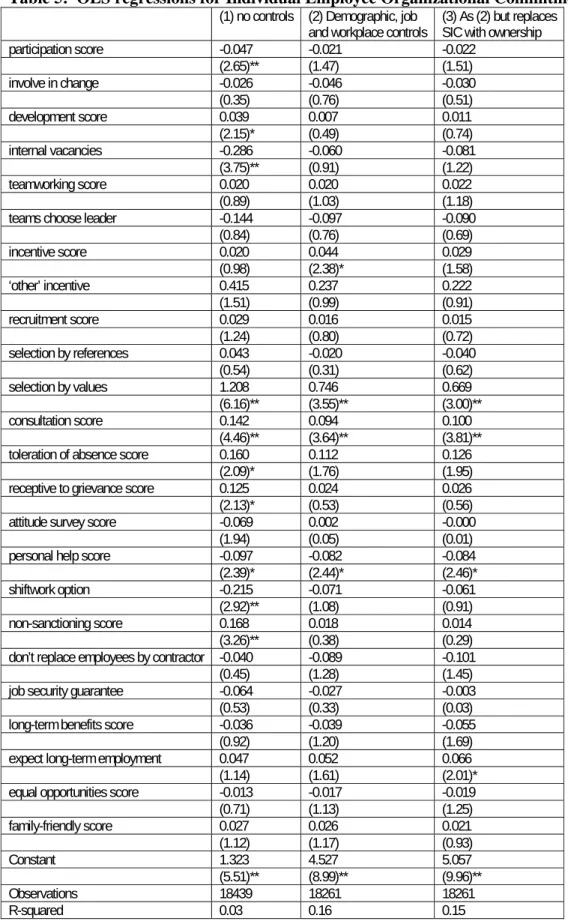
Did the effects of HPWS and POS practices on individual OC mirror their effects on workplace-level mean OC? Results are presented in Table 5 which shows regression analyses for individual-level OC using identical HPWS and POS as those used in Table 4. Model (1) enters the scores with no controls; Model (2) introduces identical workplace controls to those used earlier, plus controls for demographic and job characteristics of the worker as described earlier. Model (3) is identical to Model (2) but replaces the industry dummies with ownership dummies.17 The results are broadly reminiscent of those for mean workplace-level OC presented earlier but also contain some differences. Individual OC is positively associated with “Consultation” and “Absence Tolerance”. In contrast to the workplace-level analysis, the positive association between OC and use of “commitment to the values of the organization” as a selection criterion was robust to the inclusion of control variables. There are two other domains which were significantly associated with higher OC in at least one of the models containing controls. These are leading employees to expect long-term employment and “Financial incentives”. The only domain that was negatively associated with OC across all three models in Table 5 was the “help and favours” scale.18
We explored possible non-linear effects of HPWS and POS in the same way as we described above in relation to mean workplace-level OC. As in the case of the workplace-level analysis, the introduction of squared terms uncovered no evidence of non-linear effects at the level of individual domains or ‘global’ counts for HPWS and POS. Using dummy variables to capture ‘high intensity’ use of practices in particular domains uncovered few statistically significant effects once we accounted for observable differences in demographic, job and workplace characteristics. There were two exceptions: highly intensive use of “Consultation” – a domain emphasised in both the HPWS and POS literatures - was associated with higher individual employee OC, as was highly intensive use of “Incentives”, a domain that features in the HPWS literature as a support for ‘core’ job redesign and participation practices. Highly intensive use of practices in these two domains did not feature in the workplace-level analysis while leading employees to expect long-term employment, which was robustly positively associated with mean workplace-level OC, was only on the margins of statistical significance in the employee-level analysis.
17
Full regression analyses are available from the authors on request. Summarising the effects of demographic characteristics we find that being male, having higher academic qualifications, having a long-term sickness, illness or disability, being white British, being single/widowed or divorced and being a union member are all independently associated with lower OC. OC is u-shaped in age, hitting a low at age 22-29 years, then rising markedly among older workers. Job-related factors associated with higher OC include being on a permanent contract, part-time employment, being in a higher occupation or in personal services, working at the workplace for under a year, receiving more days training, and working in a job done equally by men and women, or a job not done by anyone else in the workplace. Little changes when one replaces single-digit occupation with three-digit occupation. The workplace controls perform in much the same way as the analyses indicated earlier. 18
In addition there were domains that were significantly associated with OC in Model (1) but became statistically non-significant with the introduction of control variables. This was the case in relation to positive associations with “Training and Development”, “Encouraging Criticism”, and the avoidance of disciplinary cases. It was also the case in relation to negative associations with “Participation”, internal promotions and
The ‘bundles’ measure which simply added up the number of times a workplace scored as a ‘high’ user in a HPWS or POS domain was positive and statistically significant indicating that, controlling for other observable differences, employees’ OC rose with the number of times the workplace scored highly on HPWS and POS domains considered jointly. This mirrors the workplace-level analysis. However, whereas the results for mean workplace-level OC were driven by the HPWS domains, the separate HPWS and POS bundle measures were positive but statistically non-significant.
9. Conclusion
This paper considers whether employers are able to influence the OC of their employees through the practices they deploy. We examine the association between OC and two broad groups of HRM practices emphasised in two different strands of the literature, namely “High-Performance Workplace Practices” (HPWPs) and practices associated with “Perceived Organizational Support” (POS). We consider their associations with mean workplace-level OC and individual employees’ OC.
Using nationally representative linked employer-employee data we find mean workplace-level OC varies a great deal across British workplaces. We are able to explain around one-quarter to four-tenths of this variance depending on our model specification. Much of the variance is associated with structural features of the workplace such as size, ownership and industry. HPWP’s tend not to be positively associated with workplace OC, with the exception of methods for consulting with employees – a sub-set of practices that also features in the POS literature. Some HPWP practices, such as new employee induction programmes, are negatively associated with OC. Some POS practices are significantly associated with OC. Employer preparedness to tolerate sickness and absence, an emphasis on rewarding rather than punishing employees, permitting working at home and employer assurances regarding long-term employment security are all positively associated with OC. Traditional paternalistic occupational benefits, on the other hand, are negatively associated with workplace-level OC. Turning to practices associated with individual employees’ OC we find a similar story, though some of the particulars differ – for example, there are positive associations between individual OC and financial incentives.
It would appear that, although employers may be able to engender greater OC on the part of their employees, the practices that do so are not those emphasized in the HPWP literature, with the exception of consultation and the involvement of employees in decision-taking. POS practices are a little better but, again, the findings are far from unequivocal. Furthermore, those practices that are ‘effective’ in engendering higher OC such as tolerance of absence, recruiting on ‘values’ and allowing employees to make decisions, tend to have a fairly low incidence in British workplaces. It may be that HRM practices are sufficiently widely used to have become too ‘ordinary’ now to impact on employees? The alternative explanation is that, despite the rhetoric, these policies have never really affected employee OC suggesting that, if they have any impact on workplace performance, it is through routes other than employee OC.
There is, however, one finding which chimes with the ideas underpinning the HPWS literature, namely that there are returns to the use of practices in combination. Analyses of both mean workplace-level OC and individual employee OC find an independent positive association between OC and the deployment of multiple practices in combination. This