Influence of Mobile Learning Training on Pre-service Social
Studies Teachers’ Technology and Mobile Phone Self-Efficacies
Adedoja Gloria* Abimbade Oluwadara
Teacher Education Department, University of Ibadan, Oyo State, Nigeria Abstract
Current instructional deliveries favour the use of mobile technology because of its inherent potentials and benefits such as portability, ease of use cost and others. Despite these benefits, many teachers especially in Sub-Saharan Africa still prefer the conventional method and use mobile phones for social engagements such as texting, chatting, callings and others. Though, these teachers use mobile phones for these social activities, using it for instruction is somewhat problematic for them without adequate training on its pedagogical implications. This is also because there are dearth of trainings in this area. Some factors that could however affect this type of specialised training include Technology Self-efficacy, Mobile Phone Self-efficacy, attitude, age and others. The sample of this present study was 101 pre-service social studies teachers in two Universities in Nigeria. The influence of the Mobile learning training on Technology/Mobile Phone Self-efficacies was explored. The results indicated that the pre-service social studies teachers have high Technology/Mobile Phone Self-efficacies after exposure to the training.
Keywords: Technology self-efficacy, Mobile Phone Self-efficacy, Mobile learning, training 1. Introduction
The Nigerian National Policy on Education (FRN, 2004), emphasises that the educational system may not rise above the quality of its teachers. Consequently, it is important to invest in the professional training of teachers. Teaching is the major activity of teachers and for them to perform this effectively in the classroom, they need to have gone through relevant, adequate and appropriate training (Bilesanmi-Awoberu, 2007). There have been some training to keep teachers abreast of new strategies, approaches and technologies in the profession. One of such trainings is the UK-Nigeria Teacher Training Project which targets achieving the MDG goal on education. This training was aimed at developing competence in planning, delivery, assessing learners’ need and managing the learning environment. It was aimed at transforming trainees to thorough professionals equipped with modern innovative method of teaching and technology of delivery.
Technology has become an integral part of our lives; it has affected various sectors of our endeavours. In education, modern technologies have been used to develop interactive and engaging content for learners, help in capacity building and professional development of teachers, help teachers to connect to the learners and others. The emphasis here is how specialised technology trainings have affected the teaching skills, technology and mobile self-efficacies of teachers. Usoro and Ogbuanya (2009) asserted that technology brings about new training strategies within the education system and the traditional methods are being jettisoned. “A teacher is the conductor needed for the integration of technology into the classroom. The fact is that to be effective, technology must be ingrained into the broader education reform movement that includes teacher training, curriculum, student assessment, and a school’s capacity for change” (Roschelle, Pea, Hoadley, Gordin, & Means, 2000).
However, Obanya (2002) opined that teacher preparation programmes are still based predominantly on traditional practices. Rozalind G. Muir-Herzig (2003) asserted that many times the training may focus on how to use equipment but will miss the importance of how to integrate the technology into the curriculum. According to Vannatta & Fordham (2004), teachers who spend more time on training are willing to use technology for teaching and learning than those who do not. Likewise, teachers who engage in training on how to integrate technology into instruction use technology more than other teachers who were not trained to use technology in teaching and learning Mayo and Kajs (2005). It has been argued that teachers who go through some level of training have positive influence towards the use of technology than those who do not engage in any training (Zhao & Bryant, 2006).
According to Aremu and Fasan (2011), self-efficacy should be considered in the training programmes for teachers because ‘teachers’ self-efficacy in relation to computer use is more important in their acquiring competence for integrating the technology into teaching and learning processes than any other factor.’ In the same vein, Farah (2011) in her study on factors influencing teachers’ technology self-efficacy determined that a targeted and specialized teacher training on instructional technology could help increase technology self-efficacy of teachers. Kumar, Rose & D’Silva (2008), also indicated that teacher’s self-efficacy and attitude towards technology can greatly affect the use of technology in the classroom.
How comfortable teachers feel about using technology in the classroom is crucial to the type of training they get and actual usage (Yuen Fook, Sidhu, Kamar, & Abdul Aziz, 2011). Teachers who feel that they have not been effectively trained on how to use technology in the classroom would probably have low self-efficacy
(Moore-Hayes, 2011). Also, teachers who believe that they have acquired the requisite skills to use technology in their classrooms are expected to have high self-efficacy (Compeau, Higgins, & Huff, 1999). According to Levin & Wadmany (2008), teachers that participate in training and ‘ongoing’ scaffolding have considerable higher self-efficacy to integrate technology and use technology for instruction than those who do not participated in training. It is pertinent to reiterate that training is paramount in teachers’ developing self-efficacy and positive attitudes toward technology. Chia-Pin & Chin-Chung (2009), determined that self–efficacy toward the use of technology is an important factor on whether or not a teacher will decide to use technology in the teaching and learning process. In the same vein, self-efficacy has been seen as an important factor in teacher’s readiness to use technology in the classroom. Moore-Hayes (2011), ascertained that teachers who feel they are not ready to use technology in instruction will probably have feelings of low self-efficacy and vice versa. Training has a positive influence on a teacher’s view and self-efficacy towards using technology in the classroom (Barton & Hayden, 2006).
It is clear from the findings of various studies reviewed that technology self-efficacy has major contribution in the adoption of a technology, in terms of using mobile devices for instruction. Also, mobile phone self-efficacy could play an important role in the actual usage of mobile phones for instructional purposes. Kenny, Van Neste-Kenny, Burton, Park & Qayyum (2012) have reiterated that the level of comfort or confidence in the teachers’ ability to use various functions on the mobile technology is crucial to effective learning process.
In terms of mobile learning skills teachers should possess during and before engaging in mobile learning instruction, the Mobile Learning Academy (2014) identifies some mobile learning skills teachers should possess, these skills include: context-awareness – learning at locations, (Re)search and informational skills, Literacy and reading, Social and collaborative skills, Technical and “new media” skills. Teachers can sharpen their skills to access the immense knowledge repository using the internet as well as take advantage of educational platforms that provide ways for students to collaborate and develop knowledge of how software interfaces work. If mobile learning will be successful, teachers must be trained on how to use mobile technologies for instruction. It is against this background that Baustista (2013) indicated that digital skills are necessary for students of nowadays, but they need to know how to use them responsibly. This implies that teachers must be adept on how these digital technologies, such mobile phones work before they can transfer the skills to the learners. According Singh (2014), designing instruction for mobile learning demands a different and unique set of qualities. He identifies eight competencies teachers should demonstrate in order to use mobile devices for learning:
1. Knowledge of the instructional approaches, tools, systems, and processes required for designing and developing effective mobile learning content.
2. Knowledge of the best practices related to the development of mobile learning content. 3. Knowledge of successful mobile learning implementations around the world.
4. Knowledge of today’s trends, research initiatives and experiments happening in the field of mobile learning.
5. Ability to analyse a business situation and the learning context, and recommend appropriate mobile learning solutions to address them.
6. Skills to design and develop effective mobile learning applications to meet business objectives.
7. Passion for learning and improvement in the areas of instructional design and mobile learning, and all related fields
8. Appreciation of the power and effectiveness of mobile learning
Therefore, this study examined the influence of mobile learning training on pre-service social studies teachers’ mobile phone and technology self-efficacies.
1.1 Hypotheses
1. There is no significant difference in the pre-service Social Studies teachers’ Mobile phone self-efficacy before and after training
2. There is no significant difference in the pre-service Social Studies teachers’ mobile phone self-efficacy technology self-self-efficacy before and after training
To test these hypotheses, paired t-test was employed to test the difference between pre and post scores in the two variables.
2. Methodology 2.1 Research Design
The study adopted a One group pre-test-post-test design, the variables in the study include; technology self-efficacy, mobile learning training and mobile phone self-efficacy.
2.2 Population for the Study
The population for the study include 200 and 300 level pre-service Social Studies teachers from the Faculties of Education of Obafemi Awolowo University, Ile-Ife, Osun State and Tai Solari University of Education, Ijebu-Ode, Ogun State. The population also include Junior Secondary School Two Students from Ile-Ife, Osun State, Ijebu-Ode, Ogun State and Ibadan, Oyo State.
2.3 Selection of Participants
Out of the population stated above, 103 pre-service Social Studies teachers were purposively selected in the Faculties of Education of Obafemi Awolowo University, Ile-Ife, Osun State and Tai Solarin University of Education, Ijebu-Ode, Ogun State. The criteria for selection were based on willingness to participate in the study, they must have been exposed to Social Studies methods and Educational technology course.
2.4 Research Instruments
2.4.1 Technology Self Efficacy Scale (TSES)
The questionnaire addresses pre-service Social Studies teachers’ technology self-efficacy. It comprises two sections. Section ‘A’ contains the demographic data of the participants, while Section ‘B’ is made up of 17 items placed alongside a four-point Likert Scale of Strongly Agree (SA), Agree (A), Disagree (D), Strongly Disagree (SD). Pre-service Social Studies teachers are expected to choose options that indicate the degree of their agreement or disagreement with each item. The instrument was given to the researcher’s supervisor and experts in the field of educational technology for face and content validity. Comments on the logical arrangement of materials and language were obtained. In order to establish the reliability of TSEQ, it was administered to sample of 20 participants who were not part of the main study. A reliability coefficient index of 0.79 was obtained
2.4.2 Mobile Phone Self-Efficacy Questionnaire (MPSEQ)
The instrument was used to elicit data about the belief of pre-service Social Studies teachers to use mobile phones for instruction. The MPSEQ is made up of 12 items placed alongside a four-point Likert Scale of Strongly Agree (SA), Agree (A), Disagree (D), Strongly Disagree (SD). The items were rated from low, medium and high. The respondents are expected to choose options that indicate the extent of their agreement or disagreement on each item. The instrument was given to the researcher’s supervisor and educational technologists for face and content validity. Comments on the logical arrangement of materials and language were obtained. In order to establish the reliability of MPSEQ, it was administered to sample of 20 students who were not part of the main study. Their responses were subjected to Cronbach alpha analysis; the reliability coefficient of 0.80 was obtained.
2.5 Procedure
2.5.1 Training of Pre-service Social Studies Teachers
Training of Pre-service Social Studies teachers on Mobile learning using the following: Mobile learning training manual; mobile learning training package, and Training workshop
(a) Training workshop
Activities in the workshop include: Research Assistant:
Step I: Distributes the Mobile Learning Training Package and the mobile learning training manual to the pre-service Social Studies teachers
Step II: Explains with the use of Multimedia how to use the package Step III: Introduces the concept of mobile learning
Step IV: Explains the benefits of mobile learning Step V: Explains the various categories of Mobile phones
Step VI: Identifies the applications and features on the mobile phones that can be used to teach. Step VII: Explains how to appropriately use the features on the mobile phones to teach.
Step VIII: Uses a concept in Social Studies to explain how to use each of the features on the mobile phone.
Step VIV: Puts the pre-service Social Studies teachers in groups.
Step X: Gives the pre-service Social Studies teacher a-hands-on activity to ensure the skills are acquired.
Step XI: The pre-service Social Studies teachers select a concept/topic in JSS II Social Studies. Step XII: Identifies the appropriate features on the mobile phone to use to select topic.
Step XIII: The trainer responds and gives feedback. (b) Mobile learning training manual
The Mobile learning training manual was given to the pre-service Social Studies teachers to study on their own. The training manual contains:
Benefits of mobile learning Types of phones and features
Using applications/features of mobile phones for instruction (c) Mobile learning training package
The learners made use of the instructional manual to learn how to use the following instructional packages:
- Audio version of the package - Video manual of the package and
- Portable document file (PDF) version of the package I. Launch presentation by clicking on Launch_presentation
II. Click on the screen to enter the package
III. The menu page opens for the learner to interact with the package
IV. From this point, the learner can choose to access any information s/he wants without following a particular sequence.
V. The Menu page contains: Types of Mobile phones Features on the mobile phone
How you can use the feature of the phone to teach Create your own mobile learning lesson plan Test yourself
Pedagogy of mobile learning 3.1 Results
3.1.1 Data Analysis
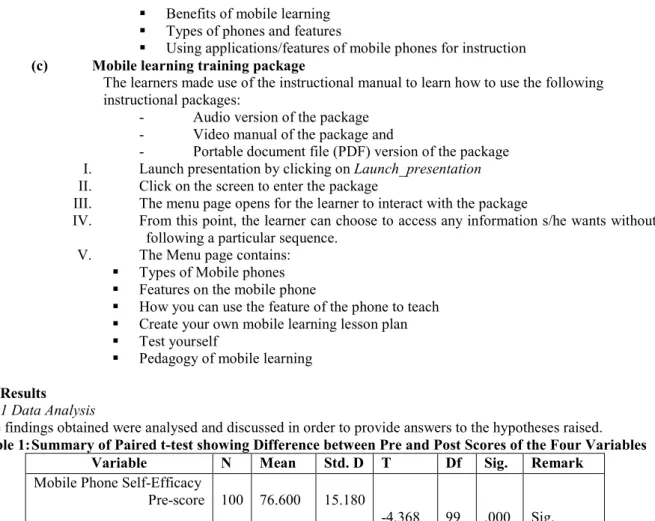
The findings obtained were analysed and discussed in order to provide answers to the hypotheses raised. Table 1: Summary of Paired t-test showing Difference between Pre and Post Scores of the Four Variables
Variable N Mean Std. D T Df Sig. Remark
Mobile Phone Self-Efficacy Pre-score Post score 100 100 76.600 84.300 15.180 8.491 -4.368 99 .000 Sig. Technology Self-Efficacy Pre-score Post score 103 103 51.612 59.767 6.673 10.854 -6.515 102 .000 Sig
Table 1 reveals that there is a significant difference between the pre and post scores of the pre-service Social Studies teachers in mobile phone self-efficacy (t = 4.368; df = 99; p<0.05). Therefore, H01c is rejected. The mean scores reveal that the post-mobile phone self-efficacy is higher (84.30) compared with the pre-mobile phone self-efficacy mean score (76.60). The difference between the pre and post scores of pre-service Social Studies teachers’ technology self-efficacy is also shown to be significant (t = 6.52; df = 102; p<0.05). Therefore, H01d is rejected. The mean scores reveal that the post technology self-efficacy is higher (59.77) compared with the pre technology self-efficacy mean score (51.61).
4.1 Discussion
4.1.1 The Effect of training on Pre-service Social Studies Teachers’ Mobile Phone Self-Efficacy
Finding from the study has shown that there is a significant difference in the pre-service Social Studies teachers’ mobile phone efficacy pre and post the training. In terms of practical relevance, the mobile phone self-efficacy of the pre-service Social Studies teachers improved significantly after the training. The implication of this is that the teacher trainees perceived themselves as being able and confident to accomplish tasks (difficult, simple or sophisticated) on the mobile phone. Due to their exposure to the training, the pre-service Social Studies teachers are convinced that they can easily learn and use various features and applications on the device. They also have a strong feeling of competence to support their lessons in the future. The theory of constructivism can be used to explain the pre-service Social Studies teachers ability to acquire high mobile phone self-efficacy because of the training they were exposed to, they see the use of mobile phone as requiring less effort and easier to use for instruction, this includes the various categories of mobile phones; Low-end Phones, Mid-end Phones, High-end Phones and Smart Phones. The feeling that mobile learning offers major benefit over existing learning methods and familiarity with the device is another factor that could have contributed to their high mobile phone self-efficacy. This confirms the findings of Kenny, Van Neste-Kenny, Burton, Park, and Qayyum (2012) that students are likely to be confident in using the mobile phone for learning if they receive some support rather than
solely relying on themselves. Also, Attewell, Savill-Smith and Douch (2009) note that mobile technology can be used to improve the self-esteem and self-confidence of learners.
4.1.2 The Effect of training on Pre-service Social Studies Teachers’ Technology Self-Efficacy
The findings from the study indicate that there is a significant difference in the technology self-efficacy of the pre-service Social Studies teachers before and after the training. This is to the effect that the technology self-efficacy of the teacher trainees improved significantly after they were exposed to the training. The implications of this that the pre-service Social Studies teachers are comfortable in using other technological tools. Similarly, they see themselves as being able to competently use technological tools, especially, for their teaching and learning. Generally, the teachers’ self-confidence to use technological tools in their future educational endeavour has improved. The reasons for the teachers’ improved technological self-efficacy may be due to wide spread access to mobile phones, knowledge of instructional technology, belief that technology can help make content more accessible and the training they were exposed to. Connectivism learning theory helps the pre-service Social Studies teachers to be able to transfer their belief to competently use mobile phone to other technological devices. Farah (2011) Suggests that there should be professional development opportunities and more targeted, specialized training on instructional technology and increased knowledge of and access to technology tools and resources. In like manner, Lambert, Gong, and Cuper (2008) are of the opinion that if teachers will improve in their skill and learn how to effectively integrate technology, training would have to go beyond a focus on basic computer skills. In essence, it must also include intrinsic properties like self-esteem and self-confidence in using technology tools.
Conclusion and Recommendation
This study has established that through adequate and proper training, the pre-service Social Studies teachers can acquire the skills to effectively use the mobile phone for instructional purposes. An effective training on mobile learning helped enhance the mobile phone self-efficacy and Technology self-efficacy of the pre-service Social Studies teachers. Technology self-efficacy, mobile phone self-efficacy can be profound factors in using mobile phones for teaching and learning. So, whatever mobile learning training is designed for the pre-in service teachers, promoting technology self-efficacy and mobile phone self-efficacy must be incorporated into such a training as it can influence the effective adoption of mobile learning.
References
Aremu. A. and Fasan O. 2011. Teacher Training Implications of Gender and Computer Self Efficacy for Technology Integration in Nigerian Schools. The African Symposium: An online journal of the African Educational Research Network 11(1)
Attewell, J., Savill-Smith, C., and Douch, R., (2009). The Impact of Mobile Learning: Examining what it means for Teaching and Learning. Published by LSN. www.lsnlearning.org.uk retrieved on 16-1-2014 Barton, R. and Haydn, T. (2006). Common needs and different agendas: How trainee teachers make progress in
their ability to use ICT in subject teaching. Some lessons from the UK. Computers and Education
49:1018-1036.
Bautista, C. (2013). 73% of teachers use cell phone for classroom activities. http://mashable.com/2013/02/28/teachers-technology/ retrieved on 16-10-2014
Bilesanmi – Awoderu, J.B. (2007). Perceived relevance of teaching practice exercise in the teacher training programme by a Nigerian University undergraduates: a case study of Olabisi Onabajo University, Ago-Iwoye, Nigeria. African Journal of Cross-Cultural Psychology and Sport Facilitation 49-60. Chia-Pin, K. & Chin-Chung, T. (2009). Teachers' attitudes toward web-based professional development, with
relation to internet self-efficacy and beliefs about web-based learning. Computers & Education
53.1:66-73.
Compeau, D., Higgins, C. A., and Huff, S. (1999). "Social cognitive theory and individual reactions to computing technology: A longitudinal study," MIS Quarterly (23:2), pp 145-158
Farah, A.C. (2011). Factors influencing teachers‘ technology self-efficacy: a case study. A Dissertation Presented in Partial Fulfillment of the Requirements for the Degree Doctor of Education Liberty University.
Federal Republic of Nigeria (2004). National Policy on Education (4th Ed). Lagos: NERDC Press.
Kenny R., Van Neste-Kenny J., Burton P., Park C., and Qayyum A. (2012). Using Self-Efficacy to Assess the Readiness of Nursing Educators and Students for Mobile Learning. The International Review of Research in Open and Distance Learning 13.3:277-296.
Kumar N, Rose R and D’Silva J. (2008). Teachers’ Readiness to Use Technology in the Classroom: An Empirical Study. European Journal of Scientific Research 21.4:603-616.
Lambert, J., Gong, Y. & Cuper, P. (2008). Applying Technology to Learning: Is it Too Much to Expect of Pre-service Teachers in an Introductory Technology Course? In K. McFerrin et al. (Eds.), Proceedings of
Society for Information Technology & Teacher Education International Conference 2008. pp. 3814-3821).Chesapeake, VA: AACE.
Levin, T., & Wadmany, R. (2008). Teachers’ Views on Factors Affecting Effective Integration of Information Technology in the Classroom: Developmental Scenery. Journal of Technology and Teacher Education
16.2:233-263
Mayo N., & Kajs, L. (2005). Educational Research Quarterly. West Monroe. 29.1:3, 13
Mobile Learning Academy (2014) 5 Skills Students Develop By Using Smartphones, http://mobilelearningacademy.org/2013/02/5-skills-students-develop-by-using-smartphones/
Moore-Hayes, C. (2011). Technology Integration Preparedness and its Influence on Teacher-Efficacy. Canadian journal of learning and technology 37.3.
Obanya, P., (2002). Revitalizing Education in Africa. Stirling-Horden Publishers (Nig.) Ltd., Ibadan, ISBN: 978-34922-9-2, pp: 137.
Roschelle, J., Pea, R,. Hoadley, C., Gordin, D., Means. B. (2000). Changing How and What Children Learn in School with Computer-Based Technologies the Future of Children and Computer Technology. 10.2. Rozalind G. (2003). Technology and its impact in the classroom. Computers and Education 42.2 004:111–131 Singh, R. (2014). Top 8 Competencies of a Mobile Learning Designer - eLearning Industry.htm.
www.elearningindustry.com
Usoro and Ogbuanya (2009) Usoro, A.D. and T.C. Ogbuanya, 2009. Creativity Technique, a Missing Link for Self- Reliance: Implication for Curriculum Development in Vocational Technical Education. International Journal of Research in Agriculture Education and Related Discipline (URADED), 3(2): 59-69.
Yuen Fook, Chan; Sidhu, Gurnam Kaur; Kamar, Nursyaidatul; Abdul Aziz, Norazah. (2011). Pre-Service Teachers' Training in Information Communication and Technology for the ESL Classrooms in Malaysia. Turkish Online Journal of Distance Education, v11 n3 p97-108
Zhao, Y. & Bryant, F. (2006). Can Teacher Technology Integration Training Alone Lead to High Levels of Technology Integration? A Qualitative Look at Teachers’ Technology Integration after State Mandated Technology Training. Electronic Journal for the Integration of Technology in Education 5.