Hypothesis Generation and Data Quality Assessment through
Association Mining
Ping Chen
Dept. of Computer and Math Sciences
University of Houston-Downtown
1 Main St., Houston, TX, USA 77002
[email protected]
Walter Garcia
Dept. of Computer and Math Sciences
University of Houston-Downtown
1 Main St., Houston, TX, USA 77002
[email protected]
Abstract
Association mining aims to find valid correlations among data attributes, and has been widely applied to many areas of data analysis. In this paper we present a semantic network based association analy-sis model including three spreading activation meth-ods, and apply this model to assess the quality of a dataset, and generate semantically valid new hy-potheses for further investigation. We evaluate our approach on a real public health dataset, the Heart-felt study, and the experiment shows promising re-sults.
Keywords: Association rule mining, Semantic network, Hypothesis generation, Data quality assess-ment
1
Introduction
Association rule mining [1] has been widely applied to numerous domains, such as analysis of market-basket datasets, text mining, and disease diagnosis. Association rules whose support and confidence are above user-specified thresholds are considered statis-tically significant and presented to end-users. While these objective measures are effective to reduce rule redundancy, incorporation of subjective and domain-specific knowledge is still a critical challenge for
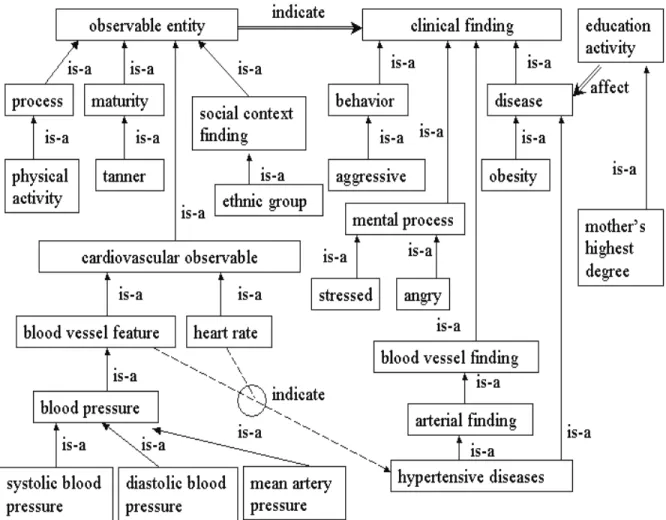
asso-ciation analysis, and these knowledge should be rep-resented in a more structured way to maximize its usage. Hence, we choose semantic network to rep-resent knowledge for association analysis. Seman-tic network has been implemented in many knowl-edge bases. Concepts and ideas in the human brain have been shown to be semantically linked, which motivates the modern research of semantic network [13]. A semantic network represents knowledge as a directed graph, where vertices represent concepts and edges represent semantic relations between the concepts. Figure 1 shows a sample semantic net-work whose vertices represent concepts and edges are labeled with names of relations. Concepts are or-ganized into a hierarchical structure by is-a edges, and other edges show causal relations, e.g., observ-able entity diagnose disease or syndrome, stressed is a mental process, diseases can be result of mental process. Comparing with other knowledge represen-tation models, a semantic network has the following advantages:
1. Easy to use. A user needs little training or com-puter background to build semantic networks. Semantic networks are easy to understand and its explanation is usually straightforward. 2. Flexible, incremental, and easy to update.
Building a semantic network does not require a user to have a complete or perfect understand-ing at the beginnunderstand-ing. Instead, the buildunderstand-ing pro-cessing can be incremental, and knowledge can
be updated locally as a user gets more familiar with a domain.
3. Generative. A semantic network is not a mere static structure, instead it has a vertex-firing mechanism called spreading activation. Firing or activation of a vertex sends activation to its se-mantically connected neighbor vertices. Spread-ing activation only accesses local neighbor ver-tices, so its time complexity does not grow with the size of the network.
In this paper we will discuss a semantic network-based association analysis model. With this model we will provide the following analysis techniques:
1. Hypothesis generation. New hypotheses are gen-erated through generalization and inference from the association rule set, and give end-users direc-tions for further investigation.
2. Data quality assessment. A dataset is just an imperfect and incomplete reflection of a real-world object or scenario. By analyzing associ-ation rules we can assess the quality of original dataset.
This paper is organized as follows. In Section 2 we discuss a knowledge model to represent domain and user knowledge. We present three spreading activa-tion methods in 3. In Secactiva-tions 4 and 5 we discuss how to assess data quality and generate hypothesis based on association mining. We evaluate our method in Section 6 using a real-world public health dataset. Related work is discussed in Section 7. We conclude in Section 8.
2
Association Modeling with a
Semantic Network
We define a semantic networkSNfor association rule analysis as a directed graph,SN = (V, A, H, S, T) [3],
• V is a set of vertices that denote the attributes in the dataset and relevant concepts from its do-main,V ={v1, v2,· · ·, vk};
• A is a set of association edges connecting mul-tiple vertices, A = {(v1, v2,· · ·, vn, u)|vi, u ∈
V,(i = 1,· · ·, n)}. An association edge
v1, v2,· · ·, vn→udenotes an association among
attributes, with v1, v2,· · ·, vn as the antecedent
part of an association (also called the body), and u as the consequent part (also called the head). For example, the association “blood ves-sel feature, heart rate→hypertensive diseases” is shown in Figure 1, which involves three ver-tices. Semantically an association edge means “associated-with”. In practice an edge often can be labeled with more specific relations, such as “result-of”, “indicate”, etc. If we know what val-ues of these attributes take, an association edge can represent one or multiple association rules,
v1=a1, v2=a2,· · ·, vn=an→u=a;
• H is a set of is-a edges connecting two vertices,
H = {(v, u)|v, u ∈ V}. An edge v is-a u de-notes a subclass-superclass relation, with v as the child, anduas the parent;
• S is a label set, S ={KN OW N, BASIC}. An association edge inAcan be label withKNOWN,
BASIC, or both.
KNOWN labels are specified by end-users. A
KNOWN association edge means that this asso-ciation is already known by the user.
A BASIC edge can be obtained from a user or other knowledge sources. BASIC association edges represent highly confident principles about a domain, e.g., “observable entity indicates clini-cal finding”. textitBASIC edges are used to iden-tify semantically invalid hypothesis generated in Section 4.
• T is a set of attribute-value pairs, andT ={vi=
ai|vi∈V}. These pairs are provided by users as
not interesting or trivial instances. For example, in public health domain, “Obesity = No” is usu-ally not interesting, but “Hypertension = Yes” is interesting.
Creation of such a semantic network can be highly automated if there exist electronic domain knowledge
sources. Figure 1 shows a fragment of semantic net-work built for our case study. The vertices are med-ical concepts from a dataset. These concepts are connected with associated-with and causal relations shown as⇒ andis-a shown as→ (dashed line if its label isKNOWN, solid line if its label isBASIC).
3
Spreading Activation
Meth-ods
To create a high-quality semantic network, often we have to acquire many association edges and their labels from end-users and other knowledge sources. However, the hierarchical design of our semantic net-work can greatly lighten the burden of knowledge ac-quisition, and many associations can be generated by spreading activation, and a user does not have to specify every association explicitly as in other exist-ing methods. Here are the three spreadexist-ing activation methods:
1. v1→u1∧u1→u2 |=v1→u2
Generally associations are transitive. 2. v1 is-av2∧v2→u|=v1→u
The antecedent part of a rule can be specialized, which is called deduction in logic. For exam-ple, Tweety is-a bird∧bird→fly|= Tweety→
fly. 1 With this method, all the associations
be-tween v2’s children andu can be replaced by a
single association v2 → u. For example, we do
not have to specify,heart rate→clinical finding, mean artery pressure →clinical finding, · · ·, in-stead, one associationobservable entity→ clini-cal finding will be sufficient.
3. u1 is-a u2 ∧v→u1 |=v→u2
The consequent part of a rule can be generalized, e.g., fly is-a move∧bird→fly|= bird→move. With this method, all the associations betweenv
andu1’s parents can be replaced by a single
asso-ciationv→u1. For example, we do not have to
1Strictly speaking, this implication is not always valid,
which is an interesting topic in modal logic.
specify,observable entity→blood vessel finding, observable entity→arterial finding,· · ·, instead, one associationobservable entity→hypertensive diseases will be sufficient.
4
Hypothesis Generation
Generating high-quality new hypotheses is very im-portant for knowledge discovery in scientific study. With concepts semantically organized and correlated in a semantic network, the intuition for generating hypotheses is that if two concepts are associated, maybe their semantically connected neighbors (chil-dren and siblings) are also associated. We have the following hypothesis generation methods,
Hypothesis Generation Method 1:
{v’s child} →u|=v→u
This is called induction in logic. Ifv’s child is as-sociated withu, likelyv is also associate with u. In-duction is useful when the direct observation of v is difficult or impossible when v is an abstract concept.
Hypothesis Generation Method 2:
{v’s sibling} →u|=v→u
Analogy is another technique used by human be-ings to generate hypotheses.
If these generated hypotheses already exist in the rule set, they will be discarded, and only new hy-potheses are kept. Hyhy-potheses are not necessarily facts, but they are more likely to be true than ran-dom guess, and they provide directions for further investigation. Additional constraints can reduce the number of hypotheses and keep only highly plausible ones, e.g., using only immediate children and siblings.
5
Data Quality Assessment
A dataset is just a sampling of a real-world object or scenario at different spatial and temporal points or intervals. Naturally we want to assess the quality of a dataset, that is, how precisely they reflect reality. Data quality is a multi-dimensional concept includ-ing completeness, appropriate amount, amount of
errors/missing values, objectivity, believability [12]. Among these properties, what directly affect the quality of association rules are:
1. whether the amount of collected data is appro-priate.
If the collected data is not enough to approxi-mate the “true” scenario precisely, we will get many wrong or coincident rules (false negative). 2. whether the set of data attributes is semantically
coherent.
An association rule is valid only if the attributes in the rule are semantically relevant. Rules gen-erated by semantically isolated attributes will likely be coincident instead of valid. A poorly de-signed experiment with many isolated attributes will miss many useful and interesting rules (false positive).
LetNx denote the number of rules of typex. To
measure these two factors, we propose the following metrics,
Data Quality Metric 1:
Qsize=
NKnownCorrect+NU nknownCorrect Nnontrivial
−rules
We calculate the ratio of the number of semanti-cally valid rules to the number of nontrivial rules. The intuition is that the larger a dataset is, the more closely it should reflect the basic domain principles, and the less semantically incorrect rules will be gen-erated.
Data Quality Metric 2:
Qattribute =
NN ewHypotheses
NU nknownCorrect+NN ewHypotheses
Since the hypotheses are generated by replac-ing original attributes with semantically similar at-tributes (children, siblings) in theunknown and cor-rect rules, the more new hypotheses we get, the more semantically incomplete the original attribute set is.
6
A Case Study
Public health monitoring and analysis is very impor-tant to national policy makers and general public.
Public health data is generally of large volume, noisy, and high-dimensional, which is an ideal testbed for data mining techniques. Therefore we chose a pub-lic health data set collected in the Heartfelt study as our case study. All experiments were performed on a Pentium 4 3.0GHz PC running Windows XP. We used the Apriori algorithm implemented in Weka 3.4 [19] to generate association rules.
6.1
The Heartfelt Study
In 1999, the Heartfelt study was conducted to collect data on adolescent health. The target population for this study was African, European, and Hispanic American adolescents, aged 11 -16 years, residing in a large metropolitan city in southeast Texas with an ethnically diverse population. 383 adolescents were recruited, and the collected data included totally 105 attributes and 16912 records. The attributes include age, gender, ethnic/racial group, physical maturity, resting blood pressure and heart rate, ambulatory blood pressure, heart rate and moods reported at 30-minute intervals, body mass index, fat free mass, psychological characteristics such as anger and hostil-ity. Numerous findings have been reported based on bio-statistical analysis of the Heartfelt study, such as stress-induced alterations of blood pressure [8], as-sociation of obesity and poor sleep quality [5], eth-nic group differences in moods and ambulatory blood pressure [9], relationship of ambulatory blood pres-sure to physical activity [4], etc.
6.2
Building
a
Semantic
Network
from UMLS to Analyze the
Heart-felt Study
Unified Medical Language System (UMLS) is de-signed to help an information system “understand” the meanings of concepts and terms and their rela-tionships in biomedical and health domain [16]. The UMLS Knowledge Sources are multi-purpose, and can be used to create, process, retrieve, integrate, and aggregate biomedical and health information. UMLS divides medical ontology knowledge into three sources: the SPECIALIST lexicon, the Metathe-saurus, and the Semantic Network. The
SPECIAL-IST lexicon is designed to provide lexical information for the SPECIALIST Natural Language Processing System. The Metathesaurus is a multi-lingual vocab-ulary database that contains definitions of biomedical terms, their various names (such as synonyms and abbreviations), and the relationships among them. The Semantic Network categorizes all concepts in the Metathesaurus into semantic types, such as clinical finding, organisms, physical activity, etc. The Se-mantic Network also defines a set of relationships be-tween biomedical concepts. These relationships pro-vide the structure for the Semantic Network. The primary relationship is the “is-a” link, which estab-lishes the hierarchy within the Semantic Network. Besides, there are also a set of non-hierarchical re-lationships, e.g., “associated-with”, “affect”, “func-tionally related to”. Using UMLS we created a se-mantic network for the Heartfelt dataset as follows (a fragment of the semantic network is shown in Fig-ure 1):
1. Analyze the attributes in the Heartfelt dataset, assign the attributes that are semantically sim-ilar to the same vertex, e.g., “age of subject in years” and “age of subject in months” are as-signed to one vertex, and totally we obtain 39 vertices;
2. Extract parent and child concepts (totally 162) of the original attributes from UMLS, and add these new concepts and theiris-a relations into the semantic network. As shown in Figure 1, majority of concepts are organized into the “ob-servable entity” tree and “clinical finding” tree; 3. Find the semantic type of each attribute using UMLS. Different concepts can have the same se-mantic type, and we found totally 9 sese-mantic types. UMLS provides 49 relations among these semantic types, and they were added into the network as “associated-with” or more specific edges, e.g., “affect” and “indicate”, and labeled withBASIC;
4. Ask a user to add additional “associated-with” edges labeled withKNOWN and specify trivial attribute-value pairs. In our experiment, we add
“associated-with” edges that should be known by general public, such as “body mass index is associated with obesity”, “age is associated with sexual maturity”, etc. Trivial attribute-value pairs are generally not interesting to medical per-sonnel, such as “obesity = no”, “blood pressure = normal”, etc.
It took us about two hours to set up this semantic network. Although actual time can vary from one dataset to another and from one user to another user, once the semantic network is set up, it can be reused by other users and revised to analyze similar datasets.
6.3
Experiment Results and
Discus-sion
We applied our hypothesis generation method to the association rules generated from Heartfelt dataset, and totally we generated 1920 new hypotheses for fur-ther investigation. These hypotheses point out new attributes that a user may collect in future experi-ments. These hypotheses introduced new attributes (siblings and children of original attributes, excluded if they already exist), we do not have any real values for these attributes. Instead, these hypotheses de-scribe possible correlations among semantically rele-vant attributes. For example,
ZBMI is associated with Maternal obesity syn-drome.
ZBMI is the z-score of body mass index that mea-sures obesity, and it is reasonable that ZBMI re-lates to maternal obesity syndrome. These hypoth-esis should be of high quality since they are based on the rules generated from real data and validated by the basic biomedical principles specified in our se-mantic network.
We calculatedQsizeandQattributeaccording to two
metrics proposed in Section 5,
Qsize= 0.36
Qattribute= 0.07
The value of Qsize is low and indicates that the
dataset is small, which is common in biomedical field due to the prohibitive data collecting cost. A small
Qattribute shows that the attributes in the dataset
are semantically self-closed since not many hypothe-sis can be generated, which indicates that the Heart-felt study was very carefully designed.
7
Related Work
Association rule mining has been proved to be very useful in many applications. One major obstacle in practice is how to identify correct, interesting, user-specific rules from a huge number of redundant, wrong, or trivial rules. Recently association rule post-processing has become a very active research area. Based on whether external knowledge sources are used, we can divide the existing methods into ob-jective measure based methods and knowledge based methods.
Objective measure based methods do not require any domain information besides the rule set itself, and can be used by both domain experts and novice users. However, lack of domain knowledge makes it impossible to detect wrong rules that are just coin-cidence and do not “make sense”, and lack of user input results in presenting many rules already known by users. Based on the analysis tasks this type of methods can be further divided into:
1. Metric-based rule evaluation. This type of ap-proaches use metrics to evaluate the significance or interestingness of an association rule, such as lift [2], statistical hypothesis tests [18]. Uninter-esting rules will be discarded. However, as shown in [15], each metric has different properties and may be useful only for some specific domains and applications, and choosing the right metric is of-ten difficult.
2. Rule summarization and generalization. To re-duce the number of rules that need manual anal-ysis, rules are analyzed with their context [7]. These methods investigate relations among rules in order to present users a concise rule set.
3. Rule ranking. [6] and [20] discussed how to ex-tract top-k significant rules with low redundancy.
8
Conclusion
In this paper, we discussed how to model domain knowledge with a semantic network and apply it to association rule analysis. Our semantic association rule analysis can generate semantically valid hypoth-esis, and assess data quality. We successfully applied our method to a public health dataset and obtained promising results.
Acknowledgments
This work is funded by National Science Foundation grant CNS 0851984 and Department of Homeland Se-curity grant 2009-ST-061-C10001.
References
[1] Agrawal, R., Mannila, H., Srikant, R., Toivonen, H., and Verkamo, A. I., Fast Discovery of Asso-ciation Rules. In Advances in Knowledge Dis-covery and Data Mining, U. M. Fayyad, et. al., Eds. AAAI press, 1996.
[2] Bayardo, R. J. and Agrawal, R., Mining the Most Interesting Rules. In Proceedings of the Fifth ACM SIGKDD International Conference on Knowledge Discovery and Data Mining, San Diego, CA, United States, August 15 - 18, 1999. [3] Chen, P., Verma, R., Meininger, J. C., and Chan, W., 2008. Semantic analysis of associa-tion rules. In Proceedings of the Internaassocia-tional FLAIRS Conference, FL, USA, 2008.
[4] Eissa, M., Meininger, J. C., Nguyen, T., and Chan, W., The Relationship of Ambulatory Blood Pressure to Physical Activity in a Tri-Ethnic Population of Obese and Nonobese Ado-lescents. American Journal of Hypertension, Volume 20, Issue 2, Pages 140-147
[5] Gupta, N. K., Mueller, W. H., Chan, W., and Meininger, J. C., Is Obesity Associated with Poor Sleep Quality in Adolescents? American Journal of Human Biology : the Official Journal of the Human Biology Council, 14(6), 2002.
[6] Han, J., Wang, J., Lu, Y., and Tzvetkov, P., Mining Top-K Frequent Closed Patterns without Minimum Support. In Proceedings of the IEEE international Conference on Data Mining, 2002. [7] Liu, B., Zhao, K., Benkler, J., and Xiao, W., Rule Interestingness Analysis Using OLAP Operations. In Proceedings of the 12th ACM SIGKDD International Conference on Knowl-edge Discovery and Data Mining, Philadelphia, PA, 2006.
[8] Meininger, J. C., Liehr, P., Mueller, W. H., Chan, W., Smith, G. L., and Portman, R. J., Stress-Induced Alterations of Blood Pressure and 24 h Ambulatory Blood Pressure in Adoles-cents, Blood Pressure Monitoring, 4(3-4), 1999. [9] Meininger, J. C., Liehr, P., Chan, W., Smith, G., and Mueller, W. H., Developmental, Gen-der, and Ethnic Group Differences in Moods and Ambulatory Blood Pressure in Adolescents, An-nals of Behavioral Medicine: a Publication of the Society of Behavioral Medicine, 28 (1), 10-9. [10] Padmanabhan, B., and Tuzhilin, A., A
Belief-Driven Method for Discovering Unexpected Pat-terns. In Proceedings of the 4th ACM SIGKDD International Conference on Knowledge Discov-ery and Data Mining, 1998.
[11] Padmanabhan, B. and Tuzhilin, A., Small is Beautiful: Discovering the Minimal Set of Unex-pected Patterns. In Proceedings of the 6th ACM SIGKDD International Conference on Knowl-edge Discovery and Data Mining, Boston, Mas-sachusetts, 2000.
[12] Pipino, L., Lee, Y., and Wang, R., Data Quality Assessment, Communications of the ACM, April 2002.
[13] Quillian, M. R., Semantic Memory, Semantic Information Processing, M. Minsky, ed., MIT Press, 1968.
[14] Sahar, S., On Incorporating Subjective Interest-ingness Into the Mining Process. In Proceedings
of the IEEE International Conference on Data Mining, 2002.
[15] Tan, P. N., Kumar, V., and Srivastava, J., Se-lecting the Right Interestingness Measure for Association Patterns. In Proceedings of the 8th ACM SIGKDD International Conference on Knowledge Discovery and Data Mining, July 2002.
[16] Unified Medical Language System. 2007. avail-able at www.nlm.nih.gov/research/umls/. [17] Wang, K., Jiang, Y., and Lakshmanan, L.
V.S., Mining Unexpected Rules by Pushing User Dynamics. In Proceedings of the 9th ACM SIGKDD International Conference on Knowl-edge Discovery and Data Mining, Washington D.C., August, 2003.
[18] Webb, G. I., Discovering Significant Rules. In Proceedings of the 12th ACM SIGKDD Interna-tional Conference on Knowledge Discovery and Data Mining, Philadelphia, PA,2006.
[19] Witten, I. H., and Frank, E., Data Mining: Prac-tical Machine Learning Tools and Techniques, 2nd edition, Morgan Kaufmann, San Francisco, 2005.
[20] Xin, D., Cheng, H., Yan, X., and Han, J., Ex-tracting Redundancy-Aware Top-k Patterns. In Proceedings of the 12th ACM SIGKDD Interna-tional Conference on Knowledge Discovery and Data Mining, Philadelphia, PA, USA, 2006.