IMPROVING EFFICIENCY AND PRODUCTIVITY IN THE CONSTRUCTION
SECTOR THROUGH THE USE OF INFORMATION TECHNOLOGIES
2 © CEFRIO 2011, ALL RIGHTS RESERVED
CEFRIO is the centre that facilitates organizational research and innovation with the help of information and communication technologies (ICTs). It regroups over 150 members from universities, industries and government as well as 60 associate and guest researchers. Its mission is to create a digital society for Québec, using technologies as a lever for social and organizational innovation. CEFRIO, as liaison and transfer centre, works in partnership to carry out research-experimentation, survey and strategic watch projects on the appropriation of ICTs in Québec and Canada. These projects touch all sectors of the economy, both private and public. CEFRIO activities are funded at 64% by its own projects and at 36% by its main partner, the ministère du Développement économique, de l’Innovation et de l’Exportation.
COLLABORATION
CEFRIO Project Team:
Josée Beaudoin
Vice‐President, Innovation & Transfer
Montréal Youni Shabah Project Director Scientific Research: Daniel Forgues
École de technologie supérieure
Sheryl Staub‐French
The University of British Columbia
This project’s main financial partner:
National Research Council
Industrial Research Assistance Program (NRC‐IRAP)
Collaboration:
Centre d’études et de recherche pour
l’avancement de la construction au Québec (CÉRACQ)
For information concerning the project, please contact the CEFRIO at the following addresses:
Legal deposit: third quarter 2011
Bibliothèque et Archives nationales du Québec Library and Archives Canada
ISBN 978‐2‐923852‐26‐3
© CEFRIO 2011, All Rights Reserved.
The information contained herein may not be used or reproduced, in whole or in part, without obtaining the prior written consent of CEFRIO.
CEFRIO’s Main Financial Partner
In Québec 888, Saint-Jean Street Suite 575 Québec (Québec) G1R 5H6 Canada Telephone: 418 523-3746 Fax: 418 523-2329 In Montréal
550, Sherbrooke Street West Suite 471, West Tower Montréal (Québec) H3A 1B9 Canada
Telephone: 514 840-1245 Fax: 514 840-1275
Improving efficiency and productivity in the construction sector through the use of information technologies
Table
of
Contents
Executive Summary ...7 1 Introduction ...9 1.1 Phase One: Goal and findings ... 9 1.2 Phase Two: Objectives and structure ... 9 2 Methodology ... 11 2.1 Research Strategy ... 11 2.2 Methods of evaluation ... 13 2.3 Sample of people interviewed ... 14
3 Analysis of IT adoption among Canadian early adopters ... 17
4 Overview of BIM adoption in Canada and the US ... 25
4.1 Comparison with United States’ construction industry ... 26
4.2 Discussion ... 48
5 Analysis of BIM Adoption among Canadian Early Adopters ... 53
5.1 Current BIM Experience ... 53 5.2 BIM Challenges ... 58 5.3 Benefits of BIM ... 61 5.4 Training Issues ... 63 5.5 Organizational and Procedural Issues ... 64 5.6 Technical Issues ... 67 5.7 Metrics ... 67 5.8 Critical success factors for BIM implementation ... 68 6 Conclusion ... 71 References ... 73 Appendixes ... 75 1. Consent forms ... 75 2. Questionnaire protocol ... 77 3. IT Interview Protocol ... 84 4. BIM Interview Protocol ... 86
Improving efficiency and productivity in the construction sector through the use of information technologies
4 © CEFRIO 2011, ALL RIGHTS RESERVED
List
of
Figures
and
Tables
Figure 1: Three Phases of the research, position of Phase II (shaded box) ... 12 Figure 2: Alignment model (Venkatraman et al, 1993) ... 17 Figure 3: Size of the companies surveyed (Canadian study) ... 25 Figure 4: Distribution of interviewed persons according to their activity areas, Canadian study ... 26 Figure 5: Levels of the current use of BIM‐tools on projects according to all Canadian respondents ... 27 Figure 6: Growth in BIM Use on Project between 2008‐2009 (McGraw‐Hill 2008) ... 27 Figure 7: Levels of the current use of BIM‐tools by professionals (Canadian study) ... 28 Figure 8: Levels of use of BIM‐tools by professional (McGraw‐Hill 2008) ... 28 Figure 9: BIM use by phase according to all Canadian respondents ... 29 Figure 10: BIM use by phase, according to their involvement in the project (Canadian study) ... 29 Figure 11: Perceived Value of BIM by Phase (McGraw‐Hill 2008) ... 30 Figure 12: Use of BIM Analysis Tools (Canadian study) ... 31 Figure 13: Use of BIM Analysis Tools (McGraw Hill 2008) ... 31 Figure 14: BIM Analysis Tools according to project involvement (Canadian study) ... 32 Figure 15: integration of scheduling and cost data with BIM (McGraw‐Hill 2008) ... 33 Figure 16: Use of BIM Modeling Tools, Canadian respondents ... 34 Figure 17: Awareness of BIM‐Related Tools (McGraw‐Hill 2008) ... 34 Figure 18: Factors that limit the full use of BIM (Canadian study) ... 35 Figure 19: Most Important Obstacles to BIM Adoption (McGraw‐Hill 2009) ... 36 Figure 20: Obstacles to BIM adoption (Canadian study) ... 36 Figure 21: Challenges to BIM Adoption (McGraw‐Hill 2008) ... 37 Figure 22: BIM Impact Evaluation (Canadian study) ... 38 Figure 23: Importance of Aspects for Measuring ROI (McGraw‐Hill 2008) ... 39 Figure 24: Training Methods within Firms (Canadian study) ... 40 Figure 25: Training Methods Within The Firm by professional category (Canadian study) ... 41 Figure 26: BIM Training Methods (McGraw‐Hill 2008) ... 42 Figure 27: Proportion of BIM Trained Employees (Canadian study) ... 43 Figure 28: Regular BIM Users among Trained Employees (Canadian study) ... 43 Figure 29: Level of BIM Training (McGraw‐Hill 2008) ... 44 Figure 30: BIM Use Evaluation (Current ‐ darker colors and for the Next 5 Years ‐ lighter colors) (Canadian study) ... 45 Figure 31: Perceived Value of BIM ‐ Five Years from Now (McGraw‐Hill 2009) ... 47 Figure 32: Importance of BIM in 5 Years (Left: our data, Right: McGraw‐Hill 2009) ... 48 Figure 33 : Technology Adoption Curve (Moore 1991) ... 49 Figure 34 : Technology deployment curve (Gartner Group 2011) ... 50
Improving efficiency and productivity in the construction sector through the use of information technologies
Table 1: List of companies/personnel interviewed regarding IT use 15
Table 2: List of companies/personnel interviewed regarding BIM use; who also completed the
questionnaire 15
Table 3: SWOT analysis of BIM adoption according to the companies selected, Canadian study 51
Executive
Summary
Initiated in fall 2010, CEFRIO’s project "Improving the efficiency and productivity of the construction sector through IT" was done in partnership with the National Research Council Industrial Research Assistance Program (NRC‐IRAP) and the Centre d’études et de recherches pour l’avancement de la construction au Québec (CÉRACQ). The research part was conducted under the supervision of Professor Daniel Forgues of École de technologie supérieure and Sheryl Staub‐French professor at The University of British Columbia, in collaboration with their respective research teams.
The project aimed at better understanding how information technologies have the potential to transform a construction project, in terms of processes and interactions between stakeholders. Phases 1 and 2 provided a better understanding of the issues in the use and adoption of information technology in the construction industry, to highlight the gaps between existing practice and literature and identify emerging practices in Canadian industry.
Research findings highlighted that technologies and tools related to building information modeling (BIM) are the most promising in terms of improving the productivity of the construction industry. This technology, covering the entire life cycle of the building, can create, coordinate, document, manage and update information about a particular building as well as its components. This collaborative and integrated process, based on a powerful data modeling capability, is one of the most visible aspects of a deep and fundamental change in the process of transforming the construction industry worldwide. Our conclusion for Phase 1 of this project was that the Canadian industry was at a crossroad. Literature regarding the impact of the GSA BIM requirements on the US construction industry indicated that this initiative triggered a paradigm shift that is transforming the way buildings are planned, designed, built and managed. We expressed a strong concern that this shift was causing the Canadian industry to lose ground in terms of its ability to deliver value and maintain competitiveness.
These concerns have been confirmed by our analysis of data gathered from early adopters of BIM, from discussions with building owners, design professionals and contractors in Canada and in the US, and from a parallel study conducted in Québec to measure design professionals’ level of understanding and adoption of Integrated Design and BIM. Our industry is seriously lagging behind, and the gap is widening. Drastic changes are required: rethinking how projects are procured and how work is organized within and among members of the project coalition.
Highly qualified personnel who can generate and implement new knowledge practices are necessary to help the Canadian industry to make this move, and public clients in Canada have to take the lead by making BIM mandatory for all their projects. However, as opposed to the situation of research and professional education in the US, because of the high level of fragmentation, lack of resources and funding, Canadian universities are still not ready to train such highly qualified personnel nor to generate a new, integrated BIM body of knowledge and related professional curricula. Public clients in Canada do not seem to understand what BIM is about, or why they have to change and integrate the way they
Improving efficiency and productivity in the construction sector through the use of information technologies
8 © CEFRIO 2011, ALL RIGHTS RESERVED
manage projects and assets‐‐nor have they begun to understand the benefits that will accrue to them by doing so.
CEFRIO and academic researchers will propose pilot projects that aim at building a strong business case demonstrating the value of BIM and providing a roadmap of changes within organizations implementing BIM. Collaborative BIM will be emphasized because of its value and because it raises the largest challenges regarding contractual arrangements and the paradigm shift of moving from a fragmented and functional‐based organization of work to an integrated management of workflow and dataflow. These pilot projects will also help to train the highly qualified personnel desperately needed by the construction industry.
1
Introduction
1.1
Phase One: Goal and findings
Phase 1 of this project established the state of knowledge of IT in the construction industry, based on studies of current practices and on the literature. The main goal of this phase was to support theoretical and empirical efforts focused on understanding the barriers to IT implementation in current construction practices, with a focus on improving efficiency and productivity. This phase reviewed the literature,
focusing on the relationships between three main areas: (1) Information Technologies, (2) the Construction
Process, and (3) Productivity.
The findings of Phase 1 showed that Building Information Modeling (BIM)‐related tools are considered the most promising technology to enhance construction productivity. However, to maximize the benefits of this technology, a variety of organizational, procedural and technical issues should be addressed. Consequently, BIM technologies should be combined with new processes that change the context and conditions in which construction projects are planned, designed, and constructed. This could be an essential factor to move forward to a higher level of maturity in terms of integrating IT in construction. Many studies (FIATECH 2005, NSCSC 2010, etc.) also showed that BIM Implementation is still a challenge for the North American construction industry. Although the US industry still has room for improvement, it is making significant progress in moving toward full implementation (McGraw‐Hill 2008, 2009). A key driver for this change was the General Services Agency’s (GSA), as well as other public agencies’, requirement that BIM be used on all federal building projects as of 2007 (GSA 2007). The Canadian construction industry, in contrast, is well behind that of the U.S. in its adoption rate.
1.2
Phase Two: Objectives and structure
The primary objective of Phase 2 is to devise, with the collaboration of innovators and early adopters of BIM in the Canadian industry, pilot projects focused on improving productivity using the most promising BIM‐related tools. The secondary objectives are to: Identify emerging practices and information technologies to support planning, design, and construction; Assess current industry practices and uses of IT/BIM tools: o Assess the extent of BIM adoption; o Identify the benefits and challenges of BIM adoption; ando Identify changes that could address the organizational, procedural and technical issues observed.
Identify relevant metrics for measuring the benefits of IT/BIM in construction.
o Identify current metrics used by industry;
Improving efficiency and productivity in the construction sector through the use of information technologies
10 © CEFRIO 2011, ALL RIGHTS RESERVED
o Propose a set of metrics for use on pilot projects. This report is divided into three parts. The first part presents the methodology adopted for Phase 2of our study. The second part presents an overview of BIM adoption in Canada and the US, which includes the positioning of BIM adoption in Canada. The third part presents an in‐depth analysis of current industry practices and uses of IT/BIM tools.
2
Methodology
2.1
Research Strategy
A significant outcome of Phase 2 is the identification of a series of pilot projects that will implement some of the most promising BIM technologies we have identified. These projects will be analyzed to assess the impact of these technologies on project performance in a variety of contexts, with the ultimate goal of improving productivity. The challenge is that the level of productivity gains is dependent on the partners’ willingness to change their business practices. There are also time and budget constraints that limit our means to conduct a large in‐depth study across the full life cycle of a construction project.
Our research strategy starts with a focus on innovators and early adopters for two reasons: these industrial partners acknowledge the value of IT to gain a competitive advantage and they will be the easiest to convince in participating to a pilot project. In fact, they have already identify what they consider the most promising tools and technologies. The figure below illustrates our approach to Phase 2, positioning this work in the context of the findings from Phase 1, and the follow‐up activities proposed for Phase 3 (Figure 1).
Improving efficiency and productivity in the construction sector through the use of information technologies
12 © CEFRIO 2011, ALL RIGHTS RESERVED
Figure 1: Three Phases of the research, position of Phase II (shaded box)
Phase I Finding 1:
Promising technology
(BIM‐related tools)
Finding 2:
Rethinking the process:
organizational, procedural
and technical issues
Phase III
Pilot Projects Improving productivity using
the most promising BIM‐related tools
and relevant metrics Phase II Interviews IT interviews Validation of Phase I Findings: BIM is most promising technology Understanding BIM adoption, implementation and impact Identify benefits, challenges, and required changes
Comparison of BIM adoption in
Canada and in the US
Questionnaires
Identify major gaps
BIM interviews Phase II Findings: BIM adoption requires changes in business practices, alignment of IT and business strategy
Improving efficiency and productivity in the construction sector through the use of information technologies
2.2
Methods of evaluation
BIM‐related technologies are just emerging in Canada. Although the topic of BIM is quite broad, the number of early adopters in the provinces studied is quite small. For this reason, we adopted a mixed‐method approach combining quantitative and qualitative analysis to develop an overview of the issues, challenges and opportunities faced by practitioners, and of the work practices that either enhance or hinder successful implementation. We recognize that the results from the quantitative analysis are based on a small sample. However, this quantitative data in combination with the qualitative data provides significant insights on the current state of BIM adoption in Canada at an exploratory level, and highlights the factors that are limiting the adoption rate compared to the US.
1. Quantitative Analysis
Questionnaires were administered online prior to all of the interviews. The purpose of collecting data through the questionnaire was to gather general information about the participating firms, to identify the current level of BIM experience, and to define the perceived value and future developments in BIM implementation. We developed our questionnaire based on two BIM Smart Market Reports published by McGraw Hill Construction in 2008 and 2009. This enabled us to more easily identify similarities and differences between the construction industry in Canada and that of the US, as well as providing a larger reference sample that may help confirm our observations. Because BIM adoption in Canada is slow and since we focused specifically on early adopters in two Canadian provinces, our sample of people who participated in the questionnaire is much smaller than the sample size of the McGraw Hill study (see Appendix 2).
2. Qualitative Analysis
Semi‐structured interviews were conducted with industry representatives to better understand the impact of IT and BIM on their work practices and construction projects.
Our research approach involved two levels of interviews: the first concentrates on the current use of information technology (IT) in construction to validate our phase one conclusions from the literature, and the second focuses on how and in which context BIM technologies are used by owners, design professionals, and contractors to improve the productivity of their processes and the quality of their output. The duration of the each interview was typically about one hour. Each interview commenced with an overview of the CEFRIO Project, and a consent form was reviewed and completed (see Appendix 1). In general, representatives were invited to talk about their current experiences in using these technologies, and to reflect on what they were considering in the near future regarding the implementation of IT and BIM (see Appendixes 3 and 4).
The IT interviews focused on the current situation in construction. Data collection was structured according to three key issues that arose from Phase 1: organizational, procedural and technical issues. Each interview concluded with some perspectives on strategic planning for future implementation.
Improving efficiency and productivity in the construction sector through the use of information technologies
14 © CEFRIO 2011, ALL RIGHTS RESERVED
The BIM interviews focused on two main topics: (1) The experiences of early adopters with respect to the implementation, development, and impact of BIM; and (2) The strategies of early adopters for expanding and enhancing BIM adoption in their firm and across their projects. Excerpts from discussions with clients, design professionals, contractors and manufacturers in conferences such as Ecobuild, Insight and Contech and in the RevitBIM user group in Montréal were added to provide a better context for analyzing these interviews.
2.3
Sample of people interviewed
In order to better understand the extent of BIM adoption in Canada, the interviews were conducted with a variety of early adopters and innovators in the construction industry based in North America. The choice of the sample was not random; people were selected through BIM user groups, BIM events, and their previous experience on BIM projects. The purpose was to gather data from the key stakeholders (clients, design professionals, contractors) in order to identify their specific challenges and perspectives regarding BIM. The tables below show who was interviewed for both the IT and BIM interviews, including the types of firms, the role of the interviewed person, and the rationale for why that particular person was chosen to be interviewed.
Improving efficiency and productivity in the construction sector through the use of information technologies
Table 1: List of companies/personnel interviewed regarding IT use
Company Field Role Activity Rationale
ARUP Consulting Engineers Associate Principal, Aviation Planning ‐ Global Leader Regional, national, international
Most advanced engineering firm in the use of IT. They are beyond BIM. Provides an insight of things to come
Pomerleau
Inc.
Construction IT Director International Only construction firm in Québec that has implemented an ERP to manage their projects
Axor Group
Inc.
Construction, management
Project Manager Regional, national, international
Only construction firm in Québec that has implemented a collaborative environment, based on Lotus Notes and Domino
SNC‐Lavalin Inc. (IT support) Engineering, Procurement, Construction Assistant‐Director, Corporate Design Systems
International Responsible for IT strategy for the second largest engineering firm in the world
Table 2: List of companies/personnel interviewed regarding BIM use who also completed the questionnaire
Company Field Role Activity Rationale
Lemay associés Architecture BIM Director National Early adopters of BIM in the
architectural field
Canam Group Manufacturing BIM initiatives
manager
International Most advanced sub‐trade firm in the use of BIM in Canada
Société immobilière du Québec Governmental Property management
Architect and Head
of the Montréal
Expertise
Regional To determine the degree of BIM implementation in the governmental sector Keith Plumbing and Heating Co. Ltd Construction General Superintendent
National In early stages of adoption, working on a pharmaceutical sciences project that we are currently studying
Busby Perkins + Will Architecture Intermediate Architectural Staff Regional, national, international
Architect uses BIM on all projects; firm has a good history of research collaboration
DPR
Construction
Construction Director of Virtual
Building
National, international
Leader in BIM adoption in the United States
Ledcor
Construction
Limited
Construction Manager of BIM &
virtual
construction
Regional, national, international
Using BIM on a pharmaceutical sciences project that we are currently studying Scott Construction Group Construction 3D / 4D Modeling Coordinator Regional, national
In early stages of adoption
ArchiData Property management Software Leader in property management Regional, national
BIM solution for space and facilities management SNC‐Lavalin Inc. Engineering, Procurement, Construction
BIM Director International Using an integrated BIM process within the PPP contract‐holder of the CUSUM mega‐hospital project
The next section describes IT adoption in Québec with a particular emphasis on the uses of IT, the benefits and challenges observed, and the work practices required for successful implementation.
3
Analysis
of
IT
adoption
among
Canadian
early
adopters
The findings of phase I of this research showed that, as opposed to other industries, the construction industry still exhibits a low maturity in the use of IT, since no significant changes in the traditional business model accompany the introduction of new tools. Therefore, the construction industry has not benefited, compared to other industries like manufacturing, from the dramatic increases in productivity related to new processes enabled or driven by the new technologies.
One of the conditions for successful use of IT is moving from an operational to a strategic use of technology. The literature suggests that the condition for a mature use of IT is to align strategy and functional integration between the IT domain and the business domain (Venkatraman et al, 1993) (Figure 2).
Figure 2: Alignment model (Venkatraman et al, 1993)
IT can enable or drive new processes (Davenport, 1993) or even new business models (Kalakota and Robinson, 2001). For example, Amazon’s business strategy is strongly aligned with its IT strategy and shows a strong functional integration. It used technology to redefine the way bookstores conduct their business.
Our first set of interviews concentrates on a very small but rich sample that allows for interesting associations with this alignment model: IT‐driven versus IS‐enabled firms; and business versus IT perspectives within the firm. Two are from engineering and two are general contractors. The analysis of
Improving efficiency and productivity in the construction sector through the use of information technologies
18 © CEFRIO 2011, ALL RIGHTS RESERVED
the interviews is cross‐referenced with data from other interviews regarding BIM that confirm our findings.
The following presents the analysis structured according to three issues: (1) organizational and procedural issues, (2) socio‐technical issues, and (3) vision.
1. Organizational and procedural issues
ARUP is the “Amazon” of the construction industry. It is a fine example on how to use proper alignment of IT with business strategy for strategic advantage. This UK‐based firm began by being as consultants in building structure. They built their reputation on the innovative use of IT and highly integrated design and construction practices. They develop their own software, manage their resources with one of the most advanced knowledge management technologies in the world, and have used BIM since the 1980’s. IT is very much a part of their business culture and strategy. They have no need for a change‐ management policy to push the use of new technology.
"There is a well‐known structure software, and it is used worldwide in
structural design, it is a software that ARUP developed, and later sold the
license for, because at a certain time, what existed on the market had not
technically fulfilled our requirement, we had a complex project and the
tools were not acceptable to be used in its design, we developed the tool,
and now it has become a reference as software for structural design. (...)
We work a lot with others to develop features, to improve and do
software‐coupling, interfaces (...). It is often driven by the nature of
projects, because they are often highly complex. (...) Often, we will
develop what we need because the market doesn’t provide it" (Business
decision maker‐ARUP)1
Another example of strategic fit is provided by Canam, a major sub‐trade specialized in steel structure that understood the strategic value of BIM to gain competitive advantage some years ago. They bought a consulting firm in Hong Kong to learn from their expertise how to better achieve a strategic fit and functional integration.
“ (…) But here, the North American market does not appear to be as quick
to incorporate BIM as in Hong Kong. In Hong Kong, we are gaining a lot
1
“Il y a un software en structure qui est reconnu, et qui est utilisé mondialement en design de structure, c’est un
software que ARUP a développé, et on a vendu la licence après, parce que, à une certain époque, on est rendu ou,
techniquement, ce qui est sur le marché ne répond pas à ce qu’on avait besoin, on avait un projet complexe et les
outils n’était pas acceptables pour faire le design de ça, on a développé l’outil et, maintenant, c’est devenu une
référence comme software en design de structure. (…) On travaille beaucoup avec les autres pour développer les
features, l’amélioration et le coupling de software, les interfaces (…). On est souvent poussés par la nature des
projets, parce que souvent on fait des projets à haute complexité. (…) Souvent on va développer ce qu’on avait
Improving efficiency and productivity in the construction sector through the use of information technologies
of expertise that will help us when BIM increases here. (Knowledge
transfer from their office in Hong Kong)”(Manufacturer‐ Canam Group) 2
One example of the implementation of ERP (Enterprise Resource Planning) within a construction firm shows a successful alignment at the functional integration level. Champions from each department spent a year with the IT personnel, planning the deployment of the platform, reassessing and optimizing the way they could better work together with the new technology.
“ERP is a living system, we want it to stay alive, and we nurture it to keep
it growing, so that people continue to follow the technology at this level.
(...) We took the best from each department for a year, we took them out
from their regular framework, and we rented a place only for the ERP
people. There, we had the system installed; then we tried everything for a
year, with all the best from each department. I would say that by doing
this, when we came back to launch the go‐live, I think their colleagues
easily got on board, and everything went fine.” (IT Director‐ Pomerleau)3
The business decision makers understood the functional value of diverting key resources from their day‐ to‐day tasks to make sure that this leap would be as smooth and as advantageous as possible. IT resources were dedicated to training and to gathering comments and suggestions from users.
We find similar views about IT with US firms. DPR is a very progressive construction firm in the US that has been successful in its strategic planning and investment for IT, and in particular BIM.
“My responsibility within DPR is looking strategically at how BIM with construction
and operation technologies could be used to deliver projects better.”
“We spent quite a bit of time doing the strategic plan for how we want to roll‐out BIM.
One of the things we did at the time was to decide that we are never going to
outsource BIM, and we had a lot of temptation where you know people were coming
to us and saying just give us your drawings and we will give you a model and then you
can call it BIM, and I think we sort of moved away from that…
“What we observed is that actually the act of, you know, getting engaged in
producing a building information model is really a key aspect of the benefits that it
2
“ (…) Mais ici le marché nord‐américain ne semble pas aussi rapide au niveau du BIM qu'on est à Hong Kong.
À Hong Kong, on est en train de prendre beaucoup d'expertise qui va nous aider quand ça lèvera ici. (Transfert de
connaissances de leur bureau à Hong Kong) »
3
“ERP est un système vivant, on veut qu’il reste en vie longtemps, on le nourrit pour qu’il continue à avancer, pour
que les gens continuent à suivre la technologie à ce niveau‐là. (…) On a pris les meilleurs de chaque département,
pendant un an, on les a sorti de leur cadre régulier, on s’est loué un local ailleurs, uniquement pour les gens de EPR.
Là, on avait le système qui était installé, puis on a tout essayé pendant un an, avec tous les meilleurs de chaque
département. Je vous dirais qu’en faisant ça, lorsque on est revenu pour répondre du go‐live, je pense que les gens
Improving efficiency and productivity in the construction sector through the use of information technologies
20 © CEFRIO 2011, ALL RIGHTS RESERVED
can bring. And the more we involve the builders in the process the better it is. So when
we get involved and we don’t have the builders involved the benefit that we see is lot
less than when you actually have the superintendent, foreman and trades.” (Virtual
Design and Construction Coordinator, DPR Construction)
Conversely, we see that Canadian engineering and construction firms do not have this sort of strategic perspective. Their work is still organized around functions and projects and not around processes. IT is considered merely as an add‐on to support activities (accounting and communications).
“We are more attached to the project, there is an overall strategy, and it
is more of a budget strategy. (...) It (ERP) helps in all our projects,
it improves them, and our payments are fast because the approvals are
faster, it is one feature of ERP, but it has many components. At a project
management level, our entire project’s data are entered in the system for
monitoring, dashboards, etc. (...). At the communication level, mobility
now takes up much of our annual IT budget. We have nearly 700 wireless
devices for all our users, so controlling all of that, etc. It requires a lot of
time at that level.”(IT Director‐ Pomerleau)4
Therefore, any efforts to modify traditional patterns of work are perceived as disruptive, generating additional work that requires resources and increases the risk of not meeting the objectives of the project. With the implementation of IT, the following summarizes the most common problems that have been confronted by the representatives interviewed:
Communication problems. Lack of communication between disciplines: the information does not necessarily pass between the project team members.
The temporary nature of teams. Teams change between different phases, therefore, modification of points of view, objectives, etc.
Coordination problems between disciplines. Each discipline works to its own advantage and there is a lack of leadership in ensuring a good flow of information.
A case in point is the lack of IT perspective within companies that only operate in Canada. Decision makers in construction firms seem to consider IT as a cost and not as an investment or something that can provide them with a competitive advantage.
4
“On est plus attachés au projet, on a quand même une stratégie globale, c’est plus une stratégie budgétaire. (…)
Ça aide dans tous nos projet. Ça les améliore. Tous nos paiements sont rapides parce que les approbations se font
plus rapidement. C’est une particularité de EPR mais il y a beaucoup de volets. Au niveau de la gestion de projet,
toutes les données de nos projets sont entrées dans le système pour avoir le suivi, les dashboards, etc. (…) Au niveau
de la communication, aujourd’hui, la mobilité prend une grande partie de notre budget TI annuellement. On a près
de 700 appareils sans fil pour tous nos usagers, donc, c’est le contrôle de tout ça, etc. Ça demande beaucoup de
Improving efficiency and productivity in the construction sector through the use of information technologies
“We don’t want to be the first, when a technology appears. We wait until
it is approved.” (IT Director‐Pomerleau)5
Another issue is the lack of recognition by public clients in Canada about the added value of technology to deliver a better product.
“We are a public organization, and there are political issues. There are
obligations to results, deadlines and announced budgets. If we can
demonstrate that the tool helps us to achieve better results, there will
always be an opening.”(Public Client‐ SIQ)6
Paradoxically, all interviewees consider that IT plays an important role in their companies. All representatives noted that the level of the use of IT is quite significant at their respective companies. Statistics indicate that the Canadian construction industry is lagging far behind others in terms of investing in IT. Construction company leaders see IT as operational systems to support projects and ensure quality control, as being useful for information management and communication between the parties of a project. However, the strategic role of IT in optimizing and improving the process of primary value‐added activities was still not well understood. The companies nonetheless recognize that IT may have an important impact on (1) transforming the internal philosophy, and (2) enhancing productivity and efficiency.
2. Socio‐technical issues
This lack of a business perspective of IT has its toll. Attempts to introduce new technology have often faced stiff resistance. Professionals are reluctant to the use of new technologies because applying these technologies requires time and effort that sometimes does not match with project schedules and costs. They focus on production, so there is little time to update their knowledge and processes.
"Frustration, a lot of frustration... and people are directly blaming
technology and not themselves. It doesn’t work... it is not good. While in
reality, it is not the technology; it's how they work with technology. "
(IT Director‐ SNC‐Lavalin)7
5
“On ne veut pas être les premiers, quand une technologie sort. On attend jusqu'à ce qu elle soit approuvée.»
6
On est une organisation publique, et il y a des enjeux politiques. Il y a des obligations de faire, des résultats, des
délais, et des budgets annoncés. Si on arrive à faire la preuve que l’outil nous aide à mieux parvenir aux résultats,
il va toujours y avoir une ouverture.
7
“Frustration, beaucoup de frustration… puis les gens vont directement blâmer la technologie, et non eux‐mêmes.
Ça ne fonctionne pas… Ce n’est pas bon. Alors que la réalité, ce n’est pas la technologie, c’est la façon dont ils
Improving efficiency and productivity in the construction sector through the use of information technologies
22 © CEFRIO 2011, ALL RIGHTS RESERVED
Change is stressful, and it makes learning hard and slow. This can make the transition to new technology difficult, and a loss of productivity will result.
"(…) There is no intellectual learning agility" (Business decision maker ‐
Axor Group)8
With no strategy, the implementation of new technology is often done with no change management approach, i.e. with no proper training or rethinking on how the technology could facilitate or improve the work process.
"In general, the percentage of time using the software to its fullest
potentials does not exceed 10 % (example: MS Office).
Using new software depends on the (Name dropping) concept or on
marketing"(Business decision maker‐ Axor Group)9
Consequently, technology is used in the wrong place, without any knowledge of the potential uses of the software, or if the process itself is well‐adapted to this technology. The perception from the business domain is that IT is expensive and does not provide the expected results.
3. Vision
The respondents recognized the important role of IT in improving productivity and enhancing competitiveness.
"(...) The new technology, it makes us more productive, more competitive,
and it opens a new market for us." (IT Director ‐ SNC‐Lavalin)10
"(…) If people use these tools at full efficiency, this will reduce time and
improve performance and efficiency." (Business decision maker ‐ Axor
Group)11
They declared that changes in the process are firstly related to the wish and the role of their clients, then to the higher management of the company.
"(...) The best way for a technology to be accepted is when the client
imposes it, because that is not negotiable. The client has an important
role to play here, because if it is based on a voluntary basis, it will be
8
“… il n’y a pas une agilité intellectuelle d’apprentissage. »
9
“En général, le pourcentage d’utilisation des logiciels d’une manière complète ne dépasse pas les 10 % (exemple :
MS Office). L’utilisation d’un nouveau logiciel dépend de la notion (Name dropping) ou du marketing.”
10
“… Les nouvelles technologies, ça nous rend plus productifs, plus compétitifs, et ça nous ouvre de nouveau
marché”
11
“… SI les gens utilisent ces outils à pleine efficacité, ceci va réduire le temps et améliorer la performance et
Improving efficiency and productivity in the construction sector through the use of information technologies
much more difficult than if it is imposed by the client." (IT Director‐ SNC‐
Lavalin)12
Despite this need for a client‐based approach, the government still does not play a big role in IT implementation. Its role should be in setting standards, and assessing the use of technology at the academic level (universities and colleges).
In identifying the most promising technologies, the interviewees considered BIM technologies (Example: Revit, Intergraph, SmartPlant, etc.) to have the most potential to improve productivity in the near future. Integrated systems (Example: virtual environments) were also mentioned as one of the promising technologies.
"In a software like Revit, where all disciplines that work on a model are
integrated, there is much less inconsistency. Everything was already
integrated from the beginning, all was designed to fit together well."
(IT Director ‐ SNC‐Lavalin)13
However, at the moment, BIM is not fully used in integrated way. It is totally separated from the process, and this is completely related to the level of client awareness.
"The process is the most important, the tool (the deliverable) could be
changed, but we cannot disassociate the two elements (processes and
deliverables). (...) A question of knowledge, of having an educated client
that understands the value added." (Business decision maker ‐ ARUP)14
The full implementation of IT is not only related to decision makers, but also to the parties and partners of the projects, especially the client. Companies still see IT as a support tool for projects (project management, reducing cost, better scheduling, etc.) rather than an approach to transform the process, which is the most important element to enhance productivity. Consequently, to maximise the benefits of IT, and to implement BIM‐related tools require an implication and willingness on the part of clients and of business decision makers to invest in the means to change practices and process thinking.
The next section focuses on BIM implementation, and identifies the degree of BIM use among early Canadian adapters.
12
“… Le mieux, pour qu’une technologie passe, c’est que le client l’impose. Parce que là, ce n’est pas négociable.
Le client a un rôle important à jouer au‐dessus, parce que, si c’est sur une base volontaire, ça va être beaucoup plus
difficile que si c’est imposé par le client.”
13
“Dans un logiciel comme Revit où toutes les disciplines d’un modèle sont intégrées, des inconsistances, il y a
beaucoup moins d’inconsistances puisque tout était déjà intégré dès le début, Tout était prévu pour que ça se tienne
bien ensemble.”
14
« Le processus est le plus important, l’outil (le livrable) peut changer, mais on ne peut pas désassocier les deux
éléments (processus et livrable). (…) Une question de connaissances, d’avoir un client éduqué qui comprenne la
4
Overview
of
BIM
adoption
in
Canada
and
the
U.S.
The quantitative data collected from early adopters allowed us to assess the extent of BIM adoption in Canada relative to our U.S. counterparts. As mentioned earlier, the sample of Canadian early adopters is much smaller than the samples in the McGraw‐Hill studies for the U.S. construction industry. Moreover, it is skewed in that our sample represents the pioneers in the Canadian industry while the McGraw‐Hill samples cover the full spectrum of users. This section presents the results of this comparison, including the current levels of BIM adoption, and the similarities and differences in the use of BIM. This helps to highlight the gap between the U.S. and Canadian construction industries in different aspects of BIM practice.
The questionnaire data was collected from January to March 2011 from a sample of ten companies, which included four contractors, two architects, a work provider (client) from the public sector, and a manufacturer (Table 2).
Figure 3: Size of the companies surveyed (Canadian study)
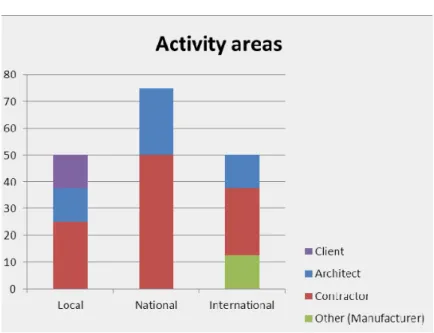
Our survey was carried out in small, medium and large‐sized companies. Figure 3 presents the percentage of people interviewed based on the size of the firm. It shows that 50% of our selected companies are large companies (more than 500 employees). Our choice of companies is also varied according to the geographic area of activities. Figure 4 presents the zones of activity of the selected companies, illustrating that the main activities are at the national level. However, the contractors and architects interviewed are involved in different projects at the regional, national and international levels.
Improving efficiency and productivity in the construction sector through the use of information technologies
26 © CEFRIO 2011, ALL RIGHTS RESERVED
Figure 4: Distribution of interviewed persons according to their activity areas, Canadian study
4.1
Comparison with the United States construction industry
This section will compare the results of our questionnaire with the McGraw‐Hill studies along twelve different parameters that address: current BIM experience; BIM implementation challenges and benefits; BIM training; and BIM value. The McGraw‐Hill research from 2008 was conducted through a survey of 82 architects, 101 engineers, 80 contractors, and 39 owners (total sample size of 302) between June 18 and August 8, 2008. The McGraw‐Hill research from 2009 was conducted through an Internet survey of industry professionals between May 28 and July 2, 2009. That survey had 2,228 complete responses. The “total” category displayed throughout the report includes 598 architects (27%), 326 engineers (15%), 817 contractors (37%), 118 owners (5%), 73 building product manufacturers (3%) and 296 other industry respondents, representing a compilation of the two McGraw‐Hill studies.
For each comparison of the twelve parameters, we will show figures from our data (these have a white background) alongside figures from the McGraw‐Hill studies (these have a light yellow background with headings outlined in blue).
a) Levels of the Current Use Of BIM Tools on Projects
Improving efficiency and productivity in the construction sector through the use of information technologies
Figure 5: Levels of the current use of BIM tools on projects, according to all Canadian respondents
Figure 6: Growth in BIM Use on Project between 2008‐2009 (McGraw‐Hill 2008)
In comparing our data with that of the McGraw‐Hill studies, we can see a significant difference in BIM use on projects between the U.S. and the Canadian samples.
b) Levels of the Current Use of BIM tools by the industry
Figure 7 is only indicative of the level of BIM use for our sample and its distribution is not representative of the industry.
However, the 2008 McGraw‐ Hill report shows a total of 72% heavy and very heavy BIM use in the U.S. industry. The study also indicates an expected rise, in 2009, in the number of light users, medium users and very heavy users (Figure 6).
Our data shows that the current experience of using BIM is still low). We observed that 75% of the professionals use BIM tools, 25% or less on their projects. 37% of these professionals use BIM tools less than 10% on their projects.
Improving efficiency and productivity in the construction sector through the use of information technologies
28 © CEFRIO 2011, ALL RIGHTS RESERVED
Figure 7: Levels of the current use of BIM‐tools by professionals (Canadian study)
Figure 8: Levels of use of BIM tools by professionals (McGraw‐Hill 2008)
To better understand this very large difference, we further analyzed the data to see if any of the factors were correlated. We found that the level of BIM use could be correlated to the activity areas – according to our sample, BIM use increases when a firm’s activities are more national or international than regional. In other words, the degree of BIM use can be related to the extent of the market share.
In contrast, the McGraw‐ Hill study (2008) showed that all professionals were “very heavy users” on a significant percentage of projects:
43% of the architects, 35% of the engineers, 23% of the contractors and 41% of the owners (Figure 8).
For our sample, only two respondents indicated that their level of BIM use was more than 25%. For one contractor, BIM use corresponded to 50% and for one of the architects the number was 100%.
Improving efficiency and productivity in the construction sector through the use of information technologies
c) BIM Use by Phases Compared with Perceived Value of BIM by Phases
The current level of BIM use is not only related to the degree of involvement in the project, but also to the project phases (Figure 9, Figure 10).
Figure 9: BIM use by phase according to all Canadian respondents
Figure 10: BIM use by Phase, according to their Involvement in the Project (Canadian study)
As shown in Figure 9, BIM tools are not currently employed in all project phases; they seem to be more used in the design phase, regardless of the speciality of the user (Figure 10).
According to 75% of users, the planning and construction phases rank as the next highest in BIM use, after designers). Considering these findings, the use of BIM, at these two phases, might interest contractors more than other users. Meanwhile, we can observe that architects and contractors are generally the users that are most concerned with using BIM, in all phases.
Improving efficiency and productivity in the construction sector through the use of information technologies
30 © CEFRIO 2011, ALL RIGHTS RESERVED
Figure 11: Perceived Value of BIM by Phase (McGraw‐Hill 2008)
When we compared our data to the data from McGraw‐Hill 2008, we also found that BIM is being used in phases that have more perceived value (design and construction/construction documents phases). However, our data shows that the design phase seems to be the most important phase, which could be because the general understanding, on the part of our participants, is that “BIM is primarily a modeling tool”.
d) The Use of BIM Analysis Tools
Our sample of BIM users seems to be aware of the potential use of BIM tools, but these tools are still under‐utilized. The following figures show tasks where BIM is employed, both from our study (Figure 12) and the McGraw‐Hill 2008 report (Figure 13), ranked by task importance.
Data from the 2008 McGraw‐ Hill report about the “perceived value of BIM by phases” (Figure 11), shows that the design and construction‐related phases have been perceived as having comparably very high value.
Improving efficiency and productivity in the construction sector through the use of information technologies
Figure 12: Use of BIM Analysis Tools (Canadian study)
Figure 13: Use of BIM Analysis Tools (McGraw Hill 2008)
Our questionnaire data indicates that quantity takeoff and conflict detection are the main uses of BIM analysis tools. Quantity takeoff is also the usage with the highest percentage in the 2008 McGraw‐Hill report. Conflict detection was not explicitly included in the McGraw‐Hill study, probably because it can also be classified as a modeling tool. The use of BIM for scheduling tasks is considered important in both studies. Estimating is not yet evaluated as a priority for our respondents, in comparison to the McGraw‐ Hill data, where it is considered as important as scheduling. The use of BIM analysis tools for energy analyzes, LEED or other Green Analyzes are also included in the McGraw Hill survey, with significant responses from participants, whereas, in our study, these uses did not rate highly with our respondents.
Improving efficiency and productivity in the construction sector through the use of information technologies
32 © CEFRIO 2011, ALL RIGHTS RESERVED
e) The Use of BIM Analysis Tools According to Project Involvement
We classified the evaluation of BIM analysis tools according to project involvement to determine which team member on the project is most likely to use BIM for different tasks (Figure 14).
Figure 14: BIM Analysis Tools according to project involvement (Canadian study)
Our data in Figure 14 shows that contractors benefit the most from the use of BIM analysis tools, and that they applied it for different tasks. Only one construction firm fully employed BIM, whereas. for other professionals. the use of BIM analysis tools is limited to some specific tasks, such as with architects who use BIM data for quantity takeoff, conflict detection, MEP coordination and scheduling.
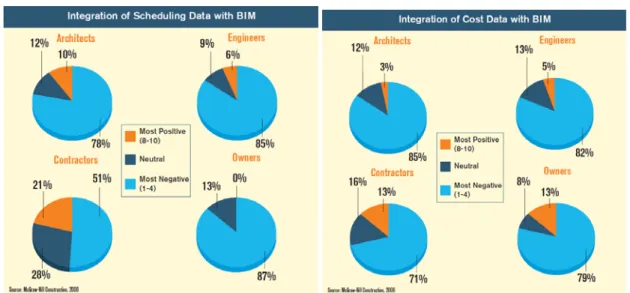
On the other hand, according to the McGraw‐Hill 2008 study, only one‐third of contractors use BIM data for tasks like quantity takeoff, scheduling and estimating. Half of the architects use energy analysis or other tools related to sustainability rating, and a large portion of owners use BIM data with project management software. Figure 15 shows the McGraw‐Hill data according to the use of BIM for integrating scheduling and cost data by different team members.
Improving efficiency and productivity in the construction sector through the use of information technologies
Figure 15: integration of scheduling and cost data with BIM (McGraw‐Hill 2008)
Our data also shows the contractors’ interest in, and use of BIM as quantity takeoff and scheduling tools, and to a similar degree as indicated by the McGraw Hill data. Even though the McGraw‐Hill 2008 report states that “Engineers (82%) and architects (85%) are least likely to use estimating in BIM”, our data shows that architects use quantity take‐off tools to support cost estimating, more than other BIM analysis tools. In contrast to the McGraw‐Hill data, the architects in our study did not report any use of energy analysis tools.
f) The Use of BIM Modeling Tools
To better understand the use of BIM in the selected companies, we asked the representatives to specify the main purpose of BIM use at their company, and which software they usually use. The responses showed that the main use of BIM is to create and analyze models, as reported by 62% of respondents. Among this 62%, all of the architects use BIM for that purpose, as well as 50% of the contractors. However, by crossing these results with preceding results concerning the use of BIM by phases and by tasks, we concluded that, until now, BIM has been used more for modelling than for analysis. 100% of respondents use BIM at the design phase and less than 37.5% use BIM for full analysis.
We also asked respondents to identify the software most used for BIM modeling; these results are shown in Figure 16.
Improving efficiency and productivity in the construction sector through the use of information technologies
34 © CEFRIO 2011, ALL RIGHTS RESERVED
Figure 16: Use of BIM Modeling Tools, Canadian respondents
Figure 17: Awareness of BIM‐Related Tools (McGraw‐Hill 2008)
Two arguments influence the choice of using Revit rather than other tools: 1) the software is less expensive than others, so the firm does not need to invest heavily in buying and updating the software, especially when the use of BIM tools is less than 10%. 2) The training for Revit is more available and less expensive, which facilitates involving employees in BIM. Navisworks is the second most popular because it helps in the integration of models and is used for conflict detection.
Both our data and the McGraw‐Hill Survey data (Figure 17) indicate Autodesk Revit and Autodesk Navisworks as the most commonly used BIM tools. According to our data, 100% of respondents use Revit, and 60% use Navisworks.
Improving efficiency and productivity in the construction sector through the use of information technologies
g) Obstacles to BIM Adoption
The implementation of every new technology faces different obstacles before full acceptance. The advantages provided by the new technology are the key to its full implementation. In our questionnaire, we asked respondents to evaluate the use of BIM, to identify factors that prevent the full use of BIM, to identify the barriers encountered, and to assess the impact of BIM implementation on projects (Figure 18).
Figure 18: Factors that limit the full use of BIM (Canadian study)
The factors that limit the full use of BIM vary among respondents, based on their experience. This is reflected in our data wherein the majority of respondents (50%) provided factors other than those proposed on the questionnaire. Among these “other” factors, they listed:
• “People need to understand this is a process and not technology. General awareness of what it can do
for you”;
• “Consultants are not up to speed yet”; • “Lack of information and trained employees”; • “Lack of internal resources”.
Figure 18 shows that the two factors that have the most influence on the full use of BIM are: (1) not enough demand for BIM from clients or others firms (37.5% of respondents) and (2) inexperienced users (25% of respondents).
Improving efficiency and productivity in the construction sector through the use of information technologies
36 © CEFRIO 2011, ALL RIGHTS RESERVED
Figure 19: Most Important Obstacles to BIM Adoption (McGraw‐Hill 2009)
The full use of BIM could be based on the maturity of the parties involved in a project: client and partners, and the maturity/experience of employees (BIM users). Thus, as one respondent said, it is a matter of awareness: “People need to understand that this is a process and not technology. General
awareness of what it can do for you”.
Since the major obstacle is a lack of client demand, the other obstacles to BIM adoption, according to our findings, were evaluated on a five‐level scale, from most important to least important (Figure 20).
Figure 20: Obstacles to BIM adoption (Canadian study)
In comparison with the McGraw‐ Hill 2009 data (Figure 19), we found that in both studies participants rated “Not enough demand from clients and/or other firms on projects” very highly. Lack of demand seems to be a very important obstacle to BIM adoption.
Improving efficiency and productivity in the construction sector through the use of information technologies
Financial resources appear to have an important impact on BIM adoption, especially when they are variable. Figure 20 shows that according to 57% of respondents (50% of whom are contractors), the ongoing cost of training and software are seen as posing very important challenges, followed by the initial cost of training. The initial cost of software does not seem to be an important hindrance to BIM adoption. However, the respondents’ evaluations of the disruption to implement new processes were divided between most important to important, so we should consider this factor as an important obstacle, in addition to the ongoing cost of software and training as well as the initial cost of staff training.
Figure 21: Challenges to BIM Adoption (McGraw‐Hill 2008)
The McGraw‐Hill 2008 data (Figure 21) indicates adequate training, buy‐in from management, costs associated with the software and hardware and lack of external incentives as the most important challenges to BIM adoption. Cost‐related obstacles and disruption to implement new processes are listed as important obstacles to BIM adoption in our data. As we can see, the industry faces similar concerns in BIM adoption in both countries.
h) BIM Benefits
The evaluation of BIM impact�