An Architecture embodies
those design decisions that influence a system’s quality attributes.1 Changes
to an architecture involve modifying a system’s gross topology as well as
its communication and coordination mechanisms. Therefore, any defects in an architecture (such as lack of de sirable security, latency, or scalability) can necessitate enormous rework. An
overly flexible architecture can lead to unnecessary work or overproduction. The time required to create such an ar chitecture can also delay downstream activities.
Each software development para digm treats architecture with a different focus. Phasebased software develop ment methodologies, such as waterfall or Rational Unified Process allocate dedicated time and focus to differ ent development activities, conducting them mostly in order (for example, re quirements, analysis, architecture, de velopment, and testing).2 Dedicating
large chunks of time to architecture up front might not only delay downstream activities but could also easily lead to overproduction waste, where the effort spent might not pay off.3
Iterationbased agile development methodologies, such as Scrum, work with predetermined two to four week sprints, each focused on feature based, highpriority tasks.4 When
there’s no upfront effort on architect ing, developers must periodically con duct refactoring for necessary changes to accommodate new features. As the system grows, conditions will neces sitate rearchitecting, which might re quire significant rework beyond the expected limits of refactoring. Sprint 0 aims to overcome this problem.5 Al
locating architectural tasks to a sprint backlog, to allow architecture and fea ture development to progress in con cert, has also been an increasingly rec ognized practice.6
Although architecture in itself is im portant, prolonging the architectural work needed to support development can impede progress. A significant challenge is to determine what size increment of an architecture is best for a given iteration to manage the
Making
Architecture
Visible to Improve
Flow Management
in Lean Software
Development
Robert L. Nord and Ipek Ozkaya, Carnegie Mellon University Raghvinder S. Sangwan, Pennsylvania State University
//
Release plans that give as much emphasis to
architecturally significant tasks as to feature-based,
high-priority functionality can achieve better outcomes by
avoiding conditions that lead to wasted time and effort.
//
FOCUS:
Lean Software DeveLopment
development flow. In this article, we show how the flow management con cept from lean software development can provide a framework for balancing the allocation of critical architectural tasks to development effort.
release Planning:
msLite case study
MSLite is a hardwarebased field sys tem that automatically monitors and controls a building’s internal func tions, such as heating, ventilation, air conditioning, access, and safety.7
During its first year, the MSLite project used an objectoriented anal ysis and design methodology. It
captured requirements as use cases, which it grouped into functionally co hesive packages. It then distributed use case packages among different teams for development. Because the use cases weren’t fully elaborated, the team didn’t yet fully understand dependen cies among the different use case pack ages. So, as the design emerged, so did new dependencies across packages, which created ad hoc communication streams among the different teams. Much to their chagrin, the teams found themselves in situations where they had to either wait for some yettobe completed work by another team or perform duplicate work. Such
interdependencies created conflicting solutions for crosscutting concerns, such as dealing with variability in building automation devices and han dling latency issues associated with the transporting events that such devices generated. As the design evolved and the teams continued to discover inter dependencies, managing the workflow became so challenging that the project was stopped midyear.
In the second year, the proj ect was undertaken from scratch, using architecturecentric meth ods.8 Building on use cases from
the previous year, the project team made explicit the systemic quality
tab
L
e
a
Architecture-related waste.
Waste category Relevance to software architecture
Overproduction Overproduction waste occurs when an excess of goods is produced. In software development, this can result from implementing low-priority or nice-to-have requirements, or creating an architecture for such requirements or for unforeseen futures without a sound basis. Delay Delay waste refers to the period of inactivity downstream in the
process that occurs because an upstream activity doesn’t deliver on time. This type of waste occurs when an organization aims to collect all architecturally significant requirements and plans to architect for them, or aims to build utmost flexibility into the system, leading to overanalysis and prolonged time spent designing the architecture. Defect Defect waste occurs when the delivered software doesn’t meet
the expected quality. Defects related to architecture can result in paramount rework when rearchitecting is needed.
LeAn deveLoPment in mAnufActuring
Much of the lean thinking in software development can be tracedback to Toyota’s manufacturing approach. However, there are some obvious differences between a manufacturing environment, with its focus on repetitive delivery of identical parts and prod-ucts, and the software development environment, in which varia-tion is necessary to create value for end users. Manufactured products have obvious phase gates, marked by the handoff of engineering drawings to production. Software development, how-ever, is an iterative process where design is an ongoing activity throughout the development life cycle; the demarcation between design and production activities is
much less distinct. Despite these dif-ferences, the focus of lean thinking on eliminating waste has shown great potential for improving software de-velopment project management.1
Software architecture has a par-ticularly strong influence on some of the waste categories from lean man-ufacturing (see Table A),2 but its cur-rent practice offers little explicit guid-ance in lean software development.
The three types of waste dis-cussed in Table A are closely related. Overproduction of architecture can create delay. Not enough production
of architecture can result in patched solutions leading to defects. Fixing these defects would lead to delay. Together, they all lead to wasted time and effort.
references
1. P. Middleton and D. Joyce, “Lean Software Management: BBC Worldwide Case Study,” IEEE Trans. Eng. Management, vol. 59, no. 1, 2012, pp. 20–32.
2. M. Poppendieck and T. Poppendieck, Implementing Lean Software Devel-opment: From Concept to Cash, Addison-Wesley, 2006.
MSLite system’s different elements before distributing these elements for development. Thus, the architec ture became a mechanism for coor dinating tasks among the different teams, resulting in a significantly improved workflow.
Our Experience
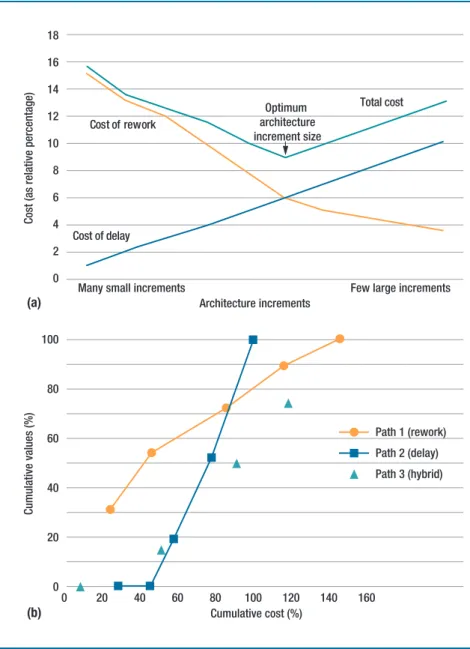
Being familiar with the MSLite proj ect, we were motivated to use lean software development’s flow manage ment concept (for more information, see the “Lean Development in Man ufacturing” sidebar) as a framework for understanding how to balance the allocation of critical architectural tasks to a development effort. Figure 1a shows our adaptation of Don Rein ertson’s visualization of optimum batch size to demonstrate the effect of architecturerelated overproduction, delay, and defect waste on the overall project, and how the size of architec ture increments affects the costs as sociated with waste.9 To demonstrate
the batch size, Figure 1b shows how we tested our adaptation by looking at the amount of cumulative cost—or the running sum of the cost incurred (both implementation and rework) up to a given release—spent on architect ing for MSLite data.
As Figure 1a illustrates, architect ing in many smaller increments re duces the cost of delay that results from waiting for an entire architec ture to be completed. However, re work is more costly, because it might involve rearchitecting. Having fewer large increments reduces the cost of rework, but at the expense of adding to the cost of delay for the larger ar chitecture increment to be completed.
Delay costs are incurred because of waiting or delay waste. Rework costs are incurred because of defect waste as well as overproduction waste.
During its second year, the MSLite development path fell somewhere in the middle of the total cost curve. In trying to understand and improve the process (architecture and increment
size), we modeled the delay and re work costs for this path in terms of the value of capabilities delivered over the total effort. To model the cost for the path, we looked at the MSLite project’s development plan, the software architecture’s module view, and its code (the DLLs).
Cumulative value is a running Many small increments Few large increments
(a) Cost of delay Architecture increments increment size 10 8 6 4 2 0
Cost (as relative percentage)
(b) Cumulative cost (%) 100 80 60 40 20 0 Cumulative values (%) 0 20 40 60 80 100 120 140 160 Path 1 (rework) Path 2 (delay) Path 3 (hybrid)
figure 1. How waste affects product development flow. (a) Costs associated with architecture-related waste. (b) The MSLite system’s influence on cost of rework. The cumulative cost of the system independent of rework is depicted as 100 percent cost on the
FOCUS:
Lean Software DeveLopment
sum of the value of delivered capa bilities (all the user stories and archi tecturally significant acceptance test cases) up to a given release. Figure 1b depicts this on the yaxis. The pace with which value is delivered in each release is indicative of the cost of de lay. For instance, there is a high cost of delay early on in the first release of the MSLite development path, path 3, where no value is delivered.
Flow Management
To see the influence of architecture on cost, we adapted path 3 using two strategies of development (modeled as paths 1 and 2 in Figure 1b) to realize the MSLite system’s requirements. Path 1 demonstrates releaseplanning strat egies focused on delaycost avoidance, and path 2 demonstrates reworkcost avoidance. These strategies represent the two extremes for decisions in itera tion planning.
Avoiding delay cost. Path 1 reduces the cost of delay at the expense of re work, focusing on small architecture increments. This path uses the pri ority of stories and acceptance test cases to guide the work (referred to
as enhancement agility10). Using an
agile approach with many short itera tions delivering small increments keeps the delay cost low because there’s little waiting. However, architectural issues aren’t visible to the end user and are likely to be initially missed or ignored, resulting in a high rework cost later on, when they can no longer be avoided. Therefore, the total cost is quite high.
Figure 1b shows this. Path 1 starts out with a high throughput (a ratio of work in process [WIP] and cycle time11) during the first two releases,
then delivery tapers off as subsequent releases take longer. The WIP limits are fixed at three stories or acceptance test cases. The drag on throughput is an indication of high rework costs to deal with the growing complexity of dependencies. This shows the effect of small architectural increments (which Figure 1a also demonstrates toward the extreme left of the total cost curve); small architectural increments create rework waste. Path 1 in Figure 1b is typical of efforts where waste elimi nation and shortterm value delivery aren’t balanced by consideration of the longerterm effects of the project’s re work cost.
Avoiding rework cost. Path 2 reduces rework at the expense of delay cost. It focuses on a few large architecture in crements, using rework cost as a guide. Using a phasebased approach and carefully considering architectural de pendencies can minimize or eliminate rework cost but at the expense of delay ing activities downstream while the ar chitecture is put in place. The total cost is therefore high.
Figure 1b demonstrates this, where path 2 starts out with low throughput of enduser value early on, owing to the delay cost while the team focuses on putting the architecture in place. Figure 1a also shows the effect of large archi tecteral increments toward the extreme right of the total cost curve.
Once the architecture is in place, throughput does improve as the team settles into a rhythm of releasing high value capabilities at regular intervals. The WIP limits change, however, be cause later releases must deal with an overloaded allocation of stories with the assumption that the architecture is ready. Although this might appear to achieve high throughput—a higher number of stories yields higher value for the release—it’s already on release
tab
L
e 1
Flow management in delay- and rework-focused release-planning strategies.
Path 1: Use delay avoidance to plan the release Path 2: Use rework avoidance to plan the release Throughput Starts out fast and then slows, owing to high cost ofrework Starts out slow while putting infrastructure in place and then increases as new stories are rapidly released
Work in process
(WIP) Highest-priority stories and acceptance test cases; stories prioritized by business value without consideration of architecturally significant risk
Architectural elements that minimize dependencies, prioritized by dependencies without business value consideration
Cycle time or waste
High rework cost due to rearchitecting, because focus is on stories initially without considering architecturally significant acceptance test cases (representing quality requirements); leads to defects and high rework
Low cost of rework because quality and architecture support are initially considered
Low cost of delay because architecturally significant
requirements aren’t initially considered High cost of delay owing to up-front architecting; high-priority stories are delayed in favor of infrastructure
Advice on how
to improve flow Reduce cost of rework by expanding focus on stories, defects, and refactoring to include acceptance test cases,
architectural technical debt, and rearchitecting
Reduce cost of delay by leveraging smaller architecture increments
5, and there’s an added complexity of having to deal with the maximum throughput in the final release.
A comparison. Although we constructed paths 1 and 2, they’re grounded in the actual system’s building blocks (re quirements and architectural elements) and can be seen as variations of path 3. We wanted to see how the architecture centric development path of MSLite would compare to these paths and pro vide insights for the best strategy for al locating architectural tasks to a devel opment effort. Table 1 compares these two extreme iterationbased agile and phasebased approaches on the basis of how they treat lean principles.
recommendations
for Practitioners
There’s no onesizefitsall approach for achieving maximum throughput value with minimal resource costs.
Focusing on flow management to analyze different approaches, how ever, can provide insight into how to improve management for both cycle time and WIP. One such insight in volves improving the visibility of ar chitecturerelated aspects of a devel opment project, as we demonstrated with the MSLite case study model ing different strategies for decision making in iteration planning. Balanc ing the two opposing forces of delay cost and reworkcost minimization will result in an improved outcome, as shown by the actual development path of the MSLite system.
The phase or iterationbased ap proaches to software development typi cally don’t provide tools to visualize ar chitecture’s role in managing developed features’ throughput. Therefore, we de signed a Kanban board to elevate the criticality of the architecture and show how it supports or inhibits throughput.
Kanban is a scheduling system that helps justintime delivery by empha sizing pulling work items from process queues with work limits.12
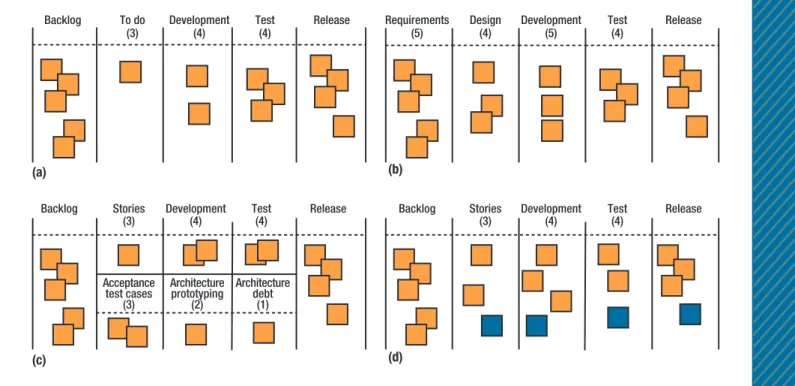
Typical Kanban boards focus on feature, story, or tasklevel allocation of WIP limits—these limits are the numbers in the columns in Figure 2, mimicking the agile development con text as shown in Figure 2a. Kanban is also used to support a phasedbased approach where the WIP limits are or ganized according to an order of de sign, development, and test (see Figure 2b).
Our Kanban board design high lights architecturerelated aspects to include infrastructure development, which is a critical aspect of improv ing throughput. There could be differ ent versions of such a board involving parallel horizontal swim lanes or color coding, as demonstrated in Figures 2c and 2d, respectively.
(a) (b)
(c) (d)
Backlog Stories
(3) Development(4) Test(4) Release
Acceptance test cases (3) Architecture prototyping (2) Architecture debt (1) Backlog Stories
(3) Development(4) Test(4) Release
figure 2. Different designs of our Kanban board for software development. (a) An agile-development-focused board. (b) A phase-based board. (c) Visualizing architecture with parallel horizontal swim lanes. (d) Visualizing architecture with color coding; architecture-related tasks are highlighted in blue.
FOCUS:
Lean Software DeveLopment
next issue:
technical
debt
A parallel swim lane for architec turerelated tasks helped us achieve architecture development in concert with feature development to improve throughput, mainly by enforcing WIP limits on activities such as eliciting architecturefocused acceptance test cases, architecture prototyping, or re work to pay back architecture debt.
Enforcing technical debt WIP lim its increases the visibility of rearchi tecting for quality and also ensures that finding and fixing defects don’t come at the expense of overall sys tem quality. Similarly, both architec tural prototyping and pulling through architecturally significant require ments (captured as acceptance test cases) should be in balance with story development.
o
ur experience in experimenting with different release plans demonstrates how lean software development has the poten tial to merge architecturally significant tasks with featurebased highpriority functionality development, unlike ag ile software development methodolo gies, where sprints can create artificial boundaries and story slicing becomes increasingly challenging. By visualizing architecturerelated tasks that contrib ute to feature throughput, including tasks that span multiple sprints, teams can achieve an effective flowbased de velopment environment.
The following actions should be kept central to the development ef fort: first, capturing architecturally significant requirements as accep tance test cases enables them to be more easily visible on a backlog or a Kanban board. In a lean environ ment, enforcing WIP limits on these acceptance test cases assists with im proving flow by managing the over production waste associated with overarchitecting. Second, when deter mining story priorities, considering the dependency of the stories on ar chitecturally significant tasks enables the pulling of related stories earlier in development and assists with flow. Fi nally, in addition to monitoring story development, monitoring the chang ing quality of the system via its ar chitecture, possibly captured as tech nical debt or reworkrelated defects, enables a response to the cost associ ated with reworkrelated waste.
Acknowledgments
This material is based on work funded and supported by the Department of Defense under contract number FA872105C0003 with Carnegie Mellon University for the op eration of the Software Engineering Insti tute, a federally funded research and devel opment center.
Carnegie Mellon University makes no warranties of any kind, either expressed or
robert L. nord is a senior member of the technical staff in the Research, Technology, and System Solutions Program at the Software Engineering Institute of Carnegie Mellon University. His research inter-ests include effective methods and practices for software architecture. Nord has a PhD in computer science from Carnegie Mellon University. He is a distinguished member of ACM. Contact him at [email protected].
iPek ozkAyA is a senior member of the technical staff in the Research, Technology, and System Solutions Program at the Software Engineering Institute of Carnegie Mellon University. Her research in-terests include empirical methods for improving software development efficiency and system evolution with a focus on software architecture practices, software economics, and requirements management. Ozkaya has a PhD in computational design from Carnegie Mellon University. She serves on the advisory board of IEEE Software. Contact her at [email protected].
rAghvinder s. sAngwAn is an associate professor of software engineering at Pennsylvania State University. His research interests include analysis, design, and development of software systems, their architecture, and automatic and semiautomatic approaches to assess-ment of their design and code quality. Sangwan has a PhD in computer and information sciences from Temple University. He’s a senior member of IEEE and ACM. Contact him at [email protected].
a
b
o
u
t t
h
e
a
u
t
hor
S
cept as restricted by copyright. The Govern ment of the United States has a royaltyfree governmentpurpose license to use, duplicate, or disclose the work, in whole or in part and in any manner, and to have or permit others to do so, for government purposes pursuant to the copyright license under the clause at 252.2277013 and 252.2277013 Alternate I.
references
1. L. Bass, P. Clements, and R. Kazman,
Software Architecture in Practice, 3rd ed.,
AddisonWesley, 2012.
5. D. Leffingwell, Scaling Software Agility:
Best Practices for Large Enterprises, Pearson
Education, 2007.
6. J. Madison, “Agile Architecture Interactions,”
IEEE Software, vol. 27, no. 2, 2010, pp.
41–48.
7. R. Sangwan et al., Global Software
Develop-ment Handbook, Auerbach Publishers, 2006.
8. R. Sangwan et al., “Integrating Software ArchitectureCentric Methods into Object Oriented Analysis and Design,” J. Systems and
Software, vol. 81, no. 5, 2008, pp. 727–746.
9. D. Reinertsen, The Principles of Product
De-velopment Flow, Celeritas Publishing, 2009.
10. N. Brown, R. Nord, and I. Ozkaya, “Enabling Agility through Architecture,” Crosstalk,
PURPOSE: The IEEE Computer Society is the world’s largest
association of computing professionals and is the leading provider of technical information in the field.
MEMBERSHIP: Members receive the monthly magazine Computer,
discounts, and opportunities to serve (all activities are led by volunteer members). Membership is open to all IEEE members, affiliate society members, and others interested in the computer field.
COMPUTER SOCIETY WEBSITE: www.computer.org
Next Board Meeting: 5–6 Nov., New Brunswick, NJ, USA
EXECUTIVE COMMITTEE President: John W. Walz*
President-Elect: David Alan Grier;* Past President: Sorel Reisman;* VP, Standards Activities: Charlene (Chuck) Walrad;† Secretary: Andre Ivanov (2nd VP);* VP, Educational Activities: Elizabeth L. Burd;* VP, Member & Geographic Activities: Sattupathuv Sankaran;† VP, Publications: Tom M. Conte (1st VP);* VP, Professional Activities: Paul K. Joannou;* VP, Technical & Conference Activities: Paul R. Croll;† Treasurer: James W. Moore, CSDP;* 2011–2012 IEEE Division VIII Director: Susan K. (Kathy) Land,CSDP;† 2012– 2013 IEEE Division V Director: James W. Moore, CSDP;† 2012 IEEE Division Director VIII Director-Elect: Roger U. Fujii†
*voting member of the Board of Governors †nonvoting member of the Board of Governors
BOARD OF GOVERNORS
Term Expiring 2012: Elizabeth L. Burd, Thomas M. Conte, Frank E. Ferrante, Jean-Luc Gaudiot, Paul K. Joannou, Luis Kun, James W. Moore, William (Bill) Pitts
Term Expiring 2013: Pierre Bourque, Dennis J. Frailey, Atsuhiro Goto, André Ivanov, Dejan S. Milojicic, Paolo Montuschi, Jane Chu Prey, Charlene (Chuck) Walrad
EXECUTIVE STAFF
Executive Director: Angela R. Burgess; Associate Executive Director, Director, Governance: Anne Marie Kelly; Director, Finance & Accounting: John Miller; Director, Information Technology & Services: Ray Kahn; Director, Membership Development: Violet S. Doan; Director, Products & Services: Evan Butterfield; Director, Sales & Marketing: Chris Jensen COMPUTER SOCIETY OFFICES
Washington, D.C.: 2001 L St., Ste. 700, Washington, D.C. 20036-4928 Phone: +1 202 371 0101 • Fax: +1 202 728 9614
Email: [email protected]
Los Alamitos: 10662 Los Vaqueros Circle, Los Alamitos, CA 90720-1314 Phone: +1 714 821 8380 • Email: [email protected]
MEMBERSHIP & PUBLICATION ORDERS
Phone: +1 800 272 6657 • Fax: +1 714 821 4641 • Email: [email protected] Asia/Pacific: Watanabe Building, 1-4-2 Minami-Aoyama, Minato-ku, Tokyo 107-0062, Japan
Phone: +81 3 3408 3118 • Fax: +81 3 3408 3553 Email: [email protected]
IEEE OFFICERS
President: Gordon W. Day; President-Elect: Peter W. Staecker; Past President: Moshe Kam; Secretary: Celia L. Desmond; Treasurer: Harold L. Flescher; President, Standards Association Board of Governors: Steven M. Mills; VP, Educational Activities: Michael R. Lightner; VP, Membership & Geographic Activities: Howard E. Michel; VP, Publication Services & Products: David A. Hodges; VP, Technical Activities: Frederick C. Mintzer; IEEE Division V Director: James W. Moore, CSDP; IEEE Division VIII Director: Susan K. (Kathy) Land, CSDP; IEEE Division VIII Director-Elect: Roger U. Fujii; President, IEEE-USA: James M. Howard
revised 22 May 2012
Selected CS articles and columns are also available for free at http://ComputingNow.computer.org.
![Figure 1b shows this. Path 1 starts out with a high throughput (a ratio of work in process [WIP] and cycle time 11 ) during the first two releases, then delivery tapers off as subsequent releases take longer](https://thumb-us.123doks.com/thumbv2/123dok_us/1807252.2759767/4.850.68.789.197.496/figure-starts-throughput-process-releases-delivery-subsequent-releases.webp)