721 | P a g e
HOW ABOUT EATING THE NEIGHBOUR?
Havlová L., Hula V., Niedobová J.
Department of Zoology, Fisheries, Hydrobiology and Apiculture, Faculty of Agronomy,
Mendel University in Brno, Zemedelska 1, 613 00 Brno, Czech Republic
E-mail: [email protected], [email protected]
ABSTRACT
Aim of this study was to focus on impacts which are affecting our synanthropic araneofauna and invading Pholcus phalangioides (Fuesslin, 1775) which is spreading noticeably in recent time. Important sources of data for this study came from observations of interspecific behaviour of
Pholcus phalangioides with our native species, specifically: Achaearanea tepidariorum (C. L. Koch, 1841), Steatoda bipunctata (Linnaeus, 1758), Steatoda castanea (Clerck, 1757), Steatoda triangulosa (Walckenaer, 1802), Tegenaria sp. (Latreille, 1804). These observations were conducted continuously during few months due to collecting and breeding necessity. Results, final summary, of this work, illustrates the current and possible future way of our synanthropic araneofauna evolution.
MENDELNET 2013
722 | P a g e
INTRODUCTION
Terms such as invasion or invasive species are widely known today and botanical and zoological invasions are the field of research of many scientists (ČSOP 2013; ČAS 2013; DAISIE 2013; Marková Z., Hejda M. 2011; Matějček T. 2005; MŽP 2012; Richardson R. R., Pyšek P. 2006, Australian Government 2013). Invasive species are very important problem in global field, so IUCN instituted Invasive Species Specialist Group for reducing threats to natural ecosystems and the native species (IUCN 2013). Invasive species with the greatest impact are the best studied, but information for understanding the mechanisms of successful invasion are needed (Pyšek P. et al.
2008).
The aim of this study was to find out the impact of invasive synanthropic spider species Pholcus phalangoides (Fuesslin, 1775) (Platnick N. I. 2013)on original synanthropic spider fauna and prediction for the future time. Pholcus phalangioides has assumptions to prefer another species of synanthropic spiders as easy prey. Main advantages of Pholcus phalangoides are aggressive mimicry (particularly whirl) (Jackson R. R. 1989) which regularly being used and constitution of body - long legs making other spider's attacks on its body difficult and ability to lose any limb to allow quick escape in case of failure or being under attack (Jackson R. R. et al., 1990).
Pholcus phalangioides is not original in our area. Its population, however, spreads quickly and resisting winter due to its synanthropic occurrence, described also by Buchar and Kůrka (2001). The findings of the behaviour and interspecies interaction describe species Pholcus phalangioides
as an aggressive predator (Jackson R. R., Brassington R. 1987). It focuses mainly on other species of spiders. So it is can be a real threat to our araneofauna.
For this purposes following spider species were selected: Achaearanea tepidariorum (C. L. Koch, 1841), Steatoda bipunctata (Linnaeus, 1758), Steatoda castanea (Clerck, 1757), Steatoda triangulosa (Walckenaer, 1802), Tegenaria sp. (Latreille, 1804) and invasive Pholcus phalangoides. Interactions between our synanthropic araneofauna and invasive species were conducted subsequently.
MATERIAL AND METHODS
Collecting of our synanthropic spiders and invasive spider (P. phalangioides) was realized in May and June 2012. Collecting localities were: Hlinsko, Rváčov, Moutnice, Hranice na Moravě and Pohořelice. There were collected 202individuals of spiders. Collected spiders were kept in plastic boxes of lenght-width-height: 13 x 11 x 6 cm and also in plastic cylindrical boxes (diameter: 5 cm, height: 10 cm). Spiders were breaded until maturity, then interactions between invasive and our synanthropic species started in laboratory conditions. Eighty six observations were carried out and analysed. Experiments consisted of observations of interactions between invasive Pholcus phalangioides and our synanthropic species – two of them were put into one box. The experiment mostly finished with the death of one of them. The number of winners and those spiders which were hunted was recorded. There were also observations of any reactions.
Analyses used for evaluation of findings, within this study, were processed using statistic software "R" and steps after Pekár and Brabec (2009).
RESULT AND DISCUSSION
Evaluation of results is primarily focused on behaviour of invasive species' predators and their impact on origin synanthropic araneofauna.
723 | P a g e of prey and their age (=size) affects the frequency of Pholcus phalangoides hunting.
The second analysis showed that particular species of our synanthropic spiders are irrelevant, it means that the most important is age (size) of prey spider.
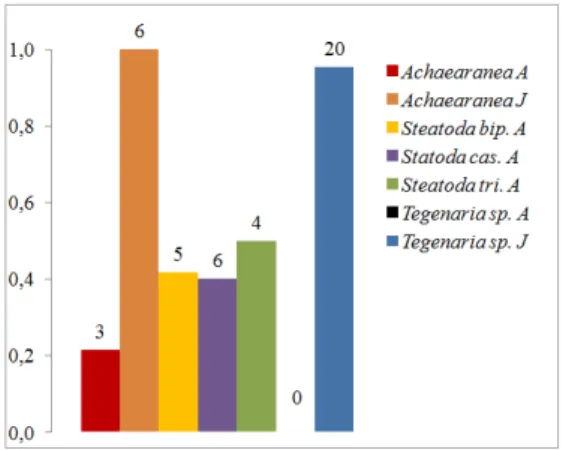
Final result of a model without interaction is shown on graph below.
Fig. 1 Influence of prey stages and species on frequency of hunt of Pholcus phalangioides. Result of GLM analyses
This graph shows importance of stage of age (size) of origin spider during Pholcus phalangioides
hunting. Numbers above columns marks numbers of attacks on particular our synanthropic spider species. Letter "A" indicates adults, letter "J" juveniles.
Much more successful attacks were recorded against juvenile individuals. These findings show, that size of potential pray is the most important factor. For example, success rate of attacks on juvenile individuals of Achaearanea tepidariorum was 100%, attacks on adults of same species was 21% only.
During the observation, no successful attack was led against adults Tegenaria sp. But juvenile of
Tegenaria sp. were hunted by Pholcus phalangoides in 95% (20 successful attacks).
CONCLUSIONS
Invasive predatory spider species Pholcus phalangioides expanded to Czech households during last 20 years. Its position in our origin synanthropic araneofauna becomes stronger. On the base of our experiments we gained the strong evidence of its aggressively and menace to Czech synanthropic araneofauna. It was proved that Pholcus phalangoides hunt especially on juvenile of synanthropic spider species. In households, it is able to assault foreign nets.
Younger development stages resist with difficulty and become prays more often, which leads us to obvious influence on populations into which Pholcus phalangioides invades.
MENDELNET 2013
724 | P a g e
Fig. 2 Side view at box with hunting Pholcus phalangioides
ACKNOWLEDGMENTS
Many thanks to Mgr. Eva Líznarová and to team project: IGA TP6/2013 “Diverzita, dynamika a ochrana antrogenně podmíněných habitatů – možnosti zpomalení ústupu biodiverzity při zachování produkčních i mimoprodukčních funkcí krajiny”
REFERENCES
AUSTRALIAN GOVERNMENT, 2013: Department of Sustainability, Environment, Water, Population and Communities. Invasive species. Database online [2013-01-15]. Available at: <http://www.environment.gov.au/biodiversity/invasive/index.html>
BUCHAR, J. a KŮRKA, A., 2001: Naši pavouci. 1. vyd. Praha: Academia, 162 s. ISBN 80-200-0964-7
ČESKÁ ARACHNOLOGICKÁ SPOLEČNOST, 2013: Česká arachnologická společnost. Database online [2013-02-12]. Available at: < http://arachnology.cz/cas/?l=cz&m=ho&c=intro> ČESKÝ SVAZ OCHRÁNCŮ PŘÍRODY, 2013: Ochrana druhů. Database online [2013-01-16]. Available at: < http://www.csop.cz/index.php?cis_menu=1&m1_id=1002&m_id_old=1000> DAISIE, 2013: Delivering Alien Invasive Species Inventories for Europe. Database online [2013-01-15]. Available at: <http://www.europe-aliens.org/default.do>
JACKSON, R. R., 1989: Predator-prey interactions between jumping spiders (Araneae, Salticidae) and Pholcus phalangioides (Araneae, Pholcidae). The Journal of zoology, 220: 553 – 559. ISSN 1469-7998
JACKSON, R. R. and BRASSINGTON, R., 1987: The biology of Pholcus phalangoides (Araneae, Pholcidae): predatory versatility, araneophagy and aggressive mimicry. The Journal of zoology
211: 227 – 238. ISSN 1469-7998
IUCN, 2013: International Union for Conservation of Nature. Database online [2013-10-02] JACKSON, R. R., BRASSINGTON, R. and ROWE, R. J., 1990: Anti-predator defences of Pholcus phalangoides (Araneae, Pholcidae), a web-building and web-invading spider. The Journal of zoology 220: 543 – 552. ISSN 1469-7998
725 | P a g e MARKOVÁ, Z. a HEJDA, M., 2011: Invaze nepůvodních druhů rostlin jako environmentální
problém. Živa,1: 10 – 14. ISSN 0044-4812.
MATĚJČEK, T., 2005: Invazní druhy jako příčina změn v krajině. Listy českého zeměpisného sdružení 2: 1 – 4. ISSN 1214-0848.
MINISTERSTVO ŽIVOTNÍHO PROSTŘEDÍ, 2012: Invazní druhy. Database online [2012-10-28]. Available at: < http://www.mzp.cz/cz/invazni_druhy>
PLATNICK, N. I., 2013: World spider catalog, version 13,5. Database online [2013-02-12]. Available at: <http://research.amnh.org/iz/spiders/catalog/INTRO1.html>
PYŠEK, P. et al., 2008: Geographical and taxonomic biases in invasion ecology. Trends in Ecology and Evolution 23: 237 – 244. ISSN 0169-5347
RICHARDSON, D. M. a PYŠEK, P., 2006: Plant invasions: meaning the concepts of species invasiveness and community invasibility. Progress in Physical Geography 30: 409 – 431. ISSN 0309-1333