Vol. 4, Nos. 3–4 (2010) 187–347 c
2011 S. Androutsellis-Theotokis, D. Spinellis, M. Kechagia and G. Gousios
DOI: 10.1561/0200000026
Open Source Software:
A Survey from 10,000 Feet
By Stephanos Androutsellis-Theotokis,
Diomidis Spinellis, Maria Kechagia
and Georgios Gousios
Contents
1 Introduction 189
1.1 Open Source Software and Other Types
of Software Distribution 191
1.2 Research, Related Disciplines, and Publications 193
1.3 Organization of this Paper 195
2 History and Evolution 197
2.1 The Early Years 197
2.2 Unbundling of Software from Hardware 200
2.3 The Early Years of Unix 201
2.4 Workstations, Networking, and the Hacker Culture 202
2.5 Notable Events in OSS History 202
2.6 OSS Meets Proprietary Software 205
2.7 OSS Becomes Mainstream 205
2.8 Mainstream OSS Applications 208
3 Projects 209
3.2 Project Success 212 3.3 Representative Examples 216 4 Communities 218 4.1 Actors 218 4.2 Leadership 222 4.3 Governance Processes 224
4.4 Coordination Challenges and Mechanisms 228
4.5 Evolution 231
5 Production Process 234
5.1 Modular Development Methodology 235
5.2 Requirements Definition 238
5.3 Incorporation of New Features 239
5.4 Code Integration 239
5.5 Release Management 241
5.6 Technical Infrastructure and Collaboration Facilities 244 5.7 Assessing Open Source Software Projects 247
5.8 Concerns 248
6 Licensing 250
6.1 Concepts and Definitions 251
6.2 Open Source Software Movements 253
6.3 License Types 254
6.4 License Selection 259
6.5 Concerns and Risks 261
7 Business Models 264
7.1 Strategic Advantages and Impact of Moving tooss 265
7.2 Prerequisites, Deciding Factors and Concerns 268 7.3 The Open Source Software Ecosystem 270
8.1 Adoption vs. Reuse 277
8.2 Criteria for Reuse 279
8.3 Adoption Drivers 280
8.4 Concerns 284
8.5 Software Reuse Process 287
9 Motivation 290
9.1 Motivational Aspects for Individuals 293 9.2 Motivational Aspects for Businesses 297
10 Impact and Outlook 300
10.1 Impact on the Software Industry 300
10.2 Impact on Society 302
10.3 Tackling Global Challenges 307
10.4 Concerns, Research, and Outlook 308
Acknowledgments 316
A Representative Applications 317
A.1 Systems Applications 317
A.2 Dekstop 321
A.3 Entertainment 322
A.4 Graphics 323
A.5 Education 324
A.6 Scientific and Engineering 324
A.7 Publishing 325
A.8 Software Development 325
A.9 Content Management Systems 329
A.10 Business Applications 329
Foundations and TrendsR in
Technology, Information and Operations Management Vol. 4, Nos. 3–4 (2010) 187–347
c
2011 S. Androutsellis-Theotokis, D. Spinellis, M. Kechagia and G. Gousios
DOI: 10.1561/0200000026
Open Source Software:
A Survey from 10,000 Feet
Stephanos Androutsellis-Theotokis
1,
Diomidis Spinellis
2, Maria Kechagia
3and Georgios Gousios
41 Department of Management Science and Technology, Athens University of
Economics and Business, Patision 76, Athens, GR-104 34, Greece, [email protected]
2 Department of Management Science and Technology, Athens University of
Economics and Business, Patision 76, Athens, GR-104 34, Greece, [email protected]
3 Department of Management Science and Technology, Athens University of
Economics and Business, Patision 76, Athens, GR-104 34, Greece, [email protected]
4 Department of Management Science and Technology, Athens University of
Economics and Business, Patision 76, Athens, GR-104 34, Greece, [email protected]
Abstract
Open source software (oss), the origins of which can be traced back to
the 1950s, is software distributed with a license that allows access to its source code, free redistribution, the creation of derived works, and unre-stricted use.ossapplications cover most areas of consumer and business
software and their study touches many disciplines, including computer science, information systems, economics, psychology, and law. Behind
developers to passive users, held together by a flexible governance struc-ture and membership, leadership and contribution policies that align their interests. The motivation behind individuals participating inoss
projects can be, among others, social, ideological, hedonistic, or signal-ing, while companies gain from their access to high-quality, innovative projects and an increase in their reputation and visibility. Nowadays many business models rely onossas a product through the provision of
associated services, or in coexistence with proprietary software, hard-ware, services, or licensing. The numerousosslicenses mainly differ on
how they treat derived software: some contain provisions that maintain its availability in open source form while others allow more flexibility. Through its widespread adoption, oss is affecting the software
indus-try, science, engineering, research, teaching, the developing countries, and the society at large through its ability to democratize technology and innovation.
1
Introduction
Open Source Software (oss) is software distributed with a license
allow-ing access to its source code, free redistribution, the creation of derived works, and unrestricted use. The history of open source software can be traced back to the 1950sshareuser group, the academic distribution
of Unix, and thegnuproject.
Open source applications cover most areas of consumer and business software. Prominent application areas include systems infrastructures like operating systems and databases, software development, personal productivity, desktop, entertainment, graphics, publishing, education, scientific, engineering, content management, and business software.
The organization of open source development projects often differs from proprietary ones in terms of their organizational structure, mem-bership, leadership, contribution policies and quality control. Lean, distributed, and often informal operations make it easy to start or participate in an oss project, but also isolate projects from market
pressures allowing many to languish or fizzle.
Behind a successfulossproject lies its community. Its actors range
from core developers to passive users. Although a community’s gover-nance structure is typically flexible, many processes and mechanisms
align the interests of the community’s members. Initiative, teamwork, communication, and cooperation are generally more important than in business software development.
The key defining element of oss is its license, which must
sat-isfy a list of important requirements. There are numerous open source licenses, and they mainly differ in how they treat derived software: some contain provisions that maintain its availability in open source form, while others allow more flexibility. Selecting an appropriate license for a new open source project is important, as is studying an open source project’s license before incorporating it into a proprietary system.
Nowadays many business models rely onoss, either as a product or
through the provision of associated services. Revenue can be obtained from the complementarity of a proprietary product with an open source one, support and training, subscriptions, and advertising. The strategic dimensions behind a move toossinclude not only opportunities related
to marketing and innovation, but also risks associated with a loss of profits and the lowering of competition barriers. On a tactical level an open source-based business model can lower development costs, enable end-user customization, but will also demand new organizational struc-tures, a higher short-term investment, and the continuous nurturing of an open source ecosystem.
oss can be reused as a (low cost) product, as an adaptable
com-ponent, or as code and other elements that are morphed into another system. Increasingly, open source systems form complete stacks used as infrastructure for other applications. In specific categories, such as web applications, the adoption level ofoss is near or even higher than
that of proprietary offerings. The impacts and effects from open source adoption affect an organization’s bottom line, its management, the soft-ware’s quality, and the software development process.
An often asked question regards the motivation behind individual and organizational participation in open source projects. The incen-tives for individuals can be social, political, ideological, hedonistic, as well as the allure of a flexible, stress-free, and bleeding edge technolog-ical environment. Companies seem to gain from their participation as well, through privileged access to a high-quality product and its devel-opment process, as well as exposure to user-driven innovation, higher
1.1 Open Source Software and Other Types of Software Distribution 191 reputation and visibility, human capital improvement, and improved employee morale.
The emergence of oss is fueling the economy as a whole through
its widespread adoption as a cheap alternative to pricey proprietary products and as a driver behind many successful e-business ventures. Open source is also directly affecting specific sectors: the software devel-opment industry through competition and new business opportuni-ties; hardware development through lower cost and barriers of entry, consumer-led innovation and policy enforcement difficulties; academia through valuable opportunities for research and student involvement in real-world applications, as well as the availability of software tools and the provision of pioneering new courses.
The future ofoss appears to be as exciting as its past. It can lead
to new design, production, marketing, and business models, as well as ways to develop large complex software systems in an organic manner. Challenges lie ahead, and problems still need to be overcome, so the potential for future research onoss is large. For instance, the
compari-son between open source and proprietary products and processes is still an area lacking solid empirical evidence. More important however is the ability of open source development models to democratize technology and innovation.
1.1 Open Source Software and Other Types of Software Distribution
Up to the late 1980s most packaged software was almost exclusively sold and distributed as a complete and finished product (a so called “precompiled binary”), which was installed on a user’s computer and then ran [24].
With the evolution of software development, computers and the internet, new models and types of software distribution appeared. These differed in aspects such as the degree of openness of the soft-ware product (i.e., how much information about the inner workings of it is exposed to the user), the possibility for the end user to modify it or use parts of it in other, derivative software works, and the cost and licensing model.
According to the classification put forward by the Free Software Foundation (fsf) [76] and elaborated by Perens in reference [181], the
main types of packaged software distributions used are the following: Proprietary or commercial software is typically distributed in binary form only, with the source code closed, i.e., not available to the public. Payment is required and the terms of use are very restrictive, not allowing modification or redistribution.
Public domain software lies at the other end of the spectrum. The authors of this type of software give up all copyright, the source code is freely available for modification or redistribution, and no fees are required. In fact it is even allowed to obtain public domain software and re-distribute it under other, non-open licensing schemes, or even remove the author’s name and treat it as one’s own work.
Freeware and shareware products do not require upfront payment and can generally also be duplicated, as is the case with public domain software, however modifications are typically not allowed as the source code is not distributed with the product.
The difference between Freeware and Shareware is that with Share-ware only limited usage of the product is allowed without payment, either for a fixed evaluation period, or with reduced functionality. Shareware is generally regarded as more of a marketing concept than a licensing option.
Open source software is the distribution and licensing approach that is the topic of this survey. The main characteristics of oss are
outlined within the Open Source Definition1 and can be summarized as follows:
• Free distribution: No licensing fees are charged for this type of software.
1http://www.opensource.org/docs/osd. Note: All interneturls in this survey, including
1.2 Research, Related Disciplines, and Publications 193
• Source code availability: The source code is distributed together with the product.
• Modifications and derivative works: The users of the software can modify the source code to create derivate software prod-ucts, or reuse (parts of) the source code in other products. However, this may be subject to specific restrictions dictated by the oss license used.
• No discrimination: Either against persons, groups or fields of endeavor.
• Licensing: oss products are copyrighted, and distributed
with a particular license that outlines the terms of their use. There are variousoss licensing options, which differ in their
degree of permissiveness and other aspects.
One of the most important aspects of an oss license is whether
any derivative work that is based on the source code of this particular software product can be distributed under different licensing schemes (either oss or proprietary), or whether it is only allowed to be
dis-tributed under the same license as the original product.
Theosslicenses enforcing the latter condition are known as
restric-tive, or “copyleft” licenses, and their goal is to ensure that the source code will remain available to the public. The different types of oss
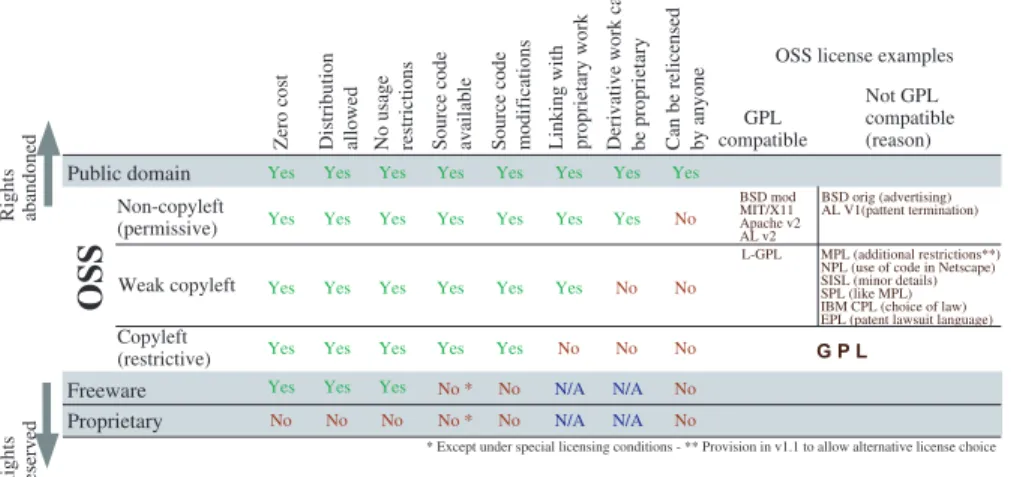
licenses are discussed in more detail in Section 6 and summarized in Table 6.1.
oss development is based on the formation of large, open and
dis-tributed communities of developers who are guided by a common belief in the freedom of software and information, and who follow collabora-tive practices such as sharing information, helping others, and studying and peer-reviewing each other’s work. Such developers are motivated by their own interest in the project and the urge to learn from it, and they are rewarded by the acknowledgement of their contributions, the resulting reputation they gain, and the success of the project itself.
1.2 Research, Related Disciplines, and Publications
The study ofoss is inherently multidisciplinary, encompassing various
Table 1.1, we provide indicative examples of research efforts spanning two or more research fields, includingoss:
• Computer and information system sciences study the techni-cal aspects ofoss development [163, 200, 201].
• Management and organizational sciences deal with the man-agement, organizational and governance aspects of oss
project [127, 164].
• Social science addresses areas related to the communities formed around oss efforts, their motivation, behavior, and
evolution [48, 176, 229].
• Psychology delves into issues relevant to the individual par-ticipants in oss projects, what drives and motivates them,
and how they are rewarded [16, 69, 138, 254].
• Economics studies the business models thatossprojects are
based on, the involvement of corporations in oss efforts,
as well as the ecosystems and collaborations built around them [19, 146, 110].
• Law focuses on the various legal, licensing and copyright issues aroundoss distribution [148, 149, 203].
• A multitude of other scientific fields (such as medicine, biol-ogy, and engineering) benefit by using oss products, and by
applying oss ideas and methods in their domain [10, 28].
Interest in oss spans many professional areas and domains,
including software development, business, research, and government. In Section 10, we discuss in more detail the impact ofoss in all these
domains of our society and global economy. We feel that this survey provides not only an overview of the field, but also considerable prac-tical information for those wishing to get involved inossas developers
or project members, by adopting oss in their products, or by gaining
insight from theoss practices, ideas, and experience.
Within this survey there are numerous references to works from many different scientific domains and disciplines. We highlight some in Table 1.1, which itemizes some of the most informative relevant works, grouped by subject. We separate empirical studies, surveys and
1.3 Organization of this Paper 195 Table 1.1. A collection of informative publications on different aspects of Open Source Software.
Empirical studies Surveys/Overviews Specific topics Project communities [46, 53, 109, 127, 128, 133, 170, 229] [21, 70, 205] Motivations [22, 75, 101, 102, 137, 138, 238] [11, 21, 190, 257] Success factors [21, 36] Software development [163, 179, 200, 218] [67, 68, 201] Innovation and future [71, 75, 238] [232, 235, 240] Adoption and reuse [98] [222] [216] Business models [204] [247] [21, 72, 205] Licenses [140, 146, 148] Generic [56] [51, 54, 83, 94, 129, 187, 245]
overviews, and articles focusing on specific subjects. We also recom-mend:
• the collected works in [54, 68],
• the 2004 theme issue ofIEEE Software[216], the 2004 issue of
Research Policy[239], the 2006 issue ofManagement Science
[240], the 2010 special issue of theJournal of the Association
for Information Systems [42], and
• the proceedings of the International Conference onoss, and
thefloss icse Workshop.
1.3 Organization of this Paper
In this survey we aim to cover most aspects ofoss, including technical,
social, organizational, economic, and legal, as well as provide an outlook to the future of oss by identifying current shortcomings and research
directions.
In particular, Section 2 overviews the history and evolution ofoss,
from the first free software development efforts to the latestoss
Section 3 deals with the organization of oss efforts into projects,
their comparison with proprietary software development efforts, and particular characteristics and potential indicators for project success.
In Section 4, we examine in more detail the characteristics of the communities that are formed aroundoss projects, the different actors
and participants, the leadership and governance mechanisms that are employed, and their evolution.
Section 5 focuses on the more technical aspects ofoss, and in
par-ticular the software development practices and processes. It presents the main characteristics ofosssoftware development and how it differs
from other domains.
Section 6 on the other hand analyses the legal and licensing perspec-tive, which is crucial as it characterizes the permissiveness and often the impact of each oss effort. We briefly outline the main oss
move-ments, the different licensing options and we provide some guidance into selecting the most appropriate licensing scheme depending on an
oss project’s characteristics.
In Section 7, we focus on the economic and financial nature ofoss
projects, and what business models can be adopted to extract busi-ness value from anosseffort. We discuss the business ecosystems that
are formed around successful oss efforts, and the various roles that
companies and organizations can play within them.
Section 8 then focuses on the important issue of adoption and reuse of oss software into other products and domains. It examines the
cri-teria for anoss product to be a good candidate for reuse, the process
of adopting and reusingoss code, and benefits but also the potential
risks and concerns that accompany this practice.
In Section 9, we discuss the motivational aspects for engaging in an
oss effort, both for individuals and for businesses and organizations.
We conclude in Section 10 with an overview of the impact that theoss process and ideology has had on the software business and our
society, closing with a discussion of the current research directions, and where they may lead the future ofoss.
2
History and Evolution
The concept of open or free software is old. Its roots lie in the 1960s and 1970s, when early computers were used in universities for research, and software programs were freely circulated among scientists. Build-ing upon each other’s software and givBuild-ing back the modifications was considered a normal communal practice and became a feature of what was known as “hacker culture” hacker being a term used in communi-ties of programmers to characterize skilled and passionate programmers (although later it also acquired a negative significance by the public). Raymond [185] and Bretthauer [24] provide excellent historical pre-spectives of the early days of the hacking movement.
In the following paragraphs we briefly trace the evolution of oss
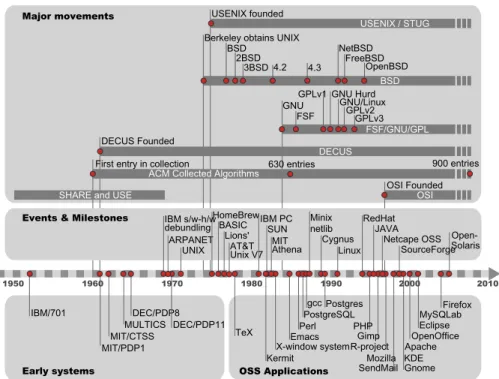
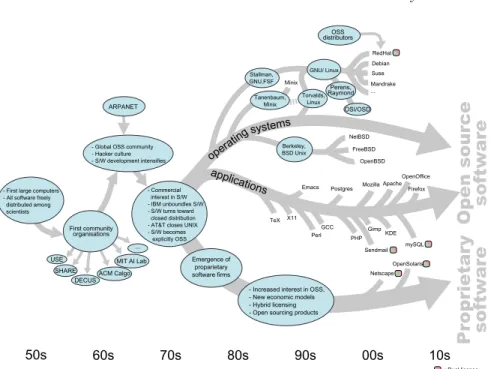
through the main systems, events, applications, and movements that shaped it. Figure 2.1 outlines this information, while Figure 2.2 offers a more diagramatic view of the transformations of theoss landscape as
one event, movement or initiative led to another, reaching the current state of the ossdomain.
2.1 The Early Years
The beginning of oss is associated with the appearance of the first
large computer systems. As programmers invented programming tools,
SHARE and USE FSF/GNU/GPL MIT/PDP1 IBM/701 DEC/PDP8 DEC/PDP11 MIT/CTSS MULTICS ARPANET UNIX BSD
Berkeley obtains UNIX BSD 2BSD 3BSD 4.3 NetBSD FreeBSD OpenBSD 4.2 BASIC SUN X-window system GNU Emacs FSF GPLv1 GPLv2 GNU/Linux GNU Hurd Cygnus Linux RedHat OSI OSI Founded Mozilla MySQLab Apache TeX Perl PostgreSQL PHP Gimp OpenOffice KDE Gnome SendMail Eclipse
Early systems OSS Applications Events & Milestones
Major movements 2000 1950 1960 1970 1980 1990 2010 HomeBrew Firefox Lions' MIT Athena
ACM Collected Algorithms
DECUS USENIX / STUG JAVA IBM PC GPLv3 Kermit R-project gcc Postgres SourceForge First entry in collection
DECUS Founded USENIX founded IBM s/w-h/w debundling AT&T Unix V7 netlib Netcape OSS Solaris Open-630 entries 900 entries Minix
Fig. 2.1 The history and evolution ofoss. Main systems, applications, events and
move-ments.
techniques, and applications to render them productive and useful, they freely shared them among themselves, often contributing to each other’s efforts.
Although the first commercial computer put on the market that required programming wasibm’s 701 in 1952 [245], it wasmit’s
acquir-ing of the first pdp-1 in 1961 that gave rise to the hacker culture
that is still recognizable today. This was the heart of mit’s
Artifi-cial Intelligence Laboratory. Later camedec’spdp-8 in 1965, followed
by the innovative pdp-11 in 1970, which was much more affordable
and had good enough performance both for universities and corporate research [198].
These early computer systems established the need for multiuser support, and the solution proposed bymit in the early 1960s was the
Compatible Time-Sharing System (ctss). This was followed by a joint
2.1 The Early Years 199
50s 60s 70s 80s 90s 00s 10s
- First large computers - All software freely distributed among scientists - Commercial interest in S/W - IBM unboundles S/W - S/W turns toward closed distribution - AT&T closes UNIX - S/W becomes explicitly OSS Stallman, GNU,FSF Berkeley, BSD Unix TeX GNU/ Linux NetBSD RedHat X11 Perl Emacs GCC PHP Mozilla KDE mySQL OpenOffice Apache Firefox Postgres Gimp
- Increased interest in OSS, - New economic models - Hybrid licensing - Open sourcing products
Netscape Tanenbaum, Minix USE ACM Calgo DECUS SHARE ARPANET
- Global OSS community - Hacker culture - S/W development intensifies OpenSolaris OSS distributors First community organisations Sendmail Emergence of proparietary software firms MIT AI Lab applications oper ating systems
Open source software
Proprietary software OpenBSD FreeBSD Minix Suse Debian Mandrake ... : Dual license ... Torvalds, Linux OSI/OSD Perens, Raymond
Fig. 2.2 A diagramatic view of the evolution and transformation of theossdomain.
to build the Multics system, which was expected to be released with its source code openly available to the public. The project ran into problems, but this led two Bell Labs researchers, Ken Thompson and Dennis Ritchie, to work on a new type of operating system (which later became Unix), whose brief history and basic operating principles are described in a seminal paper [188].
From the very beginning the communities of users that revolved around the development and use of open software felt the need to organize themselves, often in ways resembling currentossproject
com-munities.
Some of the first such instances were the shareuser group ofibm
and the Univac Scientific Exchange (use) in the 1950s and 1960s, which
were ran by volunteers to facilitate the distribution of software [64]. Similarly decus, founded in 1961 as a society for users of Digital
Equipment Corporation’s computers, promoted the open exchange of user-developed software; initially through listings and later through magnetic media [55].
TheacmCollected Algorithms,1initiated in 1960, archives software
associated with papers published in the Transactions on
Mathemati-cal Software, as well as other acm journals. It is a family of
publi-cations including a collection of around 600 software algorithms that were freely distributed for noncommercial use.2 It is one of the first organized instances of public distribution of software source code and algorithms.
Sharing software and building on each other’s work was still the only way known to the software community.
2.2 Unbundling of Software from Hardware
Up to the 1970s software was commonly distributed for free by hard-ware manufacturers, who were “bundling” it with their hardhard-ware as one product and including the cost of the software with the hardware. However, as software evolved and became more complex, so did the cost of developing it. An emerging software production industry was competing with this trend, seeking to sell their software independently. A series of antitrust suits filed against ibm in 1969 resulted in
a change in ibm’s pricing policies and the offering of computer
pro-grams for a charge [195], thus paving the way for proprietary software development. Software then started being sold, often under restrictive licenses.
Six years later Bill Gates, having created a basic interpreter for
the Altair 8800 microcomputer, found himself fighting to establish a presence on what would later become the home and personal computer software market. In an open letter to hobbyists [82], Gates argued that the notion of sharing software without paying for it was hurting soft-ware developers, and that royalty payments were critical for the devel-opment of high-quality software.
Both events, by restricting the availability of software, sowed the seeds of the ossmovement.
1http://calgo.acm.org
2.3 The Early Years of Unix 201
2.3 The Early Years of Unix
Ritchie and Thompson published the key ideas underlying the Unix operating system in 1974 [188]. Coincidentally, a 1956 “consent degree’ prohibited at&t, the legal entity behind Unix, from engaging in any
business other than the furnishing of common carrier communications services. As a result, Unix was supplied royalty-free and without any formal support [198, pp. 56–60]. The combination of Unix and the C programming language developed by Ritchie proved very popular, and spread very quickly to a large number of university and research computer labs (the “Hackerdom,” as dubbed by Raymond [185]).
With the source code in their possession, users including program-mers, students, and researchers were able to use Unix as a tool for learning, enhance it to cover their particular needs, and extend it to support their specific hardware. With no formal support from at&t
users were forced to collaborate and share ideas, information, programs, and bug fixes [198, p. 65].
A related movement sprang out of Kernighan and Plauger’s work to popularize Unix’s programming tools by publishing a book with readable and concise implementations of some key utilities [122]. The tools’ source code was made available in executable form by the book’s publisher [122, contents page]. Programmers in universities and com-puter vendors collaborated to enhance those tools and port them to various architectures, and in 1978 they formally grouped together as the Software Tools User Group [198, pp. 78–90].
In 1976 John Lions, an Australian computer scientist, published the complete source code of the 6th Edition Unix kernel together with a commentary of it [150]. It is considered an excellent description of the high-quality Unix kernel code, and for years it was the only public documentation available.
Although the first versions of Unix were freely distributed, asat&t
realized its value as a commercial product it decided to distribute Ver-sion 7 in 1979 with a license that restricted access to the system’s source code [198, p. 151]. A side-effect of this was that Unix could no longer be used in university courses for teaching (and similarly the Lions book was no longer allowed to circulate). This was the main reason Andrew
Tanenbaum later decided to develop the Minix operating system, as discussed in Section 2.5.
2.4 Workstations, Networking, and the Hacker Culture
The late 1970s and 1980s saw the flourishing of two key drivers ofoss
development, namely computer networking [184] and personal work-stations (see Ceruzzi’s account of the influence of both technologies on hacker culture development in reference [29]). Both allowed the exchange and distribution of information as well as software between programmers at a new, global scale, boosting worldwide collaboration and productivity. Programmers and hackers from many parts of the United States and the world became connected, forming a networked group with its own culture, discussions, norms of behaviour, slang, and eventually beliefs and ethics.
Two notable oss distribution efforts that were made possible by
networking advances are
• the Usenet newsgroups net.sources (1982)3 and mod.sources
(moderated — 1984),4 which were later renamed into the comp.sources hierarchy, and
• the email-based netlib repository of software serving the numerical and scientific computing communities [57].
2.5 Notable Events in OSS History
The increasing trend toward proprietary software further fuelled the emergingoss movement, whose advocates felt the need for free, open
source operating systems and applications to be available to the public, leading to several core development efforts.
The Berkeley Software Distribution The University of California at Berkeley and Bell Labs collaborated to help Unix flourish between 1974 and 1977. This gave rise to the Berkeley Software Distribution, 3http://groups.google.com/group/net.sources/msg/d2bbe4e01cfd64c6
2.5 Notable Events in OSS History 203 or bsd, a version of Unix with improved features, tools, and
utili-ties [144]. The bsd was shared with many research centers worldwide
with the provision that they first obtain a source license from at&t,
thus encouraging them to view and contribute to the source code. A second, more advanced version of the bsd was ready in 1978,
while the use of an advanced version of Unix on the new 32-bit vax
machine at Berkeley led to the 3bsd distribution in 1979 [158].
It was realized at that point that as the research community con-tinuously modified the Unix system, an organization was required to manage and coordinate the new releases. This role was undertaken by Berkeley, as a result of its involvement thus far [158].
darpa also decided to unify its activities at the operating system
level, and chose Unix as the standard to use. The new 4bsddistribution
thus came up in 1980 with a per-institution licensing arrangement, followed by a series of major releases, such as 4.3bsdthe first release to
include a fulltcp/ipstack, as well as the more recent Netbsd, Freebsd,
and Openbsd.
During the 1980s, Berkeley andat&treleased their respective new
Unix versions, which gradually became harder to tell apart.
The GNU Project, the Free Software Foundation and the GPL When the computer systems used at mit’s AI lab were replaced with
new hardware that ran a proprietary operating system, the oss
pro-grammer community that had formed around it gradually collapsed. Richard Stallman, a member of the lab, started looking for an alterna-tive that could make the oss community possible again, and this led
him to the concept of free software, and in particular to the decision to create a new, Unix-compatible operating system that he calledgnu
(Stalman’s article collection [83] contains many details on the early history of gnu). In 1985 he released the gnu Emacs editor, which he
distributed for free over the network, or packaged on tape for $150. Thegnusystem included code from other projects that were also free
software, such as the gnuCompiler Suite (gcc).
To support the gnu effort, Stallman initiated the fsf in 1985, to
promote “the freedom to share and change software.” He famously explained that “when I speak of free software, I’m referring to freedom,
not price. So think of free speech, not free beer” [83, Section 1]. Most of the income of the fsf came from the sales of copies of free
soft-ware and other related services, and secondarily from donations. Emacs and other free software, as well as manuals, were sold on tape, and later on other media. Part of this income was used to hire developers to work on basic gnu projects, such as the shell and the C library
[83, Section 18].
One of Stallman’s and thefsf’s concerns was that their work could
be taken and used in proprietary packages. To protect from this, the concept of copyleft was developed as a mid-way in between public and proprietary software. This concept was the basis for the gnuGeneral
Public License, released in 1989 [24] (see Section 6.3.1).
The combination ofgnuwith the Linux kernel developed by Linus
Torvalds (see below) in 1991, led to a complete gnuoperating system
[83, p. 28].
Minix In 1987 Andrew Tanenbaum of the Vrije University of Amsterdam released Minix, an open source operating system based on a microkernel architecture which he created mostly for educational purposes [224]. Its source code was made available to universities for study and research. The design of the Linux operating system is consid-ered to have been influenced by the Minix design principles, although Linux is not a microkernel per se.
First OSS applications Of the oss applications that were
devel-oped around that time, some are still in widespread use today, notably the X-Window System, and TEX.
The X-Window System, developed at mit but including
contribu-tions from numerous other sites, is the longest living foundation for developing graphical user interfaces. It is argued that its success was in great part due to the developers’ willingness to open its source code and distribute it for free over the network with a very permissive license [185, Section 4].
The TEX [125] typesetting system was written by Donald Knuth in 1978, and rewritten from scratch and published in 1982. It is considered as one of the most sophisticated typesetting systems. The TEX Users
2.6 OSS Meets Proprietary Software 205 Group (tug)5 was founded in 1980 as an organization for users of
TEX and people interested in typography and font design.
2.6 OSS Meets Proprietary Software
The oss and proprietary software worlds and cultures often met,
affected each other’s course, and sometimes clashed.ibm’s un-bundling
of software from hardware andat&t’s closing of the Unix source were
two such examples.
In 1975 the Homebrew Computer Club was formed by computer hobbyists and enthusiasts. The rule of the club was that anyone could take a copy of software out, as long as they brought back two copies in the next meeting [115].
At that time, Bill Gates together with partner Paul Allen had written a version of the basic computer language that became very
popular and was being wildly copied from one user to the other. Prac-tices like this led Gates to write an “open letter to hobbyists,” in which he addressed the issue of intellectual property rights and innovation.
This was one of the first cases of confrontation between two different cultures, which carried on for decades and is still ongoing.
Several years later,ossstarted influencing proprietary systems.
Var-ious software vendors added the X-Window System to their proprietary offerings, and released the end product under a nondisclosure agree-ment. Paradoxically, soon most of the users of X-Windows were not running the free mit version, but the proprietary versions that came
from these software vendors [83].oss however was already establishing
itself at an increasing pace.
2.7 OSS Becomes Mainstream
The Emergence of OSS Vendors As oss became a mainstream
phenomenon new companies were formed to benefit from this trend, and many of the existing proprietary software firms started looking toward theoss movement, adopting it and often learning from it.
oss software vendors and distributors appeared, oss licensing was
adapted to allow for hybrid solutions based on new financial and busi-ness models, new categories of services revolving around oss were
offered, and proprietary firms started opening (at least partly) their products’ source code.
Founded in 1989, Cygnus Solutions was the biggest vendor ofossat
the time. It offered technical support services, with thegnupro
Devel-opers Kit being one of its primary products [225].
At the same time, a multitide of oss software infrastructures and
applications appeared and gained widespread reputation.
Linux and OSS Distributors Linux is a free Unix-like kernel devel-oped under the lead of Linus Torvalds in 1991. One difference between the Linux project and other concurrent efforts was that since its incep-tion, it was based on a large community of developers whose work was coordinated only through the internet. Frequent, almost weekly releases ensured that plenty of feedback was received within days from hundreds of users, and this was the main quality control mechanism for selecting which code changes to keep and which to reject [185, 227].
By 1993 Linux was stable enough to compete with many commercial Unix releases, and hosted more software applications. It was distributed commercially oncd-romwith enormous success, and it was one of the
focal points of hacking activity on the internet.
The Linux kernel is often bundled with other software, such as the shell and associated utility programs developed under the gnu effort,
a graphical environment based on the X-Window System with the
kde or gnome desktops running on top, as well as various
applica-tion and server programs, such as the Firefox browser and the Apache web server, respectively.
By 19946 various Linux distributions were available at small cost, including SuSE, Debian, and RedHat. Notably RedHat Software bun-dled together hundreds of oss software packages licensed into a
so-called Linux distribution for retail sale [255].
6A comprehensive history of Linux distributions is provided by Wikipedia:http://en.
2.7 OSS Becomes Mainstream 207 Licensing Issues and The Open Source Initiative In July 1997, Bruce Perens, the leader of the Debiangnu/Linux Distribution project,
addressed the problem of many different licenses for software that claimed to be “free” by proposing the Debian Social Contract and the Debian Free Software Guidelines (described by their author in ref-erence [181]). Based on these, together with Eric Raymond who had studied and published work on the free software phenomenon and cul-ture, they formed the Open Source Initiative (osi).7 Their goal was
to establish a practical approach to software licensing and to promote commercial use ofoss [207].
The osi developed the Open Source Definition (osd) set of
guide-lines for oss licenses that guarantees several freedoms for software
users. The term Open Source Software, instead of Free Software, was proposed in order to assuage the reservations of business users. The term was met with resistance by the Free Software Foundation [83, Section 14], on grounds of not appropriately protecting the user’s freedom.
The Open-Sourcing of Mozilla In 1998, Netscape announced that it would release the source code of the current version of its Naviga-tor web browser under the name Mozilla. A licensing team wrote the software license and Mozilla.org was formed to coordinate the entire project. A group of Open Source community leaders (including Linus Torvalds and Eric Raymond) met with the Netscape legal team to discuss the existing licenses. The result was to craft a new license, the Netscape Public License (or npl) in an attempt to protect oss
developers and at the same time promote development by commercial enterprises [100].
The first draft was published for comment by the public on the internet, and the feedback received led to the design of a new version of the npl, as well as the similar Mozilla Public License (mpl).
Mozilla.org set up an organization, accumulated funds and resources and started functioning.
The Mozilla Firefox browser came about in 2004, multiply licensed under thegpl,lgpl(a version of gpl, see Section 6.3.2) and thempl
at the developer’s choice [51].
Sendmail and Dual Licensing Sendmail is a major, successful open source application (it carries most of the world’s email traffic) that was licensed under a dual license, i.e., both open and commercial. The project started in 1981 at Berkeley by Eric Allman (author of the arpanet delivermail application that was part of the bsd) as
an open development project for a Unix-based mail transfer system. The open source version is licensed under an osi-approved bsd-like
license [251]. However the company Sendmail Inc. was eventually estab-lished in 1998 by Allman to develop and sell an enhanced, commercial version of the software that includes, among other features, a gui for
facilitating installation and configuration.
So two versions of fundamentally the same software were distributed under an open source and a proprietary license. This example was later followed by other software vendors, such as Trolltech and Mysql abthat commercialized their products, the Qt widget library and the
Mysql database respectively, under a dual licensing scheme, enabling
them to be very successful in both the commercial and theoss
applica-tion ecosystem. (An account of the reasons that may lead dual-licensed software to success is provided in reference [230].)
2.8 Mainstream OSS Applications
A number of operating systems and a multitude of oss applications
emerged over the last three decades, including systems applications and infrastructure software, desktop applications, software for publishing, graphics and entertainment, scientific and business applications, and of course a whole range of tools for software development including compilers, interpreters, editors, ides, and version control systems. In
terms of user base manyoss systems occupy the first or second place
in their respective category.
Some of the most notable and successful such applications are out-lined in the Appendix of this monograph.
3
Projects
This section introduces what is commonly referred to as an open source project. This loose term encompasses a collective effort whose goal is the production and support of software products. An open source project generally consists of the following:
• A community of developers, users and other actors, based upon an organizational and governance structure, driven by specific goals, and unified by shared values and cultural char-acteristics.
• Various software production processes for the manage-ment, developmanage-ment, release and maintenance of the software products.
• Technologies, infrastructures, platforms, and tools utilized in the software production.
• A licensing model that abides by the general ossguidelines,
while at the same time ensuring the viability and success of the project.
We discuss many of the above aspects of oss projects (as well
as others) in other sections of this survey. In this section we focus on open source as a development methodology, and on cross-cutting
characteristics and concerns that distinguish open source projects from proprietary endeavors and affect their success.
3.1 Open Source vs. Proprietary Software Projects
Several key distinguishing factors highlight the differences betweenoss
and proprietary software projects. We compare the two from the fol-lowing perspectives.
Community Issues relevant to the communities formed around the projects, the different actors, motivation and membership, and decision making processes.
Software Production How code changes are managed, the testing processes followed, the release management approaches, and the tech-nical environment and infrastructure.
Business Issues relevant to licensing, business models and decisions, and how adoption and reuse of the project artifacts is encouraged.
Tables 3.1, 3.2, and 3.3 summarize some significant differentiating factors under the above three categories. These are discussed in more detail in the relevant sections of this survey. Note that in these tables we try to present the average picture, as it is reported in the literature, but
Table 3.1. Differences usually encountered between oss and proprietary software
projects. Part a: Communities.
ossprojects Proprietary projects
Membership Substantial voluntary participation Paid staff
Large number Limited number
Open to all, voluntary Closed (company) Virtual boundaries, fluid Bound by contracts Independent community Belongs to company Decision making Core developers or project leader Company/organization
No formal structure, voting consensus Strict and rigid structure Meritocratically distributed Centralized control Motivation Intrinsic and extrinsic, social/political Monetary rewards/career Actors Usually skilled and motivated Company employees
Devote part of their time to project Main occupation, full time Developers and users No users employed
3.1 Open Source vs. Proprietary Software Projects 211 Table 3.2. Differences usually encountered betweenossand proprietary software projects.
Part b: Software production.
ossprojects Proprietary projects
Environment Decentralized and geographically distributed
Mostly centralized in one or few locations
Rare face-to-face communication, asynchronous means
Regular face-to-face
communication and meetings Scarce project plans or schedules Project planning, scheduling Non-assigned jobs and tasks,
voluntary participation and selection
Work assignmed and coordinated by project leaders
Massively parallel development Smaller sized teams No explicit system-level design Rigorous design processes No list of deliverables Strict development guidelines Process and code open to all Closed communication Tasks selected based on
developers’ expertise and interestes
Developers trained and assigned specific tasks
Change management
Implementation and patch submission before final review
Documentation-level changes and review before implementation Testing
processes
Informal Formal, reporting
Peer reviewing By testers, QA engineers Community and user
participation
Within company/organization Strong community involvement
after release
Mostly completed before release (or during beta-testing) Release
management
Frequent releases of minor improvements, no fixed dates
Infrequent major releases on fixed dates
Minimal promotion and marketing
Promotion and marketing Scarce documentation and
community-based technical support
Documentation and formal technical support
clearly there are exceptions and this comparison is not representative of every singleoss project.
ossand proprietary software are the two extremes of a spectrum of
potential approaches. As a result, a variety of hybrid models emerged that encompass elements from both. The goal of these models is to capitalize on the strong points that each perspective has to offer.
Typically, proprietary and commercial software projects are char-acterized by strong emphasis on the user requirements elicitation and design phases, rigorous documentation, strict scheduling and
Table 3.3. Differences usually encountered betweenossand proprietary software projects.
Part c: Business.
ossprojects Proprietary projects
Licensing Some version of copyleft licensing Proprietary license, copyright No cost of acquiring software Software sold at a cost Business models Value-added packaging Product, service or hybrid,
Services and Support Licensing, royalties, maintenance Loss-Leader
Widget Frosting Accessorizing Dual Licensing
Adoption/Reuse Permitted at all levels, based on specific license
Incorporation and support of reused element’s production processes
assessment processes, high level technical support to the client base, and of course business mechanisms that facilitate adequate profitability.
oss on the other hand is mostly characterized by open processes,
fluid and self-organizing communities based on widespread commu-nication, a development culture stemming from collaboration, self-assignment of tasks and peer-reviewing, participation of the user base in the project, and frequent releases to reflect the outcomes of different development tasks carried out by independent groups of developers.
3.2 Project Success
We briefly discuss project success from the following three perspectives.
• What prerequisites should a project fulfill in order to have a good chance of being successful.
• How to ensure the sustainability of a project that has reached a certain level of success.
• What indicators can be used to distinguish a successful project from other, less successful ones.
3.2.1 Important Prerequisites for Success
There are certain preconditions that should be taken into account at the first steps of an oss project’s organization, and are key to its
3.2 Project Success 213 success. We briefly discuss the main ones that have been identified in the literature.
Project Starting Points Whether the project is initially conceived in the mind of one person, or among a group of developers, it starts off as an idea within a topic of interest. The strength and originality of this idea, together with any initial hints as to how it may evolve into a software artifact are key to the entire endeavor [41, 78]. Whereas with proprietary software the market pressures are likely to make projects based on mediocre ideas quickly cease to exist, withoss such projects
could be allowed to languish for a long period of time.
The audience that the project will be targeted toward should also be clear from the beginning. End users, software vendors integrating a component, system administrators, or other developers are possible users. The project should identify valid and important needs and pro-vide effective solutions for them [39, 41], otherwise it may not attract real interest.
Finally, though secondary with respect to other decisions, the natu-ral language of the project may play an important role in the exposure it will have and the user base it will reach [41, 148]. English of course is the language that appeals to the largest audience.
Community Organization The decision making processes, hierar-chical structure and leadership model for the project community should be decided upon in a way that reflects the mentality of the project cre-ators. A meritocratic culture should also be inspired and enforced to the extent possible [79].
Technical Issues An appropriate choice of technical environment and infrastructure (operating system, internet connectivity, tools, etc.) [148] as well as programming languages [41] is important for an efficient software development process. With oss additional issues
may include hosting providers for the project repository (such as SourceForge1 and GitHub2). Moreover, the choice of external project 1http://sourceforge.net/
dependencies has been shown to affect the success of a project under development [95].
Open Source Perspective The choice of licensing scheme [21, 39, 79, 148] and the definition of an effective and reasonable business model [79] are both issues that should be tackled from the beginning of the project. For example a license or business model that does not reflect the aims of the project community in terms of freedom or plans to use the project outcomes may lead to internal conflicts, forking (see Section 4.3.4), or even demise of the project after considerable effort has been invested.
3.2.2 Factors in Project Sustainability
Ensuring the sustainability of a project after it has started, and making sure that it will not stagnate or loose its momentum requires further attention. We briefly examine the evolution and sustainability of both the software system, and the project community.
Software System Sustainability As the software evolves to achieve the identified goals and cover its specifications, its documentation and testing material has to be constantly developed and adjusted as well [175, 187]. Over time, software maintainability will become an increas-ingly more complex problem. This phenomenon, defined as “software aging” [178], has been shown to equally affectossand proprietary
soft-ware in [131, 200, 256]). Consequently, a clear definition and visibility of the entire software architecture (a task that is often beyond the scope of individual developers) will greatly aid the maintenance tasks. This is a particularly sensitive matter foross projects, which are based on
a largely distributed developer base, and have also been criticized for poor documentation quality (see also Section 10.4).
Re-engineering parts of the software may be required as well [200], although due to the distributed development nature ofossprojects this
needs to be carefully coordinated. Operational support of the resulting product (including tasks such as configuration management) will also aid in making the system maintainable in the long term.
3.2 Project Success 215 Community Sustainability The sustainability of the project com-munity also needs particular attention. Initially, it is important for the project’s success to build a good first impression for the product or ser-vice offering. (For example, Choi et al. show that first impression plays a critical role in attracting more developers [32].) Afterwards, it is cru-cial to keep a high level of developer and user satisfaction [36], which can be achieved through continuously evolving and taking advantage of the developers’ skills and competencies [41] and carefully balancing and matching the project development tasks with the skills and areas of interest of the developers. Inoss efforts these skills and competencies
may be the main motivating factors for the developer’s contributions, as well as an effective safeguard against the possibility of forking.
The relationships between project members also need to be carefully managed and coordinated, and care has to be taken in maintaining a widely accepted leadership model,3 while at the same time providing adequate recognition of the achievements and efforts of all community members.
3.2.3 Success Indicators
In identifying projects that stand out as particularly successful, the following indicators could be used (a more comprehensive study is pre-sented in reference [143]).
Development Stage A project that has progressed into more advanced development stages (e.g., from alpha to beta and then to stable [36], or in a SourceForge development stage of 4 or higher [168]) is more likely to be a healthy project, backed by an active community of developers.
Popularity A frequently downloaded project (e.g., one with a down-load ranking of 85% or higher [168]) is likely to be a successful one [206]. Activity and Visibility Frequent and visible development [206] or bug fixing activities are indicators of a healthy and successful project. 3See Section 4.2 for more on the role of leadership inossprojects.
The availability of defect logs, and the average time elapsing between bugs being reported and fixed are very strong such indicators [168]. A project with accumulating bug reports that are not acted upon is likely one that is no longer actively supported.
Tools and Software Environment The software tools that are made available by the project (e.g., for automated unit testing), the portability of its code across different platforms, its compatibility with other programs, or significant efforts to internationalize and localize the project’s user interfaces and documentation, may also be indicators of a robust project.
3.3 Representative Examples
We have already introduced variousossapplications and projects, and
in the rest of this survey we will examine the characteristics of many of them in more detail. Examples of successful and popular projects that have helped shape theossdomain include the Apache4 web server, the
OpenOffice5 productivity suite, the Mozilla6 web browser, the Mysql7
relational database system, the Eclipse8development platform, Linux,9 thegnutool suite,10 and various bsd11 operating systems.
All of these projects share various common defining characteristics.
• They are supported by large, active communities of developers.
• They abide by strict guidelines concerning their software development and governance processes.
• They have set up foundations to manage the projects.
• They are partly financially supported through sponsorships and donations. 4http://www.apache.org 5http://www.openoffice.org 6http://www.mozilla.org 7http://www.mysql.com 8http://www.eclipse.org 9http://www.linux.org 10http://www.gnu.org 11http://www.freebsd.org,http://www.netbsd.org,http://www.openbsd.org
3.3 Representative Examples 217
• They include working groups responsible for the promotion of the project, and the translation of the software into different languages.
• They organize conferences and workshops to promote the project results and advances.
• Many contributions come from paid developers.
More details about the above, as well as other projects can be found in the relevant sections of this survey, as well as in their online web sites.
4
Communities
Around any successful oss project an extensive community of people
is formed. This dynamic group features members at different roles, capacities, degrees of involvement, and responsibilities. In this section, we examine the structure, elements, and characteristics ofoss project
communities.
4.1 Actors
Several studies have investigated the community structures [155, 229, 253] and ad-hoc team formation properties [40, 99, 173] that emerge in
ossprojects as a result of the distributed collective processes required
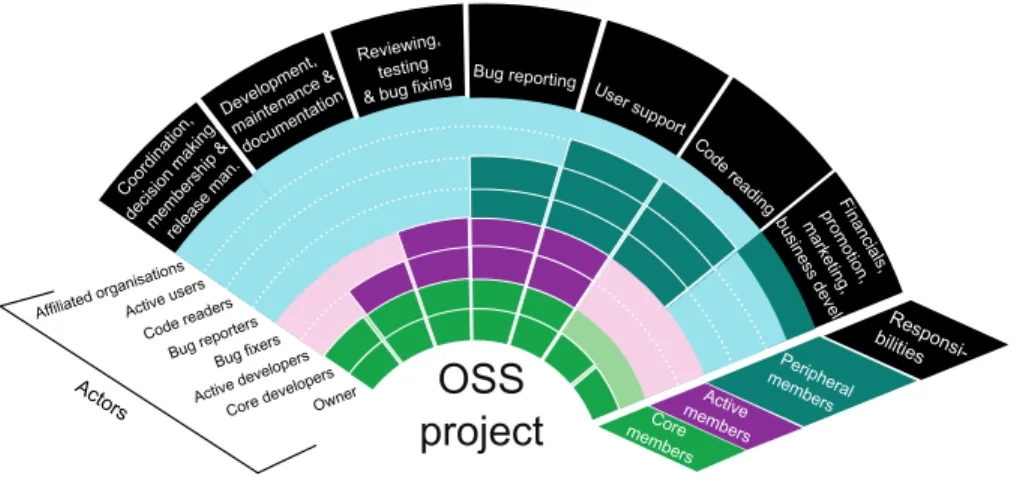
when developing software. A notable community structure that emerges in most such studies is the so-calledonion model: the project develop-ment team is organized in concentric circles, where the most inner circle includes developers that have a managerial and leadership role while outer circles have gradually less control on the project. For instance, in reference [37] the authors study project success through a survey of SourceForge projects based on the number of developers, project
4.1 Actors 219 Developm ent, maintenance & documentation Bug reporting Code re ading User supp ort Financial s, pro m otio n, market ing, bu sin ess de vel Owner Core devel opers Active develop
ers
Bugrepo
rters Bugfixe
rs Active use
rs Codereader s Affiliated or ganisation s Act ors Coordin ation, decisi on making, membership & release man . Reviewing, testing & bugfixing
Core member s Active mem bers Periphe ral mem bers Responsi-bilities
OSS
project
Fig. 4.1 The main actors ofossproject communities grouped as core, active, and peripheral
members, and their main roles and responsibilities. Additionally passive users, who can contribute to the projects’ motivation through download and use, complement the entire projects community.
activity, bug fixing, and the number of downloads. Promotion strategies permit community members to transcend community roles [58, 114].
A more detailed view of project organization in concentric circles is provided in Figure 4.1. The figure analyzes the typical structure of an oss project community, highlighting the main actors, how they
are grouped in membership categories and what responsibilities they undertake. Note that although this subdivision of responsibilities and roles may give the impression of a strict hierarchical organization, the
oss community does not usually perceive it as such, but rather as a
natural extension of the division of labor [18].
The size of the core/active parts of these project communities can vary significantly, from many projects consisting of a single person to relatively large projects involving several hundreds of active members, while the number of core members is typically considerably smaller than the number of peripheral members. Empirical evidence can be found in studies of largeoss projects, like Apache, Linux, Mozilla, and Gnome,
based on data retreived from online repositories [128, 129, 162, 163]. The various actor categories are outlined below, while Section 5 includes more details regarding many of their functions in the software production process.
4.1.1 Core Members
Oftenossprojects are inspired and initiated by one person, the project
owner, as opposed to an already formed community [11, 187]. In these cases, even if a number of core developers join the effort, the owner keeps setting the vision and often maintains most of the roles and responsibilities for the project, including, apart from the obvious tech-nical development tasks, making decisions regarding the direction the project will take, managing the releases and the licensing schemes to be adopted, and any business models required to ensure the project viability [18, 21, 129, 145, 174].
In oss projects that consist of more than a very small number
of members, however, the main strategic decisions about the overall project direction are the responsibility of a subgroup of active and fre-quently contributing members, often referred to as the core developers [11, 18, 80, 170, 192, 254], who are generally responsible for a large part of the project outcome [80, 126, 162, 163]. This “inner circle” of programmers [128] varies in size, and may also vary in time (e.g., for
gnomethe size was at a certain point in time around 50 developers, for
Apache around 15 at a different time [128], and for Freebsd9 [117]).
Core developers typically have voting rights and code commit priv-ileges [18, 21, 162, 163]. Apart from their valuable technical contri-butions to the code, they are also responsible for setting up and/or participating in committees with more specific responsibilities, most notably the release management committee. This committee is respon-sible for deciding what will be included in future releases of the project. Decisions are made through a voting process (although in various cases instead of a committee there may in fact be only one person)[73].
Some of the core developers who are responsible for handling specific modules or code areas (see Section 5.1) and their related commits are also known as maintainers [38, 53, 73, 117].
4.1.2 Active Members
The active members of anoss project consist of active developers and
4.1 Actors 221 Active developers are programmers who regularly contribute bug fixes and code for new features, as well as relevant documentation [11, 18, 170, 254]. They need to have a good understanding of large parts of the source code and the project architecture [170, 254]. As a result they often constitute the most important development force, along with core members.
Bug fixers fix bugs reported by bug reporters (or sometimes bugs they come across themselves), and therefore need to have some under-standing of parts of the source code of the project [11, 170, 254]. Often bug fixers do not have commit privileges, but they submit a patch to an active developer.
4.1.3 Peripheral Members
Peripheral members have a more sporadic participation in the project, yet they constitute the majority in oss project communities [80, 170,
254]. These members share a common interest in the project and iden-tify with it, and are in touch through the different communication chan-nels used, thus both benefiting from and contributing to knowledge exchange and build-up. Reference [258] contains an extensive literature review as well as some relevant empirical findings.
As oss project communities tend to be of a particularly dynamic
nature, peripheral members who maintain active involvement and con-sistently offer valued contributions may be granted greater systems access and more central project roles by the project’s core members. For a more detailed discussion of the these role transformations see also [58, 114, 170, 254].
The following are the main categories of peripheral members. Peripheral developers contribute to the code from time to time, usually with some localized bug fixes or minor new functionalities, as evidenced by a number of case studies [170, 254].
Bug and problem reporters identify and report bugs or other issues [11, 18, 80, 170, 254].
Code readers are involved users of the project software with an interest in the source code, which they study and sometimes also review and comment on [254].
Active users are users of the project software who typically partici-pate in the relevant fora, offer support to other users [11], and may also occasionally act as bug reporters or participate in requirements elicita-tion and testing. For a discussion of these activities see also [137]. Affiliated organizations or businesses offer various kinds of sup-port, such as financial, business development, and promotion [11, 66]. 4.1.4 Passive Users
Although they cannot be considered members of the project community in the strict sense, the passive users of the resulting software system have an involved attitude toward the project, and may offer their cri-tique and comments [11, 66, 170, 254].
4.2 Leadership
The oss project community is organized around and led by a
gover-nance and leadership structure. 4.2.1 Leadership Models
Despite the broad nature of oss projects, clearly defined and
well-structured governance models are often found in their communities [154, 174], and can be roughly distinguished in two broad categories: monarchical and federal [73, 129, 154]. [154] in particular describes a case study that was performed with focus on the motivation for and coordination of software development work in oss projects, and was
based on literature reviews, interviews withoss developers, and other
research findings.
Inmonarchical(or “star-shaped” [156]) leadership models the ini-tial project inspirer (and owner) maintains a central role, and the entire project is based on his/her decisions and visions [73, 129, 154]. A vari-ation of the monarchical model is thehierarchicalmodel [35]. In larger