EMULATOR
vs
REAL PHONE
: Android Malware Detection
Using Machine Learning
Mohammed K. Alzaylaee
[email protected]
Suleiman Y. Yerima
[email protected]
[email protected]
Sakir Sezer
Centre for Secure Information Technologies (CSIT) Queen’s University Belfast
Belfast, Northern Ireland
ABSTRACT
The Android operating system has become the most pop-ular operating system for smartphones and tablets leading to a rapid rise in malware. Sophisticated Android malware employ detection avoidance techniques in order to hide their malicious activities from analysis tools. These include a wide range of anti-emulator techniques, where the malware pro-grams attempt to hide their malicious activities by detecting the emulator. For this reason, countermeasures against anti-emulation are becoming increasingly important in Android malware detection. Analysis and detection based on real de-vices can alleviate the problems of anti-emulation as well as improve the effectiveness of dynamic analysis. Hence, in this paper we present an investigation of machine learning based malware detection using dynamic analysis on real devices. A tool is implemented to automatically extract dynamic fea-tures from Android phones and through several experiments, a comparative analysis of emulator based vs. device based detection by means of several machine learning algorithms is undertaken. Our study shows that several features could be extracted more effectively from the on-device dynamic analysis compared to emulators. It was also found that ap-proximately 24% more apps were successfully analysed on the phone. Furthermore, all of the studied machine learning based detection performed better when applied to features extracted from the on-device dynamic analysis.
Keywords
Android; Malware; Malware detection; analysis; Anti-emulation; Machine Learning; Device-based detection
1.
INTRODUCTION
The Google Android operating system (OS) is the leading OS in the market with nearly 80% market share compared to iOS, Blackberry, Windows, and Symbian mobile. Over 1 billion Android devices have been sold with an estimated 65 billion app downloads from Google Play [1]. Moreover, it is reported that more than 1.5 billion Android devices will be shipped worldwide by 2020 [2]. This has led to malware developers increasingly targeting Android devices. According to a report from McAfee, there are more than 12 million Android malware samples with nearly 2.5 million new Android malware samples discovered every year [24].
The rapid increase in malware numbers targeting Android devices has highlighted the need for efficient detection mech-anisms to detect zero-day malware. In contrast with other
mobile operating systems, Android allows users to down-load applications from third party stores, many of which do not have any mechanisms or tools to check the submit-ted apps for malware. The Google play store uses a tool called Bouncer to screen submitted applications. However it has been previously demonstrated that the Bouncer dy-namic analysis process can be bypassed by means of some simple anti-emulator techniques [26].
Android malware can be found in a variety of applica-tions such as banking apps, gaming apps, media player apps etc. These malware-infected apps may access phone data to collect privacy sensitive information, root the phone, dial premium rate numbers or send text messages to premium rate numbers without the user approval etc. Many Android malware families employ detection avoidance techniques in order to hide their malicious activities and evade anti-virus software. Commonly used detection avoidance methods by Android malware include a wide range of anti-emulator tech-niques, where the malware programs attempt to hide their malicious activities when being analysed in an emulator. For this reason, countermeasures against anti-emulation are be-coming increasingly important in Android malware detec-tion.
Several approaches for anti-emulation (or anti-virtualization) have been discussed in previous work. The paper [30] dis-cusses some methods that could be employed in order to de-tect the run-time environment thereby hindering dynamic analysis. Some malware applications, for example, will de-tect the emulator through the use of Android APIs. For instance, if the Telephony Manager API method Telephony-Manager.getDeviceId() returns 000000000000000, it means the run-time environment is an emulator rather than a real device, because no real phone will return 0s as the device identifier. This is one of the emulator detection methods used by the Pincer family of Android malware [3].
The emulator can also be detected through the network-ing environment which is different from that of a real phone, or the underlying QEMU can be detected. Morpheus [22] has also exposed more than 10,000 detection heuristics based on some artifacts that can be used to detect the run-time analysis environments. These artifacts can be used in mal-ware samples to hide the malicious activities accordingly. Dynamic analysis tools that rely on emulators (or virtual devices) such as Dynalog [14] attempt to address the prob-lem by changing properties of the environment to emulate a real phone as much as possible and to incorporate several behaviours to mimic a real phone. However, these methods
IWSPA 2017 Proceedings of the 3rd ACM International Workshop on Security and Privacy Analytics, co-located with CODASPY’17, pages 65-72, Scottsdale, Arizona, USA - March 24 - 24, 2017
whilst useful, have been shown to be insufficient to com-pletely tackle anti-emulation [21], [22], [31] .
Several dynamic analysis tools such as TaintDroid [20], DroidBox [4], CopperDroid [29], Andrubis [17], AppsPlay-ground [27] have been proposed. Similarly, some online based tools are available for Android malware analysis such as SandDroid [5], CopperDroid [6], TraceDroid [7], and NVISO ApkScan [8]. All of these dynamic approaches can be evaded by malware that use anti-emulation. Since the analysis is done in a virtualized environment.
Mutti et al. [25], have demonstrated the feasibility of device-based dynamic analysis to alleviate the problems of anti-emulation. We have also found that phones generally provide more effective analysis environment due to incom-plete nature of emulators. Many apps nowadays have func-tionality that utilize device hardware features such as sen-sors, WiFi, GPS, etc. and these require emulation in the sandbox. Therefore, devices should provide more effective analysis environment. Hence, we have designed and imple-mented a python-based tool to enable dynamic analysis us-ing real phones to automatically extract dynamic features and potentially mitigate anti-emulation detection. Further-more, in order to validate this approach, we undertake a comparative analysis of emulator vs device based detection by means of several machine learning algorithms. We ex-amine the performance of these algorithms in both environ-ments after investigating the effectiveness of obtaining the run-time features within both environments. The exper-iments were performed using 1222 malware samples from the Android malware genome project [9] and 1222 benign samples from Intel Security (McAfee Labs).
The rest of the paper is structured as follows. Section II describes the runtime analysis process for feature extraction from the phone and emulator, Section III details the method-ology and experiments undertaken for the evaluation. The results and the discussions of results will be given in Section IV, followed by related work in Section V. Section VI will present conclusions and future work.
2.
PHONE BASED DYNAMIC ANALYSIS AND
FEATURE EXTRACTION
In order to apply machine learning to the classification and detection of malicious applications, a platform is needed to extract features from the applications. These features will be used by the machine learning algorithm to classify the application. Prior to that, the algorithm must be trained with several instances of clean and malicious applications. This process is known as supervised learning. Since our aim is to perform experiments to compare emulator based detection with device based detection we need to extract features for the supervised learning from both environments. For the emulator based learning, we utilized the DynaLog dynamic analysis framework described in [14].
The framework is designed to automatically accept a large number of applications, launch them serially in an emula-tor, log several dynamic behaviours (features) and extract them for further processing. DynaLog components include an emulator-based analysis sandbox, an APK instrumen-tation module, Behaviour/features logging and extraction, App trigger/exerciser and log parsing and processing scripts [14]. DynaLog provides the ability to instrument each appli-cation with the necessary API calls to be monitored, logged
and extracted from the emulator during the run-time anal-ysis. The instrumentation module was built using APIMon-itor [10].
DynaLog currently relies on Monkey, an application exer-ciser tool, which allows the application to be triggered with thousands of random events for this experiment. These ran-dom events include ”swipes”, ”presses”, ”touch screens” etc, to ensure that most of the activities has been traversed to cover as much code as possible. In order to enable dynamic analysis and feature extraction from a real phone, the Dy-naLog framework was extended with a python-based tool to enable the following:
• At the start, push a list of contacts to the device SD card and then import them (using adb shell command) to populate the phone’s contact list.
• Discover and uninstall all third-party applications prior to installing the app under analysis (or from which fea-tures are to be extracted). This capability was imple-mented using package manager within an adb shell as illustrated in Fig. 1.
• Check whether the phone is in airplane mode or not. If it is in airplane mode, turn it (airplane mode) off. This is because with airplane mode switched on, many phone features such as WiFi, 3G/4G connectivity will be unavailable, which could affect the dynamic analy-sis. Also, Monkey (the app exerciser tool) was found to sometimes temper with the analysis by turning on the airplane mode due to its randomly sending events such as ”touch screens”, ”presses” and ”swipes”.
• Check the battery level of the phone. If the level is very low i.e. battery has discharged to a low level, put the analysis on hold (sleep) until the phone has re-charged to an appropriate level.
• Outgoing call dialling using adb shell.
• Outgoing sms messages using adb shell.
• Populate the phone SD card with other assets such as folders containing dummy files: image files, pdf, text files etc.
Each of the apps is installed and run for 300 seconds on the emulator (and then on the phone for the second exper-iment) and the behaviours are logged and parsed through scripts that extract the desired features. The features used in the experiments include API calls and Intents (signalling critical events). The API calls signatures provided during the instrumentation phase allows the APIs to be logged and extracted from the phone (or the emulator) via adb log-cat as the app is run. For malicious apps that incorporate anti-emulator techniques it is expected that the API call that could lead to the exposure of their malicious behaviour would not be logged as the malware will attempt to hide this behaviour. The analysis process is shown in Fig. 2.
Figure 1: Uninstalling third party apps from the phone using package manager in an adb (android debug bridge) shell.
Figure 2: Phone and emulator based feature extraction using DynaLog.
3.
METHODOLOGY AND EXPERIMENTS
This section describes the methodology of the experiments which were performed to evaluate the environmental effec-tiveness of detecting and extracting the features as well as analysing the performance of the machine learning algo-rithms on both emulator and real phone.3.1
Dataset
The dataset used for the experiments consists of a total of 2444 Android applications. Of these, 1222 were malware samples obtained from 49 families of the Android malware genome project [9]. The rest were 1222 benign samples obtained from Intel Security (McAfee Labs).
3.2
Environmental configurations
The two environments under which the experiments were performed had the following configurations. The first was the phone which was an Elephone P6000 brand smartphone equipped with Android 5.0 Lollipop, 1.3 GHz CPU, 16 GB internal memory, and 32 GB of external SD card storage. In addition, a sim card with call credit was installed in the phone to enable outgoing calls and 3G data usage.
The emulator environment (an Android virtual device) was created in a Santoku Linux VirtualBox based machine. The emulator was configured with 2 MB of memory, and an 8 GB of external SD card memory. The Android version in the emulator was 4.1.2 Jelly Bean (API level 16). Note that, the features are app dependent so the difference in Android versions will have no impact. The emulator was enhanced as described in [14] by adding contact numbers, images, .pdf files, and .txt files as well as changing the default IMEI, IMSI, sim serial number and phone numbers to mimic a real phone as much as possible. The emulator is also restored after each application run to ensure that all third party apps are removed.
3.3
Features extraction
After all the apps are run and processed in both analy-ses environments, the outputs are pre-processed into a file of feature vectors representing the features extracted from each application. Within the vector, each feature is represented by 0 or 1 denoting presence or absence of the feature. The files were converted to ARFF format and fed into WEKA machine learning tool for further processing. Initially, 178 features were extracted for both the phone and emulator environments. These were then ranked using the InfoGain (information gain) feature ranking algorithm in WEKA. The top 100 ranked features were then used for the experiments to compare the detection performance between the two en-vironments using several machine learning algorithms. The
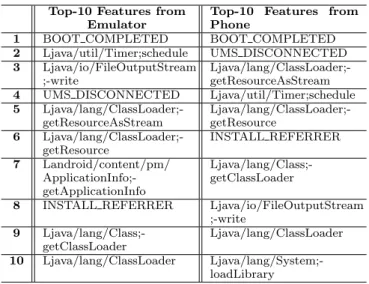
Table 1: Top-10 Ranked Features Based on InfoGain
Top-10 Features from Emulator
Top-10 Features from Phone
1 BOOT COMPLETED BOOT COMPLETED
2 Ljava/util/Timer;schedule UMS DISCONNECTED
3 Ljava/io/FileOutputStream ;-write
Ljava/lang/ClassLoader;-getResourceAsStream
4 UMS DISCONNECTED Ljava/util/Timer;schedule
5 Ljava/lang/ClassLoader;-getResourceAsStream Ljava/lang/ClassLoader;-getResource 6 Ljava/lang/ClassLoader;-getResource INSTALL REFERRER 7 Landroid/content/pm/ ApplicationInfo;-getApplicationInfo Ljava/lang/Class;-getClassLoader
8 INSTALL REFERRER Ljava/io/FileOutputStream ;-write 9 Ljava/lang/Class;-getClassLoader Ljava/lang/ClassLoader 10 Ljava/lang/ClassLoader Ljava/lang/System;-loadLibrary
top 10 ranked features (based on InfoGain) in both sets (phone and emulator) are shown in Table 1.
3.4
Machine learning classifiers
In the experiments, the features were divided into five dif-ferent sets (20, 40, 60, 80 and 100 top ranked using InfoGain) in order to compare the performance of emulator and phone based detection using machine learning algorithms. The fol-lowing algorithms were used in the experiments: Support Vector Machine (SVM-linear), Naive Bayes (NB), Simple Logistic (SL), Multilayer Perceptron (MLP), Partial Deci-sion Trees (PART), Random Forest (RF), and J48 DeciDeci-sion Tree.
3.5
Metrics
Five metrics were used for the performance emulation of the detection approaches. These include: true positive rate (TPR), true negative ratio (TNR), false positive ratio (FPR), false negative ratio (FNR), and weighted average F-measure. The definition of these metrics are as follows:
T P R= T P T P+F N (1) T N R= T N T P+F N (2) F P R= F P T P+F N (3) F N R= F N T P+F N (4)
F−measure= 2∗recall∗precision
recall+precision (5) True positives (TP) is defined as the number of malware samples that are correctly classified, whereas the false neg-atives is defined as the number of malware samples that are incorrectly classified. True negatives (TN) is defined as the number of benign samples that are correctly classified, while false positives (FP) is defined as the number of benign sam-ples that are incorrectly classified. The F-measures is the accuracy metric which incorporates both the recall and the precision.
4.
RESULTS AND DISCUSSIONS
4.1
Experiment 1: Emulator vs Device
analy-sis and feature extraction
In order to validate our phone-based machine learning de-tection, we analysed the effectiveness of running the samples and extracting features from both phone and emulator envi-ronments. Out of the 1222 malware samples used, 1205 were successfully run on a real phone compared to only 939 suc-cessfully run on an emulator. From the benign samples, 1097 out of 1222 were successfully examined using a real phone versus 786 from the emulator for the same dataset. There-fore, 98.6% malware sample were successfully analysed us-ing the phone, while only 76.84% were successfully analysed when using the emulator. Also, 90% of the benign samples were successfully analysed using the phone versus 64.27% us-ing the emulator. That gives us a total of 94.3% successfully analysed using the phone compared to only 70.5% using the emulator as illustrated in Table 2 .
The phone-based experiments were performed using a San-toku Linux-based VM. During the study we discovered that the use of USB 2.0 or 3.0 was essential. In our initial exper-iments where the default USB 1.0 was utilized to attach the phone, only 480 out of the 1222 benign samples were able to run. This was due to the fact that samples>1 MB in size took longer to analyse and hence experienced a ’time-out’ error with the use of the slower USB 1.0 standard. We also noticed that apps that did not have any Activities crashed and could not be analysed on the phone or emulator. This accounted for a small percentage of the apps that failed to run successfully.
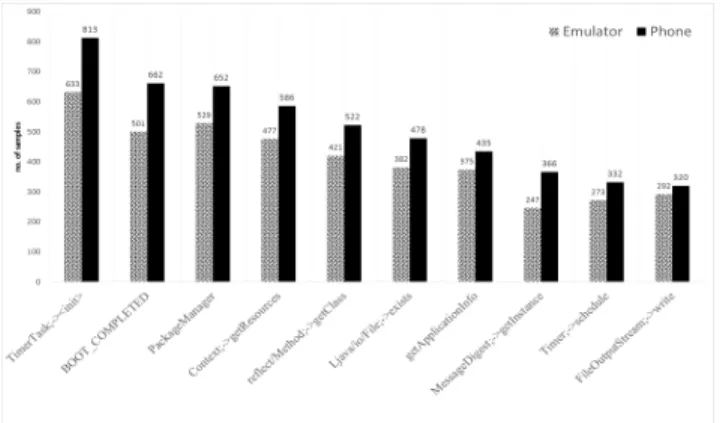
Fig. 3 and Fig. 4 show the top-10 extracted features from malware and benign dataset respectively. Fig. 3 shows that more malware features are able to be extracted from the phone based analysis vs. the emulator based analysis from the same sample set. The feature ”TimerTask;-><init>”, for example, was logged from 813 malware applications us-ing the phone, while it was only logged from 633 malware applications using the emulator. Similarly, the feature ”in-tent.BOOT COMPLETED” in Fig. 3, has been extracted from 662 malware applications using the phone whereas only 501 were extracted from the same sample set using the em-ulator.
Similar findings appear with the benign samples as shown in Fig. 4. More samples were able to be analysed using the phone. With some features, the difference between phone and emulator extraction were > 200. The more features we can extract during the dynamic analysis the better the result of the detection mechanism is likely to be. There were some features that were extracted exclusively from the phone but not with the emulator. These are shown in Table 3. The System.loadLibrary feature (found in 209 apps) is the API call associated with native code. The reason it is not logged when the emulator is used could be due to the lack of ability to run native code on the emulator. Overall, Table 2: Percentage of successfully analysed Android apps
Emulator Phone
Malware samples 76.84% 98.6%
Benign samples 64.27% 90%
Total 70.5% 94.3%
Table 3: Features extracted from Phone but not obtained with the emulator
Extracted Feature Phone Emulator
Ljava/lang/System;->loadLibrary 209 0 Ljava/net/URLConnection;->connect 14 0 Landroid/content/Context;->unbindService 4 0 Landroid/app/Service;->onCreate 3 0 BATTERY LOW 1 0 Landroid/telephony/SmsManager;->sendTextMessage 1 0
the phone based analysis shows a much higher efficiency of detecting and extracting features for analysis of the apps or training machine learning classifiers.
4.2
Experiment 2: Emulator vs Device
Ma-chine learning detection comparison
Table 4 and Table 5 present the performance evaluation results of the different machine learning algorithms (for the top 100 features). The results demonstrates that using the phone-based features for the dynamic analysis approach is more effective for detecting and classifying the applications compared to the emulator. The results shown were obtained from testing on 33% of the samples while 66% were used for training the model. Table 5 shows that higher detection rates were obtained from the phone-based features for all the algorithms (top 100 training features). TPR of >90% were obtained with all but the N.B classifier with the phone-based features. Whereas, NB, SL, PART, and J48 all had <90% TPR with the emulator-based features.As mentioned earlier, 939/1222 malware and 786/1222 be-nign samples executed successfully on the emulator (i.e. to-tal of 1725 out of 2444 samples). Out of these 1725 sam-ples, 12 did not execute successfully on the phone. Thus there were 1713 (939 malware and 774 benign) overlapping apps that executed successfully on both the emulator and the phone. Another set of experiments were performed with only the apps that executed in BOTH the emulator and phone successfully. The results (for top 100 features) using 66% training and 33% testing split are shown in Tables 6 and 7 respectively.
Figure 3: Top-10 features extracted from the malware dataset in two different analysis environments (Emulator and Phone-USB2.0)
Figure 4: Top-10 features extracted from the benign dataset in two different environments (Emulator and Phone-USB2.0)
The results show with the exception of RF, all of the tested algorithms in the data collected from emulator recorded an F-measure of<0.9, whereas with the phone, only NB, PART and J48 recorded<0.9 F-measure. Again, the results indi-cate better performance with the phone-based features.
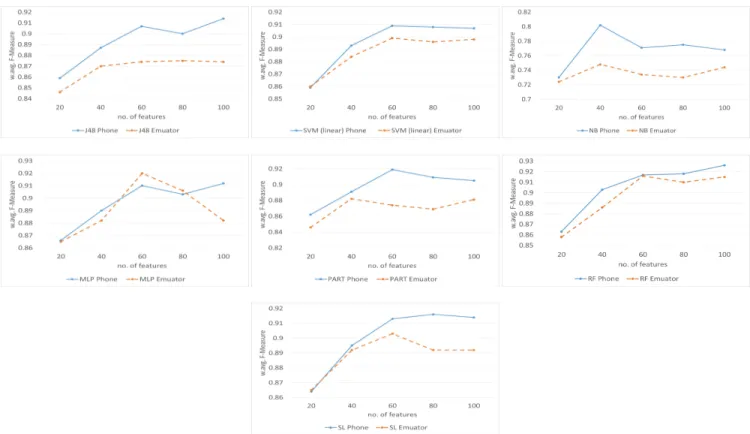
Fig. 5 shows the results from top 20, 40, 60, 80 and 100 information-gain ranked features for the first experiment. It depicts the F-measures obtained for the various machine learning algorithms trained on both phone and emulator data. From the figure it is clear that the overall detection performance is better with the phone than the emulator. It is only in the case of MLP-80 features that the emulator records a better f-measure performance.
Fig. 6 shows the results from top 20, 40, 60, 80 and 100 information-gain ranked features for the second experiment, where only apps that executed successfully in BOTH en-vironments were used. In all the cases, the phone-based experiments showed better performance except in the fol-lowing: J48-60 features, SVM-20 features, RF-100 features and SL-20 features. Thus, we can conclude that the phone-based method still surpassed the emulator-phone-based method in overall performance prediction.
Table 4: Performance Evaluation of the machine learning algorithms trained from Emulator-based features (top 100 features) ML TPR FPR TNR FNR W-FM SVM-linear 0.909 0.109 0.891 0.091 0.9 NB 0.596 0.102 0.898 0.404 0.73 SL 0.899 0.102 0.898 0.101 0.899 MLP 0.924 0.098 0.902 0.076 0.914 PART 0.896 0.109 0.891 0.104 0.894 RF 0.909 0.068 0.932 0.091 0.919 J48 0.88 0.125 0.875 0.12 0.878
4.3
Comparison with other works
In this subsection, we compare our results with those ob-tained from the DroidDolphin [31] and STREAM [15] dynamic analysis frameworks. DroidDolphin is a dynamic analysis framework for detecting Android malware applica-tions which leverages the technologies of GUI-based testing, big data analysis, and machine learning. STREAM is also
Table 5: Performance Evaluation of the machine learning algorithms from Phone-based features (top 100 features)
ML TPR FPR TNR FNR W-FM SVM-linear 0.916 0.096 0.904 0.084 0.91 NB 0.629 0.125 0.875 0.371 0.744 SL 0.919 0.085 0.915 0.081 0.917 MLP 0.919 0.088 0.912 0.081 0.916 PART 0.904 0.101 0.899 0.096 0.902 RF 0.931 0.08 0.92 0.069 0.926 J48 0.926 0.104 0.896 0.074 0.912
Table 6: Evaluation of the machine learning algorithms on Emulator-based features extracted from apps run success-fully in BOTH environments (top 100 features)
ML TPR FPR TNR FNR W-FM SVM-linear 0.89 0.122 0.878 0.11 0.885 NB 0.537 0.18 0.82 0.463 0.654 SL 0.884 0.11 0.89 0.116 0.887 MLP 0.887 0.106 0.894 0.113 0.89 PART 0.893 0.122 0.878 0.107 0.887 RF 0.911 0.069 0.931 0.089 0.919 J48 0.869 0.094 0.906 0.131 0.885
Table 7: Evaluation of the machine learning algorithms on Phone-based features extracted from apps run successfully in BOTH environments (top 100 features)
ML TPR FPR TNR FNR W-FM SVM-linear 0.905 0.109 0.891 0.095 0.907 NB 0.596 0.102 0.898 0.404 0.73 SL 0.902 0.098 0.902 0.098 0.902 MLP 0.905 0.072 0.928 0.095 0.916 PART 0.899 0.106 0.894 0.101 0.897 RF 0.918 0.064 0.936 0.082 0.926 J48 0.88 0.125 0.875 0.12 0.878
a dynamic analysis framework based on Andromaly which enables rapid large-scale validation of mobile malware ma-chine learning classifiers. DroidDolphin used 1000 to 64000 balanced malware and benign Android applications.
In the STREAM approach, the testing set used 24 benign and 23 malware applications while the training set consisted of 408 benign and 1330 malware applications. Both used split training/testing set (T.S.) and 10 fold cross-validation (C.V.) methods. Table 8 shows the comparison between our phone results (100 features) and the STREAM results, while Table 9 shows the results obtained from DroidDolphin.
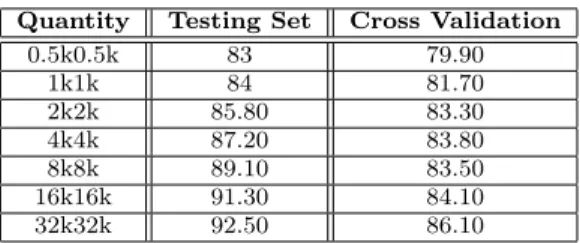
From the DroidDolphin results, it is obvious that the de-tection accuracy is increasing as the number of the training samples are increased. The accuracy rate starts from 83% for the training set with 1000 applications and increased gradually to 92.50% with 64k applications. Table 8 shows that despite the difference in the testing set numbers be-tween our work and STREAM, our phone based RF, SL, J48 and MLP perform significantly better for T.S. accuracy. In the case of C.V. accuracy, S.L performs better with our phone results, while the RF, J48, and MLP results were close to those of STREAM. The C.V. accuracy of RF, SL, J48 and MLP from our phone results showed better perfor-mance than all the DroidDolphin C.V. results.
Figure 5: F-measure for top 20,40,60,80 and 100 features. Phone vs. emulator comparison.
Figure 6: F-measure for top 20,40,60,80 and 100 features. Phone vs. emulator comparison for training with samples that executed successfully on BOTH emulator and phone.
Table 8: Accuracy results of Phone (100 features) vs STREAM
ML Real Phone STREAM
T.S. C.V. T.S. C.V. NB 75.2 72.9 78.91 79.79 Bayes net 74.8 74.1 81.25 86.23 RF 92.6 92.9 70.31 94.53 SL 91.4 90.4 68.75 89.52 J48 91.4 91.1 73.44 93.43 MLP 91.2 91.2 70.31 93.91
Table 9: Evaluation Results of DroidDolphin (Accuracy)
Quantity Testing Set Cross Validation
0.5k0.5k 83 79.90 1k1k 84 81.70 2k2k 85.80 83.30 4k4k 87.20 83.80 8k8k 89.10 83.50 16k16k 91.30 84.10 32k32k 92.50 86.10
For the T.S. results, our phone SL, J48 and MLP were bet-ter than DroidDolphin T.S. results except for the 32k/32k training/testing split T.S. results. The T.S. results from our phone based RF experiments showed better accuracy than all of the DroidDolphin T.S. results. Therefore, based on the encouraging results, we would continue our analysis us-ing the real phones with larger numbers of trainus-ing samples in future work.
5.
RELATED WORK
Once a new malware application is discovered in the wild, it should be run in a closed environment in order to under-stand its behaviour. Researchers and malware analysts rely heavily on emulators or virtual devices due to the fact that it is a comparatively low cost analysis environment. Emulators are also more attractive for automated mass analysis com-monly employed with machine learning. Hence, most previ-ous machine learning based detection with dynamic analysis rely on feature extraction using tools running on emulator environments. Contrary to previous machine learning based dynamic detection work, we attempt to utilize real phones (devices) for automated feature extraction in order to avoid the problem of anti-emulator techniques being employed by Android malware to evade detection.
Some previous machine learning based Android malware detection works such as [16], , [33], [13], [32], have consid-ered API calls and Intents in their studies. However, unlike our work, these are based on static feature extraction and thus could be affected by obfuscation. Marvin [23] applies a machine learning approach to the extracted features from a combination of static and dynamic analysis techniques in order to improve the detection performance. Shabtai et al [28] presented a dynamic framework called Andromaly which applies several different machine learning algorithms, including random forest, naive Bayes, multilayer perceptron, Bayes net, logistic, and J48 to classify the Android applica-tions. However, they assessed their performances on four self-written malware applications. MADAM [19] is also a dynamic analysis framework that uses machine learning to classify Android apps. MADAM extracted 13 features at
the user and kernel level. However, their experiments were only performed on an emulator with a small dataset. Crow-droid [18] is a cloud-based machine learning framework for Android malware detection. Crowdroid features were col-lected based on Strace from only two self-written malware samples. Most of these previous works utilize dynamic fea-tures extracted from emulator-based analysis. By contrast, in this paper our work is based on dynamically extracted fea-tures from real device and we perform a comparative anal-ysis between emulator and phone based machine learning approaches.
BareDroid [25] proposed a system designed to make bare-metal analysis of Android applications feasible. It presented analysis with malware samples from Android.HeHe [11], OBAD [12], and Android Pincer.A [3] families. Their work highlighted the anti-emulator capabilities of malware which can be solved by using real devices. Glassbox [21] also presented a dynamic analysis platform for analysing An-droid malware on real devices. However, unlike the work presented in this paper, these studies have not addressed machine learning based detection on real devices. Different from the previous studies, this paper presents a compara-tive analysis of machine learning based detection between real devices and emulators and investigates the effectiveness of run-time feature extraction in both environments.
6.
CONCLUSIONS
In this paper we presented an investigation of machine learning based malware detection using dynamic analysis on real Android devices. We implemented a tool to automat-ically extract dynamic features from Android phones and through several experiments we performed a comparative analysis of emulator based vs. device based detection by means of Random Forest, Naive Bayes, Multilayer Percep-tron, Simple Logistics, J48 decision tree, PART, and SVM (linear) algorithms. Our experiments showed that several features were extracted more effectively from the phone than the emulator using the same dataset. Furthermore, 23.8% more apps were fully analyzed on the phone compared to emulator. This shows that for more efficient analysis the phone is definitely a better environment as far more apps crash when being analysed on the emulator. The results of our phone-based analysis obtained up to 0.926 F-measure and 93.1% TPR and 92% FPR with the Random Forest clas-sifier and in general, phone-based results were better than emulator based results. Thus we conclude that as an in-centive to reduce the impact of malware anti-emulation and environmental shortcomings of emulators which affect anal-ysis efficiency, it is important to develop more effective ma-chine learning device based detection solutions. Hence fu-ture work will aim to investigate more effective, larger scale device based machine learning solutions using larger sample datasets. Future work could also investigate alternative set of dynamic features to those utilized in this study.
7.
REFERENCES
[1] Smartphone OS market share worldwide 2009-2015|
Statistic, Statista
https://www.statista.com/statistics/263453/
global-market-share-held-by-smartphone-operating-systems. [2] Global smartphone shipments by OS 2016 and 2020|
Statistic, https://www.statista.com/statistics/309448/ global-smartphone-shipments-forecast-operating-system/.
[3] F-Secure, Android Pincer A, https:
//www.f-secure.com/weblog/archives/00002538.html. [4] DroidBox, Google Archive
https://code.google.com/archive/p/droidbox/#! [5] SandDroid, Hu.Wenjun, http://sanddroid.xjtu.edu.cn/. [6] CopperDroid, http://copperdroid.isg.rhul.ac.uk/copperdroid/. [7] Tracedroid, http://tracedroid.few.vu.nl/. [8] NVISO ApkScan - Scan Android applications for
malware, https://apkscan.nviso.be/.
[9] Android Malware Genome Project, Yajin Zhou and Xuxian Jiang, http://www.malgenomeproject.org/. [10] APIMonitor, https: //github.com/pjlantz/droidbox/wiki/APIMonitor. [11] FireEye, Android.HeHe, https: //www.fireeye.com/blog/threat-research/2014/01/ android-hehe-malware-now-disconnects-phone-calls. html.
[12] Contagio mobile mini-dump, OBAD,
http://contagiominidump.blogspot.co.uk/search/ label/Backdoor.AndroidOS.Obad.a.
[13] Y. Aafer, W. Du, and H. Yin. DroidAPIMiner: Mining API-Level Features for Robust Malware Detection in Android.Security and Privacy in Communication Networks, 127:86–103, 2013.
[14] M. K. Alzaylaee, S. Y. Yerima, and S. Sezer. DynaLog: An automated dynamic analysis framework for characterizing android applications.2016 International Conference on Cyber Security and Protection of Digital Services, Cyber Security 2016, 2016.
[15] B. Amos, H. Turner, and J. White. Applying machine learning classifiers to dynamic android malware detection at scale.2013 9th International Wireless Communications and Mobile Computing Conference, IWCMC 2013, pages 1666–1671, 2013.
[16] D. Arp, M. Spreitzenbarth, H. Malte, H. Gascon, and K. Rieck. Drebin: Effective and Explainable Detection of Android Malware in Your Pocket.Symposium on Network and Distributed System Security (NDSS), (February):23–26, 2014.
[17] U. Bayer, I. Habibi, D. Balzarotti, E. Kirda, and C. Kruegel. A view on current malware behaviors. Proceedings of the 2nd USENIX conference on Large-scale exploits and emergent threats: botnets, spyware, worms, and more, page 8, 2009.
[18] I. Burguera, U. Zurutuza, and S. Nadjm-Tehrani. Crowdroid: Behavior-Based Malware Detection System for Android.Proceedings of the 1st ACM workshop on Security and privacy in smartphones and mobile devices - SPSM ’11, page 15, 2011.
[19] G. Dini, F. Martinelli, A. Saracino, and D. Sgandurra. MADAM: A multi-level anomaly detector for android malware.Lecture Notes in Computer Science
(including subseries Lecture Notes in Artificial Intelligence and Lecture Notes in Bioinformatics), 7531 LNCS:240–253, 2012.
[20] W. Enck, P. Gilbert, B.-G. Chun, L. P. Cox, J. Jung, P. McDaniel, and A. N. Sheth. TaintDroid: An Information-Flow Tracking System for Realtime
Privacy Monitoring on Smartphones.Osdi ’10, 49:1–6, 2010.
[21] P. Irolla and E. Filiol. Glassbox: Dynamic Analysis Platform for Malware Android Applications on Real Devices. 2016.
[22] Y. Jing, Z. Zhao, G.-J. Ahn, and H. Hu. Morpheus: Automatically Generating Heuristics to Detect Android Emulators.Proceedings of the 30th Annual Computer Security Applications Conference on -ACSAC ’14, pages 216–225, 2014.
[23] M. Lindorfer and M. Neugschwandtner. Marvin: Efficient and comprehensive mobile app classification through static and dynamic analysis.Computer Software and Applications Conference (COMPSAC), 2015 IEEE 39th Annual, 2:422–433, 2015.
[24] McAfee Labs. McAfee Labs Threats Predictions Report. (March):34–35, 2016.
[25] S. Mutti, Y. Fratantonio, A. Bianchi, L. Invernizzi, J. Corbetta, D. Kirat, C. Kruegel, and G. Vigna. BareDroid.Proceedings of the 31st Annual Computer Security Applications Conference on - ACSAC 2015, pages 71–80, 2015.
[26] J. Oberheide and C. Miller. Dissecting the Android Bouncer.Summercon 2012, 2012.
[27] V. Rastogi, Y. Chen, and W. Enck. AppsPlayground : Automatic Security Analysis of Smartphone
Applications.CODASPY ’13 (3rd ACM conference on Data and Application Security and Privac), pages 209–220, 2013.
[28] A. Shabtai, U. Kanonov, Y. Elovici, C. Glezer, and Y. Weiss. ”Andromaly”: A behavioral malware detection framework for android devices.Journal of Intelligent Information Systems, 38(1):161–190, 2012. [29] K. Tam, S. J. Khan, A. Fattori, and L. Cavallaro.
CopperDroid: Automatic Reconstruction of Android Malware Behaviors.Ndss, (February):8–11, 2015. [30] T. Vidas and N. Christin. Evading android runtime
analysis via sandbox detection.ASIA CCS ’14 (9th ACM symposium on Information, computer and communications security), pages 447–458, 2014. [31] W.-C. Wu and S.-H. Hung. Droiddolphin: A dynamic
android malware detection framework using big data and machine learning. InProceedings of the 2014 Conference on Research in Adaptive and Convergent Systems, RACS ’14, pages 247–252, New York, NY, USA, 2014. ACM.
[32] S. Y. Yerima, S. Sezer, and I. Muttik. Android Malware Detection : an Eigenspace Analysis
Approach.Science and Information Conference, pages 1–7, 2015.
[33] S. Y. Yerima, S. Sezer, and I. Muttik. High accuracy android malware detection using ensemble learning. IET Information Security, 9(6):313–320, 2015.