The Building Performance Tracking Handbook
C o n T i n u o u s i m P r o v e m e n T f o r e v e r y B u i l d i n g
Continuous Improvement for Every Building. That is the promise
of building performance tracking. It is a strategy to improve the
operation of facilities at any stage of performance.
It encompasses tools and practices that enable every building to boost value without breaking the bank. It is flexible and forgiving in recognizing that buildings exist to serve occupants first. And, it is practical in that it champions existing tools, low-cost tools, and intuitive tools foremost.
At the core of building performance tracking is a single principle: while tools are the enabling force for improved performance, people represent the guiding hand that leads to results. Recognizing this is the first step to seeing operating costs fall, asset values grow, and market differentiation improve for your buildings.
The future of building performance tracking is being shaped every day by the decisions of forward-looking building owners, property managers, and energy managers. With this handbook, become a part of the growing push for more responsible and effective strategies for building energy management.
About the California Energy Commission (CEC): Created by the California Legislature in 1974, the California Energy Commission is the state’s primary energy policy and planning agency. The Energy Commission has five major responsibilities: forecasting future energy needs and keeping historical energy data; licensing thermal power plants 50 megawatts or larger; promoting energy efficiency through appliance and building standards; developing energy technologies and supporting renewable energy; and planning for and directing state response to energy emergency.
About the California Commissioning Collaborative (CCC): The California Commissioning Collaborative is a non-profit organization committed to improving the performance of buildings and their systems. The CCC is made up of utility, real estate, and building services organizations and professionals who have come together to create a viable market for building commissioning in California. For more information, visit www.cacx.org.
LEGAL NOTICE
This report was prepared as a result of work sponsored by the California Energy Commission (Energy Commission). It does not necessarily represent
the views of the Energy Commission, its employees, or the State of California. The Energy Commission, the State of California, its employees,
contractors, and subcontractors make no warranty, express or implied, and assume no legal liability for the information in this report; nor does any party represent that the use of this information will not infringe upon privately owned rights. This report has not been approved or disapproved
by the Energy Commission nor has the Energy Commission passed upon the accuracy or adequacy of the information in this report.
The Building Performance Tracking Handbook
Acknowledgements
This California Commissioning Collaborative (CCC) project was funded by the California Energy Commission’s Public Interest Energy Research Program. The CCC would like to thank the many individuals and organizations that contributed their time and effort to develop this handbook, and in particular Enovity, Inc., who assisted with the research behind the handbook, the project Technical Advisory Group, and the case study participants.
Doug Chamberlin
EnerNOC
Beth Chambers
California Energy Commission
Tim Fackler
Enovity, Inc.
Jessica Granderson
Lawrence Berkeley National Laboratory
David Hodgins
Clinton Climate Initiative
Mark Jewell
EEFG, Inc.
Southard Jones
Pacific Gas and Electric Company
Srinivas Katipamula
Pacific Northwest National Laboratory
Damon McFall
Univ. of Illinois at Urbana-Champaign
Mary Ann Piette
Lawrence Berkeley National Laboratory
Carlos Santamaria
Glenborough, LLC
Chris Scruton
California Energy Commission
Denis Silva
Vanderweil Engineers
Cornel Sneekes
ABM Industries Incorporated
Ryan Stroupe
Pacific Energy Center
Dennis Thurman
Transwestern
Glenda Towns
Southern California Gas Company
Joy Ulickey
Enovity, Inc.
Brenna Walraven
USAA Real Estate Company
Bryan Welsh
Welsh Commissioning Group, Inc.
Jeff Zazzara
Emerson Climate Technologies ©2011 California Commissioning Collaborative
Prepared by Portland Energy Conservation, Inc.
Hannah Friedman, Eliot Crowe, Emilia Sibley, and Mark EffingerContract Manager
Beth Chambers, California Energy Commission
Technical Advisory Group
The project’s Technical Advisory Group provided valuable feedback during the making of this handbook. The group represents a cross-section of the commercial building and energy efficiency industries:
April 2011
The California Energy Committee of the Building Owners and Managers Association (BOMA) is pleased to endorse The Building Performance Tracking Handbook developed by the California Commissioning Collaborative.
The handbook describes the process for monitoring and improving the energy and system performance of commercial buildings. It puts the technical tools and concepts into understandable terms and provides direction to improve building performance tracking.
The reason for our endorsement is simple: the handbook presents a comprehensive process for choosing a performance tracking strategy and evaluating tools on the market. It guides building owners at every stage in this process, whether they are benchmarking with ENERGY STAR® Portfolio Manager or investing in fault detection and diagnostic tools. This handbook is also a valuable tool in supporting BOMA’s 7-Point Challenge, the BOMA 360 Performance Program, and the BOMA Energy Efficiency Program (BEEP). The mission of BOMA California is to preserve and promote the interests of California commercial real estate professionals through legislative and regulatory advocacy. Building performance tracking will become a routine part of building management in California. By endorsing this handbook, we are helping building owners identify best practice, advance their facilities, and keep pace with the commercial building industry.
Joy Cole
Chairman
The Building Performance Tracking Handbook
About the Handbook
This handbook was created to introduce the basic concepts behind building performance tracking for commercial buildings. While geared toward medium to large buildings or portfolios of buildings, many of these same concepts apply to smaller commercial buildings.
Building performance tracking is a strategy to help building owners ensure that mechanical and electrical systems operate as intended and that energy use is not higher than necessary. The handbook content was developed through a California Commissioning Collaborative research project, which discovered several key findings about building performance tracking today:
■ Building performance tracking is typically an informal process that varies considerably among building owners and managers
■ Sophisticated software and hardware tools are available, but it’s not always clear how to compare the wide variety and select the most suitable option
Most building owners have begun elements of their building performance tracking strategy. However, there is notable uncertainty in the industry regarding the specific steps and tools to achieve success. Understanding this, the handbook has three goals:
1. Describe the steps needed to continually manage building performance
2. Introduce the complex array of building performance tracking tools available
3. Provide guidance for choosing the right strategy based on business needs and resources
The handbook is not intended to comprehensively list all available tools in a “consumer report,” nor is it a technical manual for using tools. Instead, it provides a basic
framework for owners and energy managers to understand building performance tracking and ask the right questions of tool vendors, operators, and contractors about their facilities.
Who Is the Handbook For?
The handbook is primarily intended for property managers, energy managers, and facility engineers. It may also benefit facilities services contractors and building operators.
How Do I Use It?
The handbook has four main sections that build upon each other.
■ Introduction gives an overview of building performance tracking and the basis for making a solid business case. ■ The Basics outlines the three basic tools that form the
foundation for building performance tracking: energy benchmarking, utility bill analysis, and using the building automation system (BAS) for troubleshooting.
■ Beyond the Basics introduces the four tools that can take owners to higher levels of performance: energy information systems (EIS), advanced EIS, BAS metrics, and fault detection and diagnostics (FDD).
■ What’s Next? provides a framework to help decision-makers determine which tools fit their business needs, as well as a list of helpful resources.
This handbook is intended to inspire action around building performance tracking, whether owners are enhancing existing strategies or establishing new strategies for the first time. Above all, this handbook was created to show readers that building performance tracking strategies are not just for high performance buildings, but for every building.
Contents
Introduction to Building Performance Tracking 1
1 What Is Building Performance Tracking? . . . 4
Introducing Building Performance Tracking . . . 4
Building Performance Tracking and Commissioning . . . 7
How Does Building Performance Tracking Work? . . . 9
2 The Business Case . . . .12
Business Reasons for Building Performance Tracking . . . .12
Impact of Ownership and Leasing Types . . . .14
The Basics of Building Performance Tracking 17 3 Management Framework . . . .19
Why Does a Strong Management Framework Matter? . . . .19
Steps to Build a Management Framework . . . .19
4 Basic Tools . . . .24
Energy Benchmarking . . . .25
Utility Bill Analysis . . . .27
Building Automation System for Troubleshooting . . . .29
Beyond the Basics 33 5 Energy Tracking . . . .36
Energy Information Systems . . . .37
Advanced Energy Information Systems . . . .45
6 System Tracking . . . .50
Building Automation System Metrics . . . .51
Fault Detection and Diagnostics . . . .56
What’s Next? 64 7 Selecting an Approach . . . .67
introduction to
Building Performance Tracking
"Decisions made now will be with the building
for five, ten, maybe even 25 years."
— Carlos Santamaria, LEED AP
Vice President, Engineering Services, Glenborough, LLC
Introduction What Is Building Performance Tracking? Introducing Building Performance Tracking Building Performance Tracking and Commissioning
How Does Building Performance Tracking Work?
The Business Case Business Reasons for Building Performance Tracking
Impact of Ownership and Leasing Types
The Basics
Management Framework Basic Tools
Beyond the Basics Energy Tracking System Tracking What’s Next? Selecting an Approach Useful Resources
Introduction to
Building Performance Tracking
What is building performance tracking? This section introduces building performance tracking concepts and their relationship to existing building commissioning. It provides the foundation for readers to understand the tools and strategies described in The Basics and the advanced tools described in Beyond the Basics.This section is comprised of two chapters that will help answer the following questions:
What Is Building Performance Tracking?
■ What does the term “building performance tracking” mean?■ What are the reasons for heightened awareness around building performance tracking?
■ What are the essential elements of a building performance tracking strategy?
The Business Case
■ What are the strategic business and financial reasons for tracking building performance?
■ How might ownership and leasing arrangements affect the costs and benefits of building performance tracking strategies?
3
The Building Performance Tracking Handbook Introduction What Is Building Performance Tracking? Introducing Building Performance Tracking Building Performance Tracking and CommissioningHow Does Building Performance Tracking Work?
The Business Case Business Reasons for Building Performance Tracking
Impact of Ownership and Leasing Types
The Basics
Management Framework Basic Tools
Beyond the Basics Energy Tracking System Tracking What’s Next?
Selecting an Approach Useful Resources
Building Performance Tracking:
A Process of Continuous Improvement
Building performance tracking is a process of continuous improvement. The four steps in Figure 1 show the fundamental process for tracking, analyzing, diagnosing, and resolving issues with heating, ventilation, and air conditioning (HVAC) and lighting systems. Building performance is tracked on an ongoing basis and incorporated as part of standard processes.1
2
3
4
COLLECT DATA & TRACK PERFORMANCE
DETECT
PERFORMANCE ISSUES
DIAGNOSE ISSUES & IDENTIFY SOLUTIONS FIX ISSUES &
VERIFY RESULTS
Introduction What Is Building Performance Tracking? Introducing Building Performance Tracking Building Performance Tracking and Commissioning
How Does Building Performance Tracking Work?
The Business Case Business Reasons for Building Performance Tracking
Impact of Ownership and Leasing Types
The Basics
Management Framework Basic Tools
Beyond the Basics Energy Tracking System Tracking What’s Next? Selecting an Approach Useful Resources
What Is Building
Performance Tracking?
Buildings are investments with significant profit potential. In today’s commercial building market, buildings need to be comfortable for occupants and must operate efficiently to remain competitive. Building owners who achieve this balance benefit from deep cost savings and market leadership.
Introducing Building Performance Tracking
Building performance tracking is a long-term strategy for supporting the continuous improvement of building systems. It is fueled by the hardware, software, people, and processes that make optimization a regular part of building management.At its core, building performance tracking is a process that monitors how efficiently a building meets its occupants’ needs, which includes maintaining: ■ Comfortable temperatures and humidity
■ Ventilation requirements ■ Lighting requirements
Modern building HVAC and lighting systems are interactive and complex. Over time, many building systems begin to operate inefficiently and may require frequent attention to ensure they are optimized. For example, sensors may drift out of calibration, building use could change, and adjustments in control sequences might affect how well systems work together. This can result in occupant complaints and increased energy costs. Building performance tracking is a proactive strategy for achieving occupant comfort without jeopardizing energy performance.
Today’s building systems also generate huge amounts of data. This data is highly valuable, as system faults are often invisible to building operators without it. Building performance tracking helps operators gather and analyze data to diagnose problems and identify solutions.
Lastly, to become an industry leader in today’s market, owners of income-producing properties must attract and retain tenants by boosting building
5
The Building Performance Tracking Handbook Introduction What Is Building Performance Tracking? Introducing Building Performance Tracking Building Performance Tracking and CommissioningHow Does Building Performance Tracking Work?
The Business Case Business Reasons for Building Performance Tracking
Impact of Ownership and Leasing Types
The Basics
Management Framework Basic Tools
Beyond the Basics Energy Tracking System Tracking What’s Next?
Selecting an Approach Useful Resources
operating costs and better information about how a building performs compared to its peers.
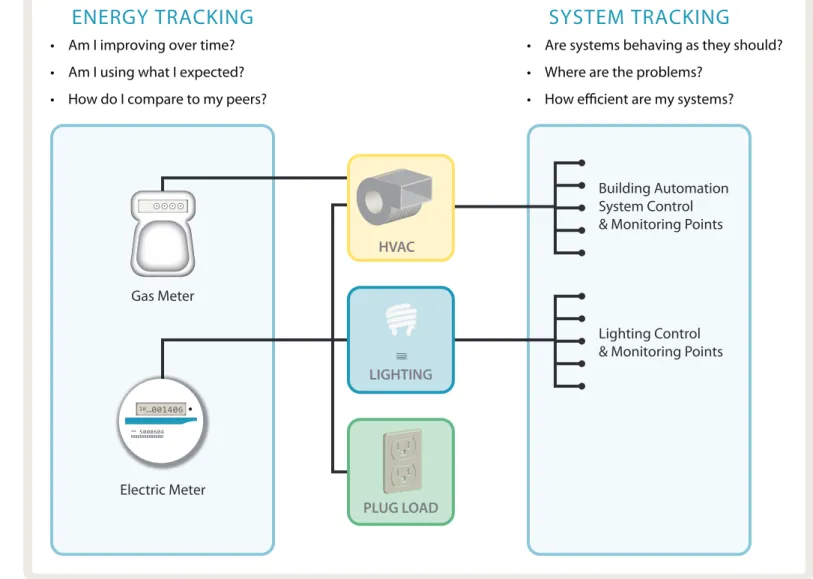
The goal of building operation is to achieve optimal occupant comfort with the least amount of energy consumption. Buildings that achieve this balance do so by addressing the two main elements of building performance: 1) System Tracking for HVAC and lighting systems, and 2) Energy Tracking for the whole building and wherever submeters are in place.
Building owners should address both sides of the coin to reap the full rewards of tracking building performance, since each side can answer different questions about building operation. Figure 2 shows how meters and controls gather data on system or energy performance for HVAC, lighting, and plug load systems.
Success Story: University of California, Davis
Eight years ago, energy management at the University of California, Davis was a limited, manual process. There were few meters available across the campus, so energy use was simply not monitored at the building level. Fast forward eight years, and UC Davis has made tremendous strides in its building performance tracking strategy.
Tracking energy performance at UC Davis is no small feat. The 5,000 acre campus operates on the scale of a small city, with 1,200 buildings totaling 14 million square feet and a wide variety of HVAC and lighting control systems.
Fortunately, UC Davis has tools and management strategies to help overcome these challenges, including an energy information system for continuous monitoring of building energy meters, and the HVAC central plant’s control system. Tool features include:
■ Electricity and gas usage data collection ■ Data aggregation and analysis
■ Reporting and data storage ■ Web-based dashboard
Introduction What Is Building Performance Tracking? Introducing Building Performance Tracking Building Performance Tracking and Commissioning
How Does Building Performance Tracking Work?
The Business Case Business Reasons for Building Performance Tracking
Impact of Ownership and Leasing Types
The Basics
Management Framework Basic Tools
Beyond the Basics Energy Tracking System Tracking What’s Next? Selecting an Approach Useful Resources HVAC LIGHTING PLUG LOAD Electric Meter
• Am I improving over time? • Am I using what I expected? • How do I compare to my peers?
• Are systems behaving as they should? • Where are the problems?
• How efficient are my systems?
Building Automation System Control & Monitoring Points
Lighting Control & Monitoring Points Gas Meter
ENERGY TRACKING
SYSTEM TRACKING
7
The Building Performance Tracking Handbook Introduction What Is Building Performance Tracking? Introducing Building Performance Tracking Building Performance Tracking and CommissioningHow Does Building Performance Tracking Work?
The Business Case Business Reasons for Building Performance Tracking
Impact of Ownership and Leasing Types
The Basics
Management Framework Basic Tools
Beyond the Basics Energy Tracking System Tracking What’s Next?
Selecting an Approach Useful Resources
Building Performance Tracking
and Commissioning
Building performance tracking can serve as an ideal complement to existing building commissioning (EBCx) – also referred to as retrocommissioning (RCx) or recommissioning (ReCx). Building performance tracking helps verify the energy savings achieved through EBCx and ensures that occupant comfort and financial benefits last.
EBCx is a systematic process for investigating, analyzing, and optimizing the performance of building systems by improving their operation and maintenance. EBCx helps ensure that building systems are well-integrated and meet current facility requirements. In practice, EBCx has been shown to reduce energy costs by an average of 16 percent, and provide non-energy benefits such as improved occupant comfort and reduced maintenance costs1. Ongoing commissioning extends the EBCx process by incorporating building performance tracking, training, and updated documentation so that energy savings persist.
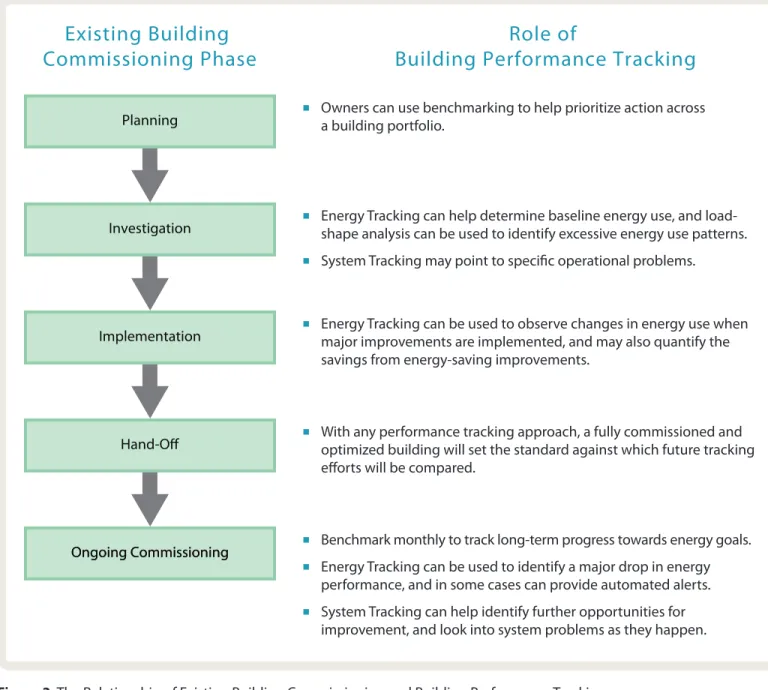
Figure 3 shows the role that building performance tracking could play at each phase of EBCx, however performance tracking strategies are not a prerequisite for EBCx.
Fix the Building or Install Performance Tracking Tools: Which Comes First?
There are two potential paths for tracking building performance and commissioning a facility:
1. Install the performance tracking system and use it to help identify problems and quantify savings. 2. Implement improvements through existing building commissioning first, then invest in the
performance tracking system to preserve the savings.
The path forward depends on a combination of staff availability and expertise, and the tools selected to support performance tracking.
While not a cut-and-dry rule, it is generally recommended to commission prior to, or during,
implementation of building performance tracking tools and strategies. This way, building systems are optimized from day one, and performance can be maintained at that level going forward.
Introduction What Is Building Performance Tracking? Introducing Building Performance Tracking Building Performance Tracking and Commissioning
How Does Building Performance Tracking Work?
The Business Case Business Reasons for Building Performance Tracking
Impact of Ownership and Leasing Types
The Basics
Management Framework Basic Tools
Beyond the Basics Energy Tracking System Tracking What’s Next?
Selecting an Approach Useful Resources
Figure 3: The Relationship of Existing Building Commissioning and Building Performance Tracking
Existing Building
Commissioning Phase
Building Performance Tracking
Role of
Planning
Investigation
Implementation
Hand-Off
Ongoing Commissioning
Ongoing Commissioning ■ Benchmark monthly to track long-term progress towards energy goals. ■ Energy Tracking can be used to identify a major drop in energy
performance, and in some cases can provide automated alerts. ■ System Tracking can help identify further opportunities for
improvement, and look into system problems as they happen. ■ With any performance tracking approach, a fully commissioned and
optimized building will set the standard against which future tracking efforts will be compared.
■ Energy Tracking can be used to observe changes in energy use when major improvements are implemented, and may also quantify the savings from energy-saving improvements.
■ Energy Tracking can help determine baseline energy use, and load-shape analysis can be used to identify excessive energy use patterns. ■ System Tracking may point to specific operational problems.
■ Owners can use benchmarking to help prioritize action across a building portfolio.
9
The Building Performance Tracking Handbook Introduction What Is Building Performance Tracking? Introducing Building Performance Tracking Building Performance Tracking and CommissioningHow Does Building Performance Tracking Work?
The Business Case Business Reasons for Building Performance Tracking
Impact of Ownership and Leasing Types
The Basics
Management Framework Basic Tools
Beyond the Basics Energy Tracking System Tracking What’s Next?
Selecting an Approach Useful Resources
How Does Building Performance
Tracking Work?
As noted in Figure 1, there are four key elements to building performance tracking:
1. Collect data and track performance. HVAC and lighting performance data is tracked along with energy consumption data. A variety of tools are available to support tracking, and typically multiple tools will be used as part of an overall management strategy.
2. Detect performance issues. This process may be automated through the use of tools, or the tools may present information in a way that makes it easier for users to identify problems manually.
3. Diagnose issues and identify solutions. The skill, knowledge, and training of building operators or service contractors are key factors in diagnosing issues successfully and identifying the right solutions.
4. Fix issues and verify results. This is the most critical step to achieving the benefits of building performance tracking.
By repeating these steps, building owners can ensure the continued persistence of improvements.
People + Processes + Performance Tracking Tools
Building performance tracking requires the three Ps: People, Processes, and
Performance tracking tools. If one of these elements is missing, the benefits will be reduced.
The First ‘P’: People
Commitment from all building management stakeholders, from the board room to the mechanical room, is essential for building performance tracking. Its success hinges on approval from all levels of an organization. Without people instituting goals and rewards, and managing day-to-day performance, tools may fall into disuse and success becomes difficult.
Each stakeholder group is motivated by different needs and will benefit from different types of tools. Table 1 outlines the major distinctions among stakeholders.
1
2
3
Introduction What Is Building Performance Tracking? Introducing Building Performance Tracking Building Performance Tracking and Commissioning
How Does Building Performance Tracking Work?
The Business Case Business Reasons for Building Performance Tracking
Impact of Ownership and Leasing Types
The Basics
Management Framework Basic Tools
Beyond the Basics Energy Tracking System Tracking What’s Next?
Selecting an Approach Useful Resources
Table 1: The Stakeholders of Building Performance Tracking
FROM THE BOARD ROOM… …TO THE MECHANICAL ROOM
Who? Building owners, property managers, and energy
managers Building engineers and operators
Interested
in… Building or portfolio-level view System or equipment-level view
Driven by… Financial value of the building, budget forecasting, occupant comfort, company brand strategy, and energy and sustainability goals
Comfort complaints, daily load requirements, equipment downtime, and equipment lifecycle
Benefits
from… Context: How will building performance influence tenant retention, asset value, carbon regulations, and marketing? This group needs tools to prioritize capital investments, compare the performance of a building or portfolio, and increase NOI.
Specifics: When is a change in performance a problem, and what are the root causes of problems? How is equipment functioning at a given time? This group needs tools to understand the status and efficiency of equipment.
To learn more about the best practice roles and responsibilities for people, visit the Management Framework chapter.
The Second ‘P’: Processes
Processes are the key to embedding best practices in the daily management of commercial buildings. Processes define the framework in which people use performance tracking tools, and are critical to ensuring that owners and operators interpret performance data, take follow-up action, and see a boost in energy cost savings. If formal management processes are not in place, utilization of tools will be vulnerable to staff turnover.
Management processes that support building performance tracking include: ■ Allocation of the financial and labor resources
■ Well-defined reporting and accountability
■ Specific language to support building performance tracking in contracts with tenants and service providers
■ Incentives for building performance tracking job execution To learn more about creating sound processes, visit the Management Framework chapter.
The Third ‘P’: Performance Tracking Tools
USAA Real Estate and ENERGY STAR Portfolio Manager
USAA Real Estate Company offers a prime example of how an inexpensive, simple performance tracking tool can create significant results. With ENERGY STAR Portfolio Manager, a free online energy benchmarking tool, and in conjunction with internal tracking tools, USAA Real Estate tracks the cost savings gained from energy upgrades across its portfolio. The company’s dedication to energy improvement led to $2.8 million in energy
11
The Building Performance Tracking Handbook Introduction What Is Building Performance Tracking? Introducing Building Performance Tracking Building Performance Tracking and CommissioningHow Does Building Performance Tracking Work?
The Business Case Business Reasons for Building Performance Tracking
Impact of Ownership and Leasing Types
The Basics
Management Framework Basic Tools
Beyond the Basics Energy Tracking System Tracking What’s Next?
Selecting an Approach Useful Resources
benchmarking tools to sophisticated portfolio management tools. At their core, all of these tools track information about building performance and relay it to building owners and operators. There is a wide range in the quality and depth of this information, the extent to which tools function automatically or manually, and the upfront and ongoing costs of tools.
The primary functions of building performance tracking tools include: ■ Tracking progress towards sustainability goals
■ Prioritizing areas for action, for example across a portfolio of properties ■ Identifying system problems or other negative energy impacts
■ Diagnosing the root cause of system problems
■ Demonstrating that a system fix has been successful, or that a new piece of equipment is operating correctly
■ Ensuring that optimized building systems remain optimized
■ Measurement and Verification (M&V) of energy savings achieved or the persistence of savings under EBCx or ongoing commissioning programs To learn more about tools, visit Basic Tools and Beyond the Basics.
The next chapter describes the benefits of building performance tracking and provides the information needed for building owners to build the business case.
Introduction What Is Building Performance Tracking? Introducing Building Performance Tracking Building Performance Tracking and Commissioning
How Does Building Performance Tracking Work?
The Business Case
Business Reasons for Building Performance Tracking
Impact of Ownership and Leasing Types
The Basics
Management Framework Basic Tools
Beyond the Basics Energy Tracking System Tracking What’s Next?
Selecting an Approach Useful Resources
The Business Case
This chapter describes the strategic business and financial benefits of building performance tracking, and gives building owners, property managers, and energy managers the facts to help obtain buy-in within their organizations.
Business Reasons for Building
Performance Tracking
As a cornerstone strategy for continuous improvement, building performance tracking is a necessary step to meet the challenges of the commercial building industry. One of these challenges is a greater focus of tenants and the public on the sustainability of buildings, requiring more compelling tenant attraction and retention strategies. In addition, owners face the continual need to increase market presence, cost savings, and asset value to maintain a competitive edge. The upward trend in energy costs is another challenge; nationwide electric costs increased by 43% on average between 1999 and 20082. Lastly, legislation on energy disclosure and carbon emissions for commercial buildings is an ongoing challenge for owners.
Why is building performance tracking necessary to meet these challenges? This chapter answers that question by describing the direct and indirect financial benefits of building performance tracking. Some of the direct financial benefits include: ■ Electric and gas cost savings
■ Higher net operating income (NOI), profit, and asset value ■ Increased occupant satisfaction and tenant attraction ■ Elevated market presence as a leader on sustainability issues
Building performance tracking has many indirect financial benefits because of the powerful knowledge it provides. With building performance tracking, owners and energy managers can:
■ Understand how a single building compares to other buildings within a portfolio, and how it compares to its own historical use as well as to industry peers. Higher performing buildings have a competitive advantage.
■ Support sustainability efforts, for instance those with more accurate energy savings and rebate calculations under programs like EBCx, and by tracking
Be Prepared for
Greenhouse Gas Reporting
On October 29, 2009, the Environmental Protection Agency (EPA) issued its Greenhouse Gas
Mandatory Reporting Rule, which requires facilities that emit 25,000 metric tons per year of carbon dioxide equivalent (CO2e) or more to collect and report their emissions to the EPA. While this excludes the vast majority of commercial facilities, which typically emit far less CO2e, it indicates where federal emissions reporting requirements may be heading.
Building performance tracking helps facilities stay on top of emerging federal requirements that may mean stricter standards for tracking, reporting, and accounting for electricity and gas use in the building
13
The Building Performance Tracking Handbook Introduction What Is Building Performance Tracking? Introducing Building Performance Tracking Building Performance Tracking and CommissioningHow Does Building Performance Tracking Work?
The Business Case
Business Reasons for Building Performance Tracking
Impact of Ownership and Leasing Types
The Basics
Management Framework Basic Tools
Beyond the Basics Energy Tracking System Tracking What’s Next?
Selecting an Approach Useful Resources
■ Provide better reporting mechanisms to all stakeholders, including operators, occupants, property managers, and investors, on the energy profile of a building or portfolio.
■ Provide a platform for occupants to see and understand their energy use. A more detailed discussion of the key benefits is included below in order to give building owners the relevant information to make the business case for building performance tracking at their organizations.
Reduce energy costs and enhance property value
Utility bills typically constitute 30 percent of a building’s operating expenses. Lower energy consumption equates to lower operating expenses, which for owner-occupied properties is a direct financial gain. For income-producing properties, a reduction in operating expenses translates into higher net operating income (NOI). NOI is calculated as:
NOI = Annual Gross Income - Operating Expenses
Assuming that all energy savings flow through to the bottom line, annual net operating income will increase by a value equal to the total annual savings. The increase in NOI contributes to higher asset value. Using the Income Approach, the most common way to value income-producing buildings, the increase in asset value is calculated as:
Asset Value Increase = Increase in Net Operating Income / Capitalization Rate Higher asset value is beneficial when a building is sold, but also when building owners want to leverage the property’s accumulated equity.
Maintain occupant satisfaction
Building performance tracking tools allow operators to identify spikes or dips in energy use more quickly, diagnose root causes, and in some cases preempt comfort complaints. A higher performing building can be a competitive advantage in attracting tenants, and a comfortable building will help retain tenants and boost occupant productivity.
Be positioned as an industry leader
Building performance tracking helps building owners improve their sustainability credentials through certification programs, including the Environmental Protection Agency’s ENERGY STAR® rating and the U.S. Green Building Council’s Leadership in Energy and Environmental Design® (LEED) program.
Link Between
Sustainability and Profits
Research that links sustainable buildings to higher rents and increased building value is growing.3,4 As this link becomes clearer, a greater emphasis will be placed on tracking building performance to maintain these benefits.
Introduction What Is Building Performance Tracking? Introducing Building Performance Tracking Building Performance Tracking and Commissioning
How Does Building Performance Tracking Work?
The Business Case Business Reasons for Building Performance Tracking
Impact of Ownership and Leasing Types
The Basics
Management Framework Basic Tools
Beyond the Basics Energy Tracking System Tracking What’s Next?
Selecting an Approach Useful Resources
Protect against liability
Gas leaks, poor indoor air quality, and non-compliant ventilation rates are examples of liability risks relating to building operation. Building performance tracking can help identify and address such system performance or safety problems more quickly, before they turn into liabilities.
Insurance for energy efficiency investments
Improvements to building systems do not always achieve the expected benefits. For example, operational control improvements may be overridden in response to a temporary event, or more efficient equipment may be installed but not optimized to reap the savings. Building performance tracking provides a window into the operation of a building, increasing the confidence in the long-term savings from energy projects.
Impact of Ownership and Leasing Types
Building ownership and leasing structures are critical factors in determining how the financial cost and benefit of building performance tracking and other energy-saving investments will affect owners, occupants, and investors. This section briefly describes the primary ownership and lease structures and their effect on stakeholder motivation.Building ownership
With owner-occupied properties, building owners typically enjoy the full benefit of energy cost savings from capital and operational improvements, while owners of income-producing properties realize benefits differently, depending on the lease structure.5
For income-producing properties, there are three major office leasing structures in the U.S.: fixed-base, net, and gross. The true value of a performance tracking tool, retrofit or operational improvement for a building owner will depend on the lease structure.
Under gross, single net, and double net leases, the same party (building owner) pays for both the capital or operational improvements and utility costs, and therefore obtains the full financial benefit of the improvements. Under triple net leases, the building owner pays for capital or operational improvements, while the tenant pays for utility costs, which may lead to the ‘split incentive’ problem. Under fixed-base leases, utility costs are shared among tenants and owners, so the benefits are shared and both parties are motivated to save energy.
Reducing Liability at UC Davis
At the University of California, Davis, an energy information system (EIS) tool alerted staff to a spike in natural gas consumption at student housing, which they quickly attributed to a gas leak in the laundry space. Fixing the leak avoided a major safety issue and produced immediate gas savings.
Energy Efficiency Economics
To learn more about leases and the financial costs and benefits of energy-saving investments, consider reading “Energy-Efficiency Economics: What You Need to Know,” HPAC Engineering.6
15
The Building Performance Tracking Handbook Introduction What Is Building Performance Tracking? Introducing Building Performance Tracking Building Performance Tracking and CommissioningHow Does Building Performance Tracking Work?
The Business Case Business Reasons for Building Performance Tracking
Impact of Ownership and Leasing Types
The Basics
Management Framework Basic Tools
Beyond the Basics Energy Tracking System Tracking What’s Next?
Selecting an Approach Useful Resources
In short, the ownership and leasing structure of commercial buildings, whether they are owner-occupied or income-producing, triple-net or gross, will influence the building owner’s monetary gain from capital and operational improvements.
‘Green leases’ for commercial buildings
The commercial building community has recognized the challenges of each lease structure and has begun to develop tools and templates to make the leasing process more energy conscious. Many options are available; two examples are listed below:
■ BOMA International Commercial Lease:Guide to Sustainable and Energy-Efficient Leasing for High-Performance Buildings7 is a guide to writing commercial real estate leases for high-performance green buildings. It offers an alternative structure to the triple net lease, in which owners have the right to pass through to tenants any capital costs that lower operating costs, including through maintenance, commissioning and green certification or rating programs.
■ The Green Leases Toolkit8, which was developed by the California
Sustainability Alliance, contains a suite of leasing guidelines and templates to facilitate dialogue between owners and tenants, define each party’s goals and objectives around sustainability, and create more transparency throughout the process.
The “Split Incentive” Problem
Split incentives happen when those responsible for paying energy bills and those making capital investment decisions are separate entities.
When owners pay utility bills, tenants are detached from their energy use and lack the financial incentive to use energy responsibly. When tenants pay utility bills, building owners are discouraged from making capital or operational improvements because tenants benefit from the energy cost savings.
Split incentives are a typical characteristic of tenant lease agreements, such as the triple net lease structure where tenants pay for utilities. Removing the split incentive problem is a key part of structuring leases to maximize energy performance.
Introduction What Is Building Performance Tracking? Introducing Building Performance Tracking Building Performance Tracking and Commissioning
How Does Building Performance Tracking Work?
The Business Case Business Reasons for Building Performance Tracking
Impact of Ownership and Leasing Types
The Basics
Management Framework Basic Tools
Beyond the Basics Energy Tracking System Tracking What’s Next?
Selecting an Approach Useful Resources
What You Learned In This Section: Introduction to Building Performance Tracking
Building performance tracking is a strategy to meet the new age of higher performing buildings. It is a strategy that is gaining attention in the press, and is a workhorse process that creates results. It requires people, processes, and performance tracking tools, and is defined by a four-step process to achieve continuous improvement.
To ensure a successful building performance tracking strategy, it is critical to gain buy-in from decision-makers through a strong business case, and understand how ownership and lease structures will influence costs and benefits.
These concepts provide the foundation for readers to understand the basic tools and strategies described next in The Basics, as well as the advanced tools described in Beyond the Basics.
The Basics of
Building Performance Tracking
“The highest aspirations and the most sophisticated
tools won’t help if you ignore the fundamentals.”
— Brenna Walraven, Managing Director
USAA Real Estate Company
Introduction What Is Building Performance Tracking? The Business Case The Basics
Management Framework Why Does a Strong Management Framework Matter? Steps to Build a Management Framework Basic Tools Energy Benchmarking Utility Bill Analysis BAS for Troubleshooting Beyond the Basics
Energy Tracking System Tracking What’s Next? Selecting an Approach Useful Resources
The Basics
of Building Performance Tracking
Building performance tracking can conjure up images of expensive tools with complex dashboards. While these tools can be powerful, they are far less valuable without a framework to drive their effective use. This section describes the basic strategies of building performance tracking for every building owner. These strategies are comprised of two main components:■ A strong management framework to guide the people and processes behind building performance tracking
■ The basic tools needed to establish a building’s baseline and to understand the context for energy and system performance. These tools include energy benchmarking tools, utility bill analysis tools, and the building automation system (BAS).
The two chapters in this section will help answer the following questions:
Management Framework
■ Why does a strong management framework matter?
■ What are the steps to build a strong management framework?
Basic Tools
■ How do I benchmark my building or portfolio? ■ What are my options for tracking utility bills?
■ How does the building automation system (BAS) fit into performance tracking? Every commercial building is unique, and there is no single ‘right’ strategy for building performance tracking. However, the concepts in this chapter describe the fundamental approach every building owner should take, whether they are starting, developing, or enhancing building performance tracking in their buildings.
“All of our energy management efforts are underpinned by two principles: energy benchmarking, so we more objectively know how we’re performing, and action plans, as a specific roadmap of how to execute and drive energy savings. The highest aspirations and the most sophisticated tools won’t help if you ignore the fundamentals.”
— Brenna Walraven Managing Director USAA Real Estate Company
19
The Building Performance Tracking Handbook IntroductionWhat Is Building Performance Tracking? The Business Case The Basics
Management Framework
Why Does a Strong Management Framework Matter? Steps to Build a Management Framework Basic Tools Energy Benchmarking Utility Bill Analysis BAS for Troubleshooting Beyond the Basics
Energy Tracking System Tracking What’s Next? Selecting an Approach Useful Resources
Management Framework
A management framework is the structure that guides building performance tracking. It encompasses both the people within the building performance tracking team and the processes that guide action, communication, priorities, needs, incentives, goals, resources, time, and training for the team. This chapter covers the specific steps to achieve a best practice management framework that supports building performance tracking.Why Does a Strong Management
Framework Matter?
Having a best practice management framework is critical to getting the greatest benefit from performance tracking tools. A management framework defines the environment in which building operators and owners use the tools, and it ensures they have the guidance needed to extract, interpret, and act on the data gathered. Typically, the greatest obstacles to building performance tracking are the lack of necessary staff time and resources to turn data collected from the tools into actions that improve the building. As a result, investment in performance tracking tools can be a net financial loss unless there is the dedicated staff time and protocols for action. Establishing a management framework will support the need for trained staff to make information actionable. Ultimately, it is a more cost-effective, long-term proposition if building owners establish a management framework before investing in sophisticated tools.
Steps to Build a Management Framework
This section lists some of the steps building owners can take to build a strong management framework for tracking building performance.While these steps are recommended, it is important for building owners to survey existing management practices in their buildings and work with their staff to build upon them. Rarely is there a need to overhaul current processes; most owners can simply revise them to focus more on energy and system performance.
The following steps are important for implementing a strong a management framework:
1. Carve out resources
2. Identify the champion and team members 3. Set quantifiable performance goals
“While energy loads arise primarily from buildings and the equipment inside them, success in reducing those loads is very much a function of dealing with people, their respective organizations, and the business realities they face.”
— Embedding Energy Efficiency in the Business of Buildings9
Introduction What Is Building Performance Tracking? The Business Case The Basics
Management Framework Why Does a Strong Management Framework Matter? Steps to Build a Management Framework Basic Tools Energy Benchmarking Utility Bill Analysis BAS for Troubleshooting Beyond the Basics
Energy Tracking System Tracking What’s Next?
Selecting an Approach Useful Resources
4. Consider incentives to motivate staff 5. Determine accountability of team members
6. Include performance tracking language in contracts
Below, each of these steps is described in order to lay the foundation for best practices in management of building performance tracking.
Carve out resources
Building owners must allocate resources to invest in performance tracking tools and the labor hours to use the tools. Refer to The Business Case chapter for guidance in making the case for these resources and obtaining management approval of the budget. Building performance tracking is a long-term strategy, so incremental investments year-to-year may be the right approach to getting started.
It is critical that the performance tracking team, especially building operators, have enough time and resources to monitor performance, identify anomalies, and take follow-up action to correct problems. Staff must review and act on performance data on a regular basis, and with adequate training so the full capabilities of the tools are realized. Sufficient time should be budgeted for these needs in order to fix the problems that are uncovered.
Identify champion and team
Having an internal energy champion and designated team allows building performance tracking to be more intentional, and enables coordinated action from property managers to operators. Clearly defining the roles and responsibilities of each team member works to eliminate confusion and focus each person’s efforts. Table 2 illustrates the range of options available when establishing the building performance tracking team.
Table 2: Building Performance Tracking Team Members
INTERNAL SUPPORT EXTERNAL SUPPORT
In-house energy manager and operations and maintenance (O&M) staff
Property manager, asset manager, or building owner
Occupants
Third-party service contractor (O&M service contractor, tool vendor) Existing building commissioning (EBCx) provider
Technical consultants
“Information must be actionable. Make the information work for you.” — Carlos Santamaria, LEED AP, Vice President, Engineering Services, Glenborough, LLC
21
The Building Performance Tracking Handbook IntroductionWhat Is Building Performance Tracking? The Business Case The Basics
Management Framework Why Does a Strong Management Framework Matter? Steps to Build a Management Framework Basic Tools Energy Benchmarking Utility Bill Analysis BAS for Troubleshooting Beyond the Basics
Energy Tracking System Tracking What’s Next?
Selecting an Approach Useful Resources
performance tracking program, while O&M staff provide on-the-ground insights to cement building performance tracking in the realities of building operation. Support from external parties can alleviate the burden of labor from in-house O&M staff while offering valuable expertise.
Set performance goals
If an organization or business has top-down mandates to reduce energy or improve sustainability, building performance tracking can directly support those efforts. If there are no pre-existing targets, then goals should be set based on energy use, cost, or the ENERGY STAR benchmark.
Consider incentives to motivate staff
Leading building managers have found incentives to be a critical piece of their overall performance tracking strategy. Bonuses and recognition can help motivate best practices. Some examples include:
■ Tie internal and third-party staff bonus payments to system and energy performance
■ Create company-wide recognition for staff and occupant efforts to save energy ■ Give occupants web access to energy dashboards, and introduce actions they
can take to cut energy use. Display this information in public areas. ■ Involve occupants in periodic audits of office space
■ Email bulletins or scorecards to employees on building performance Energy and Sustainability Goals
What are some examples of long-term goals in energy and sustainability from real facility owners? An October 2010 survey by the California Commissioning Collaborative on building performance tracking returned some examples:
■ Reduce energy use by 2 percent every year ■ Reduce energy use by 10 percent in 2010
■ Reduce electrical and fuel use by 20 percent by 2014 ■ Achieve a building energy use intensity of 50 kWh/sqft/year ■ Achieve an EPA ENERGY STAR rating of 75
Introduction What Is Building Performance Tracking? The Business Case The Basics
Management Framework Why Does a Strong Management Framework Matter? Steps to Build a Management Framework Basic Tools Energy Benchmarking Utility Bill Analysis BAS for Troubleshooting Beyond the Basics
Energy Tracking System Tracking What’s Next?
Selecting an Approach Useful Resources
Determine accountability of team members
Create a flow of information about building performance up and down the chain of command. Operators should report to high-level managers on their successes in finding problems and identifying solutions, while managers should guide operators on what areas to prioritize based on the company’s overarching goals. Well-defined reporting procedures help ensure accountability and drive action. For example, integrating building performance tracking with work order systems will drive issues identified towards resolution. Reporting protocols also provide an avenue for collecting and publishing the positive results of building performance tracking.
Involving Occupants in Building Performance Tracking
By releasing a monthly scorecard to inform building occupants of energy performance, the Oregon Department of Administrative Services found a unique way to increase involvement in energy saving efforts. The scorecard provided handy tips on how occupants could reduce their energy use, as well as a summary of progress towards its goal of reducing energy use 20 percent from 2000 levels by 2015. The result: the agency reduced its energy use 27 percent from 2000 levels by 2009.
The building had a major renovation in 2008-09 that contributed significantly to the reduced energy use.
The Pew Center on Global Climate Change provides useful material on how to make energy efficiency a core strategy of business. Read the “seven habits of highly efficient companies” in the Center’s publication From Shop Floor to Top Floor: Best Business Practices in 0 10,000 30,000 20,000 40,000 50,000 60,000 70,000 July
Jan 2000 Jan 2009 July Jan 2010 July
kWh Used
Legend
20% Goal
Occupant Scorecard
Electricity Usage Summary (through March 2010)
Quarterly (Jan - Mar ’10)
• Usage = 81,112 kWh • Cost = $6,083
Savings (Jan - Mar ’10)
• 43,063 kWh • 35% over year 2000 • Cost Savings = $3,230 • 61% combined electric
23
The Building Performance Tracking Handbook IntroductionWhat Is Building Performance Tracking? The Business Case The Basics
Management Framework Why Does a Strong Management Framework Matter? Steps to Build a Management Framework Basic Tools Energy Benchmarking Utility Bill Analysis BAS for Troubleshooting Beyond the Basics
Energy Tracking System Tracking What’s Next?
Selecting an Approach Useful Resources
Include performance tracking language in contracts
When possible, insert specific building performance tracking goals into real estate transaction documents and contracts with O&M service providers. Property Management Agreements (PMAs) present another opportunity to root building performance best practices in contract language. For example, PMA contracts could require:10
■ Energy performance benchmarking with ENERGY STAR Portfolio Manager ■ Established processes and responsibilities around EBCx
■ Training of operators, property managers and other staff on energy management
■ Defined expectations for engaging with occupants to unlock additional paths toward energy efficiency
The management framework described in this chapter offers a foundation for using the tools described in later chapters.
O&M Service Contracts
The U.S. EPA publication
Operation and Maintenance Service Contracts:
Guidelines for Obtaining Best-Practice Contracts for Commercial Buildings gives useful guidance on how to structure O&M service contracts to maximize energy performance. The guidelines recommend contracts that link tasks to energy performance, indicate specific energy performance responsibilities, goals, and milestones, and include payment incentives based on energy performance objectives.11 Top-Down Support for Building Performance Tracking is Key
The Aventine, a high-performing building in La Jolla, CA, has achieved an ENERGY STAR rating of 100 – the highest possible rating. The property management firm Glenborough’s top-down support for energy efficiency helps make it a company best practice. Management promotes energy awareness through competitions, open lines of communication, and creative autonomy for operators to find new savings investments. Glenborough also uses quarterly and annual reports to highlight and prioritize areas for improvement. These reports reinforce accountability and place energy efficiency alongside other traditional business health indicators.
Introduction What Is Building Performance Tracking? The Business Case The Basics
Management Framework Why Does a Strong Management Framework Matter? Steps to Build a Management Framework Basic Tools Energy Benchmarking Utility Bill Analysis BAS for Troubleshooting Beyond the Basics
Energy Tracking System Tracking What’s Next? Selecting an Approach Useful Resources
Basic Tools
This chapter describes the tools that are recommended best practice in every building. At some facilities these tools may be effective on their own; for others they form the foundation for progressing to the tools in Beyond the Basics. The three fundamental strategies are:
■ Energy benchmarking ■ Utility bill analysis
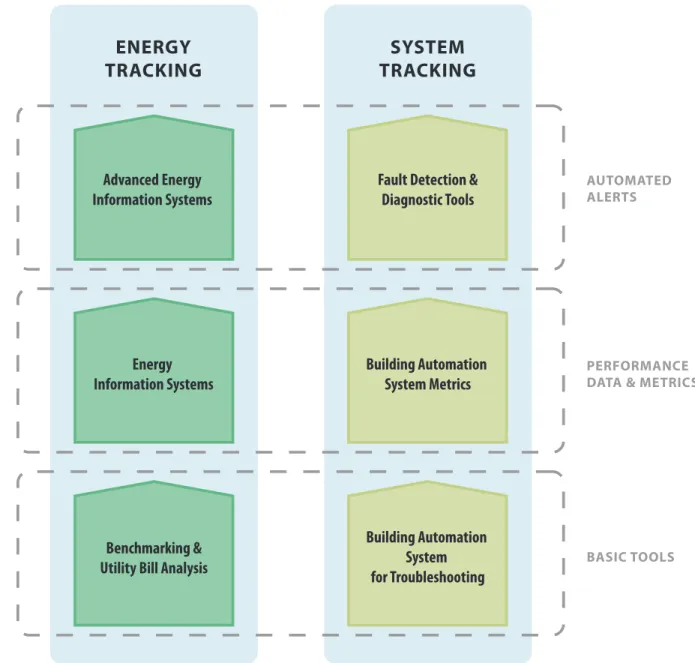
■ Using the building automation system (BAS) for troubleshooting These three tools, illustrated in Figure 4, give building owners access to fundamental information, including:
■ Energy performance data for the whole building, accessed through monthly utility bills and given valuable context through benchmarking.
■ System performance data such as supply air temperature and pressure, outside air ventilation rate, variable frequency drive speed, and zone temperatures. In a typical large commercial building, this information will be accessible via the BAS.
For energy tracking, benchmarking and utility bill analysis can be characterized as a periodic tracking approach that should be conducted monthly, quarterly, and annually. For system tracking, the BAS can be used to review and improve system operation, and to help pin down the underlying issues driving high energy use or irregular system performance.
ENERGY
TRACKING TRACKINGSYSTEM
Benchmarking & Utility Bill Analysis
Building Automation System for Troubleshooting
“You can’t manage what you don’t measure”
Building performance tracking gives property managers and operators greater control over their assets and better access to information. It also provides a platform for occupants to see, understand and become conscious about their energy use, leading to savings. Building performance tracking paves the way toward high performance, similar to the way financial reporting about investments leads to better understanding and management of those investments.
25
The Building Performance Tracking Handbook IntroductionWhat Is Building Performance Tracking? The Business Case The Basics
Management Framework Why Does a Strong Management Framework Matter? Steps to Build a Management Framework Basic Tools Energy Benchmarking
Utility Bill Analysis BAS for Troubleshooting Beyond the Basics
Energy Tracking System Tracking What’s Next? Selecting an Approach Useful Resources
Energy Benchmarking
Energy benchmarking is a strategy for comparing a building’s energy performance either to peer groups or to historical performance. Energy benchmarking has increasingly become the norm for commercial building owners, who appreciate the value of the data and ease-of-use of the tools. These tools not only benchmark performance at a point in time, but also indicate when performance improves or degrades over a longer period.
Energy Benchmarking Tools
The most common benchmarking strategies include the following: ■ Track normalized energy use with ENERGY STAR Portfolio Manager. This
tool uses data normalization to factor in variables such as weather, building operating hours, and building type.
■ Track energy use intensity (energy use per square foot) and compare to publicly available data
■ Track energy cost per square foot, and compare with industry standards, for example BOMA Experience Exchange Report® (EER) or IREM Income/Expense Analysis® Reports
Each strategy is described in greater detail below, including tips on making the method most effective.
ENERGY STAR Portfolio Manager
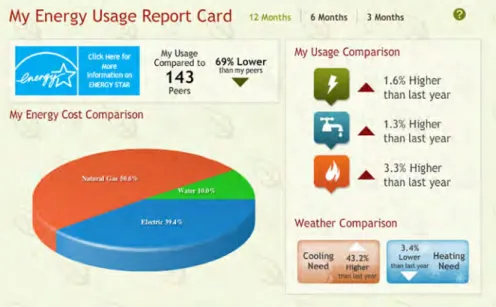
ENERGY STAR Portfolio Manager is the most well known and widely adopted benchmarking tool in the U.S. As of June 2010, nearly 130,000 buildings had received an ENERGY STAR rating, representing over 16 billion square feet. Nearly one-third of these buildings were offices.12 Because ENERGY STAR ratings have become so prevalent, they are now integrated into city and state legislation. The ENERGY STAR rating indicates a building’s performance compared to similar buildings. ENERGY STAR Portfolio Manager converts a building’s energy use intensity (energy use per square foot) into a number between 1 and 100, with 100 being the highest possible rating. If a building has a rating of 78, it means that building uses less energy per square foot than 78 percent of similar buildings, and higher energy use per square foot than 22 percent. This number is normalized for factors such as building type, occupancy, and climate. The U.S. Energy Information Administration’s Commercial Building Energy Consumption Survey (CBECS) provides the underlying building data, which all ENERGY STAR buildings are benchmarked against.
The ENERGY STAR label is valuable as a marketing tool to help attract tenants. Buildings that earn an ENERGY STAR rating of 75 or higher may qualify for
ENERGY STAR Legislation Update
As of April 2011, policies that mandate the disclosure of a building’s ENERGY STAR rating at the time of sale or lease have passed in California, Michigan, Ohio, Washington, and Hawaii, as well as in some major cities such as Denver, Seattle, and New York.
Introduction What Is Building Performance Tracking? The Business Case The Basics
Management Framework Why Does a Strong Management Framework Matter? Steps to Build a Management Framework Basic Tools Energy Benchmarking
Utility Bill Analysis BAS for Troubleshooting Beyond the Basics
Energy Tracking System Tracking What’s Next?
Selecting an Approach Useful Resources
the ENERGY STAR label for that year, and receive press and a lobby plaque. Additionally, buildings can earn up to 15 points in the Leadership in Energy and Environmental Design (LEED) Existing Buildings: Operations & Maintenance rating system through their ENERGY STAR rating.
ENERGY STAR Portfolio Manager does not calculate ratings for all building types. Fire stations, police stations, colleges and universities are some of the excluded building types. However, even if a rating cannot be obtained, all building types can still use ENERGY STAR Portfolio Manager as a tool to normalize energy use based on weather variations.
Energy Use Intensity
Tracking energy use intensity (EUI) is a manual approach to energy
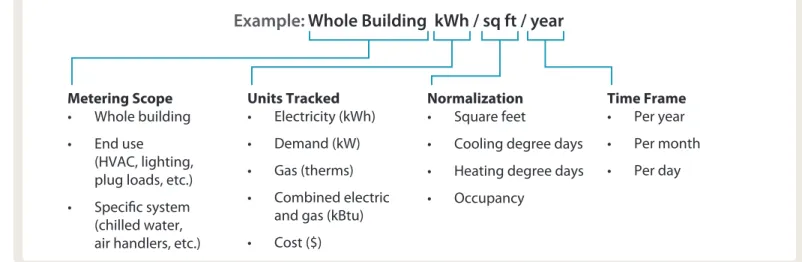
benchmarking that can be performed by any building owner with access to utility bills. Energy use intensity is calculated as a building’s energy use per square foot per year. Building owners can benchmark EUI in several ways: ■ By comparing the EUIs of buildings in a portfolio
■ By comparing a single building’s EUI to its historical EUI
■ By comparing a single building’s EUI to its peer group with data gathered from the U.S. Energy Information Administration’s Commercial Building Energy Consumption Survey (CBECS)
■ By comparing a single building’s EUI to its peer group through online energy benchmarking tools CalARCH and EnergyIQ, which are based on California Commercial End Use Survey (CEUS) data. Visit Useful Resources for further information on these tools.
Manually benchmarking EUI may not normalize for weather or other factors that may affect energy use. Nevertheless, benchmarking EUI may be a good approach if a building type or size is not covered by ENERGY STAR Portfolio Manager.
Energy Cost per Square Foot
Benchmarking the cost of electricity and gas use can be a useful strategy for owners driven by cost per square foot data. Through this approach, building owners compare a building’s utility costs either to historical performance or to regional peers. The BOMA Experience Exchange Report (EER)13 and the Institute of Real Estate Management’s (IREM) Income/Expense Analysis Reports14 are the main sources of regional peer data for the commercial office building industry. Published annually, the reports provide statistical data and analysis on financial income, expenses, and operations for offices in hundreds of cities in North America.
The information gained from these reports fits into established financial
CBECS and ENERGY STAR
The Commercial Building Energy Consumption Survey (CBECS) is a national survey that collects data on the energy use, energy costs, and energy-related characteristics of commercial buildings every four years. EPA’s Portfolio Manager compares each facility’s performance to the CBECS data to generate the ENERGY STAR rating, and not to other ENERGY STAR buildings. If a building type is not covered in ENERGY STAR, using CBECS data to benchmark can be a helpful alternative.