Trusted Launch of Generic Virtual Machine Images in
Public IaaS Environments
Nicolae Paladi1, Christian Gehrmann1, Mudassar Aslam1, and Fredric Morenius2 1
Swedish Institute of Computer Science, Kista, Sweden 2 Ericsson Research, Kista, Sweden
{nicolae, chrisg, mudassar.aslam}@sics.se, [email protected]
Abstract. Cloud computing and Infrastructure-as-a-Service (IaaS) are emerging and promising technologies, however their faster-pased adoption is hampered by data security concerns. In the same time, Trusted Computing (TC) is experienc-ing a revived interest as a security mechanism for IaaS. We address the lack of an implementable mechanism to ensure the launch of a virtual machine (VM) in-stance on a trusted remote host. Relying on Trusted Platform Modules operations such asbindingandsealingto provide integrity guarantees for clients that require a trusted VM launch, we have designed a trusted launch protocol for generic VM images in public IaaS environments. We also present a proof-of-concept implemen-tation of the protocol based on OpenStack, an open-source IaaS platform. The results provide a basis for use of TC mechanisms within IaaS platforms and pave the way for a wider applicability of TC to IaaS security.
Keywords: IaaS, security, trusted computing, trusted virtual machine launch, OpenStack
COPYRIGHT NOTE: Author manuscript, available free of charge on-line. The original publication is available at www.springerlink.com
1
Introduction
One of the distinguished trends in IT operations today is the consolidation of IT sys-tems onto common platforms. A key technology in realizing this is system virtualization [1]. System virtualization makes it possible to streamline IT operations, save energy and obtain better utilization of hardware resources. A virtualized computing infrastructure allows cloud clients to run own services in form of Virtual Machines (VM) on shared computing resources. This approach however introduces new challenges, as it means that information previously controlled by one administrative domain and organization, is now under the control of a third party provider and that the information owner loses direct control over how data and services are used and protected. IaaS [2] is one of the business models based on system virtualization and security aspects are among the main identi-fied obstacles in the face of the adoption of IaaS3. The problems with securing IaaS are evident not least through the fact that widely known platforms such as Amazon EC2, Microsoft Azure, services provided by RackSpace and other IaaS services are plagued by
3
AFCEA Cyber Committee – October, 2011, http://www.afcea.org/mission/intel/ documents/cloudcomputingsecuritylessonslearned_final.pdf
II
vulnerabilities at several levels of the software stack, from the web based cloud manage-ment console [3] to VM side-channel attacks, to information leakage, to collocation with malicious virtual machine instances [4].
A promising approach towards reducing IaaS security threats and a mean to pro-vide service confidence is the use of Trusted Computing technologies as defined by the Trusted Computing Group (TCG) [5]. The core component in the TCG-defined secu-rity architecture is the Trusted Platform Module (TPM), a hardware module that can be used as a trust anchor for software integrity verification in open platforms that also offers protected storage for sensitive parameters. TPM usage and deployment models for IaaS clouds are currently an active research area [6,7,8,9,10,11]. Earlier research has introduced principles of a trusted IaaS platform [9], later extended to cover both trusted VM launch [10] and VM migration [11]. These research results demonstrate principles of combining basic TPM attestation mechanisms with standard cryptographic techniques to design an infrastructure for VM protection. However, such solutions have limitations with respect to security, complexity and target compute host selection procedures.
In this paper we describe a secure VM launch process that overcomes these limitations, presenting a trusted launch protocol that does not require secure pre-packaging of the VM image on the client side. The proposed protocol is in particular suitable for launching generic virtual machine images (GVM images), i.e., VM images without any customer-specific modifications. The concept is further introduced below. Furthermore, in order to be usable in a significant proportion of IaaS deployment scenarios and to provide full scheduling flexibility on the IaaS side, the protocol allows the IaaS provider to select a target trusted compute host without directly involving the client. The main contributions of this paper are:
1. Introduction of the concept of generic virtual machine images in the context of IaaS security.
2. Description of a trusted launch protocol for generic VM images in IaaS environments. 3. Implementation of the proposed protocol based on a widely-known IaaS platform.
The paper is further organized as follows: In section II we give an overview of the most important related work within trusted computing in IaaS environments; in section III we define the attack scenario and formulate the problem area addressed by the current pa-per; section IV presents the main contribution of the paper, namely a platform-agnostic protocol for trusted generic virtual machine launching. In section V we perform a secu-rity analysis of the proposed protocol and continue with a description of the prototype implementation based on the OpenStack IaaS platform in section VI. We conclude in section VII with a set of further research suggestions.
2
Related work
Application of trusted computing principles within IaaS environments has been the focus of several research papers examined below.
Santos et al propose the design of a trusted IaaS platform (TCCP) that ensures VMs are running on a secure hardware and software stack with a remote and untrusted host [9]. The authors propose a remote attestation process where a trusted coordinator (T C) stores the list of attested cloud compute hosts (CH) that run a “trusted virtual ma-chine monitor” which can securely run the client’s VMs. Trusted hosts maintain in their
III memory an individual trusted key (TK) used for identification each time the client C instantiates a VM on the trusted host. The paper presents a good initial set of ideas for secure VM launch and migration, in particular the use of aT C. A limitation of this solu-tion is that the TK resides in the memory of the trusted hosts, which leaves the solusolu-tion vulnerable to cold boot attacks [12] with keys extractable from memory. Furthermore, the authors require that theT Cmaintains information about all hosts deployed on the IaaS platform, but do not mention mechanisms for anonymizing this information, making it valuable to an attacker and unacceptable for a public IaaS provider. Finally, the solution lacks both mechanisms for revocation of the TK and considerations for the re-generation of TK outside of host reboot.
A decentralized approach to integrity attestation is adopted by Schiffman et al in [13]. The primary concerns addressed by this approach are the limited transparency of IaaS platforms and the limits to scalability imposed by third party integrity attestation mechanisms, as described in [9]. The authors examine a trusted cloud architecture where the integrity of the IaaS hosts is verified by the IaaS client through a “cloud verifier” (CV) proxy that resides in the application domain of the IaaS platform provider and is accessible by the client. Thus, in the first step of the protocol the client evaluates the integrity of theCVin order to include theCVinto its trust perimeter if the integrity level of theCVis considered satisfactory. Next, theCVsends attestation requests from compute hosts CH, i.e. the hosts where the guest VM instance can potentially be deployed, thus extending the trust chain to theCH. Finally,CHverifies the integrity of the VM image, which is countersigned by the CV and returned to the client which evaluates the VM image integrity data and allows or disallows the VM launch on theCH.
While the idea of increasing the transparency of the IaaS platform for the client is indeed supported in industry [14,15], the authors do not clarify how the introduction of an additional integrity attestation component in the architecture of the IaaS platform has positive effects on the transparency of the cloud platform. Furthermore, the proposed protocol increases the complexity model for the IaaS client both by introducing the evaluation of integrity attestation reports of theCVandCHand introduction of additional steps in the trusted VM launch, where the client has to take actions based on the data returned from theCV. This requires either human interaction or a fairly complex integrity attestation evaluation component (or a combination thereof) on the client side, making a wide-scale adoption of the solution difficult.
Aslam et al proposed in [10] principles for secure VM launch on public cloud platforms using trusted computing technologies. In order to ensure that the requested VM instance is launched on a compute hostCH with verifiable integrity, the client encrypts the VM image (along with all the injected data) with a symmetric key sealed to a particular configuration ofCH, which is reflected through the values in the platform configuration registers (PCR) of the TPM deployed on the CH. The solution proposed by Aslam et al presents a suitable model in the case of trusted VM launch scenarios for enterprise clients. It requires that the VM image is pre-packaged and encrypted byC prior to the IaaS launch. However the proposed model does not cover the highly common scenario of launching a generic VM image made available by the IaaS provider or uploaded by C. Furthermore, we believe that reducing the number of steps required fromCwill facilitate the adoption of the trusted IaaS model. Likewise, direct communication betweenC and CH, as well as significant changes to the existing VM launch implementations in IaaS platforms hamper the implementation of this protocol and should be avoided. This paper reuses some of the ideas proposed in [10] and directly addresses the above limitations,
IV
namely actions to be performed byC, also touching upon the requirements towards the launched VM image and required changes to the IaaS platform.
3
Attack model and problem description
Next we define the term ”generic virtual machine images”, describe the attack model we assume in this paper and list top security and general design requirements applicable given the defined attack model. We also discuss the characteristics that can be expected from a well-designed generic VM image launch.
3.1 Generic virtual machine images
Denote byV the whole set of binary VM images and byva particular VM image offered by a vendor. Furthermore, denote byvtthe GVM image offered to an arbitrary client at timet:
Definition 1. ∀v∈V, ∀t, t0∈T : vt≡vt0
The above definition implies that all of the GVM images of a particular distribution offered by the vendor are binary identical. Furthermore, while such VM images may have any software stack installed and configured, they do not contain any client-specific customization.
A peculiar property of VM instances launched using GVM images is that they by definition cannot posses verifiable properties that could distinguish any two different instances. This property makes it difficult for an IaaS client to verify that the virtual machine instance it interacts with runs on a trusted software stack.
To overcome these issues we suggest a launch protocol where we employ the TPM functionality tofirstmake sure that the GVM image is actually launched on a trustworthy platform andsubsequently utilize the trusted platform to verify the integrity of the GVM image prior to the VM launch. The protocol performs both steps while maintaining transparency from both client and IaaS provider’s points of view.
3.2 Attack model
We share the attack model with [9,10,11] which considers that privileged access rights can be maliciously used by remote system administrators (Ar) of the IaaS provider. This implies that we use a scenario which assumes thatAr can log in remotely to any host maintained by the IaaS provider and obtain root access. However, in this model Ardoes not have physical access to the hosts. The only possibility forAr to circumvent this constraint is by succeeding to force a client to launch their VM instances on a host outside the physically secured IaaS provider perimeter and controlled by the Ar. Furthermore, we assume that anArobtaining remote root access to the host will not be able to directly access the memory of the VMs residing on the host at that time, i.e. the cloud host platform offers a closed box execution environment.
In a GVM image context this means that we considerboth the attack where the Ar attempts to launch a VM image on a non-trusted compute host instead of a trusted one
and the attack whereAr attempts to substitute the VM image requested by the client with a maliciously modified VM image.
In the current attack model, a VM instance is considered trusted if and only if it fulfills the following criteria:
V 1. The VM image used for the instance is itself trusted;
2. The VM instance is started on a trusted compute host;
3. The VM instance has the client-generated verification token injected;
3.3 Requirements for a trusted GVM image launch protocol
Considering the threat model above, it is important for the client to be able to obtain rea-sonable security guarantees form the IaaS provider. These include both trustworthiness of the computing resources, as well as guarantees regarding VM integrity and confiden-tiality. In order to also be cost and implementation efficient, the underlying infrastructure should provide such guarantees with a minimal operational overhead without increasing structural complexity. The expectations can be summarized as a set of basic requirements on a trustworthy VM launch process:
– R1: The client shall have the mechanisms to ensure that the GVM image has been launched on a trustworthy host.
– R2: The client should have the possibility to reliably determine that it is commu-nicating with the GVM image launched on a secure host, and not with a different GVM image instance.
– R3: The integrity of the launched GVM image must be verifiable by the target com-pute host.
– R4: The trusted GVM image launch procedure should be scalable and have a mini-mum impact on the performance of the IaaS platform.
– R5: Clients should have a transparent view of the secure launch procedures.
4
A secure launch protocol for generic VMs
Based on the above requirements for a secure launch protocol for generic VM images in IaaS environments, we present a platform-agnostic protocol that shows principles of using TPM functionality to ensure the integrity of the compute host and of the generic VM image requested by the client. The below protocol addresses some of the security concerns presented above by focusing on simplicity, transparency, scalability and minimal inter-ference with the currently known setup of the IaaS implementations. Furthermore, the protocol is based on widely-used and verified techniques, such as hashing and asymmetric cryptography in combination with the functionality of the TPM.
The protocol requires the participation of four entities, three of which are typically involved in VM launch in IaaS architectures:
1. Client (C) is a client of IaaS services and intends to launch or use a VM. C can be both expert (e.g. capable to assessing the security of platform configurations based on values from the measurement list, etc.) and a non-expert that requires access to a generic VM instance launched and running on a trusted platform. In either case, it is important thatC is able to either verify or trust the security of GVM images provided for launch.
2. Scheduler (S) is responsible for receiving fromCrequests for VMs instance launches and scheduling and rescheduling VM instances on available compute hosts in the provider cloud infrastructure.Sshould be able to function with the minimal possible involvement in the security-specific message passing.
VI
3. The compute host (CH) is the target resource that will be chosen by the scheduler to execute the particular VM.CHrepresents a physical or virtual server that is able to host one or more virtual machine instances (however, this paper considers the exclusively the case when the compute host is a physical server). For the purposes of the proposed protocol, aCHmust also be equipped with a TCG-compliant TPM as well as be immune to modification attempts
4. The Trusted third party (T T P) is, as the name implies, trusted by both theClient
and theCloud service provider can not be controlled or manipulated by the the the IaaS provider. The recent breaches of Certificate Authorities have emphasized the drawbacks of centralized security models and their susceptibility to attacks [16]. The more complex the operations performed by theT T P, the higher the probability of it having exploitable vulnerabilities. It is therefore important to keep the implemen-tation of theT T P as simple as possible. The main task of theT T P is to attest the configuration of the compute hosts that will host the generic VMs and assess their se-curity profile according to predefined policies. Within the current trust model,T T Ps could be implemented by C, as long as the IaaS provider agrees to that and the C has the capability to set up and operate an attestation and evaluation engine. For the purposes of the protocol, we also introduce the concept ofsecurity profile of a CH, denoted asSP.
Definition 2. A security profile (SP) is a verfied setup of an OS including underlying libraries and configuration files, which is considered to be trustedby all parties.SP can range on an ascending integer scale which reflects the level of verification, from least to most strict (and hence more restrictive).
The information needed to calculated theSPand also to compare the setup of twoCHs is stored in the integrity measurement log (IML), as the IML contains hashes of the components that were loaded or used during the boot sequence of theCH. The validity of the IML is confirmed through a signature using the attestation identity keys (AIK) of a TPM. The AIK are persistent, non-migrateable keys that are used to sign and authenticate by the means of an AIK certificate (denoted asAIK−cert) the validity of the information provided by the TPM in case of an external attestation [17]. We thus assume that theSP of any givenCH can be deterministically calculated by each of the parties involved in the protocol.4
4.1 Platform-agnostic protocol description
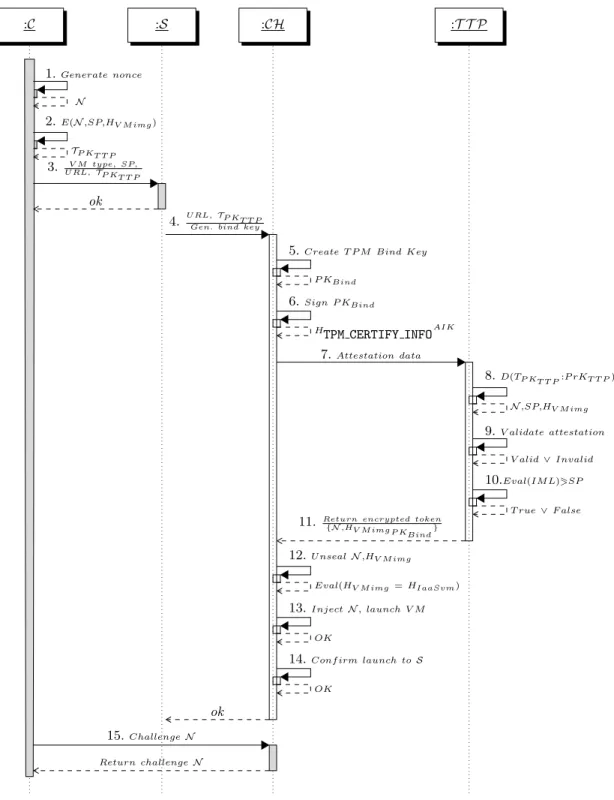
The following steps are required in order to perform a trusted generic VM launch (Fig. 1, the steps of the protocol correspond to the steps in figure5). Note that the while all of the enumerated steps must be performed at least once in order to perform trusted VM launch operations using GVM image, it is possible to optimize the protocol depending on the specifics of the operational environment.
1. Before initiating the launch procedure, clientCgenerates a sufficiently long nonceN, to be used as a proof token in communications between theC and the VM instance and must be kept secret throughout the launch process.
4 The methodology for calculating theSPof aCHis out of the scope of this article. 5
Due to space limitations, ”Attestation data” was chosen as the condensed notation for: TP KT T P, P KBind,TPM CERTIFY INFO, HTPM CERTIFY INFOAIK, IM L, AIK−cert
VII 2. Ccreates a token which we denote byT, representing a data structure with informa-tion necessary for the trusted VM launch.T containsN, the preferred SP and the hash of the VM image to be launched, denoted as HV M image 6. Finally, the token is encrypted with the public key ofT T P, denoted as P KT T P, while the encrypted token is noted asTP KT T P.
7
3. Crequests thescheduler (S)to load a generic VM by providing the following param-eters in the request:
– VM type (e.g. CentOS, Debian, etc.);
– RequiredSP;
– URL of theT T P;
– Encrypted tokenTP KT T P generated in step(2);
SPwill determine the lower bound of trust level required from the hostCHon which the VM will run, with stricter security profiles accepted.
4. S schedules a VM on the appropriate compute host, depending on its membership in the respective security profile group and sends a request to generate a bind key P KBind, also providing the URL of theT T P.
5. Once the destination host CH receives the bind key request, it retrieves a PCR-locked non-migratable TPM-based bind keyP KBind. This key can be periodically regenerated by CH according to a administrator-defined policy, using the current platform state represented by the TPM PCR. It is important to note that the values of the PCRs should not necessarily be in a trusted state in order to create a trusted state bind key.
6. In order to prove that the bind key is a non-migratable, PCR-locked, asymmetric TPM key, CH uses the TPM CERTIFY KEY TPM command in order to retrieve the
TPM CERTIFY INFO structure signed with the TPM attestation indentity key [17], which we denote asP KAIK; we also denote the signed structure by
HTPM CERTIFY INFOAIK. The TPM CERTIFY INFO data structure contains the hash of the bind key and the PCR value required for the key usage.
7. CH sends an attestation request to theT T P through an HTTPS session using the URL supplied by theC. The following arguments are sent in the request to T T P:
– Client-provided tokenTP KT T P
– Attestation data, which includes the public bind key, theTPM CERTIFY INFO struc-ture, the hash of TPM CERTIFY INFO signed with the AIK8, the IML and the AIK-certificate collectively represented as:
P KBind, TPM CERTIFY INFO,HTPM CERTIFY INFOAIK,IML, AIK-cert .
8. T T P uses its private key P rKT T P, which corresponds to the public P KT T P to attempt to decrypt the tokenTP KT T P.
9. T T P validates the attestation information obtained fromCH as follows:
– Validates the AIK certificate;
– Validates the structure of the AIK-signedTPM CERTIFY INFO;
– Validates the key P KBind by comparing its digest with the digest received in
TPM CERTIFY INFO; 6
If non-repudiation of VM launch is required, the client should also sign the VM image hash and include the signature and corresponding client certificate into the token.
7
To improve client experience these actions could be performed transparently to the client by a web browser plugin when navigating to the cloud platform’s web interface.
8
VIII
– Calculates the hash of the PCR values HP CR based on the information in the IML and compares it with the hash of PCR INFO, which is a component of
TPM CERTIFY INFO
10. T T P examines the entries in the IML in order to determine the trustworthiness of the platform and decides whether the security preferenceSP is satisfied by the current configuration of compute hostCH.
11. If step 10 is true, T T P encrypts N and the hash HV M image with the bind key P KBind obtained from CH, to ensure thatN is only available to CH in a trusted state. By sendingN encrypted with the public key P KBind available to the trusted configuration ofCH, the security perimeter expands to include three parties:Citself, statelessT T P and compute hostCH in its trusted configuration. This implies that all actions performed byCH in its trusted configuration are trusted by default. 12. Prior to launching the VM, compute hostCH decryptsN andHV M image using the
TPM-issuedP rKBind, which is available to it in its trusted configuration but stored in the TPM; next,CH comparesHV M image obtained from the T T P with the hash of the VM image offered by the IaaS provider and accepts the image for launch only in case the values are equal.
13. CHinjectsN into the VM image prior to launching the VM.
14. CHreturns an acknowledgement toS to confirm a successful launch.
15. To verify that the requested VM image has been launched on a secure platform,C challenges the VM launched on hostCH to prove its knowledge ofN.
The fact thatN is kept confidential allows it to be used as an authentication token while establishing a secure communication channel between C and the launched VM. N can be used as the pre-shared secret in order to add protection against man-in-the-middle attacks when using the Diffie-Hellman key exchange, as specified in the password-authenticated key-exchange protocol [18].
As mentioned above, some of the operations can be optimized taking into account the operational environment. For example, the validity period ofP KBind created in step
(5) can be adjusted. In a similar way, theT T P can have a cache of the P KBind keys created byCHwith verified trusted configuration. In this case, steps(9)and(10)can be skipped for a certain number of cases, which can also be regulated by an administrative policy. However, it is important to remember that the use of such a cache introduces further complexity to theT T P the analysis of which is out of the scope of this paper.
5
Protocol security analysis
In this section we present a critical review of the protocol and highlight its improvement areas that were left as future work. We begin by a security analysis of the protocol, in order to outline its strengths and weaknesses.
Returning to the security concerns of C, expressed in the requirements towards the trusted launch protocol formulated above, they are addressed as follows. Let ϕ be the guest VM instance launched onCH, then:
– R1: Following above protocol, C and ϕ have a shared secret N. The fact that ϕis running on a trusted platform is ensured by the properties of the bind key used to seal the shared secretN to the trusted configuration ofCH;
IX
Fig. 1. Trusted generic VM launch protocol: C: Client; S: “Scheduler”; CH: Compute Host; T T P: Trusted Third Party;
:C :S :CH :T T P :C :S :CH :T T P 1.Generate nonce N 2.E(N,SP,HV M img) TP KT T P 3. V M type, SP, U RL,TP KT T P ok 4. U RL,TP KT T P Gen. bind key
5.Create T P M Bind Key P KBind
6.Sign P KBind
HTPM CERTIFY INFOAIK 7.Attestation data 8.D(TP KT T P:P rKT T P) N,SP,HV M img 9.V alidate attestation V alid∨Invalid 10.Eval(IM L)1SP T rue∨F alse 11. Return encrypted token
{N,HV MimgP KBind}
12.U nsealN,HV M img
Eval(HV M img=HIaaSvm)
13.InjectN, launch V M OK
14.Conf irm launch toS OK
ok
15.ChallengeN Return challengeN
X
– R2: The fact that C is communicating with ϕ and not any other unexpected VM instanceϕ0is ensured through the combination of:a.verification ofCHby theT T P,
b.possession of the tokenN encrypted withCH’s PCR trusted configuration-bound TPM key andc.the VM image integrity verification performed by the compute host prior to the launch. A failure at any of the steps of the above sequence would prevent the trusted VM launch, a fact that would be verifiable byC.
– R3: Integrity ofϕis ensured through the verification performed byCH in a trusted
state, prior to the trusted VM launch. Thus,ϕis verified using the hash value ob-tained from theT T P along withN. By verifying the hash of the GVM image with the expectedHV M imageprovided byC, theCHensures a one-to-one correspondence between the GMVI that is to be launched and the GMVI expected byC. The chain is completed onceC verifies the presence of N injected into ϕ. The presence of the correct tokenN guarantees the integrity ofϕrequested byC.
– R4: Scalability of the protocol is ensured by the lightweight nature of the operations that are to be performed by both theT T P and theCH, flexibility in the choice of theT T P and the ability of the scheduler to retry theCHselection procedure. While a challenging topic, especially in the case of high-availability and heavy load IaaS setups, the design of a scalableT T P architecture is out of the scope of this article.
– R5: Transparency of the trusted VM launch procedure is ensured by the introduction of client parameters, such as the URL of theT T P, the trust level of the VM host and the secret token generated byC. The ability to choose theT T P opens the possibility forC to ensure the trustworthiness of the host attestation procedure, either through audit controls of theT T P or by itself serving the role of theT T P.
5.1 T T P verification model
The stateless architecture of theT T P implies that it does not maintain knowledge ofN except for the moment of sealing it toCHand does not maintain any session state at any point of the protocol. As a result, an Ar can only obtain N from T T P if they obtain T T P’s private keyP rKT T P. Furthermore, assessment of a hosts’ trust level according to a deterministic algorithm which only takes two inputs (in the form of static set of reference measurement data and dynamic attestation calls from anyCH) will be easily traceable and reproducible based on the original input data, without the need to recreate or rely on a certain state of the TPP’s internal data. Finally, a stateless architecture of theT T P contributes indirectly towards requirement R4.
5.2 Protocol caveats
One aspect that requires more attention is the possibility of a post-launch modification of CH’s software stack. The runtime process infection method, which is a method for infecting binaries during runtime9is one of the malicious approaches that could be used in this situation. This scenario is in fact a common threat to all TCG-based systems, also touched upon in [19] and is described in detail in [20] and should thus be prevented using means within the platform which is part of the trusted computing base verified at boot time, the presence of which is verified by the above protocol.
9
XI
6
Protocol implementation
In order to validate the assumptions made during the protocol design phase, we have implemented it as an extension to OpenStack, an open source IaaS platform chosen given the open access to its codebase, its large community and the traction it has gained within IaaS. This section briefly introduces the OpenStack architectural model and changes made for the prototype implementation.
6.1 OpenStack IaaS platform
The Essex release of OpenStack comprises five core components (projects), namely Com-pute (Nova), Image Service (Glance), Object Storage (Swift), Identity Service (Keystone) and Dashboard (Horizon). Nova has several sub-components: nova-api, nova-compute, nova-schedule, nova-network, nova-volume, plus an SQL database and message queue functionality to pass messages between sub-components. OpenStack components affected by the protocol implementation are mentioned here in more detail:
– Nova-api is the interface for nova- compute and volume API calls. It is through this interface most of the cloud orchestration operations are performed. The interface supports both the OpenStack and Amazon EC2 APIs.
– Nova-compute handles virtual machine instance life cycle tasks through hypervisor API calls. Notably the libvirt and XenAPI hypervisor APIs are supported.
– Nova-schedule is responsible for selecting compute host(s) to run virtual machine instances on. The host selection process is determined by which scheduling policy/al-gorithm is employed.
– The nova SQL database holds tables and relations to describe the state of nova, such as launched instances and network configurations.
– The Dashboard is a web based GUI for OpenStack operation and administration. It interfaces nova-api.
6.2 Prototype implementation
Below are the main additions to OpenStack required for the prototype implementation.
Nova SQL database The nova SQL database has been extended to include tables to hold the available compute hosts and security profiles of compute hosts:
– A security profile is an integer in the range 1-10, with a higher number being more trusted than a lower number.
– The security profile of a compute host is global, rather than specific per e.g. tenant.
Dashboard and nova-api The Dashboard web based GUI has been extended to include the option to request compute host attestation, minimum security profile selection, to-ken TP KT T P entry and T T P URL provision (3) into the “Launch Instance” dialog.
This information is included in the OpenStack API HTTP payload to nova-api, which propagates the information to the scheduler.
In the prototype implementation steps(1)and(2)are performed by a script which outputs TP KT T P, which then can be manually input into the Dashboard dialog. Note
that it is not an option to let Dashboard provide functionality for generating TP KT T P,
XII
Scheduler, compute host and virtualization driver The nova scheduler is a central com-ponent as it decides on which compute host a certain VM instance will be launched. Each scheduler works according to a specific configurable algorithm and several scheduler implementations are available in OpenStack by default. In the SimpleScheduler imple-mentation, the scheduler looks for the least loaded compute host and schedules the VM instance to be launched on that host.
We extend the behavior of the SimpleScheduler to include the policy that a host must belong to a certain security profileSPor stricter in order to be acceptable for hosting the VM instance. This policy is realized as follows: first the scheduler looks up the recorded security profile of the host in the nova database and proceeds ifSPis sufficient compared to the requirements ofC (corresponds to(4)). The second step is to request the host to attest itself withT T P. IfSP was not sufficient, the next eligible host is selected.
Steps(5)-(7)are perfomed by CH, followed byT T P in steps(8)-(11).
Token TCH = {N, HV M image}P KBind is returned from T T P to CH after which CH
includes the token in the return message to the scheduler. If the attestation was successful, the scheduler requests the now trustedCH to launch the VM instance and includesTCH in the request.
Next,CHdecryptsTCH and obtainsN andHV M image. To verify the integrity of the VM image,HV M imageis included in the call to the virtualization driver (libvirtis used by the prototype), which fetches the VM image from Glance and caches it locally onCH. The hash of the cached image is calculated and compared toHV M image. If the hashes do not match, an exception is raised. Otherwise, the launch procedure continues(12)and the file injection capability of Nova is used to inject N into the file system of the VM image to be launched(13). The VM image is then used to launch the VM instance on CH and steps(14)and(15)are completed.
7
Conclusion
In this paper we have presented a detailed trusted launch protocol for generic VM image launch in IaaS environments. Furthermore, we have provided a prototype implementation of the launch protocol in OpenStack. Detailed measurement and evaluation, as well as alternative implementation choices have been left for future work.
The presented results make a case for broadening the range of use cases for trusted computing by applying it to IaaS environments, especially within the security model of an untrusted IaaS provider. Trusted computing offers capabilities to securely perform data manipulations on remote hardware owned and maintained by a third party with a minimal risk for data integrity. The presented design is directly applicable to the process of developing a trusted virtualized environment within a public IaaS service.
Future research recommendations can be grouped into three categories:
First is the extension of the trust chain to other operation of VM instances (migration, suspension, updates, etc.), as well as data storage and virtual network communication security.
The second category includes addressing some assumptions of the proposed launch protocol, e.g. the assumption that the VM host configuration is not changed after the trusted launch of the VM instance, since even in the case of a bona fide IaaS provider the VM host can be compromised through runtime process infection. A technique to enable Cto either directly or through mediated access discover such events and protect the data used by the VM instance is a promising research topic.
XIII The third category focuses on the design and implementation of the evaluation policies of the TTP. The current assumption is that the TTP has access to information regarding “secure” configurations and the PCR values. However, taking into account the diversity of available libraries, as well as the different combinations in which they can be loaded during the boot process, verification of PCR values (such as values stored inPCR10and reference values inbinary runtime measurements) becomes a less trivial task.
XIV
References
1. Smith, J., Nair, R.: Virtual Machines: Versatile Platforms for Systems and Processes. Mor-gan Kaufmann (June 2005)
2. Krutz, R.L., Vines, R.D.: Cloud Security: A Comprehensive Guide to Secure Cloud Com-puting. John Wiley & Sons (August 2010)
3. Somorovsky, J., Heiderich, M., Jensen, M., Schwenk, J., Gruschka, N., Lo Iacono, L.: All Your Clouds Are Belong to us: Security Analysis of Cloud Management Interfaces. In: Proceedings of the 3rd ACM Workshop on Cloud Computing Security. CCSW ’11, New York, NY, USA, ACM (2011) 3–14
4. Ristenpart, T., Tromer, E., Shacham, H., Savage, S.: Hey, You, Get Off of My Cloud: Exploring Information Leakage in Third-Party Compute Clouds. In: Proceedings of the 16th ACM Conference on Computer and Communications Security. CCS ’09, New York, NY, USA, ACM (2009) 199–212
5. Pohlmann, N., Reimer, H.: Trusted Computing - eine Einfhrung. In Pohlmann, N., Reimer, H., eds.: Trusted Computing. Vieweg+Teubner (2008) 3–12 10.1007/978-3-8348-9452-6 1. 6. Neisse, R., Holling, D., Pretschner, A.: Implementing Trust in Cloud Infrastructures. In:
Cluster, Cloud and Grid Computing (CCGrid), 2011 11th IEEE/ACM International Sym-posium on. (may 2011) 524 –533
7. Sadeghi, A.R., St¨uble, C., Winandy, M.: Property-Based TPM Virtualization. In Wu, T.C., Lei, C.L., Rijmen, V., Lee, D.T., eds.: Information Security. Volume 5222 of Lecture Notes in Computer Science. Springer Berlin / Heidelberg (2008) 1–16 10.1007/978-3-540-85886-71. 8. Danev, B., Masti, R.J., Karame, G.O., Capkun, S.: Enabling Secure VM-vTPM Migration in Private Clouds. In: Proceedings of the 27th Annual Computer Security Applications Conference. ACSAC ’11, New York, NY, USA, ACM (2011) 187–196
9. Santos, N., Gummadi, K.P., Rodrigues, R.: Towards Trusted Cloud Computing. In: Pro-ceedings of the 2009 Conference on Hot Topics in Cloud Computing. HotCloud’09, Berkeley, CA, USA, USENIX Association (2009)
10. Aslam, M., Gehrmann, C., Rasmusson, L., Bj¨orkman, M.: Securely Launching Virtual Machines on Trustworthy Platforms in a Public Cloud - An Enterprise’s Perspective. In Leymann, F., Ivanov, I., van Sinderen, M., Shan, T., eds.: CLOSER, SciTePress (2012) 511–521
11. Aslam, M., Gehrmann, C., Bj¨orkman, M.: Security and Trust Preserving VM Migrations in Public Clouds. In: 2012 IEEE 11th International Conference on Trust, Security and Privacy in Computing and Communications (TrustCom), TRUSTCOM, Liverpool (2012)
12. Halderman, J.A., Schoen, S.D., Heninger, N., Clarkson, W., Paul, W., Calandrino, J.A., Feldman, A.J., Appelbaum, J., Felten, E.W.: Lest We Remember: Cold-Boot Attacks on Encryption Keys. Commun. ACM52(May 2009) 91–98
13. Schiffman, J., Moyer, T., Vijayakumar, H., Jaeger, T., McDaniel, P.: Seeding Clouds With Trust Anchors. In: Proceedings of the 2010 ACM Workshop on Cloud Computing Security. CCSW ’10, New York, NY, USA, ACM (2010) 43–46
14. Molnar, D., Schechter, S.: Self Hosting vs . Cloud Hosting : Accounting for the Security Impact of Hosting in the Cloud. In: Workshop of the Economics of Cloud Security. (2010) 1–18
15. Chen, Y., Paxson, V., Katz, R.: The Hybrex Model for Confidentiality and Privacy in Cloud Computing. Technical Report UCB/EECS-2010-5, EECS Department, University of California, Berkeley (January 2010)
16. Goyal, P.: Application of a Distributed Security Method to End-2-End Services Security in Independent Heterogeneous Cloud Computing Environments. In: Services, 2011 IEEE World Congress on. (july 2011) 379 –384
17. Trusted Computing Group: TCG Specification, Architecture Overview, revision 1.4. Tech-nical report, Trusted Computing Group (2007)
XV 18. Boyko, V., MacKenzie, P., Patel, S.: Provably secure password-authenticated key exchange using diffie-hellman. In Preneel, B., ed.: Advances in Cryptology – EUROCRYPT 2000. Volume 1807 of Lecture Notes in Computer Science. Springer Berlin Heidelberg (2000) 156–171
19. Price, M.: The Paradox of Security in Virtual Environments. Computer41(11) (November 2008) 22–28
20. Wojtczuk, R., Rutkowska, J., Tereshkin, A.: Attacking intel trusted execution technology. In: Black Hat USA 2008, August 7th, Las Vegas, NV. (2008)