GUIDE TO
DEVELOPING DISASTER RECOVERY FRAMEWORKS
Sendai Conference Version
MARCH 2015
Disclaimer: This document is the product of work performed by GFDRR staff, based on information provided by GFDRR’s partners. The findings, analysis and conclusions expressed in this document do not necessarily reflect the views of any indi-vidual partner organization of GFDRR, including, for example, the World Bank, the Executive Directors of the World Bank, UNDP, the European Union, or the governments they represent. Although GFDRR makes reasonable efforts to ensure all the information presented in this document is correct, its accuracy and integrity cannot be guaranteed. Use of any data or infor-mation from this document is at the user’s own risk and under no circumstances shall GFDRR or any of its partners be liable for any loss, damage, liability or expense incurred or suffered which is claimed to result from reliance on the data contained in this document.
The World Bank does not guarantee the accuracy of the data included in this work. The boundaries, colors, denomination, and other information shown in any map in this work do not imply any judgment on the part of The World Bank concerning the legal status of any territory or the endorsement or acceptance of such boundaries.
ABBREVIATIONS
ADB Asian Development Bank
BBB Building Back Better
BRR Agency For The Rehabilitation And Reconstruction Of Aceh And Nias - Indonesia
CFO Commission On Filipinos Overseas - Philippines
CMTS Construction Monitoring Teams
CSOs Civil Society Organizations
DRF Disaster Recovery Frameworks
DRM Disaster Risk Management
DRR Disaster Risk Reduction
DRU District Reconstruction Units - Pakistan
ERRA Earthquake Reconstruction And Rehabilitation Authority - Pakistan
EU European Union
FAiTH Foreign Aid Transparency Hub - Philippines
GDP Gross Domestic Product
GFDRR Global Facility For Disaster Reduction And Recovery
IFI International Financial Institutions
INGC National Institute For Disaster Management - Mozambique
IRA Internal Revenue Allotment
LGU Local Government Units
LINKAPIL Lingkod Sa Kapwa Pilipino - Philippines
M&E Monitoring And Evaluation
MDTFs Multi- Donor Trust Funds
MIRA Multi-Cluster/Sector Initial Rapid Assessment
MRAZI Ministry For Restructuring And Managing Flood Zones
NDRRMF National Disaster Risk Reduction And Management Fund - Philippines
NGOs Nongovernmental Organizations
OPARR Office Of The Presidential Assistant For Rehabilitation And Recovery - Philippines
PDNA Post-Disaster Needs Assessment
PEC Pakistan Engineering Council
PERRA Provincial Earthquake Reconstruction And Rehabilitation Authority - Pakistan
PFM Public Financial Management
PPP Public-Private Partnerships
RMS Results Monitoring System
RRF Reconstruction And Recovery Fund - Yemen
SERRA State Earthquake Reconstruction And Rehabilitation Authority - Pakistan
UNDP United Nations Development Programme
CONTENTS
n Disaster Recovery Framework Process Flowchart vi
n Note To Policy Makers viii
How Can Policy Makers Use the Guide? viii
Key Considerations for the Policy Makers in the Recovery Process viii
n Introduction 1
Why Disaster Recovery Frameworks? 1
What Does the DRF Guide Do? 2
DRF Guide Objectives 2
How Is the DRF Guide Used? 2
nMODULE 1. CONDUCTING POST-DISASTER DAMAGE AND NEEDS ASSESSMENT 5
Checklist 9
n Module 2. Policy and Strategy Setting for Recovery 11
Development of a Central Vision for Recovery 11
Policy Frameworks for Recovery 12
Programmatic Framework for Recovery 14
Intersectoral Prioritization 17
Setting up Sector-Level Recovery 18
Disaster Recovery in Conflict Contexts 21
Checklist 22
nModule 3. Institutional Framework for Recovery 25
Ensuring Continuity from Humanitarian Response to Recovery 25
Who Will Manage Recovery? 26
Selecting an Effective Lead Agency 27
Appointing an Effective Recovery Leader 30
Creating a Legal Institutional Mandate for Post-Disaster Land Use Planning 31
Staffing for Recovery 32
Ensuring Community Participation 34
Role of Private Sector 35
Government Coordination and Local Implementation 36
Roles of International Agencies and Development Partners 37
Checklist 38
nModule 4. Financing for Recovery 39
Post Disaster Budget Review 41
Disaster Assessments for Resource Mobilization 42
Resource Mobilization 42
Coordination and Allocation of Financial Resources 44
Auditing and Monitoring, Oversight 47
Checklist 48
nModule 5. Implementation Arrangements and Recovery Management 49
Coordination Mechanisms 49
Standard Implementation Mechanisms 50
Establish Reconstruction Standards 50
Decentralize Implementation 51
Monitoring and Evaluation 51
Procurement 53
Communication Strategy for Recovery 55
Promoting Transparency in Recovery 56
Checklist 57
n Module 6. Strenghtening Recovery Systems in National and Local Governments 59
Develop Capacity to Implement Disaster Assessments 59
Preparing Recovery Frameworks Prior to a Disaster Improves Resilience 60
Predictable Financing 61
n Common Good Practices and Lessons Identified 65
Recap of Country Case Studies under the Recovery Framework Guide Initiative 65
Lessons Learned Provide Options for Policy Action on Recovery 65 Key Lessons from the Recovery Framework Case Studies 66
n Annex I: Integrated Results Framework for Recovery Planning 71
n Annex II: Sector Recovery Planning From the National Disaster Recovery Framework, India 75
nGlossary 80
nSelected Bibliography 85
n Figures
1.1 PDNA and DRF Relationship 8
2.1 Recovery Planning Processes 11
4.1 Global View of Post-Disaster Financing 40
4.2 Key Elements of Recovery Financing 40
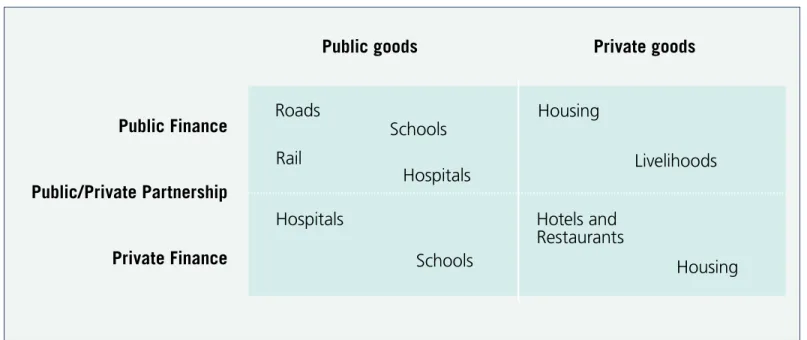
4.3 Overlap between Public and Private Funding 41
4.4 Timeframe for Use of Allocated Resources 44
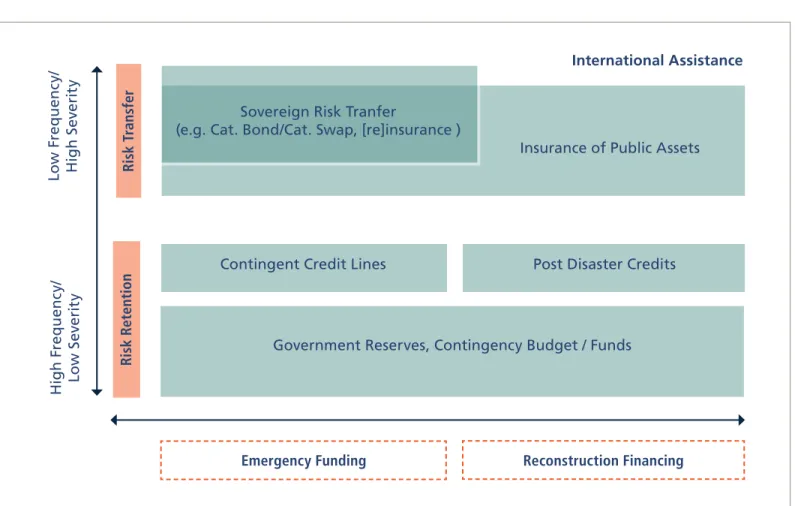
6.1 Risk Layering of Disaster Risk Financing Options 62
n Table
NOTE TO POLICY MAKERS
Instruments such as the Post-Disaster Needs Assessment (PDNA) provide a solid basis for quantifying recovery needs and formulating broad strategies. However, experience in the last several decades has shown that meeting recovery needs must go beyond simply conducting post-disaster assessments. Demand has been growing globally for a disaster recovery framework for resilient recovery that can build on the PDNA or other such assessments.
In response, the World Bank’s Global Facility for Disaster Reduction and Recovery (GFDRR) collaborated with the European Union (EU) and the United Nations Development Programme (UNDP) to produce this Guide to Developing Disaster Recovery Frameworks. The guide is intended as a practice-based, results-focused tool to assist governments and partners in planning for resilient post-disaster recovery.
How Can Policy Makers Use the Guide?
The guide provides the essential information to assist policy makers and other stakeholders in formu-lating a framework for the medium- to long-term post-disaster recovery. This framework will help in articulating the recovery vision; defining the recovery strategy; prioritizing actions; fine-tuning planning; and providing guidance on financing, implementing, and monitoring the recovery. The framework also is a tool that helps in learning and self-evaluation, leading to continuous improvements over the course of the recovery implementation.
Key Considerations for the Policy Makers in the Recovery Process
Depending on the nature of the disaster, the development of a recovery framework can range from being relatively resource-light to being resource-intensive. Similarly, depending on the scale of recovery and reconstruction required, the framework can take from a few weeks to several months to develop.
Institutional Arrangements
The preferable arrangement for post disaster recovery is to have a pre-existing entity for the core recovery planning and oversight functions required to meet recovery objectives. In the absence of such arrange-ments it is critical to designate an agency to take the lead role in coordinating or planning recovery. A lead recovery agency should be designated early into the recovery process. This guide elaborates a multitude of possible institutional arrangements for recovery implementation. However, the key
elements of an effective lead recovery agency are that it should have a clear mandate and that it should be backed by effective political and technical leadership.
Vision and Guiding Principles
Another important initial step in setting up a recovery framework is the articulation of the recovery vision and guiding principles. They enable the government to convey its recovery priorities to the public, stakeholders, and partners; and to build national or subnational consensus around them. Early setting of the vision and guiding principles for recovery is important to ensure effective transition from the immediate humanitarian response to the medium- to long-term recovery. For example, guiding principles could encourage the use of shelter materials in the humanitarian response that could be reused to reconstruct homes.
Programmatic Approach
The lead recovery agency may help the government develop a framework that takes a programmatic approach to identify priority sectors that are critical for restoring livelihoods. Such a framework would enable the use of holistic recovery management. In it, the activities of government agencies, communities, and nongovernmental entities complement one another under a government-led framework. Because a significant portion of recovery activities are undertaken by the nongovernmental entities, an inclusive recovery process would help avoid duplications and gaps. For example, certain geographic areas or sectors may be allocated to particular donors, NGOs, and implementation partners.
The lead agency would oversee the development of the recovery framework and would play a critical role in its implementation. The lead agency also could play a central role in the coordination, oversight, and monitoring and evaluation (M&E) of the progress of the recovery.
Financing for Recovery
Recovery implementation needs to be supported by the mobilization of funds and coordination mechanisms that channel funds to the implementation entities in a timely manner. Recovery may be funded through government funds, international aid, private sector financing, and community contribution. To manage recov-ery in a holistic manner, it is recommended that the government have an effective funds tracking mechanism for both on-budget and off-budget funds. A good fund-tracking mechanism along with a strong public financial management system enhance donor confidence and help in mobilizing additional funds for recovery.
Simplified Procurement
The increase in the volume of transactions and the urgency with which they need to be completed often overwhelm existing government systems. Simplified procurement procedures can provide a robust mecha-nism for the timely purchase of goods and services. Experience suggests that responsible officers are reluctant at times to use the simplified procurement procedures even if they exist within the government systems. The mandate given to the lead recovery agency under the recovery framework is important in invoking and promoting the use of simplified procedures.
Communication
Recovery is often a multisectoral activity that encompasses a broad range of actors and affected commu-nities. For this reason, it is crucial for the government to have a consolidated communications system that conveys the progress of the recovery and addresses the expectations of the affected communities. A coher-ent communications platform also is useful in communicating with donors and beneficiaries.
INTRODUCTION
The World Bank’s Global Facility for Disaster Reduction and Recovery (GFDRR) collaborated with the European Union (EU) and the United Nations Development Programme (UNDP) to produce this Guide to Developing Disaster Recovery Frameworks (DRF guide).1 This DRF guide is intended primarily for audiences involved in recovery planning within the government systems. These groups include policy-makers, leaders, and managers of recovery institutions; financial managers; monitoring and evaluation (M&E) experts; and governmental implementing agencies. Other national stakeholders including civil society organizations (CSOs), nongovernmental organizations (NGOs), and private sector entities also may benefit from the DRF guide.
This DRF guide is based primarily on good practices compiled from (a) nine countries’ disaster recov-ery experiences and (b) collaboration with the international advisory and technical working groups formed to develop the DRF guide. It is intended as a practice-based, results-focused tool to assist governments and partners in planning for resilient post-disaster recovery 2 following a large-scale disaster. The DRF guide also can be used to respond to smaller scale, recurring disasters. Finally, it provides key planning and decision-making processes for the development of recovery policies and programs. However, the DRF guide does not necessarily cover the full breadth of the actual imple-mentation of recovery.
Why Disaster Recovery Frameworks?
Tools such as the Post-Disaster Needs Assessment (PDNA) or similar assessments provide a solid basis for quantifying recovery needs and formulating broad strategies. Globally, these assessments have become regular practice immediately following disasters. However, experiences in the last several decades have shown that meeting recovery needs must go beyond simply conducting post-disaster assessments. Enabling communities to recover from disasters requires both good preparedness before the disaster and ensuring that recovery measures are aligned with ongoing development following the disaster. Consequently, demand has been growing globally for a framework for resilient recovery that can build on the PDNA or other disaster assessments tools. This framework would guide governments and other implementing stakeholders in the middle and longer term recovery efforts. The framework would help in articulating a vision for recovery; defining a strategy; prioritizing actions; fine-tuning planning; and providing guidance on financing, implementing, and monitoring the recovery.
Through developing a country-level disaster recovery framework, a government will be better positioned to drive a process that unites all development partners’ efforts. Additionally, by developing a frame-work to manage recovery, a government may be able to better address longer term disaster vulnera-bility through coherent programs that bridge the current gap between recovery and development. For example, such programs could address disaster-resistant housing, building code enforcement, safety nets, green growth, and climate change resilience. As a result of developing its recovery framework, a government likely would be able to prioritize disaster risk reduction and resilience measures within both its short- and long-term development goals.
What Does the DRF Guide Do?
This DRF guide will enable a government to create a national disaster recovery framework (DRFs) that:
• Complements PDNAs or similar assessments as a tool to program and plan the recovery.
• Lays out the roles, responsibilities, and organizing structure of the governmental and nongovernmental agencies, as well as of the local authorities and groups responsible for disaster recovery.
• Provides an integrated, program-level action plan to facilitate multisector recovery planning, prioritization, and activity sequencing. The frameworks also will guide funding and portfolio management decisions.
• Functions as a living baseline document to monitor progress and evaluate impacts.
• Ensures aid effectiveness by bringing together multiple stakeholders, governmental and nongov-ernmental, around one common and inclusive government-led platform for recovery strategizing, planning, and project management.
The DRF guide is not intended to burden the recovery process with complex rules of engagement or cooperation among national agencies and development partners. It is not a prescriptive or in-depth treatment of country-specific recovery issues and challenges. Instead, this flexible, practice-based guide offers options that can be adapted to an individual country’s conditions. Finally, the DRF guide is not an in-depth treatment of all sectoral recovery issues and challenges. Instead, it focuses on broader multi- and intersectoral recovery planning aspects.
DRF Guide Objectives
The DRF guide is intended as a tool to assist governments and partners in planning for resilient post- disaster recovery that will lead to sustainable development. Expected outcomes of implementing recovery frameworks are:
• Informed institutional and policy-setting for recovery
• Prioritization and programming based on an inclusive, transparent process that ensures participation of all stakeholders and uses national and international good practices
• Effective coordination among partners during the recovery and reconstruction processes
• Comprehensive framework for recovery financing
• Improved Implementation and monitoring and evaluation systems for recovery programs.
How Is the DRF Guide Used?
The DRF guide presents information customized to the different needs of target audiences. Understanding its structure will assist users to navigate it. The detailed content of the DRF guide is arranged in six modules, or units. These modules follow the sequence of steps required to develop and implement a framework.
Module 1: Conducting Post-Disaster Damage and Needs Assessment
Module 1 establishes the link between the PDNA, or similar disaster assessment, and the DRF. Addition-ally, the PDNA provides a brief overview of the key objectives and guiding principles of conducting disaster assessments.
Module 2: Policy and Strategy-Setting for Recovery
At almost the same time that it estimates the total damages and recovery needs of a disaster, the govern-ment can begin to set policies and strategies for recovery. Module 2 describes the guiding recovery princi-ples and good practices and the key results associated with developing programs for integrated, cross-sec-toral disaster recovery.
Module 3: Institutional Framework for Recovery
In addition to policy formulation and strategy, how institutions are set up is critical for a successful recovery. Module 3 describes good practices and key results associated with the development of effective institu-tional structures, leadership and human resources –for overseeing, managing, coordinating and imple-menting reconstruction.
Module 4: Financing for Recovery
Module 4 concentrates on the major financing challenges of post-disaster reconstruction. These challenges include quickly quantifying the economic and financial costs of the disaster, developing reconstruction budgets, identifying sources of financing, and setting up the mechanisms to manage and track funds.
Module 5: Implementation Arrangements and Recovery Management
Recovery programs must be quickly implemented and visibly improve the lives of disaster-affected popula-tions. Module 5 supplies the background information required to ensure that program implementation is effective, equitable, timely, and working toward building back a better future.
Module 6: Strengthening Recovery Systems in National and Local Governance
Module 6 examines various reforms and improvements to institutional and legislative arrangements that can be developed and implemented in advance of disasters. These advance improvements offer the best hope for disaster risk reduction.
Additional features common to all six modules are:
• Each module features Results Charts, which recommend recovery planning processes based on the results intended. The Results Charts all contain the same components: core planning processes, outputs, and actors.
• Checklists are featured at the end of each module. These checklists enable target audiences to assess rapidly whether that module’s thematic issues are integrated in the development of a DRF.
• Additional details on the strategic and implementation options available for various modules can be found either in the country good practice text boxes that accompany the main text, or in the country case studies (https://www.gfdrr.org/recoveryframework).
Additional Sections of the DRF Guide
The common best practices and lessons identified from all countries also are combined in a concluding section, “Common Best Practices and Lessons Identified”.
All good practice results at various stages of recovery planning are integrated in a Results Framework (appendix 1). It provides a clear overview of all outcomes and outputs generated by the recovery planning. A broad range of actors come together to develop disaster recovery frameworks. To ensure a shared under-standing, this DRF guide provides a Glossary of terms that may not be familiar to all users.
Detailed country case studies—the technical and thematic appendices to the DRF guide—also are available at https://www.gfdrr.org/recoveryframework. Thematic appendices that focus on specialized areas will be added to the online DRF guide progressively.
Endnotes
1 “Recovery” is defined as the restoration, and where appropriate, improvement of facilities, livelihoods, and living condi-tions of disaster-affected communities, including efforts to reduce disaster risk factors. While, “reconstruction” focuses primarily on the construction or replacement of damaged physical structures, and the restoration of local services and infrastructure. The term “recovery” in this guide encompasses both “recovery” and “reconstruction”.
2 “Resilient recovery” builds resilience during recovery and promotes resilience in regular development. Resilient recovery is a means to sustainable development.
MODULE 1. CONDUCTING POST-DISASTER DAMAGE AND
NEEDS ASSESSMENT
A post-disaster needs assessment (PDNA) is a prerequisite for developing a Disaster Recovery Frame-work (DRF). The affected country decides which damage and needs assessment methodology will be used to conduct the initial assessment. The PDNA is one established methodology for estimating damages and needs that is often used. The intent of Module 1 is to establish the linkage between the PDNA, or similar disaster assessments, and the DRF.1
Need for post-disaster assessment. Early recovery can start while humanitarian response activities are ongoing.A decision by the government on the nature of the disaster assessment and DRF is the first transitional step from humanitarian assistance to full-scale recovery and reconstruction with defined objectives. In the initial period after impact, questions arise as to what the priority recovery needs are and what the specific objectives of recovery should be. Answering these complex questions will require understanding the magnitude of the disaster. The understanding is acquired by the government undertaking assessments of damage and needs in light of the recovery objectives agreed by govern-ment policy-makers and other key actors.
Disaster assessments provide the basis on which the DRF can be further developed. Specifically, assess-ments help in the development of operational plans for deploying human, financial, and information resources to implement large-scale reconstruction programs. They also help set up credible baselines for the subsequent monitoring and evaluation of the recovery program.
Key elements of a post-disaster assessment. Some disaster-impacted countries may intend to fund the recovery to the fullest extent possible. Other such countries may have to rely on external aid for funding part of their recovery programs. For both groups, it is important at the very outset to commission a disaster assessment that will aggregate the cost of damages and losses. The assess-ment needs to be governassess-ment led. However, the assessassess-ment also must be inclusive. Inclusion means that the government must ensure participation and consultation by relevant government depart-ments (both horizontally and vertically), civil society, the private sector, and face to face with people in the affected communities.
Assessments should provide a fairly reliable estimate of the overall resource requirements and financing available to a country’s reconstruction policy- and financial decision-makers. The estimates then would enable them to initiate strategic and holistic reconstruction planning. Having a strategic perspective helps develop operational plans for deploying human, financial, and information resources to implement large-scale reconstruction programs. It also helps set up credible baselines for the subsequent monitoring and evaluation (M&E) of the recovery program.
Assessments can take different forms depending on the type and size of the disaster and on the national context. Examples follow of the types of assessments that could be used in post-disaster scenarios.
Humanitarian and early recovery assessments. Governments and international actors conduct rapid assessments in the immediate aftermath of disasters to identify humanitarian needs. These assessments often are organized around clusters that will use their sector-specific assessment method-ologies and tools. These assessments may be carried out jointly, such as through the Multi-Cluster/ Sector Initial Rapid Assessment (MIRA). In some cases, these humanitarian assessments also identify
early recovery needs. In other cases, separate assessments are designed specifically to identify early recovery needs. These assessments are undertaken at the same time as, or immediately following, the humanitarian assessments.
Sector-specific assessments. Governments conduct sector assessments by using the relevant line ministries. However, the individual line ministries may not necessarily form part of a multisectoral assessment. In the sectors in which they have expertise, international organisations such as the World Bank, the United Nations (UN) system, or the European Union (EU) can support sector-specific assess-ments. In such cases, these international agencies would supply punctual technical assistance to three specific operations:
1. Carry out the assessment
2. Setting up an assessment team that includes representatives from the relevant government minis-tries and other relevant stakeholders
3. Applying the appropriate assessment methodologies and tools.
Post-disaster needs assessments (PDNA). The PDNA is a common assessment approach developed by the EU, UNDP, and World Bank to support governments to assess damages and recovery needs. It is an inclusive process that builds on the capacity and expertise of national and international actors. When participating in such assessments, the PDNA Guides Volumes A and B should be used.2
This tool is being used in an increasing number of countries, particularly for larger scale emergencies. Governments conduct PDNAs with the support of the international community. The main goal of PDNAs is to assist a government to assess the full extent of a disaster’s impact on the country and what is needed for the nation to recover. The findings serve as the basis for designing a resilient recovery framework and for mobilizing financial resources to implement it. PDNAs provide a more comprehensive empirical basis for costing post-disaster recovery and reconstruction and for informing an international donor conference.
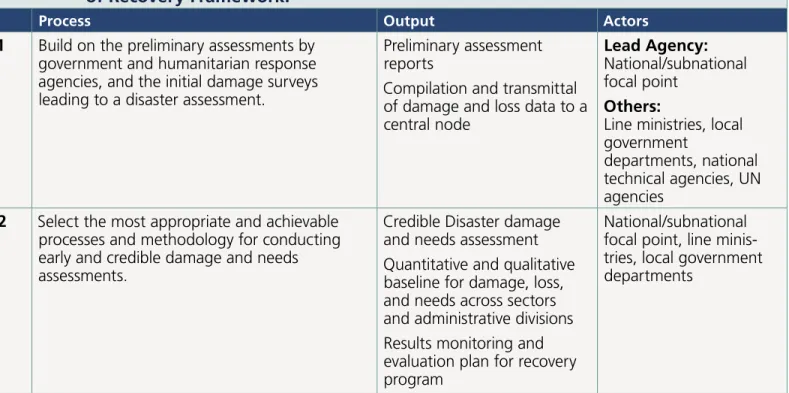
Result 1. Post-disaster Damage and Needs Assessment Provides Basis for the Development of Recovery Framework.
Process Output Actors
1 Build on the preliminary assessments by government and humanitarian response agencies, and the initial damage surveys leading to a disaster assessment.
Preliminary assessment reports
Compilation and transmittal of damage and loss data to a central node
Lead Agency:
National/subnational focal point
Others:
Line ministries, local government
departments, national technical agencies, UN agencies
2 Select the most appropriate and achievable processes and methodology for conducting early and credible damage and needs assessments.
Credible Disaster damage and needs assessment Quantitative and qualitative baseline for damage, loss, and needs across sectors and administrative divisions Results monitoring and evaluation plan for recovery program
National/subnational focal point, line minis-tries, local government departments
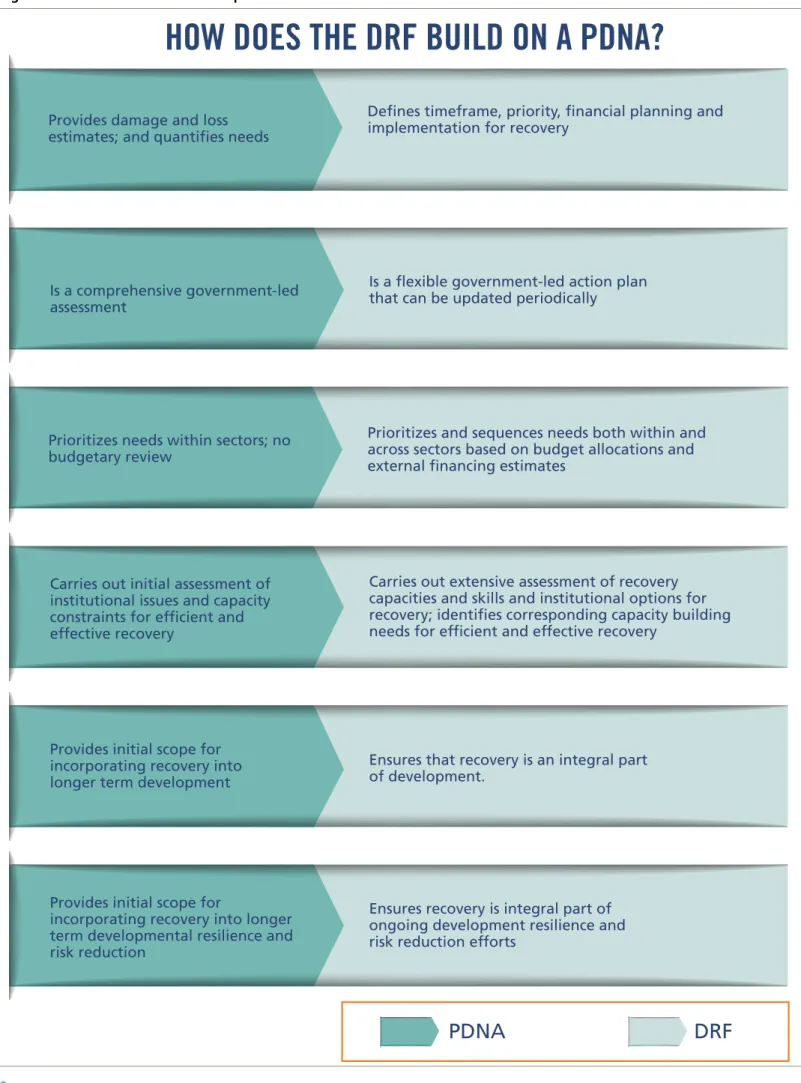
Key difference between PDNA and DRF. The PDNA and similar disaster assessments are an essential component of a successful DRF. However, their limited scope means that they cannot replace a DRF. The PDNA provides damage and loss estimates, and quantifies needs. The recovery framework (DRF) then builds on the damage and loss assessment for detailed sequencing, prioritization, financing, and imple-mentation of the recovery.
The PDNA and the recovery framework should be implemented together. In most instances, combining the process will not require additional financial resources or time. In fact, the process will significantly increase the likelihood of translating PDNA and DNA recommendations into a recovery that is resilient.
Module 1 Checklist
This checklist covers the 8 different steps required to carry out a PDNA or other similar assessment. The list is not comprehensive, but provides an overview of the primary steps to be followed.
❑ Draft terms of reference. The terms of reference guides the needs assessment regarding the sectors to be covered, data to be collected, teams to be deployed, and reports that need to be prepared.
❑ Schedule and timeframe. The needs assessment should commence after 1 or 2 weeks of disaster. However, the schedule can vary depending on the scale and nature of the disaster. Completing the needs assessment can take a minimum of 3 to 6 weeks. Before the needs assessment is begun, the government must ensure that the relief phase of disaster is almost over and that conducting a needs assessment would not impede the continuance of any relief activity.
❑ Government participation. The government must nominate its officials and experts to partici-pate in the needs assessment.
❑ Formation and training of sector teams. The needs assessment must cover all affected sectors. For each sector, [the government will choose] a team that will include the relevant experts from the government departments and other agencies. The government also must support the train-ing of sector teams in needs assessment methods through traintrain-ing programs.
❑ Collection of baseline and primary data. Government agencies should provide baseline data in relation to all the sectors that are being assessed.
❑ Field visits. Sector teams must undertake field visits to carry out assessments. These field visits need to be organized by the government. The number of field visits as well as the places to be visited will be decided in consultation with the government agencies.
❑ Writing the report. All sector teams must write their sector-specific reports and submit them to a core writing team, who will prepare and finalize the needs assessment report.
❑ Review and approval of the needs assessment report. The report will be submitted to the government for its review. The government will circulate the report within various ministries/ departments for their comments. The review needs to be conducted with a strict deadline. The writing team will incorporate the comments and finalize the report. Once the final PDNA
or similar assessment report is submitted to the government, the government should approve it. The needs assessment report then becomes official and will form the basis for recovery planning and implementation.
Endnotes
1 For additional details on conducting a PDNA, see EU (European Union), UN (United Nations), and World Bank, Post- Disaster Needs Assessment Guide, Vol. A, 2013, www.recoveryplatform.org.
2 EC (European Union, UN (United Nations), and World Bank, Post-Disaster Needs Assessment Guide, Vols. A and B, EC, UN, and World Bank, 2013, www.recoveryplatform.org.
MODULE 2. POLICY AND STRATEGY SETTING FOR RECOVERY
Visioning, policy making, and strategy setting can begin at the same time that damage assessments are taking place. These first three processes provide the government with the opportunity to reach out to affected communities to define the scope of programs. Module 2 describes the vision, guiding principles, and appropriate strategies needed to achieve integrated, cross-sectoral disaster recovery.Figure 2.1 provides a flowchart of the different processes to be followed for recovery planning.
Development of a Central Vision for Recovery
The articulation of a recovery vision enables the government to convey its recovery priorities, and build national or subna-tional consensus around them. The vision is the starting point around which the entire recovery process will be formulated. The core elements to be included in a recovery vision follow.
• Ensuring that the vision is developed at the highest level of government is critical for building consensus among the range of stakeholders. The government can invite groups of internal and external stakeholders to sessions in which it communicates and seeks input for its vision of recovery. Seeking agree-ment from stakeholders will smooth the way for unified planning. These consultations at the start of the recov-ery process then guide the expectations of the affected communities and reconstruction partners
• Ensuring coherence with development programs.
The recovery vision is intended to be coherent with the government’s broader, longer term development goals and growth and poverty reduction strategies. The vision can provide a strategic continuum between pre- and post-di-saster development planning by bridging both pre-existing development gaps and new gaps triggered by the disaster.
VISION for Recovery BBB POLICY FRAMEWORK PROJECT IMPLEMENTATION SECTOR
STRATEGY DEVELOPMENTPROGRAM
Pro-poor Opportunity Figure 2.1 Recovery Planning Processes
• Incorporating resilience and BBB in recovery vision. Resilient recovery is not well understood by most development practitioners. Countries are beginning to develop their own standards and defini-tions for resilient recovery. To support resilient recovery, this DRF guide recommends that countries pay particular attention to seven issues: Building Back Better (BBB), gender concerns, equity, vulnerability reduction, natural resource conservation, environmental protection, and climate change adaptation.
• Optimizing recovery across sectors. Whenever possible, the recovery vision should encompass public and private sectors, and promote norms for nondiscriminatory and equitable asset disbursement among individuals and communities. In the past, infrastructure reconstruction often has dominated post-disas-ter recovery. However, equally important is the priority given to the recovery of the lives and livelihoods in disaster-affected communities. People-focused recovery can be facilitated by reconstructing private assets through direct subsidies, where affordable; or through other enabling policy measures, where appropriate. Showing sensitivity to the needs of the affected population also is important in meeting and managing public expectations.
Result 2. A Recovery Vision Acceptable to All Stakeholders
Process Output Actors
1 The first step in developing a recovery frame-work is to define a clear vision for recovery at the highest possible political and bureaucratic levels of government. It is key to relate this vision to the country’s broader development context and its growth and poverty reduction programs. To be truly inclusive, a vision must in-clude input from multistakeholder consultations.
Articulation of a recovery vision
Setting up community meet-ings to build consensus for the recovery vision
Lead Agency:
National planning agency
Others:
Designated recovery agency, national/
subnational government, line ministries, civil society, communities, other partners
2 The recovery vision needs to be refined to make clear (a) prioritized goals for overall recon-struction and recovery, (b) policy standards, (c) timeframe for implementation, (d) identification of stakeholders, (e) strategic priorities by sector and geographic area, and (f) functional respon-sibilities for recovery program managers.
Working out the sectoral, geographic, and functional details of recovery
Lead Agency:
National planning agency
Others:
Designated recovery agency, national/
subnational government, line ministries
Policy Frameworks for Recovery
To adequately finance and implement post-disaster recovery and to achieve the vision, a recovery policy framework is critical. The framework should be backed by the country’s highest political and policy-mak-ing levels as well as by its plannpolicy-mak-ing and financial institutions. The framework requires high-level consensus building around the key cross-cutting operating principles and program-level performance benchmarks of multisectoral recovery.
Policy frameworks for large scale recovery from around the world typically consist of the following elements:
• Central policy-making and coordination
• Subsidiarity1 and local implementation
• Public sector facilitation of private recovery
• Independent oversight and transparency
• Effective management of public expectations and grievances
• Fostering public-private partnerships.
Ensuring and promoting longer term disaster risk reduction and climate change adaptation, environmental and social safeguards, gender sensitivity, and protection of vulnerable groups.
Result 3. Provision of an Enabling Policy Framework to Achieve a Recovery Vision
Process Output Actors
1 The government needs to develop an enabling policy framework for recovery that reflects multistakeholder consensus for action at the national and subnational levels.
Policy framework and guiding principles for recovery
Consistent and equitable application of key cross- cutting operating principles
Lead Agency:
National planning agency
Others:
Designated recovery agency, national/
subnational government, line ministries
2 The policy framework identifies the govern-ment’s priority sectors for recovery and reflects intrasectoral prioritization. In in most post- disaster contexts, recovery needs are
sequenced through the PDNA. The government needs to communicate its top recovery priori-ties to donors, recovery partners, and affected communities. Good communication by the government will build support for its priorities among the various stakeholders.
Identification of primary sectors for inclusion in the recovery program
Lead Agency:
National planning agency
Others:
Designated recovery agency, national/
subnational government, line ministries
Key Policy Imperatives for Recovery
Successful disaster recovery experiences from around the world have in common the adoption of at least three crucial policies: (a) Building Back Better, (b) converting adversity into opportunity, and (c) prioritizing pro-poor recovery.
• Building Back Better. Building Back Better (BBB) is the reconstruction approach that aims to reduce vulnerability and improve living conditions, while promoting more effective reconstruction. BBB addresses the importance of improving community resilience following disasters and identifies what is consid-ered successful recovery. Recovery policy-makers and practitioners lack consensus on what BBB should include or not. However, at a minimum, BBB signifies policy commitment to right-sizing, right-siting, and improving the resilience of critical infrastructure.
• Converting adversity into opportunity. Disaster recovery can be an opportunity to replace old infra-structure and update service delivery systems with affordable, resilient improvements.
• Pro-poor recovery.2 Prioritizing reconstruction planning to address the needs of
socioeconomi-cally vulnerable individuals and groups contributes to a more equitable society. If their needs are ignored, the poor and vulnerable are more susceptible to future hazards and shocks. Many disaster recovery programs include the provision of direct livelihood support, income generation opportu-nities, improved access to finance and microcredit, and new skills training. Governments also subsi-dize or facilitate the reconstruction of private assets, such as housing and local business enterprises. However, governments cannot substitute for private insurance to pay recovery costs.
Box 2.1 Building Back Better in Queensland, Australia
Following extensive flooding from Tropical Cyclone Oswald in 2013, the Australian and the regional Queensland government pooled resources to create an $80 million Betterment Fund. The fund enables local councils to restore or replace essential public assets damaged by Tropical Cyclone Oswald to a more disaster-resilient standard than their pre-disaster standard.
Two of the projects financed by the Betterment Fund are described below. George Bell Crossing Project
George Bell Crossing is a bridge located in the Somerset region of Queensland. The bridge had just finished being rebuilt from damage sustained in 2011 when flooding from Tropical Cyclone Owald completely washed away the crossing. Floodwaters also caused severe scouring and erosion to the eastern approach, resulting in complete demolition of the crossing.
The Betterment project will replace the crossing with a larger concrete bridge. This structure will reduce the risks of the construction material washing out and of the scouring and saturation of the pavement and subgrade. The project will make the asset more resilient against future flood events. As one local authority explained, “These funds will allow Council to replace bridges and causeways with better and more robust structures that will have longer life-spans and hopefully withstand natural disasters.
Upper Mount Bentley Road Project
The Upper Mount Bentley Road Project is located on Palm Island, a remote indigenous community. The road provides the only on-ground access to vital telecommunications infrastructure located at the peak of Mount Bentley. This road was impacted by disaster events 8 times between January 2008 and January 2013, significantly reducing safe access during disaster events.
The Betterment project included constructing concrete surfacing of the steepest or most vulnerable sections of the road. This road repair facilitated repairs to be carried out without delay to the communications tower.
Source: G. Newton, “Building It Back Better to Reduce Risks after Multiple Disaster Events,” Queensland
Reconstruction Authority, Queensland, Australia, n.d.
Identification of Priority Sectors for Recovery
The next step entails the identification of priority sectors for recovery in line with the broader recovery vision and policy framework, and based on the detailed needs and damage assessment carried out at the PDNA stage. The typical breakdown of programmatic recovery includes the following sectors: rural/urban housing development, water and sanitation, governance, transport, power, communications infrastructure, environment,3 livelihoods, tourism, social protection, health, and education.
Programmatic Framework for Recovery
Programmatic Approach to Recovery
The achievement of the recovery goals, targets, and priorities, as defined by the vision and policy frame-work, requires development and maintenance of a strategic and programmatic framework. This strategic framework is the central planning tool and oversight mechanism for cross-sectoral and integrated disaster recovery.
Where the center of such recovery planning is located is not important. In cases of inter-provincial recovery programs, it could be within a central government authority. In cases of subnational or local programs,
planning center could be located within subna-tional recovery planning and oversight entities. What is important is that large scale recovery should have a central meeting point, or node. At this point, the recovery plans and projects of the national, subnational, and local entities converge to provide the complete programmatic picture of recovery for policy-makers at all relevant levels. In many countries, the major portion of recov-ery interventions are undertaken by nongovern-mental organizations (NGOs). A programmatic approach also provides an opportunity to exercise holistic management of recovery. In this approach, the activities of government agencies, NGOs, communities, and the private sector complement each other within a government-led framework.
Benefits of Programmatic Approach
Key benefits that can be derived from program-matic and centrally overseen recovery include (a) consistent application of policy principles and imperatives across all sector programs and projects; (b) harmonized and mutually reinforc-ing recovery results and outcomes across sectors; (c) needs prioritization within and across sector programs; (d) sequencing of recovery activities according to the agreed order of prioritization to ensure the planned outcomes (e) mutually reinforcing governmental and nongovernmen-tal recovery interventions, and (f) a central node from which to monitor and evaluate recovery at a programmatic level, enabling strategic adjustments to be made as required.
Setting Program-Level Objectives for Recovery
Programmatic recovery objectives are different from sector-specific objectives. Program objectives specify what is meant by effective, efficient, and resilient recovery in the country and post-disaster context. Recon-struction and recovery plans are intended to mitigate not only the effects of the current disaster but also the impacts of future hazard events.
Box 2.2 Prioritizing Sector Recovery in Practice
Sri Lanka, Tsunami, 2004
Following the December 2004 Tsunami, the govern-ment of Sri Lanka prioritized short-term and long- term financial needs in proportion to the damages sustained and the recovery strategy.
• Short-term financial needs included the housing,
transportation, and livelihood restoration sectors.
• Damaged assets in housing and health have been
replaced with those of equal value.
• Damaged assets in transportation, water supply, and
sanitation have been upgraded. (These sectors al-ready had suffered damages before the tsunami due to the civil war.)
Lao PDR, Tropical Storms, 2009, 2011, 2013
Across multiple flood-related disasters over 2009 to 2013, in-depth inter- and intra-sectoral assess-ments emerged as important aspects of the overall post-disaster assessment framework.
• The government’s primary post-disaster data gathering
tool was a multisectoral rapid assessment. It was car-ried out within the first two weeks following a disaster.
• Each line agency assessed the damages and needs
for its relevant sector.
• Outputs of these assessments included line
agency reports that were forwarded to central level ministries.
Result 4. Application of Policy Principles for Mutually Reinforcing Recovery Outcomes across Sectors
Process Output Actors
1 The government needs to develop and main-tain a strategic and programmatic frame-work. This framework will serve as the central planning node and oversight mechanism for cross-sectoral and integrated disaster recovery. The strategic and programmatic framework increases the likelihood of (a) more equitable resource allocation and equitable needs pri-oritization within and across various sectoral programs; (b) systematic sequencing of recov-ery activities according to the agreed order of prioritization to ensure the planned outcomes at the planned times, and (c) instituting mech-anisms for central monitoring and evaluation of recovery at the programmatic level, thus making space for strategic alterations.
Programmatic recovery
framework Lead Agency:National planning agency
Others:
Designated recovery agency, national/
subnational government, line ministries
Wide-Area Land Use and Physical Planning
Existing development policies should form the basis of recovery and reconstruction planning. However, pre-existing policies may require rethinking land use zoning and the provision of physical infrastructure. Rethinking may be particularly necessary for entire regions that have been devastated and need to be re-planned and reconstructed.4
In some post-disaster situations, an area-wide planning process also can be commissioned. It would span, but also differentiate between, the urban-rural and local-regional contexts and requirements.5 Area-wide planning can deliver an integrated treatment of a broad range of land uses: settlements and residential areas; commercial areas and productive infrastructure; public infrastructure including physical, economic, and social infrastructure; and typically rural contexts such as community-owned infrastructure, forestry, farmland, animal husbandry, and fisheries.
At local levels, considerations can include plans for consolidation of unused land, improvements in energy efficiency, mitigation of environmental impact, reconstruction of strategic towns, integration of residential, ecological, and economic land uses, and plans for emergency access.
Box 2.3 Resettlement after Disasters
Samoa Earthquake and Tsunami 2009
After the September 29, 2009 earthquake and tsunami, the Government of Samoa considered resettling disas-ter-affected population centers away from coastal areas.
Since the tsunami, a significant part of the affected population has moved away from the coastal areas and indicated a wish to settle permanently in new locations away from the coast. Such population movements and attempts to rebuild communities away from natural hazard areas are common after tsunami disasters. However, the success—or failure—of communities’ and governments’ efforts to reduce vulnerability to natural risks by establishing resettlement areas is highly dependent on whether basic services can be provided quickly and sustainably post disaster to relocated people.
Affected Samoans have resettled in traditional plantation areas, in which infrastructure networks (water, electricity, roads) are nonexistent, or of poor quality. To support a more permanent upland resettlement of villages that were destroyed by the tsunami, additional investments are needed to create the necessary infrastructure networks and facilities needed to provide services at the new locations.
China Earthquake 2008
On May 12, 2008 Sichuan Province, China was struck by an 8.0 magnitude earthquake. The World Bank helped the Government develop an “Environmental and Social Safeguards Screening and Assessment Framework”. This provided a simple checklist to ascertain whether reconstruction projects needed an Environmental Impact Assess-ment or a more simplified procedure. Clear guidance was given to communities and cities on which areas could be used for rebuilding and which areas should remain untouched. Most importantly, environmental and disaster reduction considerations were built into the assessment, which enabled local communities to rapidly deploy their resources, rebuild their homes where possible, and return to normalcy. As a result, reconstruction activities did not take place in environmentally sensitive or disaster-prone areas, which greatly helped to minimize the impact of future risk.
Intersectoral Prioritization
Prioritization across sectors can help ensure equitable and demand-responsive recovery across affected jurisdictions and communities. Prioritization also can promote conflict-sensitive, pro-poor, pro-vulnerable, and gender-sensitive recovery agendas.
The areas considered sectors include the social sectors (housing, land and settlements, education, health, and nutrition); production sectors (employment and livelihoods, agriculture, commerce and trade, and industry); infrastructure sectors (community infrastructure, water, sanitation and hygiene, transport and telecommunications, and energy and electricity). Cross-cutting sectors include disaster risk reduction, environment, gender, and governance.
The first step in prioritizing is to identify the sectors targeted for reconstruction. Second, a criteria-based prioritization of recovery needs across competing intersectoral priorities should be made. Such prioritiza-tion broadens the resource allocaprioritiza-tion and the annual on- and off-budgetary flows for recovery throughout the expected recovery period.
The rule of thumb for prioritization is, first, to determine the sectors and sectoral priorities that help lever-age direct humanitarian impact in the shortest time. The case studies in this DRF guide show that housing and livelihoods often take precedence over other sectors. These two sectors are given precedence because they directly impact disaster-affected populations. The interventions in these two sectors take place simul-taneously with restoration of critical public infrastructure and service delivery. The next phase is medium- to long-term reconstruction and generation of sustainable livelihoods.
Developing Principles for Intersectoral Prioritization
The government needs to establish principles to determine the criteria for intersectoral prioritization to help ensure equitable and demand-responsive recovery across affected jurisdictions and communities. Prioritiza-tion grounded in principles ensures that sectoral program development remains consistent with the overall objectives of the reconstruction program.
Certain criteria used to prioritize recovery actions arise consistently in countries’ experiences.6 These criteria include:
• Potential for direct and widest humanitarian impact
• Pro-poor, pro-vulnerable, and gender-sensitive agendas
• Potential to generate sustainable livelihoods
• Balance between public and private sector recovery
• Balance between physical infrastructure reconstruction and less visible recovery (such as capacity building and governance)
• Restoration and rebuilding of critical infrastructure and services.
Result 5. Ensure Equitable and Demand-Responsive Recovery across Affected Communities
Process Output Actors
1 The government needs to establish a set of principles to determine criteria for intersec-toral prioritization. Prioritization ensures that subsequent sector program development and projects remain consistent with the overall ob-jectives of the reconstruction program. Prioriti-zation also helps leverage direct humanitarian impact in the shortest time.
The various sectors will compete for available resources. The government needs to estab-lish criteria-based and objectively verifiable cross-sectoral prioritization of recovery needs across these competing intersectoral priorities. Prioritization can help ensure equitable and demand-responsive recovery across affected jurisdictions and communities.
Development of criteria for intersectoral prioritization and their programming and sequencing for recovery Objective, criteria-based resource allocation; annual rationalization of recovery budget
Lead Agency:
National planning agency
Others:
Lead recovery agency, line ministries, Ministry of Finance
Setting up Sector-Level Recovery
Establishing sectoral strategies early can ensure that they are in line with the government’s overarching principles for the recovery.
Developing Sector-Specific Recovery Programs
After the policy framework and intersectoral strategies are established, the lead recovery agency typically undertakes a program-by-program approach to define sector-specific recovery programs. These programs translate the policy priorities into programs and projects that can be financed and implemented. Sector- specific recovery programs and projects are expected to reflect the policy framework and intersectoral
strategies. The programs would draw on information from assessments and surveys to plan individual sectoral projects. This consultative process broadens ownership of the recovery program. Consultation ensures the implementation of the guiding principles at the project level.
Preparatory Actions and Information Collection for Sector Program Development
By developing broad sectoral strategies early in the recovery process, sectoral policies and reconstruction objectives can be aligned to ensure synergy between reconstruction activities and development goals. The post-disaster needs assessment (PDNA) or similar initial assessment is an important reference for the development of sector-specific recovery plans. These plans can be overseen by the lead implementation agency. Technical agencies would assist with the conceptualization and development of assessment frame-works, objectives, and instruments. The lead implementation agency also may engage other public sector agencies, private sector enterprises, or civil society and community organizations for these purposes.
Result 6. Translate Intersectoral Recovery Strategy into Sector-Specific Programs
Process Output Actors
1 Initial assessments following the disaster provide a baseline for developing sector strat-egies. Sectoral policies and strategies should be refined and checked against realities on the ground. Involving local implementers and affected communities in the design phase is the most effective way to do this.
Detailed sector-specific programs developed and reviewed by affected communities
Lead Agency:
National planning agency
Others:
Local government departments, national technical agencies, civil society, communities, other partners
To inform the development of sectoral recovery programs and projects, the following surveys/assessments may be carried out:
• Land Risk Survey/Assessment. An essential input for determining whether any relocation of commu-nities is necessary.
• Land Tenure Survey/Assessment. Analyzes the issue of land and tenure records. Any disputes over ownership may delay, or even stop, the implementation of the sector planning recommendations.
• Land Availability Assessment. Primary means to identify available and suitable land that may prove socially and economically viable for displaced populations.
• Governance and Implementation Capacity Assessment. Measures the government’s capacity to implement programs.
• Social Risks and Vulnerability Survey/Assessment. Assists in identifying vulnerable disaster- affected persons.
• Infrastructure and Service Delivery Survey/Assessment. Provides results that may help design program components for rehabilitating infrastructure and resuming essential services.
• Economic and Livelihood Survey/Assessment. Assists in the adequate resumption of economic activities and livelihoods for beneficiaries of the land use and physical plans.
Setting up Consultative Processes and Forums for Inclusive Planning
Even when centrally initiated and regulated, sector-level program development is most effective when it happens early, takes action, and includes multiple stakeholders. An effective process also has a conflict-sensi-tive perspecconflict-sensi-tive. Consultaconflict-sensi-tive processes are important to ensure that sector strategies are relevant across differ-ent locales. Thematic open meetings that cut across sectors (such as housing sector recovery planning and housing design) can be organized by the lead recovery agency jointly with the relevant sectoral departments. Consulting communities about recovery increases the likelihood of widespread acceptance of it. In fact, community participation is fundamental to ensure the demand for, local ownership of, and longer term sustainability of recovery efforts. Communities’ participation also ensures that they regain access to viable sources of livelihood, economic infrastructure, and social services that are similar to or better than what they enjoyed before the disaster.
Being Conflict Sensitive and Acting to Reduce Conflicts
To this end, it is essential for the participating agencies to understand the conflict dynamics, particularly the relations between stakeholders and the issues, that create tensions and problems. It then is important to analyze how a particular intervention will impact on these dynamics.
Being conflict-sensitive is not only about understanding but also about acting on the understanding. It is important to build in the appropriate provisions and activities when interventions are first being planned— or to adjust ongoing interventions. Taking these actions will ensure that interventions do not worsen, but help to reduce, conflict tensions by reducing inequalities and bridging divisions.7
Result 7. Sector-Level Recovery Programs Developed in a Consultative and Inclusive Manner
Process Output Actors
1 Establish a consultative process to map all key stakeholders. Mapping will identify the stake-holders to be included in the planning process, thus reducing potential grievances and ensuring wide acceptance of the recovery program.
Process to map key
stakeholders Lead Agency:Line ministries
Others:
Lead recovery agency, local government departments, communities, civil society, NGOs
2 Consultations among sectors and among different levels of stakeholders (from national to community levels) are important to develop and coordinate recovery programs. This communica-tion introduces different perspectives for consid-eration in planning and implementing recovery.
Diverse consultation
modalities Lead Agency:Line ministries
Others:
Lead recovery agency, local government departments, communities, civil society, NGOs
3 Organize open meetings to involve subnational government, civil society, technical institutions, academia, private sector, and affected commu-nities. These forums can facilitate dialogue and consensus building. They are crucial for building communities’ ownership of sector recovery programs at all levels. (See more information on building ownership in Phase 3: Implementation.)
Forums for wider consultative
groups Lead Agency:Line ministries
Others:
Lead recovery agency, local government departments, communities, civil society, NGOs
Disaster Recovery in Conflict Contexts
In conflict-affected areas, there is a two-way relationship between intervention/action and conflict. All recovery actions in conflict contexts can be affected by the conflicts. However, the opposite is also true: action in a conflict-affected setting can, and is likely to, have an impact on the conflict.
Being Sensitive to Conflict and Acting to
Reduce Conflict
All conflict situations require great sensitivity from the recovery-planning agency. Recovery actions should contribute to conflict prevention, struc-tural stability, and peace building.8 To these ends, it is essential to be sensitive to conflict contexts, analyze each intervention for its effects, and act to avoid tensions and build peace.
Ensuring That All Sides in Conflict
Situations Receive Fair Treatment
Realization is growing that disaster risk-reduction and conflict-prevention measures should occur together. Disaster response must be conflict sensi-tive in order to prevent hard-won peace dividends being undermined and to ensure aid program-ming is effective.
Box 2.4 Four-Step Conflict-Sensitive-Approach in Disaster Recovery
Understand the context in which you operate, especially the conflict drivers and dynamics.
Understand the nature of intervention. This step means not just what you do (your programming), but also how you operate, where, when, and with whom (your entire engagement in the conflict context). Analyze the interaction between your intervention and the context to identify conflict risks and peace-building opportunities.
Act on this analysis to avoid negative impacts and maximize positive ones.
Module 2 Checklist
This checklist covers the different steps required to develop an effective vision, policies, and strate-gies for recovery. The checklist is not comprehensive, but provides an overview of the primary steps to be followed.
National Planning Agency
❑ Define a national recovery vision incorporating the development principles of : Build Back Better, Converting Adversity into Opportunity and Pro-poor recovery.
❑ Ensure vision is coherent with the government’s broader, longer-term development goals and growth and poverty reduction strategies.
❑ Formulate a recovery policy which prioritizes sectors for recovery, and defines key operating principles and performance benchmarks.
❑ Ensure consensus of all participants on policy framework. Setting up Consultative Processes and Forums for Inclusive Planning.
❑ Develop a program framework that sequences and makes a criteria-based prioritization of sector recovery.
❑ In conflict situations, ensure neutral and impartial treatment.
Lead Recovery Agency
❑ Contribute to development of recovery vision and policy.
❑ Support the development of guiding principles.
❑ Communicate top recovery priorities to donors, recovery partners and to affected communities.
❑ Set Program-Level Objectives for Recovery. Program objectives specify what is meant by effective, efficient and resilient recovery in your country and post-disaster context.
❑ Create forums for consultation with subnational government, civil society, technical insti-tutions, academia, private sector, and affected communities. Multi-stakeholder forums are crucial for building ownership of sector recovery programs at all levels.
❑ Rethink pre-existing policies on land use zoning and the provision of physical infrastructure. Rethinking may be necessary for entire regions that have been devastated and need to be re-planned and reconstructed.
Line Ministries
❑ Contribute to development of recovery vision and policy.
❑ Support the development of guiding principles.
❑ Set up sector level recovery strategy.
❑ Identify recovery priorities within each sector. Promote sector needs in line with the broader recovery vision and policy framework and based on the detailed needs and damage assess-ment carried out in conjunction at the PDNA stage.
Endnotes
1 See Glossary.
2 World Bank on behalf of the Operationalizing Pro-Poor Growth Research Program, “Pro-Poor Growth in the 1990s: Lessons and Insights from 14 Countries,” World Bank, Washington, DC, 2005, http://siteresources.worldbank.org/INTPGI/ Resources/342674-1119450037681/Pro-poor_growth_in_the_1990s.pdf.
3 F.G. Renaud, K. Sudmeier-Rieux, and M. Estrella, eds., The Role of Ecosystems in Disaster Risk Reduction, United Nations University (UNU) Press, Tokyo, 2013.
4 For example, in Samoa, after the 2009 earthquake and tsunami, the Government of Samoa considered resettlement away from the coastal areas.
5 A.K. Jha, with J.D Barenstein, P.M. Phelps, D. Pittet, and S. Sena, Safer Homes, Stronger Communities: A Handbook for Reconstructing after Natural Disasters, Washington, DC: World Bank, 2010, 3.
6 For details, refer to country case studies, Guide for Developing Disaster Recovery Frameworks, vol. 2, www.gfdrr.org/ recoveryframework.
7 http://www.saferworld.org.uk/downloads/pubdocs/EUConflictSensitivity_Final.pdf.
8 http://capacity4dev.ec.europa.eu/sites/default/files/file/13/11/2013_-900/guidance_note_on_conflict_analysis_in_ support_of_eu_external_action.pdf.