Ejder Bastug, Mehdi Bennis, M´
erouane Debbah
To cite this version:
Ejder Bastug, Mehdi Bennis, M´
erouane Debbah. Social and Spatial Proactive Caching for
Mobile Data Offloading. Small Cell and 5G Networks (SmallNets) workshop in conjuction
with IEEE International Conference on Communications (ICC), Jun 2014, Sydney, Australia.
Proceedings of the Small Cell and 5G Networks (SmallNets) workshop in conjuction with IEEE
International Conference on Communications (ICC).
<
hal-01098964
>
HAL Id: hal-01098964
https://hal.archives-ouvertes.fr/hal-01098964
Submitted on 30 Dec 2014
HAL
is a multi-disciplinary open access
archive for the deposit and dissemination of
sci-entific research documents, whether they are
pub-lished or not.
The documents may come from
teaching and research institutions in France or
abroad, or from public or private research centers.
L’archive ouverte pluridisciplinaire
HAL
, est
destin´
ee au d´
epˆ
ot et `
a la diffusion de documents
scientifiques de niveau recherche, publi´
es ou non,
´
emanant des ´
etablissements d’enseignement et de
recherche fran¸
cais ou ´
etrangers, des laboratoires
publics ou priv´
es.
Social and Spatial Proactive Caching for Mobile
Data Offloading
Ejder Ba¸stu˘g
⋄, Mehdi Bennis
⋆and Mérouane Debbah
⋄,
⋄
Alcatel-Lucent Chair - SUPÉLEC, Gif-sur-Yvette, France
⋆
Centre for Wireless Communications, University of Oulu, Finland
{ejder.bastug, merouane.debbah}@supelec.fr, [email protected]
Abstract—The surge in video traffic and shift toward on-demand content consumption is straining mobile operators’ networks to a breaking point. In this article, we investigate the problem of mobile data offloading for beyond4G networks from acachingperspective. Leveraging notions of prediction, storage, and social networking, it is shown that peak traffic demands can be substantially reduced by proactively serving predictable user demands, through caching at the network edge (i.e., base stations and users’ devices). Notably, we focus on two caching scenarios which exploit the spatial and social structure of the network. Firstly, in order to alleviate backhaul congestion, we propose a mechanism whereby files are proactively cached during off-peak demands based on file popularity and correlations among users-files patterns. Secondly, leveraging social networks and device-to-device (D2D) communications, we propose a procedure that exploits the social structure of the network by predicting the set of influential users to cache strategic contents and disseminate them among their social ties. Numerical results show that important gains are incurred, with backhaul savings and a higher ratio of satisfied users of up to 22%and26%, respectively. Higher gains can further be obtained by increasing the storage capability at the network edge.
Index Terms—5G, small cell networks, proactive caching, backhaul offloading, D2D communications, social networks.
I. INTRODUCTION
The rapid proliferation of smartphones has substantially en-riched the mobile experience, leading to new wireless services, including multimedia streaming, web-browsing applications and socially-interconnected networks. Currently, mobile video
streaming accounts for 50% of mobile data traffic and is
expected to have a 500-fold increase over the next ten years
[2]. At the same time, online social networking (Facebook, Twitter, Digg, etc.) is the second largest contributor to this
traffic with a 15% average share [3]. These new phenomena
compel mobile operators to redesign their networks and seek more advanced techniques in a cost-effective manner.
One way of taming these unrelenting demands is via the deployment of small cell networks (SCNs) [4], [5], by deploying short-range, low-power, and low-cost small base stations (SBSs) underlaying the macrocellular network. The gist of SCN studies revolve around self-organization, inter-cell interference coordination (ICIC), traffic offloading [6], energy-efficiency, etc (see [5] and references therein). These studies
This research has been supported by the ERC Starting Grant 305123 MORE (Advanced Mathematical Tools for Complex Network Engineering) and the SHARING project under the Finland grant 128010.
are based on the classical networking paradigm, referred to as reactive, in which users’ requests are immediately served
upon arrival or dropped causing outages. Hence, in order to cater for peak traffic demands expensive high-speed backhaul deployments are required, leading to substantial operational
expenditures (OPEX). These key observations mandate anovel
networking paradigm taking into account recent advances in storage, context-awareness, and social networking [7].
The novel networking paradigm isproactivein that network
nodes (i.e., base stations and handhelds/smartphones) exploit users’ context information and predict users’ demands to satisfy their quality-of-service (QoS) requirements [8]. This paradigm goes beyond current cellular networks which have
been designed under the precepts of dumb user terminals
with limited storage and processing capabilities. Exploiting the smartness of these sophisticated devices can substantially enhance the way contents are predicted before users actually
request them by storing them at the network edge1. As a
result, significant resource savings are achieved, minimizing operational and capital expenditures [5].
The idea of caching has recently received tremendous atten-tion. In [9], the idea of femtocaching was proposed in which BSs have low-bandwidth backhaul links and high storage capabilities. [10] explored the notion of proactive resource allocation exploiting the predictability of user behavior for load balancing. The scaling law of the outage probability is derived as a function of a prediction time window using large deviation theory. In a similar vein, [11] studied the asymptotic scaling laws of caching in device-to-device (D2D) in which users collaborate by caching popular content. Nevertheless, while interesting, these works do not address the dynamics of proactive caching under uncertainty, overlooking aspects of context-awareness and social networks. This article aims at filling the void in the dynamics of proactive network caching. Our key observation is that given the vast amount of information often available, and the fact that human behavior can be predicted, users’ future requests can be inferred upon [12]. In this paper, we propose a proactive caching framework leveraging context-awareness and storage constraints at the network edge to alleviate peak data demands and offload traffic. Specifically, by exploiting the predictability of future demands, popular contents are proactively cached before users 1Network edge refers to both small cell base stations (SBSs) and user
is possible, the proposed caching approach exploits users’ social ties (relationships and influences within their social community), physical proximity and users’ storage for content dissemination.
This paper is structured as follows. The system model and problem formulation of both caching scenarios are presented in Section II. Numerical results are given in Section III, and the impact of various parameters of interest on the figures of merits are discussed. We finally conclude in Section IV.
II. PROBLEMFORMULATION
Consider a scenario formed by M SBSs M={1, ..., M}
andN UTsN ={1, ..., N}. Each SBSm∈ Mis connected to a central scheduler (CS) via a limited backhaul link with
capacity cm, whereas user n∈ N is connected to its serving
SBS via a wireless link with capacitycm,n. In addition, when
deemed feasible, users can establish D2D communications
with other users within their communication range2. The D2D
link capacity between users n and n′ is ¨c
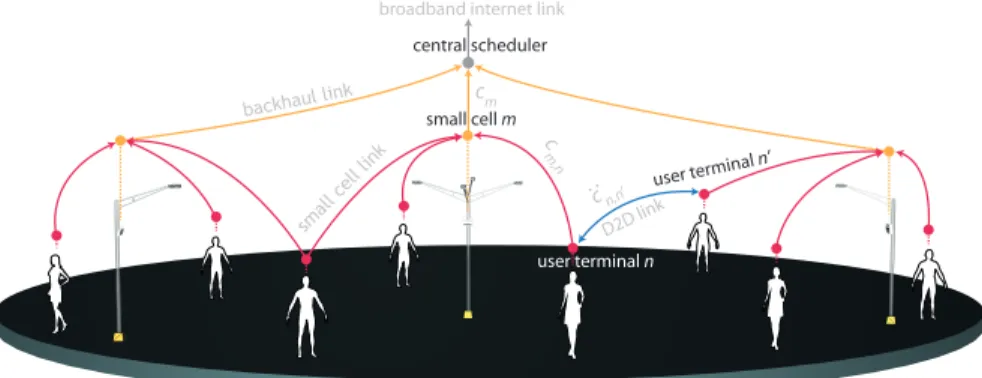
n,n′. The scenario under study is depicted in Fig. 1.
Assume that userndownloads contents from a library ofF
files,F={1, ..., F}, with probabilitiesPn={pn,1, ..., pn,F}. The files in the library F have lengths of L = {l1, ..., lF} respectively, with bitrates B = {b1, ..., bF}. Further, assume
that there are R number of file requests made by users
during T time-slots. A request r∈ R={1, ..., R} is served
immediately and is said to be satisfied, if the rate of delivery
is higher than the file bitrate, such that:
lr
t′
r−tr
≥br, (1) wherelr∈ L is the length of the requested file,tr (t′r) is the start (end) time of the delivery, respectively, andbr∈ Bis the bitrate of filefr∈ F. Therefore, the filesatisfaction ratiocan be defined as: η(R) = 1 R X r∈R 1 l r t′ r−tr ≥br , (2)
where 1{...} is the indicator function which returns 1 if the
statement holds and0 otherwise.
The goal of the network operator is to keep this ratio above a target QoS, while reducing the backhaul delivery cost. To achieve this, we closely examine two cases of proactive caching.
A. Backhaul Offloading via Proactive Caching
The importance of the backhaul has increased dramatically over the last couple of years. Indeed, traffic requirements have increased due to the all-IP flat network architecture, thus making backhaul the main network bottleneck.
Let us now suppose that the total backhaul link capacity is less than the total wireless link capacity between SBSs
and UTs, such that P
m∈Mcm ≪ Pm∈M
P
n∈Ncm,n. This assumption stems from the fact that SBSs may not
2D2D communications are assumed to be network-controlled.
bottleneck is the backhaul, a smart way of minimizing the backhaul usage is to proactively cache contents at the SBSs, during low-peak demands. Indeed, if the SBSs pre-cache the contents before users’ actual requests arrive, corresponding UTs can immediately be served from their SBSs.
Suppose that the backhaul rate during the content delivery for requestr at timet isλr(t). Then, thebackhaul load can be defined as: ρ(R) = 1 R X r∈R 1 lr t=t′r X t=tr λr(t). (3)
Further, assume that SBSm has a storage capacity of sm
and the amount of storage usage at time t is κm(t).
There-fore, the backhaul minimization problem subject to backhaul, storage and QoS constraints is written as:
minimize t′ r,r∈R ρ(R) (4) subject to λr(t)≤cm, ∀m∈ M, κm(t)≤sm, ∀m∈ M, η(R)≥ηmin, ∀r∈ R,
whereηmin is the minimum target satisfaction ratio. Solving
(4) is computationally intractable, and thus, similar to [8] a heuristic solution is used by storing popular files in the caches
of SBSs. Here, each SBS m tracks, learns and builds its
users’ demand profiles to infer on their future requests. Let
P
mdenote the discrete file probabilities of users serviced by
SBSm, referred to aspopularity matrixwhere rows represent
users and columns represent file popularities/ratings. A perfect
knowledge of Pm would allow SBSs to precache contents,
nevertheless, in practice, this matrix is not perfectly known,
large and sparse. Inspired from the Netflix paradigm [13]
and using supervised machine learning tools, a distributed proactive caching procedure is proposed by exploiting users-files correlations to infer on the probability that usernrequests filef.
The proposed caching procedure is composed of a training
and prediction step. In the training step, each SBSm builds
a model based on the available information of the popularity
matrixP
m. This is done by solving a least square
minimiza-tion problem, in order to calculate the estimated file popularity matrixPˆ m, as follows: min {bn,bf} X n,f rnf−rˆnf 2 +λ X n b2 n+ X f b2 f , (5)
where the sum is only over the (n, f) user/file pairs in the
training set where usernactually rated filef (i.e.,rnf), and
the minimization is over all the N +F parameters, where
N is the number of users and F the number of files in the
training set. In addition, ˆrnf = ¯r+bn+bf is the baseline
predictor where bf models the quality of each file f relative
to the average r¯ and bn models the bias of each user n
relative to¯r. Finally, the weightλis chosen to balance between regularization and fitting training data.
In the numerical setup, the regularized singular value de-composition (SVD) was chosen for its numerical accuracy (see
small cell m user terminal n user terminal n’ c m,n cn,n’ c m central scheduler backhaul link D2D link
small cell link
broadband internet link
:
Figure 1: An illustration of the studied network deployment. A central scheduler communicates with M SBSs via backhaul
links. In addition to their cellular connections, D2D communication among socially-connected users is depicted. [14] for comparisons of collaborative filtering (CF) methods).
Regularized SVD based CF constructs Pˆm as the low rank
version of Pm. Since the entries ofPm are partially known,
the construction of Pˆ
m is done via gradient descent, by
exploiting the least-squares property of the singular value decomposition. Subsequently, the proactive caching decision
is made based on the estimated file popularity matrix Pˆ
m.
B. Social-Aware Caching via D2D
Another mean of offloading traffic is by caching contents at the user’ cache and harnessing D2D communications for content dissemination. The goal is to reduce the load of the SBSs (and the backhaul load as a consequence). By exploiting the interplay between users’ social relationships and physical proximity, each SBS tracks and learns the set of influential users using the social graph. In particular, when a user requests a particular file, the SBS determines whether one of the influential users has the requested file. If so, it directs the influential user to communicate the file to the requesting user via D2D. Otherwise, if the file is not cached by the influential user, the SBS transmits the file directly to the requesting user from the infrastructure network.
Now, assume that UT n has storage capacity ¨sn and the
amount of its storage usage at time t is κ¨(t). Assume also
that the total rate of the SBSs during the content delivery of request r at time t is λ˙r(t), and the D2D rate is ¨λr(t). The
small cell load can be defined as:
¨ ρ(R) = 1 R X r∈R t=t′r X t=tr ˙ λr(t) ˙ λr(t) + ¨λr(t) . (6) Similar to (4), the D2D caching optimization problem can be formulated as: minimize t′ r,r∈R ¨ ρ(R) (7) subject to λ˙r(t)≤cm,n, ∀m∈ M,∀n∈ N, ¨ λr(t)≤c¨n,n′, ∀(n, n′)∈ N, ¨ κn(t)≤¨sn, ∀n∈ N, η(R)≥ηmin ∀r∈ R. In order to solve (7), the set of influential users needs to be identified. This can be done by exploiting the social
relationships among users via the notion of centralitymetric
[15]. The centrality metric measures the social influence of a node on how well it connects the network, whereby a higher value means a more influential node to its social community. In this work, we use the eigenvector centrality. Let
G= (N,E)denote the corresponding social graph composed
ofN nodes which can be described by its adjacency (or D2D
connectivity) matrixAN×N with entryan,n′,n, n′= 1, ..., N equals1 if link (or edge)¨cn,n′ exists, or0otherwise. Let the
eigenvalues of Abe λ1 ≥... ≥λN in decreasing order and
the corresponding eigenvectors bev1, ...vN. The
eigenvector-centrality is basically the eigenvectorv1which corresponds to
the largest eigenvalueλ1. A clustering method (i.e., K-means) is then applied for community formation.
Once the set of influential users is identified, the challenge is to disseminate contents within each social community, as a function of users’ social ties and physical proximity. Given the
large volume of available contents, assume thatF=F0+Fh,
whereFhrepresents the set of contents with viewing histories
and F0 is the set of contents without history. Suppose that
each user is interested in one type of available contents F.
Letπf denote the probability that content f is selected by a
given user, which by assumption follows a Beta distribution
β(α/F,1), defined as prior [16]. Therefore, the selection result
of user n, defined as the conjugate probability of the Beta
distribution follows a Bernoulli distribution. It turns out that the resulting user-file partition is reminiscent to that of the Chinese restaurant process (CRP) [16]. CRP is based upon a metaphor where the objects are customers in a restaurant, and the classes are the tables at which they sit. More precisely, in a restaurant with a large number of tables, each with an infinite number of seats, customers enter the restaurant sequentially, and each one chooses a table at random.
In the CRP with parameter β, each customer chooses an
occupied table with a probability proportional to the num-ber of occupants, and chooses the next vacant table with probability proportional to β. Specifically, the first customer
chooses the first table with probability β
β = 1. The second
customer chooses the first table with probability 1
1+β, and
the second table with probability β
1+β. After the second
customer chooses the second table, the third customer chooses
the first table with probability 1
2+β 2+β process continues until all customers have seats, defining a distribution over allocations of people to tables. Therefore, the decisions of subsequent customers are influenced by the previous customers’ feedbacks, in which customers learn from the previous selections to update their beliefs on the files and the probabilities with which they choose their files.
With that in mind, the behaviour of the proactive D2D caching procedure is analogous to the table selection in an CRP. If we view the social network as a Chinese restaurant, the contents as the very large number of files, and the users as the customers, we can interpret the contents dissemination process online by an CRP. That is within every social com-munity, users sequentially request to download their sought-after content, and when a user downloads its content, the recorded hits are recorded (i.e., history). In turn, this action affects the probability that this content will be requested by others users within the same social community, where popular contents are requested more frequently and new contents less
frequently. Let ZN×F be a random binary matrix indicating
which contents are selected by each user, where znf = 1 if
usernselects contentf and0otherwise. It can be shown that
[16]: P(Z) = β F′ Γ(β) Γ(β+N) F′ Y f=1 (mf −1)! (8)
in which Γ(.)is the Gamma function [17],mf is the number
of users currently assigned to contentf (i.e., viewing history) andF′ is the number of partitions withmf >0.
III. NUMERICAL RESULTS
In this section, we evaluate the performance of proactive caching and provide key insights under two different scenarios.
A. Backhaul Offloading via Proactive Caching
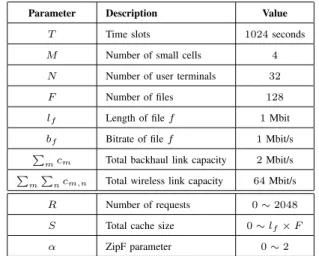
The parameters for the numerical setup are given in Table I. For simplification, the link and storage capacities are assumed to be equal. Three regimes of interest are considered: (i) low load, (ii) medium load, and (iii) high load.
Over a time duration T, Rnumbers of requests are
gener-ated. The arrival times of user requests are drawn uniformly at
random, and the requested files are sampled from the ZipF(α)
distribution. At t = 0, the popularity matrix is constructed
perfectly. Out of 20% of the elements of this matrix are
removed uniformly at random and the remaining elements of the matrix are used for training in CF. These removed entries are then predicted using the regularized SVD [18]. After the popularity matrix estimation, proactive caching is applied by storing the most popular files subject to the SBSs’ storage constraints. Having these files locally in the cache of SBSs
and starting from t = 0, the delivery is carried out by each
SBS until all requests are served. Random caching is used as a baseline procedure, referred to asreactive.
Three parameters of interests are considered for the perfor-mance plots of both proactive and reactive caching approaches:
(i) number of requests R, (ii) total cache size S, and (iii)
ZipF distribution parameter α. To see the percentages of
T Time slots 1024seconds
M Number of small cells 4
N Number of user terminals 32
F Number of files 128
lf Length of filef 1Mbit bf Bitrate of filef 1Mbit/s P
mcm Total backhaul link capacity 2Mbit/s P
m P
ncm,n Total wireless link capacity 64Mbit/s R Number of requests 0∼2048
S Total cache size 0∼lf×F α ZipF parameter 0∼2
Table I: List of parameters for the numerical setup of the proactive small cell networks.
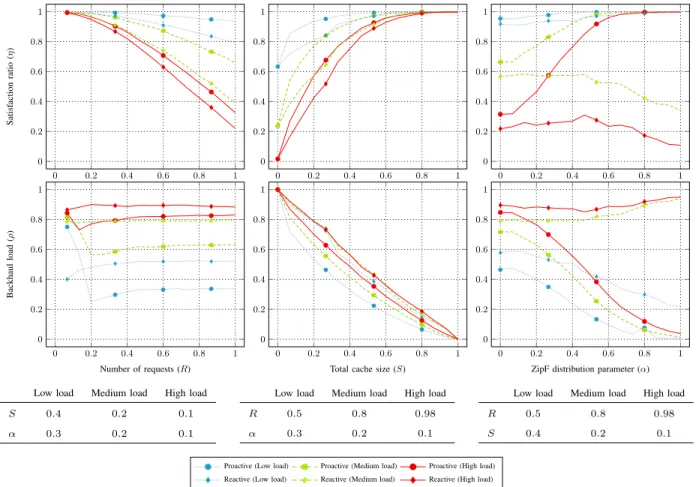
differences between the proactive and reactive approaches, plots are normalized. The evolution of the satisfaction ratios and backhaul loads are shown in Fig. 2. Each subfigure represents the impact of one parameter for a given regime while the other parameters are kept fixed.
1) Impact of number of requests: The satisfaction ratio
decreases with the increase in users’ requests. This is evident as the amount of capacity and storage resources are limited. However, the proactive caching outperforms the reactive ap-proach in terms of satisfaction ratio. On the other hand, the reactive approach generates less load on the backhaul in the case of very small number of requests. This situation can
be explained by the cold start phenomenon where the CF
cannot draw any inference due to non-sufficient amount of information about the popularity matrix. Therefore the random caching for a fixed library size outperforms the proposed approach at low load. However, as users’ requests increase, the proactive approach minimizes the backhaul load outper-forming the reactive approach, after which the gains level off.
2) Impact of cache size: It can be seen that as the total
storage size of small cell base stations increases, the
satisfac-tion ratio approaches1and the backhaul load tends to0. This
cannot be easily achieved in practice as it requires storing all file requests whereas SBSs have limited storage. Therefore, for reasonable values of cache size, it can be seen that the proactive caching outperforms the reactive case in terms of satisfaction ratio and backhaul load.
3) Impact of popularity distribution: As the popularity of
some files increases as compared to others (i.e.,αincreases),
the gain of the proactive caching becomes higher compared to the random approach in all regimes. Going from the low load regime to the high load regime, the gains further improve.
B. Social-Aware Caching via D2D
To see the impact of the parameters of interest, wireless link capacities are equally divided among users. The total D2D link capacity is shared among users according to their social links. The parameters used in the numerical setup are summarized in Table II.
0 0.2 0.4 0.6 0.8 1 0 0.2 0.4 0.6 0.8 1 Satisf action ratio ( η ) 0 0.2 0.4 0.6 0.8 1 0 0.2 0.4 0.6 0.8 1 0 0.2 0.4 0.6 0.8 1 0 0.2 0.4 0.6 0.8 1 0 0.2 0.4 0.6 0.8 1 0 0.2 0.4 0.6 0.8 1 Number of requests (R) Backhaul load ( ρ ) 0 0.2 0.4 0.6 0.8 1 0 0.2 0.4 0.6 0.8 1
Total cache size (S)
0 0.2 0.4 0.6 0.8 1 0 0.2 0.4 0.6 0.8 1
ZipF distribution parameter (α)
Low load Medium load High load
S 0.4 0.2 0.1
α 0.3 0.2 0.1
Low load Medium load High load
R 0.5 0.8 0.98
α 0.3 0.2 0.1
Low load Medium load High load
R 0.5 0.8 0.98
S 0.4 0.2 0.1
Proactive (Low load) Proactive (Medium load) Proactive (High load) Reactive (Low load) Reactive (Medium load) Reactive (High load)
Figure 2: Backhaul Offloading via Proactive Caching: Dynamics of the satisfied requests and backhaul load with respect to the number of requests, total cache size and ZipF parameter.
Parameter Description Value
T Time slots 1024seconds
M Number of small cells 4
K Number of communities 3
N Number of user terminals 32
F Number of files 128
lf Length of filef 1Mbit bf Bitrate of filef 1Mbit/s P
m P
ncm,n Total SBSs link capacity 32Mbit/s P
n P
n′,n′ 6=nc¨n,n′ Total D2D link capacity 64Mbit/s
R Number of requests 0∼9464
S Total D2D cache size 0∼lf×F β CRP parameter 0∼100
Table II: List of parameters for the numerical setup of the social networks aware caching via D2D.
At t = 0, user selection and their requests’ arrival times
are sampled uniformly at random for a time interval T. The
social graph is synthetically generated by using the preferential attachment model [19]. The eigenvector centrality is used to infer on the set of influential users in the social network, where
users are formed intoKclusters viaK-means clustering [20].
Within every social community, the file popularity distribution
is sampled from the CRP(β) and the proactive caching is
carried out by storing popular files within each community. Similarly, random caching is used as a baseline.
Three parameters are of interest: (i) number of requestsR,
total D2D cache size S and CRP concentration parameter
β. The results are normalized for ease of comparison. As
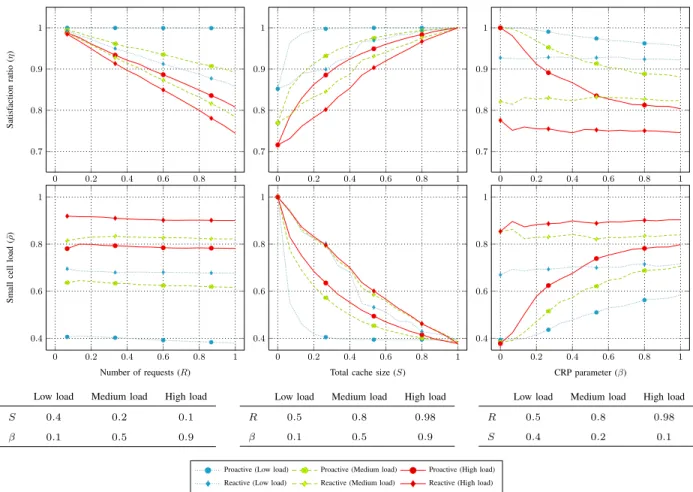
in the previous case, similar evaluation metrics are used. The evolution of the satisfaction ratio and small cell load with respect to these parameters are plotted in Fig. 3. In the following, we discuss the impact of these parameters:
1) Impact of number of requests: As the number of requests
increases, the satisfaction ratio decreases rapidly, whereas the small cell load decreases at a low pace. It can be clearly seen that the proactive caching approach outperforms the reactive approach in all regimes.
2) Impact of D2D cache size: As the D2D cache size
increases, it can be seen that the satisfaction ratio increases while the the small cell load decreases. Moreover, the incre-ment in cache size improves the performance of the reactive approach, however the gains of the proactive caching approach are higher.
3) Impact of CRP concentration parameter: In the case
of an increment in β (i.e., the number of files grows), the
satisfaction ratio and the small cell load tend to be constant under the reactive approach. On the other hand, the proactive
0 0.2 0.4 0.6 0.8 1 0.7 0.8 0.9 1 Satisf action ratio ( η ) 0 0.2 0.4 0.6 0.8 1 0.7 0.8 0.9 1 0 0.2 0.4 0.6 0.8 1 0.7 0.8 0.9 1 0 0.2 0.4 0.6 0.8 1 0.4 0.6 0.8 1 Number of requests (R) Small cell load ( ¨ ρ ) 0 0.2 0.4 0.6 0.8 1 0.4 0.6 0.8 1
Total cache size (S)
0 0.2 0.4 0.6 0.8 1 0.4 0.6 0.8 1 CRP parameter (β)
Low load Medium load High load
S 0.4 0.2 0.1
β 0.1 0.5 0.9
Low load Medium load High load
R 0.5 0.8 0.98
β 0.1 0.5 0.9
Low load Medium load High load
R 0.5 0.8 0.98
S 0.4 0.2 0.1
Proactive (Low load) Proactive (Medium load) Proactive (High load) Reactive (Low load) Reactive (Medium load) Reactive (High load)
Figure 3: Social-Aware Caching via D2D: Dynamics of the satisfied requests and small cell load with respect to the number
of requests, total cache size and CRP concentration parameterβ.
caching approach exhibits a better performance, and the gap between the proactive and reactive approaches gets smaller as
β increases. This is a by-product of the increasing file library
size with a fixed cache size.
IV. CONCLUSION
In this paper, we studied a novel proactive networking paradigm where caching plays an important role. The proactive caching solution exploits users’ predictable demands, storage, and their social relationships to minimize peak mobile data traffic demands. It was demonstrated that precaching strategic contents at the network edge engenders significant backhaul offloading gains and resource savings. Our future work will explore distributed MIMO caching and multicast caching.
REFERENCES
[1] E. Ba¸stu˘g, M. Bennis, and M. Debbah, “Living on the edge: The role of proactive caching in 5g wireless networks,”Submitted, 2013. [2] Cisco, “Cisco visual networking index: Global mobile data traffic
fore-cast update, 2012-2017,”White Paper, [Online] http://goo.gl/uQ0DJQ, 2013.
[3] Ericsson, “5g radio access - research and vision,”White Paper, [Online]
http://goo.gl/Huf0b6, 2012.
[4] J. Hoydis, M. Kobayashi, and M. Debbah, “Green small-cell networks,”
IEEE Vehicular Technology Magazine, vol. 6(1), pp. 37–43, 2011.
[5] J. Andrews, “Seven ways that hetnets are a cellular paradigm shift,”
IEEE Communications Magazine, vol. 51, no. 3, pp. 136–144, 2013.
[6] M. Bennis, M. Simsek, W. Saad, S. Valentin, M. Debbah, and A. Czyl-wik, “When cellular meets wifi in wireless small cell networks,”IEEE
Communication Magazine, Special Issue in HetNets, June 2013.
[7] Intel, “Rethinking the small cell business model,”White Paper, [Online]
http://goo.gl/c2r9jX, 2012.
[8] E. Ba¸stu˘g, J.-L. Guénégo, and M. Debbah, “Proactive small cell net-works,” in20th International Conference on Telecommunications (ICT), Casablanca, Morocco, May 2013.
[9] N. Golrezaei, K. Shanmugam, A. Dimakis, A. Molisch, and G. Caire, “Femtocaching: Wireless video content delivery through distributed caching helpers,” in INFOCOM, 2012 Proceedings IEEE, 2012, pp.
1107–1115.
[10] J. Tadrous, A. Eryilmaz, and H. E. Gamal, “Proactive data download and user demand shaping for data networks,”submitted to IEEE Transactions
on Information Theory, [Online] arXiv: 1304.5745, 2013.
[11] M. Ji, G. Caire, and A. F. Molisch, “Fundamental limits of distributed caching in d2d wireless networks,”[Online] arXiv: 1304.5856, 2013.
[12] C. Song, Z. Qu, N. Blumm, and A.-L. Barabási, “Limits of predictability in human mobility,”Science, vol. 327, no. 5968, pp. 1018–1021, 2010. [13] Netflix, “Netflix prize,”[Online] http://www.netflixprize.com, 2009.
[14] J. Lee, M. Sun, and G. Lebanon, “A comparative study of collaborative filtering algorithms,”[Online] arXiv: 1205.3193, 2012.
[15] M. Newman,Networks: an introduction. Oxford University Press, 2009. [16] T. L. Griffiths and Z. Ghahramani, “The indian buffet process: An introduction and review,”J. Mach. Learn. Res., vol. 12, pp. 1185–1224, Jul. 2011.
[17] M. A. I. A. Stegun,Handbook of Mathematical Functions with
Formu-las, Graphs, and Mathematical Tables. National Bureau of Standards
Applied Mathematics Series 55. Tenth Printing, 1972.
[18] P. Arkadiusz, “Improving regularized singular value decomposition for collaborative filtering,” inProceedings of KDD cup and workshop Vol.
2007., 2007.
[19] A.-L. Barabási and R. Albert, “Emergence of scaling in random net-works,”Science, vol. 286, no. 5439, pp. 509–512, 1999.
[20] A. K. Jain, “Data clustering: 50 years beyond k-means,”Pattern