Linear Extension Cube
Attack on Stream
Ciphers
Liren Ding Yongjuan Wang Zhufeng Li
(Language Engineering Department, Luo yang University for Foreign Language, Luo yang city, He nan Province, 471003, P. R. China)
Abstract: Basing on the original Cube attack, this paper proposes an improved method of Cube attack on stream ciphers,
which makes improvement on the pre-processing phase of the original attack. The new method can induce maxterms of higher-order from those of lower-order by the trade-off between time and space, thus recovering more key bits and reducing the search complexity on higher-dimension. In this paper, the improved attack is applied to Lili-128 algorithm and reduced variants of Trivium algorithm. We can recover 88 key bits of Lili-128 algorithm within
time complexity of O(214) and 48 key
bits of Trivium algorithm can be recovered by cubes with dimension no larger than 8 when the initialization round is 576, the results are much better than those of the original attacks.
Keywords:Cube Attack, Stream Cipher,
Linear Extension, Pre-processing,
Trivium, Lili-128
1. Introduction
In 2008, Dinur and Shamir[1]
introduced a deterministic analysis
method basing on algebraic theory, i.e. Cube Attack. Cube attack is a kind of chosen plaintext attack, it makes use of the fact that the output of a cryptosystem can be represented as a polynomial of
public variables and key bits.
Theoretically, Cube attack can be applied to all cryptosystems as long as they can be represented as tweakable polynomials. The algebraic degree of the
master polynomial can be decreased by choosing arbitrary values for tweakable variables. By doing so, the attacker can obtain linear equations about the key
bits. Hence, the security of a
cryptosystem is reduced to the problem of solving a linear equation system. Although the specific representation of a cryptosystem is unknown, the attack can still be applied to a “black box”. The performance of Cube attack against stream ciphers, block ciphers and hash
functions is quite well[2,3,4].Therefore,
Cube attack has achieved lots of attention since its announcement.
However, there being few
limitations of Cube attack. First of all, the algebraic degree of a certain cryptosystem should not be too large, otherwise it would be difficult to search
for linear expressions on the
pre-processing phase. As a result, the performance of original Cube attack against NFSR based stream ciphers and
block ciphers is limited. Second,
choosing the right cubes is
time-consuming. If the choice is not proper or the search has not been done thoroughly, the final result of Cube attack would be weakened.
With the research of Cube attack going deeper, cryptologists have come up with several extended versions of Cube attack against different algorithms.
In 2010, Dinur and Shamir[5] proposed
Dynamic Cube attack, which is based on the analysis of the internal structure of a certain cipher so that the proper choice
for the values of such dynamic
variables can lower the algebraic degree
of the master polynomial. P.
Mroczkowki[6] improved the linearity
test of Cube attack by extracting
quadratic equations. Yu Sun[7] made
improvements on the search algorithm and linearity test so that more than one linear expressions can be extracted from only one cube with the help of the trade-off between time and space.
Our work is based on the
phenomenon pointed out by P.
Mroczkowki in [6] that although the cubes were chosen randomly, there was a way to obtain new cubes from another one with linear expression. In fact, for stream ciphers with shift register, whose transitivity enables the lower-round to
influence the higher-round so that d
and d1 dimensional cubes will have
some variables in common. Therefore, more cubes can be derived from one with linear expression, thus obtaining more linear expressions.
Motivated by the above
observations, this paper proposes an improved attack on stream ciphers on the basis the original Cube attack, i.e. Linear Extension Cube Attack, which makes use of those common variables in two different dimensional cubes and the trade-off between time and space enables the attacker to induce maxterms
of higher-order from those of
lower-order, thus recovering more key bits and reducing the the search complexity on higher-dimension.
To demonstrate the application of
the extended method, this
correspondence provides Linear
Extension Cube Attack against Lili-128 algorithm and two reduced variants of Trivium algorithm and the results are much better than those of the original attacks. For Lili-128 algorithm, only
) 2 ( 9
O key streams are needed to
recover 88 key bits and the attack has
time complexity less than O(214) ,
which is better compared to O(216) of
the original Cube attack. And it is the best attack against Lili-128 to the best of our knowledge. For Trivium algorithm, when the initialization round is 525, the
original Cube attack on the 525th output
bit with 4 dimensional cubes can only recover 6 key bits, while the improved attack can directly recover 31 key bits. When the initialization round is 576, applying the improved Cube attack to
the 576th output bit, 48 key bits can be
recovered by cubes with dimension no larger than 8, while the original Cube attack on several output bits in [14] can only recover 36 key bits by cubes with dimension no larger than 8.
The organization of this paper is as follows, in section 2, the preliminaries and basic steps of Cube attack are reviewed. Section 3 contains the main contribution of this paper, where the notion of Linear Extension Cube Attack and its details are provided. To testify the performance of the improved attack, it is applied to Lili-128 and two reduced variants of Trivium algorithm in section 4. At last, section 5 is a brief summary of this paper.
2. Review on Cube Attack
Cube attack regards the investigated
cryptosystem as a polynomial P(v,k)
about the public variables v(v1,...,vm) and secret key bits k (x1,...,xn) . Let
} ,..., 2 , 1 { } ,..., {i1 i n I k be the indexes
of the public variables and tI vi1 vik be the product of these public variables, through factoring the master polynomial
by the monomial tI , we have:
) ,..., , ,..., (v1 vm x1 xn P ) ,..., , ,..., ( 1 1 ) (I m n S I P Q v v x x t .
where PS(I) , which is called the
superpoly of tI , does not have any
common variables with tI , and each
monomial term in the residue
polynomial Q(v1,...,vm,x1,...,xn)
misses at least one variable from tI.
Denote {( 1,..., ) 2m| m I v v F C } , 0 ; , 2 i I v i I F vi i as a Cube, apparently , we have I I C 2 . Summing
the polynomials when the public
variables v{v1,...,vm} walking over
the cube, we have:
I m I m v v C I S I C v v P t k v P ) ,..., ( ( ) ) ,..., ( 1 1 ) , (
I m C v v n m x x v v Q ) ,..., ( 1 1 1 ) ,..., , ,..., ( .The feasibility of Cube attack mainly depends on the following observations:
Theorom 1[1] For any
polynomial P(v,k) and public
variable v(v1,...,vm) , we have 2 mod ) , ( ) , (v k P( ) v k P S I C v I .
Proof: Each monomial term in the
residue polynomial of P(v,k) ,that is,
) ,..., , ,...,
(v1 vm x1 xn
Q misses at least one
variable from tI , the value of each term
from Q(v,k)after 2ktimes computation
is 0, thus ( , )0
CI
v Q v k . Next, if and
only if vi1,...,vik are all set to 1, the coefficient of PS(I)(v,k) would be 1. #
A term tI is called a maxterm if
its superpoly is a linear polynomial while not a constant.
Example 1: Let P(v1,v2,v3,x1,x2,x3)v1v2x1v1v2x3 1 2 2 1 1 3 1 vv x vv x , where (v1,v2,v3)
being the public variables and
) , ,
(x1 x2 x3 being the key. And define
I={1,2}, through factoring the master
polynomial by the monomial tI , we
have: ) , , , , , (v1 v2 v3 x1 x2 x3 P 1 ) 1 ( 1 3 1 3 1 2 2 1v x x vv x x v . )} 0 , 0 , 1 ( ), 0 , 1 , 0 ( ), 0 , 0 , 1 ( ), 0 , 0 , 0 {( I C , by
summing the polynomial over this cube, we have:
I C v x x x v v v P( 1, 2, 3, 1, 2, 3) 1 ) , , , ( 3 1 2 3 1 3 ) ( v x x x x x PS I .Cube attack consists of two phases, the preprocessing phase and the on-line phase. During the pre-processing phase, the attacker can arbitrarily assign values to both the public variables and the key bits, and choose appropriate cubes to do the computation. Then the linearity test is applied to test whether the superpoly is linear or not. The main purpose of this phase is to extract linear expressions about the key bits as many as possible. During the on-line phase, the attacker can only control the public variables, through which he can conduct the cube sum over the same cube in order to obtain the value of the right side of a certain expression. The main purpose of this phase is to establish linear equations. Due to the selection of different cubes, he can establish a system of linear equations. At last, the key bits are recovered by solving the equation system.
3. Linear Extension Cube
Attack
3.1 The Main Observation
When it comes to the shift register, a higher-position of a lower-round will
become a lower-position of a
higher-round with the extension of round itself. Therefore, the existence of common variables between the master
polynomials before and after the
extension is certain. Using these
cubes, the attacker can analysis the target cryptosystem of higher rounds on the basis of the attack results of a lower
round. Motivated by the above
observation, this paper proposes Linear Extension Cube Attack against stream ciphers. The main idea of this extended attack is to make improvement on the pre-processing phase of the original attack. Thanks to the transitivity of the shift register, by the trade-off between
time and space, maxterms of
degreed1 can be derived from those
maxterms of degree d , thus obtaining
more linear expressions so that more key bits can be recovered.
To demonstrate the main
contribution, definitions and examples are given as follows.
Definition 1 Let N {1,2,...,n} , } , , , {i1 i2 ik I , I U , I k, define
the maxterm as tI vi1vi2 vik , through
factoring the master polynomial by tI ,
we have: PtIPS(I) Q. Let tI1tIvs, where sN\I , ' ) 1 ( 1 ' t P Q P I S I
denotes the master polynomial after
extension, monomial tI1 is called the
1-time extended maxterm of tI if
1 ) deg(PS(I1) . Example 2: ) , , , , , , , (v1 v2 v3 v4 x1 x2 x3 x4 P 1 3 2 3 2 1 4 3 2 1v v x vv v v v x v 2 1 3 2 1 2 3 1v x vv x xx v 1 3 2 4 3 2 1v v (x 1) v v x v 2 1 3 2 1 2 3 1v x vv x xx v ① ) , , , , , , , ( 1 2 3 4 1 2 3 4 ' v v v v x x x x P 1 3 2 3 2 1 1 4 3 2 1v v v x vv v v v x v 2 1 3 2 1 2 3 1v x vv x xx v ② '
P denotes the master polynomial after
extension, let I {1,2,3} , we have
maxterm as tI v1v2v3 according to ①, let I' {1,2,3,4} , then 4 3 2 1 1 ' t vv vv tI I is also a maxterm
according to ②, so tI1 is called the
1-time extended maxterm of tI.
Note that, to conduct the Linear Extension Cube Attack, the target cryptosystem should be extended first so that the algebraic degree of master
polynomial would increase. For
extension here, it implies one round as well as several rounds, the existence of 1-time extended maxterm holds true for both conditions. The following of this section discusses the existence of 1-time extended maxterm under the extension of round.
Theorom 2 P(x) denotes the master polynomial of a cryptosystem,
through factoring P(x) by maxterm tI ,
we have: P(x)tIPS(I)Q , P'(x) denotes the polynomial after extension by one round, then the 1-time extended
maxterm of tI is existed by the
possibility of 1 if tI satisfies that ' ) ( ' '(x) t P Q P I S I , where 2 )
deg(P'S(I) ,and can be represented
as val(x)g(x), where deg(l(x))1
and aI.
Proof: Since tI is a maxterm of
) (x
P , we have: P(x)tIPS(I) Q .
Assuming that tI1 tI va is a 1-time
extended maxterm of tI , where aI
according to definition 1, then we have
' ) ( ' 1 '(x) t P Q P I S I , where 1 )
deg(P'S(I) . Obviously, the following
equations hold true:
' ) ( ' '(x) t v P Q P I a S I ③ '' ) ( '' '(x) t P Q P I S I ④ Note that, ' \| Q v tI a , '' \| Q tI and a I I t v t | , then we have: '' ' t g(x) Q Q I ⑤
Subsitute ⑤ into ③, then combine it
'' ) ( ' '' ) ( ' ' ) ( ' '' ) ( '' )) ( ( ) ( Q x g P v t Q x g t P v t v P Q t Q P t I S a I I I S a I I S a I I S I In conclusion, P''S(I) vaP'S(I)g(x)
meets the criteria for the existence of
1
I
t . #
Corollary 1 P(x) denotes the master polynomial of a cryptosystem
and tI denotes one of its maxterms,
let P'(x) be the polynomial after the
extension of r(1rn) round, then
the 1-time extended maxterm of tI is
existed by the possibility of 1 if
I
t satisfies the criteria in Theorom 2.
Proof: According to the proof of Theorom 2, the times of extension would not make any differences on the existence of tI1. #
Note that, although the existence of 1-time extended maxterm is not strictly related to the times of extension, it is impossible to find maxterm through increasing the cubes by one when the algebraic degree of master polynomial goes too large after several rounds of extension. Example 3: 5 4 1 4 3 2 3 2 1 5 1,..., ) (x x xx x x x x xx x P x2x3(x1x4)x1x4x5 5 4 2 1 5 4 3 5 1 5 1 4 3 2 5 4 2 1 5 3 2 1 5 4 3 5 4 3 2 5 4 2 1 5 4 3 2 5 3 2 1 5 2 4 3 5 4 1 4 3 2 3 2 1 5 2 5 2 4 3 6 5 2 5 2 4 3 6 5 2 ' ] ) ( [ (1 ) ) ( ) ( ) (,..., , ) ( ) ( x x x x x x x x x x x x x xxxx x xxx xxxx xxxx x x x x x x x x x x x x x x x xx x x xx xxx xxx xxx x x x x xx x x xxx P P '
P denotes the master polynomial after
extension, note that tI x2x3 is a
maxterm of P, there exists tI1 tI x4, which satisfies the criteria in Theorom 2, being the 1-time extended maxterm of
I
t .
3.2 Attack Procedure
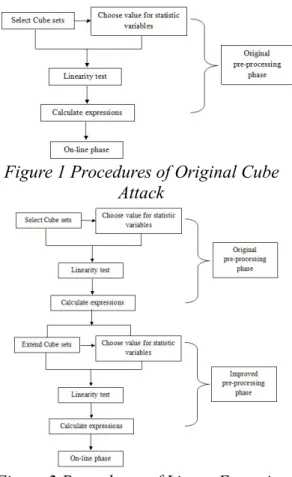
Compared to the original Cube attack, the Linear Extension Cube Attack makes improvement on the
pre-processing phase. Cube attack
consists of two phases, pre-processing
phase and on-line phase. The improved attack, which makes use of the cubes with linear expressions, consists of the
original pre-processing phase, the
improved pre-processing phase and on-line phase. The following figures reveal the difference between the two versions of Cube attack:
Figure 1 Procedures of Original Cube Attack
Figure 2 Procedures of Linear Extension Cube Attack
As is shown above, the details of the improved attack display as follows:
Phase 1, the original pre-processing phase. In this phase, the attacker can arbitrarily choose values for both public variables and key bits in order to find proper cubes.
(1) Choose the initial dimension as
d and walk over all of the d
dimensional cubes;
(2) Sum over each cubes and use linearity test to find maxterms;
(3) Calculate algebraic normal forms for each linear expression.
Phase 2, the improved
search d1 dimensional cubes on the basis of the results of the original pre-processing phase.
(1) Store all of the d dimensional
cubes obtained via phase 1;
(2) Extend the investigated
cryptosystem by extension of round or choosing the next output bit;
(3) Extend each maxterm of degree
d respectively. Firstly, modify each
variable of the d dimensional cube
according to the regulation of the target algorithm. The modification here means
increase by one (or r), decrease by one
(or r ) or stay the same for each
variable. Secondly, add a new variable
from the public variables to set I to
form a new cube;
(4) Sum over the new d1
dimensional cube and use linearity test to find maxterms;
(5) Calculate algebraic normal forms for each linear expression;
(6) Testify the linear dependence of
linear expressions by Gaussian
elimination.
Phase 3, the on-line phase.
According to the cubes obtained by phase 1 and phase 2, the attacker can choose values for the public variables to obtain the value of the right side of each expression. At last, the key bits are
recovered by solving the linear
equations system.
Special attention should be paid to the following steps:
(1) The extension of the targeted algorithm is necessary after walking
over all of the d dimensional cubes
since there is no 1-time extended maxterms under the same polynomial;
(2) There is no need for Gaussian elimination after walking over all of the
d dimensional cubes since linearly
independent expressions can be derived from linearly dependent ones. Therefore, Gaussian elimination is introduced after the extension in the improved attack.
The pseudo-code of the improved pre-processing phase is as follows:
Algorithm 1:The Improved Pre-processing Phase
Input:V ;// set of public variables, vi denotes each variable
T;// set of maxterms of degree d, Ii denotes each maxterm
R;// number of round extension
0
r ;// initialization of round extension
Output:linear expressions
repeat
r ;
repeat
Choose an Ii which has not been chosen from T;
repeat
Modify each variable in Ii;
Choose a vi which has not been chosen from V , i.e. Ii' Ii{vi}; Sum over Ii';
Introduce linearity test;
until
Walk over V ;
until
Walk over T;
Figure 3 The Pseudo-code of the Improved Pre-processing Phase
4. The Application of
Linearity Extension Cube
Attack
To demonstrate the application of
the extended method, this
correspondence provides Linear
Extension Cube Attack against Lili-128 algorithm and two reduced variants of
Trivium algorithm when the
initialization round is 525 and 576 by using the personal computer equipped
with i-5 CPU, 1.7GHz dominant
frequency and 2GB RAM.
4.1 Attack 1: Lili-128
4.1.1
Brief
Introduction
of
Lili-128 Algorithm
Lili-128[10] is one of the candidate
algorithms of NESSIE. The
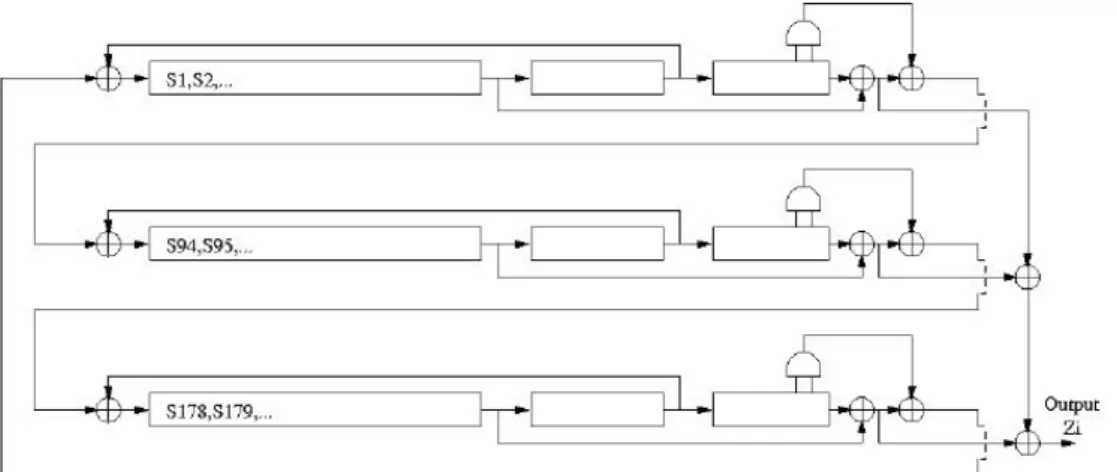
clock-controlled algorithm is consists of two linear feedback shift registers, a linear function and a non-linear function, where one LFSR is used to clock control and the other to generate key stream. The following figure displays it in detail:
Figure 4 The Structure of Lili-128 Algorithm
c
LFSR contains 39 bits for clock
controlling,k 2, c(t)(1c(t)4) is generated by fc , where 1 2 ) , (x12 x20 x12x20 fc . LFSRd
contains 89 bits for key stream
generation, n10 , and the 10 input
positions of fd , with the algebraic
degree of 6, the nonlinearity of 480 and
correlation immunity of 3, are (0,1,3,
7,12,20,30,44,65,80).
4.1.2 Attack Procedure
Step 1, initialization. Since LFSRc
does not directly control the bit
generation, attacking against LFSRd is
a common choice. To make the extended Cube attack possible, an initialization process is introduced to Lili-128 to make sure that the initial vector and key bits are blended thoroughly.
Step 2, choose annihilator.
According to the result of algebraic attack in [8], g(x)x44x80 is one of the
annihilators of fd which render
4 )
deg(fdg instead of 8.
Step 3, choose initial dimension of cubes and the output bit. In this paper,
the 20th output bit is attacked and we
search cubes with the dimension of 2 to obtain linear expressions thanks to the annihilator which reduces the algebraic degree of master polynomial to 4.
Step 4, 1-time extension of
2-degree maxterms.
(1) Bound the extension of round as 2;
(2) choose one 2 dimensional cube a time until they are walked over;
(3) modify each variable in the cube according to the algorithm;
(4) choose one number a time from 0 to 87 to form a new 3 dimensional cube ;
(5) sum over the new cube and extract linear expression by linearity test;
(6) extend the algorithm by one round until it meets the bound.
4.1.3 Attack Result
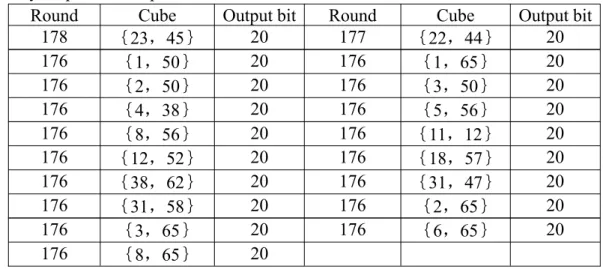
We found 161 cubes with the dimension of 2 within seconds when the initialization round is bounded from 176 to 178. What was more, on the improved pre-processing phase, only 19 2-degree R
maxterms are needed to extend enough 3 dimensional maxterms, with which 88 linearly dependent expressions can be
obtained. The cubes used for extension are as follows:
Table 1 2-degree maxterms used for extension
Linear Extension Cube Attack searches 3 dimensional cubes on the basis of 2 dimensional cubes, which dramatically reduces the search scale on
3 dimensional cubes. Only 1987
times computation are needed to extract enough expressions so that the time complexity of the improved attack on
pre-processing phase is O(213) and the
total time complexity of our attack is
less than O(214) . And its data
complexity is O(29) since the 88 linear
expressions are obtained from 5 cubes with the dimension of 2 and 83 cubes with the dimension of 3.
Compared to the previous attacks on Lili-128, our attack is the best as the following table displays:
Table 2 Complexity of various attacks on Lili-128
4.2 Attack 2: Reduced Variants
of Trivium
4.2.1
Brief
Introduction
of
Trivium Algorithm
Trivium[1]is one of the candidate
algorithms of eSTREAM. The length of
IV is 80 bits and the initial key is also
80 bits. During the initialization, the internal state is updated for 1152 rounds. The 288 bits of its internal state store in 3 nonlinear feedback shift register with different length. The following figure displays it in detail:
Round Cube Output bit Round Cube Output bit
178 {23,45} 20 177 {22,44} 20 176 {1,50} 20 176 {1,65} 20 176 {2,50} 20 176 {3,50} 20 176 {4,38} 20 176 {5,56} 20 176 {8,56} 20 176 {11,12} 20 176 {12,52} 20 176 {18,57} 20 176 {38,62} 20 176 {31,47} 20 176 {31,58} 20 176 {2,65} 20 176 {3,65} 20 176 {6,65} 20 176 {8,65} 20 Time and Space Attack[11] Algebra Attack[8] Fast Algebra Attack[12] Cube Attack[13] Our Attack Key stream 246 218 260 212 29 Pre-processing 216 213 On-line 248DES 257 234 212 210
Figure 5 The Structure of Trivium Algorithm
The feedback to each register consists of a nonlinear combination of bits from different registers. The output bit of each round is a linear combination of six state bits, two taken from each register.
4.2.2 Attack Procedure
Step 1, choose initial dimension of cubes. When the initialization round is 525, we randomly search 4 dimensional
cubes for maxterms and linear
expressions. When the initialization round is 576, according to paper [14],
we search cubes with the dimension no larger than 7.
Step 2, choose the output bit.
When the initialization round is 525, we apply the improved attack to the
525th output bit. On the original
pre-processing phase, 8 cubes with the
dimension of 4 can be obtained without
Gaussian elimination and they are
extended on the improved
pre-processing phase. The cubes are as follows:
Cube Expression Cube Expression
{0,13,14,70} x57 {11,21,38,74} x63
{13,23,72,75} x61 {34,62,67,75} x54
{25,26,31,57} x27 {4,50,72,75} x61
{22,40,42,68} x27 {2,6,35,45} x47
Table 3 Original Results on the 525thOutput Bit
When the initialization round is 576, we apply the improved attack to the
576th output bit. On the original
pre-processing phase, 20 cubes with the dimension of 6 or 7 can be obtained
without Gaussian elimination and they
are extended on the improved
pre-processing phase. The cubes are as follows:
Cube Expression Cube Expression
{22,32,35,47,68,77} x55 {5,7,17,54,58,74} x19 {9,15,21,40,67,69} x56 {24,33,42,46,68,76} x20 {2,6,32,36,38,57} x6 {11,30,34,45,51,66} x19 {18,20,53,56,76,78} x221 {5,15,26,42,49,62} x4 {8,10,18,26,30,73} x62 {22,23,37,56,60,67,77} x19 {7,9,23,25,50,55,71} x27 {1,9,11,12,22,41,69} x61x671 {10,11,13,24,29,55,62} x59 {9,34,44,57,65,68,78} x57 {1,8,10,15,35,51,70} x57 {8,18,26,31,37,63,64} x20 {4,20,23,58,64,68,71} x24 {20,23,32,34,53,58,74} x19
{1,13,27,30,35,45,65} x61x671 {7,8,26,29,57,61,77} x64
Table 4 Original Results on the 576thOutput Bit
Step 3, 1-time extension of
12-degree maxterms.
(1) Bound the extension of round as 5 and extend the algorithm by 1 round; (2) choose one dimensional cube a
time from table 2 (table 3) until they are walked over;
(3) modify each variable in the cube according to the algorithm;
(4) choose one number a time from 0 to 79 to form a new 13 dimensional cube ;
(5) sum over the new cube and conduct linearity;
(6) extend the algorithm by one round until it meets the bound.
4.2.3 Attack Result
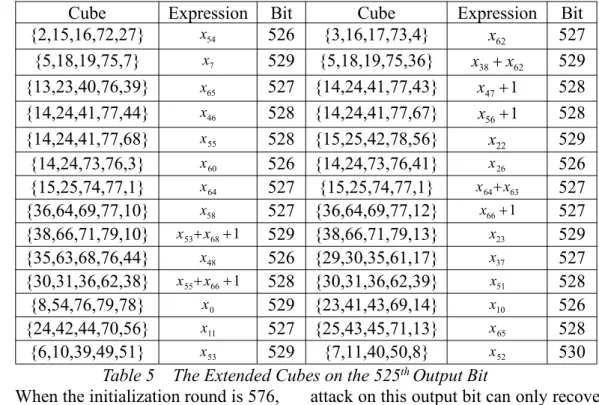
When the initialization round is 525, 28 5-dimensional cubes can be obtained
after Gaussian elimination by extending the 8 4-dimensional cubes in table 3.
And 31 key bits can be directly
recovered altogether. The extended cubes are as follows:
Cube Expression Bit Cube Expression Bit
{2,15,16,72,27} x54 526 {3,16,17,73,4} x62 527 {5,18,19,75,7} x7 529 {5,18,19,75,36} x38x62 529 {13,23,40,76,39} x65 527 {14,24,41,77,43} x471 528 {14,24,41,77,44} x46 528 {14,24,41,77,67} x561 528 {14,24,41,77,68} x55 528 {15,25,42,78,56} x22 529 {14,24,73,76,3} x60 526 {14,24,73,76,41} x26 526 {15,25,74,77,1} x64 527 {15,25,74,77,1} x64x63 527 {36,64,69,77,10} x58 527 {36,64,69,77,12} x661 527 {38,66,71,79,10} x53x681 529 {38,66,71,79,13} x23 529 {35,63,68,76,44} x48 526 {29,30,35,61,17} x37 527 {30,31,36,62,38} x55x661 528 {30,31,36,62,39} x51 528 {8,54,76,79,78} x0 529 {23,41,43,69,14} x10 526 {24,42,44,70,56} x11 527 {25,43,45,71,13} x65 528 {6,10,39,49,51} x53 529 {7,11,40,50,8} x52 530
Table 5 The Extended Cubes on the 525thOutput Bit
When the initialization round is 576,
26key bits can be directly recovered and
a linear equation about another 2 key bits can be obtained by extending those cubes in table 3, while the original
attack on this output bit can only recover
13 bits and obtain a linear equation
about another 2 key bits. The extended cubes are as follows:
Cube Expression Bit
{23,33,36,48,69,78,62} x56 577 {24,34,37,49,70,79,29} x57 578 {6,8,18,55,59,75,16} x561 577 {14,20,26,45,72,74,43} x16 581 {26,35,44,48,70,78,27} x39x57 578 {26,35,44,48,70,78,37} x22 578 {26,35,44,48,70,78,57} x39 578 {11,13,21,29,33,76,65} x54 579 {12,14,24,30,34,77,6} x64 580 {7,17,28,44,51,64,59} x48 578
{10,20,31,47,54,67,1} x2 581 {10,20,31,47,54,67,6} x65 581 {9,11,25,27,52,57,73,10} x39 578 {9,11,25,27,52,57,73,28} x39x411 578 {10,12,26,28,53,58,74,0} x55 579 {11,13,27,29,54,59,75,17} x151 580 {24,25,39,58,62,69,79,40} x68 578 {24,25,39,58,62,69,79,74} x58 578 {11,12,14,25,30,56,63,29} x60 577 {5,12,14,19,39,55,74,54} x1 580 {8,24,27,62,68,72,75,4} x62 580 {4,16,30,33,38,48,68,39} x17 579
Table 6 The Extended Cubes on the 576thOutput Bit
Combined with Bedi’s result in [14], we can improved the final result by applying the Linear Extension Cube Attack to only one output bit. 48 key bits can be directly recovered by cubes with dimension no larger than 8, while the
original Cube attack can only recover 36 key bits on the same condition. With the help of 10-dimensional cubes, the original Cube attack can only recover 45 key bits. The following table displays the results in detail:
Bedi’s Ours’ Bedi’ Ours’
Dimension 10 8 8 10
Key Bits 45bits 48bits 36bits 55bits
Table 7 Comparison of Results
Note that, this paper conduct the
new method of Cube attack on the 576th
output bit with boundary of cube dimension, more output bits and larger dimensional cubes can be implemented in future work and the more than 55 key bits should be recovered.
4.3 Analysis
Linear Extension Cube Attack can improve the complexity in two ways, one is that more key bits can be recovered so that the complexity of brute force attack is improved. The other is that the search scale on higher rounds is narrowed. Instead of walking over all
of the d1 dimensional cubes, the
attacker only need to search on a relatively smaller scale. Assuming there
are m public variables altogether, t
maxterms of degree d can be obtained
by the original attack, then the search
scale on d1 dimension is )) ( (t m d O instead of ( d1) m C O .
5. Conclusion
Motivated by the observation in [6], this paper proposes an improved attack on stream ciphers basing on the original Cube attack, i.e. the Linear Extension Cube Attack, which makes improvement on the pre-processing phase of the original attack and the trade-off between time and space enables the attacker to induce maxterms of higher-order from those of lower-order, thus recovering more key bits and improving the search complexity on higher-dimension. This paper provides Linear Extension Cube Attack against Lili-128 algorithm and
two reduced variants of Trivium
algorithm. For Lili-128 algorithm, only )
2 ( 9
O key streams are needed to
recover 88 key bits and the attack has
time complexity less than O(214). It is
the best attack on Lili-128 to the best of our knowledge. For Trivium algorithm, 48 key bits can be recovered by cubes with dimension no larger than 8 when the initialization round is 576, the results
are much better than those of the original attacks.
We also find two interesting phenomena during our experiments. First, the improved Cube attack is applied to Trivium algorithm when the initialization round is 672, 9 key bits can be directly recovered by the improved
attack on the 672thoutput bit, which is 2
more than Dinur and Shamir’s attack on the same output bit in [1]. However, the performance is not sparkle compared to variants of lower round. Here we
propose an open problem about
enhancing the performance of the Linear Extension Cube Attack against ciphers with complex initialization.
Second, the algebraic degree of a certain monomial may increase by
) 2 (a
a after 1-round extension. Hence,
the extension from d to d1 can
also be improved to da , which
extends the attack by adding a new
indexes into a cube and searching for
linear expressions. Therefore, the
improvement of Linear Extension Cube Attack is also considerable in future research.
At last, according to our
experiments and results, we should say that our new method of Cube attack is efficient and of certain importance, especially with the application of lightweight cryptography.
References
[1]. Dinur I, Shamir A. Cube Attack
on Tweakable Black box
polynomials[A]. Advances in
Cryptology-EUROCRYPT
2009[C]. Springer Berlin
Heidelberg, 2009: 278-299.
[2]. Pierre Alain Fouque, Thomas
Vannet. Improving Key Recovery to 784 and 799 rounds of Trivium
using Optimized Cube
Attacks[EB/OL]. In Fast Software
Encryption 2013.
http://fse2013.spms.ntu.edu.sg:80.
[3]. Xinjie Zhao, Tao Wang, Shize
Guo.Improved Side Channel
Cube Attacks on PRESENT
[EB/OL]. Cryptology ePrint
Archive, 2011.
http://eprint.iacr.org/2011/165.
[4]. Aumasson J P, Meier W, Dinur I.
Cube Testers and Key Recovery Attacks on Reduced Round MD6 and Trivium[A]. Fast Software
Encryption[C]. Springer Berlin
Heidelberg, 2009: 1-22.
[5]. Dinur I, Shamir A. Breaking
Grain-128 with Dynamic Cube
Attacks[A]. Fast Software
Encryption[C]. Springer Berlin Heidelberg, 2011: 167-187.
[6]. Mroczkowski P, Szmidt J. The Cube Attack on Stream Cipher Trivium and Quadraticity Tests[J].
Fundamenta Informaticae, 2012, 114(3): 309-318.
[7]. Yu Sun, Yongjuan Wang. Cube
Attack and Its Improvement[J]. Computer Science, 2012, 39(100): 77-80.
[8]. Nicolas T. Courtois, Willi Meier.
Algebraic Attacks on Stream Ciphers with Linear Feedback[A].
Advances in
Cryptology-EUROCRYPT
2003[C]. Springer Berlin
Heidelberg, 2003: 345-359.
[9]. Guo Li, Wei Wang, Yongjuan
Wang. Cube Attack on Lili-128 Algorithm[J]. Advanced Cipher Study, 2012, 2.
[10].E. Dawson, A. Clark, J. Golic et
al. The Lili-128 Keystream
Generator[C]. Proceedings of
First NESSIE Workshop, 2000.
[11].Markku-Juhani Olavi Saarinen: A Time-Memory Trade-off Attack
Against LILI-128[A]. FSE
2002[C], LNCS 2365, Springer, 2002: 231-236.
[12].Nicolas T. Courtois. Fast Algebraic Attacks on Stream Ciphers with Linear Feedback[A].
Advances in
Cryptology-CRYPTO 2003[C].
Springer Berlin Heidelberg, 2003: 176-194.
[13].Guo Li, Wei Wang, Yongjuan Wang. Cube Attack on Lili-128
Algorithm[J]. Research of
[14].Bedi, S.S., Pillai, N.R. Cube
Attacks on Trivium[EB/OL].
Cryptology ePrint Archive, 2009.