i
EDUCATION SECTOR DEVELOPMENT
PLAN
2013-2017
MINISTRY OF EDUCATION
ii
Contents
CHARTS ... V TABLES ... VI ACRONYMS ... VII EXECUTIVE SUMMARY ... VIII
I. Introduction ... viii
II. Situational Analysis ... ix
Low access and High disparities ... ix
Low Quality and Relevance: ... ix
III. Plans and Strategies for Educational Development ... xi
IV. Overview of the five year plan... xii
Component 1: Increase Equitable Access to Basic education and literacy, Secondary and TVET education. ... xiii
Component 2: Quality and Relevance of Education ... xiv
Component 3: Institutional Capacity Development ... xiv
V. Implementation ... xv
VI. Monitoring, Evaluation and Reporting ... xv
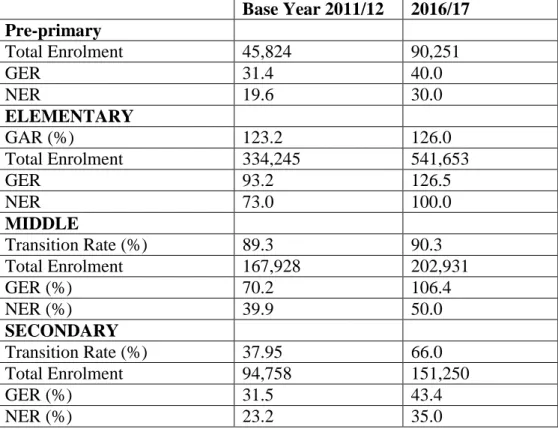
VII. Costs and Financing ... xvi
VIII. Conclusion... xvi
CHAPTER I: ... 1
1. INTRODUCTION ... 1
1.1 National Context and Strategy of Education ... 1
1.2 Eritrean Education Strategy ... 2
1.3 Financing Education ... 4
2. VISION ... 6
3. OVERALL OBJECTIVES ... 6
4. STRATEGIC PRIORITIES ... 7
5. OVERALL TARGETS ... 8
CHAPTER II: INSTITUTIONAL CONTEXT ... 10
1. Progress and achievements ... 10
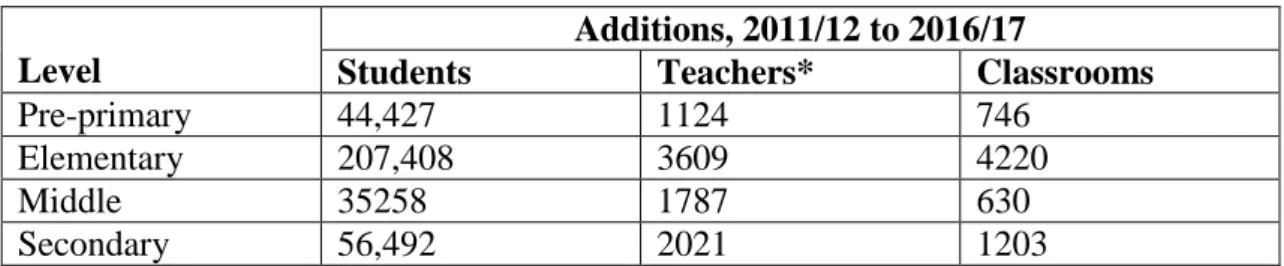
1.1 Access and Equity ... 10
1.2 Quality and Relevance of Education ... 14
1.3 Institutional Capacity ... 17
iii
2.1 Low access/low equity ... 18
2.2 Equity by location. ... 19
2.3 Equity by gender. ... 20
2.4 Teacher Supply ... 24
2.5 Low Learner Achievement ... 25
2.6 High wastage in general education ... 25
2.7 Limited institutional and financial capacity ... 28
156. Finance. ... 29
CHAPTER III: POLICY CONTEXT ... 31
1. The Declaration of Policy on Education (1991) ... 31
2. The Macro Policy of the Government of Eritrea (November 1994) ... 31
3. The Transitional Constitution of the Peoples’ Front for Democracy and Justice (PFDJ) ... 32
4. Constitution of the State of Eritrea ... 32
5. The Concept Paper for a Rapid Transformation of the Eritrean Education System (2002) ... 33
6. The National Education Policy on Education (2003) ... 33
7. National Economic Policy Framework and Programme (NEPF) – 1998-2000 (1998) ... 33
8. Poverty Reduction Strategy Paper (PRSP) (2003) ... 33
CHAPTER IV: STRATEGIES FOR EDUCATIONAL DEVELOPMENT ... 37
1. Expanded and Equitable Access ... 37
2. Girls’ and Women’s Education ... 37
3. Quality and Relevance of Education ... 38
4. Reduction in wastage ... 39
5. Technical and Vocational Skills Development. ... 39
6. Institutional Capacity Development ... 40
7. Financing Strategy ... 40
CHAPTER V: SPECIFIC OBJECTIVES, TARGETS AND ACTIVITIES ... 41
A. Specific Objective 1: Improve Access and Equity ... 41
1. Basic Education (Formal and Adult Education) ... 41
2. Adult Literacy education ... 46
2.1 Overall Objectives ... 46
3. Secondary Education ... 47
4. Technical and Vocational Education ... 50
5. Expansion of Teacher Training Outputs ... 51
B. Specific objective 2: Improve the Quality of Learning and Relevance of Education ... 55
iv
2. Technical and Vocational Skills Development ... 55
3. Reduction in wastage. ... 57
C. Specific Objective 3: Institutional Capacity Development ... 57
3.1 Overall Objective ... 57
3.2 Strategies/activities ... 57
3.3 Financing Strategy. ... 60
3.4 Tertiary Education and Training Institutions ... 66
CHAPTER VI: IMPLEMENTATION ARRANGEMENTS ... 67
Ministry of Education (MOE) ... 67
The Steering Committee... 67
MOE Departments, Divisions and Units ... 68
CHAPTER VII: MONITORING AND EVALUATION (M&E) ... 69
Review and reporting issues ... 69
REFERENCES ... 71
ANNEXES ... 72
Annex 1: Eritrea - Projected Costs of the ESDP, 2013-17 ... 72
Annex 2: Detailed Cost Projections ... 82
General Education ... 82
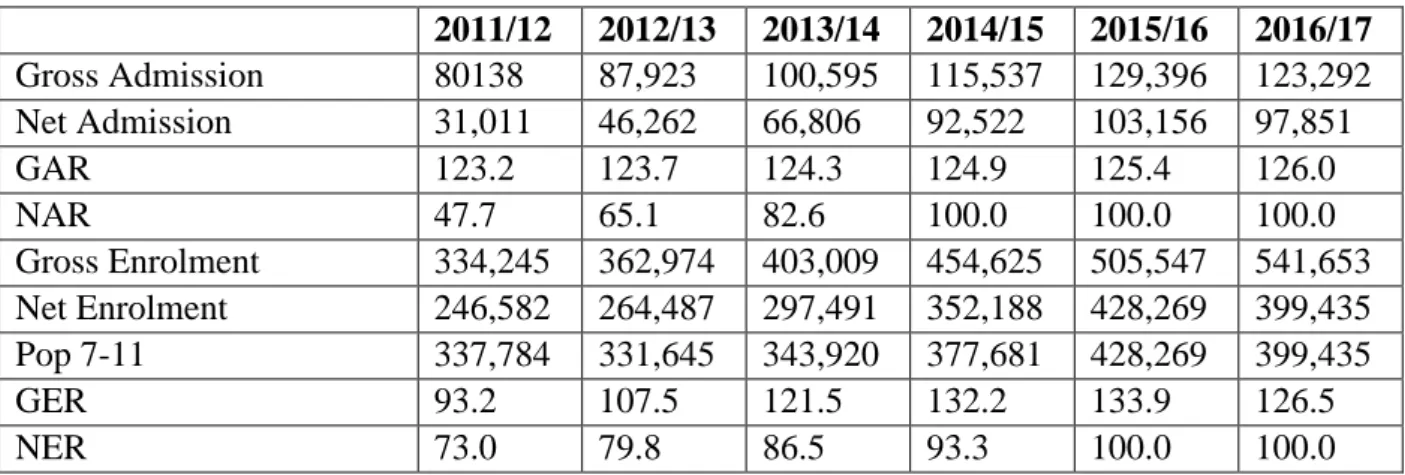
TVET ... 87
ADULT LITERACY & COMPLEMENTARY EDUCATION FOR OUT OF SCHOOL CHILDREN ... 88
ADMINISTRATION & CAPACITY DEVELOPMENT ... 90
Annex 3: Enrolment Projections (2013-2017) ... 91
PROGRAMME PROJECTION FOR PRE-PRIMARY EDUCATION (2011-2017) ... 91
PROGRAMME PROJECTION FOR ELEMENTARY EDUCATION (2011-2017) ... 92
PROGRAMME PROJECTION FOR MIDDLE SCHOOL EDUCATION (2011-2017) ... 94
PROGRAMME PROJECTION FOR SECONDARY EDUCATION (2011-2017) ... 95
Repetition and Drop-out Targets ... 96
Annex 4: Logical Framework ... 98
v
CHARTS
Page
Chart 1: Gross Enrolment by Level and Year, 2005/06 – 2010/11 Chart 2: Gross Enrolment Rate by Level and Year, 2005/06 – 2010/11
Chart 3: Enrolment in the Literacy Program by Gender and Year, 2005/06 – 2010/11 Chart 4: Technical and Vocational Training – Intermediate Level Enrolment by Gender
and Year, 2005/06 – 2010/11
Chart 5: Total Enrolment in NAVCOT and Technical Schools, 2007/08 – 2010/11 Chart 6: Number of Children age 7-11 out of school, 2005/06 – 2010/11
Chart 7: Elementary Level Gross and Net Enrolment Ratios by Region, 2010/11 Chart 8: Middle Level Gross and Net Enrolment Ratios by Region, 2010/11 Chart 9: Secondary Level Gross and Net Enrolment Ratios by Region, 2010/11 Chart 10: Gender Parity Index (GPI) by Level, 2010/11
Chart 11: Gross and Net Enrolment Ratios by Level and Gender, 2010/11 Chart 12: Enrolment by Level, Gender and Year, 2005/06 -2010/11
Chart 13: Total Enrolment in Grade 12 and Number of Graduates from Technical School by Year, 2004 -2011
Chart 14: Percentage of TVET Graduates by year, 2005 – 2011 Chart 15: Percentage of Repeaters by Level and Gender, 2010/11 Chart 16: Percentage of Dropouts by Level and Gender, 2010/11 Chart 17: Survival Rate to Grade 5 by Year, 2005/06 -2010/11
Chart 18: Transition Rate from Elementary to Middle Level by Year, 2005/06 – 2010/11 Chart 19: Completion Rate of Grade 5 by Year, 2010/11 to 2015/16
Chart 20: Projected Enrolment by Level, 2010/11 to 2015/16 Chart 21: Gender Parity Index (GPI) by Level, 2010/11 to 2015/16
vi
TABLES
PageTable 1: Projected Transition Rates, Total Enrolment and Enrolment Ratios, 20010/11 to 2015/16
Table 2: Additional Students, Teachers and Classrooms between 2010/11 and 2015/16 Table 3: Projection of Enrolments in Pre-primary Education by year, 2010/11 to 2015/16 Table 4: Projection of Enrolments in Elementary Education by level and year, 2010/11 to
2015/16
Table 5: Projected Increases in Student Flows (%) in Elementary Education Table 6: Program projections: Enrolments in middle schools
Table 7: Projected Increases in Student Flows (%) in Middle Level Table 8: Projected classroom requirements in pre-primary schools Table 9: Projected classroom requirements in elementary schools Table 10: Projected classroom requirements in middle schools Table 11: Adult literacy projection of age 15-49, 2010-2015 Table 12: Programme projections: Enrolment in secondary schools
Table 13: Projected Increases in Student Flows (%) in Secondary Education Table 14: Projected classroom requirements in Secondary schools
Table 15: Pre-primary Schools - Teacher Demand and Supply Table 16: Elementary Schools - Teacher Demand and Supply Table 17: Middle Schools - Teacher Demand and Supply Table 18: Secondary Schools - Teacher Demand and Supply
Table 19: Development cost for Improving Access/Equity in ‘000 USD - 2012-2016 Table 20: Development cost for quality/relevance of education in ‘000 USD, 2012-2016 Table 21: Development cost for Institutional capacity building in ‘000 USD, 2012-2016 Table 22: Total Development Cost in ‘000 USD, 2012-2016
vii
ACRONYMS
ATEI Asmara Teacher Education Institute AWPB Annual Work Plan and Budget
CEE Complementary Elementary Education CPD Continuous Professional Development DP Development partner
DGE Directorate of General Education
DKB Debubawi-Keih-Bahri (Southern Red Sea) ECD Early childhood development
EIT Eritrean Institute of Technology ELO Expected learning outcome EFA Education For All
EMIS Education management information system EPHS Eritrea Population and Health Survey EPLF Eritrean Peoples’ Liberation Front
ENQF Eritrea National Qualification Framework
ESECE Eritrean Secondary Education Certification Examination FRS Functional Requirement Specification
GAR Gross admission ratio GER Gross enrolment ratio GPI Gender parity index
ICT Information and communications technology LAPG Learner Assessment and Progression Guide LEMIS Labour Market Information System
LIAE Library and Information Association of Eritrea M&E Monitoring and evaluation
MDG Millennium Development Goals MML Minimum mastery learning
MLA Monitoring of Learning Achievement MOE Ministry of Education
MOLHW Ministry of Labour and Human Welfare NAR Net Admission Ratio
NER Net Enrolment Ratio
ODLP Open and Distance Learning Program PFDJ Peoples’ Front for Democracy and Justice PGE Provisional Government of Eritrea
PRC Pedagogic resource centre
PRSP Poverty Reduction Strategy Plan PTSA Parent-teacher-student association PRR Procedures Rules and Regulations
SACMEC Southern Africa Countries Monitoring & Evaluation consortium SKB Semiemawi-Keih-Bahri (Northern Red Sea)
SDC Skills Development Centre
TRS Technical Requirement Specification TVET Technical-vocational education and training USD United States Dollar
viii
EXECUTIVE SUMMARY
I. Introduction
1. This plan covers all sectors except tertiary education and is based on the principle that education sub-sectors do not exist in isolation from each other, but need to perform in a coherent, holistic and complementary way in order to optimize the achievement if the desired goals. The Plan is a rolling five-year plan to be updated annually.
2. Eritrea is a very poor country economically. It has suffered much hardship as a consequence of its struggle for independence and ongoing regional instability and also because of the harshness of much of its physical environment and climate.
3. Eritrea recognizes the importance of education and training for the future prosperity and wellbeing of the country and its people, in that they have the potential to develop the knowledge and skills required for a vibrant, competitive economy, foster social development and equality and to enable people to generate increased income and lift themselves out of poverty.
4. For these reasons, the Government of the State of Eritrea considers education to be the cornerstone of all national development efforts, particularly in human resources development, economic growth and poverty alleviation. Accordingly, it is making significant investments in the development of human resources by providing education and health services for the entire population, so that they are able to fully participate in the civic, cultural, political, social and economic affairs of their nation. Consequently, Eritrea’s development strategy emphasizes people as the most central resource for its reconstruction and development and this is reflected in the national theme ‘Our People are our Future.’ In this context, the Government has stated its commitment to MDG and EFA goals. However, entrenched problems in the education and training system impede Eritrea’s ability to accomplish these goals.
5. Economic growth and poverty reduction have been the twin goals of the government’s development programs since independence. Eritrea has considerable potential to generate growth in agriculture and livestock production, fisheries, mining, small and medium enterprises, tourism, telecommunications as well as infrastructure. Education and training are crucial for successful development in all these fields.
6. Eritrea seeks to create a modern, technologically advanced, and internationally competitive economy. A critical mass of qualified, trained and experienced human resources is a major prerequisite for export-led industrial development as well as sustainable industrial development. The existing technological base of the productive sectors of the economy is antiquated and woefully inadequate to achieve international competitiveness. As in agriculture, low educational and skill levels act as a tight constraint on industrial growth. Eritrea has an acute shortage of skilled manpower in virtually all sectors.
ix 8. In short, the shortage of appropriate human capital is impacting all aspects of the
development effort in both the private and public sectors.
II. Situational Analysis
9. At the time of liberation in 1991 education and training were extraordinarily limited in terms of access, infrastructure and quality. Since then Eritrea has achieved significant progress in rehabilitating, expanding and improving the education system. Total enrolments more than doubled at elementary level between 1991/92 and 2010/11, and tripled at middle and secondary levels over the same period. Enrolments in adult literacy classes reached over 40,000 in 2010/11. Despite the impressive progress, Eritrea faces daunting challenges in its quest to provide equitable access to quality basic education and employable skills for its youth and adults. The challenges are:
Low access and High disparities
10. Gross enrolment ratios have reached 93.2% at elementary level, 70.2% at middle level and 31.5.5% in secondary education. Still, about 121,000 Eritrean 7-11 year old children are not enrolled in school. Disparities in access to schooling exist by location and by gender. At the elementary and middle level gross enrolment ratios range from about 56.6% in the Southern Red Sea Region to 110% in Debub. Several factors explain the disparities, including the marked variation in physical and climatic conditions, shortage of schools, community attitudes to education, and the difficulty of reaching certain segments of the population, especially in sparsely populated areas.
11. Significant differences also exist between boys’ and girls’ participation in education. Gross enrolment ratios are between 13, 10.5 and 6 percentage points lower for girls than for boys at elementary, middle and secondary school levels.. Negative environmental (demand) side factors include poverty, inability to afford the direct costs of schooling as well as loss of children’s labor, and social and cultural obstacles, such as early marriage and undervaluing the benefits of education for girls. Educational (supply) factors include lack of female teachers and of trained teachers in mother tongue, overcrowded classrooms, inadequate supply of learning and instructional materials, perceived lack of relevance of curriculum, lack of sanitation facilities, and long distance to school.
Low Quality and Relevance:
12. Learning achievements: The Monitoring of Learning Achievement (MLA) study of 2008
analyzed the proportion of students in elementary education who acquired learning competencies in core subjects. It indicated that despite great efforts to extend access, quality was very low. None of the regions or grade 3 pupils tested achieved the minimum mastery level in any subject. Low performance in mathematics and English is a matter for national concern. Achievements varied widely by region, with Maekel 2.6 times higher than the Anseba region in overall Grade 3 mastery. The performance of all regions was markedly lower in Grade 5 than in grade 3. Girls’ combined scores compared favorably with males at grade 3 in Mathematics, but significant differences existed in English, with performance 12 percentage points below boys. Nevertheless, girls have performed at grade 3 in Mother
x Tongue 9.6 percentage points higher than boys. At grade 5 both girls and boys performed equally.
13. Both supply and demand factors explain these disappointingly low academic results, for similar reasons to those which inhibit access. Demand-side problems include poverty, child domestic labor, weak parental interest, distance from school and socio-cultural barriers. Multiple supply-side educational factors include: (i) shortage of teacher and school manager competencies, qualifications and accountability for results (in the 2010/11 academic year, only 69% of teachers at middle level were formally qualified, and just 83% in the secondary phase); (ii) problems in curriculum relevance; (iii) overcrowded schools and classrooms, often with dilapidated facilities and broken equipment (at secondary level, on average teachers teach about 65 students per class) ; and (v) inefficient use of the school calendar and school day resulting in much less than intended time on task.
14. TVET – relevance and quality: Lack of relevance manifests itself first in lack of demand-responsiveness. The country lacks an effective labor market information system (LMIS) by which to guide the direction of the system. Employers, the ultimate users of the output of the TVET system, do not participate in advising the system. Formal skills training is limited to traditional trades. Technical schools are marginal in the overall education system, accounting for only 5% of enrolments at secondary level. Public non-formal skills training is also negligible.
15. The quality and effectiveness of TVET also present problems. TVET institutions lack the main inputs required for sound and effective training: qualified and experienced instructors, textbooks and teaching materials and operational, reasonably up-to-date equipment. Mechanisms do not exist to coordinate training policies among the key public actors and employers. Insufficient data exists about the performance of the training institutions and their graduates in the labor market.
16. High wastage and dropout: The Eritrean education system is characterized by wastage de to high repetition rates at all three levels, generally between around 12% of students at each grade each year. Low internal student flows means that it takes 6.5 student-years of inputs to graduate one student from the five-year elementary phase. Repetition and late entry account for large differences between net and gross enrolment ratios at elementary and middle levels. 14% and 23% moreof the age group could be accommodated within existing elementary and middle institutions, respectively, with efficient internal flows. High repetition rates increase the cost of education and deny other children an opportunity for schooling.
17. Limited Institutional and Financial Capacity: The Ministry of Education faces two main constraints: limited MOE implementation capacity at central, Zoba and local levels, and scarce financial resources. Modern systems are lacking that would enable more efficient management of planning information, budgeting and expenditures.
18. EFA goals cannot be reached without substantial increases in financial resources to support education and training. The ability of Government to mobilize further resources for education is constrained under present circumstances. Education and training are free at all levels and the government shoulders virtually all the expenses of teacher salaries and building construction. Parents at present finance some of the operating costs of schools through voluntary contributions.
xi
III. Plans and Strategies for Educational Development
19. The Government’s strategies for economic growth and poverty reduction seek to transform Eritrean society and create a modern, vibrant and competitive economy. Eritrea aims to make basic education available to all, regardless of their ethnic origin, sex and religion. The Government is committed to meet the EFA goal of achieving universal primary education, ie a net enrolment of 100%, by 2015. Gross and net enrolment ratios at the middle level will reach 106.4% and 50% respectively by 2016, with corresponding gross and net enrolment ratios of 43.4% and 35% at the secondary level. These targeted increases imply an additional enrolment of 207,408 at elementary level, 35,258 at middle level and 56,492 at secondary. 20. In the planned five year period MOE will target out-of-school youth, reduce class sizes and
the number of double shift schools, reduce repetition and increase learning achievement. This will allow significant gains in internal efficiency that will increase the net enrolment ratio to about 100%, 50% and 35% at elementary, middle and secondary levels education respectively, by 2016/17.
21. The MOE places top priority on the expansion of educational opportunities for females. Female gender parity with males will be achieved in elementary and middle education by 2015/16. However, gender parity will not be achieved in secondary education until 2016. 22. The Ministry has introduced several new policies aimed at resolving the key problems.
These include new curricula that are vertically and horizontally integrated, specification of expected learning outcomes for each grade and subject, learner-centered and interactive teaching methods, and continuous assessment of student performance to facilitate efficient student passage through the system. Greater relevance will be achieved in middle and secondary education through the introduction of practical courses as enrichment to core academic subjects. Policies have been drafted for TVET and Adult Education aimed at expanding access and improving the quality of education.
23. The Ministry will pursue multiple strategies to achieve its priority objectives. The strategy to improve access involves targeting of classroom construction for underserved areas and populations; breaking the bottleneck on the output of trained teachers; implementing community-based campaigns and reducing the direct and indirect costs to parents of enrolment of their children. Efforts will also be made to extend and reinforce adult literacy programmes, in part using media education. Within this context MOE has prepared a separate strategy for female education including: raising gender awareness of the communities and teachers; revising curricula and teaching materials to make them gender sensitive, disability sensitive and age-appropriate; expanding the number of female teachers; opening boarding schools and hostels for girls in remote areas; ensuring grade 1 entry at the proper age; and improving gender-disaggregated data for monitoring. In adult education extensive campaigns and interventions will be made to lower illiteracy rate to 10% during the plan period.
24. Strategies for quality improvement include the following interventions: curricula revisions with focus on expected learning outcomes; provision of adequate, up-to-date textbooks; increasing teacher and school leader competencies through staff development; improving teaching methods and time on task; provision of facilities to relieve overcrowding and facilities and equipment for science and ICT; reduction in double shifting, stimulating parental interest and continuing MLA studies to track progress on learning achievements.
xii Quality of the literacy program will also be improved through the enhancement of facilitators’ and coordinators’ competencies; curriculum review and textbook production; and by expanding community reading centers.
25. The strategy to reduce student repetition and dropout recognizes that virtually all of the interventions designed to increase access and boost quality will also reduce student wastage. Such reductions are essential to reduce costs in the system and free up capacity for new students. Both school and non-school factors will be addressed, including the use of continuous assessment, remedial instruction, information campaigns to counter negative parental attitudes, in part through radio and media, and building of strong, community-based parent-teacher-student-associations (PTSA). In addition, direct incentives will be employed for the poorest students, including financial assistance to offset the direct costs of schooling. 26. The strategy for vocational and technical skills development seeks to build
demand-orientation into the training system; achieve more effective mastery of skills competencies; broaden coverage and expand the quantitative output of skills to meet economic requirements in various sectors; mobilize adequate financing to augment operating costs; and strengthen the management capacity for skills development.
27. The strategy for building institutional capacity seeks to bring better educational services to schools through functional analysis and readjustment of structures, procedures, resources and staff development.
28. The financing strategy calls for increased contributions from the Government, communities, the private sector and the assistance of Development Partners to reach the targets set out in this plan, including the MDG and EFA Goals.
IV. Overview of the five year plan
29. The Ministry’s Five Year Education Sector Development Plan (ESDP), 2013-2017, represents a significant milestone in plans for the education sector. It translates the vision of Government and the strategies chosen to deliver it into outputs and outcomes, and identifies the planned inputs and activities necessary to achieve the desired results.
30. The three objectives of the plan are to:
Increase equitable access to basic (including adult and non-formal education), secondary and technical and vocational education;
Improve the quality of basic, secondary and technical and vocational education; and
Strengthen institutional capacity to deliver better quality education services.
31. In accordance with the overall sectoral priorities, the Plan features the following three components:
a) Increase Equitable Access to Basic education and literacy, Secondary education and TVET;
b) Improve Quality and Relevance of Basic, Secondary education and TVET; and c) Institutional capacity building.
32. The ESDP will achieve the following total increases by level: 44,427 more pre-primary students, 1124 pre-primary teachers and 746 pre-primary classrooms; 207,408 more
xiii elementary students, 3609 elementary teachers and 4220 elementary classrooms; at the middle level 35,258 more students, 1787 teachers and 630 classrooms; and at secondary level 56,492 more students, 2021 teachers and 1203 classrooms.
Component 1: Increase Equitable Access to Basic education and literacy, Secondary and TVET education.
33. The ESDP 2013-2017 objective is to have all children complete elementary education and 80% complete middle level, with targeted learning achievements as defined by the curriculum.
34. This overall objective requires three principal accomplishments by 2015/16: equity of access, efficient student flows and quality, i.e. to:
a) Enrol 100% of age-eligible children in elementary school, and 80% in middle school; b) Keep them in school, progressing at a reasonable pace, reducing repetition from 12%
to 0% from grades 1-3 and 7% for grades 4-5 at elementary level and from 12% to 7% per annum at middle level; decreasing dropout at elementary level to no more than 2% per annum and to 4% p.a. at middle level); and
c) Ensure that students have mastered the essentials of the curriculum, i.e. 80% of the students score 50% on a test of their knowledge, skills and competences.
35. The principal means to achieve the objective of expanded access to school are: (a) construction of 807 pre-primary, 2776 elementary, 548 middle and 572 secondary school classrooms plus boarding facilities, carefully locating them where they will serve underprivileged groups and regions; (b) expansion of teacher outputs by enhancing Asmara Teacher Education Institute (ATEI) and College of education and expanding enrolments in these, and by providing brief vacation time courses.
36. The Plan will also concentrate on increasing literacy. The adult literacy and post-literacy program will be expanded to reach more than 300,000 non-literate adults and youth, and a non-formal education program will be organized for about 50,000 out-of-school youth during the five year period. Quality, and supply, of teaching materials and appropriately trained teachers for the adult literacy program will be enhanced. Media education, particularly radio, will feature prominently.
37. The principal inputs to the literacy program are: construction of transportable classrooms, greater use of media (especially radio), revision of curricula and materials, facilitator training and systematic monitoring and quality assurance.
38. Secondary education is important as a means to supply educated and trainable graduates. It also has positive externalities, such as improved health, reduced infant mortality and better family planning. The scope, quality and gender balance of post-secondary education depend on the graduates of secondary education. Pressure for expansion of secondary intake is likely to mount quickly. Thus improved and expanded provision of secondary education occupies a central and pivotal place in the future development of the country.
39. The ESDP projects an increase in the transition rate from middle school (Grade 8 leavers) to secondary level to 66.0%. Secondary enrolment is projected to increase by 56,492, an increase of 59.6%, raising gross enrolment ratio from 31.5% to 43.3%. The total enrolment of
xiv females is expected to increase substantially, over the plan period. The net enrolment ratio at secondary level is expected to increase from 23.2% to 35%, an increase of 74.6%. The gender parity index is expected to improve from 0.74 in 2010/11 to 0.95 in 2015/16.
40. The Plan is for increased access to be achieved through construction of 1203 classrooms, targeting underserved areas, expansion of qualified teachers and reduction in repetition; as well as social mobilization campaigns to increase demand for education services.
41. At secondary level, planned inputs will significantly increase the proportion of students who gain minimum mastery level at graduation. Inputs include; curricula development, provision of more and better textbooks, improvement of the qualifications of school directors and teachers (including through distance education), reduction in double-shifting, enhancing libraries and laboratories for science, expansion of ICT, and introduction of enrichment programmes in practical skills.
42. TVET will be strengthened by the expansion of skills outputs through reinvigoration of Skills Development Centers, building new technical schools and renovating existing ones. The organization and management of skills development will be strengthened. In collaboration with the Ministry of Labor and Human welfare (MOLHW) the sub-sector will be strengthened through collection and analysis of labor market information, building the capacity of the central MOE to take on support functions. Also, multipurpose training providers for out-of-school youth and adults will be encouraged.
Component 2: Quality and Relevance of Education
43. The main means to achieve the objective of quality improvement are curriculum development, expansion of textbook provision, enhancement of school support systems’ development and interventions to improve the competence of teachers through in-service staff development, including of school leaders. Distance education features prominently in the strategy to upgrade teacher qualifications.
44. Improvement in the quality of adult education will be achieved through the development of curriculum and textbooks, supply of adequate teaching and learning materials and increasing the supply of qualified facilitators and coordinators.
45. Raising the quality of skills training will be achieved through development of competency-based training, increasing the supply of trained instructors and re-equipping of existing training institutions. The outputs of these investments are expected to be a system of skills formation more responsive to labor market demands, higher standards of quality, and a major expansion in the number of beneficiaries acquiring relevant skills.
Component 3: Institutional Capacity Development
46. The ESDP draws on the findings of an institutional capacity assessment conducted in 2005. The main activities to increase effectiveness and efficiency in the delivery of educational services include a review of roles and responsibilities among the various actors, together with the distribution of functions among the various organizational structures; and identification of the gaps between needed and available inputs. The plan prioritizes support to capacity development in: organizational development; staff professional skills development; systems
xv development including EMIS, budgeting and human resources; updating of regulations and addressing equipment requirements.
V. Implementation
47. The overall objective of the implementation framework is to ensure that the plan gets implemented fully, on time and within budget. This requires, inter alia, an effective administrative structure, efficient procedures, capable human resources and sufficient financing for implementation.
48. Key implementers of the plan will comprise the Ministry of Education (MOE), the zoba and local education offices. In executing its functions, the MOE will be assisted by other government ministries and regional administrations. These are primarily the Ministries of National Development, Finance, Public Works, Labor and Human Welfare and Justice. 49. The MOE will be responsible for the policy development and implementation of strategic,
legal, and institutional aspects of the plan and will retain oversight of these aspects. The MOE will also retain responsibility for the management of the entire implementation process of the plan. A Steering Committee chaired by the Minister of Education with all five MOE Directors-General as members will; foster a common understanding of the plan goals and policies; provide strategic oversight; review and approve annual work plans and budgets; coordinate the various branches of the MOE in plan implementation; assess the performance of the MOE in plan implementation; take corrective actions to avoid or overcome problems; and report on program implementation to higher levels of government.
50. The implementation and execution functions of the MOE will be undertaken by the respective structures of the MOE within which the technical and substantive aspects of the plan will be mainstreamed. These structures include the various Departments at headquarters, Zoba offices, Sub-zoba offices and schools.
VI. Monitoring, Evaluation and Reporting
51. In order to assess whether the development objectives of the ESDP are being met, a monitoring and evaluation system will be established in the MOE. Monitoring and evaluation of plan performance will systematically be carried out during the plan period, integrated into the daily operation of the plan at all levels and used to encourage innovation, team building, and local project ownership. The foundation of the plan monitoring and reporting systems will be the Logical Framework and its key performance indicators.
52. There will be quarterly, annual and final reporting on performance measures against the objectives and indicators of the ESDP. A Joint Annual Review Meeting (JARM) will be convened with representation of key GSE officials from MOE and other Ministries, consistent with the latter’s responsibility to contribute to the success of the program. Development Partners who provide financial and other support to the Program will also be able to participate; as well as the members of the reconstituted Education Working Group (EWG).
xvi
VII. Costs and Financing
53. The five year ESDP will cost approximately US$ 545 million for increasing equitable access, US$ 89 million for improving quality and relevance of education and US$ 59 million for institutional capacity building. The overall cost for the three components amounts to approximately US$ 700 million. The recurrent cost implications of the Plan will be substantial. Government welcomes the support of development partners in meeting the overall costs.
VIII. Conclusion
54. The Plan is expected to generate substantial benefits through increased access to basic education (which includes adult and non-formal education), secondary and technical education and improved student achievement at all levels. Major reductions are projected in gender disparity and increased participation among other hard-to-reach disadvantaged groups. The increased relevance of educational content and expansion of outputs from TVET institutions will promote skills needed both for economic growth and increased personal incomes. Employers increasingly will have access to more of the skills and competencies they need, and the economy overall will have more of the workers required for accelerated development. The population will also benefit from more and better education through the resultant greater opportunities to participate fully in the civic, cultural, political, and social affairs of the nation.
1
CHAPTER I:
1. INTRODUCTION
55. The developments and trends of education throughout the world reveal that education systems of developing countries have made unprecedented progress in recent years. However, the future holds major challenges for countries at all the various stages of educational and economic development. Despite the increasing endeavour of governments, the achievement is expected to remain the same mainly due to the rapid increase in the school age population combined with falling enrolments.
56. Eritrea recognizes the importance of education and training for the development of the country. Education develops the knowledge and skills required for a vibrant, competitive economy. It enables people to generate increased income and lift themselves out of poverty. It fosters social development and equality among the people.
57. For these reasons, the Government of the State of Eritrea considers education to be the cornerstone of all national development efforts, particularly in human resources development, economic growth and poverty alleviation. Accordingly, it is making significant investments in the development of human resources by providing education and health services for the entire population, so that they are able to fully participate in the civic, cultural, political, social and economic affairs of their nation.
1.1 National Context and Strategy of Education
58. Eritrea, an independent state in Africa, is bounded on the east by the Red Sea, on the southeast by Djibouti, on the south and west by Ethiopia, and on the north and northwest by Sudan. Eritrea is one of the newest countries in Africa, having attained its independence after a 30-year war with Ethiopia. Eritrea attained de facto independence in May 1991 and de jure independence two years later in 1993. Asmara is its capital city. For administrative purposes, Eritrea is divided into six regions (zobas), 58 sub-regions, 704 administrative areas and about 2580 villages.
59. Eritrea covers an area of 121,144 sq km and the Red Sea coast stretches more than 1,000 kilometers. The Denakil Depression in the southeast, which is inhabited by the Afar community, falls below sea level and has been the site of some of the highest temperatures recorded on earth. The National Geographic of October 2005 described it as the cruellest place on earth, “a place of dry sands and even drier gravel beds, rocky lava flows, active volcanoes, burning salt flats, temperatures that often top 120°F”. To the west, the coastal plain rises sharply to the highland plateau, where altitudes range from 1,830 to 3013 meters above sea level and annual rainfall is significantly higher than it is at the coast. The population on the plateau is mostly inaccessible due to the rugged terrain and remoteness of the area. Agriculture is the norm in the plateau region. Livestock raising and fishing predominate in the north, west and in the drier coastal plains and the arid regions of the north and west.
60. Since the last decade, Eritrea has experienced recurrent droughts and socio-economic challenges resulting from the no war no peace stalemate with neighboring Ethiopia. These
2 contributed to the slowing down of its normal growth and development. Worse yet, degradation of natural resources, inadequate infrastructures, and shortage of skilled human power pose daunting constraints to its overall development process.
61. Eritrea has not had a population census since independence. The population estimates used come from a variety of sources. In recent years, the Government has been using the total population figure of 5.4 million, which was the estimate that appeared in United Nations publications. However, recent demographic and health surveys indicate that the true figure is considerably lower. The Eritrean Office of National Statistics now estimates that the total population is about 3.6 million.
62. The national education statistics are based on age-specific population estimates provided by the Office of National Statistics, consistent with the revised population total. Thus in the Education Sector Development Plan, estimates such as numbers of out-of-school children and of enrolment ratios are consistent with the revised, 3.6 million, total population figure, not the earlier 5.4 million.
63. Eritrea’s economy is mainly based on agriculture, light industry, fisheries and services including tourism. Almost 80 per cent of Eritreans live in rural areas, with the majority relying on rain-fed agriculture and livestock rearing for their livelihoods. Eritrea is presently developing its tourist industry around the Red Sea port of Massawa and the export potential of its mineral reserves, including gold, copper and potash. Gold extraction commenced in 2011, and oil and natural gas reserves are possible. Eritrea ranked 177 of 187 countries on the 2011 Human Development Index, a composite index that combines GDP with adult literacy and life expectancy. There are limited data on developmental and income inequality.
64. High gross domestic product (GDP) growth of 8.7% was estimated for 2011, with per capita GDP of US$ 549 in 2012 representing a 16% increase on 2011 (IMF data). In spite of many challenges, Eritrea undertook rehabilitation and reconstruction of the country giving priority to food security and the construction of necessary infrastructure, the provision of social services and social protection based on the principle of social justice.
1.2 Eritrean Education Strategy
65. The Government of the State of Eritrea considers education as key to national development. An important milestone during the Eritrean struggle for independence was the development of a new education system. The previous curriculum of the colonial powers deliberately perpetuated marginalization of Eritreans and subjected them to degrading experiences and concepts that undermined the dignity of Eritreans. For example the teaching of Eritrean languages was replaced with instruction in the national language of the occupying forces. During the struggle for Eritrean independence, education was considered critical to the success of the struggle and accordingly the Eritreans involved in the struggle were given quality education even at the battlefront. The new National curriculum was developed and it emphasized the development of literacy in all local languages within a relevant education system. Schools were set up mostly in open spaces in the liberated areas. All citizens were encouraged to learn irrespective of their age, gender, ethnicity, religion, location and occupation through formal and non-formal means. Mobile schools were opened for nomadic populations. That experience formed the basis for innovative strategies of education service delivery that the country still utilizes.
3 66. After independence in 1991, education for all was pursued with renewed vigor and spread to all parts of the country. The clearest testament to the government resolve to eliminate illiteracy was the foresighted declaration of free and compulsory education for all Eritreans across all levels including secondary and tertiary education.
67. The Ministry of Education has adopted a three band structure (National Education Policy, 2010) consisting of basic education (that comprises pre-primary, elementary and middle school), secondary education, and tertiary education. The structure allows combinations of parallel formal and non-formal channels of basic education with opportunities for transition from one system to the other. The policy further provides for transition between different education channels in the system based on combinations of accredited academic performance and experiential learning. Of significance is the flexibility in the system which allows a second chance to education for the large number of the children, adolescents and young people who are out of school with commitments to reaching EFA goals by 2015.
68. In addition to two years of pre-school, basic education lasts 8 years and is split into grades 1-5 (elementary) and grades 6-8 (middle). Secondary education lasts four years (Grades 9-12) and it provides general secondary education in arts and sciences. There are also technical and vocational training secondary schools where students join from general education after the completion of grade ten. Upon completion of secondary education and based on performance in the secondary education certificate examination students join institutions of higher learning (tertiary), or go into technical and vocational education and training (TVET).
69. The Government affirms that education is the cornerstone for all national development efforts This is articulated in the Interim Poverty Reduction Strategy Paper (I-PRSP, 2004), which states that developing Eritrea's human resources capacity through education, health and human welfare sectors is one of the key strategies for attaining the goals and objectives of economic growth and poverty reduction.
70. The Macro-policy (1994), the National Education Policy and Adult Education policy provide guidelines to uphold the equitable access and delivery of quality education at all levels for all citizens.
71. Since 1993 the education sector has experienced significant progress in terms of rehabilitation of infrastructure and in the general expansion of the education system. The government’s macro policy objectives for education are: i) development of a population equipped with necessary skills, knowledge and culture for a self-reliant and modern economy; ii) development of self-consciousness and self-motivation in the population to fight disease, attendant causes of backwardness and ignorance; and iii) provision of basic education to all, regardless of their ethnic origin, sex and religion. These macro objectives have subsequently been reconfirmed by the current National Education Sector Plan 2013 - 2017 of the Ministry of Education.
72. TheGSE emphasis on social justice is clearly articulated in the education system’s vision as stated in the National Education Policy 20101:
Our education system aspires to produce all round citizens along with a firm commitment to country, people and social justice. This aspiration includes the
1
4
development of creative and productive individuals who are capable of contributing towards the attainment of a modern, competitive, harmonious and self-reliant Eritrea.
73. The 2010 National Education Policy underlines the Ministry of Education’s commitment on reaching the unreached and the goal for creating a literate society that can provide good quality education to all the children and at all levels. It calls for the provision of free and compulsory basic education; the use of the mother tongue teaching at the elementary level; and the expansion of secondary and tertiary education opportunities as the most essential components of the education system. It also provides alternative routes for those who may not benefit from the formal provisions. These include the Complementary Elementary Education (CEE) for children who fail to enrol into elementary school at the right age, nomadic education for pastoral communities, and adult literacy, which targets adults who missed out on their educational opportunities. Upon successful completion of grade 12 and the National Secondary Education Certificate Examination (NSECE) a student can enter one of the seven colleges2.
1.3 Financing Education
74. Based on its standing objective of nation building, the Government of Eritrea encourages sectors that invest in programs that contribute to poverty eradication and national food security program. Education is among the top priority sectors.
75. The Government has shouldered the responsibility of providing education to its citizens since independence but the resources have not been sufficient to guarantee social justice in education. Other constraints have equally contributed to the inability to guarantee social justice in education. For example, despite the implementation of the free and compulsory education agenda since independence, over 30% children of school age cannot access basic education. These statistics undermine the resolve of government to promote equity and social justice, they also threaten the government efforts to achieve EFA and MDG goals.
76. Whereas the Government plays the dominant role in the provision of education, there are other non-governmental (private) education providers from pre-school up to the tertiary levels. The MOE is responsible for the training of ECD, elementary, middle and secondary school teachers, curriculum design and development, providing textbooks and the supervision. The central government is responsible for paying and recruiting teachers, setting standards, providing the overall policy framework and monitoring and evaluation for the entire sector.
77. The overall government expenditure on education represents approximately 8-10% of the total national budget. Education expenditure as a percentage of the Gross Domestic Product (GDP) is in the range of 2.6% to 3.7% based on the GDP estimates of the World Bank. The basic education sub-sector share of the total government spending in 2008 was 25.3% and in 2011 it slightly declined to 25.1%. The non-salary percentage of basic education spending in 2008 was 50.7% and declined to 42.3% in 20113.
2
The seven new colleges are: Eritrea Institute of Technology at Mai Nefhi; Hamelmalo Agricultural College at Hamelmalo; College of Health Sciences, Asmara; Orotta School of Medicine, Asmara; College of Marine Sciences and Technology, Massawa; College of Business and Economics, Halhale; and, College of Arts and Social Sciences, AdiKeih.
5 1.3.1 Actual Spending on Education
78. In projecting costs of an education sector plan, it is necessary to show them in the context of the amount that is actually being spent on education at present. The Ministry of Finance provided data to the ESDP costing team in December 2012, of which the overall total is summarised in Table A. Together with World Bank estimates of Eritrea’s GDP, these data show education spending as proportions of GDP and total government spending. They indicate that, in its spending on education, Eritrea may be in the lower part of the spectrum of countries of similar income levels, perhaps giving space for increased spending.
Education Spending (including higher education) in the Context of GDP and Total Public Spending
Actual Actual Actual Actual
2008 2009 2010 2011
GDP US$ Mn (World Bank) $1,380.2 $1,856.7 $2,117.0 $2,609.0 GDP Nkf Mn (World Bank) Nkf20,702.4 Nkf27,850.5 Nkf31,755.0 Nkf39,135.0 Total Education Spending Nkf
Mn (MoF) Nkf 763.8 Nkf908.6 Nkf1,038.2 Nkf1,036.4
Education Spending as % GDP 3.7% 3.3% 3.3% 2.6%
Education Spending as %Total Government Spending (MoF data)
8% 10% 8% 8%
Education Spending excluding
Higher Education Nkf Mn (MoF) Nkf 601.5 Nkf 823.1
Source: Ministry of Finance, except GDP figures, which come from the World Bank website database, converted to Nakfa at 15 to the US dollar.
79. Further analysis of actual expenditure is not presented here, since data from the MoE show spending grouped in different ways. These presentational differences make it difficult for sector decision-makers and planners to manage the system with a clear understanding of what has actually been happening in the recent past, and the relative priorities of different parts of the sector as shown by the resources committed to them. Given that the EMIS data on enrolment and the school system are comprehensive and produced relatively quickly, a better understanding of where money is spent would allow good analysis of system costs, which would be helpful to all concerned. The two Ministries are working to resolve the problem, and it is hoped in the near future to have available an analysis, presented in an agreed form, that meets the needs of both.
80. The government therefore appreciates the support of development partners in complementing its programmes. Key external support to the sector has been received towards the following specific interventions:
i) The 2003-2008 Education Sector Investment Plan (ESIP) supported by the World Bank and later became part of the ESDP;
ii) The Education Sector Development Plan (2005-2009) supported by African Development Bank, European Union, Islamic Bank, UNDP, UNESCO, UNFPA, UNICEF, and World Bank. The funding of this programme was composed of loans, grants and government contribution total of USD 90,972,780.20 and Euro 53 million
6 iii) The ESDP (2013-2017): Currently the active development partners to the sector are the African Development Bank (USD 19.7 million), Islamic Development Bank (USD 200,000) and UNICEF (USD 9 million).
81. The current partners include the African Development Bank support to the Technical and Vocational Education and Training sub sector, UNICEF support to the Basic Education sub sector, and the Islamic Development Bank support to elementary education. Much as education is free across the various levels, community financing constitutes a significant proportion of funding to the sector. Community financing includes in-kind support in the form of labour for the construction of classrooms, the provision of scholastic items to schoolchildren (at subsidized cost), the provision of school uniforms and payment for utilities like water and electricity by PTAs. However, community contributions have not been systematically quantified to determine the percentage of the total contribution to the sector. 82. The government of Eritrea welcomes more external partnerships and has initiated
discussions with potential partners including the European Union with the view to mobilising support towards the education sub-sectors that are under-funded.
83. It is estimated that the implementation of the new Education Sector Plan will cost at least USD 700,000,000. Basing on previous Government inputs to the sector, amounting to USD 50 million annually, the projected Government contribution to the ESP is likely to amount to USD 250 for the five years. Other confirmed contributions are from ADB ($ 19.7 million), UNICEF ($9 million) and Islamic Bank ($ 0.2 million). The funding gap at the moment is $421, 000,000
2. VISION
84. The Government’s economic growth and poverty reduction strategy seeks to transform Eritrean society and create a modern, vibrant and competitive economy. The education sector strategy, along with other elements of the development strategy in health, agriculture and other sectors, is designed to contribute to the achievement of this vision. The social and economic dimensions of education are reflected in a draft mission statement of the MOE: “To provide all citizens of the State of Eritrea with access to learning opportunities and to ensure a quality of education and training provision relevant and responsive to individual and national development needs. This provision shall take note of the special circumstances of specific social groups, including disadvantaged communities.”4
3. OVERALL OBJECTIVES
85. The Government’s Macro-Policy (1994) was the first document to establish the objectives of the education sector. They remain valid today. The overall objectives are: (i) the development of a population equipped with necessary skills, knowledge and culture for a self-reliant and modern economy; (ii) development of self-consciousness and self-motivation in the population to fight disease, attendant causes of backwardness and ignorance; and (iii) provision of basic education to all, regardless of their ethnic origin, sex and religion.
4 Ministry of Education, Our People Are Our Future: A Framework for the Development of Human Resources
7 86. The Macro-Policy also defined a policy framework for the sector, which envisaged:
Providing Universal Primary Education (up to seven years)
Meeting skilled manpower/labour requirements of both the public and private sectors by steadily increasing enrolments at the secondary, technical and vocational schools.
Promoting continuing education through formal and informal channels to achieve higher literacy rates and technical competence.
Expanding tertiary education to meet the envisaged manpower/labour requirements of the country.5
87. The Concept Paper for a Rapid Transformation of the Eritrean Educational System (2002) refers to problems of access to education at all levels including higher education, lack of employment orientation and the wastage of resources. It states,
“The time is ripe for the Eritrean government to make all the necessary changes and reforms … to make the Eritrean education system measure up to the needs of the country to produce the people necessary to propel it forward as a viable … nation of the twenty first century. The reforms must achieve the following:
All wastage of person power, resources, effort and time in the educational system must be abolished inasmuch as it is humanly possible
All doors and opportunities must be open to Eritreans of all ages to develop to their full potential both professionally and personally.
Education must be employment oriented such that at the end of any level of education any person can find gainful employment commensurate with the person’s level of education and training.
The standards and quality of education and training in the education system must be high enough such that products of the educational system would have a high degree of acceptability in … employment”.6
4. STRATEGIC PRIORITIES
88. The following priority areas have been adopted by the Ministry as the most important for development over the coming five years:
Increasing equitable enrolment in basic and secondary education through the construction of classrooms and ancillary facilities and targeted interventions aimed at girls and other disadvantaged children.
enhancing and expanding the provision of literacy and continuing education for adults and out of school youth;
Improving the quality of basic, secondary and technical and vocational education by expanding teacher training and professional support, replacement of expatriate teachers by Eritreans at secondary level; development of curriculum and pedagogical reforms; improvement of educational support systems;
Developing technical skills and technology training, by expanding existing technical schools and establishing new ones with due attention to cost-effectiveness and the
5 Eritrea, Macro- Policy, 1994, 39-40. 6Concept Paper, 5-6.
8 technical skills and training geared to meet labour market demand. Training will be imparted in trades selected in consultation with the local industry to create strong employment linkages;
Strengthening sector capacity to deliver better quality educational services by developing institutional capacity of the Ministry and regional offices in matters of policy planning, management, and monitoring and evaluation to implement the intended transformation of the education sector.
5. OVERALL TARGETS
89. The Government is committed to meeting the EFA goal of achieving universal primary education by 2015. The Government aims to achieve a net enrolment ratio of 100% in elementary school by 2016/17. At the middle level Gross and Net Enrolment Ratios (GER/NER) will reach 106.4% and 50% respectively over the same period, with corresponding GER and NER of 43.4% and 35% at the secondary level. In the next five years, this increase requires an additional enrolment of 207,408 at the elementary level, 35,258 at middle level and 56,492 at secondary level. The projected enrolments are based on the assumptions that GER at elementary, middle and secondary levels will reach 126.5%, 106.4% and 43.4% respectively by 2016/17. During the same period NER are expected to reach 100%, 50% and 35% at elementary, middle and secondary levels respectively. It is also targeted to reduce class sizes and number of double shift schools, and concentrate on reducing repetition and dropout rates while at the same time increasing learning achievements. These measures will enable significant gains in internal efficiency, which will increase the number of age-appropriate children by about 190,468 at elementary level, over the same five year period.
90. Ministry of Education (MOE) has established pre-primary (formal and non-formal) schools within the education sector and has adopted a policy of support for 2 years of Early Childhood Development for each child prior to enrolling in elementary school. The target of the five year plan is to have 30% of the children within the 5-6 year age range enrolled in these schools.
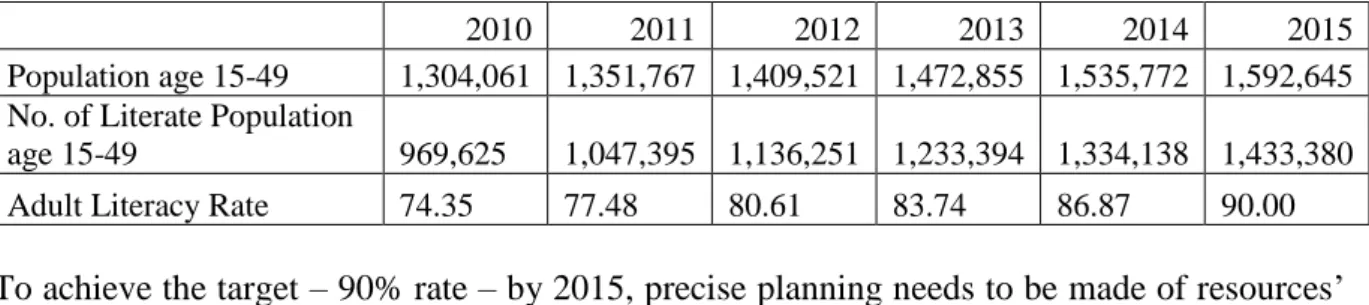
91. In the adult education program the target is to achieve 90% adult literacy (from the current baseline of 74%).
92. The target for technical and vocational education is to admit about 20% of students who complete grade 10 to Vocational high schools. Students will be provided with integrated knowledge and skills-based education and training to ensure adequate supplies of competent people, with adequate skills for the attainment of the government’s overriding national development priorities.
93. Gender targets have been set for general education, adult education and technical and vocational education to ensure that the participation and success of girls and women increase in tandem with that of boys.
94. However, entrenched problems in Eritrea’s education and training system impede its ability to accomplish the sector goals. These problems include: inadequate access to education, low quality, low internal efficiency of education and limited delivery and human and financial capacity. These problems are examined in sequence in Chapter 2, followed by the
9 Government’s policies (Chapter 3) and strategies, objectives and activities in Chapter 4 and finally the implementation arrangements and monitoring and evaluation Chapter 5 onward.
10
CHAPTER II: INSTITUTIONAL CONTEXT
1. Progress and achievements
1.1 Access and Equity
95. When liberation was achieved in 1991, access to education was extraordinarily limited in terms of coverage of the school-age population; infrastructure had deteriorated, the teaching force was inadequate in terms of both quantity and qualifications, teaching and learning materials were inadequate in quantity and quality, the curricula were out of date, and the capacity to plan and manage the education system was markedly deficient at both the national and zoba levels. These challenges confronted all levels/types of education: primary, middle, secondary, vocational and technical, tertiary, and adult education.
96. Eritrea has achieved significant progress in rehabilitating and expanding the education system. In the last five years (2005/06-2011/12):
The number of kindergartens at pre-school level increased from 462 to 476 out of which 239 are Community Care Giver Centres. The gross enrolment ratio for pre-primary increased from 21.6% to about 31.4% of the 5-6 age group. From 2005/06 to 2009/10 enrolments at elementary level decreased from 364,263 to 286,021 and started to increase in 2010/11 to 334,245;
Over the same period enrolments at middle school increased from 148,082 to 167,928 students (Chart 1).
Adult Literacy rate has increased from 56% (DHS 2002) to 74% (EPHS 2010);
Secondary school enrolments increased from 77,644 in 2005/06 to 94,758 in 2010/11 (Chart 1);
Enrolments in Technical and Vocational Education increased from 1547 in 2005/06 to 4640 (an increase of 200%) in 2010/11.
Elementary education curricula have been developed and implemented in all nine Eritrean languages. Instructional materials have been produced in all these languages;
11
Chart 17: Gross Enrolment by Level and Year, 2005/06 – 2010/11
Source: Eritrea: Essential Indicators, 2010/11.
Chart 2: Gross Enrolment Rate by Level and Year, 2005/06 – 2010/11
Adult Education
97. Despite the unfavourable socio-economic conditions in the region due to conflict, drought and economic hardship, provision of a sustained adult literacy program in the past and the increase of adult literacy rate can be taken as a remarkable achievement. The initiative taken to introduce alternative education for out of school children in creating access to the basic literacy program is also another important example of progress made where many boys and girls benefited.
98. Among the remarkable achievements recorded in the past 20 years in the area of adult literacy in the country, the major ones are the following:
It is encouraging to note that around 85.2 per cent of the youth population (15-24 years old) and 74% adults age 15-49 are literate. The latter increasing from about 20% in the post-independence period (1991/1992);
12
Development of National Policy for Adult and non-formal education;
Curriculum developed and instructional materials prepared and published in all local languages for the literacy program (literacy and post literacy);
More than 80 community reading rooms attached to literacy program established contributing to the creation of a literate environment (cultivation of the habit of reading and promotion of self-learning);
Preparation and use of different monitoring and evaluation forms and instruments;
Awareness creation among the population and stakeholders in the country on the importance of literacy and continuing education;
The provision of alternative, complementary elementary education for out of school children in which more than 800 children were mainstreamed to the formal school at the middle level with encouraging progress; and
99. However, enrolments in adult literacy decreased sharply from 101,730 in 2005 to 46,125 participants in 2010, of whom 40,828 were female. (Chart 3)
Chart 3: Enrolment in the Literacy Program by Gender and Year, 2005/06 – 2010/11
100. According to survey findings and reports from the regions, the decline in literacy enrolment as seen in Chart 3 is due to two main reasons: firstly, it is due to the decrease in the number of illiterate peoples in areas where the literacy program had been functioning; and secondly, related to rather loose co-operation of partners in motivating potential learners to attend literacy learning centers. Nevertheless, a comprehensive survey will be required to investigate the illiteracy status and establish accurate current figures.
101. Complementary Elementary Education (CEE) for out of school children is a government program managed as part of the adult literacy and post-literacy program in the country. It started as a pilot project in 4 zobas (Semenawi Keih Bahri, Debubawi Keih Bahri, Anseba & Gash Barka). The main target groups are disadvantaged boys and girls 9-14 years old. In the past five years (2007-2010) more than 10,000 children (about 50% girls) have benefited at the first level and more than 800 joined the formal system at middle level.
102. This initiative is in line with the Education for All (EFA) national commitment as a second chance opportunity. In this five year plan this initiative will be scaled up in order to accommodate more children from the disadvantaged areas.
13 103. It is also intended to mainstream out-of-school children into appropriate levels in the formal school system or into apprenticeship schemes or TVET depending on their age, capacity and interest. It is therefore expected that successful completers of the four year program will be admitted to grade 6 in the middle school phase.
Technical Education
104. The Government has given top priority to the production of high–quality human capital w