Now you caN get gas
eveN where you caN’t get gas
Ref: 11/09
Calor Gas Limited
Athena House
Athena Drive
Tachbrook Park
Warwick CV34 6RL
For specialist sales advice call 0800 216 659
E-mail: [email protected]
Website: www.calor.co.uk
Information in this publication is intended for guidance only. © Calor Gas LimitedThis brochure has been designed to provide sufficient ‘first stage’ information to allow consultants and others to understand the advantages and implications of using Calor LPG. Calor Gas can take no responsibility for actions taken based on the information contained in this brochure: more detailed information is available on request. It is strongly advised that Calor Gas be consulted on the specific technical detail of a project before proceeding. Call Calor on 0800 216 659 to talk to a specialist.
calor. committed to service
all the beNefits of maiNs gas, for all types of
commercial buildiNgs, where maiNs gas is Not available.
Calor is the UK’s leading supplier of LPG, operating one of the
UK’s largest LPG storage facilities with an impressive customer
support infrastructure to match its market position.
Calor operates the only truly nationwide distribution network in
the UK LPG industry. There are 16 strategically positioned bulk
distribution depots, together with 10,000 dealers and cylinder
outlets available for the smaller consumer.
Calor has the largest LPG tanker fleet in the UK, which
means gas can delivered in bulk to any location on the
UK mainland. Also available is a computerised automatic
top-up bulk delivery system which uses a telemetry system
mounted on the tanks to ensure continuity of supply regardless
of consumption.
Calor can provide a free, no-obligation survey and quotation
service. Free planning and advice is always available.
Calor has technical staff who can provide expert guidance
on all aspects of the use of LPG, without obligation. Once
the decision has been taken to use Calor LPG, a totally
committed specialist workforce is placed at the customer’s
disposal. This includes an all-day, every-day emergency
call-out service.
Calor operates a registered Quality Management System as
described in BS EN ISO 9001. The company is also a member
of key trade associations in its areas of activity.
For specialist sales advice please call 0800 216 659 and
quote COMHEAT.
DiD you know that your Calor lPG SuPPly Can be uSeD for all theSe aPPliCationS? from fork lift truCkS
to CroP DryinG you CoulD Power a whole ranGe of thinGS CheaPly anD effiCiently. for more information
Call freePhone 0800 216 659, ViSit www.Calor.Co.uk or email [email protected].
• Air-conditioning • All terrain vehicles • Asphalt/bitumen heating • Autogas
• Barbecues • Bird scaring • Blown air heating • Boiler systems • Boiling rings • Catering • Central heating • Convection heating • Crop chilling • Crop desiccation and weed control
• Dishwashing • Drying
• Fire training rigs • Food processing, smoking and production • Fork lift trucks
• Fridges and freezers • Game rearing • Generators • Golf cars • Grain/crop drying • Greenhouse heating • Hot air ballooning • Incineration • Kilns and furnaces
• Lawnmowers • Lighting • Powerboat fuel • Metal work • Patio heating • Pig rearing • Plaque heaters • Pool heating • Poultry rearing • Process heating • Radiant heating • Real flame fires • Roof torches • Showers • Shrink wrapping • Space heating • Spot heating • Tar boiling • Temporary lighting • Urns • Utility vehicles • Warm air heating • Water heating • White lining
Calor LPG Systems
A Calor LPG system generally consists of one or more storage tanks; underground service pipework to the building; regulators which reduce the natural pressure of the gas to appliance working pressure; an emergency control valve outside the building and installation pipework inside the building to serve the appliances. The storage tanks may be buried underground or installed on the surface.
For small installations, the tanks may be replaced by cylinders. In this instance the usual arrangement is to have two sets of cylinders connected to an automatic changeover device to ensure a continuous supply. For a metered supply to a multi-occupancy site, a central storage tank can serve all users, with each having a meter.
The design of storage installations is undertaken by Calor specialists to provide the optimum solution taking into account the available space, the gas off-take of the appliances and the amount of storage required. Applications
Generally, Calor LPG can be used in the same types of commercial and industrial space and water heating systems as natural gas, including, for example, radiator systems, warm-air heating, strip and plaque radiant heaters and industrial unit heaters. Calor LPG is equally suitable for use with condensing boilers.
Calor LPG can also be used in gas-powered absorption-type air-conditioning systems, replacing electric compressors.
No change is required to the techniques employed for heat load and loss calculations and there are only minor additional or different requirements for the installation or flueing of boilers or other appliances.
Choice of appliance
Calor LPG vapour has approximately 2.5 times the energy of the same volume of natural gas. It’s therefore important that any appliances fuelled by LPG are designed and manufactured for that purpose. Most appliances which burn natural gas are also available to burn LPG and appliance manufacturers generally produce suitable appliances or have conversion kits. Installation of appliances
Because LPG is heavier than air, no LPG-burning appliances should be installed in cellars or basements, or otherwise below ground level.
As with all gas systems, work must only be undertaken by Gas Safe™ registered installers, who must also
be certified as competent to work on particular LPG systems by holding the relevant ACS modules.
calor lpg systems
aNd applicatioNs
Installing a Calor LPG below ground tank Figure 1.
Calor LPG System
Figure 2.
Above ground tank installation
Figure 3.
Below ground tank installation
Calor LPG above ground tanks
Storage tank Service pipe Emergency control valve Appropriate backfill (eg excavated earth with stones and sharp objects removed) Sacrificial anode (providing corrosion protection) Anchor straps Concrete base Service pipework Regulator Tank Concrete hard-standing Service pipework Valve hood Surface cover Warning mesh 200mm below surface Marker pegs
The appropriate size of tank will depend on the following factors:
• total estimated gas consumption of all of the appliances on the system at peak demand
• physical constraints imposed by the site
• access for installation of tank
• access for deliveries
• required frequency of delivery
Where the site allows, it is sensible to allow for storage of sufficient gas for six weeks consumption at maximum demand.
More than one tank can be used to provide the necessary storage requirement and provide sufficient surface area to give the required maximum off-take rate.
Off-take capacity
The tank must be able to boil-off gas fast enough to supply the maximum hourly demand for gas of all of the appliances at peak time. The larger the tank, the greater the surface area of the liquefied gas, and the greater the potential off-take rate. However, in practice, the off-take rate is restricted by the vapour off-take valve.
For maximum off-take rates for standard tank sizes, see Table 2. However, it should be noted that tanks can be grouped to provide the required off-take rate.
Gas requirement
The figures in Table 1 provide a useful rule of thumb for calculating gas requirement against appliance heat input.
taNk siziNg
Every tank installation varies, so this brochure is intended for general guidance only. Please consult a Calor specialist on the most suitable positioning for storage tanks. Depending on the conditions of the site and factors such as water table and soil type, tanks can be sited either above or below ground. The unobtrusiveness of underground tanks makes them ideal for sensitive locations such as listed buildings and National Parks. A suitable roadway must be provided to allow the tank to be delivered and serviced by delivery tankers; the roadway must allow the tanker to get within 25m of the inlet valve and be sited so that the driver can see the vehicle during the re-filling process.
To ensure that the Company is able to fulfil its statutory obligation to provide a safe gas supply, Calor require access to the land on which the tanks are sited, including the access road and gas pipeline.
Further information on tank siting is available in UKLPG Code of Practice COP1.
Above-ground tanks
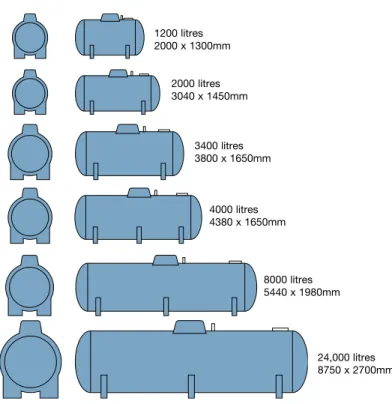
Tanks are available in sizes of 1,200, 2,000, 3,400, 4,000, 8,000 and 24,000 litres for installation above ground; more than one tank can be used in a single installation. Tanks which are installed above ground may require a purpose-built compound which might need to be fenced if the general public has access to the area.
A Calor specialist will advise on the design of the storage compound which consists of a smooth concrete hard-standing covering the area occupied by the tanks and a security fence spaced a minimum of 1500mm from the tank(s) on all sides; the space between the fence and the hard-standing can be concrete or gravel.
All materials used within the compound must offer a fire resistance of at least 2 hours. A wall can be provided as part of the security fence, providing it meets the 2-hour fire resistance requirement and is installed parallel to the longest axis of the tank(s). It is permissible to use two walls but they must be parallel to one another.
For all installations, a water supply will be needed for fire brigade use and a 19mm hose-reel where the storage capacity exceeds 2,000 litres.
Where there is any risk of damage to the installation by road vehicles, suitable crash protection must also be provided.
taNk sitiNg
Table 2.
Maximum off-take rates for standard tank/cylinder sizes
Tank capacity Tank size Maximum off-take rate: Equivalent
(litres) (LxD, mm) (m3/h) heat input (kW/h)
Above-ground tanks 1200 2000x1300 5.66 150 2000 3040x1450 7.10 187 3400 3800x1650 10.00 261 4000 4380x1650 10.20 269 8000 5440x1980 17.56 463 24,000 8750x2700 39.65 1046
Table 4. Separation distances for multi-tank installations
Propane Minimum safety distances Maximum Distance Height capacity) from buildings, boundary, number between of firewall* (litres property line or fixed of tanks tanks (m) (m)
ignition source (m): in group
no firewall with firewall
A B C 1200 3 1.5 5 1 1.4 2000 3 1.5 3 1 1.5 3400 7.5 4 6 1 2 4000 7.5 4 6 1 2 8000 7.5 4 3 1 height of vessel 24,000 15 7.5 6 1.5 height of vessel
* the height of the vessel if greater Table 1.
Gas requirements against appliance heat input Heat input Gas requirement:
(kW/h) (m3/h) (kg/h) 10 0.38 0.72 20 0.76 1.44 30 1.13 2.16 40 1.52 2.88 50 1.89 3.60 70 2.65 5.04 100 3.78 7.19
Table 3. Compound dimensions
Tank capacity Configuration Plinth size Compound size
(litres) (LxW, m) (LxW, m) 1200 single tank 2.5x1.1 5.5x4.1 2 tanks abreast 2.5x3.2 5.5x6.2 2 tanks in-line 6.0x1.1 9.0x4.1 3 tanks abreast 2.5x5.3 5.5x8.3 3 tanks in-line 9.5x1.1 12.5x4.1 2000 single tank 3.2x1.3 6.2x4.3 2 tanks abreast 3.2x3.7 6.2x6.5 2 tanks in-line 7.4x1.3 10.4x4.3 3 tanks abreast 3.2x5.9 6.2x8.9 3 tanks in-line 11.6x1.3 14.6x4.3 4000 single tank 4.9x1.4 7.6x4.4 2 tanks abreast 4.9x3.8 7.6x6.9 2 tanks in-line 10.3x1.4 13.2x4.4 3 tanks abreast 4.9x6.2 7.6x9.2 3 tanks in-line 15.8x1.4 18.8x4.4 4 tanks abreast 4.9x8.6 7.6x11.6 5 tanks abreast 4.9x11.0 7.6x14.0 6 tanks abreast 4.9x13.4 7.6x16.4
Figure 4. Tank sizes
Height (to top of tank hood) x length (mm)
Figure 5. Compound dimensions for vessels from 2500 to 9000 litres
Note: All dimensions are approximate and tank sizes can vary depending on manufacturer. 1200 litres 2000 x 1300mm 2000 litres 3040 x 1450mm 3400 litres 3800 x 1650mm 4000 litres 4380 x 1650mm 8000 litres 5440 x 1980mm 24,000 litres 8750 x 2700mm
With no firewall With firewall
Perimeter Property perimeter A 1 - 1.5m A C A A B A Firewall Building Building A A A C
The supply pipework should be designed by a Calor specialist to ensure it provides an adequate supply of gas and that it conforms to the relevant standards. UKLPG Code of Practice COP 22 provides further information on the design of pipework systems for LPG installations. This is available directly from UKLPG, www.uklpg.org
Pipework safety and safety valves
The vapour pressure in the storage tank is generally about 7 barg at a temperature of 15°C. This must be reduced to a medium service pressure of 0.75 barg. Three valve devices are installed between the storage tank and the intake point at the building in order to control the pressure and to provide an emergency cut-off point:
• first-stage regulator, normally fitted to the vapour connection on the storage tank; reduces the pressure to about 0.75 barg; may also incorporate an over-pressure shut-off (OPSO).
• second-stage regulator, fitted after the first-stage regulator, either at the tank or on the wall of the building; reduces the medium pressure of 0.75 barg to the working pressure of 37 mbarg; includes an OPSO or, in the case of installations which fall under the ‘Gas Safety (Installation and Use) Regulations 1998’, an under-pressure shut-off (UPSO).
• emergency-control shut off. This valve is labelled with isolation instructions and details of Calor’s 24 hours a day, 365 days a year emergency call-out service.
Pipework
Typically, polyethylene (PE) pipe is used underground and galvanised steel pipework above ground.
The service pipework between the tank and the building should be installed in a trench. The pipework should be run directly between the first or second-stage regulator on the outlet of the tank to the customer’s emergency control valve on the outside of the property. The route for the pipe should be as short and direct as possible. PE pipework should not be installed above ground or inside any building. Additionally, pipework must not be run under the footings of a building.
Trench
The trench should provide a minimum of 600mm of cover and not less than 750mm where it passes under roadways or grass verges. These depths can be reduced by placing concrete slabs or tiles approximately 100mm above the pipe. Yellow indicator tape should placed
between 100 and 300mm above the pipe to mark the location of the trench. If the pipe is of polyethylene, it is preferable to specify a metallic-cored indicator tape to help subsequent location of the pipe run.
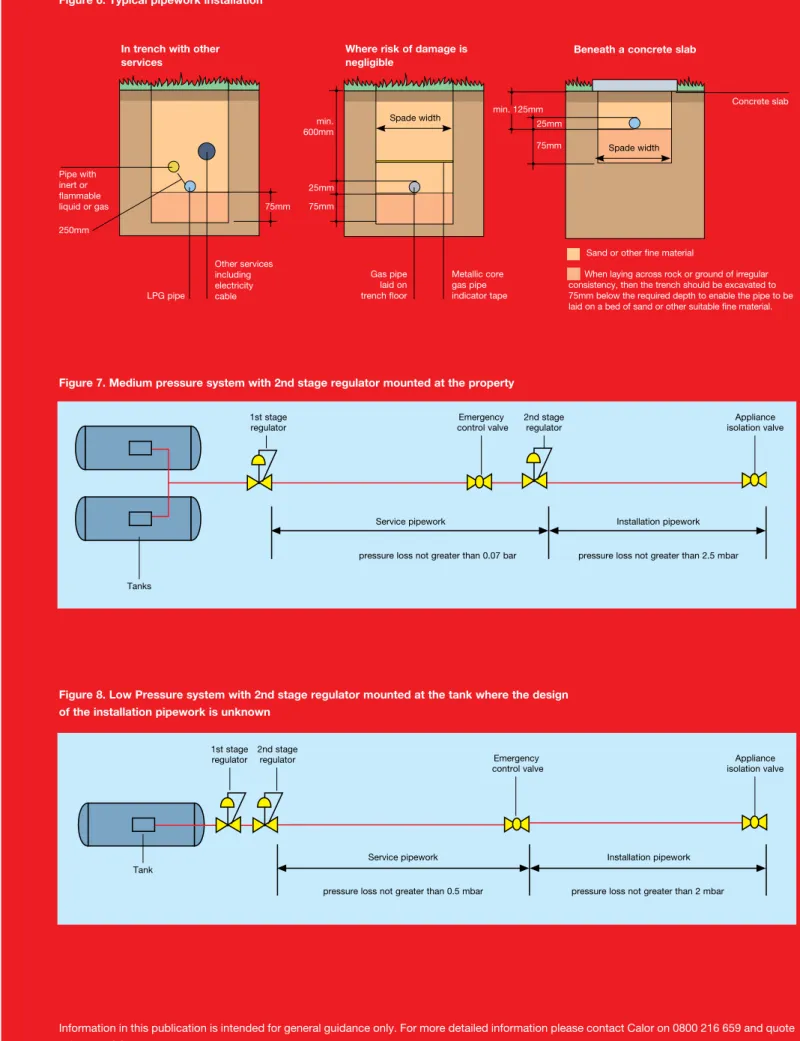
If the LPG supply pipe is to be run in the same trench as other services, the LPG gas supply pipes should be separated by at least 250mm from pipes carrying inert or flammable liquids and gases, and by 250mm from other services, including electric cables (See figure 6).
Pipe sizing
Generally, LPG requires smaller diameter supply pipe than natural gas, and the most commonly used sizes are 25mm and 32mm diameter.
Pressure losses
The majority of LPG appliances operate at an inlet pressure of 37 mbarg. To ensure that this pressure is always available, the pipework diameter must be sufficient to overcome losses inherent in the system. In a typical low-pressure domestic supply, the maximum pressure drop from regulator to appliance inlet should be 2.5 mbarg. (See figure 7 and 8).
As in all supply systems, pressure loss is proportional to the length of the pipe run and is increased by the use of bends, fittings and valves. If the number and type of fittings is not known, a pressure loss figure of 5-10% will normally be sufficient to accommodate an average number of fittings in anything other than the most complex system.
Where pressure loss could be a problem, the installation can be designed using a medium-pressure supply. For a medium-pressure commercial supply, the pipework should be designed for a maximum 0.07 barg pressure loss under full load.
A Calor specialist will advise on the most appropriate pipe sizes for a particular application. Pipe-sizing tables are available on request.
For further information please contact Calor for specialist advice on 0800 216 659 quoting reference COMHEAT.
supply pipework
Figure 8. Low Pressure system with 2nd stage regulator mounted at the tank where the design of the installation pipework is unknown
Figure 7. Medium pressure system with 2nd stage regulator mounted at the property
Service pipework Installation pipework
pressure loss not greater than 0.07 bar pressure loss not greater than 2.5 mbar
Service pipework Installation pipework
pressure loss not greater than 0.5 mbar pressure loss not greater than 2 mbar
Figure 6. Typical pipework installation
Spade width Spade width Gas pipe laid on trench floor Metallic core gas pipe indicator tape 25mm 75mm min. 600mm Other services including electricity cable Pipe with inert or flammable liquid or gas 250mm LPG pipe In trench with other
services Where risk of damage is negligible Beneath a concrete slab
25mm Concrete slab Tank Tanks 1st stage regulator 2nd stage regulator Emergency control valve Appliance isolation valve 2nd stage regulator 1st stage regulator Emergency
control valve isolation valveAppliance
min. 125mm
Information in this publication is intended for general guidance only. For more detailed information please contact Calor on 0800 216 659 and quote reference COMHEAT.
Sand or other fine material 75mm
75mm
When laying across rock or ground of irregular consistency, then the trench should be excavated to 75mm below the required depth to enable the pipe to be laid on a bed of sand or other suitable fine material.
As with any fuel or energy
source, LPG should be
considered in the context of capital cost, running cost and maintenance cost.
Capital cost
In terms of capital cost, an LPG installation will probably be cheaper than laying a natural gas pipeline, and the installation costs are cheaper than oil. Capital costs will be incurred in the construction of the plinth to support the tank, trenching for pipework, excavation for underground tanks, any costs associated with the tank compound and the construction of impact protection around the tanks. The storage tanks are rented from Calor, who retain ownership and are responsible for their maintenance.
Running cost
Actual running costs, compared to other non-mains gas fuels, will depend on the building and site layout and the chosen heating system. It is recommended that Calor is consulted at an early stage to discuss the specific installation.
Maintenance cost
LPG is a cleaner burning, low sulphur fuel and direct maintenance costs will be comparable to those incurred by a natural gas system which are generally low. There will be additional costs associated with the physical maintenance of the tank compound and associated roadway and fencing.
Planning considerations
In certain situations, the local planning authority may require a formal planning application for the installation of LPG storage tanks. There are no special requirements for preparing the application, but the drawing should show the position of the tank in relation to the boundary of the property and any adjacent buildings. Separation distances should be clearly itemised.
A guidance leaflet is available on request.
Building Regulations
In April 2006, major changes to the Building Regulations for England and Wales, including Part L, came into force. The aim of these changes is to reduce carbon emissions from buildings and implement the EU’s Energy Performance of Buildings Directive. The demands are more stringent than in previous Part L documents. The Elemental Method and Target U-value Method has ceased to be a way of showing compliance for new dwellings. The changes require new buildings to meet a target CO2 emission rate. This is calculated
from a computer model which provides a figure for the maximum mass of CO2 permitted to be emitted from the
building according to its floor area. The figure is given in kg/m2 per year, and relates to carbon emissions from
heating, hot water, ventilation cooling and lighting. In the case of existing buildings, the new regulations require improvements to the energy efficiency of the whole building.
Gas, oil and solid fuel all offer significant carbon emissions benefits when compared to electricity. The low carbon emissions of gas, including LPG, allow the building designer more freedom in the construction of the building envelope and insulating materials. Table 5 shows the relative CO2 and carbon emissions for
the common fuels used in heating buildings. Table 5.
CO2 and carbon emissions for the common heating fuels used in buildings.
Emissions: kg CO2/kWh kg carbon/kWh LPG 0.234 0.064 Natural Gas 0.194 0.053 Oil 0.265 0.072 Solid Fuel 0.293 0.086 Electricity 0.422 0.113
Source: Building Regulations Approved Document L2A 2006 Edition
The Code for Sustainable Homes
The Government will be publishing a Code for Sustainable Homes to further increase standards over and above building regulations. The Code will set star ratings for home buyers on the energy efficiency and environmental sustainability of new homes.
The first star rating will be more comprehensive and demanding than current building regulations, and new publicly funded homes will be expected to reach level 3 on the star ratings system, significantly higher than current building regulation standards.
In the proposal document, specific reference is made to homes where mains gas is unavailable. It states there is a ‘strong influence of the choice of fuel for space heating and hot water. Homes unable to use mains gas for space and water heating will have to invest in additional energy efficiency measures or incorporate lower carbon technologies.’
Source: Proposals for Introducing a Code for Sustainable Homes - A Consultation Paper. The Office of the Deputy Prime Minister.
guide to costs, plaNNiNg coNsideratioNs,
buildiNg regulatioNs aNd the code for sustaiNable homes.
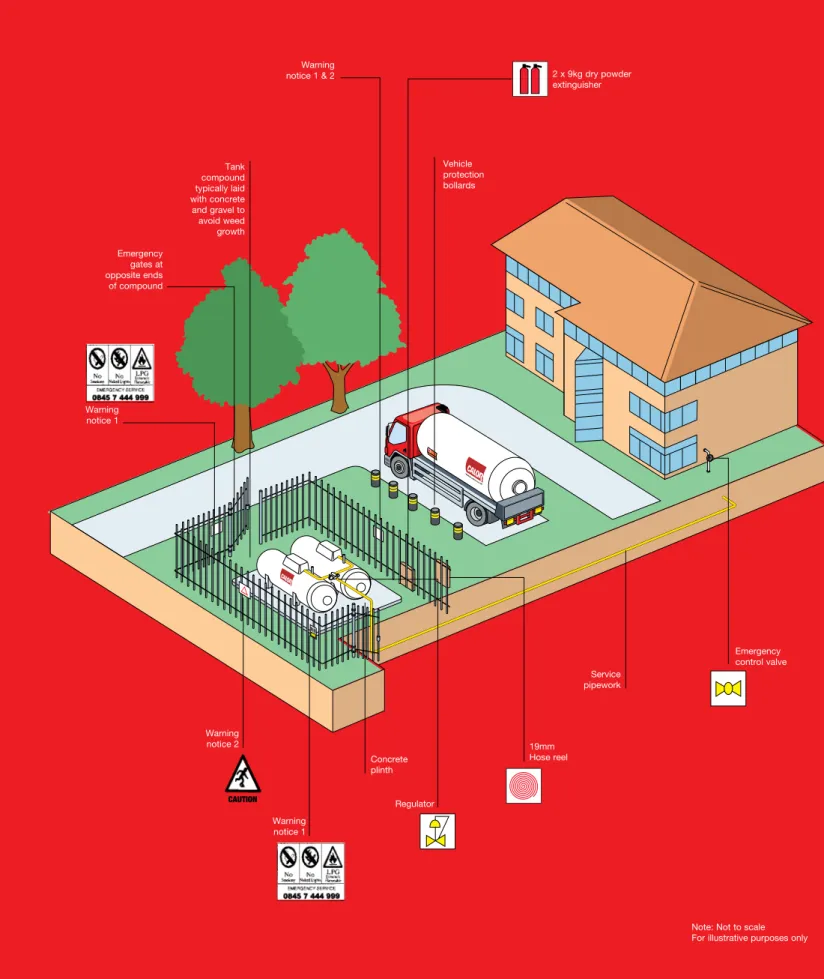
Figure 9. Typical Calor LPG installation layout
Warning
notice 1 & 2 2 x 9kg dry powder
extinguisher Tank compound typically laid with concrete and gravel to avoid weed growth Concrete plinth Vehicle protection bollards Emergency gates at opposite ends of compound Warning notice 2 cautioN Regulator Warning notice 1 19mm Hose reel Emergency control valve Service pipework Warning notice 1
Note: Not to scale For illustrative purposes only
CalorForce was established in 2003 as Calor’s specialist Customer Engineering and Installation Organisation. Since then we have been delivering our expert knowledge and renowned customer care and now operate the largest dedicated LPG technician organisation in the UK.
With increasingly complex and changeable legislation, CalorForce offers understanding and expertise in LPG. Whatever your requirements, you can rest assured your work would be carried out by our highly trained personnel to exact technical and legislative standards.
the CalorforCe Commitment
• CalorForce is the professional and flexible service, working with you to meet your requirements and provide a timetable to suit you
• We fully cost work before starting and provide you with a fixed quotation
• All CalorForce technicians carry ID cards for security purposes and we ensure they are fully qualified for the work undertaken • For complex installations we offer unrivalled technical design capabilities and full project management
• All work is covered by our warranty*
*Subject to Terms and Conditions.
Call CalorForce for:
lPG aPPlianCe inStallation, SerViCinG anD
maintenanCe
We install, service and repair the full range of LPG appliances from large industrial burners to fires and cookers
PiPework inSPeCtion anD teStinG
All gas pipe work requires periodic testing, particularly older installations or those at risk of mechanical damage. We carry out gas-leak detection, safety inspection and pressure testing to all above or below ground LPG pipework. Additionally, underground polyethylene pipes using modern electro-fusion welded joints are installed where required.
bulk anD CylinDer SuPPly inStallationS
We can undertake projects whatever their size, from cylinders to bulk, single or large scale multiple tank installations. For your continued peace of mind, we will continue to carry out service and maintenance work on the installation on an ongoing basis.lanDlorD anD CommerCial CertifiCation
Holiday caravans, mobile homes and permanent buildings used for letting must have a current Landlord Certificate. We are able to carry out all relevant tests and inspections and provide all legislative certification.inStallation, SerViCinG anD
rePair from Calor
Installation • Service • Repair • Pipe Work Inspection • Health & Safety Certification
“Completing 39 installations and associated pipework at five different sites
within five weeks was a tall order. But CalorForce completed the work ahead
of schedule without compromising standards.”
(Peter Gould, consultant to Bourne Leisure)
fuellinG the future.
As responsible businesses, we all have an important role to play in managing our energy requirements and minimising our carbon footprint.
And as an energy provider, we take this responsibility more serious than most. It’s why we invest in the latest energy efficient technologies and why you can trust us to help you save money and energy.
Below you will find a selection of high efficiency appliances fuelled by LPG which are available now.
GhP - GaS heat PumP
• A Gas Heat Pump provides simultaneous heating and cooling. • Sanyo’s Gas Heat Pump can result in heating efficiencies of over 140%
• A Gas Heat Pump can help you reduce your CO2 and NOx
emissions whilst producing 100% heating performance even in severe winter conditions
• Sanyo’s Gas Heat Pump guarantees free hot water at 65 degrees
• A Gas Heat Pump can reduce electricity consumption and demand
ChP - CombineD heat anD
Power unit
• Combined heat and power can deliver overall fuel efficiencies well in excess of 75%
• CHP is an efficient way of producing usable heat and generating electricity
• A CHP can reduce energy costs and deliver significant reductions in harmful greenhouse gases
• A CHP can work with existing fuels that might already be in place, such as LPG
Solar
• Solar thermal technology has less of an environmental impact than traditional water heating systems
• Uses solar collectors or ‘panels’ to harness the energy provided by the sun, converting it to energy to heat water • During periods of low solar gain, a back up fuel needs to be considered. Calor LPG is an ideal back up
Health & Safety
LPG is a non-poisonous flammable gas which is heavier than air. Although precautions must be taken to prevent escaped gas from entering underground chambers or pipe and duct systems, the hazards it presents in use are little different from those associated with natural gas. All work must be undertaken by Gas Safe™ registered
installers, who must also be certified as competent to work on LPG systems by holding the relevant ACS module(s).
The following points should be noted:
• As with any fuel-burning system, it is important that adequate air is provided for combustion and that there is also adequate ventilation. Please note: Ventilation requirements are different to natural gas.
• Like any gas installation, an LPG system should be regularly inspected and serviced to ensure its continued safe operation.
• Storage tanks should be protected from excessive ambient temperatures and a source of water for fire fighting and suitable fire extinguishers should be provided at the storage compound.
• Safe separation distances between any storage tanks and buildings etc must be maintained.
• There must be safe access to allow the storage tank to be installed or removed.
• Storage tanks should not be sited immediately under overhead electric power cables.
Legislation
The ‘Gas Safety (Installation and Use) Regulations 1998’ cover the siting and installation of all gas-burning equipment on premises.
There are requirements for the identification and marking of sites where LPG is stored listed in the ‘Dangerous Substances (Notification and Marking of Sites) Regulations 1990’.
Codes of Practice
Calor has produced a series of safety data sheets covering the use and handling of LPG; see ‘References’, on following page. Copies of these sheets are available on request.
The UKLPG has produced a series of codes of practice dealing with external works and the tank installation. These are available directly from www.uklpg.org
Technical Information
Standards
Calor LPG is either ‘commercial propane’ or ‘commercial butane’ as defined in BS 4250:1997 ‘Specification for commercial butane and propane’.
Composition
Calor liquefied petroleum gas (LPG) is available in the form of either propane (C3H8), with a small amount of
propene and pentane; or butane (C4H10), with smaller
amounts of propane, pentene and pentane. In its natural state, LPG is colourless and odourless; a stenching agent is added during manufacture for safety reasons. Butane is more appropriate to use in portable equipment and leisure appliances and is generally not suitable for commercial and industrial applications.
Identification
When supplied in cylinders, propane cylinders can be identified by their red colour; butane cylinders are blue. Weight
In liquid form, 1957 litres of propane weighs 1 tonne. Density
Propane is roughly one-and-a-half times heavier than air and has a density of 1.85kg/m3. As a liquid, the density
is 512kg/m3.
The liquid to propane gas expansion ratio is 274. Burning properties
Ignition temperature, 460-580°C. Maximum flame temperature, 1980°C. Flammability range, 2-11% gas in air.
Volume of air-to-burn unit volume of gas, 23; the comparable figure for natural gas is 9.6:1 and this means that adequate ventilation is extremely important for combustion efficiency.
The combustion of LPG produces carbon dioxide (CO2) and water vapour. If the combustion air supply is
restricted, carbon monoxide will be produced. Calorific value
At 95MJ/m3, the calorific value of propane is roughly
three times that of commercial natural gas. 1 litre of liquid propane produces 7.1kWh. Chemical reactions
LPG is aggressive to certain non-metallic materials such as natural rubber and some plastics, and hoses and connections must be certified as suitable for use with the gas.
Toxicity
LPG is non-toxic but, at very high concentrations in air, can act as an anaesthetising agent.
Like any gas, it will act as an asphyxiant, at high concentrations, by decreasing available oxygen.
health & safety aNd
techNical iNformatioN
Standards
BS EN 12864:2001 Low pressure, non adjustable regulators having a maximum outlet pressure of less than or equal to 200 mbar, with a capacity of less than or equal to 4kg/h, and their associated safety devices for butane, propane or their mixtures. BS EN 13785:2005 Regulators with a capacity of up to and including 100kg/h, having a maximum nominal outlet pressure of up to and including 4 bar, other than those covered by EN 12864 and their associated safety devices for butane, propane or their mixtures.
BS EN 13786:2004 Automatic change-over valves having a maximum outlet pressure of up to and including 4 bar with a capacity of up to and including 100kg/h, and their associated safety devices for butane, propane or their mixtures BS 4250:1995 Specification for commercial butane and propane.
BS 5482-1:2005 Code of practice for domestic butane - and propane - gas - burning installations. Installations at permanent dwellings, residential park homes and commercial premises, with installation pipework sizes not exceeding DN 25 for steel and DN 28 for corrugated stainless steel or copper. Part 2:2001 Installations in caravans and non-permanent dwellings.
BS 6843 Classification of petroleum fuels. Part 3:1988 Liquefied petroleum gases.
BS 7281:1990 Specification for polyethylene pipes for the supply of gaseous fuels.
BS 7336:1990 Specification for polyethylene fusion fittings with integral heating element(s) for use with polyethylene pipes for the conveyance of gaseous fuels.
BS EN 12818:2002 Inspection and requalification of LPG tanks up to and including 13m3 underground.
Building Regulations
Part L - Dwellings
Approved Document L1A: Conservation of fuel and power (New dwellings) (2006 edition)
Approved Document L1B: Conservation of fuel and power (Existing dwellings) (2006 edition)
Part L - Buildings other than dwellings
Approved Document L2A: Conservation of fuel and power (New buildings other than dwellings) (2006 edition) Approved Document L2B: Conservation of fuel and power (Existing buildings other than dwellings) (2006 edition). Technical standards for compliance with the ‘Building Standards (Scotland) Regulations 1990’ (as amended), Part J: conservation of fuel and power.
Acts of Parliament and Regulations
Climate Change Levy (Electricity and Gas) Regulations 2001 Climate Change Levy (General Amendment) Regulations 2002 Climate Change Levy (General) Regulations 2001
Dangerous Substances (Notification and Marking of Sites) Regulations 1990
Electricity and Gas (Energy Efficiency Obligations) Order 2001
Electricity and Gas Order 2001 Gas Act 1986
Gas Safety (Installation and Use) Regulations 1998. Highly Flammable Liquids and Liquefied Petroleum Gases Regulations 1972.
Pressure Systems and Transportable Gas Containers Regulations 1989.
Health & Safety
Guidance notes chemical safety: Storage and use of LPG at metered estates. CSCS11. London, Health & Safety Executive, 1987.
Safety data sheet: Calor butane. Safety data sheet: Calor propane.
The storage of flammable liquids in containers. HS(G) 51. London, Health & Safety Executive, (date).
Using Calor Gas safely: butane. Using Calor Gas safely: propane.
Codes of Practice
COP 1. Bulk LPG storage at fixed installations. Part 1, Design, installation and operation of vessels located above ground.
COP 1. Bulk LPG storage at fixed installations. Part 2, Small bulk installations for domestic and similar purposes. COP 1. Bulk LPG storage at fixed installations. Part 3, Examination and testing.
COP 1. Bulk LPG storage at fixed installations. Part 4, Buried/mounded LPG storage vessels.
COP 3. Prevention or control of fire involving LPG. COP 15. Valves and fittings for LPG service. COP 22. LPG piping system design and installation.
refereNces
Now you caN get gas
eveN where you caN’t get gas
Ref: 11/09
Calor Gas Limited
Athena House
Athena Drive
Tachbrook Park
Warwick CV34 6RL
For specialist sales advice call 0800 216 659
E-mail: [email protected]
Website: www.calor.co.uk
Information in this publication is intended for guidance only. © Calor Gas LimitedThis brochure has been designed to provide sufficient ‘first stage’ information to allow consultants and others to understand the advantages and implications of using Calor LPG. Calor Gas can take no responsibility for actions taken based on the information contained in this brochure: more detailed information is available on request. It is strongly advised that Calor Gas be consulted on the specific technical detail of a project before proceeding. Call Calor on 0800 216 659 to talk to a specialist.