Chiropractic management of elbow tendinopathy
following a sports related trauma
Jordan A. Gliedt,
DC*Clinton J. Daniels,
DC, MS*** Chiropractic Physician, Private Practice Chandler, AZ, USA
** Chiropractic Physician, Private Practice Brentwood, MO, USA
Corresponding Author: Jordan A. Gliedt, DC Chiropractic Physician, Private Practice 655 S. Dobson Rd., A205
Chandler, AZ 85224 Phone: 480.845.0568 [email protected] ©JCCA 2014
Objective: This report describes chiropractic
management of a case of sub-acute elbow pain and swelling with Active Release Technique® and acupuncture.
Case presentation: A 41-year-old male presented to a chiropractic clinic with a primary complaint of elbow pain and swelling following a fall while playing basketball five weeks prior.
Intervention and Outcome: Treatment consisted of two sessions of needle acupuncture and one treatment of Active Release Techniques® (ART) applied to the left elbow region.
Conclusions: The patient’s outcomes indicated a quick resolution of subjective complaints and objective findings with the chosen treatment. Further research is needed to demonstrate safety, clinical effectiveness, and cost effectiveness when compared to other treatments.
(JCCA 2014;58(1):52-57)
k e y w o r d s: chiropractic, acupuncture, Active
Release Techniques (ART)®, elbow pain
Objectif : Ce rapport décrit la gestion chiropratique
d’un cas de douleur subaiguë et de gonflement au coude grâce à la technique Active Release TechniqueMD et à
l’acupuncture.
Exposé de cas : Un homme de 41 ans s’est
présenté à une clinique de chiropratique se plaignant principalement de douleurs et de gonflement au coude à la suite d’une chute lors d’un match de basketball cinq semaines auparavant.
Intervention et résultat : Le traitement consistait en
deux séances d’acupuncture et d’un traitement par la technique Active Release TechniqueMD (ART) appliquée à
la région du coude gauche.
Conclusions : Les résultats indiquent une résolution
rapide des plaintes subjectives du patient et des constatations objectives grâce au traitement choisi. D’autres recherches s’imposent pour démontrer l’innocuité, l’efficacité clinique et la rentabilité de cette méthode par rapport à d’autres traitements.
(JCCA 2014;58(1):52-57)
m o t s c l é s : chiropratique, acupuncture, Active
Introduction
Forearm extensor tendinopathy is commonly seen be-tween the fourth and fifth decades of life, with higher in-cidence in men than women, and more commonly of the dominant arm.1,2 The onset of symptoms predominately
arises from repetitive movement with wrist extension and alternating pronation and supination of the forearm. It is likely to be a self-limiting pathology and approximately 80% of patients newly diagnosed report improvement at one year.1,2 An estimated 4-25% of patients are
non-responsive to conservative management and will require surgical intervention.1,2 Recognized poor prognostic
fac-tors for non-operative care include manual labor, dom-inant arm involvement, long duration of symptoms with high baseline pain levels, and poor coping strategies.3
Pathology of the extensor tendon is thought to origin-ate with the extensor carpi radialis brevis (ECRB) and may additionally incorporate the extensor carpi radialis longus (ECRL), and extensor carpi ulnaris (ECU) mus-cles. Upon suffering a tendinopathy injury, these tendons appear to undergo a degenerative process characterized by immature fibroblasts, the appearance of nonfunctional vascular buds and the presence of disorganized collagen.4
The purpose of this report is to describe the success-ful chiropractic management of a case of elbow pain and swelling. This case appears to be the result of a sports related trauma as opposed to an overuse mechanism.
Case
A 41-year old-Caucasian male presented with a primary complaint of generalized left elbow pain and swelling. The complaint began approximately five weeks prior fol-lowing a fall while playing basketball. The patient de-scribed tripping and falling forward, landing on his left elbow, pointing to his left olecranon process. Medical consultation was sought at an orthopedic medical phys-ician’s office a few days following the injury. At that time, plain film radiographs were performed on the left elbow, revealing no abnormal findings and no treatment was rendered. Despite self-administered massage and use of non-specified over-the-counter non-steroidal anti-inflam-matory medication, he continued to experience pain and swelling around the left elbow joint. He denied any sensa-tion of numbness, tingling, burning, night time pain and/ or muscles weakness. The patient described his elbow pain as a dull ache with the pain rated 5/10 on a numerical
pain rating scale. The patient further described his com-plaint as constantly “bothersome” on a daily basis and preventing him from engaging in pain-free recreational athletic activities, particularly basketball. The patient expressed that all activities that engaged his left elbow intensified his pain. The patient additionally noted a sec-ondary complaint of minimal pain in the mid-back that began soon after the described fall. The patient failed to describe this complaint on a numerical pain rating scale. Review of past medical, health and family histories re-vealed no previous history of related complaints, no addi-tional co-morbidities or addiaddi-tional items of note.
Physical examination revealed postural forward rota-tion of the shoulders bilaterally, a moderate decrease in left elbow extension due to pain, a moderate restriction in movement with thoracic spine flexion, extension and rotation bilaterally, and normal upper extremity deep ten-don reflexes and muscle strength testing. Static palpation of the left elbow region revealed multiple areas of tender-ness in the common wrist extensor muscles just distal to their insertion site. Static palpation of the thoracic spine revealed hypertonic erector spinae musculature bilateral-ly in the regions of T3-T8. Motion palpation of the thor-acic spine revealed a lack of motion in the sagittal plane at the T3-4 and T6-7 vertebral motor units. Provocative testing revealed pain at the left lateral epicondyle upon resisted wrist extension (Cozen Test), and was unremark-able for resisted wrist flexion, varus and valgus stress testing of the left elbow. Marked swelling about the left elbow was noted particularly at the olecranon process and common wrist extensor musculature. He was diagnosed with sub-acute left elbow tendinopathy and thoracic spine segmental dysfunction secondary to a low-impact trauma. Upon completion of examination, four acupuncture needles were superficially inserted into palpated areas of tenderness, just distal to the insertion site of the common wrist extensor muscles, for fifteen minutes. High velocity, low amplitude (HVLA) spinal manipulation was applied to the thoracic spine, with treatment area based upon re-stricted movements found in the examination. A home exercise program consisting of Brugger’s exercises (A description of Brugger’s exercises is beyond the scope of this paper and is described elsewhere)5 were given to
follow-up session, the patient reported his swelling to have drastically reduced. The patient rated his elbow pain at a 1/10 on a numerical pain rating scale. He indicated that he had not yet attempted to engage in recreational athletic activities since the prior visit, but felt like he could do so with minimal pain. Physical examination revealed min-imal swelling and hypertonicity of the left wrist extensor muscles. Static palpation of the left elbow region revealed multiple areas of tenderness in the common wrist extensor muscles just distal to their insertion site. Four acupuncture needles were superficially inserted into the left elbow just distal to the insertion site of the common extensor muscles for fifteen minutes. Additional treatment was administered consisting of the Active Release Techniques (ART)® wrist extensor group protocol, incorporating the extensor carpi ulnaris, extensor digiti minimi, and extensor digitorum muscles. Status post-treatment left elbow swelling and left wrist extensor muscle hypertonicity was decreased and the patient reported no pain. The patient was instructed to re-turn for follow-up upon rere-turn of swelling or on as needed basis. Further treatment was not administered to the thor-acic spinal region due to a lack of related subjective and objective findings at time of the follow-up visit.
The patient was contacted via telephone for follow-up at one week and six weeks post-treatment and reported no symptoms and full function of the left elbow. He reported a return to normal recreational athletic activities including basketball.
Discussion
The differential diagnosis in lateral elbow pain includes lateral epicondylitis, radial tunnel syndrome, occult frac-ture, lateral synovial plica, injury to the lateral collat-eral ligament, and radiohumcollat-eral joint disease (synovitis, osteoarthritis).4 A thorough workup of the patient with
lateral elbow pain should include provocative testing, orthopedic maneuvers, neurological examination, neuro-dynamic testing, and when clinically indicated diagnostic imaging.
Provocative testing of elbow injuries should include Mill’s, Cozen’s, Varus/Valgus and Milking Maneuver. Mill’s test is performed by palpating the lateral epi-condyle and passively pronating the patient’s forearm, flexing the wrist fully, and extending the elbow. Pain over the lateral epicondyle of the humerus indicates a positive test for lateral epicondylitis.6 Cozen’s test is perfomed by
asking the patient to actively make a fist, pronate the fore-arm, and radially deviate and extend the wrist while the examiner resists the motion. A sudden severe pain in the area of the lateral epicondyle of the humerus is a positive sign for lateral epicondylitis.6 Valgus and varus testing
of the elbow alternatively stresses the medial and lateral collateral ligaments respectively. The patient’s elbow is flexed to 20 to 30 and stabilized with the examiners hand, a varus force is applied to test the lateral collateral liga-ment or a valgus force is applied to test the medial collat-eral ligament.6 Milking Maneuver is an additional test for
the medial collateral ligament. It consists of the patient sitting with the elbow flexed to 90 degrees or more and the forearm supinated. The examiner grasps the patient’s thumb under the forearm and pulls it imparting a valgus stress to the elbow. Reproduction of symptoms indicates a positive test and a partial tear of the medial collateral liga-ment.6 If the examiner suspects neurological involvement
it would be wise to continue provocative movements with neurodynamic testing.7
Therapeutic modalities for lateral elbow pain vary widely and lack definitive evidence.8 Non-steroidal
anti-inflammatory drugs (NSAIDs) and corticosteroid injec-tions have traditionally been used for the management of these patients. However, they have not been shown to be more effective than watchful waiting in the long-term.9,10
Studies using NSAIDs to treat individuals who have a ten-dinopathy show minimal, if any, improvement in pain.11
Based on a meta-analysis of physical interventions for lateral epicondylitis, exercise, manipulation techniques (including cross-friction massage), and acupuncture have shown significant short-term relief.9 The same
meta-an-alysis indicated that forearm strapping, taping, laser ther-apy, extracorporeal shock wave therther-apy, electromagnetic field and ionization, ultrasound, and phonophoresis either did not demonstrate a significant effect or showed an in-consistent effect on outcomes.9
A combination of acupuncture, ART® and spinal
ma-nipulation seemed to have been effective at resolving the patient’s complaints and allowing him to return to normal activities. Traditional acupuncture theory acknowledges the notion of qi, described as life force or energy. There-fore, treatments seek to recognize energetic imbalances and attempt to restore the identified disharmonies.12
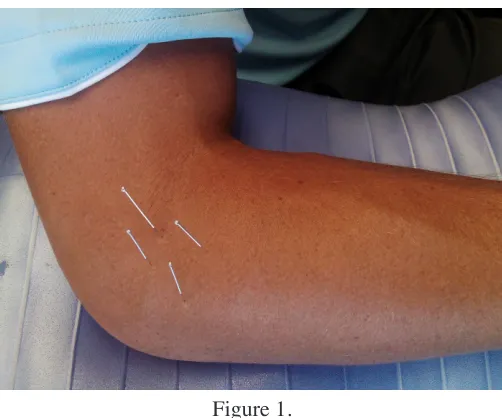
control the flow of qi throughout the body. Traditional theory holds that restoration of energy flow subsequently encourages healing and decreases symptoms. For local-ized problem areas, a technique known as “surround the dragon” is commonly implemented. In this case, the “sur-round the dragon” technique was utilized. (Figure 1) This technique is performed by first palpating the area, particu-larly local “ah shi” or tender points, and stimulating the sites of tenderness. Studies have attempted to understand the physiological mechanisms to explain the benefits ap-preciated following acupuncture. Multiple theories on the analgesic mechanism of action have been concluded, in-cluding such theories as: release of endogenous opioids, stimulation of descending anti-nociceptive pathways, re-lease of inhibitory neurotransmitters such as norepineph-rine and serotonin, release of beta-endorphins, deactiva-tion of multiple limbic areas subserving pain associadeactiva-tion, modulating the hypothalamic-limbic system, activation of the pain neuromatrix, and placebo.13-15 Acupuncture
has also been shown to initiate other systemic behaviors such as regulating central and peripheral blood distribu-tion and microcirculadistribu-tion.16-18 However, the mechanisms
of these actions are yet to be fully understood.
ART® is described as a hands-on touch and case-man-agement system that allows a practitioner to diagnose and treat soft-tissue injuries. This therapy is based on the ob-servation that the anatomy of the forearm has traversing tissues situated at oblique angles to one another that are prone to reactive changes producing adhesions, fibrosis and local edema and thus pain and tenderness.19, 20 During
ART® therapy, the clinician applies a combination of deep digital tension at the area of tenderness and the patient act-ively moves the tissue through the adhesion site from a shortened to a lengthened position.19 It is performed by
ap-plying a specific contact to the effected tissue and taking the tissue from a shortened position to a fully lengthened position while contact passes longitudinally along the soft tissue fibers.21 In this case, in order to treat the wrist
exten-sor group, the clinician applies proximal tension distal to the lateral epicondyle while the patient extends the elbow and pronates and flexes the wrist.21 (Figure 2) This
proced-ure is conducted several times until the practitioner sub-Figure 1.
Four acupuncture needles were superficially inserted into the common wrist extensor musculature region just distal to the lateral epicondyle. Two sessions of acupuncture were completed in this fashion for fifteen
minute duration. One session of Active Release TechniquesFigure 2. ® wrist common
jectively determines the tissue is moving properly and the adhesions are no longer palpated.20 To date, there is little
data regarding outcomes of ART® management of soft-tissue injury and no models describing the mechanism of action of this therapy has been established.22
HVLA spinal manipulation is an intervention com-monly administered by chiropractors with the goal of restoring proper joint function and decreasing pain. In this case, HVLA manipulation was administered to the thoracic spine. Spinal manipulation is performed by ap-plying a small thrust of specific magnitude in a controlled fashion to a targeted spinal joint. Although the mechan-ism of spinal manipulation has yet to be fully understood, data suggests the use of spinal manipulation as an option for the management of different types of spine related disorders, particularly of cervical and lumbar origin.23-25
According to a 2010 report by Bronfort et al, spinal ma-nipulation is considered inconclusive, yet favorable, for the management of mid-back pain.23
Although some studies have been conducted concern-ing acupuncture and manual therapies, such as Active Re-lease Techniques (ART)®, for the management of certain musculoskeletal conditions, there is a lack of data regard-ing their use in sub-acute pain and swellregard-ing followregard-ing low-grade trauma. In this case, the patient reported a sub-stantial decrease in subjective symptoms and objective findings following one visit and full relief of symptoms following the second visit. No adverse effects were re-ported and the patient was able to gain sustained resolu-tion of his condiresolu-tion within approximately one week of initial presentation to a chiropractic office. This case of-fers support for the use of chiropractic related therapies for the management of sub-acute elbow pain and swelling following a low-grade sports related trauma. To the best of our knowledge this is the first report describing a com-bination of acupuncture needling and active release tech-nique for the treatment of elbow pain and tendinopathy.
Limitations
A fault of this study is a lack of objective outcome meas-urements throughout the case. The treatment was multi-modal and there is no way to determine the extent to which any individual treatment modality may or may not have contributed to the perceived beneficial outcome. The findings from one case may not necessarily be applicable to others.
Conclusion
A case is presented with sub-acute elbow pain and swell-ing followswell-ing a sports related trauma. The patient’s clin-ical outcomes indicated a quick resolution of subjective complaints and objective findings with the chosen treat-ment. Further research in the form of additional case re-ports, case series, and clinical trials need to be performed to demonstrate the safety, clinical efficacy, and cost ef-fectiveness of Active Release Techniques and acupunc-ture when compared to other treatments.
Consent
Written informed consent was obtained from the patient for publication of this case report. A copy of written con-sent is available for review by the Editor-in-Chief of this journal.
Authors’ Contributions
JG cared for the patient, performed the literature review, and prepared the manuscript. CD performed the literature review and assisted in preparation of the manuscript. Both author’s read and approved the final manuscript.
References
1. Verhaar JA. Tennis elbow. Anatomical, epidemiological and therapeutics aspects. International Orthopaedics. 1994; 18(5):263-267.
2. Hamilton PG. The prevalence of humeral epicondylitis: a survey in general practice. J Royal College of General Practitioners. 1986;36(291):464-465.
3. Haahr JP, Anderson JH. Prognostic factors in lateral epicondylitis: a randomized trial with one-year follow-up in 266 new cases treated with minimal occfollow-upational intervention or usual approach in general practice.
Rheumatology (Oxford, England). 2003;42(10):1216-1225. 4. Villaseñor-Ovies P, Vargas A, Chiapas-Gasca K, Canoso
JJ, Hernández-Díaz C, Saavedra MÁ, Navarro-Zarza JE, Kalish RA. Clinical anatomy of the elbow and shoulder. Reumatol Clin. 2012;8(S2):13-24.
5. Liebenson, C. Rehabilitation of the Spine: A Practitioner’s Manual. 2nd Ed. Lippincott, Williams & Wilkins;
Baltimore: 2007.
6. Magee D. Orthopedic Physical Assessment. 5th Ed.
Elsevier; St.Louis: 2008.
7. Shacklock, M. Clinical Neurodynamics: A new system of musculoskeletal treatment. Elsevier, Butterworth, Heinemann; London: 2005.
9. Bisset L, Paungmali A, Vincenzino B, Beller E. A systematic review and meta-analysis of clinical trials on physical interventions for lateral epicondylalgia. Br J Sports Med. 2005;39:411-22.
10. Bisset L, Beller E, Jull G, Brooks P, Darnell R,
Vicenzino B. Mobilization with movement and exercise, corticosteroid injection, or wait and see for tennis elbow: randomized trial. BMJ Clinical Research. 2006;333(7575):939.
11. Magra M, Muffulli N. Nonsteroidal anti-inflammatory drugs in tendinopathy. Clin J Sports Med. 2006;16:1-3. 12. Council of Colleges of Acupuncture and Oriental
Medicine. Frequently Asked Questions. (Accessed 2 May 2013). <http://www.ccaom.org/faqs.asp#1>
13. Biella G, Sotgiu ML, Pellegata G, Paulesu E, Castiglioni I, Fazio F. Acupuncture produces central activations in pain regions. Neuroimage. 2001;14:60-66.
14. Wu MT, Sheen JM, Chuang KH, Yang P, Chin SL, Tsai CY, Chen CJ, Liao JR, Lai PH, Chu KA, Pan HB, Yang CF. Neuronal specificity of acupuncture response: a fMRI study with electroacupuncture. Neuroimage. 2002;16:1028-1037.
15. Pomeranz B, Stux G. Scientific Bases of Acupuncture. Springer Verlag; Berlin: 1989. pp. 1-199.
16. Pomeranz B. Edited by Stux G. Springer Verlag; Berlin: 1987. Acupuncture Research Related to Pain, Drug Addiction and Nerve Regeneration, Scientific Bases of Acupuncture; pp. 35-52.
17. Chen YS, Yao CH, Chen TH, Lin JG, Hsieh CL, Lin CC, Lao CJ, Tsai CC. Effect of acupuncture stimulation on peripheral nerve regeneration using silicone rubber chambers. Am J Chin Med. 2001;29:377-385.
18. Sheng-Hsiung Hsiao, Li-Jen Tsai. A neurovascular transmission model for acupuncture-induced nitric
oxide. J Acupuncture and Meridian Studies – September 2008;1(1): 42-50. DOI: 10.1016/S2005-2901(09)60006-6). 19. Schiottz-Christensen B, Mooney V, Azxad S, Selstad D,
Gulick J, Bracker M. The role of active release manual therapy for upper extremity overuse syndromes – a preliminary report. J Occup Rehab. 1999;9(3)201-211. 20. Mooney V. Overuse syndromes of the upper extremity:
rational and effective treatment. J Musculoskeletal Med. 1998;15(8):11-18.
21. Leahy PM. Active Release Techniques ®Soft Tissue Management System for the Upper Extremity – 2nd
Edition. 2008. pp. 7, 20, 158.
22. Howitt SD. Lateral epicondylosis: a case study of conservative care utilizing ART and rehabilitation. J Can Chiro Assoc. 2006;50(3):182-189.
23. Bronfort G, Haas M, Evans R, Leininger B, Triano J. Effectiveness of manual therapies: the UK evidence report. Chiropr Osteopat. 2010 Feb 25;18:3. doi: 10.1186/1746-1340-18-3.
24. Bronfort G, Evans R, Anderson AV, Svendsen KH, Bracha Y, Grimm RH. Spinal manipulation, medication, or home exercise with advice for acute and subacute neck pain: a randomized trial. Ann Intern Med. 2012 Jan 3;156(1 Pt 1):1-10. doi: 10.1059/0003-4819-156-1-201201030-00002.