The Institute of Musculoskeletal Health
and Arthritis (IMHA)
Knowledge Exchange Task Force:
An Innovative Approach to Knowledge Translation
Mary Brachaniec
William Tillier
Flora Dell
Contact: Elizabeth Robson, CIHR – Institute of Musculoskeletal Health and Arthritis, Department of Surgery, Heritage Medical Research Building, University of Calgary, 3330 Hospital Drive, NW, Calgary, AB, T2N 4N1. Telephone (403) 320-0068.
Mary Brachaniec Member of the IMHA/Knowledge
Exchange Task Force Member, Canadian Arthritis Patient
Alliance and Cochrane Consumer Network
Executive Member, Programs and Services Chair, Board of Directors,
The Arthritis Society New Brunswick Division Moncton, New Brunswick, Canada
William Tillier
Member of the IMHA/Knowledge Exchange Task Force
Member, Medical and Scientific Advisory Committee,
Muscular Dystrophy Canada Psychologist, Ministry of the Solicitor
General and Public Security Province of Alberta Calgary, Alberta, Canada
Flora Dell
Chair, Knowledge Exchange Task Force Member, IMHA Advisory Board Executive Member, Canadian Centre for
Activity and Aging, University of Western Ontario Member, Board of Directors, Canadian
Arthritis Network
Recipient of Queens Golden Jubilee Award
This article will introduce the concept of Knowledge Translation (KT), as defined and used by the Canadian Institutes of Health Research (CIHR). The Institute of Musculoskeletal Health and Arthritis (IMHA), one of the 13 institutes under the umbrella of CIHR, has created the Knowledge Exchange Task Force (KETF) to research KT and to determine how to best develop and implement KT initiatives within the Canadian research milieu. Task Force goals, objectives and activities will be outlined and summarized in poster form. KETF Members, or Research Ambassadors, will be recognized, along with the names of their Parent Organizations. The paper will detail the process of KT, as defined by CIHR, and a promising KT project created by IMHA to build communication pathways between scientific researchers, consumers and multiple stakeholders with the ultimate goal of improving the quality of life of all Canadians.
(JCCA 2006; 50(1): 8–13)
k e y wo r d s: Knowledge Translation (KT), chronic pain, Canadian Institutes of Health Research (CIHR), The Institute of Musculoskeletal Health and Arthritis (IMHA).
Introduction
Current medical research is exceedingly complex and in-creasingly difficult to access for other researchers, for health care workers and for patient and client groups. In light of this, a movement to translate research knowledge into more understandable and useful terms has recently begun. Knowledge translation, as it is generally known, represents the broad array of activities that take place be-tween the researcher and his/her creation of new knowl-edge, and its beneficial impact on Canadians.
The Canadian Institutes of Health Research (CIHR)
Created by the Government of Canada in June of 2000, the Canadian Institutes of Health Research (CIHR) is the premier health research funding agency in Canada. CIHR’s mandate is “To excel, according to international-ly accepted standards of scientific excellence, in the crea-tion of new knowledge and its translacrea-tion into improved
health for Canadians, more effective health services and products and a strengthened Canadian health care sys-tem”.1
Knowledge Translation includes all steps between cre-ation of new knowledge and its appliccre-ation to yield bene-ficial outcomes for society.2
CIHR defines Knowledge Translation (KT) as “ the ex-change, synthesis and ethically-sound application of knowledge – within a complex system of interactions among researchers and users – to accelerate the capture of the benefits of research for Canadians through im-proved health, more effective services and products, and a strengthened health care system.”2
There is currently a large gap between “what we know” and “what we do.” Knowledge Translation aims to reduce, and ultimately close, this gap by facilitating in-formation sharing between the creators of new knowl-edge (researchers) and those who apply and benefit from this knowledge (end-users).
KT strategies help to define the research question and hypotheses, determine how the research will be done (methods), conduct the research itself, interpret new knowledge gained and determine how to best disseminate it to multiple stakeholders.2 Strategies vary for different
types of research (i.e., biomedical versus clinical) and different groups of intended end-users such as patients/ consumers, health care professionals, policy makers and other researchers.2
CIHR supports research on KT concepts and process-es, contributes to building KT networks of researchers and research users, seeks to strengthen and expand both KT and KT research, and supports and recognizes KT ex-cellence.2
The Institute of Musculoskeletal Health and Arthritis
The Institute of Musculoskeletal Health and Arthritis (IMHA), one of the thirteen institutes under the umbrella of CIHR, “is the champion and primary source of fund-ing for Canadian health research across six foci: arthritis, musculoskeletal rehabilitation, bone, skeletal muscle, skin and oral health”.3
IMHA’s vision is to sustain health and enhance quality of life by eradicating the pain, suffering and disability caused by arthritis and musculoskeletal, oral and skin conditions.
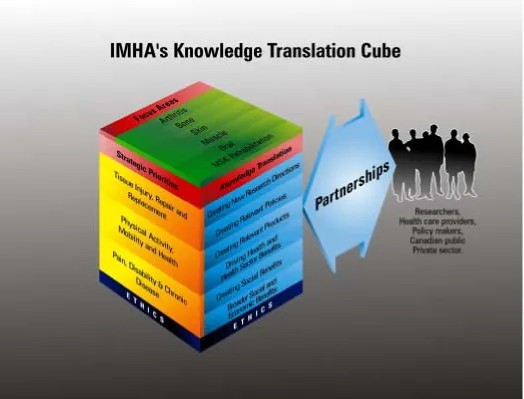
strate-gic research priorities that guide all of its initiatives: • Physical Activity, Mobility and Health;
• Tissue Injury, Repair and Replacement; and • Pain, Disability and Chronic Disease.
IMHA recognizes that strategic and effective research requires an active dialogue between those who conduct investigations (researchers) and the end-users/stakehold-ers who consume and fund them. This dialogue does not just happen – it requires a forum in which the various stakeholders can interact; a “shared language” in which
they can communicate; and dissemination strategies for information sharing to a wider audience. To set this proc-ess in motion, and in response to CIHR goals, IMHA has recently created the Knowledge Exchange Task Force (KETF).
The Knowledge Exchange Task Force
The Task Force is comprised of national representatives from IMHA’s six focus areas – most of whom are patients and consumers of health care. In joining the Task Force, these individuals became Research Ambassadors of KT
within the Institute. Current members and the organiza-tions in which they represent are presented at the end of this article.
The KETF brings researchers, patients, and other stakeholders such as health care professionals and stu-dents together to share and discuss current research either completed or underway. In so doing, KETF members learn about research carried out by IMHA researchers , and seek to translate the knowledge gained into language and approaches suitable for dissemination within their own organizations, with other stakeholders and ultimate-ly, with the Canadian Public as a whole. The end-user be-comes an active research partner in the promotion and implementation of the research and its conclusions.
In addition to translating information gained through research to Canadians, the KETF also assists in the iden-tification of research priorities of primary importance to the groups they represent. This process helps to ensure that IMHA supports research that addresses the needs of Canadians.
Knowledge Translation is an integral component of the overall strategic plan and priorities identified by IMHA.
FIGURE 1 Source: IMHA 2005
Under the guidance of IMHA’s Scientific Director, Dr. Cyril Frank, the KETF is led by IMHA Advisory Board member, Mrs. Flora Dell. The first meeting took place November, 2004, and subsequent meetings have followed bi-annually. Activities to date have focused on research relating to chronic, non-malignant pain and its manage-ment. The Task Force has been privileged to hear presen-tations from several CIHR researchers including: Dr. Sandra LeFort (Chronic Pain Self-Management: Results of Two Research Studies), Dr. James Henry (Pain & Chronic Pain: Basic Principles & Exciting Developments in Canada), Dr. Alex Jadad (Rebuilding Public Trust in Medical Research: What Can We Do?) and Dr. Lynne Breau (Inter-Disciplinary Team Management for Chil-dren with Chronic Pain).
KETF meetings provide an opportunity for Research Ambassadors to share “best practices” relating to KT and plan future activities. Efforts were enhanced when the Directors and Managers of the parent organizations rep-resented by Research Ambassadors attended the most
re-cent KETF meeting. These individuals brought forward many insights and recommendations for improving our Knowledge Exchange activities with plans already under-way for their implementation. CIHR – IMHA Trainees (Research Students) also attended the last meeting and contributed fresh ideas to further our goals. These stu-dents learned a great deal about the process of KT which will serve them well in their careers and in creating dia-logues with groups such as this one.
Possible future steps for the Task Force include: • Adding stakeholders such as policy makers;
• Expanding topics to include research relating to physi-cal activity;
• Carrying out research on KT possibly through the CIHR - Community Alliances for Health Research (CAHR) Program
Conclusion
Knowledge translation will quickly become an indispen-sable tool with the potential of increasing the impact of new knowledge on the health of Canadians. It will also enable a wider audience of both professional and lay stakeholders (primarily clinicians and patients) to access, understand and draw conclusions based upon complex re-search findings. Canada is leading the way in this effort though the efforts of IMHA’s Knowledge Exchange Task Force. The current focus on chronic non-malignant pain should be of interest to Canadian Chiropractors.
For more information on IMHA – KETF please see our poster presentation (on pp 12), previously presented at the IV Canadian Cochrane Symposium, Montreal, Cana-da, December, 2005.
Currently, the KETF is comprised of the following indi-viduals:
Nicola Birchall – The Canadian Paraplegic Association Blair Boudreau – Group of IX - A Nova Scotia Seniors’ Organization (Oral Health)
Mary Brachaniec – The Arthritis Society and the Canadi-an Arthritis Patient AlliCanadi-ance
Priscilla Cole – Osteoporosis Canada Barbara Grimster – Lupus Canada
Phil Hughes – Group of IX - A Nova Scotia Seniors’ Organization (Oral Health)
Gezina Ilse – Osteoporosis Canada
Maria Judd – Canadian Health Services Research Foun-dation
Otto Kamensek – Arthritis Research Centre
Diane Ladouceur – Active Living Coalition for Canadi-ans with a Disability
Linda Li – Canadian Physiotherapy Association Pam Sherwin – Children’s Arthritis Foundation William Tillier – Muscular Dystrophy Canada
Regina Willmann – Canadian Chiropractic Association Flora Dell – KETF Chair, IMHA Advisory Board Member
Erna Snelgrove-Clarke – KETF Vice-Chair, IMHA Advi-sory Board Member
Elizabeth Robson – KETF Project Staff Lead
For more information please contact the Institute of Mus-culoskeletal Health and Arthritis by e-mail at [email protected] or visit our website at http://www.cihr-irsc.gc.ca/e/13217.html .
References
1 Canadian Institutes of Health Research (CIHR) [homepage on the Internet]. Ottawa: Her Majesty the Queen in Right of Canada; c2004 [modified: 2005-02-14; cited 2006 January 4] Available from http://www.cihr-irsc.gc.ca/e/24418.html 2 Canadian Institutes of Health Research (CIHR) [homepage
on the Internet]. Ottawa: Her Majesty the Queen in Right of Canada; c2004 [modified: 2005-02-14; cited 2006 January 4] The CIHR Knowledge Translation Strategy 2004 – 2009; [about 8 screens]. Available from http://www.cihr-irsc.gc.ca/ e/26574.html.
3 Canadian Institutes of Health Research, Institute of Muscu-loskeletal Health and Arthritis, [homepage on the Internet]. Calgary: Institute of Musculoskeletal Health and Arthritis; c2005 [modified: 2005-06-22; cited 2006 January 4]. Annu-al Report of Activities 2003-2004; [about 10 screens]. Avail-able from http://www.cihr-irsc.gc.ca/e/28339.html