
Mapping and QTL analysis of the barley population Chebec × Harrington
6
0
0
Full text
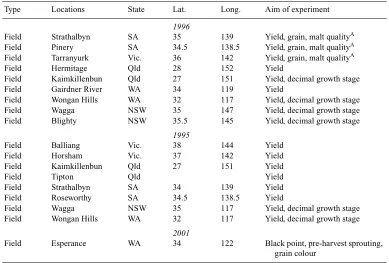
(2) 1126. Australian Journal of Agricultural Research. Table 1.. A. R. Barr et al.. Comparison of Chebec and Harrington for key traits when grown under South Australian conditions. Trait type Malt. Disease Plant type. Grain size. Phenotype. Chebec. Extract Diastatic power Viscosity β-amylase isoform Post harvest dormancy Cereal cyst nematode Spot form net blotch Stature Spikelet Bvp Early growth Size. Moderate Low Low SD2L Low. High Very high Low SD1 Very low. Resistant Moderate seedling resistance Moderately tall 2 row Short Erect Moderately large (av. 48 mg). Susceptible Susceptible Tall 2 row Long Erect Moderately small (av. 42mg). provide seed for the South Australian and National Barley Molecular Marker Program (a nationally coordinated and funded program in Australia) field experiments in the period 1994–96. One hundred and twenty individuals were chosen for map construction and phenotyping. Table 1 shows the comparison of Chebec and Harrington for key traits when grown under South Australian conditions.. Table 3.. Harrington. Table 2.. Markers used in construction of maps. Marker type. Numbers. AFLP RFLP SSR Other Total. 47 258 41 2 348. Experiments conducted with the Chebec × Harrington population. Type. Locations. State. Lat.. Long.. Aim of experiment. Field Field Field Field Field Field Field Field Field. Strathalbyn Pinery Tarranyurk Hermitage Kaimkillenbun Gairdner River Wongan Hills Wagga Blighty. SA SA Vic. Qld Qld WA WA NSW NSW. 1996 35 34.5 36 28 27 34 32 35 35.5. 139 138.5 142 152 151 119 117 147 145. Yield, grain, malt qualityA Yield, grain, malt qualityA Yield, grain, malt qualityA Yield Yield, decimal growth stage Yield Yield, decimal growth stage Yield, decimal growth stage Yield, decimal growth stage. Field Field Field Field Field Field Field Field. Balliang Horsham Kaimkillenbun Tipton Strathalbyn Roseworthy Wagga Wongan Hills. Vic. Vic. Qld Qld SA SA NSW WA. 1995 38 37 27. 144 142 151. 34 34.5 35 32. 139 138.5 117 117. Yield Yield Yield Yield Yield Yield Yield, decimal growth stage Yield, decimal growth stage. Field. Esperance. WA. 2001 34. 122. A. Black point, pre-harvest sprouting, grain colour. Grain and malt quality includes hardness, grain diameter, and grain weight (measured with SKCS system); grain protein; malt traits including soluble protein, wort β-glucan, Kolbach Index, free α-amino nitrogen, diastatic power, IOB and EBC hot water extract and viscosity (J. F. Panozzo et al., unpublished data)..
(3) 250. 200. 150. 100. 50. 0. 1H. Xhor1 Xbcd402b Xbcd372 XksuD14 XP12/M50-94 XP13/M61-164 Xabg53 XP13/M50-114 Xawbma5 Xpsr381 Xbcd453a Xcdo580 XP11/M48-132 Xawrm1 Xpsr544 Xawbms80 Xpsr929a XBmac501 Xbcd22 Xwg184 X7GLOB Xbcd310 Xbcd508 Xcdo400 Xabg373 Xbcd340 Xwg241 Xcdo393. 2H. Fig. 1.. XpA3 Xawbma28 XksuD18 Xabg707a Xcdo57a Xbcd205 Xbcd175 Xwg516 Xbcd339f Xhvm36 Xpsr666 Xabg397 Xpsr108a Xbcd221 XBmag692 XCesA1 Xpsr117b Xexo2f Xabg5 Xpsr131 Xabc454 Xabg453 Xbcd402a Xwg996 Xabc309 Xcdo474a Xcdo370 XksuI32 Xabc468 XP13/M61-58 Xgms3 XBmac132 Xhvm23 Xabc162 Bmy2 Xbcd386 Xcdo366 XP13/M47-192 Xabc451 XBmag140 Xabg14 Xbcd334 Xaaw605 Xbcd355 Xcdo588 Xcdo474b Xwg180 Xawbms56 Xmwg865 XBmag125 Xmwg503 Xawbma21 Xcmwg694 XP14/M47-201 Xpsr901 XS120 Xbcd453b XRlch4(Ne) XEBmac793 Xcdo665b Xcdo1335b Xpsr540 Xhvm54Xcdo373 XHvCSG XksuF41 Xabc153 Xabc165 XaraI Xbcd512 Xpsr934 Xbcd292 Xbcd410 Xwg645 Xbcd339c Xawbma17. XBmac29. 4H. Xfh11 XP14/M47-328 Xwg719 Xcdo1406 Xabg498 Xwg114 XksuE2 Xcdo1312 Xcdo677 Xbcd1130 Xcdo63 Xexo2e BmyI XHvGalT(C) Xexo2c. Xwg622 XGERMIN Xbcd339a XHvOLE Xbcd351a XpA2 XMNEa Xwg232 Xcdo795 XP13/M50-110 Xpm Xawbms62 Xpsr141 XHvGalT(A) XMNEB XP13/M47-454 Xabg472. 5H. Linkage map derived from the doubled haploid Chebec × Harrington lines.. 3H. Xbcd451. XHvGalT(B). Xpsr596. XgIV. XP13/M50-336. XksuD19. Xwg110. XBmag13. XP13/M50-331. Xabg4. XCslE1(A). XpTAG645. Xbcd298. XksuA1c. XpA6. Xwg940. XP14/M61-154. Xwg405c. Xpsr312. Xcdo718. Xwg178. XCesA5a. Xhvm33. Xbcd809. Xpsr1316. Xabc171. Xpsr1196. XAwwm1. XksuA3b. XpTAG683. XksuD4 Xabc483 XksuA1d XP14/M61-270 XHVTL XP12/M50-370 Xcdo665a Xcdo1335a XksuH7 XP13/M50-167 Xabc164 XP14/M51-239 XP11/M48-181 Xabg705 XP13/M50-79 XBmag105 XP11/M48-223 Xwg405b Xbcd276 Xpsr117a XksuA1a Xpsr161 Xpsr1204 Xbcd1072 Xbcd147a XP13/M49-211 Xawbms53 XHvACLI Xawbms75 Xhvm3 Xawbms88 Xawbms70 XP14/M61-98 XAWPCB7B Xpsr360 XksuA3a XP12/M50-71 Xwg181 Xwg564 XP14/M47-220 Xbcd351b Xwg364 XP14/M61-294 XP13/M47-384 XP11/M48-235 XCslE1(B) Xpsr911 Xpsr637c Xwg1026 Xabg3 Xexo1a Xexo2d Xpsr426 Xabg712 Xbcd265 Xbcd808 XP13/M61-198 X-I Xawbma3 Xcdo419 Xabg391 Xpsr370 Xpsr115 Xbcd339e Xabg707b XCesA2 Xawbma32 Xpsr394 XRlch4(Na) Xabg463 Xcdo460 Xabg460 Xabg57 Xcdo506 Xgms1. 6H. Xcdo347. Xawbma20. XP13/M61-216. XP13/M61-328. Xmwg897. Xcdo836. Xbcd15b. XP14/M47-197. Xabc154. XP13/M49-101. Xbcd269. GT/M58-151. XNAR7a. XAMYI. XBmac806. Xwg286. Xabc156. Xawbma23. XCesA6. XP14/M61-171. Xwg405a. Xabg654. Xbcd21. XNAR7b. XP13/M50-120. Xbcd342. Xpsr899. Xawbma36. Xabg62. 7H. Xpsr160 Xabg704 Xpsr637a Xabg75 Xpsr119 Xabc255 Xbcd15a Xcdo1400 Xbcd129 Xbcd135 Xabg320 Xbcd339b XHvWAXY4a XHVWAXYG Xabc152 Xwg789a XP14/M47-164 Xabg497a Xabg380 SSS1 XLimitDex XP11/M48-364 XHVCMA XP13/M50-76 Xabg11 Xpsr108b Xawbma26 Xpsr929b Xabg701 XHV22S XBmag217 XBmag321 XksuA1b Xcdo358 Xcdo595 Xwg789b Xawbms37 Xiso-amy5p Xabg652 Xcdo57b Xabc308b XBmag183 XBmag369 XP11/M48-317 XBmag341 XP13/M50-108 XP14/M51-175 Xabg476 XPP Xbcd147b XP14/M61-275 Xawbma15 Xawbma16 XksuE19 Xpsr637b XP11/M48-384 Xabc305 Xabc306 Xpsr547 Xabc321 XksuE18a Xabg497b XP14/M47-355 XP13/M50-102 XMNEc Xabg461 XRlch4(Nd) XP13/M47-300 Xwg420 Xhvm11 XBmac156 XP12/M50-286 Xhvm49 XpTAG732 XRphPrior XRlch4(Nc) Xabc308a. Mapping and QTL analysis of Chebec × Harrington Australian Journal of Agricultural Research 1127.
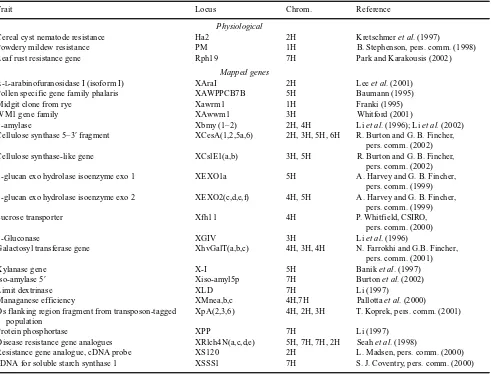
(4) 1128. Australian Journal of Agricultural Research. Table 4.. A. R. Barr et al.. Physiological traits and known gene markers mapped in Chebec × Harrington. Trait. Locus. Chrom.. Reference. Cereal cyst nematode resistance Powdery mildew resistance Leaf rust resistance gene. Physiological Ha2 PM Rph19. 2H 1H 7H. Kretschmer et al. (1997) B. Stephenson, pers. comm. (1998) Park and Karakousis (2002). α-L-arabinofuranosidase I (isoform I) Pollen specific gene family phalaris Midgit clone from rye WM1 gene family β-amylase Cellulose synthase 5–3′ fragment. Mapped genes XAraI XAWPPCB7B Xawrm1 XAwwm1 Xbmy (1–2) XCesA(1,2,5a,6). 2H 5H 1H 3H 2H, 4H 2H, 3H, 5H, 6H. Cellulose synthase-like gene. XCslE1(a,b). 3H, 5H. β-glucan exo hydrolase isoenzyme exo 1. XEXO1a. 5H. β-glucan exo hydrolase isoenzyme exo 2. XEXO2(c,d,e,f). 4H, 5H. Sucrose transporter. Xfh11. 4H. β-Gluconase Galactosyl transferase gene. XGIV XhvGalT(a,b,c). 3H 4H, 3H, 4H. Xylanase gene Iso-amylase 5′ Limit dextrinase Managanese efficiency Ds flanking region fragment from transposon-tagged population Protein phosphortase Disease resistance gene analogues Resistance gene analogue, cDNA probe cDNA for soluble starch synthase 1. X-I Xiso-amyl5p XLD XMnea,b,c XpA(2,3,6). 5H 7H 7H 4H,7H 4H, 2H, 3H. Lee et al. (2001) Baumann (1995) Franki (1995) Whitford (2001) Li et al. (1996); Li et al. (2002) R. Burton and G. B. Fincher, pers. comm. (2002) R. Burton and G. B. Fincher, pers. comm. (2002) A. Harvey and G. B. Fincher, pers. comm. (1999) A. Harvey and G. B. Fincher, pers. comm. (1999) P. Whitfield, CSIRO, pers. comm. (2000) Li et al. (1996) N. Farrokhi and G.B. Fincher, pers. comm. (2001) Banik et al. (1997) Burton et al. (2002) Li (1997) Pallotta et al. (2000) T. Koprek, pers. comm. (2001). XPP XRlch4N(a,c,d,e) XS120 XSSS1. 7H 5H, 7H, 7H, 2H 2H 7H. Li (1997) Seah et al. (1998) L. Madsen, pers. comm. (2000) S. J. Coventry, pers. comm. (2000). Table 5.. Key trait–marker associations implemented in Australian Breeding programs. Trait. Locus. Chrom.. Positive allele. Reference. Malt extract Diastatic power Cereal cyst nematode resistance Early flowering. Xabg57, XGMS01 Xabg57, XGMS01 Aawbma21, Bmag125 Xabg2 Xabg14, Xbmag140 Xabg57, XGMS01. 5H 5H 2H 2HS 2HL 5H. Harrington Harrington Chebec Chebec Chebec Chebec. Collins et al. (2003, this issue) Coventry et al. (2003a, this issue) Kretschmer et al. (1997) Coventry et al. (2003b, this issue) Coventry et al. (2003b) Li et al. (2003, this issue). Resistance to pre-harvest sprouting. Construction of map Methods used for DNA extraction, type of markers assayed, linkage map construction, and quantitative trait loci (QTL) analysis are as described by Barr et al. (2003, this issue). Table 2 summarises the markers used to construct the map. The total genetic length of the map is ~1330 cM. Distorted segregation ratios to the expected 1:1 were detected for specific chromosome segments located on 2H, 5H, 6H, and 7H. This observation has been previously documented by. Logue et al. (1995). Detailed maps of the 7 chromosomes are shown as Fig. 1. Phenotypic data collected Following seed multiplication in 1993, the full population was available for field experiments in 1994, 1995, and 1996 and 2001. Experiments were conducted at 16 locations spread over 5 states (Table 3). Two experiments were chosen from the 1995 and 1996 experiments on the basis of grain.
(5) Mapping and QTL analysis of Chebec × Harrington. protein (preferably 9.5–12.0%) and grain plumpness for malting. In addition to the field trial program, Chebec × Harrington has been extensively used in mapping, genetic, and physiological studies (Table 4) which, when combined with the North American Barley Genome studies of Harrington × TR306 and Harrington × Morex (Tinker et al. 1996; Mather et al. 1997), make the Harrington genome a very well characterised model. QTL analysis MapManager QTX (Manly et al. 2001) was used to develop associations between markers and QTLs. Statistical associations were based on regression analysis. The likelihood ratio statistic (LRS) was calculated using the interval mapping functions in MapManager QTX. Permutation analyses (1000 iterations) were carried out to determine whether a particular value of the LRS was highly significant (99.9%). The Q-gene analytical package (Nelson 1997) was used to confirm associations using interval mapping and maximum likelihood statistics [logarithm of odds ratio (LOD) values] and to generate graphical representations of maps and marker–trait associations. The yield data from 15 experiments conducted in 5 states of Australia were analysed using spatial models. Yield and yield stability were associated with the basic vegetative period locus on 2H (B. R. Cullis and A. B. Smith, unpublished data). Additional detailed analyses of the malt quality data by Patrick Lim, Joe Panozzo, Monica Radcliffe, Belinda Evans, Brian Cullis, and Alison Smith have also been conducted. Validation Two major studies have been conducted to validate the effect of alleles identified from Chebec × Harrington. They involve the Harrington alleles associated with diastatic power (Coventry et al. 2003a, this issue) and malt extract (Collins et al. 2003, this issue). These studies confirm that loci of crucial importance to breeding malting barley for Australian conditions were identified in this population. A QTL for pre-harvest sprouting has been identified on chromosome 5H at the marker locus ABG57-GMS01, which explains over 70% variation for pre-harvest sprouting (Li et al. 2003, this issue). This marker was validated in a Stirling × Harrington doubled haploid population. Implementation The most important traits identified in the Chebec × Harrington population are resistance to cereal cyst nematode (Kretschmer et al. 1997) and the QTL controlling malt extract and diastatic power, although other traits are also significant (Table 5).. Australian Journal of Agricultural Research. 1129. Conclusions The Chebec × Harrington population has been a valuable source of many genes, QTLs, and marker loci, 5 of which have been implemented in Australian breeding programs (Tables 4 and 5). These marker loci have been very valuable in Australian breeding programs as breeders attempt to transfer resistance to cereal cyst nematode from Chebec and the malt quality traits from Harrington into new malting barley lines. Through the work of Karakousis et al. (2003, this issue), several simple sequence repeat markers are now available for monitoring these traits in Australian breeding programs. References Banik M, Li CD, Langridge P, Fincher GB (1997) Structure, hormonal regulation and chromosomal location of gene encoding barley, 1,4β-xylan endohydrolases. Molecular and General Genetics 253, 599–608. doi:10.1007/S004380050362 Barr AR, Jefferies SP, Broughton S, Chalmers KJ, Kretschmer JM, Boyd WJR, Collins HM, Roumeliotis S, Logue SJ, Coventry SJ, Moody DB, Read BJ, Poulsen D, Lance RCM, Platz GJ, Park RF, Panozzo JF, Karakousis A, Lim P, Verbyla AP, Eckermann PJ (2003) Mapping and QTL analysis of the barley population Alexis × Sloop. Australian Journal of Agricultural Research 54, 1117–1123. Baumann U (1995) Pollen mRNA of Phalaris coerulescens and their possible role in self-compatibility. PhD Thesis, Department of Plant Science, University of Adelaide. Burton RA, Jenner H, Carrangis L, Fahy B, Fincher GB, Hylton C, Laurie DA, Parker M, Waite D, van Wegen S, Verhoeven T, Denyer K (2002) Starch granule initiation and growth are altered in barley mutants that lack isoamylase activity. The Plant Journal 31, 97–112. doi:10.1046/J.1365-313X.2002.01339.X Collins HM, Panozzo JF, Logue SJ, Jefferies SP, Barr AR (2003) Mapping and validation of chromosome regions associated with high malt extract in barley (Hordeum vulgare L.). Australian Journal of Agricultural Research 54, 1223–1240. Coventry SJ, Collins HM, Barr AR, Jefferies SP, Chalmers KJ, Logue SJ, Langridge P (2003a) Use of putative QTLs and structural genes in marker assisted selection for diastatic power in malting barley (Hordeum vulgare L.). Australian Journal of Agricultural Research 54, 1241–1250. Coventry SJ, Barr AR, Eglinton JK, McDonald GK (2003b) The determinants and genome locations influencing grain weight and size in barley (Hordeum vulgare L.). Australian Journal of Agricultural Research 54, 1103–1115. Eglinton JK, Langridge P, Evans DE (1998) Thermostability variation in alleles of barley β-amylase. Journal of Cereal Science 28, 301– 309. Franki MG (1995) The Midget chromosome as a model to study cereal chromosome structure. PhD thesis, Department of Plant Science, University of Adelaide. Harvey BL, Rossnagel BG (1984) Harrington barley. Canadian Journal of Plant Science 64, 193–194. Hayes PJ, Cerono WHM, Kuiper M, Zabeau K, Sato A, Kleinhofs D, Kudrna A, Kilian M, Saghai-Maroof D, Hoffman and North American Barley Genome Mapping Project (1997) Characterizing and exploiting genetic diversity and quantitative traits in barley (Hordeum vulgare) using AFLP markers. Journal of Agricultural Genomics 2, http://www.ncgr.org/jag/ Karakousis A, Barr AR, Chalmers KJ, Ablett GA, Henry R, Langridge P (2003) Potential of SSR markers for plant breeding and variety.
(6) 1130. Australian Journal of Agricultural Research. identification in Australian barley germplasm. Australian Journal of Agricultural Research 54, 1197–1210. Kretschmer JM, Chalmers KJ, Manning S, Karakousis A, Barr AR, Islam AKMR, Logue SJ, Choe YW, Barker SJ, Lance RCM, Langridge P (1997) RFLP mapping of the Ha 2 cereal cyst nematode resistance gene in barley. Theoretical and Applied Genetics 94, 1060–1064. doi:10.1007/S001220050515 Lee RC, Burton RA, Hrmova M, Fincher GB (2001) Barley arabinoxylan arabinofuranohydrolases: purification, characterization and determination of primary structures from cDNA clones. The Biochemical Journal 356, 181–189. doi:10.1042/0264-6021:3560181 Li CD (1997) Genetic control of hydrolytic enzymes in germinating barley (Hordeum vulgare L.). PhD thesis, Department of Plant Science, University of Adelaide, S. Aust. Li CD, Langridge P, Lance RCM, Xu P, Fincher GB (1996) Seven members of the (1–3)-beta-glucanase gene family in barley (Hordeum vulgare) are clustered on the long arm of chromosome 3 (3HL). Theoretical and Applied Genetics 92, 791–796. doi:10.1007/S001220050194 Li CD, Langridge P, Zhang XQ, Eckstein PE, Rossnagel BG, Lance RCM, Lefol EB, Lu MY, Harvey BL, Scoles GJ (2002) Mapping of barley (Hordeum vulgare L.) beta-amylase alleles in which an amino acid substitution determines beta-amylase isoenzyme type and the level of free beta-amylase. Journal of Cereal Science 35, 39–50. doi:10.1006/JCRS.2001.0398 Li CD, Tarr A, Lance RCM, Harasymow S, Uhlmann J, Westcot S, Young KJ, Grime CR, Cakir M, Broughton S, Appels R (2003) A major QTL controlling seed dormancy and pre-harvest sprouting/ grain α-amylase in two-rowed barley (Hordeum vulgare L.). Australian Journal of Agricultural Research 54, 1303–1313. Logue SJ, Oti-Boateng C, Karakousis A, Kretschmer J, Manning S, Lance R, Langridge P (1995) Segregation analysis of DNA markers in anther culture-derived populations of barley (Hordium vulgare L.). In ‘Proceedings of the 7th Australian Barley Technical Symposium’. Perth. pp. 210–217.. A. R. Barr et al.. Mather DE, Tinker NA, Laberge DE, Edney M, Jones BL, Rossnagel BG, Legge WG, Briggs KG, Irvine RB, Falk DE, Kasha KJ (1997) Regions of the genome that affect grain and malt quality in a North American two-row barley cross. Crop Science 37, 544–554. Nelson JC (1997) Q-gene: software for marker-based genomic analysis and breeding. Molecular Breeding 3, 239–245. doi:10.1023/ A:1009604312050 Pallotta MA, Graham GC, Langridge P, Sparrow DHB, Barker SJ (2000) RFLP mapping of manganese efficiency in barley. Theoretical and Applied Genetics 101, 1100–1108. Park RF, Karakousis A (2002) Characterization and mapping of gene Rph19 conferring resistance to Puccinia hordei in the cultivar ‘Reka 1’ and several Australian barleys. Plant Breeding 121, 232–236. Seah S, Sivasithamparam K, Karakousis A, Lagudah ES (1998) Cloning and characterisation of a family of disease resistance gene analogs from wheat and barley. Theoretical and Applied Genetics 97, 937–945. Tinker NA, Mather DE, Blake TK, Briggs KG, Choo TM, Dahleen L, Dofing SM, Falk DE, Ferguson T, Franckowiak JD, Graf R, Hayes PM, Hoffman D, Irvine RB, Kleinhofs A, Legge W, Rossnagel BG, Saghai-Maroof MA, Scoles GJ, Shugar LP, Steffenson B, Ullrich S, Kasha KJ (1996) Loci that affect agronomic performance in tworow barley. Crop Science 36, 1053–1062. Whitford R (2001) From intimate chromosome associations to wild sex in wheat (Triticum aestivum). PhD thesis, Department of Plant Science, University of Adelaide.. Manuscript received 15 November 2002, accepted 31 October 2003. http://www.publish.csiro.au/journals/ajar.
(7)
Figure
Related documents
Fig. 5: Electrophoretic isozymes showing the curative effect of N. oculata algal extract against streptozotocin-induced diabetes on a) CAT pattern and b) POX pattern in
Even though the current study paid close attention to only one category of product (Mobile Phones' industry) in the Malaysian market, it is shown that in order to boost
Nilai R 2 sebesar 0,504 artinya persentase sumbangan pengaruh variabel brand image terhadap minat beli sebesar 50,4% sedangkan sisanya 49,6% dipengaruhi oleh variabel
The Change management program takes a look at the basic principles of change management and discusses the main theories interpreting the processes within the organization
• Develop and implement training roadmap for crisis situations • Manage and implement business continuity plans • Evaluate business continuity plans. • Manage
Because family-friendly child care centers have fewer gaps in expectations between staff and families, a family- friendly environment is likely to translate into greater
o Responds to an audio text correctly and appropriately o Retrieves information from and audio texts accurately o Paraphrases an audio text effectively and accurately.. 14.1
