Rule-based detection of emotions in
the Khan Academy platform
Derick Leony, Pedro J. Muñoz-Merino, José A. Ruipérez-Valiente,
David Arellano Martín-Caro, Carlos Delgado Kloos
Departament of Telematic Engineering, Universidad Carlos III de Madrid Av. Universidad, 30, 28911, Leganés (Madrid), Spain
{dleony@it, pedmume@it, jruipere@it, 100073234@alumnos, cdk@it}.uc3m.es
Abelardo Pardo
School of Electrical and Information Engineering, University of Sydney NSW, 2006, Australia
Abstract—The current relevance of Massive Open Online Courses (MOOCs) has provoked researchers in educational technology to work towards improving their pedagogical outcomes. Adaptive MOOCs are an example within this context. Given the importance of affective information within the adaptive systems, we propose a set of models to detect four emotions known to correlate with learning gains. The implementation of the models and the initial results from its application in a case study dataset are also provided.
Keywords—MOOCs, emotion detection, user modeling, learning analytics.
I. INTRODUCTION
Massive Open Online Courses (MOOCs) have disrupted the educational landscape during the last years [1]. Several thousands of people have enrolled in MOOCs, encouraged by the quality of the universities offering them and the inclusion of recognized professors in the teaching staffs. Furthermore, this high level of demand is being compensated with a constant increase of universities that get involved in the creation of courses as well as the affordances of platforms available to offer courses (e.g. Coursera, edX, FUN, FutureLearn).
The high expectation created by the appearance of MOOCs has provoked a high-paced evolution of the pedagogical and pedagogical approaches in order to improve their effectiveness. One of the lines of research with this goal is to leverage the knowledge gained from adaptive learning [2]. Educational tools like intelligent tutoring systems and recommender systems have demonstrated the benefits of personalizing the educational resources and instructional design to the profile of the learner. The application of adaptation becomes more evident when participants in a MOOC can be categorized according to their engagement [3].
In an adaptive educational system, the learner profile can include information like current learning skills, learning style learning goals and accessibility needs. Along with these characteristics, students’ emotions can enrich the contextual the
contextual information available in the adaptive system [4]. Furthermore, previous studies have shown the co-occurrence of some emotions with learning gains [5]. Thus, the inclusion of affective information in MOOCs can be used to customize the learning experience or to suggest the teaching staff to perform an intervention to improve the outcomes of the course.
The inclusion of affective information can be achieved with some level of certainty through the analysis of the actions done by students in a learning environment [5]. In this work, we present four models for the detection of emotions known to be related with learning gains (i.e., boredom, confusion, frustration, and happiness). The models are defined following a rule-based approach combined with linear regression models.
The rest of the article is organized as follows. Section 2 describes the Khan Academy platform and the interaction being captured for this study. Afterwards, section 3 presents four models developed to infer emotions from the collected data. A description of the implementation of the models is provided in section 4. Finally, conclusions and a short discussion are presented in section 5.
II. KHAN ACADEMY PLATFORM
Khan Academy was one of the first systems to provide a set of educational resources similar to those included in a MOOC [6]. While there are some differences in the pedagogical approach followed in Khan Academy because of the lack of the concept of a course. Learners cannot enroll in a course to follow a specific sequence of activities, nor there is an option to create a community around each topic that could encourage the creation of a learning community.
Another element common in both MOOC platforms and the Khan Academy platform are exercises. These consist of multiple-choice questions about the concepts explained in the videos. The exercise can include mathematical expressions that improve the readability of the question posed. If the learner is not completely sure about the answer to the question, the tool includes the option to provide hints. Figure Fig. 1 presents a screen capture of an algebra exercise as an example of the element just described.
In addition, the Khan Academy platform provides mechanisms for gamification which are not common in other platforms. For instance, the platform attributes badges to a learner that has achieved of a specific goal, such as watching a given number of videos or answering some exercises correctly.
III. MODELS TO DETECT EMOTIONS
Using the information available in the Khan Academy platform, we have four models for detecting emotions that present a correlation with learning gains of students. As shown by Baker et al. in [5], the observation of confusion and engagement has been proven to correlate positively with learning gains, while boredom and frustration present a negative correlation.
For all of the emotions, we have selected only those events occurring during the last hour. This decision relies on the fact that more recent events tend to affect in a higher level the emotional state of a person in any context. Furthermore, those events occurring within the hour have a different weight on the current emotional state, depending on how recent they are. For instance, an event occurring one minute ago has a greater weight than an event occurring 50 minutes ago.
A. Detection of frustration
The inference of the frustration of the student (SF) is based on the learner tries of the exercises. Those exercises that have been are considered not to increase the frustration of the learner. On the other hand, if the last try of the student has not been correct, there is understood to be a level of frustration, with a behavior characterized by the following equation, where
A is a constant to be defined.
( )
{
( )
( 1)
If the student has not tried to solve the exercise, the frustration is understood to be null at the beginning and to increase with the pass of the time. The following equation is proposed to calculate the frustration generated in this case. As in the previous case, B is a constant to be defined according to the learner.
( ) {
( )
( 2)
As mentioned above, the frustration generated by the exercise is weighted according to its time of occurrence. The weight of the exercise is calculated with the following equation, where E represents the exercise and M the set of minutes in which the exercise occurred.
( )
∑( ) ( 3)
The same equation is used to calculate the exercise weight for the other emotions. Finally, the emotion of the student is incremented by the level generated by the exercised weighted in equation ( 3. This calculation is used in every emotion model given the incremental change provoked by each exercise. Thus, the equation used to update the student emotion is the following, being SE the student’s emotion, EE the increment of emotion generated by the exercise, and EW the weight of the exercise.
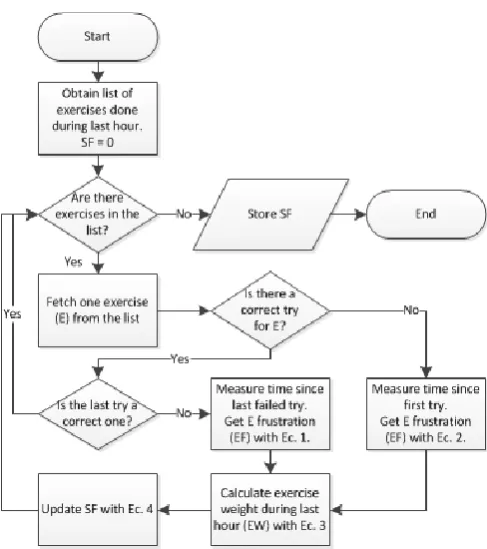
( 4) The result obtained is used as an index between 0 and 1 that indicates the level of frustration generated by the exercises in the platform. Fig. 2 presents a diagram of the process to calculate the frustration following the equations described above.
B. Detection of confusion
The process to infer the emotion of confusion is similar to the one used to infer frustration. Indeed, previous works have found difficulties to define models for confusion and frustration that do not correlate between themselves.
incorrect. Thus, the concept evaluated by the exercise is not completely clear for the learner.
The surrounding steps of the model coincide with those of the frustration model: each one of the exercises done by the learner during the last hour is analyzed in order to get its individual effect on the learner confusion. If a learner has given a wrong answer to an exercise that had been solved previously, it is understood that the confusion associated to that exercise is total (coefficient of 1). The equation used to calculate the confusion generated by the exercise (EC) is the following.
( ) {
( )
( 5)
As in the previous cases, C is a constant assigned to each learner. It can be seen that the equation that describes the confusion in terms of elapsed time trying to solve an exercise follows the same structure that the one describing the frustration of the learner. The main change between the two models is the smaller offset on the X axis for the confusion model. The reasoning behind this decision is that the learner can be confused at a very early stage of the assigned task, while frustration is most common at a later stage, when the learner would have spent more time to try to solve the problem. The flowchart describing the process for inferring confusion is presented in Figure Fig. 3.
C. Detection of boredom
Our proposal for the inference of boredom relies on the flow theory proposed by Csikszentmihalyi [7]. In this theory, a learner is understood to be bored when the difficulty of the challenges presented is lower than the recommended for her level of skills. On the other hand, learners whose skill levels are not enough for the problems to solve are understood to undergo through the emotion of anxiety.
The process to infer the level of boredom of the learner follows the same initial steps described in the previous two models. The list of exercises responded during the last hour are analyzed individually to calculate their individual effect and calculate a weighted sum of the complete set.
The main difference in this model when compared with those for frustration and confusion is the lack of a linear function to describe the level of boredom with respect to the elapsed time. In this case the calculation has been simplified by, first, calculating the arithmetic mean and the standard deviation of the durations to solve exercises by the student. Then, we define that a problem assigned to a student is less than the expected if it is less than the mean minus one arithmetic mean. Another difference between previous models and this is that in this case an exercise is qualified to cause boredom to the student in a discrete way, this is, an exercise either cause boredom on the student or not cause it at all, while confusion and frustration were understood to be continuous functions. The diagram of the boredom model is illustrated in Figure ¡Error! No se encuentra el origen de la referencia.. Fig. 2 Flowchart for model to predict the level of frustration of a student (SF)
in the Khan Academy Platform
D. Detection of happiness
The final model aims to infer the level of happiness that the student is experiencing as a result of the interactions with Khan Academy. Although this model maintains the idea of analyzing only the events that occurred during the last hour, it also incorporates the analysis of gamification elements because of their direct relation with the happiness of the student. Specifically, we take into account the badges obtained by the learner because of solving each exercise.
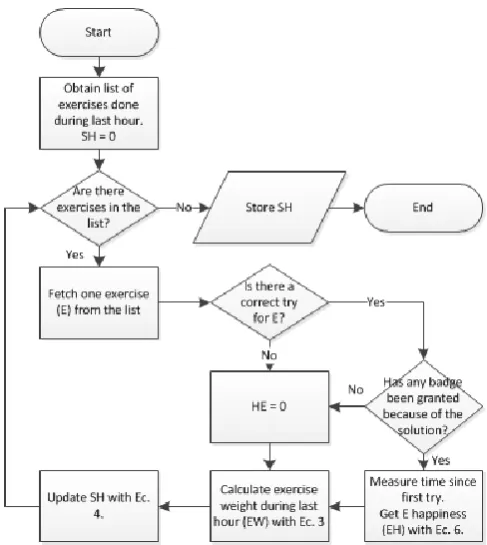
As a point of reference, if the work done to solve the exercise does not provide a badge to the student, the happiness generated by that specific exercise is understood to be none. This model also includes the analysis of the emotion with respect to the time that the student has taken to solve the problem. Unlike the models for frustration and confusion, the level of happiness is understood to decrease with time. The process for this model has been illustrated in figure Fig. 4.
IV. IMPLEMENTATION OF THE MODELS
The four models have been implemented and integrated into ALAS-KA, a learning analytics module for the Khan Academy platform [6]. This module extends the analytics capabilities provided by the platform and includes new metrics and visualizations of information obtained from the analysis of patterns of activities performed by its users.
Furthermore, the developed application can be divided in two areas: the core inference engine and the presentation layer. The implementation of the inference engine follows follows a modular approach, having as a basic element the code in charge of the operations frequently used in the inference of
emotions. Each emotion is implemented from this starting point. Thus, the implementation of other models for the detection of these and other emotions can easily be performed by the reutilization of these tools.
All of the implemented models take into account the ProblemLog provided by the Khan Academy. This log includes all of the information about users’ interaction with exercises and the timestamp in which they have occurred. The process in charge of the analysis was scheduled recurrently in order that data processes could be executed as frequent as possible. The main advantage presented by this log is its role of gathering all of the data related to the actions of the student within the platform. This approach facilitates the process of collecting and normalizing the information generated.
The presentation layer includes the elements needed in the paradigm of Model-View-Controller (MVC). In this scenario, the view is a set of HTML templates that create a complete web page by using the data provided by the controllers. The final visualization presents a combo box to select the student whose emotions wanted to be inferred, and a table with the information of emotion changes in a timeline. Figure Fig. 7 presents a capture of the implementation of the model of frustration, presenting both the personal levels, in red, and the class group ones, in blue.
The implementation was then applied on the data collected from students that attended the initialization courses named “Cursos cero” (Courses Zero) during the Summer of 2013. This application served as a proof of concept of the definition of the models, as well as an evaluation of the efficiency of the Fig. 4 Diagram for the model to detect student happiness (SH)
implementation regarding the calculation of all the needed metrics.
V. DICSUSSION AND FUTURE WORK
The presented models are based on theoretical foundations that define some aspects of the behavior presented by students when experiencing certain emotion. The implementation of the four models successfully demonstrated that firstly, the feasibility of implementing the proposed models and secondly, that the implementation was efficient enough to analyze a large amount of data in a relatively short time.
Although the majority of the previous work has centered the detection of emotions through the use of artificial intelligence or machine learning algorithms, the use of rules for the detection can help overcome issues such as the slow start, or lack of initial data to calibrate the parameters using by artificial intelligence algorithms. In addition, by adding logic to the inference of each emotion, the teaching staff can be aware of the different metrics that could have interfered in order to detect a given emotion on a student. By providing awareness of these issues, the teaching staff can make better informed decisions.
One of the main lines of future work is the evaluation of the proposed models by correlating the inferred emotions with the actual emotion being experienced by the students. The information can be obtained through a form where students must indicate the level of each of the four emotions assessed. However, this issue gains more relevance in MOOC scenarios, where we don’t have direct access to the students’ environment and can assess whether their emotions are well identified.
Another topic for further analysis is the application of the presented models in other MOOC platforms, such as EdX. The
fact that most of the elements considered for the detection of emotions are present in most of the current platforms can be a starting point to generalize the models and the vocabulary use for their definition.
ACKNOWLEDGMENT
This work has been funded by the Spanish Ministry of Economy and Competitiveness Project TIN2011-28308-C03-01 and the Regional Government of Madrid project S2009/TIC-1650.
REFERENCES
[1] C. O. Rodriguez, “MOOCs and the AI-Stanford Like Courses: Two Successful and Distinct Course Formats for Massive Open Online Courses,” Eur. J. Open, Distance E-Learning, vol. 1, 2012.
[2] N. Sonwalkar, “The First Adaptive MOOC: A Case Study on Pedagogy Framework and Scalable Cloud Architecture—Part I,”
MOOCs Forum, vol. 1, pp. 22–29, 2013.
[3] R. F. Kizilcec, C. Piech, and E. Schneider, “Deconstructing Disengagement: Analyzing Learner Subpopulations in Massive Open Online Courses,” in Proceedings of the Third International
Conference on Learning Analytics and Knowledge - LAK ’ 13, 2013,
pp. 170–179.
[4] D. Leony, H. A. Parada, G., P. J. Muñoz-Merino, A. Pardo, and C. Delgado Kloos, “A Generic Architecture for Emotion-based Recommender Systems in Cloud Learning Environments,” J.
Univers. Comput. Sci., vol. 19, no. 14, pp. 2075–2092, 2013.
[5] R. S. J. d. Baker, S. K. D’Mello, M. M. T. Rodrigo, and A. C. Graesser, “Better to be frustrated than bored: The incidence, persistence, and impact of learners’ cognitive–affective states during interactions with three different computer-based learning
environments,” Int. J. Hum. Comput. Stud., vol. 68, no. 4, pp. 223– 241, Apr. 2010.
[6] J. A. Ruipérez-Valiente, P. J. Muñoz-Merino, and C. Delgado Kloos, “An architecture for extending the learning analytics support in the Khan Academy framework,” in Proceedings of the First International Conference on Technological Ecosystem for
Enhancing Multiculturality, 2013, pp. 277–284.
[7] M. Csikszentmihalyi, Flow and the psychology of discovery and