U.S.ENVIRONMENTALPROTECTIONAGENCY
OFFICE
OF
INSPECTOR
GENERAL
EPA Needs to Manage
Nanomaterial Risks More
Effectively
Report Contributors: Natalie Hanson
Jeffrey Harris Lauretta A. Joseph Kalpana Ramakrishnan Thane Thompson
Abbreviations
CBI Confidential business information EPA U.S. Environmental Protection Agency
FIFRA Federal Insecticide, Fungicide, and Rodenticide Act NNI National Nanotechnology Initiative
NMSP Nanoscale Materials Stewardship Program OAR Office of Air and Radiation
OCSPP Office of Chemical Safety and Pollution Prevention OECA Office of Enforcement and Compliance Assurance OIG Office of Inspector General
OMB Office of Management and Budget OPP Office of Pesticide Programs
OPPT Office of Pollution Prevention and Toxics ORD Office of Research and Development OW Office of Water
SNUR Significant New Use Rule TSCA Toxic Substances Control Act
Cover photos: From left: hollow silica nanoshells for imaging and targeted drug and gene delivery treatments for cancer (photo credit William Trogler, Ph.D. and Sadik Esener, Ph.D.); quantum dots being used to reveal the molecular fingerprints of individual cells for early cancer detection (photo credit Jian Liu, Ph.D. and Shuming Nie, Ph.D.); ZnO wire arrays (photo credit Z.L. Wang, Ph.D.); and a 5-micron bead surrounded by 60-nanometer gold particles (photo credit Ximei Qian, Ph.D. and Shuming Nie, Ph.D.). (photographs courtesy National Cancer Institute http://nano.cancer.gov/learn/understanding/library.asp)
Hotline
To report fraud, waste, or abuse, contact us through one of the following methods:
e-mail: [email protected]. write: EPA Inspector General Hotline
phone: fax:
1-888-546-8740 202-566-2599
1200 Pennsylvania Avenue NW Mailcode 2431T
U.S. Environmental Protection Agency 12-P-0162 December 29, 2011 Office of Inspector General
At a Glance
Why We Did This Review
The purpose of this review was to determine how effectively the U.S. Environmental Protection Agency (EPA) is managing the human health and environmental risks of
nanomaterials.
Background
Nanomaterials are currently used in a wide variety of applications, including
consumer products, health care, transportation, energy, and agriculture. The Agency considers nanomaterials as chemical substances that are controlled at the scale of approximately one-billionth of a meter. EPA has the authority, through several environmental statutes, to regulate
nanomaterials. Although the development of nanomaterials and nanomaterial-enhanced products is expanding rapidly, the health implications of nanomaterials have not yet been determined.
For further information, contact our Office of Congressional and Public Affairs at (202) 566-2391.
The full report is at:
www.epa.gov/oig/reports/2012/ 20121229-12-P-0162.pdf
EPA Needs to Manage Nanomaterial Risks More Effectively
What We Found
We found that EPA does not currently have sufficient information or processes to effectively manage the human health and environmental risks of nanomaterials. EPA has the statutory authority to regulate nanomaterials but currently lacks the environmental and human health exposure and toxicological data to do so effectively. The Agency proposed a policy under the Federal Insecticide, Fungicide, and Rodenticide Act to identify new pesticides being registered with nanoscale materials. After minimal industry participation in a voluntary data collection program, the Agency has proposed mandatory reporting rules for nanomaterials under the Federal Insecticide, Fungicide, and Rodenticide Act, and is also developing proposed rules under the Toxic Substances Control Act.
However, even if mandatory reporting rules are approved, the effectiveness of EPA’s management of nanomaterials remains in question for a number of reasons:
Program offices do not have a formal process to coordinate the dissemination and utilization of the potentially mandated information.
EPA is not communicating an overall message to external stakeholders regarding policy changes and the risks of nanomaterials.
EPA proposes to regulate nanomaterials as chemicals and its success in managing nanomaterials will be linked to the existing limitations of those applicable statutes.
EPA’s management of nanomaterials is limited by lack of risk information and reliance on industry-submitted data.
These issues present significant barriers to effective nanomaterial management when combined with existing resource challenges. If EPA does not improve its internal processes and develop a clear and consistent stakeholder communication process, the Agency will not be able to assure that it is effectively managing nanomaterial risks.
What We Recommend
UNITED STATES ENVIRONMENTAL PROTECTION AGENCY WASHINGTON, D.C. 20460
THE INSPECTOR GENERAL
December 29, 2011 MEMORANDUM
SUBJECT: EPA Needs to Manage Nanomaterial Risks More Effectively
Report No. 12-P-0162
FROM: Arthur A. Elkins, Jr.
Inspector General TO: Jim Jones
Acting Assistant Administrator for Chemical Safety and Pollution Prevention
This is our report on the subject evaluation conducted by the Office of Inspector General (OIG) of the U.S. Environmental Protection Agency (EPA). This report contains findings that describe the problems the OIG has identified and corrective actions the OIG recommends. This report represents the opinion of the OIG and does not necessarily represent the final EPA position. Final determinations on matters in this report will be made by EPA managers in accordance with established audit resolution procedures.
Action Required
Because you have provided a corrective action plan with milestone dates, you are not required to provide a written response to this report. Should you choose to provide a response, your response will be posted on the OIG’s public website, along with our memorandum commenting on your response. Your response should be provided as an Adobe PDF file that complies with the accessibility requirements of Section 508 of the Rehabilitation Act of 1973, as amended. The final response should not contain data that you do not want to be released to the public; if your response contains such data, you should identify the data for redaction or removal. We have no objections to the further release of this report to the public. We will post this report to our website at http://www.epa.gov/oig.
If you or your staff have any questions, please contact Wade Najjum at (202) 566-0827 or
Table of Contents
Chapters
1 Introduction ... 1
Purpose ... 1
Background ... 1
Prior Reports ... 7
Noteworthy Achievements ... 7
Scope and Methodology ... 8
2 EPA Does Not Have Sufficient Information and Processes to Effectively Manage Nanomaterial Risks... 9
Formal Coordination Process Needed to Prioritize Work and Assess Nanomaterial Risks ... 9
EPA Should Improve Communicating Nanomaterial Information to the Limitations in Detection and Assessment Inhibit General Public ... 10
Existing TSCA Limitations Challenge Nanomaterial Management... 10
Effective Management ... 11
Conclusions ... 11
Recommendation ... 12
Agency Comments and OIG Evaluation ... 12
Status of Recommendations and Potential Monetary Benefits... 13
Appendices
A Agency Response and OIG Comment... 14
Chapter 1
Introduction
Purpose
The purpose of this review was to determine how effectively the U.S. Environmental Protection Agency (EPA) is managing the human health and environmental risks of nanomaterials.
Background
Nanomaterials encompass a wide range of substances based on the understanding and control of matter at the scale of nanometers—the equivalent of one-billionth of a meter. Nanomaterials are nanoscale materials or materials that contain nanoscale structures internally or on their surfaces. Nanomaterials are currently used in a wide variety of applications, including consumer products, health care, transportation, energy, and agriculture. While some nanomaterials can occur naturally, this report focuses on intentionally manufactured nanomaterials. Figure 1 illustrates the relative size of nanomaterials.
Figure 1: Size and scale of nanomaterials
Though the development of nanomaterials and nanomaterials-enhanced products is expanding rapidly, the health or environmental implications of nanomaterials have not yet been determined.1 Research has shown that exposure to
nanomaterials may produce effects that differ from those observed with
conventionally scaled materials. Some nanomaterials may cross the human blood-brain or placental barrier in ways that larger particles cannot. 2,3
The many applications of nanomaterials present new opportunities to improve products, processes, and technologies. Some of these applications may improve how contaminants are measured, monitored, managed, and minimized in the environment. However, there also exists the potential for exposures to
nanomaterials during product manufacturing, use, and/or at the end of the product life cycle through recycling, landfills, and waste incineration. Depending on the individual properties, nanomaterials may be able to enter the human body through the skin, through ingestion, and through inhalation. For example, because some carbon nanotubes resemble asbestos fibers, researchers are questioning whether they may lead to diseases such as mesothelioma. Further, research has shown that, when combined with ultraviolet light and sweat, nanotitanium dioxide in
sunscreen is capable of altering proteins in the skin. More research is needed to determine whether this may cause skin diseases.
Risks to public health are dependent, in part, on exposure. Public exposure has likely been limited to date. Table 1 illustrates examples of commercial
applications of nanomaterials and their respective potential routes of exposure to the public.
1 EPA's website states that in some cases there may be beneficial characteristics of nanomaterials when used for
drug delivery and disease treatments. EPA acknowledges that this characteristic could also result in unintended
impacts for manufactured nanomaterials not designed for disease therapies.
2 P. Wick, A. Malek, P. Manser, D. Meili, X. Maeder-Althaus, L. Diener, P.A. Diener, A. Zisch, H.F. Krug, U. von
Mandach, “Barrier Capacity of Human Placenta for Nanosized Materials”, Environmental Health Perspectives, vol.
118, no. 3, pp. 432-6, March 2010.
3 Panyala, NR; Pena-Mendez, EM; Havel, J. (2008). Silver or silver nanoparticles: a hazardous threat to the
Table 1: Consumer exposure for several types of nanomaterial products
Product type Release and/or exposure source Exposed
population
Potential exposure route Product application by consumer to skin Consumer Dermal
Sunscreen
Release by consumer to water supply (e.g., washing with soap and water)
General
population Ingestion Disposal of sunscreen container with residual
sunscreen after use to landfill or incineration
General
population Inhalation or ingestion
Paints and
coating Weathering, disposal
Consumers, general population
Dermal, inhalation or ingestion
Clothing Wear, washing, disposal Consumers, general population
Dermal, inhalation, ingestion from surface or ground water
Electronics Release at end of life or recycling stage Consumers, general population
Dermal, ingestion from surface or ground water
Sporting goods Release at end of life or recycling stage Consumers, general population
Dermal, inhalation, ingestion from surface or ground water Source: EPA, Nanotechnology White Paper, 2007.
In 2010, federal support of nanomaterial research and development totaled $1.9 billion. Federal research and development efforts are coordinated by the National Nanotechnology Initiative (NNI). The NNI creates a framework for shared goals, priorities, and strategies for each federal agency to leverage the resources of all participating agencies. Along with 25 other federal agencies, EPA works with the NNI to conduct research on nanomaterials.
EPA is one of nine federal agencies that dedicate funding to identify any potential adverse effects of nanomaterials and the risks these nanomaterials pose to human health and the environment. Each size, formulation, and application of a
nanomaterial used as a pesticide or industrial chemical could potentially introduce a unique risk that EPA is required to understand and address.
EPA’s Approach to Managing Nanomaterials
EPA has the statutory authority to regulate nanomaterials during various stages of their production, use, and disposal. EPA can regulate nanomaterials during their manufacture, formulation, distribution in commerce, use, and/or disposal through the Toxic Substances Control Act (TSCA). EPA can regulate nanomaterials in pesticides through the Federal Insecticide, Fungicide, and Rodenticide Act (FIFRA), the authority under which EPA regulates the sale, distribution, and use of pesticide products in the United States. EPA can regulate nanomaterials released into the environment using the Clean Air Act; the Clean Water Act; the Comprehensive Environmental Response, Compensation and Liability Act; or the Resource Conservation and Recovery Act.
and reviewed over 120 new chemical notices under TSCA for nanoscale materials, including carbon nanotubes. EPA’s management of nanomaterials under TSCA has evolved from a voluntary approach to a regulatory approach. In January 2008, EPA began collecting data from manufacturers using the voluntary Nanoscale Materials Stewardship Program (NMSP). EPA sought information on production, importation, and use; exposures; risk management practices; hazards; pollution prevention; and physical and chemical properties. EPA scientists
intended to use data collected through this program, where appropriate, to aid in determining how and whether certain nanoscale materials or categories of
nanoscale materials present risks to human health and the environment. Although 29 companies provided data that described or identified 123 nanomaterials, only 4 companies were willing to participate in the portion of the program that
encouraged them to sponsor the development of test data and provide that information to EPA. Based on the limited response to the program, EPA discontinued the NMSP in December 2009 and began developing regulatory approaches under Sections 5 and 8(a) of TSCA to collect nanomaterial data from manufacturers of industrial chemicals.
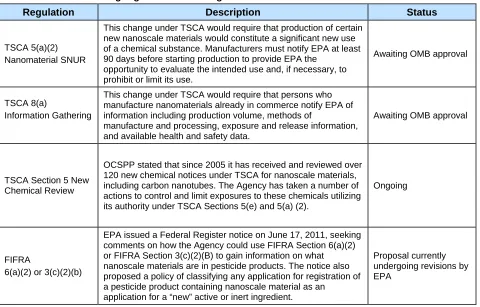
As shown in table 2, EPA is developing proposals for new data reporting
requirements for FIFRA and TSCA. In July 2010, EPA submitted a request for a modification of FIFRA to the Office of Management and Budget (OMB). This submission sought to clarify the information collection ability of FIFRA
regulations by including a description of nanomaterials in the policy, which would require manufacturers to submit more nano-specific data. In October 2010, EPA submitted a proposed TSCA revision to OMB. Under this proposal, any chemical substance from 1 to 100 nanometers will be subject to TSCA’s Significant New Use Rule (SNUR). This regulatory revision treats the nanomaterial as a new chemical and requires submission of data to EPA at least 90 days prior to commencing manufacture of these types of materials.
On June 17, 2011, EPA issued a Federal Register notice (76 FR 35383) seeking comments on how the Agency could use FIFRA Section 6(a)(2) or FIFRA Section 3(c)(2)(B) to gain information on what nanoscale materials are in pesticide products. The notice also proposed a policy of classifying any
Table 2: New and existing regulations affecting nanomaterials
Regulation Description Status
TSCA 5(a)(2) Nanomaterial SNUR
This change under TSCA would require that production of certain new nanoscale materials would constitute a significant new use of a chemical substance. Manufacturers must notify EPA at least 90 days before starting production to provide EPA the
opportunity to evaluate the intended use and, if necessary, to prohibit or limit its use.
Awaiting OMB approval
TSCA 8(a)
Information Gathering
This change under TSCA would require that persons who manufacture nanomaterials already in commerce notify EPA of information including production volume, methods of
manufacture and processing, exposure and release information, and available health and safety data.
Awaiting OMB approval
TSCA Section 5 New Chemical Review
OCSPP stated that since 2005 it has received and reviewed over 120 new chemical notices under TSCA for nanoscale materials, including carbon nanotubes. The Agency has taken a number of actions to control and limit exposures to these chemicals utilizing its authority under TSCA Sections 5(e) and 5(a) (2).
Ongoing
FIFRA
6(a)(2) or 3(c)(2)(b)
EPA issued a Federal Register notice on June 17, 2011, seeking comments on how the Agency could use FIFRA Section 6(a)(2) or FIFRA Section 3(c)(2)(B) to gain information on what nanoscale materials are in pesticide products. The notice also proposed a policy of classifying any application for registration of a pesticide product containing nanoscale material as an
application for a “new” active or inert ingredient.
Proposal currently undergoing revisions by EPA
Source: OIG analysis.
Until the TSCA and FIFRA reporting requirements are complete, EPA will continue to lack the information to determine how and whether certain nanoscale materials or categories of nanoscale materials present risks to human health and the environment.
EPA has determined that nanomaterials will be regulated under existing statutes for chemicals. Therefore, EPA’s effectiveness in managing nanomaterials will depend upon the effectiveness of its existing regulatory frameworks under FIFRA and TSCA. In our 2010 evaluation of TSCA’s New Chemicals Program, we identified a number of shortcomings:
The program was limited by an absence of toxicity testing and
environmental fate data, and a reliance on modeling, as TSCA does not require upfront testing. Because EPA depends on information reported by industry, it can initially fail to identify chemical risks not self-disclosed by manufacturers.
The program was limited by TSCA’s requirement to protect claims of
designations inhibit independent peer reviews, oversight by external parties, and information sharing across EPA offices.
Program Office Roles and Authority to Regulate Nanomaterials
The majority of EPA’s nanomaterial funding has been appropriated to the Office of Research and Development (ORD) to conduct research on nanomaterials. According to the Office of Chemical Safety and Pollution Prevention, it was the first to regulate nanomaterials based on the new chemical requirements under TSCA Section 5(e).
Office of Research and Development
ORD is leading scientific efforts to understand the potential risks to human health and the environment from exposure to nanomaterials. In 2008, ORD created the Nanomaterials Research Strategy document to help guide the Agency in answering key science questions regarding the
source, fate, exposure, risk assessment, and risk management of nanomaterials. In 2010, EPA received approximately $18 million for nanotechnology research efforts, and ORD had approximately 35 full-time equivalents4 engaged in both research and grant oversight. ORD plans to incorporate nanomaterial research into a broader Chemical Safety and Sustainability Research Program. According to ORD, this program is intended to combine the use of high-throughput chemical screening and prioritization approaches used in other toxicology efforts with ongoing nanomaterial research. An ORD representative stated that if the TSCA and FIFRA regulatory changes take effect, the additional information that could be collected would be used to guide ORD’s research efforts as the Chemical Safety and Sustainability Research Program evolves into an integrated chemicals-related research program.
Office of Chemical Safety and Pollution Prevention
OCSPP reviews, regulates, and evaluates the risks of industrial chemicals and pesticides sold in and imported into the United States. OCSPP
currently has approximately five full-time equivalents working on nanomaterial activities. Within OCSPP are OPPT and the Office of Pesticide Programs (OPP). The primary responsibility of OPPT is to implement TSCA and the Pollution Prevention Act. Under these laws, EPA evaluates new and existing chemicals and their risks, and finds ways to prevent or reduce pollution before it enters the environment. OPPT also seeks to promote understanding of chemical risks by providing
information to the public. OPP is responsible for reviewing and registering pesticides under FIFRA. One of OPP’s primary efforts is evaluating
4 FTE employment is the total number of hours worked, divided by the compensable hours applicable to each fiscal
potential new pesticides. Nanomaterials are currently being included in some pesticides. As nanomaterials become more widely used in
commerce, OPP expects that the need to review different types of nanomaterial formulations will increase.
Other EPA Program Offices
Several other EPA program offices have the statutory authority to regulate nanomaterials to address risks posed in the environment. The Office of Air and Radiation (OAR), the Office of Solid Waste and Emergency
Response, and the Office of Water (OW) all have statutory authority to regulate nanomaterials in their respective environmental media.
Additionally, the Office of Enforcement and Compliance Assurance (OECA) will have the responsibility to enforce any regulations upon enactment.
Prior Reports
In the EPA Office of Inspector General (OIG) Report No. 10-P-0066, EPA Needs a Coordinated Plan to Oversee Its Toxic Substances Control Act Responsibilities, issued February 17, 2010, we found that EPA’s management of chemical risks under TSCA was limited by an absence of chemical test data, reliance on risk modeling rather than on actual test results, and a lack of transparency. The report also stated that oversight of regulatory actions designed to reduce known risks was a low priority, and that the resources allocated by EPA were not
commensurate with the scope of monitoring and oversight work. In addition, we found that EPA’s procedures for handling CBI requests were predisposed to protect industry information rather than to provide public access to health and safety studies.
The U.S. Government Accountability Office issued Report 10-549,
Nanomaterials Are Widely Used in Commerce, but EPA Faces Challenges in Regulating Risk, in May 2010. This report reviewed the current prevalence of nanoscale materials in commerce, discussed the challenges related to regulating nanoscale materials, and recommended that EPA utilize the authorities of FIFRA and TSCA to regulate nanomaterials.
Noteworthy Achievements
EPA has been working to identify the risks that nanomaterials pose to human and the environment. In 2005, EPA launched a collaborative public process to design and develop the NMSP, and the program was initially implemented in 2008 NMSP encouraged manufacturers to develop and submit information on
In 2007, EPA published the Nanomaterial White Paper to outline general nanomaterial issues for the Agency to focus upon. EPA also published its
Nanomaterials Research Strategy in 2009, intended to guide ORD’s nanomaterial research program. EPA has also been active in sharing information with other international organizations, including the Organization for Economic Cooperation and Development and the International Organization for Standardization.
Scope and Methodology
We conducted this performance evaluation in accordance with generally accepted government auditing standards. Those standards require that we plan and perform the evaluation to obtain sufficient, appropriate evidence to provide a reasonable basis for our findings and conclusions based on our objectives. We believe that the evidence obtained provides a reasonable basis for our findings and
conclusions based upon our objectives. We conducted this evaluation from October 2010 through September 2011.
The scope of this evaluation focused on EPA’s responsibilities for oversight, assessment, and regulation of nanomaterials. As a result, we interviewed all applicable media offices, including OAR, OCSPP, OECA, Office of Solid Waste and Emergency Response, and OW. We interviewed the Office of General Counsel to determine its assessment of EPA’s statutory authority to regulate nanomaterials. We reviewed the American Bar Association analysis of EPA’s authority to regulate nanomaterials under TSCA; FIFRA; the Clean Air Act; the Clean Water Act; the Comprehensive Environmental Response, Compensation and Liability Act; and the Resource Conservation and Recovery Act.
We conducted interviews at a wide variety of academic institutions, including the Smalley Institute for Nanoscale Science and Technology at Rice University, the University of Michigan Risk Science Center, and the University of Dublin. We interviewed representatives of nongovernmental organization such as Resources for the Future, the Environmental Defense Fund, and the Silicon Valley Toxics Coalition. We also interviewed representatives from the International
Chapter 2
EPA Does Not Have Sufficient Information and
Processes to Effectively Manage Nanomaterial Risks
At the time of our review, EPA did not have sufficient information or processes to effectively manage the human health and environmental risks of nanomaterials. EPA does not have a formal process to coordinate the dissemination and
utilization of nanomaterial information or communicate nanomaterial risks. EPA is not clearly communicating policy changes and the risks of nanomaterials to external stakeholders. Also, existing TSCA limitations and resource issues challenge EPA’s ability to assess the risks of nanomaterials using its existing models. Finally, technological limitations inhibit nanomaterial detection in the environment, and a reliance on industry data impedes effective nanomaterial management. If these challenges are not resolved, EPA will continue to lack assurance that it is making effective nanomaterial management decisions.
Formal Coordination Process Needed to Prioritize Work and Assess
Nanomaterial Risks
EPA does not have an Agency-wide, formal process to disseminate manufacturer data gathered from TSCA and FIFRA data calls to program offices outside of OCSPP. Program offices such as ORD need manufacturer data to prioritize work and assess risks. OCSPP staff stated that both OPP and OPPT have established relationships with specific individuals in ORD and in the Office of Science Policy to guide discussions, share information, and review documents specific to
nanomaterials. However, this information sharing is not facilitated by a formal process; rather, it depends on personal relationships between program office staff. Information sharing based on personal relationships can be easily disrupted by transfers, travel, retirements, or other personal factors.
Coordinated sharing of nanomaterial data call information will also be important if additional regulatory actions become necessary. For instance, OW could use the information-gathering provisions of the Clean Water Act to collect information about potential effluent discharges containing nanomaterials. While OW has not employed this authority, coordination with other offices will be important to determine whether and when to employ that authority. Additionally, it will be important for OECA to effectively enforce regulations to ensure that data submission requirements are followed. OECA officials stated that OECA has challenges developing enforcement cases for nanomaterials, and must rely heavily on OCSPP’s expertise.
2007, OCSPP convened such a group, but, according to OCSPP staff, it was disbanded in 2008 after only a few meetings. Because of the growing number of nanomaterial products entering the marketplace and the anticipated receipt of new TSCA and FIFRA data following approval of the requested information-gathering rule changes, it will be increasingly necessary for these program offices to
formally share information and coordinate their efforts.
EPA Should Improve Communication of Nanomaterial Information to
the General Public
Through Federal Register notices, program office Web pages, public
presentations, and meetings, EPA has sought to communicate information related to nanomaterials and to gather input from stakeholders. However, the Agency as a whole has not provided a transparent overall message about nanomaterials to the general public. For some important and/or controversial topics, such as lead exposures and hydraulic fracturing, the Agency maintains websites that provide an overall picture of the topic, including safety concerns and the Agency’s related activities. However, there is no such website for nanomaterials. Several program offices have nanomaterial-related pages, but these pages only provide information related to that particular program’s activities.
Reports published by the Woodrow Wilson International Center for Scholars in 2005 and 20095 cautioned that poor public communication of nanomaterial risks could threaten the beneficial advancements of the technology and lead to a lack of public trust in the government to make the right decisions. The 2005 report
concluded that the public wants more information in order to make informed decisions about nanomaterials.
The Agency should be prepared to communicate to the public any nonconfidential risk information generated or collected through its FIFRA, TSCA, and research activities. Because nanomaterials is an emerging issue, it will be important for EPA to keep the public informed on the benefits and risks, how the public might be exposed, and what regulatory approach the Agency is taking.
Existing TSCA Limitations Challenge Nanomaterial Management
Nanomaterials will pose additional challenges to EPA’s TSCA programs. As identified in a prior OIG report, the EPA New Chemicals Program is limited by resources, a lack of information on new chemicals, and its resultant dependence on modeling to conduct risk assessments. These shortcomings will be exacerbated by the fact that, according to OPPT representatives, the predictive models they use for traditional chemicals may not be applicable to nanomaterials. Because
5 Jane Macoubrie,
Informed Public Perceptions of Nanotechnology and Trust in Government, 2005; Dan M. Khan
OPPT relies on self-reported data from industry, it may miss chemical risks that manufacturers have not disclosed.
In addition, the 2010 U.S. Government Accountability Office report identified several challenges for the Agency in assessing the risks of nanomaterials using its existing models. These challenges include the potential for variations in toxicity corresponding to small differences in the size, shape, surface area, and reactivity of each individual nanomaterial. As a result, accurately assessing any risks of new nanomaterials will be difficult for the Agency.
Limitations in Detection and Assessment Inhibit Effective Management
EPA faces technological limitations in its ability to manage nanomaterials. As stated earlier, technology may not currently exist to detect nanomaterials in the ambient environment or to remove them if they are found. Thus, the Agency may not be able to monitor, identify, and remediate nanomaterial contamination if it were to occur in the natural environment. Traditional toxicological screenings for nanomaterials are costly and time consuming. According to a senior ORD official, traditional toxicological studies for chemicals cost approximately $10 million and endure for 5 years. Although more resources are needed, the Agency is in the process of testing a new high-throughput screening system called ToxCast,6 which is intended to allow the Agency to more rapidly assess chemicals (including nanomaterials). Given EPA’s resource limitations, potential budget cuts, and the findings in our prior TSCA evaluation, the costs associated with current methods to develop toxicological data may not be suited for nanomaterial data generation.
Conclusions
EPA does not have sufficient information to determine the risks nanomaterials pose to human health and the environment. Without a formal coordination process, EPA depends on informal relationships between program office staff to prioritize nanomaterial research efforts and communicate nanomaterial risks. Further, industry stakeholders and the public are not receiving an overall message about policy changes or nanomaterial risks. These management issues, combined with the challenges of existing TSCA limitations, resource constraints, and limitations on technical detection and risk assessment, provide significant barriers to effective nanomaterial management. If EPA does not improve its internal coordination and develop a clear and consistent stakeholder communication process, the Agency will not be able to assure that it is effectively managing nanomaterial risks.
6 EPA launched ToxCast to forecast toxicity using high-throughput screening. This screening examines hundreds of
Recommendation
We recommend that the Assistant Administrator for Chemical Safety and Pollution Prevention:
1. Develop a process to assure the effective dissemination and coordination
of nanomaterial information across relevant program offices.
Agency Comments and OIG Evaluation
The Agency agreed to our recommendation for a formal process to assure the effective dissemination and coordination of nanomaterial information across relevant program offices, and provided a corrective action plan with milestone dates. The Agency also suggested a revised report title, to which the OIG agreed. The Agency also provided additional information regarding OCSPP’s ongoing efforts to assess and manage the health and environmental risks of nanomaterials. It identified numerous activities to demonstrate nanomaterial-related efforts at the intra-Agency, interagency, and intergovernmental levels. The OIG did note most of these activities while conducting the evaluation. We added a “Noteworthy Achievements” section to chapter 1 of the report, which gives a brief overview of these activities.
EPA did not agree with the OIG finding that the Agency is not clearly
communicating nanomaterial information to the public. However, the OIG still believes that the Agency, as a whole, should provide a transparent overall
Status of Recommendations and
Potential Monetary Benefits
POTENTIAL MONETARY
RECOMMENDATIONS BENEFITS (in $000s)
Rec.
No. Page No. Subject Status1 Action Official
Planned Completion
Date Claimed Amount Agreed-To Amount
1 12 Develop a process to assure the effective dissemination and coordination of nanomaterial information across relevant program offices.
O Assistant Administrator for Office of Chemical Safety and Pollution Prevention
07/31/12
O = recommendation is open with agreed-to corrective actions pending C = recommendation is closed with all agreed-to actions completed U = recommendation is unresolved with resolution efforts in progress
Appendix A
Agency Response and OIG Comment
UNITED STATES ENVIRONMENTAL PROTECTION AGENCY
WASHINGTON, D.C. 20460
OFFICE OF CHEMICAL SAFETY
MEMORANDUM AND POLLUTION PREVENTION
SUBJECT: Response to OIG Draft Report No. OPE-FY11-001: “EPA Cannot Effectively Assess or Manage Nanomaterial Risks”
FROM: Stephen A. Owens Assistant Administrator TO: Arthur A. Elkins, Jr.
Inspector General
This memorandum is in response to the Office of Inspector General’s (OIG) September 30, 2011, Draft Report entitled “EPA Cannot Effectively Assess or Manage Nanomaterial Risk.” The Office of Chemical Safety and Pollution Prevention (OCSPP) appreciates the opportunity to comment on this report.
While OCSPP recognizes the significant research that was done by the OIG’s staff to prepare the Draft Report, the report could be improved by correcting factual errors and by including
additional information on the substantial efforts that OCSPP already is undertaking to address potential health and environmental risks from the use of nanomaterials. I am highlighting several key items below, and others are discussed in more detail in the attached technical comments. First, the title of the report significantly overstates the actual findings set forth in the body of the report, and for that reason, gives a misleading impression about both EPA’s authority over nanomaterials and the actions the EPA already has been taking in this area. The title should more accurately read, “EPA Needs to Manage Nanomaterial Risks More Effectively,” and we
OIG Response: We changed the report title as suggested.
There already is an existing process for coordination between OCSPP, the Office of Research and Development and other program offices, but OCSPP nevertheless supports the OIG’s recommendation that the Agency establish a more formal process. Please see the attached Corrective Action Plan for more details on our approach to implementing this recommendation, which we believe can be accomplished during fiscal year 2012.
Additionally, the Draft Report does not discuss actions that the Agency already is taking to assess and manage potential health and environmental risks from nanomaterials under both the Toxic Substances Control Act (TSCA) and the Federal Insecticide, Fungicide, and Rodenticide Act (FIFRA). Information describing the Agency’s efforts, as discussed below, would help readers appreciate why the Draft Report’s only recommended corrective action is to establish a more formal process for internal agency coordination.
OIG Response: We understand and acknowledge that the Agency has conducted numerous activities in the pursuit of effectively managing nanomaterials as described in OCSPP’s response. However, the purpose of this report is to present the result of our evaluation, the objective of which was “to determine whether EPA is effectively managing the human health and environmental risks of nanomaterials.” As such, we did not find it necessary to include many of the details OCSPP has described in this response. To provide better context in our report and credit the Agency for steps taken to date, we have added a “Noteworthy
Achievements” section to chapter 1 of the report. This section gives a brief overview of many of the activities listed in OCSPP’s response.
Further, contrary to the Draft Report’s statement that EPA is “not clearly communicating nanomaterial information to the public,” the Agency has taken significant steps to provide information, seek public input, and engage the public in general on Agency actions to assess and manage potential health and environmental risks from nanomaterials.
Outlined below are some of the significant steps the Agency has taken regarding its oversight of nanomaterials and to engage and inform stakeholders and the public on these activities.
Intra-agency, Interagency, and Intergovernmental Activities
EPA was an early leader in identifying science and policy issues regarding nanomaterials. In December 2004, EPA's Science Policy Council created a cross-Agency workgroup charged with describing key science issues EPA should consider to ensure that society accrues the important benefits to environmental protection that nanotechnology may offer, as well as to better
understand any potential risks from exposure to nanomaterials in the environment. EPA released an external peer review draft of the Nanotechnology White Paper in December 2005, and in a Federal Register notice (70 FR 75812) announced its availability and the opening of a docket for public comments. After review and consideration of public comments, EPA's Science Policy Council issued the Nanotechnology White Paper in February 2007. The purpose of the White Paper was to identify the science issues and needs associated with nanotechnology, to support related EPA program office needs, and to communicate these nanotechnology science issues to stakeholders and the public.
OCSPP collaborated closely with the Office of Research and Development (ORD) in the development of ORD’s Nanomaterial Research Strategy. As an example of this collaboration, OCSPP established a requirement for carbon nanotube premanufacture notices (PMN) that companies submit a one-gram sample of their PMN material for inclusion in the ToxCast portion of ORD’s research on nanomaterials.
EPA participates in a variety of interagency efforts relating to nanotechnology. For example, OCSPP has taken a leadership role in addressing nanotechnology and nanomaterials as a member of the White House Emerging Technologies Interagency Policy Coordination Committee
(ETIPC). EPA also was one of the key agencies most involved in the effort by the
Administration to develop a set of principles for regulation and oversight of nanotechnology applications. The principles, entitled “Policy Principles for the U.S. Decision-Making
Concerning Regulation and Oversight of Nanotechnology and Nanomaterials,” were announced in June 2011, after an extensive interagency effort in which EPA played a leading role and are intended to guide the development and implementation of the Administration’s regulatory approach to nanomaterials and nanotechnology. In addition, in partnership with ORD, OCSPP has participated in the interagency Nanotechnology Environmental and Health Implications (NEHI) working group, and through the NEHI contributed to both the 2008 and 2011 National Nanotechnology Initiative (NNI) strategies for environmental, health, and safety research. OCSPP chairs the steering committee of the multi-stakeholder NanoRelease Project, which is composed of risk management experts from government, industry, nongovernmental
organizations, and international organizations. This activity is filling important gaps in our knowledge of exposure to nanomaterials, and is focused on:
Providing focus to broad policy debates by working through scenarios under which specific engineered nanomaterials might be released from products;
Examining the full life cycle of products that might act to release nanomaterials;
Developing “state of the science” reports about release measurement for the specific material types chosen that describe what is known and what research gaps exist; and
Enabling improvements, standardization, and widespread use of methods by carrying out tests using reference nanomaterial-matrix and positive controls in a “round robin” or similar approach.
Coordination and collaboration with the states has been an important element in EPA’s approach to nanotechnology. For instance, OCSPP’s Office of Pollution Prevention and Toxics (OPPT) interacted closely with the state of California on its carbon nanotube survey activities, including participating in a stakeholders’ workshop convened by California agencies. In addition, OCSPP and ORD are co-funding a grant to the Environmental Council of the States (ECOS) to support activities related to emerging chemicals issues, including nanomaterials.
OCSPP also has played a leadership role in international activities related to nanotechnology. OCSPP chaired the OECD’s Working Party on Manufactured Nanomaterials (WPMN) during its first program of work, and continues to co-lead the United States delegation to the WPMN. A number of OCSPP staff have contributed, and continue to contribute, to several WPMN activities.
In September 2009, the Assistant Administrator for OCSPP gave the keynote address at an international conference on nanotechnology in which he announced EPA’s increased focus on potential health and environmental risks from nanomaterials and the Agency’s intention to utilize its authority under TSCA and FIFRA more fully to assess and manage those risks. In addition, OCSPP staff led the planning and implementation of a 2010 workshop between U.S. and
European scientists and regulators on nanomaterial science issues, and in 2011 developed a work plan with the Canadian government to conduct joint activities related to information and
assessment needs for our respective nanotechnology-related regulatory and policy activities. Activities under TSCA
Under TSCA, EPA is taking significant actions to ensure that new and existing nanoscale
materials are reviewed, that information on potential risks is collected and that any necessary risk management actions are taken. Since 2005, EPA has received and reviewed over 120 new
chemical notices under TSCA’s new chemicals program for a variety of new nanoscale materials, including carbon nanotubes, fullerenes, quantum dots and nano-metal oxides. The Agency has taken a number of actions to control and limit exposures to these chemicals, including limiting the uses of the nanoscale materials, requiring the use of personal protective equipment, such as impervious gloves and NIOSH approved respirators, limiting environmental releases, and requiring testing to generate health and environmental effects data.
In 2006, EPA launched a collaborative public process to design and develop a voluntary effort, the Nanoscale Materials Stewardship Program (NMSP), to help provide a firmer scientific foundation for regulatory decisions by encouraging the submission and development of
the availability for public comment of a Concept Paper that outlined the Agency's initial thinking on the design and development of the NMSP and conducted a public meeting to obtain additional input in August 2007. EPA finalized the design and format of the NMSP based on written public comments, and comments received at the public meeting and scientific peer consultations. In January 2008, EPA announced the final NMSP and invited interested parties to participate in the program. Thirty-one companies or associations submitted information to EPA covering over 132 nanoscale materials. EPA placed all public versions of NMSP submissions on its TSCA nanotechnology webpage. A year later, in January 2009, EPA publicly released a report on the NMSP reporting the information it had received.
Although the NMSP provided EPA with useful information regarding a limited number of nanoscale materials in commerce, significant environmental health and safety data gaps remain on a number of nanomaterials. Accordingly, in light of the limitations of the NMSP and the need to better understand the existing nanomaterials already in commerce, EPA has begun efforts to develop new data reporting requirements for nanomaterials under TSCA. EPA’s new approach was forecast by OCSPP’s Assistant Administrator in his September 2009 keynote speech, including the need to address these data gaps.
In January 2008, after providing the public and stakeholders an opportunity to review and provide comment, EPA released a paper, “TSCA Inventory Status of Nanoscale Substances – General Approach (2008),” that outlined EPA's thinking regarding whether a nanoscale material is a "new" or "existing" chemical substance under TSCA. In October 2008, EPA published a Federal Register notice regarding the TSCA Inventory status of carbon nanotubes which
indicated that EPA considers carbon nanotubes to be new chemical substances under TSCA, and therefore they are subject to review prior to introduction into the marketplace.
In October 2010, the Agency submitted to the Office of Management and Budget (OMB) for interagency review a proposed rule under TSCA Section 8(a) to require reporting of certain information on nanomaterials by industry and a proposed “significant new use rule” (SNUR) under TSCA §5(a)(2). Under these proposals, certain chemical substances with nanomaterials not already manufactured would be subject to a SNUR under TSCA §5(a)(2) that would require submission of a “significant new use notice” (SNUN) to EPA at least 90 days prior to
commencing manufacture of these types of materials. The notice would provide EPA with the opportunity to evaluate the new use and address any unreasonable risks to human health or the environment. Data on other chemical substances with nanomaterials already being manufactured would be required to be reported to EPA under TSCA §8(a). These proposals were developed by OCSPP after extensive discussions with stakeholders and public outreach.
stakeholders, ranging from the Transatlantic Consumer Dialogue to the American Chemistry Council to Personal Care Products Council. In addition, OPPT has briefed many other federal agencies, congressional staff, and state agencies, as well as interagency and government advisory bodies such as ECOS, the NEHI, the President’s Council of Advisors on Science and
Technology, and the National Academy of Sciences. OPPT also has conducted focused outreach for specific programmatic activities, such the NMSP and its draft TSCA significant new use and information-reporting rules. In many of these outreach activities, OPPT and ORD staff have collaborated and in some cases have given joint presentations, so that communication and discussion of the Agency’s nanotechnology-related TSCA activities are conducted with full appreciation for the interrelationships between the development of regulatory activities and the evolving scientific understanding about the health and environmental implications of
nanotechnology.
Activities under FIFRA
The Agency has also undertaken multiple efforts under FIFRA with respect to the use of nanomaterials in pesticides. These efforts can be described in three broad categories relating to the development of scientific understanding of risk assessments for nanomaterials in pesticides, the development of regulatory policies, and outreach to stakeholders.
Scientific Policies. Shortly after issuance of the 2005 draft White Paper, OCSPP’s Office of Pesticide Programs (OPP) assembled an interdisciplinary team of scientists and regulatory specialists to develop policies and procedures for the assessment and regulation of pesticides containing nanomaterials. This group participated in intra-agency and interagency activities to become familiar with the scientific and regulatory issues facing other regulatory programs. In 2009, OPP sought the advice of its FIFRA Scientific Advisory Panel (SAP) on how to assess the risk of pesticides containing nanosilver. The SAP is a federal advisory committee that includes independent external scientist who provide advice on scientific issues arising in the regulation of pesticides. The SAP advised OPP that nanosilver could have different properties from ionic or bulk silver and therefore should be separately tested and evaluated.
Regulatory actions. Consistent with recommendations by the Government Accountability Office (GAO) in its 2010 report, in June 2011 EPA published a Federal Register notice proposing a new policy on how it will use its authority under FIFRA to oversee and gather information on
nanoscale materials in pesticide products. In that Notice, the Agency proposed to classify any application for registration of a pesticide product containing nanomaterials as an application for a “new” active or inert ingredient and described how it could use FIFRA §6(a)(2) or §3(c)(2)(B) to gain information on what nanoscale materials are in pesticide products. This Notice generated significant public interest. EPA received 159 public submissions, three of which contained 12,895 letters. The majority of commenters expressed support for EPA’s proposed policies. OCSPP has reviewed the public comments and recently submitted a draft final policy to OMB for interagency review.
nanomaterials in pesticide products. One of the early applications proposed to register a product containing nanosilver for use as a materials preservative on textiles. Following the SAP’s advice, OPP developed a draft risk assessment for the pesticide. In 2010 EPA issued its risk assessment for public comment as part of its proposed conditional registration of the nanosilver pesticide. This was the first time that EPA had proposed to grant registration of a pesticide that explicitly contained nanomaterial. The Agency received public comments on the proposed registration from a broad spectrum of stakeholders, including private citizens and is in the process of making a final decision on the registration.
In conjunction with its review of this nanosilver pesticide registration application, OPP has been working to identify pesticides that contain nanomaterials that were not disclosed to EPA during the registration process. EPA’s ability to know which currently registered pesticide actually contain nanomaterials would be enhanced by finalization of the FIFRA policy discussed above. OPP has also held numerous pre-submission meetings with potential applicants for the
registration of pesticide products containing nanomaterials. At these meetings, OPP works with the companies to ensure they understand Agency’s registration process and the types of
information and data needed by the Agency to make the required statutory findings to register a product.
Outreach. OPP has solicited extensive and frequent public comment on its actions relating to nanomaterials, including at meetings of the Pesticide Program Dialogue Committee (PPDC) (a committee consisting of members from academia, industry, non-governmental groups, and state governments); the State FIFRA Issues Research and Evaluation Group (SFIREG); and the Tribal Pesticide Program Council (TPPC). OPP also given presentations at and participated in
stakeholder forums to discuss its policy and regulatory thinking on nanomaterials, including, for example, the September 2011 International Biocidal Products Directive Conference, the August 2011 Association of Structural Pest Control Regulatory Officials Conference, the April 2011 CropLife America meeting, the Responsible Industry for a Sound Environment (RISE) 2011 Spring Conference, and the May 2011 American Bar Association SEER Nano Governance Program Planning Forum. Moreover, EPA presented its draft risk assessment of the nanosilver pesticide product at multiple national scientific meetings, including the 2010 Society of
Environmental Toxicology and Chemistry annual meeting, the December 2010 Society for Risk Analysis annual meeting, and the March 2011 American Chemical Society Spring meeting. In addition, EPA’s assessment was presented at the May 2011 Joint Special Meeting of The Toxicology Forum/Regulatory Governance Initiative: Nanoparticles: Tools for Toxicology. Factual Errors About EPA’s TSCA and FIFRA Authority
Finally, the Draft Report contains several key factual errors that inaccurately characterize EPA’s statutory authority under FIFRA and TSCA. For example, the Agency is responsible for
discuss EPA’s TSCA authority for new chemicals. Further, the Draft Report does not make clear that FIFRA does not authorize the Agency to regulate the manufacturing process for pesticides containing nanomaterials, and it inaccurately states that that “several nanomaterials have been found to be effective when used as pesticides.” Under FIFRA, EPA has not made any
determinations on the efficacy of nanomaterial products.
These errors are discussed in more detail in the attached technical comments, as are other errors relating to other aspects of the Agency’s efforts on nanomaterials.
OIG Response: In the above comments, OCSPP has expressed concerns over an omission related to TSCA authority, and the potential for incorrect interpretation of the report language related to TSCA and FIFRA jurisdiction. The OIG does not view these as “factual errors.” To ensure accurate interpretation of the language in the report, we made changes to the language regarding TSCA and FIFRA jurisdiction and FIFRA responsibilities in chapter 1. We also removed the statement “several nanomaterials have been found to be effective when used as pesticides” to avoid the implication that EPA has made this claim. Additionally, we have reviewed and incorporated as appropriate several of the suggested edits provided in OCSPP’s detailed “Technical Comments” document.
Conclusion
In sum, EPA has been committed for several years to developing and taking action to ensure the safe use of nanoscale materials, and to engaging and informing our stakeholders and the public on these actions. We believe that recognition of the scope and extent of the Agency’s activities regarding nanomaterials, and correction of the factual errors in the Draft Report would put your report and its recommendation in better context.
Corrective Action Plan for Report No. OPE-FY11-001 “EPA Cannot Effectively Assess or Manage Nanomaterial Risks”
11/28/11
Recommendation to the Assistant Administrator, Office of Chemical Safety and Pollution Prevention: Develop a process for dissemination and coordination of nanomaterials information across relevant program offices.
Specific Recommendation Corrective Action Target Date Develop a process to assure
the effective dissemination and coordination of
nanomaterials information across relevant program offices.
By January 31, 2012, convene a workgroup consisting of representatives from all relevant offices to begin development of process. Complete draft document outlining process.
January 31, 2012
Appendix B
Distribution
Office of the Administrator Deputy Administrator
Acting Assistant Administrator for Chemical Safety and Pollution Prevention Agency Follow-Up Coordinator
Agency Follow-Up Official (the CFO) General Counsel