Article
1
Technical Interoperability for Machine Connectivity
2
on the Shop Floor
3
Magnus Åkerman 1, *, Johan Stahre 1, Ulrika Engström 2, Ola Angelsmark 2, Daniel McGillivray 2,
4
Torgny Holmberg 2, Maja Bärring 1, Camilla Lundgren 1, Martin Friis 3, and Åsa Fast-Berglund 1
5
1 Industrial and Materials Science, Chalmers University of Technology
6
2 Ericsson Research, Ericsson
7
3 Manufacturing Development Centre, SKF
8
* Correspondence: [email protected]; Tel.: +46-(0)729-636518
9
10
Abstract: This paper presents technical solutions to increase Industry 4.0 maturity. Within the
“5G-11
Enabled Manufacturing” project, a 5G network has been deployed at the shop floor to enable fast
12
and scalable connectivity. This network was used to connect a grinding machine to a private cloud
13
to enable visibility and transparency of the production data, which is the basis for Industry 4.0 and
14
smart manufacturing. Results indicate a present lack of commercially available product
15
independent solutions for interconnection and data transfer despite the availability of open
16
standards and well-documented demonstrator projects. The solution is described and discussed
17
regarding technical interoperability, focusing on the system layout, communication standards, and
18
open systems. From the discussion, it is derived that manufacturing end-users are in need to expand
19
and further internalize knowledge on future information and communication technologies to
20
reduce their dependency on equipment and technology providers.
21
Keywords: interoperability; IoT; connectivity; Industry 4.0; smart manufacturing.
22
23
1. Introduction
24
The next generation cellular wireless technologies, 5G, will enable a scalable all-in-one
25
connectivity platform that supports connectivity of ubiquitous equipment, enabling a fourth
26
industrial revolution (Industry 4.0). The technology only partially exists today, as requirements are
27
being refined and formalized into the open 3GPP international standard that is set for the near future
28
[1]. However, connectivity infrastructure is only one piece of the puzzle towards the goal to achieve
29
highly flexible fully interconnected manufacturing system. As suggested by Vernadat [2], the ability
30
for systems to interconnect can be divided into technical, semantic, and organizational levels, that are
31
incorporated in the holistic concept of interoperability. Technical interoperability includes
32
connectivity but also deals with syntactical and architectural aspects. Interoperability has been an
33
important part of manufacturing system design since software systems were first introduced to aid
34
resource management during the Computer Integrated Manufacturing (CIM) era during the 1990s.
35
Since then there has been a rapid development of information technologies, e.g. Cloud Computing;
36
Big Data; Internet of Things (IoT); Internet of Services (IoS); and Cyber-Physical Systems (CPS) [3-7].
37
Such technologies need to be further adopted by the industry in order to build smart manufacturing
38
systems, which emphasizes the importance of interoperability [8, 9].
39
The work presented has been conducted within the research project “5G-Enabled
40
Manufacturing” (5GEM). The project is a collaboration between a large manufacturing company
41
(SKF), a large telecommunication system provider (Ericsson), and academia (Chalmers University of
42
Technology). The project investigates the general question of how 5G networks can be utilized in a
43
production system. The key question is how the manufacturing industry can enhance the speed and
44
quality of the application of new communication technology to improve manufacturing performance.
45
The aim of this paper is to present challenges and solutions regarding technical interoperability in an
46
industrial setting. A real-world case of connecting a grinding machine to a cloud infrastructure using
47
the current state of the art cellular technology is described and presented in detail. The results are
48
discussed focusing on technical interoperability, divided into the three areas: system layout,
49
communication standards, and open systems, beyond fast and scalable connectivity to increase
50
Industry 4.0 maturity.
51
2. Background
52
2.1 Industrial digitization and Industry 4.0 maturity
53
A key issue for manufacturing enterprises is to ensure that the application of new technologies
54
adds value to their core business. A key goal of Industry 4.0 is to create cyber-physical production
55
systems (CPPS) from which data-driven autonomous systems can emerge. The Industry 4.0 Maturity
56
Index model [10] is a way to measure how far an enterprise has reached towards this goal. The model
57
sets several prerequisites needed for an industrial system to take advantage of new capabilities. To
58
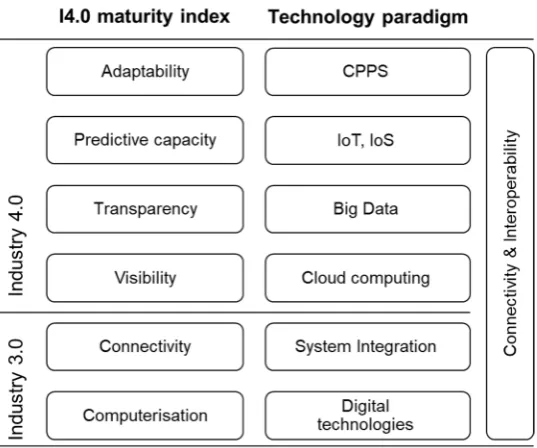
reach these different steps, many things need to be in place. Figure 1 shows a high-level list of what
59
technological solutions, or paradigms, that can be loosely connected with each step. The first step,
60
computerization, is to have a digital system as opposed to a purely mechanical one, a development
61
that once triggered the third industrial revolution during the 1950’s. The second step is to connect the
62
various digital systems. The academic discussion about the complexity of such interconnections
63
intensified during the 1980’s, during the Computer Integrated Manufacturing (CIM) era, which leads
64
to multiple frameworks of enterprise integration and interoperability [2, 11].
65
The third step is named visibility, which means to have a digital model of the factory. Data from
66
machines and sensors need to be collected and stored continuously so that the current state of the
67
production system is always known and based on facts. Collecting all the relevant data in a complex
68
manufacturing environment requires an efficient and scalable information system. A solution is to
69
utilize shared resource pooling and Cloud Computing technologies [12]. According to the National
70
Institute of Standards and Technology (NIST) cloud computing 'is a model for enabling ubiquitous,
71
convenient, on-demand network access to a shared pool of configurable computing resources (e.g.,
72
networks, servers, storage, applications, and services) that can be rapidly provisioned and released
73
with minimal management effort or service provider interaction' [3].
74
I4.0 maturity index four is called transparency, which means to make sense of the digital models
75
to understand the current situation. A central aspect of this is to use algorithms for data analysis in
76
Big Data applications. A popular definition of Big Data includes the four important V’s of data and
77
comes from an IDC report 2011 [13]. “Big data technologies describe a new generation of technologies
78
and architectures, designed to economically extract value from very large volumes of a wide variety
79
of data, by enabling high-velocity capture, discovery, and/or analysis.”
80
In the fifth step, predictive capacity, real-time data and analyzed information needs are linked,
81
aggregated, simulated etc. into useful information which can be used for decision-making. This aligns
82
with a certain aspect of IoT that focus on a layered architecture and the use of middleware [5].
83
Encapsulating functionality in well-defined services enables and simplifies data sharing between
84
new and legacy systems with IoS [6, 14].
85
The sixth and last step in the Industry 4.0 Maturity Index model is called adaptability. It is the
86
end goal of both Industry 4.0 and IoT, which is also referred to as smart manufacturing or smart
87
industry [15, 16]. A Cyber-Physical Production System (CPPS) is an adaptable system with the
88
capability to sense its environment and dynamically react to it. Since this reaction need to function at
89
different time scales, depending on which part of the system that needs to adapt, there is a need for
90
92
Figure 1. A high-level illustration of what technological solutions, or paradigms, that can be loosely
93
connected with each step in the Industry 4.0 maturity index model.
94
2.2 Technical interoperability and enabling technologies
95
Interoperability issues relate to technical, semantic, or organizational aspects [2]. Technical
96
interoperability aspects regard the data exchange between different information technologies at the
97
physical and syntactical level. When considering data for CPS in manufacturing it is important to
98
differentiate between configuration data and run-time data [7]. Configuration data is generated
99
during the design of the system and describes the physical parts of the system. Run-time data is
100
generated during the operational phase and describes the status of the manufacturing process.
101
Optimal synergies are achieved when these data types can share the same models, which require
102
usage of industrial standards for both design and operations. The automation engineering standard
103
Automation ML (AML) and communication standard OPC Unified Architecture (OPC UA) are
104
examples of standards that can be semantically linked [17].
105
Another core consideration when interconnecting systems is the layout, meaning how each
106
entity relates to others in terms of computation and decision making. The classical control system is
107
hierarchical and deterministic, operating with centralized decision making. In such systems, data
108
only flows vertically between child and parent nodes. The IoT paradigm assumes a decentralized
109
approach where data can flow horizontally. Such systems are event-driven and non-deterministic
110
where a more complex system emerge, which needs new methods to be managed [7]. A practical
111
approach to achieve CPS in manufacturing is to create a semi-hierarchical approach with emphasis
112
on modularization. An example is a solution by Wang and Haghighi [18], promoting a holonic
113
(modularized) system where each Holon is controlled by a software agent (autonomous unit).
114
Approaches to the layout problem, developed outside of the manufacturing domain, include
115
various platforms and middleware for IoT applications that have gained traction lately. IoT
116
platforms, also called frameworks or middleware, are systems that simplifies the integration of things
117
(e.g. sensors, machines, and equipment) through decoupling to enable IoT applications. There are
118
three types of IoT systems: service-based, cloud-based, and actor-based [19]. Service-based systems
119
are centralized heavy-weight generic platforms often deployed in a cloud environment [20].
Cloud-120
based systems are application specific services often tied to a specific product. Actor-based
121
middleware systems are flexible and scalable since they support deployment in different layers.
122
Examples of actor-based middleware are the Ptolemy framework, Node-RED, and Calvin [21-23].
123
Actors are reusable function blocks that can easily be deployed on different hardware. Some
124
supports the needed requirements [24, 25]. This allows computations closer to the network edge, thus
126
allowing for a more decentralized system, known as edge-networks or fog computing [26].
127
IoT systems are natural aggregators of data, often including data analytics capabilities for Big
128
Data applications. When data volumes grow the system requires technologies that can distribute
129
computing and storage capabilities and send a large amount of data between the different nodes.
130
There are several open-source projects that can enable these systems, such as Hadoop, Spark, and
131
Kafka [27-29] for distributed computing and data streaming. For data storage, the NoSQL databases,
132
which are more flexible than the traditional relational databases, is a key technology [4]. The term
133
NoSQL, which should be read as “not only SQL”, incorporates characteristics like non-relational,
134
distributed, open-source, and horizontally scalable [30].
135
Frameworks for CPS and IoT often include a middle layer that connects objects and applications
136
through services [31-33]. This is called a Service Oriented Architecture (SOA), which principle is to
137
connect business functions (services) from providers to consumers by using service locators or service
138
brokers [34]. A definition of a service, therefore, need to account for business and technical
139
perspectives as well as the consumer and provider perspectives but from the technical perspective, a
140
service is an encapsulation of functionality [35]. SOA is often used synonymously with Web-services
141
but this is only one implementation. Web services often comply with the Representational State
142
Transfer (REST) style that implies stateless interactions and a hierarchical resource representation
143
[36]. SOA is also supported by the above-mentioned communication protocol for industrial
144
automation, OPC UA. New communication protocols have also been developed to support
145
ubiquitous and sometimes limited hardware, such as Message Queuing Telemetry Transport (MQTT)
146
and Constrained Application Protocol (CoAP) [37, 38].
147
To interconnect all the ubiquitous equipment that is assumed in the IoT paradigm requires a
148
fast, robust, and scalable connectivity platform. The next generation open telecommunication
149
standard of cellular wireless technologies, 5G, is estimated to be commercially available around 2020.
150
As in previous cellular telecom standards, 5G is developed within the 3G Partnership Project (3GPP)
151
framework, building on components from the 4G/LTE, the prevalent telecom standard. Some of the
152
key characteristics of 5G are higher data rates, shorter delays, and high reliability [39].Requirements
153
integrated into the new standards reflect the needs of tomorrow, i.e. “a fully mobile and connected
154
society” [40]. Ongoing standardization efforts have defined several scenarios and connected them
155
with sets of requirements [1]. These requirements need several solutions, most of which already
156
partially exist [41].
157
3. Method and project description
158
The methodology applied to this work is the design science approach. Design science research
159
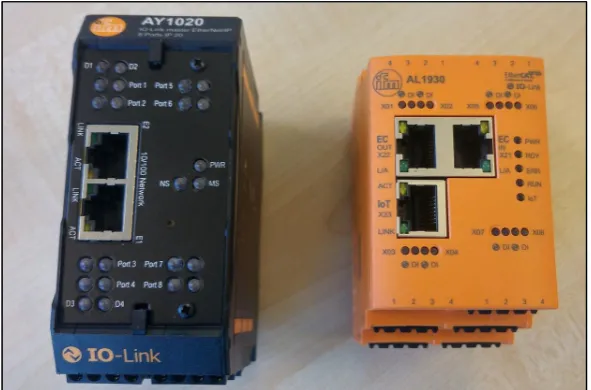
centers around artificial artifacts, designed and developed with the researchers deeply involved. This
160
methodology has been successfully used in information systems research where an artifact can be
161
software, hardware, a method, a theory etc. [42]. The crucial aspects of design science for information
162
systems research are illustrated in the information systems research framework developed by
163
Hevner, et al. [43]. An artifact is designed and evaluated in a design/test cycle. The design/test cycle
164
gets its relevance in an iterative process of adapting to real-life business needs and evaluating the
165
results in the intended environment, which in this case is the shop floor. The design/test cycle is built
166
on theories from the common knowledge base, and new learnings from the design/test cycle can often
167
result in new theories that should be communicated to contribute to new knowledge and expand the
168
knowledge base, this is called the rigor cycle.
169
As mentioned above, the project (5GEM) investigates how the next generation cellular networks,
170
5G, can support manufacturing industries in implementing smart manufacturing systems. Part of the
171
investigations was to deploy a cellular network on the shop floor, connect a grinding machine, collect
172
data from the grinding process, and to utilize that data in real-time and analytics applications. The
173
results from the applications provide the system feedback loop that can interconnect with an
174
automated system, e.g. controlling the machine directly, or be displayed to manufacturing operators
175
the fast and scalable connectivity that the infrastructure provided, this required software and
177
hardware designed to collect and transfer the data between source and utilization, which are the
178
relevant artifacts for this research. To connect a producing grinding machine to a cloud network
179
seems like a straightforward task. However, there are many things to consider regarding the technical
180
aspects. First, there is a question of what data that should be collected, then there is the problem of
181
how to collect that data, then that data needs to be transferred. Solutions for the latter are the relevant
182
artifacts that are further described in the results chapter. Figure 2 shows how these artifacts relate to
183
the project goal and infrastructure.
184
185
Figure 2. The artifacts described in the results section are the enabling technologies connecting the
186
grinding machine to the data consumers on top of the basic connectivity infrastructure.
187
3.1. Connectivity infrastructure
188
The project infrastructure is distributed over three Swedish cities: Gothenburg, Lund, and
189
Stockholm. See Figure 3 for an overview of the setup. In Gothenburg, the SKF factory is connected to
190
Ericsson’s facilities through a radio-link. The Gothenburg site is connected to Ericsson’s core network
191
and linked to facilities in Lund which is a data center that hosts a private cloud in terms of processing
192
and storage. The gathered data is also distributed to the data analytics site in Stockholm. On the shop
193
floor, the closest thing to a 5G network was deployed, which is a dedicated LTE network with “5G
194
enabling technologies”. Devices are connected to the network through either embedded modem (e.g.
195
LTE enabled mobile phones) or using external USB modems.
196
197
Figure 3. Summary of the project connectivity infrastructure.
198
3.2. Mobile Operator Support System
200
SKF has a specialized operator support system with an iOS client [44]. This system can take
201
advantage of a 5G connection in two ways. The first way is that the iOS hardware can directly connect
202
to a 5G system, which enables the user to send and receive data faster. This is useful when e.g.
203
streaming video instructions. The second way is to interconnect the operator support system with
204
the real-time data collected from the grinding machine and the possible results that come from the
205
data analysis.
206
4. Results
207
Data from the grinding process is collected through four separate systems: the grinding machine
208
onboard computer, a vibration system, IO-Link sensors, and an embedded sensor. While it is possible,
209
to some extent, to connect the sensors to the machine PLC and transfer all the data from the onboard
210
computer, that solution was opted out because it would require too much change in the machine, a
211
task requiring a very limited resource. Each system supports different communication standards
212
and/or methods, which made the overall system more complicated. To simplify this, the actor-based
213
IoT middleware Calvin was used for aligning the data transfer. Calvin is a distributed software
214
system, which allows its function blocks to run on different hardware while they communicate
215
seamlessly with each other. The reference implementation of the Calvin platform, Calvin-base [23],
216
runs on most Linux systems, which means that Calvin can run in hardware in the local cloud as well
217
as in the data center.
218
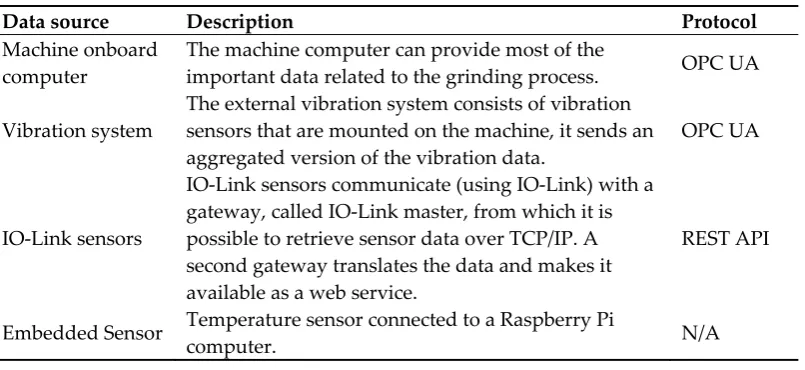
The different connected systems are summarized in Table 1. The grinding machine computer
219
and the vibration system are connected through the OPC UA standard, which they support to various
220
degrees. The external sensors support the IO-Link protocol, which allows data extraction directly
221
over TCP/IP. However, to simplify the connection to the Calvin actor, another gateway was
222
developed that translates the TCP stream and share the data as a RESTful web service. This
223
translation software was developed using the Play framework [45] and the raw data could be mapped
224
using the IO-link data sheets. The embedded sensor is a temperature sensor directly connected to a
225
Raspberry Pi computer. Since Calvin can run on Raspbian, the Linux distribution supported by the
226
Raspberry Pi, a Calvin actor can communicate directly with the embedded sensor.
227
Table 1. The different connected system from which the data is collected.
228
Data source Description Protocol
Machine onboard computer
The machine computer can provide most of the
important data related to the grinding process. OPC UA
Vibration system
The external vibration system consists of vibration sensors that are mounted on the machine, it sends an aggregated version of the vibration data.
OPC UA
IO-Link sensors
IO-Link sensors communicate (using IO-Link) with a gateway, called IO-Link master, from which it is possible to retrieve sensor data over TCP/IP. A second gateway translates the data and makes it available as a web service.
REST API
Embedded Sensor Temperature sensor connected to a Raspberry Pi
computer. N/A
229
To connect the systems to Calvin, support for each communication or device was needed. This
230
was achieved by implementing a plugin which handles all communication with the device or service
231
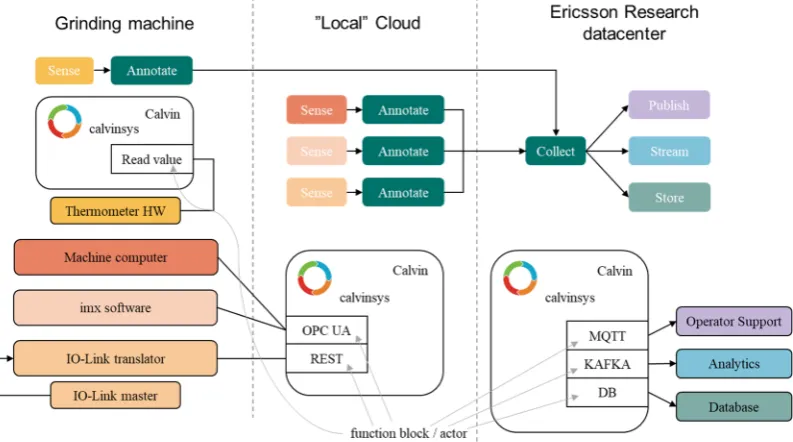
in the platform abstraction layer, called calvinsys. The Calvin application, visualized in Figure 4, is
232
running in a Calvin system spanning three instances – one on a Raspberry Pi located near the
233
machine, one in the local cloud in the factory, and one running in the Ericsson Research data center.
234
part of the platform itself. The function blocks, or actors, are distributed on the three calvinsys
236
instances and the communication between them is seamless, meaning that the physical separation of
237
the calvinsys instances is invisible to the function blocks.
238
When the data has been transferred to the cloud through the Calvin application, it is distributed
239
to three different data consumers: the database, the analytics application, and the mobile operator
240
support system. The operator support system already utilizes the publish/subscribe protocol MQTT
241
as the default communication protocol. After deciding on the structure for the topics for the MQTT
242
messages, a Calvin function block was implemented that publish the needed datatypes. The data is
243
also streamed to the data analytics center with the help of Kafka [29], which can also fetch stored
244
information from the database if needed. The database, called MongoDB, is a general-purpose
245
NoSQL database. Here the data is stored with value, timestamp, and origin of the data as key
246
components.
247
248
Figure 4. The Calvin application is distributed over three physical locations. One in the Raspberry Pi
249
located by the machine that reads the thermometer values, one in the local cloud in the factory reading
250
data from the machine and external sensors, and finally in the central private cloud to distribute and
251
store the data.
252
Each day, the application explained above collects and transmits about one million data entries,
253
most of them from the onboard machine computer. The data analytics experts use these entries to test
254
and evaluate new algorithms and approaches. At the shop floor, the operators can see and act on a
255
few of these data entries and remote monitoring and control can now easily be expanded upon.
256
5. Discussion
257
The described artifacts have been implemented and tested in a real-life production system at
258
SKF and have been proven to enable several steps towards CPPS. Scalable connectivity is achieved
259
through 5G for both stationary and mobile equipment. By exploiting Calvin as a common
260
connectivity platform together with open industry standards for data communication and storage,
261
relevant information is made visible in a cloud environment. Kafka and MongoDB are used to stream
262
aggregated data to the analytics center that can apply algorithms and increase system transparency.
263
Since Calvin also aligns the different type of connected systems, both locally in the factory and
264
centrally in the private cloud, it would also simplify the process of connecting more machines and
265
equipment, a prerequisite for more predictive capacity. Furthermore, the mobile operator support
266
system allows manufacturing operators to access real-time data and to share important information.
267
There are many ways to connect a machine on the shop floor and some of the described enabling
268
data from a machine at the shop floor there seem to be no obvious solution that fits a generic machine
270
setup. Machine suppliers are adding their own support for data collection but then there is the issue
271
of data ownership and supporting a multitude of different monitoring systems. The solution
272
described here is one generic way to acquire data from machines or equipment.
273
5.1. System layout
274
One important aspect regarding system layout is choosing between the different approaches
275
when it is possible to get the data in different ways. The machine onboard computer is the most
276
important system since it is the source of several datatypes that cannot be collected otherwise. Getting
277
this data proved to be a challenge because the computer had to be reprogrammed to gain access to
278
the desired data. This programming task directly, or indirectly, interfered with production since both
279
the machine and the engineer are valuable resources needed to run the manufacturing process. If
280
choosing e.g. IO-Link instead the solution is logically decoupled from the physical process.
281
Calvin is used for aligning all connections to the grinding machine. The result is identical data
282
collection applications over different connections and with high reusability. Another advantage is
283
the ability to run the function blocks, or actors, distributed in the local cloud. To have the platform
284
hosted inside the factory allow the system to function in isolation for a period, meaning it can
285
seamlessly store data to be transmitted later if the connectivity to the data center suddenly disappears
286
[19]. The Calvin application is created by defining the data flows, which is also the approach in other
287
IoT middleware. To create these data flows can be easier for people without experience in generic
288
programming languages, which should also be considered when choosing solution [19]. When
289
scaling the application, platforms like Calvin can also aid with the decision of software deployment
290
using the required-based approach [48]. This means that the function blocks can only run where the
291
correct requirement is met e.g. that there is a specific sensor present.
292
5.2. Communication standards
293
The plugin that needed to be developed in this situation was support for OPC-UA. While it was
294
straightforward to use existing open source solutions for the actual communication, there were some
295
issues with slight variations in the implementations that had to be considered. Upgrading software
296
in an industrial setting is not always an option, the machine in question is crucial to the
297
manufacturing process. This means that the adaptability of the IoT platform is important.
298
Two systems support OPC UA as the communication protocol, the grinding machine onboard
299
computer and the IMX (vibration system), which is a natural choice since it is an open,
platform-300
independent system that supports SOA and can enable other future synergies [17, 49]. A limitation
301
of OPC UA that was evident during this project is the difference in the various implementations that
302
is due to them being self-certified.
303
With the IO-link enabled sensors it is possible to extract the data directly bypassing the machine
304
computer. That avoids meddling with the machine program but it can also miss out on the possibility
305
of semantic alignment that adopting the OPC UA standard can enable. In this case, a separate
306
translation software was developed which required some work but modern software frameworks
307
simplified this task [45]. The solution presented here is a stand-alone REST API supporting the few
308
sensors that were mounted to the machine. Such implementation could be made to support almost
309
all IO-link sensors by connecting it to the common device library service that 2017-07-24 had more
310
than 80% of all devices documented [19, 50]. Since the presented application was developed, the
311
company IFM have released gateways with an IoT connection (Figure 5) which basically works
312
similarly to the REST API that was developed for this application, with a web service exposing the
313
315
Figure 5. IoT enabled IO-Link gateway to the right, the old one used for this application to the left.
316
MQTT is used to send real-time data to the mobile operator support system. The data is sent
317
using the JSON structure, which is the de-facto standard for Web services and aligns well with the
318
document database solution. There is little to say about that other than it shows the benefit of utilizing
319
well-defined open standards.
320
5.3. Open systems
321
Without a doubt, the open-source solutions were crucial for the implementations in this project.
322
This is true regarding both the data management infrastructure and end-point solutions. The open
323
systems for process distribution, data streaming, and data storage are industry standard and
324
developed and well tested through the emergence of large and well known social platforms [51]. For
325
systems like Calvin, the open-source approach is important since existing and future
326
implementations benefit from a large community that can share content. Using Raspberry Pi’s or
327
other low-cost microcomputers with attached hardware modules are excellent tools for testing and
328
verifying IoT solutions. However, to take advantage of these systems requires own responsibility and
329
overall system knowledge. Traditional industrial systems are hierarchical, centralized, and built for
330
robustness. This leads to stand-alone systems since each subsystem are built fully deterministic and
331
with a well-defined scope. Decentralized systems with more horizontal connections are more flexible
332
and complex [7].
333
6. Conclusions
334
A solution has been implemented in a real-life industrial setting and discussed regarding
335
technical interoperability, focusing on the system layout, communication standards, and open
336
systems. The findings are tied to the key question of improving manufacturing performance by tying
337
the technical implementation to the Industry 4.0 maturity Index model. From the discussion, it can
338
be derived that manufacturing enterprises need to internalize the knowledge of how IT systems can
339
be utilized to be able to connect their existing and new equipment while not being too reliant on
340
technology providers. The example of IoT enabled IO-Link sensors also shows the fast development
341
of available equipment but that this development will most likely align with existing efforts if current
342
standards and state of the art solutions are followed.
343
Acknowledgments: The authors gratefully acknowledge the financial support from the national, Digital
344
References
346
1. "3GPP TS 22.261: Service requirements for the 5G system; Stage 1," Release 15 ed, 2017.
347
2. F. B. Vernadat, "Technical, semantic and organizational issues of enterprise interoperability and
348
networking," IFAC Proceedings Volumes (IFAC-PapersOnline), vol. 13, pp. 728-733, 2010.
349
3. P. Mell and T. Grance, "The NIST Definition of Cloud Computing - Recommendations of the National
350
Institute of Standards and Technology," 1047-6210, 2011.
351
4. M. Chen, S. Mao, and Y. Liu, "Big Data: A survey," Mobile Netw Appl, vol. 19, pp. 171-209, 2014.
352
5. L. Atzori, A. Iera, and G. Morabito, "The Internet of Things: A survey," Computer Networks, vol. 54, pp.
2787-353
2805, 10/28/ 2010.
354
6. C. Schroth and T. Janner, "Web 2.0 and SOA: Converging Concepts Enabling the Internet of Services," IT
355
professional, vol. 9, 2007.
356
7. L. Monostori, B. Kádár, T. Bauernhansl, S. Kondoh, S. Kumara, G. Reinhart, et al., "Cyber-physical systems
357
in manufacturing," CIRP Annals - Manufacturing Technology, vol. 65, pp. 621-641, 2016.
358
8. M. Hermann, T. Pentek, and B. Otto, "Design Principles for Industrie 4.0 Scenarios," in 49th Hawaii
359
International Conference on System Sciences (HICSS), Hawaii, 2016.
360
9. S. Mittal, M. A. Khan, D. Romero, and T. Wuest, "Smart manufacturing: Characteristics, technologies and
361
enabling factors," Proceedings of the Institution of Mechanical Engineers, Part B: Journal of Engineering
362
Manufacture, 2017.
363
10. G. Schuh, R. Anderl, J. Gausemeier, M. t. Hompe, and W. Wahlster, "Industrie 4.0 Maturity Index:
364
Managing the Digital Transformation of Companies," acatech STUDY, Munich2017.
365
11. D. Chen and N. Daclin, "Framework for enterprise interoperability," Proc. of IFAC Workshop EI2N, pp.
77-366
88, 2006.
367
12. Q. Zhang, L. Cheng, and R. Boutaba, "Cloud computing: state-of-the-art and research challenges," J Internet
368
Serv Appl, pp. 78-18, 2010.
369
13. J. Gantz and D. Reinsel, "Extracting Value from Chaos," 2011.
370
14. N. Papakostas, J. O'Connor, and G. Byrne, "Internet of things technologies in manufacturing: Application
371
areas, challenges and outlook," pp. 126-131, 2016.
372
15. J. Gubbi, R. Buyya, S. Marusic, and M. Palaniswami, "Internet of Things (IoT): A vision, architectural
373
elements, and future directions," Future Generation Computer Systems, vol. 29, pp. 1645-1660, 9// 2013.
374
16. K.-D. Thoben, S. Wiesner, and T. Wuest, "“Industrie 4.0” and Smart Manufacturing – A Review of Research
375
Issues and Application Examples," Int. J. of Automation Technology, vol. 11, pp. 4-16, 2017.
376
17. R. Henßen and M. Schleipen, "Interoperability between OPC UA and AutomationML," The 8th International
377
Conference on Digital Enterprise Technology, 2014.
378
18. L. Wang and A. Haghighi, "Combined strength of holons, agents and function blocks in cyber-physical
379
systems," Journal of Manufacturing Systems, vol. 40, pp. 25-34, 2016.
380
19. A. H. Ngu, M. Gutierrez, V. Metsis, S. Nepal, and Q. Z. Sheng, "IoT Middleware: A Survey on Issues and
381
Enabling Technologies," IEEE Internet of Things Journal, vol. 4, pp. 1-20, 2017.
382
20. H. Derhamy, J. Eliasson, J. Delsing, and P. Priller, "A Survey of Commercial Frameworks for the Internet
383
of Things," presented at the 20th Conference on Emerging Technologies & Factory Automation (ETFA),
384
2015.
385
21. (2017-11-22). Ptolemy II. Available: https://ptolemy.eecs.berkeley.edu/ptolemyII/
386
23. (2015, 2017-12-15). Calvin - Lets Things Talk to Things. Available:
388
https://www.github.com/EricssonResearch/calvin-base
389
24. E. Latronico, E. A. Lee, M. Lohstroh, C. Shaver, A. Wasicek, and M. Weber, "A Vision of Swarmlets," IEEE
390
Internet Computing, vol. 19, pp. 20-28, 2015.
391
25. P. Persson and O. Angelsmark, "Calvin – Merging Cloud and IoT," Procedia Computer Science, vol. 52, pp.
392
210-217, 2015.
393
26. M. Yannuzzi, R. Milito, R. Serral-Gracià, D. Montero, and M. Nemirovsky, "Key ingredients in an IoT
394
recipe: Fog Computing, Cloud computing, and more Fog Computing," presented at the 19th International
395
Workshop on Computer Aided Modeling and Design of Communication Links and Networks (CAMAD),
396
2014.
397
27. (2017-11-05). Apache Hadoop. Available: http://hadoop.apache.org/
398
28. (2017-12-18). Apache Spark: Lightning-fast cluster computing. Available: http://spark.apache.org/
399
29. (2017-11-29). Apache Kafka: A distributed streaming platform. Available: https://kafka.apache.org/
400
30. (2017-12-18). NoSQL. Available: http://nosql-database.org/
401
31. L. Xu, W. He, and S. Li, "Internet of Things in Industries: A Survey," IEEE Transactions on Industrial
402
Informatics, vol. PP, pp. 1-11, 2014.
403
32. A. Botta, W. d. Donato, V. Persico, and A. Pescapé, "Integration of Cloud computing and Internet of Things:
404
A survey," Future Generation Computer Systems, vol. 56, pp. 684-700, 2015.
405
33. X. F. Liu, M. R. Shahriar, A. Sunny, L. S. N., M. C., and L. Hu, "Cyber-physical manufacturing cloud:
406
Architecture, virtualization, communication, and testbed," Journal of Manufacturing Systems, vol. 43, 2017.
407
34. M. Endrei, Patterns: service-oriented architecture and web services vol. 1st. Poughkeepsie, N.Y.: IBM Corp.,
408
International Technical Support, 2004.
409
35. R. Perrey and M. Lycett, "Service-Oriented Architecture," presented at the Applications and the Internet
410
Workshops, 2003.
411
36. R. T. Fielding, "Architectural Styles and the Design of Network-based Software Architectures," Doctor of
412
Philosophy, University of California, IRVINE, 2000.
413
37. IEC/ISO 20922. Information technology -- Message Queuing Telemetry Transport (MQTT) v3.1.1. Available:
414
http://www.iso.org/iso/catalogue_detail.htm?csnumber=69466
415
38. Z. Shelby, K. Hartke, and C. Bormann, "The Constrained Application Protocol (CoAP)," 2014.
416
39. "5G radio access – capabilities and technologies," Uen 284 23-3204, April 2016 2016.
417
40. "NGMN 5G Whitepaper," 2015.
418
41. I. F. Akyildiz, S. Nie, S.-C. Lin, and M. Chandrasekaran, "5G roadmap: 10 key enabling technologies,"
419
Computer Networks, vol. 106, pp. 17-48, 2016.
420
42. A. R. Hevner and S. Chatterjee, Design research in information systems: theory and practice vol. 22. London;New
421
York;: Springer, 2010.
422
43. A. R. Hevner, S. T. March, J. Park, and S. Ram, "Design science in information systems research," MIS
423
Quarterly, vol. 28, pp. 75-105, 2004.
424
44. M. Åkerman, Å. Fast-Berglund, M. Karlsson, and J. Stahre, "Introducing Customized ICT for Operators in
425
Manufacturing," Procedia CIRP, vol. 41, pp. 490-495, 2016.
426
45. (2018-02-28). play. Available: https://www.playframework.com/
427
46. J. Schlechtendahl, M. Keinert, F. Kretschmer, A. Lechler, and A. Verl, "Making existing production systems
428
47. D. Mourtzis, E. Vlachou, and N. Milas, "Industrial Big Data as a Result of IoT Adoption in Manufacturing,"
430
Procedia CIRP, vol. 55, pp. 290-295, 2016.
431
48. O. Angelsmark and P. Persson, "Requirement-Based Deployment of Applications in Calvin," Interoperability
432
and Open-Source Solutions for the Internet of Things: Second International Workshop, vol. 10218, pp. 72-87, 2017.
433
49. (2017-11-21). Unified Architecture. Available: https://opcfoundation.org/about/opc-technologies/opc-ua/
434
50. (2017-08-30). What is IO-Link? Available:
http://www.io-link.com/en/Technology/what_is_IO-435
Link.php?thisID=76
436
51. R. Sumbaly, Jay Kreps, and S. Shah, "The big data ecosystem at linkedin," Proceedings of the 2013 ACM
437