Stabilization Of Red Soil Used As A Sub-Base
Material
Rizwan Qayoom Sheikh, Er Vishal Yadav, Er Ashish Kumar
Abstract: As in many areas in India, high quality aggregate are getting scarce and is becoming very much expensive due to the requirement for highly quality aggregate in the flexible pavement is getting higher and also the transportation of such aggregates from distant areas increase its value and hence makes it expensive. Thus marginal aggregates comes into act in low volume roads by doing certain changes in the gravely soil to make it feasible for rural roads in India. So if we use such material in Sub-Base course by enhancing its chemical and physical properties leads us to improved construction material and monetary benefits can also be achieved. Therefore, this study is mainly concentrated upon boosting the properties of marginal material (Red Soil) by adding Lime and Cutback Bitumen. There was an attempt to use Lime to enhance the strength of the gravel soil (Red Soil) and Cutback Bitumen is used to increase the water resistant ability of the soil. All the work which involved the increasing the strength and the water resistant ability of the soil was expressed in terms of CBR and UCS value.
Index Terms: California Bearing Ratio, Cutback Bitumen, Lime, Maximum Dry Density, Optimum Moisture Content, Red Soil and Specific gravity. —————————— ——————————
1
INTRODUCTION
In different states of India availability of the high quality aggregates is becoming scarce at a very high rate and also the rates for availing such type of aggregates is very expensive due to the transportation of such material from very long distances. Also increasing amount of high quality aggregates used in the flexible pavement and in the asphalt concrete mix makes the scenario worse, hence reducing the amount of high quality aggregates. Thus marginal aggregates comes into act in low volume roads by doing certain changes in the gravely soil to make it feasible for rural roads in India. Use of these aggregates comes out to be cost efficient. Marginal aggregates can be defined as that material which is not normally feasible for road construction but it can be made usable for road construction in low volume roads by doing certain techniques like stabilization which changes the properties of such aggregates and makes it feasible for the construction of sub-base or base course. Also by changing the procedures of the construction and by changing pavement design of road makes these type of aggregates workable in road construction. Use of such aggregate are often considered but it can be made into use only after the complete study and testing whether we should use such material or not. And this decision whether or whether not to use this material in road construction should only be taken after the complete analysis. The characteristics which we analyze and also the affect of these characteristics on the pavement, its quality and the construction. Such areas which face this crisis should be properly identified and work should be done according to the characteristics of the soil or aggregate present there in bulk and appropriate designing and testing should be done to make that material feasible for road construction. The cost efficiency should also be considered.
This research would try to define the effect of using marginal aggregates in dynamic pavements in terms of engineering. Strategies will be tested to improve the performance of marginal aggregates equal to that of regular aggregates. The main focus for versatile pavements will be on marginal aggregates.
2
LITERATURE
REVIEW
B. K. Majumder; Animesh Das; and B. B. Pandey (1999) cement treated aggregate (marginal) like Laterite and pit run aggregates which are available in bulk in east area of India. Hence he transformed it into cost efficient building material for the low vol roads of the India by the addtition of the cement, sand of the river and aggregate. Patil and Patil(2013) have tried various sub-evaluation soil properties using soil stabilizer and poor materials that are generally accessible. The added substance such as RBI Grade 81 is used to enhance sub-assessment soil properties. Use moorum with RBI Grade 81 could enhance the CBR estimate of sub-level soil and decrease the development cost to some degree. From the CBR study, it is found that the splashed soil CBR estimate is increased by 476.56%, i.e. 2.56% to 14.76% by settling soil with 20% moorum and 4% RBI Grade 81. The different soil blends: moorum: RBI Grade 81 was tried for the highest dry thickness (MDD), ideal humidity content (OMC) and splashed CBR esteem for the distinctive extents. Al-Abdul Wahab and Asi (1997) used black-top and medium curing black-top emulsified settings to settle both marl and sand fall. Lime and Portland bonds (2% and 4%) were added to the settled soils in order to accelerate the healing process and reduce the strength of the water damage. It was found that stable operators improved both the performance of the shear and the impermeability to water damage to the damaged soils. Portland concrete was observed to be more compelling than lime. Swami, R. K. and Arun, Uma (2015) found out by using using appropriate stabilization techniques, the inferior locally available materials can be improved and used in lower layers of pavement. Wentao Li; Douglas J. Wilson, Ph.D.; Tam J. Larkin, Ph.D.; and Philippa M. Black, Ph.D (2019) evaluated cement and lime treated marginal Greywacke aggregate The continuous strain behavior of the marginal aggregate under soaked conditions improved significantly after the lime / cement stabilization, reaching levels close to and even better than that of the premium aggregate. Cement stabilization has been more effective than lime stabilization in improving the ————————————————
RIZWAN QAYOOM SHEIKH, MTech Scholar (Highway and Transportation Design), Department of Civil Engineering.Rimt University, Mandi Gobindgarh, Punjab,India Email: [email protected]
Vishal Yadav, Assistant Professor Civil Engineering Department, Rimt University, Mandi Gobindgarh, Punjab,India.
4540 marginal aggregate's permanent strain behavior which was
obtained by doing an X-ray diffraction test (XRD) and a repeated tri-axial load test (RLT) were used to investigate the material's mineralogical composition and permanent strain behavior. roads of the India by the addtition of the cement , sand of the river and aggregate. Ramana Murthy (2006) studies the impact of Moorum soil studied the impact of moorum with cement for base and sub-base on load deformation behavior of WBM test stretch. Significant improvement was recorded in elastic deformation after cement treatment. Settlement was decreased in this research by 17 to 36 percent and elastic settlement was decreased by 67 to 72 percent for WBM stretches cement treatment. After 12% of cement was added to moorum it became workable for the concrete pavement as its strength was adequately increased and is also an alternate for the expensive concrete pavements. A.C.S.V. Prasad & C.N.V. Satyanarayana Reddy (2015) researched upon the characteristics of cement stabilized well graded gravel by varying the amount of cement content by 6 percent; 10 percent and 14 percent. Hence tested the cube specimen by curing it with water for and 28 days and then checked its compressive strength and the results showed 20 percents increase CBR value in well graded gravel, MDD is also increased, compressive strength also increased.
3
OBJECTIVES
The ultimate objective is to build stabilized gravel for use in road building as marginal aggregates.
The aim of this research is therefore to use Red soil by focusing on the following characteristics.
To make the best use of Red soil in pavement construction
(in sub base course) by ensuring adequate strength and shear quality performance
To study Red soil characterization with Lime and Cutback
bitumen as additives.
4
METHODOLODY
4.1 MATERIALSUSED
RED SOIL: Red soil has many colors in India depending upon the topography of the states in the country. It can vary from red green white and sometimes it can also be black and blue. It has a very large amount of iron present in it which makes it varies its colors mentioned before. It has very less amount of hummus and magnesium and lime but pH of the red soilvaries from acidic to neutral. Metamorphic and crystalline rocks the rocks from which red soil is made from after the weathering for many decades. Also it is formed from acid granites and quartize rocks. It is chemically somewhat rich in aluminuim and silica and can vary from clay to sand which has different specific gravities. 10.6 percent of the country's total territory is covered by this soil. Such type of soil can be seen in different textures that can vary from clay to sand of which the most of the soil can be seen in the form of loam. These type of soils are gravely and in the uplands it can be porous but it is highly fertile and dark in the areas which are situated in the plains. The main material that is used in my study is Red soil which was collected from Orissa.
LIME: Lime refers to products which are derived from the calcined limestone which can be as quicklime and hydrated lime. It is a natural sedimentary rock which has a very high
amounts of calcium or magnesium and also small amounts of other minerals are also present in it. It can be mined from the quarries.
THE LIME CYCLE: This type of product has a ability to return to its original form after the processing of this lime. Burning calcareous to make fast lime is a process which is done in the lime. Hydrated lime is produce by the addition of the water to quicklime. At this period of time, co2 reacts with the hydrated lime to make it back to calcareous. Several years to an hour is needed by the hydrated lime to convert it back to the calcareous with the help of the processes done in industries. The benefits of lime stabilization include:
It enhances the relative stability of the soil.
It also enhances the CBR percentage and overall strength
of the soil.
It will also show resistance to the freeze thaw.
It will also show long time improvement in the preservation
of the soil.
CUTBACK BITUMEN: This type of bitumen can be classified by the penetration class of the bitumen. As using oils reduces its viscosity for temporary being. Then the reactant is evaporated in the air leaving the resultant bitumen again hard hence the initial viscosity is temporarily decreased. Bitumen penetration degree is somewhat thermoplastic, which shows different viscosity at different temperatures. Also the fact is very important that the product recovers to its initial place. As the temperature is increased fluidity is gathered for different types of Bitumen. Viscosity and time of heating is managed by varying the temperature and the addition of the volatile oil amount.
4.2 TESTSREQUIRED
SPECIFIC GRAVITY: Ratio of weight of given volume of the soil solids in the air, at a standard temperature which is 27 degree here in India, to the weight of an equal volume of distilled water in air at that temperature or it is the proportion btw heavy dirt solids and wt of same volume of the water is known as the Specific gravity. The temperature should be kept in mind while doing the test. Also gas refined free water should be taken. ―G‖ is the soil gravity. Particular gravity is important to find the thickness, void proportion & the porosity of the soil. This test was done in the volumetric flask whose dirt density is calculated and divided by heaviness of volume of the water. The specific gravity is determined at room temperature by this equation:
G = {w2 – w1} / {w4 - w1} {w3 – w2}
CALIFORNIABEARINGRATIOTEST
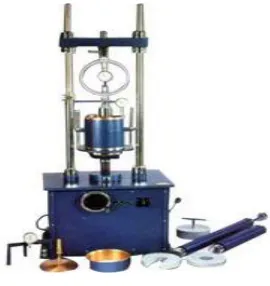
It gives us the material‘s resistance towards the penetration of the plunger. It was developed by CDH for calculating and
Tab 1: General Specific Gravity of different soils
TYPES OF
SOIL SPECIFIC GRAVITY
SAND 2.63 – 2.67
SILT 2.65 – 2.70
CLAY AND SILT 2.67 – 2.90
evaluating sub base course or the subgrade course construction materials for the pavements. It is done in remolded or undisturbed specimen. This test is done in order to find the asphalt thickness which is needed for the pavement. CBR is higher at 2.5mm penetration. The mould size for our tests done on the soil specimen is 2250cc which is the regular volume of the mould. The IS Sieve which was used in this research is 20mm sieve i.e; soil specimen should pass through 20mm sieve and should retain at 4.75mm sieve. The proctor test done on the soil specimen, hence maximum dry density came out to be 1.7gm/cc and optimum moisture content was 15 percent. Thus the CBR value was estimated at 2.5 mm penetration and also at the 5mm penetration. 4 days Red soil soaked CBR came out to be 12.6%.
Fig 1 : CBR Testing Machine
UNCONFINEDCOMPRESSIONTEST
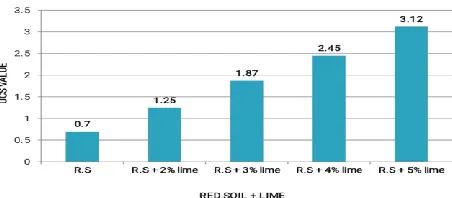
In this test load is applied axially at a constant rate of strain without any lateral support to the soil specimen and increased until failure occurs. The compressive load per unit area required to fail soil specimen under such conditions is called unconfined compressive strength of the soil. This test is applicable for cohesive soil. But this test is done as per IS 4332 part 5 for gravels. In this test soil is passed through 20 mm sieve (90% of the soil should pass through it) and should be retained on 4.75 mm sieve. UCS value for Red Soil was found out to be after testing, 0.705 kg/cm2
Fig 2 : UCS Mould and Plunger
5
RESULTS
AND
DISCUSSION
5.1 Basic engineering properties of Red Soil.
Table 2 - Basic properties of Red Soil
These properties were calculated by doing several tests on the red soil and the results are given in the above table. Several tests included the specific gravity test, plastic limit and liquid limit test and modified proctor test. These tests are done on the Red soil sample only before adding the stabilizing admixtures like Lime and Cutback Bitumen. In below table gradation of soil is given:
Table 3 - Gradation followed by Red Soil
IS SIEVE Percentage by weight passing within the range
80.00mm 100
40.00mm 100
20.00mm 100
10.00mm 85
4.75mm 45
600 micron 30
300 micron 18
75 micron 5
5.2 PROPERTIES OF THE RED SOIL WERE CHANGED AFTER THE ADDITION OF VARYING PERCENTAGE OF LIME:
Variation in OMC and MDD:
Table 4 - Variation in OMC after adding 2-5% of lime with
Red Soil
Soil + Additive Variation In OMC
Red Soil 15%
Red Soil + 2 % Lime 15.3%
Red Soil + 3 % Lime 15.7%
Red Soil + 4 % Lime 16.1%
Red Soil + 5 % Lime 16.6%
S. No Property Test result
1 Specific gravity 2.64
2 Liquid Limit,% 41
3 Plastic Limit,% 20.15
4 Plasticity Index,% 19.85
5 O.M.C,% 15
4542
Table 5 - Variation in MDD after adding 2-5% of lime with
Red Soil
Soil + Additive Variation In MDD(gm/cm3)
Red Soil 1.775
Red Soil + 2 % Lime 1.856
Red Soil + 3 % Lime 2.017
Red Soil + 4 % Lime 2.189
Red Soil + 5 % Lime 2.268
The optimum moisture content kept on increasing as the percentage of lime content was increased because of the lime which acts as pore filler and hydration initiator which leads to high water consumption. Hence the MDD increases as well.
5.3 VARIATION IN CBR AND UCS AFTER ADDITION OF LIME:
Fig 3 - CBR test variation graph
Fig 4 - UCS test variation graph
Lime acted as effective stabilizer which increased the load bearing capacity of the Red soil. Also the lime acted as pore filler and the cause for hydration initiator reactor in the soil contributed in the enhancement of the value of CBR of the Red soil and The UCS values increased as the lime content was varied from 2% to 5% in the soil which confirms CBR test results, hence proves to be a good stabilizer for Red soil. The
UCS test done on Red soil with varying percentage of lime is shown in below figure. Uni-axial load was transformed on the soil specimen and failure was noticed on the top of the soil sample.
5.4 CHANGE IN CBR and UCS VALUES AFTER ADDITION OF CUTBACK BITUMEN:
Fig 5 - CBR test variation graph
Fig 6 - UCS test variation graph
Increase in the CBR values from 1 to 2 percent addition of cutback bitumen in the Red soil while a gradual decrease can be seen while increasing the amount of cutback bitumen from 3 to 5 percent. At 2 percent CBR value is higher than normal Red soil and Same as in above CBR result increase in the UCS values from 1 to 2 percent addition of cutback bitumen in the Red soil while a gradual decrease can be seen while increasing the amount of cutback bitumen from 3 to 5 percent. At 2 percent UCS value is higher than normal Red soil. CBR is
calculated in percentage and UCS in kg/cm2.
Fig 8 – Testing of UCS sample
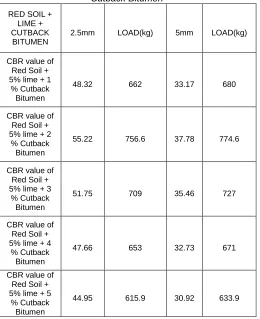
5.5 MAXIMUM VALUES OF CBR OBTAINED FOR RED SOIL AFTER ADDING 5% OF LIME AND 1-5% OF CUTBACK BITUMEN.
Table 6 - CBR value of Red Soil after adding Lime and
Cutback Bitumen
RED SOIL + LIME + CUTBACK
BITUMEN
2.5mm LOAD(kg) 5mm LOAD(kg)
CBR value of Red Soil + 5% lime + 1
% Cutback Bitumen
48.32 662 33.17 680
CBR value of Red Soil + 5% lime + 2
% Cutback Bitumen
55.22 756.6 37.78 774.6
CBR value of Red Soil + 5% lime + 3
% Cutback Bitumen
51.75 709 35.46 727
CBR value of Red Soil + 5% lime + 4
% Cutback Bitumen
47.66 653 32.73 671
CBR value of Red Soil + 5% lime + 5
% Cutback Bitumen
44.95 615.9 30.92 633.9
Fig 9 - CBR test variation graph
5.6 MAXIMUM VALUES OF UCS OBTAINED FOR RED SOIL AFTER ADDING 5% OF LIME AND 1-5% OF CUTBACK BITUMEN.
Table 7 - UCS value of Red Soil after adding Lime and
Cutback Bitumen
SOIL + ADDITIVES UCS VALUES(kg/cm2)
Red Soil + 5 % Lime + 1%
CBT 2.99
Red Soil + 5 % Lime + 2%
CBT 3.47
Red Soil + 5 % Lime + 3%
CBT 3.87
Red Soil + 5 % Lime + 4%
CBT 3.57
Red Soil + 5 % Lime +
5%CBT 3.45
Fig 10 - UCS test variation graph
5.7RESULTSREVIEW
Several tests were done on the different samples of the Red soil with the addition of lime and cutback bitumen separately and then mixing both additives in varying proportionate.
Tests were done upto5% of lime with varying percentage of cutback bitumen (upto5% ).
4544 IJSTR©2020
and 2% of cutback bitumen.
According to rulebook for low volume Indian rural roads 5% of lime and 2% of cutback bitumen is sufficient for the construction of sub-base course with Red soil.
5.8SUMMARYOFTHERESULTS
From the above results it was summarized that there is an increment in the CBR and UCS values of Red Soil with the addition of the Cutback bitumen and Lime as the stabilizers. So as per the requirements for the low volume rural roads of India the best combination which I choose is Red soil with 5 percentage of Lime and 2 percentage of Cutback Bitumen.
6
CONCLUSION
AND
FUTURE
SCOPE
The conclusion of my laboratory tests that was done on Red soil to make it possible for use in the rural roads of India is discussed in this chapter. Also this chapter addresses the scopes and the guidelines for the future research work.
6.1 CONCLUSION
The maximum dry density and optimum moisture content
was increased effectively due to the addition of the lime in the Red soil because it acted as pore filler and hydration reaction initiator.
The load bearing capacity of the Red soil was enhanced as the CBR values showed increment by adding lime and cutback bitumen to it.
The unconfined compression strength was enhanced with
the varying %age of lime. Also proving the results of the CBR test.
It is good for low volume roads but for high volume roads
more work is to be done to make it workable
The ultimate results showed increase within the CBR
value and the UCS value which demonstrates that it can be used in the sub base course, as it permits the IRC code for rural roads of India.
6.2 FUTURE SCOPE
My results showed increase in CBR and UCS values
upto5% of lime and varying percentage of cutback bitumen (upto5%), hence in future higher percentage of lime and cutback bitumen can be added to see the variation in results.
Many types of Bitumen emulsions can more over be
utilized within the Red soil stabilization to improve its properties with same tests i.e; CBR test and UCS test.
Bitumen emulsion and the cement combination can also
be used to see distinction within the results of Red soil. Many other added substances can be blended with Red soil like fly ash, stone dust etc to see the variations within the results.
Red soils quality can moreover be analyzed by different soil test such as I.T.S and Elasticity Unit test by adding Cutback Bitumen and Lime.
7
REFERENCES
[1] A. S. R. Rao and Gopal Ranjan 1991 Basic and Applied Soil Mechanics.
[2] Highway engineering by S K Khanna and Justo, 9TH
edition 2011.
[3] B. K. Majumder; Animesh Das; and B. B. Pandey
1999: Journal of Materials in Civil Engineering:
Volume 11 Issue 3 - August 1999.
[4] Patil and Patil 2016: International Research Journal
of Engineering and Technology: Volume: 03 Issue: 07 | July-2016.
[5] Al abdul wahab 1997: Building and Environment: Journal: Volume 32, Issue 4, July 1997.
[6] Swami, R. K. and Arun, Uma: International Journal
for Environmental Rehabilitation and Conservation 2015: Volume VI: No. 2 2015 [101 – 104].
[7] Wentao Li; Douglas J. Wilson, Ph.D.; Tam J.
Larkin, Ph.D.; and Philippa M. Black, Ph.D: Journal
of Transportation Engineering, Part B:
Pavements/Volume 145 Issue 3 - September 2019. [8] Ramana Murthy, V., Hari Krishna, P., Deva Pratap
2006: "Construction and evaluation of stable WBM stretches of cement": Journal: Volume: 21 Issue: 09 | May 2006.
[9] A.C.S.V. Prasad & C.N.V. Satyanarayana Reddy 2015: Strength characteristics of cement stabilized well graded gravel: Journal: Volume 17, Issue 8, January 2015.
[10] IRC SP 020: Rural Roads Manual: Indian Roads Congress
[11] IS 2720 (Part 5) - 1985 ‗‘Determination of liquid limit and plastic limit‘‘
[12] IS 2720 (Part 16)-1987 ‗‘Determination of CBR‘‘ [13] IS 4332 (Part V) - 1970 ‗‘Determination of UCS of
stabilized soils‘‘
[14] IS 2720 (Part 10) - 1973 ‗‘Determination of
unconfined compressive strength‘‘
[15] IS 2720 (Part-8) - 1983 ―Determination of Water Content Dry Density Relation using heavy Compaction‖
[16] Methods of test for stabilized soils: Part II Determination of moisture content of stabilized soils mixtures.