4127
Evaluation Of Performance Indicator Of Micro
Enterprises Working Under The Theeramythri
Project
Sethulekshmi J R, T G Manoharan,
Abstract— Theeramythri project was part of the rehabilitation program for Tsunami victims and concentrating on empowering women fisherfolk by raising their level of income by starting micro enterprises. As per the official parlance Theeramythri belongs to the core of core programme of Government of Kerala. Majority of the participants of Theeramythri are poor and vulnerable section of the society. An aid of Rs. 89 crores were distributed to the Tsunami affected for their betterment in daily and professional life. The Theeramythri project has provided financial assistance to 5000 selected women folk for starting various types of micro enterprises in 2010. In order to study the performance indicator of micro enterprises, four important factors are considered they are Marketing, Finance, Operations and Human resource management. We have taken 230 micro enterprises as sample size for this study. Multistage random sampling technique is used for selecting the sample and data collection. A structured interview schedule were used for collecting the primary data from the micro enterprise units. Percentage analysis, mean square analysis, Chi-square test for goodness of fit are the major tools used for data analysis. In this context a study is necessitated to assess the performance of micro enterprises under the Theeramythri project for taking necessary measures for the further improvement of the functioning of the enterprises in question.
Index Terms— Alternative livelihood, Fisherwomen, Micro enterprises, Performance indicator, South Kerala, Tsunami rehabilitation, Theeramythri project.
—————————— ——————————
1 INTRODUCTION
IN the fisheries sector, women play an important role in their fish related activities such as fish sales, fish drying, making value added fish products, fish packing and marketing. Long ago, in order to increase family income, women entered the marketing cycle in a more professional manner. Educational status of fisherwomen is comparatively very low, but they do multitasking to accomplish not only in fisheries but also in their families and communities. Generally, the status of women in the society is not equal to the men folk and this situation is too worse in the case of marginalized community like fisherfolk. This scenario needs to change and women in fishing activities must be considered as equal and successful members as in the mainstream society, which will definitely increase their own and family status and living conditions. Since 2005, the Kerala government has developed and implemented various programs to provide relief and rehabilitation to the affected, namely the Tsunami Rehabilitation Program (TRP), the Tsunami Emergency Assistance Program (TEAP) and the Prime Ministers National Relief Fund (PMNRF). An aid of Rs. 89 crores were distributed to the Tsunami affected for their betterment in daily and professional life and approximately 2500 livelihood initiatives and microenterprises of the Tsunami affected were facilitated and about 5000 fisher women were benefiting from this maneuver. The Society for Assistance to Fisherwomen (SAF) is an agency came in to being under the Fisheries Department, Kerala, immediately after the Tsunami, in June 2005 to emancipate the costal population from the disaster. Later, several Tsunami relief programs were merged in 2010 under a new and integrative livelihood programme called “Theeramythri”. The project is aimed at offering fisherwomen alternative livelihood opportunities by focusing on their empowerment for social, economic and gender areas.___________________
Sethulekshmi J R – Research Scholar, Amrita Vishwa Vidyapeetham
T.G.Manoharan – Assistant Professor(Sr.Grade), Amrita Vishwa Vidyapeetham
The main objective of Theeramythri programme are
1. To promote integrated sustainable development of the women fisherfolk of Kerala.
2. To promote alternative livelihoods among fisherfolk for enhancing their incomes and improving their quality of life
3. To encourage new livelihood avenues through capacity and skill building of fisherfolk.
4. To enhance the modernisation of technologies for improving efficiency and quality in livelihood ventures. 5. To build awareness among fisherfolk on quality
improvement in production processes.
6. To develop leadership and management acumen among fisherfolk through capacity building and training.
7. To promote common production and service centres. 8. To support the communities in production processes
as well as in marketing of their products and services.1
From beneficiary selection to funding, SAF is unique in its functioning and in turn empowerment of women. Theeramythri programme is spread across nine marine districts in Kerala, concentrating on empowering women fisherfolk by raising their level of income by starting micro enterprises. This project was part of the rehabilitation program for Tsunami victims. SAF has formed small scale fisherwomen‟s activity based groups and extended financial, technological and managerial support to set up local friendly small businesses. The beneficiaries should belong to the fishing community in order to start a new micro enterprise under this program and the age range is between 20 to 55 years old. Initially two thousand five hundred units were set up under various programs now falling to thousand micro enterprises. Earlier each group consists of ten members, which was reduced to six and finally to end with four members for better management of the business. The total number of live projects in South Kerala is 528. Tailoring and
garments, Fish and Fish processing, Provision stores, Trading stationary, Bakery, Hire service, Coir, IT and Information Technology Enabled Services (ITEs) are the main categories of entrepreneurial group assisted by SAF projects.
Each business‟s initial cost is two lakhs in which the department offers 80% of the total fund (Rs. 160000) as a subsidy. 5% for the fund as a beneficiary contribution, and 15% of the total cost as a repayable bank loan. Furthermore, the department also gives interest free loans (Rs.85000) for the unit‟s technological upgrade in the later stages where necessary. The group‟s success and failure entirely depend on the activity group members‟ cooperation and positive attitude towards their joint effort. The significant reason for joining in SAF programme is for enhancing their income and to achieve a self-sustainable alternative livelihood in the future. The activity group‟s main strength is its unity and efficient coordination. The group formation of the activity group is done through with the help of community leaders, Mission coordinators, Friends, Family members, and Media. The Theeramythri Management Council (TMC) is a panchayath level forum for activity groups. From its beginning stages of beneficiary selection to monitoring the group‟s functions, it is conducted via TMC meetings where the local panchayath leader plays an important role. It maintains good relationship with local leaders as financial transactions are managed through the TMCs. A revolving fund provides support to existing micro enterprises as working capital. The activity groups receive working capital support from the revolving fund without charging any interest. The various slabs of Rs.10000/25000/40000/ and Rs. 60000 are currently being provided as working capital revolving fund to the activity group. The success of the programme can be ensured through the continuous monitoring done by the coordinators. The mission undertaking by the coordinators to see all the financial transaction shall be clearly recorded for the better working of the women ventures. So the women entrepreneurs are encouraged to run the business without diverting fund for their personnel use. SAF has failed to create a brand name for all products under a single Theeramythri outlet. So consumers are not willing to buy products from the
Theeramythri activity groups. During Onam and other important festivals, SAF has setup various stalls for brand creation, engaging in various state and national exhibitions such as IITF etc. The activity group is very slow to expanding their new innovations by adding to its current product lines. Most of the products are manufactured under limited technology and their product quality is therefore poor. Different activity groups make different type of products across different states.
2.
REVIEW OF LITERATURE
SHGs have contributed to the development of the social and economic status of women and also empower women by increasing their income, expenditure and saving habits. They have developed self-confidence and independence among rural women, which in turn has increased rural peoples livelihoods. The success of any women empowerment strategy depends on the following factors they are education level, hard work, social customs, family planning, environment and collective strategies beyond micro credit to increase women‟s endowments enhance their exchange outcomes visa-viz socio cultural and political spaces are required for women empowerment. The study was based on identifying the various
aspects of the activity groups‟ performance appraisal with the objective of examining the current status of SAF activity groups and their impact on the empowerment of needy fisherwomen, identifying the important attributes that determine the performance or non- performance of innovators and laggards, analysing the performance or positive changes of the various categories of activity groups after involvement in the project Theeramythri (Shyam, Athira, and Reeja, 2017). The aim of the research paper is to determine the monitoring and evaluation of benefits of different units across different categories and to develop a blue print for their future goals and actions (Shyam,et.al., 2016)
The benefits acquired by the leader as well as the group members were discussed in the study, shortcomings in the current functioning, group cohesiveness, nature of group leadership and future requirements are also mentioned. In addition, the study identified the constraints in the current functioning of activity groups and suggested appropriate measures by establishing effective mechanisms for building trust between group members (Shyam.S. Salim, et.al, 2017). The results of this study disclose the major role played by the SHGs in increasing women‟s empowerment by making them financially stronger, more confident and helping them to make decisions (Shalumol, et.al, 2017).
3.
OBJECTIVE OF THE STUDY
To assess the organisational performance of micro enterprises working under the Theeramythri project in South Kerala.
4.
STATEMENT OF THE PROBLEM
The Theeramythri project has provided financial assistance to 5000 selected women folk for starting various types of micro enterprises in 2010. These enterprises are spreaded over on the nine coastal districts. It has been learned that 75 percent of the units are successfully functioning while others are either defunct or struggling to survive. Meanwhile, a few studies were conducted in order to understand the status of the working of these micro enterprises under the Theeramythri project. In this context it is imperative to have a serious look in to the functioning of these micro enterprises in order to assess their effectiveness. It is also learned that no serious studies has been undertaken to evaluate the working of Theeramythri micro enterprises. It is purported to assess the management functional areas of the organisation such as Operations, Finance, Human Resource Management, and Marketing. The financial discipline of the organisation is pivotal for its sustainability and growth. Better operational activities and marketing efficiency are also important for the successful functioning with the micro enterprises. Management of Human Resource within the organisation is also a determinant on the success of the organisation. A study is necessitated to assess the performance of micro enterprises under the Theeramythri project for taking necessary measures for the further improvement of the functioning of the enterprises in question. Thus, the study is entitled as “Evaluation of Performance Indicator of Micro Enterprises working Under the Theeramythri Project”.
5.
RESEARCH METHODOLOGY
4129 Theeramythri micro units. Secondary data for the study were
collected from Government Department of fisheries, Society for Assistance to Fisherwomen (SAF), Reports, and Journals. The unit of the present study is the fisherwomen micro enterprises under the Theeramythri project in the operational areas of Thiruvananthapuram, Kollam and Alappuzha Districts. There are 528 microenterprises running by the fisherwomen under the Theeramythri project in these three marine districts. The district wise distribution of micro enterprises are 140 units in Thiruvananthapuram, 215 units in Kollam and 173 units in Alappuzha. It is understood that out of these enterprises 81 micro units are defunct due to various reasons.We have used a formula (Yamene, 1967) for determining the sample. The formula for deriving the sample size from the population of micro enterprises is N = N/ (1+N (e) ^2, where „N‟ is the population and „e‟ is the value equal to 0.05. Thus the calculated sample size is 528/1+ (528*(0.05) ^2) = 228. But for the convenience of sampling pattern we have arisen the sample size to 230. 230 micro units were taken as total sample units for the study and the sample units from each district have been selected by applying the technique of proportionate random sampling. As such the sample size constitute 61 units in Thiruvananthapuram, 94 units in Kollam and 75 units in Alappuzha district. Out of 42 marine villages were micro enterprises are functioning, we have selected 10 villages from each district for taking the sample size of the micro enterprises thus, 6 villages were selected for covering study on 61 sample enterprises. The number of units selected from each village in Thiruvananthapuram district is 6 each. 10 marine villages were selected in order to collect the primary data from 94 sample micro enterprise thus 10 micro enterprises constitutes the sample enterprises from each village in Kollam district.
Micro enterprises are come under the study in Alappuzha district where also 10 villages were selected for covering study on 75 sample enterprise in the district. Thus, 8 micro enterprises were included from each village for collecting data from Alappuzha district.A structured interview schedule were used for collecting the primary data from the micro enterprise units. Percentage analysis, mean square analysis, Chi-square test for goodness of fit are the major tools used for data analysis.
6.
ANALYSIS AND INTERPRETATION
6.1 Demographic profile of Respondents
The demographic variables of beneficiary fisherwomen taken for the study are Gender, District, Marital status, Age, Religion, Education, Family structure, Employment of spouse, Before joining, After joining, Location of business, origin of business, Number of years, Area of business, Knowing about Theeramythri programme, Profitability, Owned or Rental, Hours spend, Monthly salary and Experience.
Table 6.1.1
Particulars Number of
Fisher women
Percentage
GENDER Female 332 100.0
DISTRICT Kollam 137 41.3
Thiruvananthap
uram 75 22.6
Alappuzha 120 36.1
MARITAL STATUS
Single 1 .3
Married 324 97.6
Widow 7 2.1
Divorce 0 0
AGE Up to 30 years 38 11.4
31-40 years 112 33.7 41-50 years 142 42.8 Above 50 years 40 12.0
RELIGION Hindu 188 56.6
Christian 144 43.4
Source: Primary data
The table shown above depicts the district wise classifications of respondents and according to that about 41.3 per cent of respondents reside in Kollam district, 22.63 percent of respondents are from Thiruvananthapuram district and 36.1 per cent of respondents belong to Alappuzha district. Gender wise classification of the respondents is clearly stated in the table and according to that, without a doubt we can say that 100 percentage of women from the fisherman community is a part of the project and are getting benefited from it. The subsequent category of classification is the marital status of beneficiary fisherwomen that is Single, Married, Divorced and Widowed. From what we have seen in the table it is quite clear that most of the beneficiary belong to the married category. The next distinction of employees is based on age factor and they are categorized as: up to Up to 30 years, 31- 40 years, 41-50 years, Above 50 years. According to the table 11.4 per cent of beneficiary respondents belong to the age group of Up to 30 years, 33.7 per cent of beneficiary respondents belong to the age group of 31- 40 years, 42.8 per cent of beneficiary respondents belong to the age group of 41-50 years and 12 per cent of beneficiary respondents belong to the age group of Above 50 years. An astonishing revelation is that preponderance of beneficiary fisherwomen is at the age group of 41 - 50. When there are 56.6 per cent of Hindu beneficiaries, 43.4 percent people belongs to the Christian community.
Table 6.1.2
EDUCATION Below SSLC 154 46.4
SSLC 123 37.0
Plus Two 38 11.4
Degree 15 4.5
Above Degree 2 .6
FAMILY STRUCTURE
Joint Family 33 9.9
Nuclear Family 299 90.1
EMPLOYME
NT OF
SPOUSE
Fisherman 231 69.6
Government
Employee 33 9.9
Private Employee 49 14.8
Own business 6 1.8
Unemployed 9 2.7
Gulf 4 1.2
Source: Primary data
respondents are in the Nuclear family covering 90.1 percent and only 9.9 percent of women belong joint family and this give a picture of the family structure of these fisherwomen. The data regarding the demographic variable of employment of spouse is collected from the beneficiary respondents for the purpose of study. The respondents‟ employment of spouse is categorized as Fishermen, Government Employee, Private Employee, Own business, Unemployed, and Gulf. 69.6 percent of them belong to the category of Fishermen, 9.9 percent belong to the category of Government Employees, 14.8 percent of respondents belong to the Private Employee category, 1.8 percent have their own business, 2.7 percent of these men are Unemployed and in those families women are the bread winners and 1.2 percent of men work at Gulf. This information throws light upon the fact most of the beneficiaries husbands are fishermen.
Table 6.1.3
BEFORE JOINING
House wife 85 25.6
Fish marketing 46 13.9
Student 1 .3
Akshaya 2 .6
Tailoring 63 19.0
Fish drying 19 5.7
Fish processing 4 1.2
Bakery 4 1.2
Prawn peeling 22 6.6
Fish packing 8 2.4
Fish sorting 12 3.6
Stationary 18 5.4
Hire service 8 2.4
Hotels and caterings 18 5.4
Beauty parlour 2 .
6
Net making 8 2.4
Coir 8 2.4
Tuition centre 4 1.2
Source: Primary data
Theeramythri project came to soothe the life of women belonging to the fisherman commune. Before the project got implemented majority of the fisherwomen, that is, 25.6 percent were housewives, 13.9 percent were in the field of fish marketing, as the income in these families were low only 0.3 percent were students, 0.6 percent of women worked in the akshaya centres, to make the two ends meet 19 percent of women chose the field of tailoring, fish drying and fish processing were two important categories that they preferred 5.7 percent and 1.2 percent respectively selected this category, 1.2 worked in bakery, 6.6 percent women went for prawns peeling, 2.4 percent of women went for fish packing and 3.6 chose fish sorting. 5.4 percent depended on stationary stores for their living, when 2.4 percent are in hire service 5.4 percent took hotels and catering to earn their living, a mere amount of 0.6 percent of women work in beauty parlours, 2.4 percent of women are in the field of net making, 2.4 percent of women are also in the field of coir making and 1.2 percent of women run tuition centres to earn their living.
Table 6.1.4
AFTER
Fish processing 58 17.4
Tailoring and Garments 83 25 Hotel and Catering 41 12.3
Provision store 42 12.7
Trading and stationary 21 6.3
Beauty Parlour 13 3.9
JOINING Hire Service 19 5.7
Tuition Centre 4 1.2
Coir 4 1.2
Akshaya 3 0.9
Bakery 44 13.3
Source: Primary data
The upshot of the project is that 17.4 percent of women got engaged in fish processing, 25 percent of women entered into tailoring and garments,12.3 percent now joined hotel and catering, 12.7 percent of women started working in provision store, 6.3 percent joined in trading and stationary industry, the percent of women working in beauty parlour got increased to 3.9, 5.7 percent joined higher service, 1.2 percent started tuition centres, 1.2 percent went in coir industry, 0.9 percent worked in akshaya and 13.3 percent of women worked in bakeries.
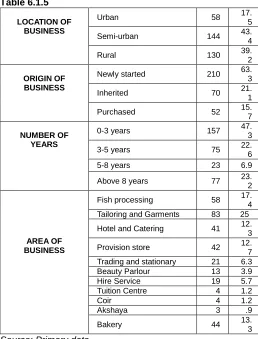
Table 6.1.5
LOCATION OF BUSINESS
Urban 58 17.
5
Semi-urban 144 43.
4
Rural 130 39.
2
ORIGIN OF BUSINESS
Newly started 210 63.
3
Inherited 70 21.
1
Purchased 52 15.
7
NUMBER OF YEARS
0-3 years 157 47.
3
3-5 years 75 22.
6
5-8 years 23 6.9
Above 8 years 77 23.
2
AREA OF BUSINESS
Fish processing 58 17.
4 Tailoring and Garments 83 25 Hotel and Catering 41 12. 3
Provision store 42 12.
7 Trading and stationary 21 6.3
Beauty Parlour 13 3.9
Hire Service 19 5.7
Tuition Centre 4 1.2
Coir 4 1.2
Akshaya 3 .9
Bakery 44 13.
3
Source: Primary data
4131 years, 5-8 years and Above 8 years. 47.3 per cent of
respondent beneficiary are belong to 0-3 years, 22.6 per cent of respondents belong to 3-5 years, 6.9 per cent of respondents belong to 5-8 years and 23.2 per cent of respondents belong to Above 8 years. Majority of the respondents belong to 0.3 years.
Depending on the area of business 17.4 percent of women got engaged in fish processing, 25 percent of women entered into tailoring and garments,12.3 percent now joined hotel and catering, 12.7 percent of women started working in provision store, 6.3 percent joined in trading and stationary industry, the percent of women working in beauty parlour got increased to 3.9, 5.7 percent joined hire service, 1.2 percent started tuition centres, 1.2 percent went in coir industry, 0.9 percent worked in akshaya and 13.3 percent of women worked in bakeries. Table 6.1.6
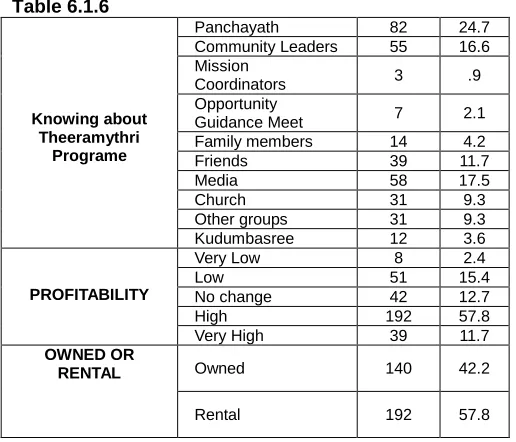
Knowing about Theeramythri
Programe
Panchayath 82 24.7
Community Leaders 55 16.6 Mission
Coordinators 3 .9
Opportunity
Guidance Meet 7 2.1
Family members 14 4.2
Friends 39 11.7
Media 58 17.5
Church 31 9.3
Other groups 31 9.3
Kudumbasree 12 3.6
PROFITABILITY
Very Low 8 2.4
Low 51 15.4
No change 42 12.7
High 192 57.8
Very High 39 11.7
OWNED OR
RENTAL Owned 140 42.2
Rental 192 57.8
Source: Primary data
The data regarding the demographic variable of knowing Theeramythri programme is collected from the beneficiary respondents for the purpose of the study. Based on the table figures, 24.7 percent of respondents belong to the Panchayath, 16.6 percent of respondents belong to community leaders, 0.9 percent of respondents belong to Mission coordinators, 2.1 percent of respondents belong to Opportunity Guidance Meet, 4.2 percent of respondents belong to Family members, 11.7 percent of respondents belong to Friends, 17.5percent of respondents belong to Media, 9.3 percent of respondents belong to Church and other groups, 3.6 percent of respondents belong to Kudumbasree.The maximum percentage of respondents revealed that, knowing Theeramythri is through Panchayath level.The beneficiary fisher women respondents are categorised based on profitability of the micro enterprises for the purpose of the study. Based on the table figures, 2.4 percent of respondents belong to very low, 15.4 percent of respondents belong to low, 12.7 percent of respondents belong to no change, 57.8 percent of respondents belong to High, and 11.7 percent of respondents belong to very high. There was a surprising preponderance of women from the High category.The building of the micro enterprises are categorised as owned or rental. As per the table 42.2 percent of respondents belong to owned and 57.8 percent of respondents belong to rental category. The lion portion of the respondents doesn‟t own a house and
are staying in rented houses.
Table 6.1.7 HOURS SPEND
1-5 years 11 3.3
6-8 years 256 77.1
More than 8 hours 65 19.6
MONTHLY SALARY
Below Rs.5000 76 22.9
5000-10000 41 12.3
10000-15000 163 49.1
15000-20000 50 15.1
Above 20000 2 .6
EXPERIENCE Upto 3 years 109 32.8
3-6 years 122 36.7
Above 6 years 101 30.4
Source: Primary data
The maximum hours spend by the beneficiary fisher women in their micro enterprises is categorised in to three. Based on the table figures, 3.3 percent of respondents belong to 1-5 hours, 77.1 percent of respondents belong to 6-8 hours and 19.6 percent of respondents belong to More than 8 hours. The penultimate classification is based on the monthly salary. The monthly salary brackets are as follows Rs.5000, Rs. 5000-10000, Rs. 10000-15000, Rs. 15000-20000, Rs. Above 20000. Based on the table 22.9 percent of respondents belong to the category of Below Rs.5000, 12.3 percent of respondents belong to Rs. 5000-10000, 49.1 percent of respondents belong to Rs. 10000-15000, 15.1 percent of respondents belong to Rs. 15000-20000 and 0.6 percent of respondents belong to Rs. Above 20000. Maximum number of respondents are from the salary category of 10000-15000.
The final category is experience and the beneficiary fisherwomen are categorised as Up to 3 years, 3-6 years, and Above 6 years. Based on the table 32.8 percent of respondents have experience of Up to 3 years, 36.7 percent of respondents belong to the experience range of 3-6 years, 30.4 percent of respondents have experience of Above 6 years. The maximum percentage of respondents belongs to the experience group of 3-6 years.
6.2 Assessment of performance indicators of the micro business unit
Source: Primary data
The rating of 332 beneficiary fisherwomen respondents shows that the marketing performance received by the beneficiary are at a high level as depicted in table. It is seen from the table that 78.01 percent and 73.19 percent of the beneficiary respondents opined that the Product and Price received by them are adequate while 10.53 percent and 12.34 percent of beneficiary opined that they are not received product and price adequately. 11.4 percent and 14.4 percent of beneficiary have rated neither positively nor negatively in respect of the variable Product and Price. In case of the variable place and promotion, the beneficiary respondents opined positively are 70.74 percent and 59.32 percent respectively while 12.95 percent and 17.16 percent of beneficiary have negatively opined in this regard. 16.26 per cent and 23.49 percent of beneficiary respondents have rated neither positively nor negatively in respect of the variables Place and Promotion. The above results of the rating are reiterated by the result shown through the mean score rating analysis shown in table. All the results are above to the statistical mean value of three. The mean score value of the concept Product, Price, Place and Promotion are 4.92, 4.20, 4.11 and 3.96 percent. And the overall mean score for the variable Marketing performance is 4.30 percent. The results clearly indicates that the marketing performance of beneficiary fisher women is at a high level based on beneficiary opinion.
Table 6.2.2
Source: Primary data
The rating of 332 beneficiary fisherwomen respondents shows that the performance of operational aspects received by the beneficiary are at a high level as depicted in table. It is seen from the table that 90.05 percent, 87.04 percent and 88.85 percent of the beneficiary respondents opined that the Timely procurement, Transportation and Storing received by them are
adequate while 6.32 percent, 6.61 percent and 5.71 percent of beneficiary opined that they are not received Timely procurement, Transportation and Storing adequately. 3.61 percent, 6.32 percent and 5.42 percent of beneficiary have rated neither positively nor negatively in respect of the variable Timely procurement, Transportation and Storing. In case of the variable Quality measures, Availability of goods, and Support system of suppliers the beneficiary respondents opined positively are 89.14 percent, 87.94 percent and 91.26 percent respectively while 4.81 percent, 6.91 percent and 6.02 percent of beneficiary have negatively opined in this regard. 6.02 percent, 5.12 percent and 2.71 percent of beneficiary respondents have rated neither positively nor negatively in respect of the variables Quality measures, Availability of goods, and Support system of suppliers. The above results of the rating are reiterated by the result shown through the mean score rating analysis shown in table. All the results are above to the statistical mean value of three. The mean score value of the concept Timely procurement, Transportation, Storing ,Quality measures, Availability of goods, and Support system of suppliers are 4.86, 4.91, 4.94, 4.68, 4.68 and 4.88 percent. And the overall mean score for the variable Marketing performance is 4.83 percent. The results clearly indicates that the performance of operational aspect of beneficiary fisher women is at a high level based on beneficiary opinion.
Table 6.2.3
Source: primary data
The rating of 332 beneficiary fisherwomen respondents shows that the Financial performance received by the beneficiary are at a high level as depicted in table. It is seen from the table that 64.45 percent and 84.33 percent of the beneficiary respondents opined that the Profitability and Liquidity received by them are adequate while 24.69 percent and 12.04 percent of beneficiary opined that they are not received Profitability and Liquidity adequately. 10.84 percent and 9.33 percent of beneficiary have rated neither positively nor negatively in respect of the variable Profitability and Liquidity. In case of the variable Solvency and Turnover, the beneficiary respondents opined positively are 87.04 percent and 57.82 percent respectively while 9.63 percent and 24.69 percent of beneficiary have negatively opined in this regard. 7.53 percent and 12.65 percent of beneficiary respondents have rated neither positively nor negatively in respect of the variables Profitability, Liquidity, Solvency and Turnover.
4133 And the overall mean score for the variable financial
performance is 3.90 percent. The results clearly indicates that the financial performance of beneficiary fisher women is at a high level based on beneficiary opinion.
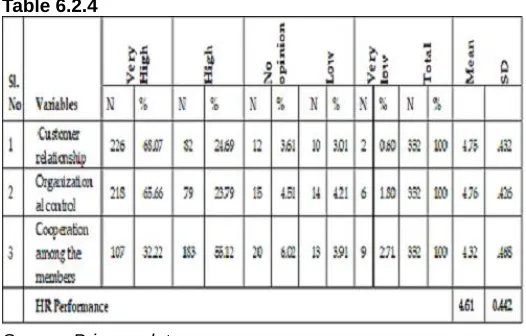
Table 6.2.4
Source: Primary data
The rating of 332 beneficiary fisherwomen respondents shows that the Human Resource performance received by the beneficiary are at a high level as depicted in table. It is seen from the table that 92.76 percent and 89.45 percent of the beneficiary respondents opined that the Customer relationship and Organisational control received by them are adequate while 3.61 percent and 6.01 percent of beneficiary opined that they are not received Customer relationship and Organisational control adequately. 3.61 percent and 4.51 percent of beneficiary have rated neither positively nor negatively in respect of the variable Customer relationship and Organisational control. In case of the variable Cooperation among the members, the beneficiary respondents opined positively are 87.34 percent respectively while 6.62 percent of beneficiary have negatively opined in this regard. 6.02 percent of beneficiary respondents have rated neither positively nor negatively in respect of the variables Customer relationship, Organisational control and Cooperation among the members. The above results of the rating are reiterated by the result shown through the mean score rating analysis shown in table. All the results are above to the statistical mean value of three. The mean score value of the concept Customer relationship, Organisational control and Cooperation among the members are 4.75, 4.76 and 4.32 percent. And the overall mean score for the variable Human Resource performance is 4.61 percent. The results clearly indicates that the Human Resource performance of beneficiary fisher women is at a high level based on beneficiary opinion.
Table 6.2.5 The Overall performance indicator of micro enterprises
Sl.No Area of Organisational
Performance Mean
Standard Deviation
1 Marketing 4.30 0.434
2 Operations 4.83 0.642
3 Finance 3.90 0.584
4 HRM 4.61 0.442
Total 4.41 0.526
Source: Primary data
All the results are above to the statistical mean value of three. Therefore the total mean score value of the concept Marketing, Operations, Finance and Human Resource are 4.30, 4.83, 3.90 and 4.61 percent. And the overall mean score for the performance indicator of micro enterprise is 4.61 percent. Therefore the total mean score vale of the overall organisational performance is 4.41. The results clearly indicates that the organisational performance of micro enterprise in the Theeramythri project is at a high level based on the beneficiary opinion.
H0: The organisational performance of micro enterprises working under Theeramythri project in south Kerala is not high Ha: The organisational performance of micro enterprises working under Theeramythri project in south Kerala is high
Table 6.2.6 Chi-Square test for goodness of fit to assess the organisational performance of micro enterprises working under the Theeramythri project in South Kerala.
Orgaisational
Performance Frequency Per cent
Chi-Square
Value
P Value
Low 77 23.19
273.74 <0.01**
Moderate 96 28.92
High 159 47.89
Total 332 100
Note: ** denotes significant at 1% level
Since the P value is less than 0.01, the null hypothesis is rejected at 1 Per cent level of significance. Hence the alternate hypothesis that “The organisational performance of micro enterprises working under Theeramythri project in south Kerala is high” stands accepted. The above table shows that maximum number of respondents gave a positive rank towards the organisational performance of micro enterprises working under the Theeramythri project. It indicates that the performance indicators of the micro enterprises has improved after the implementation of Theeramythri Projects.
7.
FINDINGS
1. The study revealed that there is a steady growth in the marketing performance of the micro enterprises working under the Theeramythri project.
2. The results clearly indicate that there is an increasing trend in the performance of operational aspects of the micro enterprises working under the Theeramythri project in south Kerala.
3. The study shows that the financial performance of the micro enterprises working under the Theeramythri project in south Kerala is at a high level based on beneficiary fisherwomen opinion.
4. The performance aspect of human resource management shows a greater progress of the micro enterprises working under the Theeramythri project in south Kerala.
5. Therefore it is revealed that there exist a steady growth in the organisational performance of micro enterprises working under Theeramythri project in south Kerala.
The Theeramythri project is aimed at offering fisherwomen alternative livelihood opportunities by focusing on their empowerment for social, economic and gender areas. The present study is focused on to evaluate the performance of micro enterprises working under the Theeramythri project in South Kerala. The sample size of the study was 230 micro enterprises proportionately selected from 10 marine villages from each district. The researcher has administered a questionnaire consisting of four components of performance indicator to assess the micro business unit. The study reveals that the performance indicators of the micro enterprises in the Theeramythri project is high due to the continuous monitoring done by the mission coordinators. The result of the study has found that the marketing performance, operational aspects, Human resource and financial performance of the micro enterprises has been increasing during the period of study. Therefore, the total mean score value of the area of organisational performance is 4.41. The results clearly indicates that the overall performance indicator of micro enterprises is at a high level based on the beneficiary opinion.
REFERENCES
[1] Shyam.S. Salim, et.al,” A PERFORMANCE APPRAISAL OF THEERAMYTHRI ACTIVITY GROUPS IN KERALA”, IMPACT: International Journal of Research in Applied, Natural and Social Sciences, vol.5, pp.135-150, Mar 2017. [2] Shyam, S Salim, Reeja Fernandez and Athira, N R,” Performance Appraisal of Theeramythri Initiatives in Kerala: Benefit Monitoring Assessment and Visioning for the Future”. Technical Report. ICAR-Central Marine Fisheries Research Institute, Kochi, 2016.
[3] Shyam, S Salim, Reeja Fernandez and Athira, N R,” Dynamics In Theeramythri Activity Groups:Analysing Coherence Among The Group Members”, Asian Journal Of Agricultural Extension, Economics & Sociology, pp.1-9, Feb 2017.
[4] Shyam S. Salim, Geetha R., “Empowerment of
fisherwomen in Kerala- An assessment, Indian Journal of Fisheries “, 73-80, 2013.
[5] Shalumol Salas,S.N. Ojha, V.Ramasubramanian, V.P. Vipinkumar and P.S. Ananthan, “Entrepreneurship based empowerment among fisherwomen self-help groups of Kerala” Indian J.Fish, pp. 106-111, 2017.
[6] Priya S.V and Sreeranganadhan K., “Gende Issues and Challenges of Fisherwomen to Become an Entrepreneur in Kerala”, 3rd
International HR conference, vol.3, pp.276-283, 2016.
[7] Lina Samuel, “ WOMEN, WORK AND FISHING; AN EXAMINATION OF THE LIVES OF FISHERWOMEN IN KERALA, SOUTH ASIA RESEARCH, SAGE, vol.27, pp. 205-227, 2007.
[8] P.Aswathy, K.Kalpana, “The „Stigma‟ of Paid Work: Capital, State, Patriarchy and Women Fish Workers in South India”, Journal of International Women‟s Studies, Vol.19, pp.113-128, May 2018.
[9] Biswas N., “Turning the tide: Women‟lives in fisheries and the assaultof capital, Economic and Political Weekly, vol.46, pp.53-60, 2011.
[10]P.Aswathy, K.Kalpana, “Womens work, survival strategies and capitalist modernization in South Indian small-scale fisheries: the case of Kerala”, Gender, Technology and Development, vol.22, pp. 205-221, Feb 2017.
[11]http://safkerala.org/theeramythri_programme.html
[12]R.J. Vidmar, “On the Use of Atmospheric Plasmas as Electromagnetic Reflectors,” IEEE Trans. Plasma Science, vol. 21, no. 3, pp. 876-880, available at http://www.halcyon.com/pub/journals/21ps03-vidmar, Aug. 1992. (URL for Transaction, journal, or magzine)
[13]J.M.P. Martinez, R.B. Llavori, M.J.A. Cabo, and T.B. Pedersen, "Integrating Data Warehouses with Web Data: A Survey," IEEE Trans. Knowledge and Data Eng.,
preprint, 21 Dec. 2007,