IJSRR, 7(4) Oct. – Dec., 2018 Page 1483
Research article
Available online www.ijsrr.org ISSN: 2279–0543
International Journal of Scientific Research and Reviews
Efficient Data Collection In WSN Using Grid Based Routing Protocol
With Multiple Mobile Sink
SowndharyaN.
Dept. of Computer Technology,KG college of Arts and Science,Coimbatore, India.
ABSTRACT:
Wireless sensor networks are limited in energy source, utilizing the sink mobility has been found a better choice to tackle the problem of limited energy conserved environment, this also may help to balance the node energy. Data dissemination to the mobile sink is difficult and challenging task and this creates a scheduling problem too for the resource constrained sensor nodes. This problem is due to the dynamic network caused by the mobility model. To improve the data collection in energy limited networks, the system proposes multiple mobile sink ability. This deploys more than one mobile sink in the network environment for optimal destination and different delay constrained nodes. While increasing number of mobile sinks, it may involve with many sub problems such as interference and coordination between Mobile sinks. In order to overcome the several existing problems, a novel scheme proposed named as GRP a Grid based Routing Protocol with multiple mobile sinks is proposed. Unlike the existing approaches, this enhances data delivery performance by using multiple mobile sinks and by deploying fine scheduling methodology is important points in the sensor field, the proposed scheme does not allow packet drop while overflow of data at such situation. It aims to optimize the trade-off between nodes energy consumption and data delivery.
KEYWORDS:
WSN, GRP, Energy Consumption,Multiple mobile sink,Cell header.*Corresponding author
N.Sowndharya
Dept. of Computer Technology,
KG college of Arts and Science,
KGiSL Campus, Thudiyalur road,
Saravanampatti, Coimbatore, India.
IJSRR, 7(4) Oct. – Dec., 2018 Page 1484
I.
INTRODUCTION
Wireless Sensor Networks (WSN) usually has thousands or hundreds of sensors which are
randomly deployed. Sensors are powered with battery, which is the most important issue in sensor
networks, since routing consumes a lot of energy. Such sensor nodes are deployed in thousands to
form a network with capacity to report to a data collection sink (base station) as seen in Figure 1.1.
An efficient routing scheme in sensor network is also important.In Wireless sensor Networks
unattended sensor nodes in the environment are expected to have significant impact on the efficiency
of many military and civil applications such as combat field surveillance, security and disaster
management sensor network.
Fig1 Architecture of WSN
Figure 1 Typical architecture of a wireless these systems process data gathered from multiple
sensor nodes to monitor events in an area of interest. For example, in a disaster management system
large number of sensors can be dropped by a helicopter. These sensor nodes can assist rescue
operations by locating survivors, identifying risky areas and making the rescue crew more aware of
the overall situation1.Such application of Wireless sensor networks not only increases the efficiency
of rescue operations but also ensure the safety of the rescue crew.
II.LITERATURE REVIEW
The proposed a tree based algorithm known as RD-VT (rendezvous design with a variable BS
track) to find the RP on SMT (Steiner minimum tree), where data will be efficiently buffered and in
turn decreasing the sink tour length. The tree based algorithm is a Steiner tree spans a given subset of
vertices of a graph. In the studies conducted in, the path of the mobile sink is fixed, and sensor nodes
are randomly deployed near the sink’s travelling path. Sensor nodes that are inside a mobile sink’s
communication range play the role of RPs and collect data from other sensor nodes. Xing et al.
[2008] propose RD-FT, where the movement of a mobile sink is governed by application deadline.
They also consider obstacles that restrict the movement of a mobile sink along a predefined path.
The objective is to find a set of RPs on the fixed path such that the length of data forwarding paths
IJSRR, 7(4) Oct. – Dec., 2018 Page 1485 required packet delivery time. Xing et al. in [2009] proposed two rendezvous planning algorithms
known as RP-CP (Optimal Rendezvous Planning with Constrained ME Path) and RP-UG
(rendezvous planning with utility based greedy heuristic). RPCP deals with constrained mobile sink
path. A tree is constructed which connects all the sensor nodes present in the field with sink node as
the root. A weight is assigned to each of the edges present in the tree. The weight corresponds to the
number of nodes uses that edge to transfer the data to the sink. To construct a path, RP-CP first sorts
all the edges with respect to their weight. Then the highest weighted edge is selected until the length
of the selected edges becomes less than or equal to the required packet delivery time1.
In this paper existing system, in multi-hop communications, nodes that are near a sink tend to
become congested as they are responsible for sending data from nodes that are farther away. Thus,
the closer a sensor node is to a sink, the faster its battery drops out, whereas those farther away may
maintain more than 90% of their initial energy. This leads to non-uniform utilization of energy,
which results in network partition due to the formation of energy holes. As a result, the sink node
becomes disconnected from other nodes, thereby impairing the WSN. Hence, balancing the energy
consumption of sensor nodes to prevent energy holes is a critical issue in WSNs. In existing works
the limitations such as the maximum number of feasible sites, maximum distance between feasible
sites, and minimum halt time govern the movement of a mobile sink and the problem occur to
determine how the mobile sink goes about collecting sensed data2.
Disadvantages
Time consumption because a mobile sink visits each sensor node and collects data via a single hop.
Loss of energy by visiting every node to collect data.
Intractable and impractical as the resulting because of increasing number of nodes.
III.METHODOLOGY
Effective data collection in wireless sensor network is a trivial task in order to perform the
above a novel scheme called GRP expanded as Grid based Routing Protocol with multiple mobile
sinks is proposed. Unlike the existing approaches, this improves data delivery performance by
employing several mobile sinks and by deploying fine scheduling at strategically most important
points in the sensor field, the proposed scheme does not allow packet drop at such situation. Main
idea is to optimize the trade-off between nodes energy consumption and data delivery3.
Proposed system describes about GRP scheme which includes the procedure of constructing the
virtual infrastructure and maintaining fresh routes towards the latest location of the mobile sink. A
IJSRR, 7(4) Oct. – Dec., 2018 Page 1486 where the total number of cells is a function of the number of sensor nodes3. This includes the
scheduling process and communication among cell headers over the sensor grid. A set of nodes close
to center of the cells are appointed as cell headers which are responsible for keeping track of the
latest position of the mobile sink and relieve the rest of member nodes from taking part in routes
re-adjustment. Nodes other than the cell headers associate themselves with the closest cell headers and
report the observed data to their cell heads. Adjacent cell headers communicate with each other via
gateway nodes. Before describing the methodology of GRP scheme, it is worthwhile to highlight the
various statements of the sensor networks4. In WSN Nodes are randomly deployed and throughout
remain static and all the nodes are of homogeneous architecture and know their location information.
Some sensor nodes adapt their transmission power based on the distance to the destination nodes.
The mobile sink does not have any resources constraints and it performs periodic data collection
from sensor nodes while moving around the sensor field and maintains communication with the
closest border-line cell heads for data collection2.
Grid based Routing Protocol (GRP) is proposed, whereby each sensor node is assigned in a
grid corresponding to its hop distance and the number of data packets that it transmitted to the closest
cell header. GRP is validated using extensive computer simulation that enables a mobile sink to
retrieve all sensed data within a given deadline while conserving the energy expenditure of sensor
nodes. The use of GRP, this helps to bound the tour length. This means a subset of sensor nodes are
designated as cell header, and other nodes simply forward their data to cell headers4. A tour is then
computed for the set of cell headers, which is called rendezvous is designed for selecting the most
suitable cell headers that minimize energy consumption in multi-hop communications while meeting
a given packet delivery bound. Another problem here is to select the set of cell headers that result in
uniform energy expenditure among sensor nodes to maximize network lifetime.
Advantages
To reduce energy consumption by reducing multi-hop transmissions from sensor nodes to
cell headers.
By selecting the sensor node that transmits the highest number of data packets and have
the longest hop distance from the tour and it reduces the network energy consumption.
Achieves 45% more energy savings and 29% better distribution of energy consumption
between sensor nodes.
GRP establishes a virtual grid structure that allows the fresh sink position to be easily
delivered to the grid and regular nodes to acquire the sink position from the grid with
IJSRR, 7(4) Oct. – Dec., 2018 Page 1487
The grid structure can be easily regulated. So this mitigates the hotspot problem.
The mobile sink selects cell header nodes along its path and the CH nodes relay sensor
data to the sink1.
Sink localization:
Sink localization is the process of identifying nearest mobile sink in the region. This
procedure calculates distance between each sensor node using the distance based algorithm. The
distance calculation technique uses absolute point-to-point distance estimates the range of node or
angle estimates in location calculation. So, distance-based methods require the additional equipment
but through that this can reach much better resolution than in case of range-free ones. In this process
the results of the inter node distance calculation is used. The calculated distances are converted into
geographic coordinates of network nodes. The coordinates of nodes can be calculated using
geometrical techniques2. The GRP is adopted to develop the accuracy of calculated estimates. This
algorithm will check the calculated coordinates and distances to increase the accuracy of location and
optimize the coordinates and distances.
Grid Construction
The grid consists of a set of nodes that are called the grid member nodes. As long as the grid
encapsulates center position of the network is predetermined, it can change. The shape of the grid
might be imperfect as long as it forms a closed loop. Various examples of the grid structure are
shown in Fig. 3.1.
After the deployment of the WSN, the grid is initially constructed by the following
mechanism: An initial grid size is determined. The nodes within the region considered as grid
member to the cell, which is defined by this boundary, by a certain threshold are determined to be
grid node candidates.
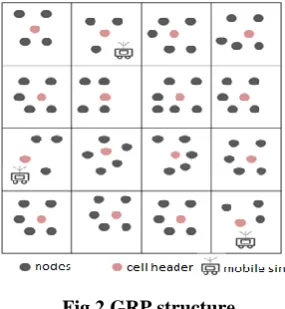
Fig 2 GRP structure
The above fig2 represents the overall structure of GRP, this shows the mobile sink traverse
IJSRR, 7(4) Oct. – Dec., 2018 Page 1488 is performed to collect data from each sensor node. And it also finds the neighbor grid nodes of each
cell. This step is crucial for the re nodes to be able to access the grid. Moreover, each node should
determine its position with respect to the grid.
In the proposed system, totally 100 nodes are randomly deployed over an area of size 800m x
800 m where the communication ranges of the nodes are assumed to be 60 m and the default grid
size is set to 120m.
GRP Selection and Re-scheduling Process
In this section, the chapter proposes the scheduling process of GRP, a novel grid routing
protocol for wireless sensor networks with multiple mobile sink. In this section, the chapter proposes
GRP, a novel grid routing protocol for wireless sensor networks with multiple mobile sink. GRP
have two roles on sensor nodes: cell header node and sensor node1. Cell header nodes form a cell
header structure which is a closed loop of single-node width shown in fig 2. The common process of
GRP is as follows.
Advertisement of sink position to the cell header periodically, Sensor nodes obtaining the
sink position information from the cell header whenever necessary, and Nodes disseminating their
data via the cell headers nodes if mobile sink is far else the sensor node transmits directly, which
serve as intermediary agents connecting the sink to the network. The three sensor roles are not static,
meaning that sensor nodes can change roles cell header the operation of the WSN. Three simple
assumptions are made before going into the details of the protocol
V.CONCLUSION
In Wireless sensor networks data collection from energy constrained nodes is an important
task. Mobile sink based data collection techniques has been introduced to perform optimal route
planning, data collection scheduling, and fast emergency message gathering by discovering the
multiple mobile sinks. This avoids data loss issues in energy restricted nodes by applying grid based
data collection and dissemination by sharing the positions of MS with their neighbors and also
addressed the selection of energy optimized node with stable path among the neighbors which not
only describes the selection of correct position neighbors but also best link stability RPs. Thus
overcome the data loss and also data dissemination failures. The availability of MS has been
identified with the duration probability of a MS that is subject to link failures caused by MS
mobility. The proposed work is implemented using NS-2. The performances are analyzed and
addresses that GRP scheme has reduced the packet loss and delay and increases the packet delivery
IJSRR, 7(4) Oct. – Dec., 2018 Page 1489
VI.FUTURE ENHANCEMENT
To increase the merits of the proposed research work, plan to investigate the following issues
in our future research:
An integrating the GRP in WSN protocol.
Simulate these algorithms in various mobility models and radio propagation models.
The distributed version of algorithms should be designed and applied to real environment in near future.
VI.REFERNCES
1. A. Erman, A. Dilo, and P. Havinga, “A virtual infrastructure based on honeycomb
tessellation for data dissemination in multi-sink mobile wireless sensor networks,” EURASIP
J. Wireless Commun. Netw., 2012;17(4): 1–54.
2. ShuaiGao, Hongke Zhang and Sajal K Das, "Efficient Data Collection in Wireless Sensor
Networks with Path-Constrained Mobile Sinks", IEEE Transaction on Mobile Computing,
April 2011;10(5): 1-20.
3. S. Gao, H. Zhang, and S. Das, “Efficient data collection in wireless sensor networks with