Characterising organic hydrogen bonds
Irene Nobeli
A thesis submitted to the University of London in partial fulfilment of the requirements for the degree of Doctor of Philosophy
ProQuest Number: U642784
All rights reserved
INFORMATION TO ALL USERS
The quality of this reproduction is dependent upon the quality of the copy submitted.
In the unlikely event that the author did not send a complete manuscript and there are missing pages, these will be noted. Also, if material had to be removed,
a note will indicate the deletion.
uest.
ProQuest U642784
Published by ProQuest LLC(2016). Copyright of the Dissertation is held by the Author.
All rights reserved.
This work is protected against unauthorized copying under Title 17, United States Code. Microform Edition © ProQuest LLC.
ProQuest LLC
789 East Eisenhower Parkway P.O. Box 1346
For my parents and fo r Oliver
A cknowledgements
Academic Acknowledgements
None of the work described in the following chapters would have been possible without the enthusiasm and continued support of my supervisor, Dr Sally Price. Learning from her and working with her has been both a privilege and a pleasure. It is my hope that, if, in any way, I have let her down, the completion of this Ph.D. will partially make up for it.
The last three years have been made not only easier, but also much more enjoyable from the presence of all the people in room 124. Thanks to everybody and for everything. From advice on how to login, to biochemistry lessons, and from the mystery of space groups, to correcting unreadable first drafts of this thesis, you have all been very patient and kind with me. Special thanks to Swee L. Yeoh whose final year project formed the basis for the work described in chapter V.
Drs Robin Taylor and Jos Lommerse have provided me with many useful discussions, especially during the critical period of my first year, and I am grateful for their help.
I am indebted to Dr Richard Wheatley, whose clear explanations and friendly advice helped me out during my struggle with the overlap model. Chapters VI and VII would not exist without his help, and without the software he kindly provided. The frequent references to his work reflect the impact of his ideas on the present study. Similarly a large part of this thesis is based on Dr Anthony Stone’ s work, who, without knowing it, has had a great influence on the development of many of the ideas in this thesis.
Acknowledgements
Personal Acknowledgements I should thank -at least!- the following people:
My mother and father -the first chemists I met- for 27 years of love and support. Although this is not the fascinating chemistry which they know, and which they taught me, it is chemistry, and it can, at times, be fascinating!
My brother who never fails to make me laugh.
Sally for two months extension in time, patience, and more...
Ana for her warm mediterranean smiles...and hot delicious soups! Gracias, they really kept me going...
Jas, Robert and David, who helped, one way or the other, to make my first year so special. When they left, I realised how quiet the office can get... Special thanks for these rare aerobics classes (they were not a total waste of time). And for managing a smile and keeping my spirits up at the gloomiest o f times.
X p u a a a and Giovanni, who always give me the illusion that the world is better than it really is. Euxotpiax©. Grazie.
• All the guys (and lately girls) that I used to refer to as “the Clary’s”, who added fun, parties, and considerable amounts of liquid vitamins to my time in UCL. Special thanks to Marcelo who would convincingly support ideas he didn’t believe in, just to have a discussion with me.
Theresa, Tanja and Helen from room 124 for the endless supplies of chocolate, sweets, and patience in those difficult times of write-up!
A bstract
Abstract
The intermolecular geometry and relative strengths of hydrogen bonds between alkanol fragments and aromatic heterocycles, containing nitrogen and/or oxygen acceptors, have been studied using a combination of statistical studies of organic crystal structures in the Cambridge Crystallographic Database, and intermolecular perturbation theory calculations. The variation in the strength of the hydrogen bond with the nature of the acceptor, the orientation of the donor molecule, and the influence of neighbouring groups is well reflected in the electrostatic component of the intermolecular energy. To model this variation, an anisotropic electrostatic model, such as distributed multipoles centred on the atoms, is required. This anisotropic electrostatic model, combined with a simpler empirically fitted 6-exp
dispersion-repulsion potential, successfully predicts the main trends in the relative strengths of the hydrogen bonds between a number of aromatic heterocycles and methanol, and it predicts intermolecular geometries for the complexes that qualitatively agree with the most commonly observed patterns in the database.
Table o f contents
Table of Contents
Acknowledgements (academic)... 3
Acknowledgements (personal)...4
A b stract...5
Table of contents...6
C h ap ter I. Overview...1 0 References for chapter 1... 14
C h ap ter II. The theory of interm olecular forces...15
II. 1. Introduction... 15
11.2. The forces between molecules... 17
11.2.1. Long range interactions... 18
11.2.2. Short range interactions... 19
II. 3. The calculation of intermolecular forces...19
II.3 .1. Intermolecular forces from experiments... 19
11.3.2. Intermolecular forces from ah initio methods... 22
II.3 .2.1. Supermolecule calculations... 23
11.3.2.2. Density functional theory... 25
11.3.2.3. Perturbation theory calculations... 27
I II.3.2.3.1. Perturbation theory at long range... 27
II.3.2.3.2. Perturbation theory at short range...32
II.3.3. Intermolecular forces in model potentials... 37
11.3.3.1. The need for model potentials...37
11.3.3.2. Types of model potentials... 37
11.3.3.3. Potentials for atoms... 39
11.3.3.4. Modelling the electrostatic interactions... 42
11.3.3.4.1. The central multipole expansion... 42
11.3.3.4.2. The point charge model... 44
11.3.3.4.3. The distributed multipole model...46
11.3.3.4.4. Penetration electrostatic energy... 51
11.3.3.5. Modelling the induction energy...51
11.3.3.6. Modelling the dispersion energy...52
11.3.3.7. Modelling the exchange-repulsion... 56
11.4. Summary... 58
II. 5. References for chapter II... 60
C h ap ter III. The natu re and modelling of the hydrogen bond...6 6 III. 1. A brief history of the hydrogen bond... 67
111.2. Definition o f the hydrogen bond...6 8 III. 3. The strength of the hydrogen bond...70
Table o f contents
III. 7. Directionality o f the hydrogen bond...80
III.7.1. The Legon-Millen rules... 81
III. 7.2. The geometry of the hydrogen bond in the literature...83
111.7.2.1. Statistical studies...83
111.7.2.2. Theoretical calculations...87
III. 8. Summary...8 8 III.9. References for chapter III... 90
C hapter IV. Hydrogen bonding properties of oxygen and nitrogen acceptors in arom atic... heterocycles... 94
IV. 1. Summary... 94
IV.2. Introduction...95
IV.3. Methods...96
IV.4. Results...98
IV.4.1 Results from the CSD searches... 98
IV.4.1.1. Nitrogen versus oxygen acceptors in the CSD... 98
IV.4.1.2. The geometry of the hydrogen bond in the CSD 98 IV.4.2. Results from theoretical calculations... 100
IV.4.2 .1 Geometry optimisation of the monomers... 100
IV.4.2.2. Scan o f the potential energy surface using a model... potential...101
IV.4.2.3. Intermolecular Perturbation Theory calculations.. . 103
I IV.4.2.3.1 IMPT at T>MA+6-exp minima...103
IV.4.2.3.2 IMPT at comparable geometries... 103
IV.4.2.3.3. Hydrogen bond length vs. strength...105
IV.5. Discussion... 105
IV.5.1. Nitrogen versus oxygen: Competition for hydrogen bonds... 105
IV.5.2. Effect o f other heteroatoms in the ring... 108
IV. 5.3. Directionality of the hydrogen bond...110
IV.5.4. Hydrogen bonds to the aromatic ring... 112
IV.5.5. C—H " '0 hydrogen bonds...113
IV. 6. Conclusions... 113
IV.7. Appendix for chapter IV... 139
IV.8. References for chapter IV... 150
C hapter V. The hydrogen bonding abilities of furans, phenols and anisoles... 152
V .l. Summary... 152
V.2. Introduction... 152
V.3. Method... 154
V.4. Results... 155
V.4.1 Results from CSD surveys... 155
V.4.2. Results from theoretical calculations... 156
V.5. Discussion...157
Table o f contents
C h ap ter VI.
Use of m olecular overlap to predict intermolecular repulsion in N H— O ...
hydrogen bonds... 165
VI. 1. Summary...165
VI.2. Introduction... 166
VI.3. Method...173
VT.3.1. Construction o f the potential energy surfaces for testing th e.... overlap model... 173
VI.3.2 Calculation of the overlap and overlap models... 174
VI.3.3 Evaluation o f the overlap model for the exchange-repulsion. 176 VI.4. Results and Discussion... 177
VI.4.1 The proportionality o f intermolecular overlap and IM P T ... exchange-repulsion...177
VI.4.2 Testing the assumption; Sp(iotai)«Sp (nh)+Sp^(no)... 177
VI.4.3 Results from the GMUL analysis...178
VI.4.3.1. Isotropic repulsion parameters... 178
VI.4.3.2. Anisotropic repulsion parameters...179
VI.4.3.3. Omission of small coefficients and its effect on the model... 180
VI.4.3.4. The neglect of variation of with interatomic separation...181
VI.4.4. Comparison o f the overlap models...181
, VI.5. Conclusions... 184
'■ VI.6. Appendix...197
VI.7. References for chapter VI... 198
C h ap ter VII. A systematic potential for the modelling of the oxalic acid crystal structures. . .200 VII. 1. Summary... 200
VII.2. Introduction...200
VII.2.1. The Modelling and Prediction of Crystal Structures... 200
VII.2.2. The role of intermolecular forces in crystal structures... 204
VII.2.3. Intermolecular force fields for carboxylic acids... 206
VII.2.4. The case of oxalic acid...208
VII.2.5. The potential used in this study...209
VII.3. M ethod... 210
VII.3.1. Distributed Multipole Analysis of the oxalic acid molecules... from the two polymorphs...2 1 0 VII.3.2. Derivation of the repulsion parameters...211
VII.3.3. Fitting o f the overlap-repulsion proportionality constant...212
VII.3.4. Fitting the pre-exponential parameters to atom-atom overlaps 213 VII.3.5. Derivation of the dispersion parameters... 214
VII.4. Results...215
Table o f contents
VII.4.4. Results from GMUL analysis...218 VII.4.5. Atom-atom dispersion coefficients... 219 VII.4.6. Results from crystal structure minimisation...220
VII.4.7. Fitting the pre-exponential A to the atom-atom overlaps....223 VII.4.8. DMAREL results from new A parameters... 224
VII.4.9. Results from normalising the H—O bond length to 0.971 A . ..
224 VII. 5. Discussion... 225 VII. 5.1. Comparison of the present model with FIT: The H —H and....
H—C interactions... 227 VII.5.2. Analysis of basis set effects on prediction for repulsion 227 Vll.5.3. Validity o f combining rules within the overlap model 229 VII. 5.4. Comparison of the two oxygen atoms...230 VII.6. Conclusions...230
VII.7. References for chapter VII... 251
Chapter V m .
I. Overview
Chapter I
Overview
Hydrogen bonds between molecules have attracted a lot of scientific interest due to their abundance in the solid state and their important role in the biological activity of molecules. This thesis is partly a theoretical investigation into the nature of hydrogen bonds aimed at understanding common patterns observed in crystal structures, and partly an effort to improve model potentials so that they more accurately reflect the potential energy surfaces of hydrogen bonds. This chapter gives an overview of the problems and solutions dealt with in this thesis.
I. Overview
means, that current assumptions of the transferability of parameters for such potentials, even amongst similar systems, need to be investigated.
This thesis begins with a study of specific systems, aromatic heterocycles containing N and/or O atoms. These heteroatoms are potential hydrogen bond acceptors and the comparative study of their hydrogen bonds to a molecule such as methanol is of interest to the design o f new ligands, where substitution o f nitrogen with oxygen would be an easy way of obtaining a distinct type of ligand from an existing one. This work uses a combination o f statistical studies from the Cambridge Structural Database (CSD)^ and intermolecular perturbation theory calculations (IMPT)^’^’'* on model systems to derive conclusions on the preferred acceptors and geometries among possible and often competing hydrogen bonds. Both approaches have advantages and limitations, and thus we use them as complementary in this study. Indeed, the agreement between the two methods is encouraging.
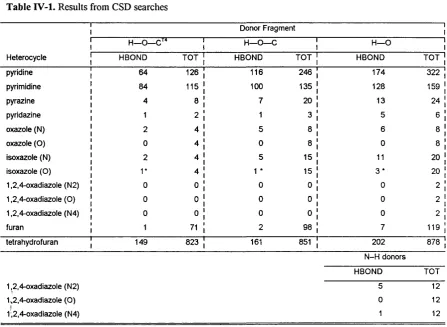
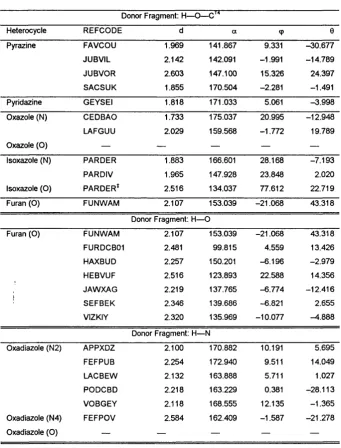
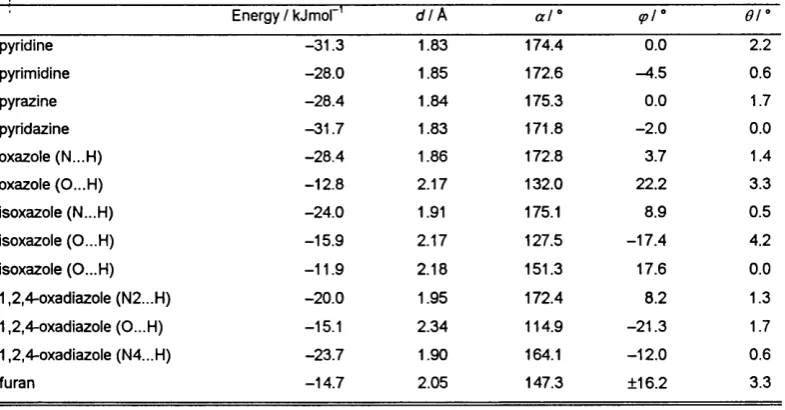
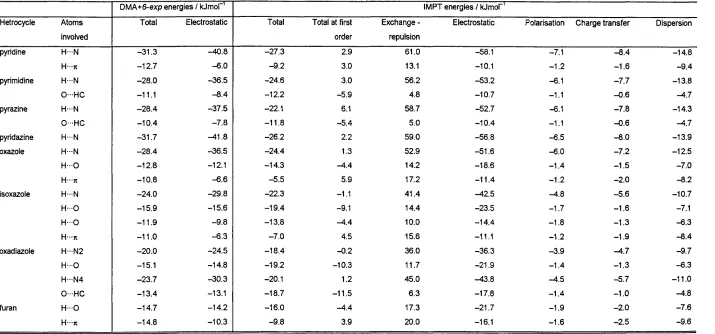
In the first part of results (chapter IV), the CSD is used to retrieve and analyse hydrogen bonds between C— O—H fragments and the nitrogen or oxygen acceptor in seven aromatic monocyclic heterocycles. Statistical analysis shows that hydrogen bonds to aromatic oxygens are very rare, and that bonds to nitrogen acceptors are mostly formed in the direction of the idealised lone pair. The directionality observed in the CSD is confirmed by IMPT calculations at the most energetically favourable regions of the intermolecular surface, located during a scan using an atom-atom model potential. The key feature of this potential is the representation o f the electrostatic forces using Distributed Multipole Analysis (DMA),^’^ which accurately models anisotropic interactions arising from the non-spherical distribution of charge densities around bonded atoms. The repulsion and dispersion are more conventionally modelled using an isotropic 6-exp form: Aqx^ { -oR) + C JI^, with A, B and C fitted to
I. Overview
bonds, but the variation of the energy with conformation is not large. Furthermore, it is found that the electrostatic component of the intermolecular potential makes a major contribution to the variation with conformation.
This study shows then that the use of an accurate anisotropic electrostatic model is indispensable in representing the variation with hybridisation and environment of the charge density on the atoms involved in hydrogen bonds. If the charge density varies considerably among these similar systems, it can be expected that this will not only influence the electrostatic component, but the other terms as well. In this thesis we focus our interest on the exchange-repulsion, which governs how close two molecules can approach each other, and which needs to be better modelled to reflect the variation of repulsion with different orientations of the donor and acceptor atoms, as well as the variation with hybridisation state of these atoms.
Chapter VI is an account of our attempt to go beyond the DMK+6-exp
potential to improve the representation of repulsion, and subsequently improve the determination of the hydrogen bond length. This thesis investigates the overlap model, which assumes that the intermolecular repulsion is proportional to the overlap of molecular charge densities. The usefulness of the overlap model in splitting up the total repulsion in hydrogen bonded systems into atom-atom contributions is tested. Furthermore, the derivation of an analytical anisotropic expression for the repulsion in N -'H — O hydrogen bonds is attempted. Methanol is used as a model donor, and pyridine and methylcyanide as hydrogen acceptors. The proportionality constant between repulsion and overlap is fitted to IMPT calculations for a large number of hydrogen bonded geometries. These geometries are representative of the bulk of the hydrogen bonds between pyridine rings (or cyanide groups) and alcohols observed in a collection of crystal structures, retrieved from the CSD. Although the anisotropy in the repulsion for the above systems is small, the method is generally successful in reproducing the IMPT value for the repulsion within the error inherent in the overlap assumption.
I. Overview
exchange-repulsion between oxalic acid molecules in the dimer, with the final goal of accurately reproducing the crystal structures of oxalic acid. Most empirically fitted transferable potentials for carboxylic acids do not perform well for at least one o f the two polymorphs o f oxalic acid. This is probably because oxalic acid is unique in that the two carboxylic groups are adjacent to each other. This would affect mostly the parameters for carbon, as these carbons must be very different than carbons in the alkane chain of longer carboxylic acids. Our isotropic repulsion potential, in combination with a Slater-Kirkwood dispersion model and a DMA representation of the electrostatics, and with no fitting to experimental data, performs better in reproducing the structures o f both polymorphs of oxalic acid, than an empirically fitted 6-exp potential which uses the same representation for the electrostatic forces. This non-empirical potential can be improved, if the pre-exponential parameters are fitted to a small number o f calculated atom-'-atom overlaps, so as to absorb part of the error from neglecting the anisotropy. This requires the use o f accurate exponents and consequently large basis sets. However, good exponents can be derived for a small molecule representative of a whole class of molecules (and assumed transferable for the whole class), thus allowing the use of much better basis sets, than the ones which would have been possible for larger molecules.
I. Overview
References for chapter I.
1. Allen, F. H., Davies, J. E., Galloy, J. J., Johnson, O., Kennard, O., Macrae, C. F., Mitchell, E. M.,
Mitchell, G. F., Smith, J. M., and Watson, D. G., J. Chem. Inf. Comput. Sci., 31 (1991), 187.
2. Hayes, I. C., and Stone, A. J., M olec. Phys., ^ (1984), 83.
3. Stone, A. J., Chem. Phys. Lett., 211 (1993), 101.
4. Stone, A. J., The Theory o f Intermolecular Forces, Oxford; Clarendon Press, 1996, chapter 6.
5. Stone, A. J., Chem. Phys. Lett., ^ (1981), 233.
IL Theory o f intermolecular forces
Chapter II.
The theory of intermolecular forces
n.l.
IntroductionThe science of chemistry deals mainly with the making and breaking of bonds between atoms, but the world around us is a manifestation of the forces between molecules. Everyday observations, such as the condensed phase of matter, suggests that even neutral molecules interact with each other, and that this interaction most often has both attractive and repulsive regions. Understanding the interaction of molecules is a pathway to understanding the physical world, and so it is a challenge very close to the chemists’ heart.
The title of this chapter refers to intermolecular forces, but it is much more common to discuss the interactions between molecules in terms of the potential {U)
II. Theory o f intermolecular fo rc es
F{R) =
(mi)
aK
In the simplified approximation, where the interaction of the two molecules is a function of their separation, chemical intuition tells us that the intermolecular potential will look like fig. II. 1. The idea of molecules attracting and repelling each other goes back to the 18th century when it was initially suggested by Boscovich, but it was Clausius in 1857 who first stated that attraction must be dominant at long range and repulsion at short, ^ giving rise to a picture similar to fig. II. 1. Eisenschitz and London^ showed that the shape of the potential curve arises from a balance of the long range terms and exchange- repulsion. The potential has a well around a minimum energy separation R=p, it goes through zero (at R=a, the collision diameter) as the molecules are brought together, and becomes positive fast as the molecular electron densities start to overlap. At distances larger than p, the attractive interaction must fall off slowly, as the intermolecular distance increases. It is worth noting here that the forces in fig. II. 1 become repulsive for separations smaller than p, yet the energy of the two molecules remains negative up to
R~<j. AI significant part of this dissertation focuses on the repulsive interactions in the area where the total potential is still negative.
Even this simple picture of the intermolecular potential would need either a large number of single-point calculations to describe it, or a mathematical form, some function of R involving parameters which need determination. In reality, the situation is far more complicated as most molecules are not even approximately spherical, and so their potential is not only a function of R, but also a function of orientation D. In the general case, we deal with a six-dimensional potential energy surface, three coordinates needed for the intermolecular vector R and three angles for the description of the orientation of the molecular axes of one molecule with respect to the axes of the other.
II. Theory o f intermolecular fo rces
methods. Finally, it concludes with a review of the attempts to construct model potentials, in an effort to substitute the computationally expensive, and often unknown, real potential with a mathematical function, the parameters of which are determined via experimental or theoretical methods. As it will become obvious, certain aspects o f the theory of intermolecular forces are given much more emphasis on account of their relation to the rest of the thesis. Thus, for example, the electrostatic and repulsion forces are particularly emphasised, as is the development of accurate model potentials based on the monomer wavefunctions. Consequently, this chapter does not do justice to every contribution to the intermolecular forces, and it is far from a comprehensive review of the subject. The reader is directed to the many cited references and a large number of books/reviews such as those by Hirschfelder,^ Margenau and Kestner,'^ Maitland et al,^ Pullman,^ Arrighini,^ Gray and Gubbins,^ Pertsin and Kitaigorodsky,* Huyskens et al^, and recently Stone.
n.2.
The forces between moleculesThe discussion in this chapter focuses on forces of electrostatic origin, and hence forces that arise from the presence of charged particles in molecules, i.e. nuclei and electrons. Of course magnetic and gravitational forces also exist between particles, but these are so weak that they cannot account for the strength of the observed intermolecular forces. These will therefore be ignored in this discussion.
The contributions to the intermolecular interaction are commonly divided into long- and short-range, the division being primarily a question of whether the overlap of charge distributions of the molecules can be considered negligible or not. The energy for long-range interactions has an inverse power relationship to the distance between the molecules, whereas the short-range one falls approximately exponentially with distance.
It is appropriate here to introduce also the concept of pairwise additivity. This is the idea that the potential of a collection of molecules A, B, C, D,...etc, can be treated as the sum of all two body terms;
UABCD... ...+ U (II:2)
II. Theory o f intermolecular fo rces
the presence of C, D ...Thus, the sum of the pair potentials differs from the real total intermolecular potential by a term This term can be split into different contributions, such as three-body, four-body terms etc, and even each one of these can be further split into more identifiable contributions. For example, one of the three body terms, known as the triple dipole energy was first derived and estimated by Axilrod and Teller. We shall see that the importance o f this concept stems from the fact that non-pairwise additive contributions to the intermolecular potential are naturally much harder to model. Each contribution to the interaction between molecules is described here briefly in terms of its physical significance.
11.2,1. Long range interactions
Electrostatic energy. This is the classical Coulombic interaction between the undistorted charge distributions of two molecules. For neutral molecules, it is due to the interactions between the non-spherically symmetrical distribution of charge due to the nuclei and the electrons. The electrostatic interaction between two molecules can be expressed in a straightforward way in the form of an integral over the charge densities of the molecules:
Ue,=
J
P
(n:3)r — r
all_space I 1 2 1
where is the charge distribution of molecule A, whose position (determined by the vector ri) is |r i-r2| distance away from molecule B.
The electrostatic interaction is pairwise additive, attractive or repulsive, and shows the greatest orientation dependence. Hence, it is expected to be the dominating force in determining the orientation of the interacting molecules.
Induction (polarisation) energy. A nonadditive, and always attractive term, the polarisation energy arises from the distortion o f the charge distribution on one molecule in the presence of the electric field of all surrounding molecules. For neutral molecules, it is normally the smallest (in magnitude) long range term. For example, the interaction of a charge and the dipole it induces will have an induction term that falls off as .
II. Theory o f intermolecular fo rces
perturbation theory - at higher order there are non-additive terms) term. It has no “classical” explanation, but it describes the mutual correlation of electrons belonging to different mononers, the effect being one o f lowering the energy.
77.2.2. Short range interactions
When charge overlap occurs, all long range terms are modified, and this effect must be taken into account for an accurate representation o f intermolecular forces. Charge overlap gives rise to terms known as penetration electrostatic, exchange induction and exchange dispersion. The last two will be ignored throughout this thesis, although they may have a non-negligible effect on the intermolecular potential. In addition, the following new types o f interaction arise at short range:
Exchange-Repidsion energy. This non-additive and repulsive term consists of two components: The exchange energy (pairwise additive and attractive), a non-classical term, describes the exchange o f electrons of parallel spin between two molecules, leading to a lowering o f the energy. The second term is a non-additive repulsion arising from the Pauli exclusion principle, which, in a naive interpretation, means that electrons with parallel spin cannot occupy the same space. Since the repulsion energy is approximately twice as large as the exchange energy, their sum is repulsive and it is actually the dominant contribution at short range.
Charge-transfer energy. This is an attractive term corresponding to the charge transfer which arises from excitations of electrons from occupied orbitals of one molecule to virtual ones o f the other. We shall see later on that the charge transfer energy is by definition meaningful, only when the molecular orbitals can be identified as belonging to one or the other monomer. Where no such definition is possible, the separation of the charge transfer form the polarisation energy is somehow artificial.
II.3. The calculation of intermolecular forces
77.5.7. Intermolecular forces from experiments
IL Theory o f intermolecular fo rces
determining and quantifying the interactions between molecules. In fact, there is still, and will always be, a complementary relationship between experimental and theoretical methods, as progress in either field challenges researchers in the other to provide support and confirmation for the new observation or prediction.
To the present day there is no direct way of measuring intermolecular forces. What are measurable are macroscopic properties which depend on the intermolecular forces through some functional form. This means that information on the forces must be extracted from experimental data and this is not an easy task. Experimental errors will hinder this procedure but more importantly success will depend on the theory that connects the observations to the forces. Often a set of experimental data may be equally well represented by many potential functions. Therefore some model mathematical form must be assumed, and then the data must be used to fit the parameters in the model. The fitting o f the parameters to experimental data is crucial, as the reliability of the potential in future simulations will be directly related to this fitting. A common problem is overfitting, i.e. constructing a model that fits the available data accurately but has little predictive pow er,. as it is a poor representation of the real potential. The use of sufficient experimental data that comes from a variety of sources is needed, in order to obtain a realistic potential. Theoretical guidance is indispensable in the extraction o f a potential from experimental measurements, as this can limit considerably the functional form and number of parameters for fitting. Testing an existing potential is a generally less demanding procedure, as there is no need for a large number of observations, as long as these are chosen carefully to cover as wide as possible a range of the distance and orientations that the potential is effective in.
II. Theory o f intermolecular forces
Spectroscopy is probably the single most important method for the determination of intermolecular potentials. Molecular beam microwave spectroscopy for example can be used to obtain the microwave spectra of weakly bound complexes. A disadvantage of this method is that the information obtained is averaged over the large amplitude vibrations of such complexes. Alternatively, far-infrared spectroscopy provides a wealth of information,^^ and advances in the lasers and detectors used in this method are responsible for the numerous investigations of complexes that led to information on the potential energy surfaces of Ar—HCl,^'* Ar--H2 0,^^ and Ar—HgN.^^
Molecular beam scattering experiments use two crossed beams of molecules to calculate properties such as differential cross sections which are directly related to the depth o f the potential and the separation of molecules at the van der Waals minimum. Scattering techniques provide information on both the attractive and repulsive parts of the potential and are thus complementary to spectroscopy.
Information on the intermolecular potential of gases is most commonly obtained from the second virial coefficient. This is the first of a series of temperature dependant coefficients describing the deviation of a real gas from the ideal gas behaviour, described as PV=RT. It depends solely on the pair potential, but, in practise, inversion of the virial coefficient data to obtain the potential is impossible, as in the general case o f two non linear molecules this coefficient is an integral over the six dimensions describing their distance and orientation. However second virial coefficients are often used as tests for the form and parameters of model potentials.
Other properties of gases, such as thermal conductivity,^^ or viscosity and diffusion coefficients*^ also depend only on the pair potential and so they can be used in theory to derive information for the potential. In practise these properties involve more complicated inversion procedures and so their use is limited to testing the validity of potentials.
II. Theory o f intermolecular forces
structures are very sensitive to the potential, at least for the orientations sampled in the crystals. Hence, crystal structures provide a good source of information for fitting of parameters in potentials.^”’^'
Finally, experiments are often used for the calculation of properties of the monomers, such as multipole moments, which can be used for the description of the intermolecular potential at long range. The dipole moment for example is often determined via measurements o f the dielectric constant or using spectroscopy (the Stark effect), or electron density maps from X-ray diffraction.^^ The anisotropy in the refractive index induced by non-uniform electric fields (induced birefringence) can be used to determine quadrupole moments.^^ Mean polarisabilities are related to the refractive index and they can also be determined from electric-dipole absorption spectra.
11.3,2. Intermolecular forces from ab initio methods
The following discussion on the accurate calculation of intermolecular forces is in fact not totally accurate as two basic assumptions are made. The first one is the neglect of relativisjiic effects. The theory of relativity tells us that no information can travel faster than the speed of light. This includes the “knowledge” o f one particle concerning the positions of other particles around it. Hence the basic assumption of quantum mechanics that the particles know exactly where other particles are, breaks down for distances where the information is delayed by the finite speed of light. This leads to retardation effects that must be considered in the potential. However, the distances we normally deal with are so small that neglect o f relativity is not a problem. Where it becomes important it can be taken into account using quantum electrodynamics^"^ but for the rest of this thesis it will be ignored.
II. Theory o f intermolecular forces
assuming them fixed in space is a valid approximation in most cases. The problem then reduces into a fixed-nuclei moving electrons one, in which the separation of the molecules can be defined exactly as the separation between two nuclei, or two centres of masses. In rare cases the Bom-Oppenheimer approximation will break down, such as when the nuclei move fast as in high energy molecular beam collisions, or if electronic quantum states of the same symmetry cross. However such situations will not be considered in this dissertation.
II. 3.2.1. Supermolecule calculations
The intermolecular potential between two molecules A and B can be defined as the energy required to bring A and B together from infinity, i.e.
u = - E g (11:4)
where Eab is the energy of the complex A - B, and Ea and Eb are the energies of the isolated molecules. The energies Eab, Ea and Eb are solutions of the time independent
Schrodinger equation;
!
H\ \ f = E\\f (11:5)
(within the Born Oppenheimer approximation). From equation 11:4, to calculate the intermolecular potential Uab we need to calculate the energies Eab, Ea and Eb. This is the supermolecule approach, as the complex A - B is considered as one entity (a supermolecule) for the calculation of the energy Eab- The Schrodinger equation has analytical solutions only for the hydrogen atom, so that the energies E are generally approximate solutions obtained from ab initio calculations.
II. Theory o f intermolecular forces
limit and it would be obtained with an ideally complete basis set. Even at the Hartree-Fock limit, the calculated interaction energy of the system will be only an estimate of the true energy, as SCF calculations do not account for the dispersion energy between molecules. This is due to the fundamental assumption o f SCF theory that each electron moves in the average field o f all others, its movement being independent of the movement of all other electrons. The electrons are said to be uncorrelated.
Methods which attempt to correct the SCF energy by including the correlation of electrons are known as correlation methods. Configuration interaction (Cl), coupled- clusters (CC) and Moller-Plesset perturbation theory truncated at various orders (MP2, MP4, etc), are all attempts to account for electron correlation. Including electron correlation adds, normally, a considerable amount of time to the calculation, and for rather large systems it may be altogether prohibitive.
In an ideal situation, complete basis sets would be used in conjunction with sophisticated methods for the electron correlation, and the true values of the energies of monomers and of the complex would be obtained for any separation and orientation of interacting molecules. In practise, even today’s supercomputers cannot cope with the task of calculating ab initio the true potential for even small sized molecules during simulations of the liquid phase, where thousands of such calculations are needed. We shall see later on that this is exactly where model potentials become indispensable.
II. Theory o f intermolecular fo rces
aware o f this problem, when balancing the quality of the calculation against time and hardware requirements.
A method for the calculation of molecular energies of interaction should be ideally independent of the basis set used. If this is not possible - and this is the case with current computers and software - what would be required of the method then, is that it produces results that converge slowly to a limit as the quality of the basis set gets better and better. However, the basis set superposition error (BSSE), i.e. the lowering o f the interaction energy caused by the use o f finite basis sets is a problem affecting most calculations. The BSSE problem stems from the fact that basis sets currently in use are never complete, and thus, a molecule A that is inadequately described by its own basis functions may use the basis functions of a molecule B to improve its own intramolecular description, as if the electrons and nuclei of B were not there. This is causing a spurious lowering of the energy of interaction. There are methods correcting BSSE (the most popular being the Boys- Bernardi counterpoise method^^), but for a long time there was controversy in the literature^^’^^’^^’^® on whether this is actually an overcorrection leading to underestimated interaction energies. Recently it has been argued that there is no problem of overcorrection.^^ In any case, the correction of BSSE is still an undeniable time- consuming task. A more promising approach for the future may be the a priori avoidance o f the problem. Gianinetti et al?^ have recently suggested such a method, based on a modification of the Roothaan equations, which they claim is particularly suitable for the computation of intermolecular interactions.
II. 3.2.2. Density functional theory
Density functional theory (DFT) is strictly not an ab initio but a semi-empirical m e t h o d . I t s basis is the theorem by Hohenberg and Kohn^'^ that the electron density p(r)
II. Theory o f intermolecular forces
Hamiltonian would be known, the waveflinction and energy of the system would be known, and from these every property o f the system could be calculated. This is ideal but it has very little practical value as it does not give any guidance on how to calculate the energy from a given density. However, it is possible to reduce the problem to the determination o f a functional known as the exchange-correlation functional. Following the Kohn-Sham^^ methodology, this functional is the equivalent of the exchange contribution in the SCF formalism. Once the exchange-correlation functional is determined, the DFT method is complete. It is not known whether the exact functional will ever be found. Indeed, it is not sure whether it even exists, which means that the basis of DFT is itself not very rigorous. But DFT methods can start from approximations for which there are exact solutions, such as the uniform electron gas (also known as LDA, the local density approximation), and improve using different approaches such as the Becke exchange correction,^^ and correlation functionals,^* or the Lee-Yang-Parr^^ correlation functional.
Theoretical chemists embraced in the last decade DFT methods which became extremely popular, mainly due to their reduced computational expense, as compared with correlatpd ab initio methods. Their applicability to the description of intermolecular potentials is however debatable, their main problem being their poor representation of the dispersion energy. Their accuracy has also been debated on the grounds that the numerical methods employed for the evaluation of the energy contain errors o f the order of intermolecular energies. Results from Pérez-Jordâ and Becke'**’ on rare gas diatomics were -not unexpectedly- poor as dispersion was severely underestimated. Del Bene et al.^^
11. Theory o f intermolecular forces
crystal structure) can be predicted within a few hundredths of an  using B-LYP and B3- LYP functionals, and a minimum TZ(2d,2p) type basis set (but this large basis set was of equivalent computational expense as a DZ(d,p) at the MP2 level). In any case, it should be noted that the failures of DFT can in principle be corrected, if the right functional is ever constructed, and so this method has the potential to play an important role in the determination of intermolecular potentials in the future.
II. 3.2.3. Perturbation theory calculations
Stone has argued'*^ that perturbation theory is a natural way o f calculating intermolecular forces, since they are relatively weak compared to the forces that keep molecules together, and that it is intuitive to treat them as a small perturbation to the total Hamiltonian for the interacting molecules. The attraction behind using perturbation theory is that, in essence, this is using information from the monomers to obtain the dimer potential energy. This idea will recur in this dissertation, as it is the basis for most efforts to develop simplified approaches to the calculation of intermolecular potentials.
113.2.3:^1. Perturbation theory at long range
Long range perturbation theory of intermolecular forces was first discussed by London'*^ but many have re-formulated it since, amongst them Margenau,'** Longuet- Higgins,'*^ and Buckingham.
At long range, perturbation theory is simplified because the exclusion principle can be neglected. More specifically, the wavefunctions of the monomers are non-zero in different non-overlapping regions of space, which means that the waveflinction of the complex does not need to be an antisymmetrised product of them. The assumption that electrons can be assigned to individual molecules reflects a “polarised” view of the complex, and hence it is also referred to as the “polarisation approximation”. There is a small error involved in the assumption that the wavefunctions do not overlap at long range, as the overlap can never be exactly zero. However, this error decreases exponentially with the increasing separation between the molecules, and it is already negligible at moderate separations of interest to the intermolecular potential.
II. Theory o f intermolecular forces
have Hamiltonians Ha and Mb, with the unperturbed Hamiltonian for the interacting system being simply; H^=Ha-^Hb. The perturbation V is then defined as the electrostatic (Coulombic) interaction between the electrons and nuclei of^4 and those o ïB \
i^A j€B
The zeroth order energy is the energy of a system with infinite separation of the monomers and it is simply the sum of the monomer energies:
U ' ^ = E \ + E l (11:7)
where: and |//g| Vg), and a and y/g are ground state
wavefunctions of the molecules A and B respectively.
From eq. 11:7 then the intermolecular potential should be the sum of all terms higher than zeroth order. At first order we obtain the electrostatic energy:
= (v> bH v> b) (n:8)
At second order, we obtain the induction and dispersion energies, which contain no terms with both molecules in the ground state. The induction energy of A is described by a term where A is at an excited state and B in the ground state:
U L = - E (U:9)
and vice versa for the induction energy of B\
u L = - Z ( n : i o )
Vb b
Finally the dispersion energy arises from the terms where both molecules are excited:
^ E... + £ . . . - E ° - E ‘!
IL Theory o f intermolecular forces
Here, the products Ya Yb are eigenfunctions of the unperturbed Hamiltonian i f .
It is important to note that SCF wavefunctions for the monomers can be used in perturbation theory to recover part of the dispersion energy, whereas in a supermolecule calculation, correlated wavefunctions are required for the dispersion energy to be included.
A physical interpretation is possible for the above terms, in the frame of the multipole expansion approximation. Following S t o n e , t h e perturbation operator F is re expressed as a power series in the intermolecular separation R in the spherical tensor notation:
V = QfT,„Q!
(n:
12)
This is a very compact notation, where the perturbation has been expressed in terms of the tensors T, and the irreducible components of the electrostatic multipole operators Q. A repeated suffix summation convention has been used, and there is a further abbreviation in that the subscripts t and u are each used to represent a spherical harmonic The interaction tensors T are defined in terms of the real components of the normalised S
functions, S , as:
where the subscript /; refers to the rank of the multipole on molecule A and k indicates
that we deal with real components. The tensors T depend only on the separation and relative orientation o f the molecules A and B. Hence, they can be tabulated and used irrespectively o f the molecules’ identities. Formulae for /y+/2<=4 have been given by Price
et and listed by Stone^® in a slightly different form. Hàttig and Hess^^ introduced later a simpler method for deriving these formulae and listed expressions for terms up to and including IT^. Hàttig^^ has recently published recurrence relations for the calculation of higher rank spherical multipole interaction tensors using the lower rank ones.
IL Theory o f intermolecular forces
scalar products of the unit vectors along the local molecular axes and the vector R from molecule A to molecule B. This is very advantageous in simulations where the potential needs to be evaluated many times for different intermolecular separation and orientations.
Coming back to eq. 11:13, we can replace F in the Rayleigh-Schrodinger scheme and obtain the components of the intermolecular potential in expansions of inverse powers
OÏR, as:
U = Y ,C „ X „ ,R - (11:14)
Cm depend on the properties of the monomers and Xm on the relative orientation of the molecules. The values of m will depend on the symmetry of the system, and, of course, on which component of the total energy is evaluated. As an example we can consider the simple case of the interaction between two dipoles. The expectation value of the multipole operator g / is simply the multipole moment Q^t, so that the electrostatic energy will be proportional to the product of f / f l and inversely proportional to as /;+/2+l=3 here. If we assume for simplicity that the intermolecular vector R lies along the z-axis, and the origin 6 f the system is molecule A, then the interaction tensor for the two dipoles becomes:
^
0,10=
;) + z" z")
(n;15)
where P is the unit vector along R, and - r is the projection of the local z-axis of molecule A on R.
Note that, as the electrostatic energy can be either positive or negative, the property o f the T tensors to average zero over all space means that this interaction will show the greatest angular variation, and thus it will be the most important term in determining the geometry o f the complex, irrespective of its magnitude.
//. Theory o f intermolecular fo rces
induction energy on molecule A will be a sum of terms including the polarisability of A and two multipole moments of B, and so, if more than one molecules are interacting with A,
the two multipole moments will not necessarily belong to the same molecule, giving rise to three body terms. The non-additivity of the induction energy introduces some severe problems in the commonly used pairwise additive potentials.
The multipolar expansion for the dispersion energy is more complicated. Equation II; 11 transforms to:
u , . . , = - Z
E E C C
('I' X \Qf IM'" )(v 0\Q!I \Qt IVX )('!'« |ô f I ' I ' a )
Now we need to separate this sum into a product of two terms, one containing A only, and the other B only. However, the denominator is a sum o f terms depending on A and terms depending on B, so such a separation is by no means trivial. One possible solution is the use o f the Casimir - Polder identity:”
'
(n:17)
a + b 71 •’0 (<7^ + œ ^ ){b^ + co ^ )
This is valid for a,b>0, so the identity is valid for the ground states o f A and B. This leads to an expression of the dispersion energy in terms of the polarisabilities of molecules A and
B at the imaginary frequency ioy.
u ,,,
=
(n:
18)
where a sum is implied over t,u,v, and w.
Another possibility is the use of the Unsold” or average-energy approximation. Setting the denominator of equation II: 16 to:
II. Theory o f intermolecular fo rces
with a product of polarisabilities:
Equation 11:19 reduces in the case of atoms to the London formula for the dispersion energy.
It is worth noting that both the multipolar electrostatic and induction energies of two spherical charge distributions are zero, and so the only interaction present at long range in this case is the dispersion energy.
The use of an expansion series for the description of the intermolecular potential naturally leads to the question of whether this series converges. Unfortunately for model potentials, the series at second or higher order diverges for any finite However, it converges asymptotically,^^ i.e. when R tends to infinity. In the case of the electrostatic interaction, the multipole expansion converges within a region, but it is slowly convergent for short separations. The convergence problems of the multipole expansion seriously limit its application to intermolecular potentials.
II. 3.2.3''2. Perturbation theory at short range
Perturbation theory as described in the previous paragraph fails at short separations of the interacting molecules. One reason is that, as we saw, the multipole expansion formalism fails to converge, although such an expansion is not really essential to the perturbation treatment. More importantly, the theory fails because it ignores the overlap o f the wavefunctions at short separations, and thus it cannot account for intermolecular repulsion arising from the Pauli exclusion principle.
IL Theory o f intermolecular fo rce s
set, their antisymmetrised products do not. This has the serious implication that these antisymmetrised products cannot be the eigenstates of any zeroth-order Hermitian Hamiltonian.
The problems of antisymmetrised wavefunction products lead naturally to the idea that it might still be possible to use the Rayleigh-Schrodinger formalism, if no antisymmetrisation takes place. The idea is that the unsymmetrised product functions can be used as starting points and the results should converge to the antisymmetrised function. In practise however, this is impossible, as it has been shown both analytically^* and numerically^^ that even for the simple case of H - H the perturbation expansion converges extremely slowly and is of no practical use. Moreover, as it was pointed out by Claverie,^” if the products of the antisymmetrised wavefunctions are not themselves antisymmetrised, then the Rayleigh-Schrodinger expansion will converge (if it converges at all) to what he calls the “mathematical ground state” (rather than the physical ground state), which is an unphysical lowest energy state that violates the Pauli principle.
It is then clear that some new approach to perturbation theory is needed for the short range interactions o f molecules. The so called exchange perturbation theories attempt to overcome the aforementioned problems. Comprehensive accounts of these methods and references to the numerous attempts have been given by Claverie,^’ Chipman
et Jeziorski and Kolos,^^ Jeziorski et and recently by S t o n e . I n general, exchange perturbation methods use either the orthogonal unsymmetrised product functions and they have to overcome the problem of the total wavefunctions not being antisymmetric (these are known as symmetry-adapted perturbation methods), or they use the non-orthogonal antisymmetrised product functions and must abandon the natural partitioning of the Hamiltonian (known as symmetric methods). Outlines of some of these methods will be given in brief. We will expand only on the Hayes-Stone perturbation theory (the one used in this work), which was the most accurate and computationally feasible method at the time that the calculations were performed.
IL Theory o f intermolecular fo rces
Musher and Amos/^ Hirschfelder/^ and Kirtman/^ An important contribution to symmetry-adapted methods was from Jeziorski and Kolos^^ who proposed an iterative scheme for the derivation of an antisymmetrised wavefunction for the system. The speed of convergence of the iterative procedure was improved by introducing symmetry-forcing. Electron correlation has also been included in this treatment, and a full program is now available that uses the symmetry-adapted perturbation approach.^'^’^'^ Details on these methods are beyond the scope of the dissertation, and the reader is referred to the original work for a complete description.
IL Theory o f intermolecular fo rces
Hayes and Stone^* suggested that a replacement of the eigenvalue equation
Hy/=Ey/hy the secular equation:
d e t( H -£ S ) = 0 (U:20 )
would overcome the problem of defining a zeroth order Hamiltonian. The procedure involves matrix elements between determinantal wavefunctions of non-orthogonal orbitals. Hayes and Stone** have provided the required expressions, the complex form of which has been a deterrent to the use of non-orthogonal spin-orbitals in perturbation theory. The secular determinant can be expanded about the leading diagonal yielding a perturbation expansion of the energy:
/>0
^ 2 y ~^OO^Oj)(^jk - ^OO^jkX^kO - ^ o o ^ k o ) ^
k>j>0 jj- ~ ^oo)i^kk - ^0 0)
In this expression the first term Hqq is simply the energy at first order, i.e. the sum
! ^ _ (Y" W Y ' )
of the zeroth and first order energies and it is an abbreviation for — -i—, where 'F ('F h r )
is the ground state Slater determinant of all occupied molecular orbitals on both molecules. The denominator is not generally 1 due to the non-orthogonality of the molecular orbitals. The separation into zeroth and first order energies is not a problem, as the zeroth order energy is simply the sum of the monomer energies, so the first order energy can be defined by difference.
Hayes and Stone chose to partition the energy at first order into three additive and one non-additive term. The additive terms are the zeroth order energy, the electrostatic energy between electrons and nuclei on the two molecules and the exchange energy from interactions o f electrons with parallel spin. The non-additive term is the repulsion arising from the overlap of the monomer charge distributions.
II. Theory o f intermolecular fo rc es
according to whether the electrons are excited to virtual orbitals in the same, or in different molecules. Single excitations within the same molecule result in polarisation energy (equivalent to induction at long range), and from one molecule to the other in charge transfer energy (which vanishes at long range). The distinction between the two is somehow arbitrary, as the use o f a complete basis set on one molecule would suffice to describe the electrons on the second molecule, and in this case, the meaning of charge transfer energy would be lost. From the double excitation terms the most important ones are the dispersion (mixing of single excitations in each fragment) and the charge transfer correlation. The latter arises from the correlation of one electron, transferred from the orbital o f one molecule to the orbital of the other, with an electron in the acceptor molecule. This last term would be included in the dispersion at the basis set limit, but it is advisable to include it separately*^ when small basis sets are used. The other three terms are known to be spurious and so they will not be considered here.
The use of SCF monomer wavefunctions, which neglect electron correlation within the same molecule, is introducing an additional small error. Part of this contribution is recovered in the “intramolecular correlation” second order double excitation term. This
I
term would actually represent the intramolecular correlation, if intermolecular overlap was neglected, which is not the case in this method.
II. Theory o f intermolecular fo rc e s
II. 3.3. Intermolecular forces in model potentials
II. 3.3.1. The need fo r model potentials
The need for accurate intermolecular model potentials cannot be overestimated. Ideally we would like to know the exact value of the potential on any point in the intermolecular potential energy surface. This means either a complete, known analytical function of the potential which is clearly not available, or the possibility o f very accurate (preferably exact) calculations at every single point on the surface. The previous paragraphs have shown that exact treatments are possible (in theory) only for some of the components, and only within a range of intermolecular separation. In practise, it is for very few systems that almost exact calculations are feasible. The size of the problem is probably better understood with the use of an example. Mok et al.^^ used no less than 20480 points to characterise the intermolecular potential energy surface of the water dimer. This was possible using density functional theory calculations, but it can be easily understood that a more elaborate ab initio method and a larger system would have made such a calculation impossible. Symmetry-adapted perturbation treatments, for example, have been performed to our knowledge for nothing larger than uracil-water.^^
II. 3.3.2. Types o f model potentials
There is no unique way of categorising model potentials. One obvious way would be perhaps to make a distinction between empirical potentials fitted to experimental data or ab initio calculations, and those that are derived from theory. In the first case, an assumption is made of the functional form of the potential, and the parameters in the model are fitted to the available data. In the latter case, theory is employed to derive an analytical form, although some approximations are often necessary for simplicity. Potentials from first principles have the very obvious advantage that they can be improved, if the theory they are based on is improved. Such an improvement is not generally possible for models based on empirical observations, which normally lack any rigorous justification.
II. Theory o f intermolecular fo rces
set o f like-molecules, or even models that are supposed to be valid for many different systems. The latter are likely to be very simple in form, and not very accurate.
IL Theory o f intermolecular fo rces
A final distinction between potential forms is based on whether they are isotropic, i.e. the energy has a dependence on the intermolecular separation only, or anisotropic, where the relative orientation of the molecules affects the energy of the system. Isotropic atom-atom potentials may be a fair approximation to the general shape of a molecule but their basic assumption of treating molecules as superpositions o f spherical charge distributions contradicts the modern theories of bonding. According to the latter, the valence electrons of atoms rearrange on bonding, and the redistribution of charge leads to non-spherical features such as 7t-density or lone pairs. Isotropic potentials will fail to describe the anisotropic effect of such features, and hence, more accurate potentials are needed to account for the anisotropy in the charge distribution around atoms. For small polyatomics it is now possible to use potentials that incorporate anisotropy for every contribution. One of the earliest examples was the potential for chlorine, constructed by Wheatley and Price^^ which included anisotropy in all three contributions considered (electrostatic, repulsion and dispersion), and which needed only four fitted parameters to account for many of the solid and liquid properties of chlorine. A more recent and probably better known example is the water potential of Millot and S t o n e . T h e level of complexity of these potentials indicates that in most cases including anisotropy in every term is still a question of the level of accuracy required, a total anisotropic potential remaining a luxury in terms of computational cost for polyatomics. A potential with some anisotropic and some isotropic terms could well be adequate for many cases. The inclusion of anisotropy in the electrostatic and exchange-repulsion contributions is at the heart of this study and hence they will be more extensively reviewed.
II. 3.3.3. Potentials fo r atoms
We start the discussion of intermolecular potentials with a brief review of potentials used for the interaction of atoms, because these have been the basis for the development of potentials for molecules. It is not difficult to imagine that atom-atom potentials are naturally derived from our knowledge of the interaction between atoms.
II. Theory o f intermolecular fo rces
Consequently it is known as the hard sphere potential. This very simplistic potential cannot alone account for attractive forces, and hence cannot even justify the existence of condensed phases. An alternative dates back to the beginning of the century, and it is essentially one of the best known and most widely used potentials. First Mie and later Lennard-Jones^® suggested a potential of the form:
(n:
22)
with n>m. The first term in this equation represents the repulsive and the second the attractive forces between molecules. Under the influence of London’s work on dispersion forces, the exponent m has been commonly set to 6, and this definitely added some theoretical rigour to an otherwise empirical potential. The repulsion part has been assigned a variety of exponents (with no theoretical justification), amongst which a common one is 9 and probably the most common is 12. The latter satisfies the need for a steep repulsive wall, and it has the computational advantage of being the second power of R^. This potential turned out to be rather successful for properties of the rare gases, such as viscosity and the second virial coefficient, and probably reached its peak with the Monte Carlo calculation of properties of Ar at high densities.^^ In fact, the success of the Lennard-Jones potential was such, that through the following 70 years it became the standard in intermolecular potentials, often inhibiting further progress in the field. Some of the early successes of this simple potential turned out to be fortuitous and the results of cancellation of errors. However, the lack of accurate experimental data and a lack of computational algorithms meant that the Lennard-Jones potential remained the most popular potential amongst chemists, even when its replacement with a more accurate form was long overdue.
An alternative to the form used for the description of the repulsion potential was soon suggested by Born and M a y e r . T h e y proposed an exponential decay in accordance with the relationship between the repulsive forces and the overlap of the wavefunctions. This was combined with the London dispersion term to give the