ADVERTISING IMAGES ILLUSTRATING THE CONTENTS OF PRIMARY SCHOOL TEXTBOOKS: THE PORTUGUESE CASE
Isabel Farinha
UNIDCOM - IADE Creative University
Abstract
This paper discusses the relationship between advertising images found in Portuguese primary Natural Science and Maths school textbooks and product placement, an in-school marketing form of advertising, tied to the role of the child in a consumer society. One strand of this research looks at the fit between the type of products/logos abounding in these school textbooks and the target children (six to ten years old), analysing also the market share of the publishing industries involved. Another focus is the relationship between textbook exercises and brand photographs.
We evidence in short that, in a world of marks and globalize products, the sources that jointly constitute the market of influence of the children they are after all, dispersed multiple, neutralizing therefore, the effect of the commercialization of the curriculum, in the three-dimensional model of market.
Key words: in-school marketing, school textbook, product placement, child consumer, captive audience
INTRODUCTION
This research studies the brands abounding in primary school textbooks (Natural Sciences and Mathematics between 1995-2006) and the children target (6 to 10 years), analysing also the market share of the publishing industries involved and the relationship between textbook exercises and brand photographs. Furthermore it uses in-depth interviews to question the position of players who are directly or indirectly involved in regulating, producing, consuming and circulating school textbooks. The empirical data collected allowed to conclude that both Natural Sciences and Mathematics textbooks were intentionally using products, once they are part of the indicators of child (snacks, toys, stationary) and house (food and drink), shaping children’s daily lives as in McNeal’s (1992) market model. Indeed, the pre-fabricated images proliferating in most textbooks sampled are commodifying them.
1. BRAND IMAGES COMMODIFYING SCHOOL TEXTBOOKS
“The new world is the world of the brand, not the universe of the product” (Naomi Klein, 2002). The usage of advertising images to illustrate the contents of primary school textbooks highlights the role that brand names are playing in today's western society. Brands must be examined attending to their target consumer and their function as identity markers, as they represent much more than an utilitarian object. As markers, goods and products become extensions of an individual, defining behaviour and lifestyles (Giddens, 2001), socially stratifying and consolidating inclusion in, or exclusion from a peer group. The choices made become signifiers, making a statement about their social agents. They contribute to the social reproduction of specific consumer practices, the possession of certain brands, the use of particular services and the shared iconography of given images. Brand choices are value-laden perceptions of differentiation representing references encoded in collective representations of the semantic memory. Contemporary social values are in permanent flux between the spheres of communication and consumption. The paradigm of social identity encompasses both seeing and having.
A new site of meaning now exists at the crossroads where state curricula textbooks fork from advertising. But what is a school textbook? It is first and foremost an educational and pedagogical book (Tormenta, 1996) giving it reference work status and a role in socio-cultural education, a conduit for the transmission of historic-ideological values (Choppin, 1992, quoted in Piedrahita, 1998). The values are shown both explicitly, when the technical-pedagogical aim is laid out, and implicitly, discernable in the texts and illustrations selected (Gerard & Roegiers, 1998). The interplay from a textbook’s internal organisation results in a combination of verbal and iconic codes, investing it with a bi-media nature (Espinosa, 1996). It is also a vehicle which transmits knowledge and fosters capabilities and competences, and which also evaluates this learning through the activities it contains (Grinberg, 1997). It embodies both a public and private dimension: as a set book it has to conform to norms from the Ministry of Education being then the most visible face of the curriculum (Decree-Law No.369/90); beyond this, it is a product of the publishing industry and so ruled by competitive market practices and in this sense, it is one of the most lucrative markets in existence (Torres Santomé, 1995). Textbooks can also be seen as marketing or advertising tools once their educational and pedagogical content is replete with commercial images. This is part of the definition of product placement in the Portuguese Advertising Code (Decree-Law No.330/90), which considers it as another form of sponsorship, one not governed in relation to educational products. In this logic, in-school marketing sees the school as a medium. This has been studied by the European Commission in its Marketing in schools report (Consumer Policy and Consumer Health Protection, 1999), which sees actions undertaken in the school milieu as essentially concerned with extending the target range, the time they remain in the space and the possible contacts this medium brings. The report dealt with four vectors of communication: educational, sponsoring, advertising/commercial and patronage. Hence, it shows the importance of the three-dimensional children’s market of self, secondary/influencer and future (McNeal, 1992), viewing regulation of marketing to children as absolutely vital. This model also underlines the need to understand the codes in advertising messages, particularly those identifying and decoding the level of persuasion (Kapferer, 1989). Nevertheless it becomes a vehicle for the construction of social identity (Giddens, 2001), adding to socialisation via consumption (Bocock, 1993), and acting as a form of integration into a media-laden, globalised culture. It also calls for the acquisition of competencies in media and consumption studies, making this part of school and educational industry management in late capitalist societies (Apple, 2000; Mesquita, 2000; Pacheco, 2000).
2. IN-SCHOOL MARKETING
In-school marketing sees the school as a source of socialisation material for the child consumer, as do other traditional media and other agents of production such as parental and peer relationships (Molnar, 1999; Gunter & Furnham, 2001). Traditional, public service, educational material has become ‘commodified’ into a new forum and medium (Torres Santomé, 2000). Commercial and advertising practices invest in products’ symbolic value (Braga da Cruz, 1997) in order tocajole their audience, offering symbolic goods appealing to desire and dreams, purposely using icons and values to stimulate and manipulate their target’s consumer behaviour. Advertising language diffuses images and symbols as a meanof communication. Children memorise better visuals, rather than linguistic images and icons (Brée, 1995). As such, the links between branded images - an inescapable part of lived life - and the symbolic world are seen here as facilitators of the learning process.
Assessing the impact of marketing on the child target reveals differentiated positioning. Two distinct models subsist. The first sees the child as completely manipulated by media’s marketing actions while the other sees the child as acquiring the competences and capabilities which make her/ him‘critical’ (Kapferer, 1989). Despite this dual perspective, it is possible to find situations in which the desire for acquisition is a result of the symbiosis between advertising’s seductive, persuasive techniques and an understanding of the information’s objective information (Kapferer, 1989). This view is borne out by several studies which define the operative period as being from the ages of 7 to 12 years old, according to Jean Piaget (Strasburger & Wilson, 2002), thus covering the primary school years. This is the
period in which the child is in the process of ‘becoming himself’ and interprets surrounding information in the light of her/his imagination.
3. THE PEDAGOGIC ROLE OF BRAND PHOTOGRAPHS AS SOCIO-CULTURAL
MARKERS
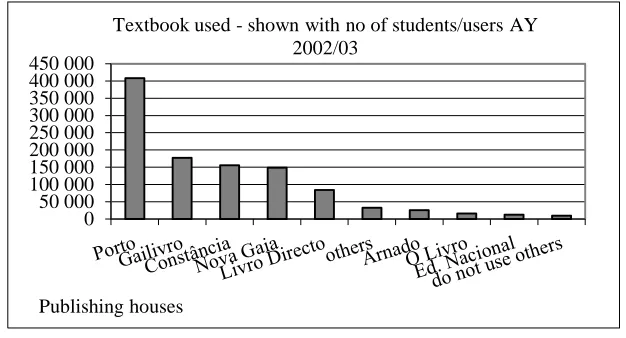
Analytically were selected, from the list of school textbooks used in 2002/03, three publishers which Maths and Science books were used the most in schools. Hence, 48 books falling into two time periods encompassing a total of 10 academic years (1995/96 - 2005/06) were analysed. These publishing houses were Porto Editora, who offered an average of seven or eight editorial lines per school year, Gailivro and Nova Gaia publishers, who had approximately four to five editorial lines every year within this period (Figure 1). A textbook for each of the two time periods under study was selected.
Figure 1. Textbooks used, shown with no. of students/users, AY 2002/031
Source: DEB, current Direcção Geral de Inovação e Desenvolvimento (DGIDC), (Board of Curricular Innovation and Development).
Curiously, in terms of iconography, it is stressed that “the status of textbook illustrations seems somewhat contradictory and ambiguous; the illustrations are as much foregrounded as they are minimised” (Evans, Watson and Willows, 1987 quoted in Pereira, 2000, p. 223.). Specifically, the illustrations are “highlighted – if inconsistently - by publishers and teachers, they are undervalued by educationalists and researchers into education” (Woodward, 1993 quoted in Pereira, 2000, p. 222). Moreover and despite Duchastel’s (1990) claim that one of the major problems here is “the lack of a well-delineated conceptual framework to provide an analysis of images and their impact on learning” (quoted in Amador & Carneiro 1999, p.125), a verbal-iconic based content analysis was undertaken. This was both a morphological mapping and a scrutiny of the images transmitting functional/objective dimension. Therefore, an Observation Grid applicable to the images from the sample textbooks (Figure 2 and Figure 3) was drawn up to aid in this.
1 Total no. of 1,073,224 Science, Portuguese and Maths textbooks used, from Year 1 to Year 4 of Primary
School. The category ‘Do not use’ equals a total no. of 9,840 students who did not use them. 0
50 000 100 000 150 000 200 000 250 000 300 000 350 000 400 000 450 000
Publishing houses
Textbook used - shown with no of students/users AY 2002/03
Figure 2. Brand photographs in 2nd year Maths textbook (1st stage)2
Source: Monteiro, A. & Rocha, C. (1999), Fio-de-Prumo 2º ano, Coimbra, Liv. Arnado, p.119.
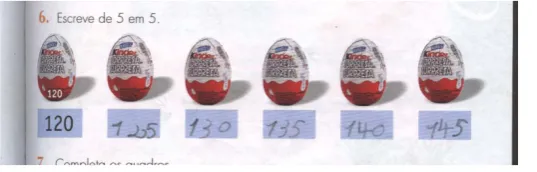
Figure 3. Brand photographs in 2nd year Maths textbook (2nd stage)3
Source: Monteiro, A. & Rocha, C. (2002), Fio-de-Prumo 2º ano, Coimbra, Liv. Arnado, p.97.
Accordingly, the verbal-iconic analysis undertaken showed that the series of photographs, constituting as they do visual representations of contemporary culture and everyday material, confirm the presence of commercial products and their logos in scholastic material. Livraria Arnado/Porto Editora, the largest publishing group in this sector, has the greatest amount of brand photographs, whereas the other two publishing houses have a lesser market share (Nova Gaia and Gailivro) displaying a smaller amount. Interestingly, while the Natural Sciences textbooks contain the greater number of photographs, it is the Maths textbooks which have the greatest amount of brand photographs. This type of photograph plays a weightier role as a cognitive object in practice exercises. This is mainly accomplished by having brand photos as part of activities, pointing undoubtedly towards a learning strategy promoting know-how.
In parallel, and depending on the degree of iconic identification with the object represented, the logo itself is not foregrounded and is only fully identified in the background. The majority of the images found take up to a ¼ page, only appearing on a certain number of pages per textbook. To ensure that ‘branding’ is indeed vital to contemporary society, the list given by McNeal (1992) was adapted for the Marktest product categories assessing the frequency of each product type. This process incorporates the argument that what stimulates the imagination relies on the imaginary consumption we practice, which depends heavily on what we’re given to consume (Calado, 2000).
2
Analysing this image shows us that the photo is less than a ¼ page, demonstrating the concentration per page ratio in the textbook in question. The brand of the stationery items displayed is clearly shown across the range. Dynamic verbs are used, encouraging readers to carry out the exercises, and the brand is equated with the product. It is also worth pointing out that the activity should be carried out after studying the photograph, as the text demands.
3 Analysing this image shows us that the photo is less than a ¼ page, demonstrating the concentration per page
ratio in the textbook in question. Logo identification is total: the products shown are placed squarely in the dessert/sweet category. The illustration has to be used as a reference in that the activity can only be carried out by referring to the brand photograph, making the visual image part of the text.
Moreover, scrutinising the interplay between photograph and text shows how the marketing image meshes with the main learning goals. The text demands a direct focus on the image, making the latter the main conduit of information. In tandem there is the interwoven nature of the photograph and text on the page, both showing the complementary role that image plays.
So, under this methodology, data showed that Science and Maths textbooks use products forming the backdrop of children’s daily lives. In terms of foodstuffs, there are yogurts, dairy goods, cakes, desserts, soft drinks, frozen goods and preserves. Maths textbooks have a greater range of foodstuff product placement photos. There is also a high rate of stationery items. In line with McNeal’s (1992) sphere of influence of children model, there are ‘pre-fabricated image’ goods which are part of the ‘children’ (snacks, toys, stationery items) and ‘home’ (food and drinks) markers circulating freely in the textbooks under study, with ‘family’ products (hygiene, medicines, banks) appearing the least. From these results comes the inference that marketing strategies are adapted to the target chosen and that the textbook is a medium and plays a role in in-school marketing. Therefore, seeing that branding denotes identity in contemporary society, as the brands seen in textbooks act as the lowest common denominator:
Whether we like it or not, individual and private fantasy, replete with images “is not constructed innocently: it is riddled with external images. While this storehouse of fantasy can play home to all possible combinations, it will select those which serve the best; the most interesting, the most pleasant, the most fun (cf Calvino, p.111). The illustrator can play a determining role in this choice. And herein lies a weighty responsibility (Calado, 2000, p.118).
4. COMMODIFYING THE TEXTBOOKS: ACCOMMODATION AND DIVERGENCE BY
PLAYERS DIRECTLY OR INDIRECTLY INVOLVED
Pedagogic and cultural practices are rife with commercial preoccupations. This premise results in a deep knowledge of the process of textbook production, distribution and commercialisation (Torres Santomé, 1995). In terms of primary school Maths and Science textbooks, this is illustrated by the use of images which are typical of a media-laden society, as the position of direct and indirect players in the process reveals some paradoxes which mirror distinct social roles.
The role which brand photographs play in the commodification of the school textbook gives rise to results which are either accommodating or divergent, depending on the strength of identification with this reality. According to the Ministry of Education specialists (the regulatory body), the brand photographs have not been a thorny issue or either been covered by any existing legal framework. But, it was argued that if the Ministry verified any advertising in school textbooks it should be seen in context, and also that this kind of material implies necessarily the acquisition of consumer ccompetencies. The same felt the advertising standards authority - Portuguese Association of Advertisers (APAN), although they showed no consensual position on in-school advertising in school textbooks beyond feeling it should be based on market self-regulation and respecting the Code of Good Practice for Commercial Advertising to Minors:
(...) in such countries as (...) the USA, there has been an outcry against situations in which (...) Maths textbooks were used in a way I consider offensive and unsuitable (...) brands (...) from the food area, to tell children 2 hamburgers + 3 hamburgers = 5 hamburgers. They don’t say ‘hamburgers’, they say the brands, or when talking about soft drinks, and so on, they mention brands. I find it quite improbable that this would come to pass in Europe, for a variety of ethical reasons. I think it improbable ... I do not know of any situation here in Portugal similar to this. [APAN Director]
Besides these statements, all the teachers, parents’ associations, publishing market representatives and media agencies interviewed condemned in-school marketing in school textbooks.
Moreover, looking firstly to the positions of those considered part of the cycle of consumption of the school textbook, particularly the teachers, it's time to say that they live in a world of icons and yet whose professional training does not include how to decode different types of images represented, and for whom the object-image must always have an educational context. They believe in the author and
illustrator’s creative freedom, although this is a controversial issue, throwing a series of questions into sharp relief. These range from questions of regulations vs. market autonomy to the idea that the presence of consumer goods may benefit the teaching-learning process. Consumer goods capable of stimulating the imagination may just anchor the child to the real world:
I must say I am somewhat personally against this, but sometimes it can work in a positive way. If the child sees a product which he knows well from his daily life, that makes him work harder and remember the message they’re sending a bit better, doesn’t it? [Teacher]
Nevertheless, a parent/guardian representative interviewed felt it was a sporadic occurrence and that transparency and clarification were needed to see “(...) what was involved, what kind of interests could be at play in the publication (...), apparently the fault of the brands” [CONFAP Director] in this school textbook. Finally, they sustain that the positions of all the agents involved in textbooks’ cycle of circulation must be clarified. The brand-images have to be contextualised, and their use should have a pedagogic explanation as its basis. These agents include those in the publishing sector, for example, illustrators, who have no academic training as to the value of images in learning contexts, and whose socio-professional background leads them in their selection of images. The brand-image becomes here a pedagogical resource, a cognitive object:
(...) we work with everyday objects (...) which are very rich from a mathematical point of view. When I’m working with tin cans, packages of whatever they might be, cereals, etc., (...) it seems phoney to me to cover up the brand label (…), if in kids’ daily lives these containers are linked to consumer goods they’re used to using, why should I now, just because I’m working with a can in the shape of a parallelepiped and which happens to be a breakfast product brand, cover it up?” [Teacher and textbooks author of Association of Mathematics Teachers (APM)]
According to the interviews made, one can appreciate that the publishing sector and teachers value positively the pedagogical functions of the brand-photographs as socio-cultural markers. The former include the pedagogical value of the image and its verbal-iconic nature which can aid both learning and the assessment of the competencies to be acquired. Also worth highlighting is the image’s interpretative and transforming function (its referential dimension); its power as a catalyst of citizenship and contemporary values. Thus, and in spite of the lack of knowledge expressed in academic studies from the receptor’s point of view, it is felt that children have better recall of picture stimuli (Brée, 1995). Market studies show that awareness of this is vital in marketing/consumer behaviour. Teachers, however, feel images in current school textbooks are more decorative than educational, capturing students’ attention. School texts can be chosen and/or used, making other, multidisciplinary tools necessary to interpret them. These tools can add to analysis/decoding of images. As such, governmental agencies need to overhaul the statutes dealing with image and content in curricular matters and in the school space, beginning by implementing image-education programmes.
To conclude, and considering in-school advertising as a whole, this highlights the thinking behind certain standpoints which contribute to an understanding of a communicative activity which is still banned in Portugal (as the European Commission report states):
I would like to know what the law says about this, so we could study it ...I’m told it’s banned, but when we searched for that law, we couldn’t find it (...). We have to know how to do things in media today; we have to consider advertisers and decent practices tied to social responsibility (…). I don’t think it’s a question of money but perspective (…) in a corporate project, it’s a form of democracy, a way to organise which soon … I feel will be beneficial (...). [Agência de Comunicação Pedagógica/Pedagogic Communication Agency Director]
Above all, perplexity and complexity are values at play here and they reveal a phenomenon emerging from its chrysalis:
The law is clear on this issue and I feel that only through absent-mindedness or masochism can a company produce (...) a boomerang effect, in the worst sense …. And that Code of Good Practice (…), we foresaw that also. [APAN Director]
CONCLUSION
Reflective analysis has shown that images play a weighty socio-cultural role in a world of globalised brand names and goods, a world in which the sources that together constitute children’s sphere of influence are themselves diffuse. The greater part of interviewees felt these were multiple and disperse and this picture tends to dilute the effects of curriculum commodification in the three-dimensional market model. This is the backdrop to the notion that the abstract nature of creatively generated fictional images can in extremis render them inoperable in today’s consumer society. In this context, the photographs of brands which are part of everyday experience, and are thus a link to the real and symbolic world, are seen to facilitate the learning process. This pragmatic view does not exclude any ethical considerations, such as placing a cap on marketing-mixed strategies, preserving the school and educational material’s role of inducing a neutral critical spirit free of economic models and ideological connotations.
In-school marketing must be analysed in greater depth. Education has to foster critical and creative cognition of communicative language. This presupposes that the analytical framework must include images coming from outside the teaching-learning milieu, particularly those arising from the media and information spheres. This would encompass decoding commercial messages and constitute media literacy, training sorely needed in today’s consumer society and which is the cornerstone of the critically thinking child. Acquisition of these competencies can prevent the ‘manipulated child’ and make aware audiences in a pluralist and democratic society possible. This adds fuel to the heated debate of who is in charge of citizenship, consumer and media education.
It is an intrinsic part of the media culture which characterises developed societies and the scarcity or poor allocation of public funds which traditionally guaranteed the working of institutions. So, more specific pan-European legislation and more effective self-governing market mechanisms need to be implemented. Indeed, this complex situation has to involve the many social agents bound up in it, and measures for the free circulation of information among them must be put into place. This should be set out in a new and transparent legal measure, for example a new Code of Advertising, as so far neither public nor private regulatory statutes have kept pace with media practices.
REFERENCES
Amador, Filomena & Carneiro, Helena (1999). The Role of Images in school textbooks of Natural Sciences of Basic Education: an analysis of the concept of evolution [O Papel das Imagens nos Manuais Escolares de Ciências Naturais do Ensino Básico: Uma Análise do Conceito de Evolução]. Journal of Education [Revista de Educação], vol. VIII (2), Department of Education, F.C., U.L. [Departamento de Educação da F.C. da U.L.), 119-129.
Apple, Michael W. (2000). Educating the “right” way. Schools and the conservative alliance [Educar à maneira da “direita”. As escolas e a aliança conservadora]. José Augusto Pacheco (ed.) Educational Policies - Neoliberalism in education [Políticas Educativas – O neoliberalismo em educação]. Oporto, Porto Editora, 7-20.
Bocock, Robert (1993). Consumption. London, Routledge.
Braga da Cruz, Manuel (1997). Comments, Interculturalism and Social Cohesion in Educational Intervention [Comentários, Interculturalidade e Coesão Social na Intervenção Educativa]. Colloquium Magazine / Education and Society [Revista Colóquio/ Educação e Sociedade], 1/97 - New Series [Nova Série]. Lisbon, Calouste Gulbenkian Foundation, 64-66.
Bree, Joel (1995). Children, consumption and marketing [Los niños, el consumo y el marketing]. Barcelona, Ediciones Paidós.
Calado, Isabel (2000). The functionality of the images in general and in particular the case of illustrations: good images are needed [A funcionalidade das imagens em geral e o caso, em particular, das ilustrações: boas imagens precisam-se]. Viana et al. (eds) Proceedings of the 2nd National Meeting of Investigators in Reading, Children's Literature and Illustration [Actas do 2º Encontro
Nacional de Investigadores em Leitura, Literatura Infantil e Ilustração] (December 6-7). Institute of Child Studies [Instituto de Estudos da Criança]. Braga, University of Minho, 107-120.
Decree-Law No.330/90 (October 23). Code of Advertising [Código da Publicidade]. Retrieved from http://www.bocc.ubi.pt/pag/estado-portugues-codigo-publicidade.html.
Decree-Law No.369/90 (November 26). School textbooks [Manuais Escolares]. Ministry of Education
[Ministério da Educação]. Retrieved from
http://min-edu.pt/Scripts/ASP/news_det.asp?newsID=115&categorialID=leg.
Espinosa, M. P. Prendes (1996). Analysis of images in school textbooks [Análisis de Imágenes en Textos Escolares]. University of Murcia, Pixel-Bit Magazine, Media & Education Magazine [Revista Pixel-Bit, Revista de Medios y Educacion], No. 6: 1-18. Retrieved from http://www.sav.us.es./pixelbit/articulos/n6/n6art/art62.htm.
Gerard, Francoise-Marie & Roegiers, Xavier (1998). Design and evaluate school textbooks [Conceber e Avaliar Manuais Escolares]. Oporto, Porto Editora, 13-109; 172-174; 194-197.
Giddens, Anthony (2001). Modernity and Self-Identity [Modernidade e Identidade Pessoal]. Lisbon, Celta Editora, 1-100; 167-191.
Grinberg, Silvia (1997, November). Text and Context of School books [Texto y Contexto de los libros Escolares], Proceedings of the Second Seminar - School Texts in Latin America [Actas del Segundo Seminário - Textos Escolares en Iberoamérica], Quilmes, Argentina 1-9. Retrieved from http://www.unq.edu.ar/textos_escolares/ponencias2/12.txt.
Gunter, Barrie & Furnham, Adrian (2001). Children as Consumers - A Psychological Analysis of the Youth Market [As Crianças como Consumidoras – Uma Análise Psicológica do Mercado Juvenil]. Lisbon, Instituto Piaget.
Kapferer, Jean-Noël (1989). The Child and Advertising [A Criança e a Publicidade]. Oporto, Rés Editora.
Klein, Naomi (2002). NoLogo - The Power of Brands [NoLogo – O Poder das Marcas]. Lisbon, Relógio d’Água Editores.
Martins, Jorge M. (1999). The Book and UNESCO - Towards an integrated view of the book chain in the context of new technologies [O Livro e a UNESCO - Para uma visão integrada da cadeia do livro no quadro das novas tecnologias]. Journal of CIES, Centre for Research and Studies in Sociology [Revista do CIES, Centro de Investigação e Estudos de Sociologia], ISCTE, No. 30, Oeiras, Ed.Celta, 145-163.
McNeal, James (1992). Kids as Customers - A Handbook of Marketing to Children. New York, Lexington Books, 2-173.
Mesquita, Leopoldo (2000). Education and Economic Development - contribution to the study of a relationship of this nature [Educação e Desenvolvimento Económico – contribuição para o estudo da natureza presente de uma relação]. Education [Politica Educativa], No. 8, Lisbon, Institute for Educational Innovation Policy [Instituto de Inovação Educacional].
Molnar, Alex (1999, October15). The Commercial Transformation of American Public Education, Ohio Valley Philosophy of Education Conference, Bergamo, Ohio: EPSL/ Education Policy Studies Laboratory. Commercialism in Education Research Unit, 1-7. Retrieved from http://www.asu.edu/educ/epsl/ceru.htm.
Monteiro, A. & Rocha, C. (1999). Plumb-line 2nd year [Fio-de-Prumo 2º ano], Coimbra: Livraria Arnado, 119.
Monteiro, A. & Rocha, C. (2002). Plumb-line 2nd year [Fio-de-Prumo 2º ano], Coimbra: Livraria Arnado, 97.
Consumer Policy and Consumer Health Protection (1999). Marketing in schools, Report on a study conducted for the European Commission, June, GMV-Conseil, 1998. Retrieved from
http://www.aeforum.org/aeforum.nsf/3deac671ffcb0cc780256c5100355eb5/ade64bb696f500c080256 815003b72cc/$FILE/ecom0057.pdf.
Pacheco, J. Augusto (2000). Trends decentralization of curriculum policies [Tendências de descentralização das políticas curriculares]. JA Pacheco (org) Educational Policies - Neoliberalism in education [Políticas Educativas – O neoliberalismo em educação]. Oporto, Porto Editora, 91-107.
Pereira, A. M. Simões (2000). The Didactic Discourse in Iconography of Physics [A Iconografia no Discurso Didáctico da Física], Phd Thesis in Educational Sciences [Tese de Doutoramento em Ciências da Educação]. Lisbon, Open University [Universidade Aberta].
Piedrahita, M. V. Alzate (1998). Shool textbooks and books reading initiation: A field investigation [Los manuales escolares y los libros de iniciación a la lectura: campo de investigación]. Journal of Human Sciences [Revista de Ciências Humanas] No 17: 1-10.Retrieved from http://www.utp.edu.co/%7Echumanas/revistas/revistas/rev17/alzate.html
Strasburger, Victor C. & Wilson, Bárbara, J. (2002). Children, Adolescents & the Media, London, Sage Publications, 61-65; 246-251; 266-269; 322-365; 376-377; 405-407.
Tormenta, J. Rafael (1996). School textbooks. Tradition or Innovation? [Manuais Escolares. Inovação ou Tradição?] Lisbon, Institute for Educational Innovation [Instituto de Inovação Educacional], 9-24; 51-64.
Torres Santomé, Jurjo (1995). The Hidden Curriculum [O Curriculum Oculto]. Lisbon, Porto Editora, 51-113; 201-212.
Torres Santomé, Jurjo (2000). The teachers at the time of neoliberalism- socio-political aspects of their work [O professorado na época do neoliberalismo - Aspectos sóciopolíticos do seu trabalho]. J. Augusto Pacheco (ed.) Educational Policies - Neoliberalism in education [Políticas Educativas – O neoliberalismo em educação]. Oporto, Porto Editora, 67-90.