STUDENT VIEWS ON EXPERIMENTAL METHOD OF TEACHING IN BIOLOGY EDUCATION
Suat Yildirim1, Muhittin Dinç2, Yavuz Bağci3
1Karatay TOKİ Anatolian High School, Karatay / Konya, Turkey
2Necmettin Erbakan University, Ahmet Keleşoğlu Education Faculty, Meram / Konya, Turkey
3
Department of Biology, Faculty of Science and Art, Selcuk University, Konya, Turkey
Abstract
The purpose of this study is to investigate students views on experimental teaching methods of teaching biology course topics. In 2014-2015 academic year in Konya, the research has been carried
out on 50 students that are studying in different branches of the 11th grade at Karatay TOKI Anatolian
High School. In research 25 five-point Likert questionnaire has been applied to ascertain students’ view about laboratory experiments activities. It was concluded that the students developed positive attitude towards the experimental teaching method. The studies have been concluded by presenting some questions with the idea that students will be able to develop their interests to biology laboratory.
Key words: biology education, biology laboratory, experimental methods
INTRODUCTION
Science is interested in everyday life and close environment as directly or indirectly. Although it choose dealing with subjects of life and daily events, the subjects-related with science containing abstract and complex concepts cause bearing difficulties to understand (Akdeniz et al., 1994).
A good science education in Educational Institutions can be possible with the lesson that laboratories and experiments are dominant and is away from memorizing. Students find the facility for testing and verifying theoretical knowledge they read in the laboratory. Student will be able to see the image of test instrument used in the laboratory but can not use. And this will prevent a permanent and effective learning which provides learning in a short time (Güven and Gürdal, 2002).
In today’s student-centered approach preparing an environment for students comes to the fore. Therefore they will learn by doing themselves and living which will make them more active. Laboratory studies are also an important part of this process. Practical studies will contribute students to learn with doing and living and this will cause a permanent learning (Uzun and Sağlam, 2003; Tolga, 2000).
Learning at a level to be creative in biology can only be done by learning meaningful information. And learning meaningful information depends on the integration of a system of related concepts to each other. Experimental methods improve students’ ability of making research and thinking. In addition these methods provide students scientific thought and behavior skills (Gerçek and Soran, 2005).
The aim of this study is to ascertain the effect of experiments done in laboratories on teaching the subjects of biology.
MATERIALS AND METHODS
The sample of the research is constituted by 50 students from different classes of 11th grade in Karatay TOKI Anatolian High School in Konya in 2014-2015 academic year and the students from Anatolian High Schools of Ministry of Education. To collect of data in this study, the questionnaire developed by Yeşilyurt (2003, 2005), Ayas (1993), Akdeniz and Karamustafaoğlu (2002) and El-Gendy (1984) is modified to suit the requirements of biology teaching and used to define the students’ view on
experimental method. The survey has been made using likert type questionnaire comprising of 25 statements with 5 point scale range from strongly agree to strongly disagree. These data are presented in tables and graphs are evaluated to statistics in percent.
RESULTS AND DISCUSSION
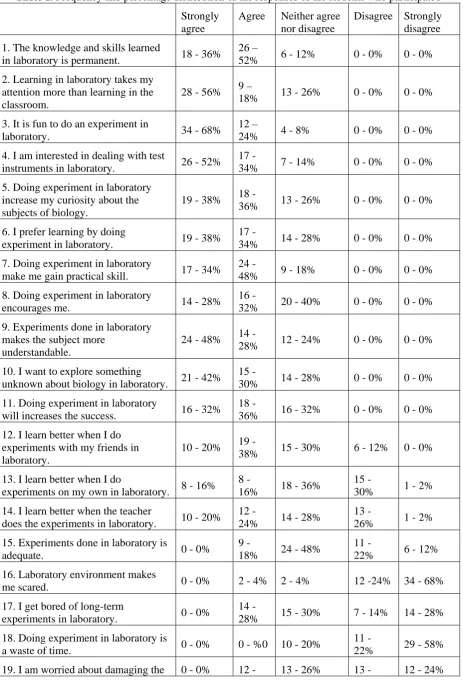
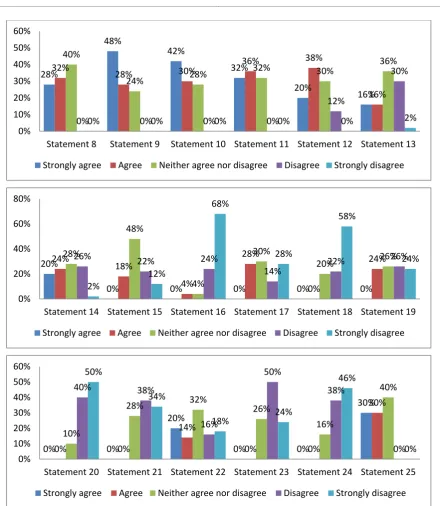
Likert-type questionnaire administered to students’ responses and the percentage frequency distributions are shown in Table 1 and Figure 1.
In the 1st expression students are asked about the permanence of the knowledge and skills learned in laboratory. 18 of them (36%) strongly agree, 26 of them (52%) agree and 6 of them (12%) are neither agree nor disagree (Table 1, Figure 1).
In the 2nd expression students are asked if learning in laboratory is more effective than learning in the classroom. 28 of them (56%) strongly agree, 9 of them (18%) agree and 13 of them (26%) are neither agree nor disagree (Table 1, Figure 1).
In the 3rd expression students are asked if doing experiment in laboratory is fun. 34 of them (68%) strongly agree, 12 of them (24%) agree and 4 of them (8%) are neither agree nor disagree (Table 1, Figure 1).
In the 4th expression students are asked if doing experiment in laboratory draws the attention of them. 26 of them (52%) strongly agree, 17 of them (34%) agree and 7 of them (14%) are neither agree nor disagree (Table 1, Figure 1).
In the 5th expression students are asked if doing experiment in laboratory increase their curiosity about their views of subjects of biology. 19 of them (38%) strongly agree, 18 of them (36%) agree and 13 of them (26%) are neither agree nor disagree (Table 1, Figure 1).
In the 6th expression students are asked to take their opinions about the preference of learning by doing experiment in laboratory. 19 of them (38%) strongly agree, 17 of them (34%) agree and 14 of them (28%) are neither agree nor disagree (Table 1, Figure 1).
In the 7th expression students are asked if doing experiment in laboratory make them gain practical skill. 17 of them (34%) strongly agree, 24 of them (48%) agree and 9 of them (18%) are neither agree nor disagree (Table 1, Figure 1).
In the 8th expression students are asked about encouraging to do experiment in laboratory. 14 of them (28%) strongly agree, 16 of them (32%) agree and 20 of them (40%) are neither agree nor disagree (Table 1, Figure 1).
In the 9th expression students are asked if doing experiments in laboratory makes the subject more understandable. 24 of them (48%) strongly agree, 14 of them (28%) agree and 12 of them (24%) are neither agree nor disagree (Table 1, Figure 1).
In the 10th expression students are asked about researching something unknown in biology. 21 of them (42%) strongly agree, 15 of them (30%) agree and 14 of them (28%) are neither agree nor disagree (Table 1, Figure 1).
In the 11th expression students are asked if doing experiment in laboratory increases the success of students. 16 of them (32%) strongly agree, 18 of them (36%) agree and 16 of them (32%) are neither agree nor disagree (Table 1, Figure 1).
In the 12th expression students are asked if they want to do experiments with their friends in laboratory. 10 of them (20%) strongly agree, 19 of them (38%) agree, 15 of them (30%) neither agree nor disagree and 6 of them (12%) are disagree (Table 1, Figure 1).
Table 1. Frequency and percentage distribution of the responses of the students who participated Strongly
agree
Agree Neither agree nor disagree
Disagree Strongly disagree
1. The knowledge and skills learned
in laboratory is permanent. 18 - 36%
26 –
52% 6 - 12% 0 - 0% 0 - 0%
2. Learning in laboratory takes my attention more than learning in the classroom.
28 - 56% 9 –
18% 13 - 26% 0 - 0% 0 - 0%
3. It is fun to do an experiment in
laboratory. 34 - 68%
12 –
24% 4 - 8% 0 - 0% 0 - 0%
4. I am interested in dealing with test
instruments in laboratory. 26 - 52%
17 -
34% 7 - 14% 0 - 0% 0 - 0%
5. Doing experiment in laboratory increase my curiosity about the subjects of biology.
19 - 38% 18 -
36% 13 - 26% 0 - 0% 0 - 0%
6. I prefer learning by doing
experiment in laboratory. 19 - 38%
17 -
34% 14 - 28% 0 - 0% 0 - 0%
7. Doing experiment in laboratory
make me gain practical skill. 17 - 34%
24 -
48% 9 - 18% 0 - 0% 0 - 0%
8. Doing experiment in laboratory
encourages me. 14 - 28%
16 -
32% 20 - 40% 0 - 0% 0 - 0%
9. Experiments done in laboratory makes the subject more
understandable.
24 - 48% 14 -
28% 12 - 24% 0 - 0% 0 - 0%
10. I want to explore something
unknown about biology in laboratory. 21 - 42%
15 -
30% 14 - 28% 0 - 0% 0 - 0%
11. Doing experiment in laboratory
will increases the success. 16 - 32%
18 -
36% 16 - 32% 0 - 0% 0 - 0%
12. I learn better when I do experiments with my friends in laboratory.
10 - 20% 19 -
38% 15 - 30% 6 - 12% 0 - 0%
13. I learn better when I do
experiments on my own in laboratory. 8 - 16%
8 -
16% 18 - 36%
15 -
30% 1 - 2%
14. I learn better when the teacher
does the experiments in laboratory. 10 - 20%
12 -
24% 14 - 28%
13 -
26% 1 - 2%
15. Experiments done in laboratory is
adequate. 0 - 0%
9 -
18% 24 - 48%
11 -
22% 6 - 12%
16. Laboratory environment makes
me scared. 0 - 0% 2 - 4% 2 - 4% 12 -24% 34 - 68%
17. I get bored of long-term
experiments in laboratory. 0 - 0%
14 -
28% 15 - 30% 7 - 14% 14 - 28%
18. Doing experiment in laboratory is
a waste of time. 0 - 0% 0 - %0 10 - 20%
11 -
22% 29 - 58%
19. I am worried about damaging the 0 - 0% 12 - 13 - 26% 13 - 12 - 24%
equipment of laboratory. 24% 26%
20. Doing experiment in laboratory
doesn’t take my attention. 0 - 0% 0 - %0 5 - 10%
20 -
40% 25 - 50%
21. I do not understand the
experiments done in laboratory. 0 - 0% 0 - %0 14 - 28%
19 -
38% 17 - 34%
22. Experiment should be done at first
and then the lesson should be taught. 10 – 20% 7 -
14% 16 - 32% 8 - 16% 9 - 18%
23. Experiments done in laboratory in
not appropriate to the topic. 0 - 0% 0 - 0% 13 - 26%
25 -
50% 12 - 24%
24. Learning by doing experiment in
laboratory is boring. 0 - 0% 0 - 0% 8 - 16%
19 -
38% 23 - 46%
25. Laboratory experiments are
indispensable element of biology. 15 – 30% 15 -
30% 20 - 40% 0 - 0% 0 – 0%
In the 13th expression students are asked if they want to do experiments on their own in laboratory. 8 of them (16%) strongly agree, 8 of them (16%) agree, 18 of them (36%) are neither agree nor disagree, 15 of them (30%) disagree and 1 of them (2%) strongly disagree (Table 1, Figure 1).
In the 14th expression students are asked if they want the teacher to do the experiments in laboratory. 10 of them (20%) strongly agree, 12 of them (24%) agree, 14 of them (28%) are neither agree nor disagree, 13 of them (26%) disagree and 1 of them (2%) strongly disagree (Table 1, Figure 1).
In the 15th expression students are asked if the experiments done in the laboratory are sufficient. 9 of them (18%) agree, 24 of them (48%) are neither agree nor disagree, 11 of them (22%) disagree and 6 of them (12%) strongly disagree (Table 1, Figure 1).
36%
56%
68%
52%
38% 38% 34%
52%
18% 24%
34% 36% 34%
48%
12%
26%
8% 14%
26% 28%
18%
0% 0% 0% 0% 0% 0% 0% 0% 0% 0% 0% 0% 0% 0%
0% 20% 40% 60% 80%
Statement 1 Statement 2 Statement 3 Statement 4 Statement 5 Statement 6 Statement 7
Strongly agree Agree Neither agree nor disagree Disagree Strongly disagree
Figure 1. The percentage distribution of the responses of the students who participated
In the 17th expression students are asked if the experiments which last a long time make them bored. 14 of them (28%) agree, 15 of them (30%) are neither agree nor disagree, 7 of them (14%) disagree and 14 of them (28%) strongly disagree (Table 1, Figure 1).
In the 18th expression students are asked if doing experiment in the laboratory is a waste of time. 10 of them (20%) are neither agree nor disagree, 11 of them (22%) disagree and 29 of them (58%) strongly disagree (Table 1, Figure 1).
In the 19th expression students are asked if they have worries about damaging laboratory equipment. 12 of them (24%) agree, 13 of them (26%) are neither agree nor disagree, 13 of them (26%) disagree and 12 of them (24%) strongly disagree
28%
48%
42%
32%
20% 16%
32% 28% 30% 36% 38%
16% 40%
24% 28%
32% 30% 36%
0% 0% 0% 0%
12%
30%
0% 0% 0% 0% 0% 2%
0% 10% 20% 30% 40% 50% 60%
Statement 8 Statement 9 Statement 10 Statement 11 Statement 12 Statement 13
Strongly agree Agree Neither agree nor disagree Disagree Strongly disagree
20%
0% 0% 0% 0% 0%
24% 18% 4% 28% 0% 24% 28% 48% 4% 30%
20% 26%
26% 22% 24%
14% 22%
26%
2% 12%
68% 28% 58% 24% 0% 20% 40% 60% 80%
Statement 14 Statement 15 Statement 16 Statement 17 Statement 18 Statement 19
Strongly agree Agree Neither agree nor disagree Disagree Strongly disagree
0% 0%
20%
0% 0%
30%
0% 0%
14%
0% 0%
30%
10%
28% 32% 26%
16%
40%
40% 38%
16% 50% 38% 0% 50% 34%
18% 24%
46% 0% 0% 10% 20% 30% 40% 50% 60%
Statement 20 Statement 21 Statement 22 Statement 23 Statement 24 Statement 25
Strongly agree Agree Neither agree nor disagree Disagree Strongly disagree
In the 20th expression students are asked if doing experiment takes their attention or not. 5 of them (10%) are neither agree nor disagree, 20 of them (40%) disagree and 25 of them (50%) strongly disagree (Table 1, Figure 1).
In the 21st expression students are asked if the experiments in the laboratory are understood. 14 of them (28%) are neither agree nor disagree, 19 of them (38%) disagree and 17 of them (34%) strongly disagree (Table 1, Figure 1).
In the 22nd expression students are asked if they want to do experiment at first and then the course. 10 of them (20%) strongly agree, 7 of them (14%) agree, 16 of them (32%) are neither agree nor disagree, 8 of them (16%) disagree and 9 of them (18%) strongly disagree (Table 1, Figure 1).
In the 23rd expression students are asked if the experiments are appropriate for the subjects. 13 of them (26%) are neither agree nor disagree, 25 of them (50%) disagree and 12 of them (24%) strongly disagree (Table 1, Figure 1).
In the 24th expression students are asked if learning by doing experiment is boring. 8 of them (16%) are neither agree nor disagree, 19 of them (38%) disagree and 23 of them (46%) strongly disagree (Table 1, Figure 1).
In the 25th expression students are asked if the experiments are indispensable elements of biology courses. 15 of them (30%) strongly agree, 15 of them (30%) agree and 20 of them (40%) are neither agree nor disagree (Table 1, Figure 1).
According to the result of research in 1, 2, 3, 4, 5, 6, 7, 8, 9, 10, 11 and 25th the expressions are mostly “strongly agree” or “agree” as a positive outlook. Besides there are a few expressions of “neither agree nor disagree”. In 18, 20, 21, 23 and 24th the expressions are mostly “strongly disagree” or “disagree” as a positive view. Besides there are a few expressions of “neither agree nor disagree”. In the research 15, 16, 17 and 19th the expressions are mostly “strongly disagree” or “disagree”. Besides that there are a few responses as “agree” or “neither agree nor disagree”. In the research 12 and 14th the expressions are mostly “strongly agree” or “agree” and a few responses as “strongly disagree” or “disagree” and “neither agree nor disagree”. In the research 13 and 22nd the expressions equally “strongly agree” or “agree”, “strongly disagree” or “disagree” but mostly the expressions are “neither agree nor disagree”.
As a result students expressed that,
1. Knowledge and skills learned in laboratory is permanent.
2. Learning in laboratory is more effective than learning in the classroom.
3. It is fun to do an experiment in laboratory.
4. Studying with tools and equipment in laboratory draws their attention.
5. Doing experiment in laboratory increase their curiosity about biology subjects.
6. They prefer learning by doing experiment in laboratory.
7. Doing experiment in laboratory make them gain practical skill.
8. Doing experiment in laboratory encourages them.
9. Doing experiments in laboratory makes the topic more understandable.
10. They want to research something unknown about biology in laboratory.
11. They think doing experiment in laboratory increases their success.
12. They learn better when they do experiments with their friends in laboratory.
13. They are neither agree nor disagree about doing experiments on their own in laboratory
14. They learn better when they do experiments with the teacher in laboratory.
15. The experiments done in laboratory are not sufficient.
16. They are not afraid of laboratory environment.
17. They do not get bored of long-lasting experiments in laboratory.
18. Doing experiment in laboratory is not a waste of time.
19. They do not have worries about damaging the tools and equipment.
20. Doing experiment in laboratory takes their attention.
21. They understand the experiments done in laboratory.
22. They are neither agree nor disagree about doing experiment in laboratory first and then having the course.
23. The experiments done in laboratory are suitable for the subject.
24. Learning by doing experiment in laboratory is not boring.
25. Laboratory experiments are essential elements of biology courses.
Arslan et al. (2006) found in their study that when they compared the course which is supported by laboratory methods with the method of teaching with visual materials, the success of the students in the course supported by laboratory methods is higher. In a similar research the students who do the experiments themselves were compared with the students who learn by visual and expressing method and it is stated that the students who learn by doing living are more successful (Killermann, 1998).
Berg et al. (2003), reported that in a research through the college students, the experiments based on solving problems have positive effects as well as the positive effects on attitudes and perceptions. Yeşilyurt et al. (2005) reported that the students in primary school started to have a positive attitude towards science laboratories. Uzun and Sağlam (2005) reported in their research that experimental studies have a positive effect in their success. In addition, the average of the success of the students who do experiments in the laboratory is statically different from the students who do not try doing experiments at all.
In this study students have expressed that they want to perform experiments in laboratory in biology course.
RECOMMENDATIONS
1. Experimental studies should be done to make biology lessons clearer, fun and enjoyable.
2. In order to develop a positive attitude towards laboratory studies, appropriate conditions should be provided.
3. Rather than trying to make experimental a show, students should be given the opportunity to do experiment in groups and teacher should be only a guide. Therefore, students’ should be provided the opportunity of learning by doing and living.
4. Before starting the experiment in laboratory, students’ readiness levels must be measured and students should be prepared with theoretical knowledge for experiment.
5. Laboratory equipment and materials should be brought to a level so that experiments can be done.
6. Thought of damaging tools and materials must be stopped and students should be encouraged to do experiment in laboratories.
7. Questions about experiments should be asked in written exams in order to increase the interest and success of the students’.
REFERENCES
Akdeniz, A. R., Ayas A. ve Çepni S., 1994. Fen Bilgisi Eğitiminde Laboratuvarın Yeri ve Önemi, II. Çağdaş Eğitim Dergisi, 206, 24-28.
Akdeniz, A. R. ve Karamustafaoğlu, O., 2002. Fizik Öğretim Yöntemleri Uygulamalarında Yürütülen Öğrenci Etkinliklerinin Değerlendirilmesi, V. Ulusal Fen Bilimleri ve Matematik Eğitimi Kongresi, ODTÜ, Ankara.
Arslan, O., Mirici, S., Özel, Ç.A., Sevimli, A. ve Samancı, N.K., 2006. Agrobacterium Aracılığı ile Gen Aktarımı Konusunun Laboratuvar Destekli Olarak İşlenmesinin Öğrenci Başarısına Etkisi, VII. Ulusal Fen Bilimleri Eğitimi Kongresi, Ankara.
Ayas, A., 1993. A Study of Teachers’ and Students’ Views of the Upper Secondary Chemistry Curriculum and Students’ Understanding of Introductory Chemistry Concept in the Black Sea Region of Turkey, Unpublished Doctorate Thesis, Southampton University, UK.
Berg, C., Bergendahl, B.C. and Lundberg, K.S.B., 2003. Benefiting from an open-ended experiment? A comparison of attitudes to, and outcomes of, an expository versus an open-inquiry version of the same experiment, International Journal of Science Education, 25 (25), 351-372.
El-Gendy and O. E., 1984. A Study of the Student Understanding of the Basic Chemistry Concepts in Egyptian Secondary School, Ph. D. University of Cardiff, UK.
Gerçek, C. ve Soran, H., 2005, Öğretmenlerin Biyoloji Öğretiminde Deneysel Yöntem Kullanma Durumlarının Belirlenmesi, Hacettepe Üniversitesi Eğitim Fakültesi Dergisi, 29, 95-102.
Güven, İ. ve Gürdal, A., 2002. Ortaöğretim Fizik Derslerinde Deneylerin Öğrenme Üzerindeki Etkileri, V. Ulusal Fen Bilimleri ve Matematik Eğitimi Kongresi, Ankara.
Killermann, W., 1998. Research into Biology Teaching Methods, Journal of Biological Education, 33, 4-9.
Tolga, A., 2000. Ortaöğretim Biyoloji Eğitiminde Görsel ve İşitsel Materyal Kullanımı, Bilim Uzmanlığı Tezi, Hacettepe Üniversitesi, Ankara, 50-52.
Uzun, N. ve Sağlam, N., 2003. Ortaöğretim Biyoloji Programında Genetik Konularının Değerlendirilmesi ve Öğrencilerin Genetiğe Karşı İlgisinin Saptanması, Hacettepe Üniversitesi Eğitim Fakültesi Dergisi, 24, 129-136.
Uzun, N. ve Sağlam, N., 2005. Genetik Konularının Öğreniminde Deney Uygulamalarının Akademik Başarıya Etkisi, Hacettepe Üniversitesi Eğitim Fakültesi Dergisi, 28, 196-200.
Yeşilyurt, M., 2003. Yükseköğretim Temel Fizik Laboratuvar Uygulamalarında Bütünleştirici Yaklaşım, Yayınlanmamış Doktora Tezi, KTÜ Fen Bilimleri Enstitüsü, Trabzon.
Yeşilyurt, M., Kurt, T. ve Temur, A., 2005. İlköğretim Fen Laboratuvarı için Tutum Anketi Geliştirilmesi ve Uygulanması, Pamukkale Üniversitesi Eğitim Fakültesi Dergisi, 3 (17), 21-31.