EFFECT OF MINERAL DEFICIENCIES
ON GROWTH AND PHYSIOLOGICAL
CHARACTERS OF GRAMINACEOUS PLANTS
BY K. N. LAL AND M.
s.
SUBBA RAO* Banaras Hindu University, Varanasi-5EssENTIALITY of nitrogen, phosphorus and potassium for the growth requirements of plants needs no emphasis. Manurial schedules for the various crops to changing edaphic and climatic conditions is a con-tinuous process. D~ficiency of one or the other of these three essential nutrients results in deficiency symptoms leading to various types of abnormalities both in term<> of external and internal attributes. Recog-nition of such attributes and preparation of coloured plates of deficiency symptoms (Wallace, 1944) has been attempted off and on to facilitate field workers in the ready identification of these deficiencies and their amelioration to tone up quality and quantity of yields.
In the following pages an attempt has been made to provide information on the effect of deficiencies of nitrogen, phosphorus and potassium on physiological characteristics of the three important Graminaceous plants, barley, paddy and maize grown under sand nutrient culture. Plants were raised in Hoagland's nutrient solution as indicated in an earlier publication (Lal De and Rao, 1949). Four series of cultures were m'!intained (i) complete nutrient culture where all the macro- and micro-elements were applied; (ii) nitrogen-deficient medium where all the macro and micro-elements were applied excepting nitrogen; (iii) phosphorus-deficient medium where the cultures con-tinued all the elements except phosphorus and (iv) potassium-deficient culture where all elements except potassium were applied. The composition of the nutrient solution applied has been given in the pub-lication already referred to. In all, 8 litres of nutrient solution were applied per each culture during the entire life-cycle-4 litres imme-diately after transplanting the seedlings and the remaining four litres in two instalments at 15· day intervals after the first application.
The plants growing under these four series of cultures were sampled at three stages of the life-cycle for measurement of various plant charac-ters, namely, height, tiller number, leaf number, and leaf size, fresh weight of leaves and entire plant, dry weight of component organs and entire plants. Photosynthesis, respiration, pigment content of leaves and net assimilation· rate were recorded. The methods used for these estimations were the same as those stated in earlier publications from
MINERAL DEFICIENCIES AND GROWTH
173
this institution. The data have been presented in the text tables along with critical differences at five per cent. level of probability. Com-parative responses on barley, paddy and m:tize have been recorded and discussed in the following paragraphs alongside similar responses on wheat and sugarcane recorded by earlier investigators (Singh et a! .. 1942).
EXPERIMENTAL FINDINGS
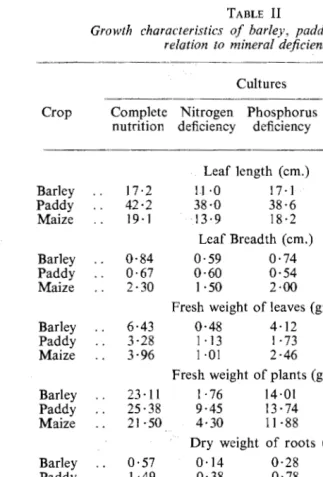
A. Deficiency effects of macro-elements.-The height of barley plants was found to be significantly affected by age, treatments, and age x treatment interaction. Phosphorus deficiency failed to depress height significantly while deficiencies of potassium and nitrogen markedly depressed it. In paddy, age, treatment, and age x treatment interaction showed significant effects. All deficiencies reduced height of the plant significantly below that of the complete nutrient cultures. No significant differences between - N and - P and between - P and - K cultures were recorded. Nitrogen deficiency reduced height the most while potassium deficiency was less effective. Height of plants under phosphorus deficiency was in between that recorded for - N and - K plants. In maize, main effects due to age and treatment and age x
treatment interaction were all significant. Deficiencies, in general, reduced height below that of the complete nutrient culture. Differences in height of plants grown under - K and - P were insignificant. Absence of nitrogen reduced height the most (Tables I, II).
TABLE I
Hefg!zt, tillering aad le1j number in bar fay, paddy and maize in relation to m."neral deficiencfes
Crop Complete Nitrogen Phosphorus Potassium S.D. at nutrition deficiency deficiency deficiency 5%
Height (em.)
Barley 52·9 25·5 50·8 46·4 3·58
Paddy 101·4 81· 3 86·5 89·6 6·07
Maize 62·6 29·9 45·7 48·0 3·23
Tiller Number
Barley 5·77 l·ll 4·33 3·33 0·74
Paddy 3·33 1·00 2·22 2·0 0·43
Leaf Number
Barley 32·33 7 ·11 21·55 19·88 4·35
Paddy 14·9 6·0 10·8 10·5 1·51
Maize 10·3 7·6 9·1 9·7 0·74
174
k. :N. tAt AND M. s. StJBBA RAOTillering.-In barley tillering was significantly affected by age and
treatments and varied in the order - complete nutrition
> -
P> -
K> -
N. Differences between individual cultures were statisticallysig-nificant. In paddy, age and treatment effects and treatments X age
interaction were all significant. Differences in tillering between - P
and - K plants were not significant. All deficiencies reduced
tillering below that of the control in the order-complete nutrition
> -
P, - K> -
N (Table I).Leaf number.-Leaf number was again found to be significantly affected by age, treatment, and age x treatment interaction in barley. In paddy and maize, main effects of age and treatments were only
significant. The order of response was complete nutrition
> -
P,- K
> -
N in all the three crops indicating that nitrogen deficiency reduced leaf number the most, while phosphorus and potassium defi-ciencies were less effective in n;ducing it. Differences between - Pand - K cultures were insignificant (Table I).
Leaf size.-Leaf size was found to be the largest in complete nutrient cultures and was reduced in other deficient cultures. In barley, the effect of phosphorus and potassium deficiencies on leaf length and leaf width was not significant at all while nitrogen deficiency reduced them markedly. In paddy, leaf length was not depressed significantly in - N and - P cultures but was reduced significantly in - K plants. Leaf width was significantly reduced in all the three deficient cultures. But the differences between - N and - P cultures were not significant at all. In maize, all deficiencies reduced leaf width below that of the control
in the order-complete nutrition
> -
P> -
K> -
N. Lengthof the leaves, however, was not significantly reduced under phosphorus
deficiency although ·under - N and - K reductions were marked.
Nitrogen deficiency again had the most adverse effect (Table II).
Fresh weight of leaves.-Fresh weight of the leaves of barley was found to be markedly reduced under nitrogen and potassium deficiencies, but was not reduced significantly by the absence of phosphorus. In paddy, all deficiencies lowered leaf weight below that of the control. Differences between the three deficient cultures were not significant at all. In maize, all deficiencies reduced fresh weight of leaves in the
order-complete nutrition
> -
P, - K> -
N. Differences betweenP and - K cultures were not significant (Table II).
Fresh weight of entire plants.-The effects were as follow:
Barley Complete nutrition,
> -
P, - K, - N.Paddy Complete nutrition,
> -
K, - P, - N.Maize Complete nutrition,
> -
P, - K, - N.Comparison of the effects indicated that nitrogen deficiency had the most deleterious effect on the fresh weight of the entire plant in all the
three crops. Differences between the complete culture and - P,
MINERAL DEFICIENCIES AND GROWTH
17S
TABLE II
Growth characteristics of barley, paddy and maize in relation to mineral deficiencies
Cultures
- - - S.D. at
Crop Complete Nitrogen Phosphorus Potassium 5%
nutrition deficiency deficiency deficiency
Leaf length (em.)
Barley 17 ·2 11 ·0 17 ·1 14·3 4·40
Paddy 42·2 38·0 38·6 24·5 7·34
Maize 19 ·1 13·9 18·2 16·3 1·54
Leaf Breadth (em.)
Barley 0·84 0·59 0·74 0·75 0·19
Paddy 0·67 0·60 0·54 0·55 0·056 .
Maize 2·30 1·50 2·00 1·70 0·19
Fresh weight of leaves (gm.)
Barley 6·43 0·48 4·12 2·67 3·67
Paddy 3·28 1·13 1·73 1 ·71 0·73
Maize 3·96 I ·01 2·46 1·76 1·29
Fresh weight of plants (gm.)
Barley 23 ·11 1·76 14·01 11 . 51 10·03
Paddy 25·38 9·45 13·74 13·83 4·40
Maize 21 ·50 4·30 11·88 9·40 7·58
Dry weight of roots (gm.)
Barley 0·57 0·14 0·28 0·42 0·27
Paddy 1·49 0·38 0·78 0·58 0·418
Maize 0·46 0·13 0·32 0·30 0·09
Dry weight of stem (gm.)
Barley 4·76 0·36 2·22 I ·98 1·58
Paddy 5·49 1·67 2·39 2·77 1·75
Maize 2·30 0·40 1·40 I ·10 0·74
Dry weight of leaves (gm.)
Barley 2·42 0·15 1 ·16 0·93 _,_Q:67
Paddy 1·96 0·62 0·90 0·95 j)·52
Maize 0·95 0·41 0·79 0·55 0·169
Dry weight of entire plant (gm.)
Barley 8·41 0·76 4·83 4·09 4·86
Paddy 9·95 2·88 4·66 5·12 2·14
Maize 4·65 1·05 2·68 2·25 ' 1·28
-116
k. N. LAL AND M. S. SUB13A RAO"maize, - P and - K, and - N cultures did not show any significant
differences amongst themselves (Table II).
Dry weight of plant and component parts.-In barley, dry weight
of the root, stem, leaves and entire plant varied in the order-complete
nutrition, - P, - K and - N. Nitrogen deficiency significantly
reduced the dry weight of all the component parts and entire plant. But the differences in total dry weight due to phosphorus and potassium deficiencies were not significant. Dry weight of leaves and stem, was, however, m01rkedly reduced under these two deficiencies. Phosphorus deficiency also lowered dry weight of roots of barley but the
effects of- K were not significant. Differences between - P and - K
cultures were generally insignificant amongst themselves (Table II).
In paddy, the dry weight of the entire plant and component parts was again the highest in complete nutrient culture and the lowest under nitrogen deficiency. Phosphorus and potassium deficiencies were equally effective in reducing the dry weights of entire plants and component parts. Differences amongst the deficiency cultures, however, were gene-rally insignificant (Table II).
In maize, nitrogen_ deficiency showed the most adverse effect on dry weight of different plant parts. Phosphorus and potassium defi-ciencies also reduced the dry weights of these organs but the differences between these two cultures were insignificant (Table II).
Photosynthesis, net assimilation rate, and respiration.-Net
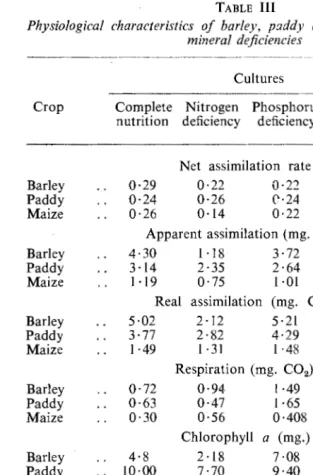
assimila-tion rates of the different cultures did not differ significantly in barley and maize. All deficient and complete nutrient cultures showed insig-nificant differences amongst themselves. Apparent and real photo-synthesis was found to be the most depressed by lack of nitrogen and less so by the absence of potassium in barley. In paddy, apparent assimilation was found to vary less m01rkedly among the three deficient cultmes. Tendency towards depression of photosynthesis was noticed. Real assimilation -of paddy leaves, on the contrary, showed relatively less efficiency under- N, but-- P and - K cultures appeared to show better efficiency than the control. In maize, differences in assimilation
rate of-control and - N cultmes appeared more marked than the
c::>rresponding differences between complete nutrient and - P or - K
r;ultures. In regard to respiration of leaves, C02 output tended to
increase under all the deficiencies. In paddy, - P and - K cultures
showed higher respiration than the control. In maize, all the cultures appeared to have higher leaf respiration than the complete nutrient. Mineral deficiencies tended to increase respiration of leaves (Table III).
Pigment.-Chlorophyll a content of barley was markedly increased
under - P and lowered in - N and - K cultures. In paddy, differences between control and phosphorus deficient cultures were less evident.
Nitrogen and potassium-deficiencies again lowered chlorophyll a content.
In maize, lack of nitrogen reduced chlorophyll a while 'absence of K
MINERAL DEFICIENCIES AND GROWTH
177
TABLE Ill
Physiological characteristics of barley, paddy and maize in relation to mineral deficiencies
Cultures
- - - S.D. at Crop Complete Nitrogen Phosphorus Potassium 5%
nutrition deficiency deficiency deficiency
Net assimilation rate
Barley 0·29 0·22 0·22 0·30 0·09
Paddy 0·24 0·26 <!·24 0·30 0·41
Maize 0·26 0·14 0·22 0·25 0·73
Apparent assimilation (mg. C02)
Barley 4·30 1 ·18 3·72 2·58
Paddy 3·14 2·35 2·64 2·39
Maize 1 ·19 0·75 1·01 0·98
Real assimilation (mg. C02)
Barley 5·02 2·12 5·21 4·29
Paddy 3·77 2·82 4·29 4·30
Maize 1 ·49 1. 31 1·48 I ·68
Respiration (mg. C02)
Barley 0·72 0·94 1·49 I. 7l
Paddy 0·63 0·47 1·65 I ·91
Maize 0·30 0·56 0·408 0·70
Chlorophyll a (mg.)
Barley 4·8 2 ·18 7·08 2·46
Paddy 10·00 7·70 9·40 5·60
Maize 8·09 3·70 8·67 10·50
Chlorophyll b (mg.)
Barley 2:54 1·28 3·48 1·93
Paddy 7·40 4·70 5·30 5 ·10
Maize 6·3 7·40 10·4 8·7
Carotin (mg.)
Barley
..
0·00945 0·00703 0·00710 0·00630 Paddy..
0·00840 0·00730 0·00798 0·00698Maize 0·00580 0·00520 0·00560 0·00580
Xanthophyll (mg.)
Barley 0·00204 0·00620 0·00573 0·00240
Paddy 0·00790 0·00760 0·00650 0·00690
Maize 0·01020 0·00720 0·00700 0·00800
---~----r----·---~---~--~-178 K. N. LAL AND M. S. SUBBA RAO
The chlorophyll b content of barley leaves increased under phos-phorus deficiency while under - N and - K cultures it was lowered. In paddy, all deficiencies reduced the chlorophyll b content of leaves. In maize, phosphorus deficiency increased chlorophyll b content (Table III).
Carotin and xanthophyll concentrations in all the three crops varied but slightly under the three deficiencies from the control (Table III).
CONCLUSIONS
Effects of nitrogen deficiency.-Of the three mineral nutrients, nitro-gen was found to be the most important while phosphate and potassium followed in successive order. Deficiency of nitrogen reduced height, tillering, leaf number, leaf size, fresh weight of leaves and of entire plant and dry weight of component parts. Nitrogen deficiency also depressed apparent assimilation in barley and maize and real assimilation in barley and paddy. Respiration of barley and maize leaves was increased in absence of nitrogen. Chlorophyll a content was reduced in both barley and m:tize while concentration of chlorophyll b was lowered in barley and paddy only. Its deficiency had no effect on carotin content of leaves. Under nitrogen deficiency the xanthophyll content of barley was increased whereas that of maize was reduced. Nitrogen deficiency, therefore, brought about an all-round depression in various metabolic activities and growth attributes.
Singh et a!. (1942) also found similar depression in almost all physiological ch:tracters in wheat and sugarcane. On the other hand, La!, De and Rao (1951) found no alteration in the rate of respiration at the maturity stage of the sugarcane crop under complete deficiency of nitrogen. Gregory and Richards (1929) and Gregory and Sen (1937), however, found reduced respiration and normal assimilation in barley under a partial deficiency of nitrogen. Further, nitrogen deficiency, up to m'lximum leaf area, showed no effect on assimilation by Gregory (1929) with both N.A.R. and photosynthesis corraborating each other. The results obtained in the present investigation however show that in m'lize, barley and paddy the N.A.R. was also significantly affected by the total absence of nitrogen in the medium.
Effects of phosphorus deficiency.-Phosphorus deficiency in barley markedly reduced tillering, leaf number and dry weight of roots, stem and leaves; chlorophyll b and xanthophyll were, however, increased. In paddy, all vegetative characters excepting leaf size were reduced under phosphorus deficiency, while respiration, real assimilation and xanthophyll were increased. In maize, again, almost all the vegetative characters were reduced in phosphorus deficiency while respiration and chlorophyll b content were increased.
Studies on wheat by Lal, Malkani and Pathak ( 1946) also showed similar responses to total deficiency of phosphorus. Singh et a!.
MINERAL DEFICJENCIES AND GROWTH
179
(Gregory and Sen, 1937) and photosynthesis (Gregory and Richards, 1929) and Verma (1945) under partial deficiency of phosphorus, the present study showed a rise in both respiration and real assimilation rates. The balance of photosynthesis over respiration was however found to be not much, resulting in reduced N.A.R. and depressed vege-tative growth.
Effects of potassium deficiency.~Potassium deficiency has been found in the present investigation to lower the vegetative vigour of these plants as measured by height, tillering, leaf width, leaf number, and fresh and dry weight of component parts of barley. On paddy and maize the reduction in vigour, however, was of lesser intensity than that recorded under nitrogen deficiency. Occasionally potash-deficient cultures behaved similar to phosphorus-deficient cultures in the extent of vegetative vigour of these plants. Its absence has been noted to reduce chlorophyll a and b content of barley and chlorophyll a content of paddy.
Similar results of potassium deficiency were reported by Lal and Pathak (1948) and Lal and Shrivastava (I 949). Marked changes in nitrogen metabolism ensued in potassium-deficient barley plants (Richards and Templeman, 1936). But in wheat Gassner und Goeze (1932) found increased rate of photosynthesis under potash deficiency; actually photosynthesis was found to decrease with increasing con-centrations of potash. Further, assimilation was found to be the lowest in complete absence of this element (Gassner und Goeze, 1933) which has been confirmed by the present study only in case of barley. But iro crops like paddy and maize no such effects were seen. Further. poor assimilation efficiency of barley was correlated with low content of chlorophyll in the leaves under potash deficiency. Thus it has been brought out in these studies that the responses of the three crops, barley, paddy and maize, to the total absence of the three major nutrients, were not identical. The responses to nitrogen and phosphorus deficiencies were more or less uniform, but the responses to deficiencies of potash appeared to vary from crop to crop.
SUMMARY
The influence of deficiencies of nitrogen, phosphorus and potas-sium on growth and physiological characteristics of barley, maize and paddy was investigated. The plants were raised in sand with Hoaglands' culture solution.
180 t<:. N. LAL AND M. S. SUBBA RAO
Phosphorus deficiency reduced tillering, leaf number, dry weight
of comp::ment p:uts in b:uley. Chlorophyll b and xanthophyll
concentra-tions were slightly increa>ed. In paddy, all vegetative characters except-ing leaf size were reduced. Respiration, real assimilation and
xantho-phyll content w~re slightly improved under phosphorus deficiency.
In maize, again, vegetative growth was reduced while respiration and
chlorophyll b content were increased.
Potassium deficiency decreased the vegetative vigour of all the three phnts although the reduction in vigour was less than that recorded for nitrogen deficiency. Differences between potassium-deficient" and phosphorus-deficient plants were less evident. Absence of potassium
also reduced chlorophyll a and b content of barley and chlorophyll a
content of paddy.
Comp:uative effects of these deficiencies of barley, paddy, maize, wheat and sugarcane have been discussed and indications given of the m'lnner in which absence of these ingredients affected growth of these Graminaceous plants.
REFERENCES
GASSNER, G. UND GOEZE, G. (1932). Uber den Einfinss dor ka\iemhnmg auf die assimilations prvsse von weizenblc.ttcrn. Ber. Dentsch. B~t., Ges., 50, 412-82.
- - - (1933). W0't~re untersuchungen ul:er die abr.angigl.cit der l'.ssimilations grosse jmg~r gc;troide blattAr von dor k~JiArraLrung der versucLhpf Janzen.
Zeit. wiss. Bioi. Abt. E. Plantz., 20, 391-406.
GREGOIIY, F. G. (1926). The effect of climc.tic conditior.s on tl:e grcwth of tarley.
Ann. B1t., 40, 1-26.
- - AND RicHARDS. F. J. (1929). Physiological stt:dir.s in plc.rt nutrition. I. TJ-.e effJct m8, lllrial ddicier.cy on the respirr.ticn arcd assimi!:Jtion rate in barley.
Ibid., 1 J, 119.
- - AND SEN, P. K. (1937). Physiologiccl studies in rlart nutrition. VI. Tl:e rc}latio:t of respirdtion rato to tl:e carbo! .ydrate and nitregen metaboli~m of tf.e barley leaf as determined by nitrogen and potassium defi::imcy. Ibid., 521-63.
LAL. K. N .. MALKANI, S. AND PATHAK, H. S. (!946). Dcfic!ercy, st flkicr-cy dfocts of r.~rtiliznrs on growth and protein content of wl.cat. Proc. Ind. Acad. Sci.,
24 B, 225-42.
--AND PATHAK, H. S. (1948). Eff.~ct of fertilizer dcficioncies and st fficiencif.s upon gruwth a'1d dcvelopmeLt of sug<J.rcaEe. Jour. Ind. Bot. Soc., February 1948.
- - AND SHI>IVA~TAVA, S. (1949). Studies in crop pl.ysiology. Nutrition c.ffects uo.-.,, developmc,1t and vegetative vigour of sugarcar..e. Proc. Ind. Acad. Sci.,
29
B, 109-28. •- - RAJAT DE AND SuBBA RAo, M. S. (1951). Effect of nitrogen, phosphorus ~,d potassium defi-:ie!lcies on respiration rate of sugarcane leaves. Ibid., 33 B,
1-13.
RICHARDS, F. J. AND TEMPLEMAN, W. G. (1936). P!-.ysiological studies in plant nutri-tion. IV. Nitrogca metabolism in mlation to nutrient d{ficiency and age in leaves of barley. Ann. B~t., 50, 363-403.
SINGH B. N. et al (1937-42). Progress Reports of &heme of Research on the Physio-logy of Cane and Wheat. hd. Courcil Agril. Res., New :Celhi.
VERMA, S. S. (1935). Thesis Univ. London (Ann. Rev. Biocl•em., 1937).
WALLACE, T. (1944). The Diagnosis of Mineral Deficiencies in flants. His Majest,Y's