e
-ISSN: 2278-067X,
p
-ISSN: 2278-800X, www.ijerd.com
Volume 7, Issue 1 (May 2013), PP. 86-93
Reduce Load at Base Station by Node Authentication
Using Intra-Cluster Formation in Wireless Sensor
Network
Keyur N. Zala
1, Diwan Raimagia
2, J. N. Rathod
31,2,3 Atmiya Institute of Technology & Science, Rajkot, Gujarat, India.
Abstract:- Area of Wireless sensor networks is very wide such as military, environment, agriculture and so on. Security is critical to sensor networks deployed in hostile location, such as military field and security observation. The need of security on digital environment has appeared. Various cryptographic algorithms has been offered to transmit data in a secure environment. In this study, focus is drawn on load to base station while implementing public key cryptography. We proposed Hierarchical framework for key distribution. Here main function of cluster head is to distribute key to cluster nodes and decrypt data from nodes to cluster head. With our frame work load on base station is reduced, result shows that load on base station after clustering of data is much reduced and malicious nodes are dropped by cluster head. Here Public-key encryption i.e. RSA, Chinese Remainder Theorem
is implemented.
Keywords:- Base Station (BS), Cluster Head (CH), Member node (MCH),RSA, RSA with CRT,
AODV, Bit rate, Packet delay, Number of packets.
I.
INTRODUCTION
All Most previous research efforts consider homogeneous sensor networks, where all sensor nodes have the same configuration and capabilities. However, a homogeneous ad hoc network suffers from poor fundamental limits and performance. Research has verified its performance bottleneck both theoretically and through simulation experiments and test bed measurements. Several recent works studied Heterogeneous Sensor Networks (HSNs), where sensor nodes have different capabilities in terms of message passing, calculation, energy supply, storage capability space, reliability and other aspects.
In a wireless sensor network, physical security of wireless links is virtually impossible because of the broadcast nature and resource limitation on sensor nodes and uncontrolled environments where they are left unattended [1]. Consequently security attacks on information flow can be widespread, e.g. passive interception of data transmission, active injection of traffic and overloading the network with garbage packets. Modification of information is possible because of the nature of the wireless channels and uncontrolled node environments. An opponent can make use of these natural impairments to modify information and also render the information unavailable. Wireless sensor networks also have the general security requirements of integrity, availability, confidentiality, authentication, and non-repudiation. These security requirements can be provided by a key distribution mechanism [2] with requirements of scalability, efficiency, key connectivity and resilience.
load and complexity increases at base station because of key distribution to all sensors, and decryption of data and find malicious node by base station. All this leads to increase in load to base station.
II.
ATTACKS
IN
WIRELESS
SENSOR
NETWORK
Attacks against wireless sensor networks could be mostly classified from two different points of view [7-11]. One is against the security mechanisms and another is against the basic mechanisms (like routing mechanisms). Below are some of the major attacks described, which occurs in wireless sensor networks.
A. Denial of Service
Denial of Service is produced by the unintentional failure of nodes or malicious action. The simplest Denial of Service attack tries to weaken the resources available to the target node, by sending more and more unnecessary packets and thus prevents genuine network users from accessing services or resources to which they are entitled [3]. Denial of Service attack is meant not only for the adversary’s attempt to destabilize, disorder, or devastate a network, but also for any event that diminishes a network’s capability to provide a service. Several types of Denial of Service attacks in different layers might be done in wireless sensor networks. At physical layer the Denial of Service attacks could be congestion and tampering. At link layer, collision, collapse, wrong. At network layer, ignore and greed, homing, misdirection, black holes and at transport layer this attack could be performed by malicious flooding and resynchronization. The mechanisms to prevent Denial of Service attacks include payment for network resources, reposition, well-built authentication and detection of traffic.
B. Attacks on information in Transit
In a sensor network, sensors monitor the changes of specific parameters or values and report to the sink according to the requirement. The information in transit may be changed, spoofed, replayed again or mislaid while sending the report. As wireless communication is susceptible to eavesdropping, any attacker can observe the traffic flow and get into action to suspend, intercept, alter or fabricate packets thus, provide wrong malicious information to the base stations or sinks. During transmission, as sensor nodes usually have short range of transmission and limited resource, an attacker with high processor and better communication range could assail several sensors simultaneously at same time to modify the actual data.
C. Sybil Attack
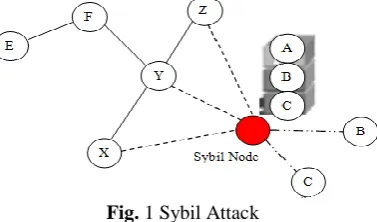
In Wireless Sensor Network mostly, the sensors might need to work together to complete a job, hence they can use the subtasks distribution and redundancy of information. In this case, a node can act as more than one node using the identities of other genuine nodes (Figure 1). This type of attack where a node forges the identities of more than one node is the Sybil attack [5]. Sybil attack tries to mortify the integrity of data, security and resource consumption that the distributed algorithm attempts to accomplish. Sybil attack can be done for attacking the distributed storage, data aggregation, selection, routing mechanism, reasonable resource allocation and misconduct detection. Basically, wireless ad hoc networks are vulnerable to Sybil Attacks. However, as WSNs can have some sort of base stations or gateways, this attack could be prohibited using efficient protocol.
Fig. 1 Sybil Attack
D. Blackhole/Sinkhole Attack
Fig. 2 Conceptual view of blackhole attack
E. Hello Flood Attack
This attack uses HELLO packets as a weapon to convince the sensors in WSN. In this kind of attack an attacker with a high radio transmission range and processing power sends HELLO packets to a number of sensor nodes which are isolated in a large area within a WSN. The sensors are thus convinced that the antagonist is their neighbour. As a result, while sending the information to the base station, the victim nodes try to go all the way through the attacker as they know that it is their neighbour and are ultimately spoofed by the attacker.
F. Wormhole Attack
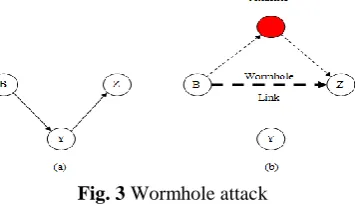
Wormhole attack is a critical attack in which the attacker records the packets (or bits) at one location in the network and tunnels those to another location. The tunnelling or retransmitting of bits could be done selectively.
Fig. 3 Wormhole attack
Wormhole attack is a significant threat to wireless sensor networks, because; this kind of attack could be performed even at the initial phase i.e. discovery of neighbor nodes information. Hence Wormhole attack does not require compromising a sensor in the network. Fig 3 (a/b) shows a situation where a wormhole attack takes place. When a node B (base station or any other sensor) broadcasts the routing request packet, the attacker receives this packet of information and replays it in its neighborhood. Each adjacent node receiving this replayed packet will consider itself to be in the perimeter range of Node B, and hence will mark this node as its parent. Thus, even if the victim nodes are multi hop at a distance from B, attacker in this case convinces victim node that B is only a single hop away from them, thus creates a wormhole attack.
III.
OVERVIEW
OF
ENCRYPTION
STANDARDS
A. Public Key Encryption
There are a lot of secret key algorithms. The most commonly used three algorithms are Caesar shifts, DES and RSA. One of the most important opinions about public-key encrypting systems is that these systems can never provide unconditional security. Because other side can find value A obtaining B=ek(A), by using rule EK by using encrypted expression B. A expression is decrypted form of expression B. Hence, studies are made on computable security of public-key encryption standard algorithm. It is preferred that suitable public-key algorithm is easily computable and inverse transforming function is also hardly computable. This is generally called infectivity.
Injective functions are used in the RSA systems. But formal person can obtain easily the rule of inverse transforming through the private key. Before talking about details of RSA, it is useful to explain two subjects about modular arithmetic and numbers theory.
B. RSA Algorithm
The security of the RSA cryptosystem depends on the difficulty of factoring large integers. The longer the key, the higher the work factor the cryptanalyst has to pact with. For breaking the system by exhaustive search of the key space, the work factor is exponential in the key length. Secrecy comes from having a strong (but public) algorithm and a long key.
C. RSA with CRT Algorithm
A major difference between the RSA scheme and cryptosystems based on the discrete logarithm problem is the fact that the modulus used in the RSA encryption scheme is the product of two prime numbers. This allows utilizing the Chinese Remainder Theorem (CRT) in order to speed up the private key operations. The usage of the CRT for RSA decryption is well known from mathematical point of view. But for a hardware implementation, special multiplier architecture is necessary to meet the requirements for efficient CRT-based decryption.
IV.
CLUSTER
FORMATION
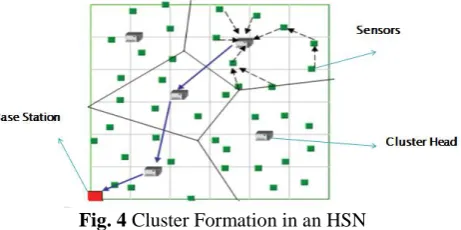
A Current Clusters are formed in an HSN. We have designed an efficient clustering scheme for HSNs. Because of the page limit, we will not describe the details of the clustering scheme. Let us assume that each H-sensor can communicate directly with its neighbor H-H-sensors (if not, then relay via L-H-sensors can be used). All H-sensors form a basic support in an HSN [12]. After cluster formation, an HSN is alienated into multiple clusters, where H sensors serve up as the cluster heads.
An illustration of the cluster formation is shown in Fig 4 where the small squares are L sensors, large rectangular nodes are H-sensors, and the large square at the bottom-left corner is the sink.
Fig. 4 Cluster Formation in an HSN
In wireless sensor networks, a cluster algorithm is a good option to reduce redundant data transfer and organize nodes effectively for long life [10]. In this paper we implement and evaluate a new hierarchical and flexible clustering algorithm on the middleware layer based paradigm.
V.
PROPOSED
ARCHITECTURE
Fig. 5 Authentication of Nodes by Cluster Head
Here, in these architecture two levels of authentication is proposed for authenticating nodes to CH and authentication of CH by BS (Base station) is done.
As shown in figure 5, initially cluster head member nodes sense data, after sensing, data is encrypted with RSA or RSA with CRT algorithm using public key of CH. After encryption of data, encrypted data and key are combined to generate hash value using any hashing algorithm say MD5 or SHA.
After generating hashing, encrypted data and hash value are combined and send it of CH. At Cluster head hash value is generated using private key. Now newly generated hash at CH and hash send by MCH are compared, if hash value is found incorrect node is considered to be malicious and nodes are not considered as member of CH and instead of forwarding data to BS, malicious nodes are dropped at CH hence work load of BS is reduced
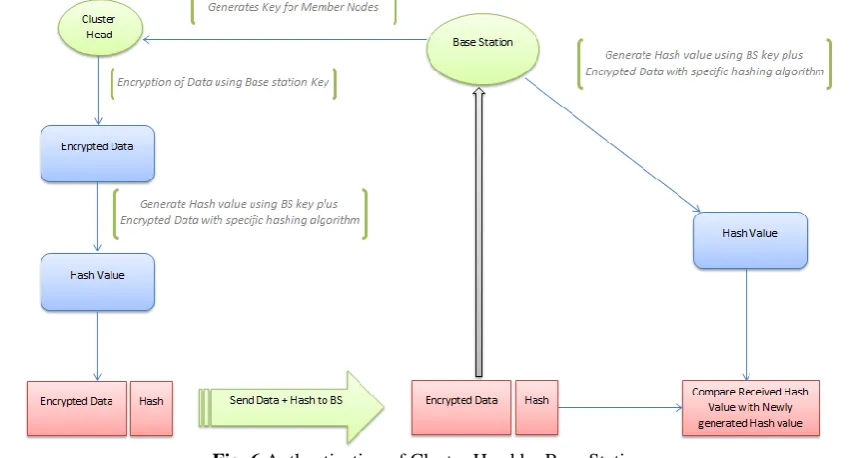
As shown in figure 6, Encrypted data at cluster head (CH) and using Public key of BS generates hash value using any hashing algorithm say MD5 or SHA.
After generating hashing, encrypted data and hash value are combined and send it of BS. At Base Station hash value is generated using private key. Now newly generated hash at BS and hash send by CH are compared, if hash value is found incorrect CH is considered to be malicious and Cluster Head are not considered as member of BS and instead of accepting data from CH, malicious CH are dropped at BS. After node authentication data are decrypted and considered as valid.
VI.
EVALUATION
OF
PROPOSED
FRAMEWORK
We had taken 100 nodes for simulation. 6 clusters are used. AODV routing protocols is used for routing process. We had simulated the same scenario in three different environments using three different encryption algorithms RSA, and RSA+CRT. For generating hash value MD5 algorithm is used.
TABLE I Environment Variables And Its Associated Values Used In Experiment
No. Environment Variables Associated Values
1 Simulation Tool Cygwin+Ns-Allinone-2.28
2 Bandwidth of HSN
Environment
1MB
3 Initial Energy 100 Joules
4 Antenna Type Omni Direction
5 Base Protocol AODV
6 Total Number of Nodes 100
7 Encryption Standards RSA and RSA with CRT
8 Hashing Algorithm MD5
9 Optimal number of cluster
heads
6
10 Simulation time 3600s
We have improved three primary performances using the Route-Driven methods. Using routing driven approach we had achieved three things.
Encryption methods have been established for the data transmission from sensor nodes to the cluster head, there by the malicious data will be blocked in the cluster head itself thereby reducing the unnecessary malicious data traffic from cluster head to base station.
For the Sensor nodes and Cluster head encryption, key generation parameters are distributed dynamically within the cluster itself rather than getting common key from the base station. This reduces the unnecessary overhead of the base station.
Dynamic key generation and Route Driven Encryption have been established using three algorithms viz. RSA Algorithm and RSA with CRT Algorithm. The Performance Analysis for these Algorithms is tabulated below.
TABLE III Performance Analysis
Parameters RSA Algorithm RSA with CRT
Algorithm
Key Size 1024 bits 1024 bits
Security High Highest
Approach Asymmetric Asymmetric
Encryption Slow Fastest
A. Energy Consumption
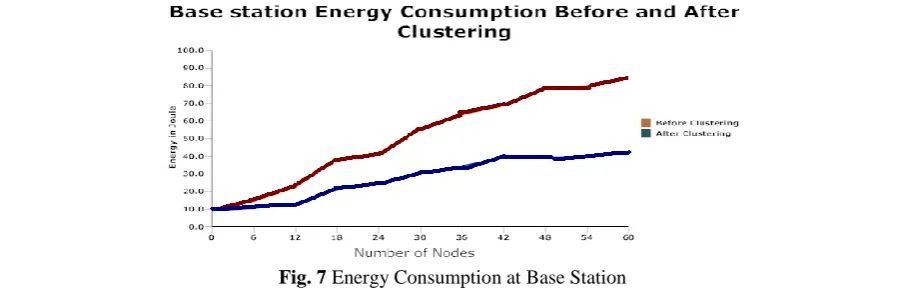
Based on the Simulation Analysis, the Energy consumption at base station increases as number of nodes increases, but after formation of cluster result shows that performance in this case, energy consumption is very less as workload at base station reduces because of cluster formation key generation during encryption and acknowledgement to nodes reduces. All the data is being encrypted both in cluster head and base station is represented in the graphical analysis.
B. Malicious Packet
Based on the Simulation Analysis, the packet received at base station must be secure i.e. packets send by malicious nodes must be dropped. Thus because of two levels of hierarchy, majority of work of removing malicious data is done by cluster head instead of base station, base station only checks data encrypted by cluster head. Hence as shown in graph packets received is reduced at base station as malicious packets are dropped by cluster head.
Fig. 8 Malicious Packet
C. Performance speedup of Base Station
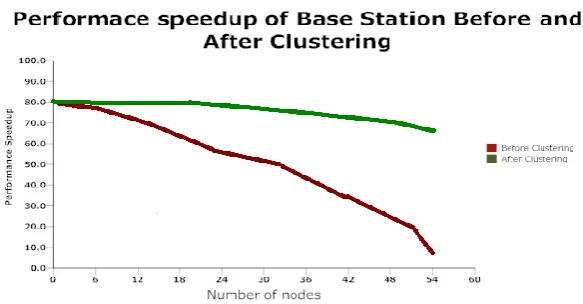
This Simulation Analysis Chart shows the number of packets received in the case of RSA, RSA with CRT Algorithms under the simulation environment. The Performance results show that during simulation as number of nodes increases the work load of base station increases drastically as base station needs to generate key during encryption process, performs encryption of packets, check whether packets received is malicious or not, validate new nodes etc. As load increases to base station, performance reduces as shown in figure 7; hence clustering is the best option for reducing work load to the base station. As majority of work done occurs at cluster head, hence performance at base station increases.
Fig. 9 speedup ratio with number of nodes at base station
VII.
CONCLUSION
Through simulations, we have compared the performances of Energy consumption at base station, malicious packet received at base station, Load ratio with number of nodes at base station. Result shows that cluster formation is better as compared to direct packet sending and receiving at base station as majority of work is distributed at cluster head.
REFERENCES
[1]. Asmae BLILAT, Anas BOUAYAD, Nour el houda CHAOUI, Mohammed EL GHAZI. Wireless
sensor network: security challenges.
[2]. Md. Iftekhar Salam, Pardeep Kumar, HoonJae Lee. An Efficient Key Pre-distribution Scheme for
Wireless Sensor Network
[3]. Using Public Key Cryptography.
[5]. A. D. Wood and J. A. Stankovic. (2002) Denial of service in sensors networks, Computer, 35(10) pp 54-62.
[6]. Ren Xiu – li, Yang Wei Method of detecting the Sybil Attack Based on Ranging in Wireless Sensor
Network.
[7]. C. Y Chong, and S. P. Kumar. (2003) Sensor networks: evolution, opportunities, and challenges,
Proceedings of the IEEE, 91(8), pp 1247-1256.
[8]. P. A. Szewczyk, R. Tygar, J. Wen, V. Culler, “SPINS: Security protocols for sensor networks, Wireless
Networks”, 8(5) pp 521-534.
[9]. K. J. Rabiner, W. Balakrishnan, “Adaptive protocols for information dissemination in wireless sensor
networks”, in Proceedings of 5th ACM/ IEEE-MOBICOM’99 conference.
[10]. Hamed EL_afandi . An Intellig ent Wireless Ad hoc Routing Protocol. In University of
Wisconsin_Milwaukee, 2006.
[11]. C.Schurgers and M. B. Srivastava. Proceedings of IEEE MlLCOM," Energy efficient routing in
wireless sensor networks", 2008.
[12]. Ding, P., Holliday, J., and Celik, A. Distributed energy hierarchical clustering for wireless sensor