FPGA Implementation of Transform Based
Advanced Encryption Technique for Visual
Cryptography
Shweta Modi Dr. Meghana Kulkarni
PG Student Associate Professor
Department of VLSI Design and Embedded Systems Department of VLSI Design and Embedded Systems Center for PG Studies, Visvesvaraya Technological
University, Belagavi, Karnataka, India
Center for PG Studies, Visvesvaraya Technological University, Belagavi, Karnataka, India
Abstract
The main aim of the paper is to investigate the hardware performance and effect of peak signal to noise ratio (PSNR) values for digital images using DWT based steganography technique. The proposed system is designed with an efficient secured algorithm for enhancing the visual quality. The cover image is resized and applied to DWT to obtain four bands such as LL, LH, HL and HH. Similarly the message image is repeated with same process to obtain four bands. The values of LL band of cover and LL band of message image are fused with LSB technique, later IDWT is applied to obtain stegano image. In decoding the same process is reversed to obtain the message image. Further we design an efficient VLSI architecture for the above algorithm and the performance parameters such as area, speed and PSNR are analyzed. To design an efficient VLSI architecture the sub modules are combined and pipelining is done by using single clock in order to enhance the performance of the system in terms of speed and area.
Keywords: FPGA, Image Steganography, LSB Technique, Wavelet Transform, Key sharing etc
________________________________________________________________________________________________________
I. INTRODUCTION
Security is a major issue in communication and storage of images in present era. A variety of encryption scheme have been proposed to ensure security of data. In a wide range of applications image encryption is being used such as multimedia system, internet communication etc. As an example in a core banking system, there is a chance of encountering forged signature for money transaction. Similarly in the case of password, the password of customer can be hacked and misused in the net banking system. Hence security is challenge in these day by day life applications is more.
The main aim of this paper is to secure the customer information and to prevent the possible forgery of password hacking. Here the concept of image processing, an improved steganography and visual cryptography is presented. This describes a method for integrating together cryptography and Steganography through image processing. There are two methods for providing security to the information i.e. Cryptography and Steganography.
Steganography [1] is gained from Greek words 'stegos' means "cover" and 'grafia' means "writing" hence defined as "covered writing". Steganography is mainly used for security purpose in which the secret data is inserted or embedded in a cover. Message and Carrier are matters in steganography. Message is a secret data that should be hidden in a cover image and Carrier is cover image or the material in which secret data or message is embedded. Steganography also divided into three types such as Text, Image and Audio.
II. LITERATURESURVEYS
In this paper [2] Zig-Zag scanning pattern algorithm is presented for hiding information in an image and is more complex algorithm in steganography. Visual cryptography technique is used for encrypting the message as shares that is embedded in separate host image. To make the secret shares invisible the message is embedded into a host images. For providing double security of image shares, digital watermarking is used. Using Least Significant Bit Insertion technique (LSB) the share is embedded into host image. This scheme provides more security for hiding information and it cannot be hacked by the attacker. The performance can e calculated by PSNR, Histogram analysis and numerical experimentation. It explains that the embedding time linearly varies with message length. The system provides high level of security after the simulation result.
(IJSTE/ Volume 2 / Issue 12 / 093)
cryptography, steganography and watermarking to hide the information and to produce good results for MSE. The proposed novel gives better security for hiding the data [3].
III. PROPOSED ARCHITECTURE
In the proposed architecture, first the image is resized to a specific size (256x256) for easier implementation of hardware. The 2D-DWT is applied on both image to generate all four bands namely LL, LH, HL and HH bands respectively. Now mix two image LL coefficients using average LSB encoding and decoding techniques. Mix these new LL band coefficients in carrier image by taking 2D-IDWT.
Preprocessing:
In pre-processing the captured image is resized to a particular size and color to gray conversion is done.
Discrete Wavelet Transform (DWT)
DWT is a tool to transform time domain signal to frequency domain signal. The main advantage of DWT is temporal features [7]. Due to temporal-resolution features DWT can be able to consider both location and time information for domain transform which will give more accuracy of conversion than usual techniques. As a result we can be able to achieve more PSNR values.
For our implementation we use Haar Transform which is the basic Wavelet Transform. The equation for Haar transform L and H-band is given in equation (1) and (2)
𝐿 − 𝐵𝑎𝑛𝑑 =𝐴+𝐵
2 (1)
𝐻 − 𝐵𝑎𝑛𝑑 =|𝐴−𝐵|
2 (2) Where, A and B are image pixel values.
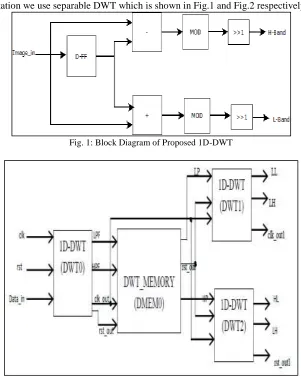
For hardware implementation we use separable DWT which is shown in Fig.1 and Fig.2 respectively.
Fig. 1: Block Diagram of Proposed 1D-DWT
Average Alpha Blending Technique
LSB technique is mainly used to combine two images. The basic equation of LSB encoding and decoding [10] is given in equation (3) and (4)
𝐿𝑆𝐵 𝐸𝑛𝑐𝑜𝑑𝑖𝑛𝑔 = ((𝛼 ∗ 𝐿𝐿1) − ((1 − 𝛼) ∗ 𝐿𝐿2)) (3) 𝐿𝑆𝐵 𝐷𝑒𝑐𝑜𝑑𝑖𝑛𝑔 = 𝑎 − (𝑏 + (𝑐 ∗ |𝑏|)) (4) Where, LL1 and LL2 are LL-band coefficient of Hidden and Cover image respectively.
α is the factor determining the percentages of pixel value is considered
But this cannot reduce the pixel value which is directly related to required binary bits. To reduce bit size we modify the above equation as
𝐴𝑣𝑒𝑟𝑎𝑔𝑒 𝐿𝑆𝐵 𝐸𝑛𝑐𝑜𝑑𝑖𝑛𝑔 =((𝛼∗𝐿𝐿1)−((1−𝛼)∗𝐿𝐿2))
2 (5) 𝐴𝑣𝑒𝑟𝑎𝑔𝑒 𝐿𝑆𝐵 𝐷𝑒𝑐𝑜𝑑𝑖𝑛𝑔 = 2 ∗ (𝑎 − (𝑏 + (𝑐 ∗ |𝑏|)) (6)
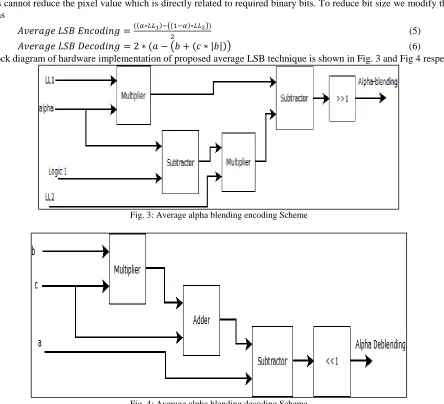
The block diagram of hardware implementation of proposed average LSB technique is shown in Fig. 3 and Fig 4 respectively
Fig. 3: Average alpha blending encoding Scheme
Fig. 4: Average alpha blending decoding Scheme
IV. FPGA IMEMENTATION RESULTS
The architecture is implemented on Spartan-6 ATLYS FPGA using System Generator tool. The coding part is done using VHDL coding language. For simulation purpose Xilinx 14.5 tool is used.
The device utilization is shown in table 1
Table – 1 Device Utilization
Parameters Utilization No. of Occupied Silce 851 Number of LUT-FF Pair Used 2415
No. of fully used FF Pairs 1203 Multiplexers 0 Maximum Frequency 153.312
(IJSTE/ Volume 2 / Issue 12 / 093)
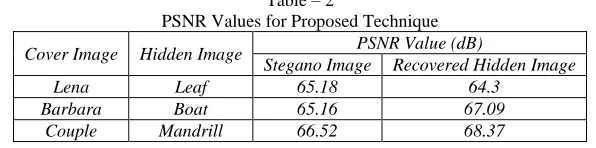
Table – 2
PSNR Values for Proposed Technique
Cover Image Hidden Image PSNR Value (dB)
Stegano Image Recovered Hidden Image
Lena Leaf 65.18 64.3
Barbara Boat 65.16 67.09
Couple Mandrill 66.52 68.37
V. PERFORMANCE COMPARISONS
PSNR Comparisons
The accuracy of proposed technique is compared with existing techniques in-terms of PSNR values of Stegano image which is tabulated in Table 3.
Authors Techniques Image PSNR
R. Gayathri and V. Nagarajan [2] List Significant Bit Lena 55.91 Mandrill 55.90 Madhusudhan et al., [3] RSA and DCT
Lena 36.48 Cameraman 36.50 Peppers 38.76 Manjinder Kaur and Varinder Kaur Attri [6] Interpolation and List Significant Bit
Man 44.98 Boat 44.49 Peppers 45.11
Proposed Methods DWT and Average LSB Technique
Lena 65.18 Cameraman 62.55 Boat 64.83 Peppers 65.46 Man 62.44
Hardware Comparisons
Hardware comparisons of proposed technique with existing techniques in-terms of area utilization and maximum operating frequency is given in Table 4.
Parameters Jatin and Bhatt [11] Vasantha and Videya [12] Proposed Method
Number of Slice Registers 2411 1880 1840
Number of Slice Flip-flops ---- 2118 1895
Number of 4 input LUTs ---- 2971 2451
Number of MULT18x18s ---- 3 0
Maximum operating frequency (MHz) 107.75 65.342 153.312
VI. CONCLUSION
In this paper we implement image steganography using Discrete Wavelet Transform and average LSB technique. The DWT-IDWT is used to introduce randomness of the pixel values present inside cover image. The absolute block is used to force negative coefficients values to zero which will increase the PSNR values of the reconstructed Image. Without this block we will get noises like salt and pepper noise. The average alpha blending technique reduce the bit size of the transmitted stegano image as a result low communication channel bandwidth is required to transmit the stegano image.
The proposed technique can be able to provide good accuracy of hidden image and cover image in-terms of high PSNR values than existing techniques due to above reasons. Also the proposed technique uses 7% less hardware resources than existing techniques and the operating frequency is 50% higher than existing techniques. This is because the proposed architecture is built using basic logic gates; no multiplier is being used here.
REFERENCES
[1] https://en.wikipedia.org/wiki/Steganography.
[2] R. Gayathri and V. Nagarajan, “Secure data hiding using Steganographic technique with Visual Cryptography and Watermarking Scheme”, ICCSP, pp.118-123, 2015.
[3] Rupesh Gupta and Tanu Preet Singh, “New Proposed Practice for Secure Image Combing Cryptography Stegnography and Watermarking based on Various Parameters”, IC3I, pp. 475-479, 2014.
[4] Madhusudhan Mishra, Gangadhar Tiwari and Arun Kumar Yadav, “Secret Communication using Public key Steganography”, ICRAIE, pp. 1-5, 2014. [5] Sudhanshu Suhas Gange and Ashok A.Ghatol, “Combination of Encryption and Digital Watermarking Techniques used for Security and Copyright
[6] Asit Kumar Subudhi, Krishna Kabi, Abhilipsa Subudhi, Himanshu Patra and Jyoti Bikash Panda, “An Enhanced Technique for Color Image Watermarking using HAAR Transform”, EESCO, pp. 1-5, 2015.
[7] https://en.wikipedia.org/wiki/Discrete_wavelet_transform
[8] Ricardo Jose Colom-Palero, Rafel Gadea-Girones, Francisco Jose Ballester-Merelo and Marcos Martinez_perio, “Flexible Architecture for the Implementation of the Two Dimensional Discrete Wavelet Transform Oriented to FPGA Device”, Elsevier, pp. 509-518, 2004.
[9] https://en.wikipedia.org/wiki/Haar_wavelet [10] https://en.wikipedia.org/wiki/lsb_compositing.
[11] Jatin Chaudhari and K.R. Bhatt, “FPGA Implementation of Image Steganography: A Retrospective”, IJEDR, pp. 2117-2121, 2014.