ISSN (e): 2250-3021, ISSN (p): 2278-8719
Vol. 09, Issue 10, October. 2019, Series -IV, PP 25-37
Assessing Climatic Change Impacts on Water Resource of
Different Districts of Odisha
Abhijeet Das
1,Dr.Bhagirathi Tripathy
21Assistant Professor (Consolidated), Civil Engineering Department, IGIT, Sarang, Odisha. 2
Assistant Professor, Civil Engineering Department, IGIT, Sarang, Odisha. Received 16October 2019; Accepted 31 October 2019
ABSTRACT:
It is rightly spoken “Climate change eclipses the planet earth”. The issue is so predominant now, it gradually restricting our social life, peace and harmony. Number of natural calamities like flood, cyclone, drought, severe heat and cold wave, rising of sea level, melting of snow etc is some of the ready effects directly felt in different parts of the globe. The cause may be many beginning from urbanization to modern life style. But sometimes these may be part of our growth. So there may be trade off or compromise between growth and balance with nature.The study may be a small step towards recognizing the arrival of climate change and its impact on particularly agriculture, as our state largely depends on agriculture based economy. The monthly rainfalls (1901-2010) of total 30 districts from IMD sources are considered for the purpose. The statistics of all the rainfall data are calculated along with its time series plotting. The trend analysis has been done using Kendall rank test at 1%, 5% and 10 % significance level. The average monthly temperature trend is also calculated similarly. The sensitive districts of rainfall are marked. The inflows to reservoirs within these districts are also checked. The standard cropping pattern adopted in different parts of the state is also shown in this study. As there is a short fall in June, rainfall the inflow to reservoir is also reducing. But during July on ward the rainfall as well as the inflow is also improving. In different studies it was also established that although there is no remarkable change in total rainfall, the change is seen in its spatio-temporal variation.
Keywords:
Climate, Natural calamities,Urbanization, Rainfall, Time series, Kendall rank test.I.
INTRODUCTION
Climate change is inevitable and unstoppable in its nature. Climate change is a phenomenon due to emissions of greenhouse gases from fuel combustion, deforestation, urbanization and industrialization resulting variations in solar energy, temperature and precipitation.
It is a real threat to the lives in the world that largely affects water resources, agriculture, coastal regions, freshwater habitats, vegetation and forests, snow cover and melting and geological processes such as landslide, desertification and floods, and has long-term effects on food security as well as in human health and also threaten livelihood and economic stability. Climate is one of the main determinants of agricultural production. Throughout the world there is significant concern about the effects of climate change and its variability on agricultural production.Current climate variability and change is predicted to cause increasing global temperature and subsequently impact the rainfall.
Agriculture is one of the most climate sensitive sectors as it is continuously and directly affected by temperature and precipitation.Climate changes pose significant economic and environmental risks worldwide. The economy of Odisha mainly depends on agriculture, and this in turn largely depends on available water resources. Climate variability is concerned with the changeability in the mean state and other statistics (such as Mean, Standard deviation, Coefficient of variation, Skewness, Kurtosis etc.)of climate elements on all spatial and temporal scales beyond those of individual weather events.Climate change is on the other hand is variability that continues over a longer period and statistically significant. Climatic variability particularly rainfall is the major factor influencing the agricultural productivity and sustainability in the tropics. Around 60% of the Indian agriculture is rain-dependent, distress-prone and vulnerable to climate. Constant increase in green house gas concentrations, since pre-industrial times, has led to positive radioactive force of the climate, tending to warm the surface.
II.
REVIEW OF LITERATURE
in all countries through agriculture production. It affects to food security is in four dimensions, food availability, food accessibility, food utilization and food system stability. It will also have an impact on human health, livelihood assets and food production and distribution channels (FAO, 2008). Due to rising global population size, climate change will challenge agricultural production and food4 security (location of production, supply, volume, quality) and by 2080, agriculture output Least Developed Countries (LDCs) may decline by 20 percent due to climate change and yields could decrease by 15 percent on average, while output in industrial countries is expected to decrease by 6 percent (Masters et al., 2010). It will affect about 200 million people and their families worldwide who live by fishing and aquaculture (Greg et al., 2011).In India, Gross Domestic Product (GDP) may decrease up to 6.2% and agriculture production may decrease up to 24% by 2080 due to climate
change (Zhai and Zhuang, 2009; and Zhaiet al., 2009).The concept of the AF was applied in order to explore
potential impacts of climate change on IDF curves using GCM/RCM data. AF represents the general ability of climate models in simulating the reanalysis data, which is the reasonable estimate of actual gridded historical climate. The six regions in the Orissa examined in this study represent a wide range of climatic conditions observed across the 30 districts including desert, tropical, temperate, and continental climates, which are influenced by a range of storm types (e.g., synoptic and convective). For most regions, future climate projections suggested an increase in the intensity of extreme storms with strong regional variations. The results also revealed the dependence of AF values on return period and storm duration as related to the characteristics of extreme rainfalls. In general, AF values deviated more significantly from 1 for short-duration, high-intensity storms. At the individual return period level the uncertainty in the AF values was high as indicated by the high significance level. Projected future rainfall intensities were higher than historical intensities for most regions. However, variations between storm characteristics (duration and return period) were more pronounced for short- duration, high-intensity events than they were for long duration, low-intensity events. The sizeable variation between historical and future rainfall intensities for short-duration events, however, generally supported the notion that precipitation intensity will be more severe in future decades (Endreny and Imbeah 2009).Gao et al. (2002) have applied stochastic hydrology methods to analyze the characteristics of annual inflow evolution of Miyun reservoir. It is obvious from their experiment that the annual inflow decreasing is mainly caused by human activities, such as extreme population increase and land use changes. Modeling the changes of in-flow to reservoir has been studied by Dilini et al. (2013) for effective water management. Sahu etal. (2012) made use of an artificial intelligence technique called the self-organizing map (SOM) to perform trend and cluster analysis for the inflows into the flood-control reservoirs of Indiana. Along with SOM, this research also used the Mann-Kendall test and a revised Mann-Mann-Kendall test for regional analysis for northern reservoirs of Indiana. Sethy et al. (2015) performed a trend analysis for precipitation and inflows time series for Salia river basin of Odisha, India which is draining to Chilikalake using the Mann– Kendall test. In order to assess the impact of climate change ARNO model was used to simulate the inflows into Salia reservoir calibrating the observed inflow Dawson et al. (2015) have studied about trends in water quality and quantity for 11 major reservoirs of the Brazos and Colorado river basins in the southern Great Plains.
STUDY AREA:
General: Orissa is a state on the eastern seaboard of India, located between 17°49' and 22°36‟ Northlatitudes
Physiographic Region:
The state of Orissa located on the eastern coast of Indian peninsula is quite rich in natural resources and has several bio-diversity hot spot areas of the Indian subcontinent. Rain gauge stations are plotted as shown in (figure 2).
III.
METHODOLOGY
General:
The long term monthly rainfall data over a period of 110 years (1901-2010)of 30 districts were obtained from India metrological department (IMD) website (http://www.Indiawaterportal.org/met data). The rainfall trend analysis was conducted for all the districts of Orissa on monthly, seasonal(monsoon from June to October) and annual basis.The trend was analyzed using non- parametric Mann-Kendall test (Mann1945;Kendall, 1975). The MK test has been employed by a number of researchers to ascertain the presence of statistically significant trend in hydrological climatic variables such as temperature, precipitation with reference to climate change. The MK test checks the null hypothesis of no trend versus the alternative hypothesis of the existence of increasing or decreasing trend. The regional water resources study was done by analyzing the rainfall data for 30 districts of Odisha for the period of 1901 to 2010. Ground water and surface water recharge have been summed according to availability of rainfall for 30 districts of Odisha.
The climate data was extracted as shown in (figure 3) for Odisha in ARCGIS 10.3.3. For minimum temperature, maximumtemperature, mean and maximum rainfall, minimum rainfall andmean using extract by mask using boundary of Odisha maps.
(Figure3. Extraction of climate data of Odisha) Mann-Kendall Test:
Inverse Distance Weight (IDW):
IV.
RESULTS AND DISCUSSIONS:
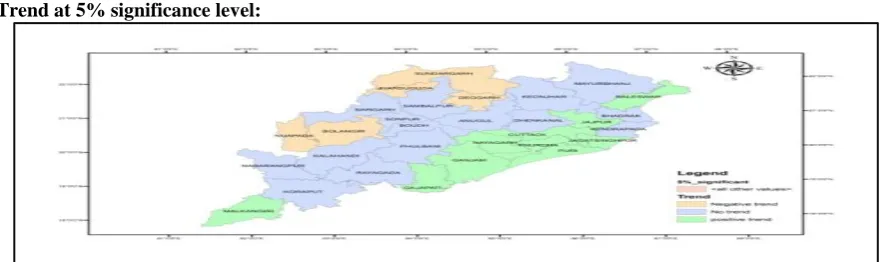
In the present study trend analysis of annual, monsoon and temperature has been carried out.For this initially the available rainfall and temperature data was classified in the above period .Further Mann-Kendall test was applied for three significance levels i.e. 1%,5%and 10%.On the basis of Z-statistics of each significance level the trends in of Orissa has been determined. The trends in total rainfall,annual maximum rainfall,monsoon rainfall and total temperature were investigated through the Kendall‟s test for Orissa. The monthly data were used to compute seasonal and annual time series of total rainfall. The (Figures 10, 11, 12) of annual and monsoon rainfall and temperature trend at 5% and 10% significant level of 30 districts are shown below.
The statistical parameter i.e. maximum,mean, standard deviation, skewness, coefficient of variation (Cv) and kurtosis of rainfall are calculated. These parameters help in explaining the characteristics of rainfall.
Trend at 5% significance level:
(Figure11.Annual Rainfall trend at 5% significant level)
Trend at 10% significance level:
(Figure12.Annual Rainfall Trend at 10% significant level)
Table 1.(Annual trend and Z values of 30 districts)
SL.NO DISTRICT ANNUAL TREND TEST STATISTICS
VALUE (Z_VALUE)
5% 10%
1 ANUGUL No No 0.77
2 BALESWAR Rising Rising 2.017
3 BARGARH No Falling -1.75
4 BHADRAK No No 1.57
5 BOLANGIR No Falling -1.85
6 BOUDH No No 0.41
7 CUTTACK Rising Rising 2.33
8 DEOGARH No Falling -1.88
9 DHENKANAL No No 1.29
10 GAJAPATI Rising Rising 2.1
11 GANJAM No Rising 1.75
12 JAGATSINGHPUR Rising Rising 3.32
13 JAJPUR Rising Rising 1.97
14 JHARSUGUDA Falling Falling -2.01
15 KALAHANDI No No -0.37
16 KENDRAPADA No No 1.44
17 KEONJHAR No Rising 0.9
18 KHURDHA Rising Rising 2.01
19 KORAPUT No No 1.18
20 MALKANGIRI Rising Rising 2.7
21 MAYURBHANJ No No 1.33
22 NABARANGPUR No No -0.86
23 NAYAGARH Rising Rising -2.48
24 NUAPADA Falling Falling -2.84
25 PHULBANI No Rising 1.75
27 RAYAGADA No No 0.44
28 SAMBALPUR No No -1.05
29 SONEPUR No No -0.86
30 SUNDARGARH Falling Falling -2.13
Table3.(MONSOON TEMPERATURE TREND AT 5% AND 10% SIGNIFICANT LEVEL OF 30 DISTRICTS)
V.
CONCLUSION
The economy of our state is fully dependent on agriculture.The quantity and spread of rainfall over entire 30 districts is very important in this regard as most of our land is rain fed.It has been assessed that 31.30 lakh hectares cultivable land can be brought under irrigation through major & medium irrigation projects. By end of March 2015, irrigation facilities of 13.91 lakh hectares have been created. Still a large area remains un- irrigated and agriculture in this area totally depends on the mercy of rain god. The information on quantification and its trend will definitely help planning and scheduling of our agriculture.
Our state has 7 majors and 45 medium irrigation storage structures comprising a live storage capacity of 153246 ham. Further mega lift irrigation storage are being initiated to improve the irrigation scenario.
Thestatistics like annual maximum,mean, standard deviation, skewness, coefficient of variation (Cv) and kurtosis for district wise monthly rainfall data of 110 year are calculated. These parameters help in explaining the characteristics of rainfall. Districts wise rainfall trend was analysed over a period of 110 years (1901-2010) and temperature trend of 102 years (1901-2002).Using most powerful non-parametric Kendall rank test at 1%, 5%and 10% significant level.Annual and monsoon rainfall increasing and decreasing at 5%and 10%significant level.The trend at monsoon temperature showed that most of districts have no trend but Jagatsinghpur, Kandhamal, Koraput,Malkangiri,Nayagarh and Puri are shown rising trend at 5% and 10% significant level. The reservoirs show a delayed and decreased inflow during the month of June, which compels for starting of cropping season, may be shifted to late June or early July. Creation of irrigation potentials is highly essential in order face the varying rainfall scenario.
REFERENCES
[1]. Adams, Richard M. , Hurd, Brian H. , Lenhart Stephanie , Leary, Neil., (1998) Effects of global climate
change on agriculture:an interpretative review CLIMATE RESEARCH Clim Res, Vol. 11: 1,20,21 [2]. Adamowski, K., and Bougadis, J. (2003). “Detection of trends in annual extreme rainfall.” Hydrol.
Processes, 17, 3547–3560.
[3]. Aggarwal, P. K. (2007) Climate change: implications for Indian agriculture. Hydrology Review 22, 37–
46. Roorkee: Indian National Committee on Hydrology.
International organization of Scientific Research
37 | Page
[5]. Allen, R. G., Pereira, L. S., Raes, D., and Smith, M. (1998). “Crop evapotranspiration. Guidelines for computing crop water requirements.” FAO. Irrigation and drainage paper 56, Rome.
[6]. Amien, I., P. Rejekiningrum, and Pramudia et al. (1996), Effects of interannual climate variability and climate change on rice yields in Java, Indonasia„, Water, Air, and Soil Pollution 92, pp.29-39.
[7]. Annual report on natural calamities (2011-12) Government of Odisha
[8]. Arnell NW, Liu C, Compagnucci R, da Cunha L, Hanaki K, et al. (2001) Hydrology and water resources.
In: Climate Change 2001: Impacts, adaptation, and vulnerability. Cambridge University Press, Cambridge, UK.
[9]. Arora, M., Goel, N. K. & Singh, P. (2005) Evaluation of temperature trends over India. Hydrol. Sci. J. 50(1), pp. 81–93.
[10]. Barman, D., Saha, A.R., Kundu, D.K. and Mahapatra, B.S. (2012) Rainfall characteristics analysis for jute based cropping system at Barrackpore, West Bengal, India. Journal of Agricultural Physics 12 (1): pp. 23-28.
[11]. Bates, B.C., Kundzewicz, Z.W., Wu, S., and Palutikof, J.P. (eds) (2008) Climate Change and Water. Technical Paper of the Intergovernmental Panel on Climate Change. IPCC Secretariat, Geneva: 210pp. [12]. Boko, M., Niang, I., Nyong, A., Vogel, C., Githeko, A., Medany, M., Osman-Elasha, B., Tabo, R. and
Yanda, P. (2007) Climate change 2007: Impacts, adaptation and vulnerability. In Parry, M.L., Canziani, O.F., Palutikof, J.P., Van der Linden, P.J. andHanson, C.E., Contribution of Working Group II to the Fourth Assessment Report of the Intergovernmental, 433-467. Cambridge: Cambridge University Press.
[13]. Brekke LD, Norman LM, Kathy EB, Quinn NW, Dracup JA (2004) Climate change impacts uncertainty
for water resources in the San Joaquin River basin, California. J Am Water Res Assoc 40: 149-164.
[14]. Brown, R. A., and Rosenberg, N. J. (1999). “Climate change impacts on the potential productivity of corn
and winter wheat in their primary United States growing regions.” Clim. Change, 411, pp.73–107. [15].
Brumbelow,K.A; and Georgakakos, A.(2007) Consideration of Climate Variability and Change in Agricultural Water Resources PlanningJournal of Water Resources Planning and Management, Vol. 133, (3).
[16]. Burn, D.H (1994) Hydrologic effects of climatic change in west-central Canada. Journal of Hydrology,
Vol.160 (1) pp.53–70.
[17]. Burn, D.H, Cunderlik, J.M and Pietroniro, A (2004) Hydrological trends and variability in the Liard River basin. Hydrol Sci J, Vol. 49(1) pp.53–67
[18]. Cain, N.L, Haasz, D., Henges-Jack, C., Kiparsky,M., Hunt, C., Moench, M., Palaniappan, M., Srinivasan,
V. and Wolff, G.H (Eds.),(2004) The World‟s Water 2004-2005, Washington DC, Island Press, pp.177.
[19]. Charles Bong Hin Joo a, Ting Sie Yew a, Rosmina Ahmad Bustamia, Frederik Josep Putuhena a, “Impact
of Climate Change and Its Variability on the Rainfall Pattern in Sarawak River Basin” International Conference on Water Resources (ICWR 2009) 26 – 27 May 2009.
[20]. Christensen, J.H., Hewitson, B., Businoc, A. and Chin, A. (2007) Regional climate projections. In: Solomon, S. (ed.) Climate Change 2007: The Physical Science Basis. Contribution of Working Group 1 of the Fourth assessment Report of the Intergovernmental Panel on Climate Change. Cambridge University Press, cambridge: pp.840-84.
[21]. Climate Change and Water. Technical Paper of the Intergovernmental Panel on Climate Change, IPCC Secretariat, Geneva, pp 210. Pak Sum Low (2005) Climate Change and Africa. New York; Cambridge University Press, pp.30.
[22]. Danodia, A and Sastri, (2015) ASRAS Impact of rainfall variability on water resources of Chhattisgarh
state with special reference of mannkendall test statistics on the context of climate change, Eco. Env. & Cons. 21 (4) :pp. 125-132.