ISSN (e): 2250-3021, ISSN (p): 2278-8719 Vol. 05, Issue 02 (February. 2015), ||V4|| PP 41-45
Programmed Oxygen Delivery System
Sahar Emad Omer
1, Abdelrasoul Jabar Alzubaidi
2Post Graduate (PHD) candidate
Sudan University of science and Technology- Engineering College- Electronics Department
Abstract : The aims of this paper is to program a data base of prominent and the most common diseases, which requires supplementary oxygen care, by determining the specific range between the maximum and minimum dose of oxygen that can give a satisfied result. The minimum level will be given automatically. To increase the oxygen level and to determine the patient timing will be subjected to medical consultation and doctor's recommendations .The main objectives are to prevent over dose risk , to avoided medical mistakes, to relieve hypoxemia and to maintained adequate oxygenation of tissues.
The methodology is based on, designing the control circuit, through which the oxygen dose can be controlled via stepper motor with solenoid valve. The opening of the solenoid valve is controlled according to the signal coming from the microcontroller. The microcontroller Atmage 32 is programmed by using the basic compiler language (BASCOM) to control the stepper motor. Through the observation, giving (39) steps from the stepper motor results in (10 L/min) , which is the maximum output from the total opened valve . Based on this result , the mathematical segmentation is done.
Keywords: microcontroller Atmage 32 , stepper motor , oxygen care , solenoid valve , hypoxemia.
I. INTRODUCTION
Hypoxia literally means "low oxygen" but is defined as a deficiency in the amount of oxygen that reaches the tissues of the body. It differs from hypoxemia, which means an inadequate amount of oxygen traveling in the blood. Hypoxia may be due to hypoxemia, for example, if an inadequate amount of oxygen reaches the tissues because there is an inadequate amount of oxygen in the blood, or it may be due to other causes. The lack of oxygen in tissues is also known as "oxygen starvation". If a complete lack of oxygen occurs in the tissues, it is termed anoxia. Oxygen therapy is one of the most critical consideration in the management of diseases crossing different medical and surgical specialties. Oxygen is an atmospheric gas essential for survival of all living things. The gas was isolated by Joseph Priestley and its importance in respiratory physiology was described by Antoine Lavoisier. The problems of oxygen deficiency as well as the need and indications for oxygen therapy were subsequently recognized. Oxygen is now considered as an important drug required for the management of hypoxemia and several other diseases characterized by hypoxic conditions. It is, therefore, used for a large number of pulmonary and non-pulmonary diseases for its definitive, supplementary or palliative role.
II. METHODOLOGY
Too much or too little oxygen can be harmful. To compensate the oxygen shortage, this compensation is done manually through the flow meter. Sometime inaccurate tuning makes the flow meter repeatedly malfunction. Mis- estimation attributed to the adjustment of flow in liters per minute leads to over dose. High oxygen exposure causes:
III. SYSTEM LAYOUT
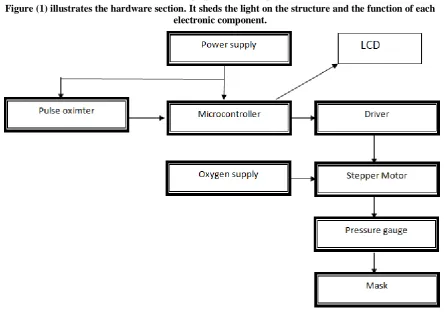
Figure (1) illustrates the hardware section. It sheds the light on the structure and the function of each electronic component.
Figure (1) The block diagram of the system
Microcontroller Atmaga 32 :
Microcontroller is an electronic device which has all the required parts that makes it capable to operate standalone. It is designed to monitor and control different tasks. In addition to the processor it includes memory, various interface controllers, one or more timers, an interrupt controller, and last but definitely not least general purpose Input / Output pins which allows it to directly interface to its environment. It is a tiny computer on a single integrated circuit .It provides highly flexible and low cost effective solution to many embedded control application.
Driver L298
The L298 is a dual H-bridge driver for DC brushed motors and stepper motors. It supports a wide operating voltage range .This driver is capable of driving loads up to 2A continuously.
Stepper motor
A stepper motor is an electromechanical device which converts electrical pulses into discrete mechanical movements. The shaft or spindle of a stepper motor rotates in discrete step increments when electrical command pulses are applied to it in the proper sequence. The motors rotation has several direct relationships to these applied input pulses. The sequence of the applied pulses is directly related to the direction of motor shafts rotation. The speed of the motor shafts rotation is directly related to the frequency of the input pulses and the length of rotation is directly related to the number of input pulses applied .A stepper motor can be a good choice whenever controlled movement is required.
Pulse oximeter :
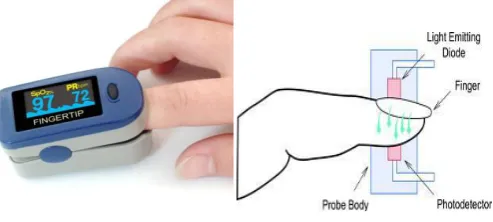
The fundamental physical property that allows the pulse oximeter to measure the oxygen saturation of hemoglobin is that blood changes color as hemoglobin absorbs varying amounts of light depending on its saturation with oxygen. As the hemoglobin oxygen saturation drops, more and more red light is absorbed and the blood becomes darker. Figure (2) illustrates the portable pulse oximeter.
Figure (2) The portable pulse oximeter
Oxygen cylinder
Compressed oxygen cylinders are commonly used in hospitals, community-based care centers, and in patient’s homes for the provision of oxygen enriched air to patients in need.
Pressure gauge
Oxygen regulators are essentially valves that control the flow of oxygen from a tank to the outlet or delivery instrument(Figure 4-9).. The oxygen regulator is the valve that cuts of the flow of high-pressure oxygen and allows only a controlled amount of the gas to reach the outlet instrument.
Humidifier
Humidifier is a device connected to the flow meter to provide moisture to the dry oxygen coming from the supply cylinder .
The mask
An oxygen mask provides a method to transfer breathing oxygen gas from a storage tank to the lungs. LCD
Liquid crystals are a state of matter that has the properties between solid crystal and common liquid .The most common application of LCs are in liquid crystals displays (LCD).
The aim of the hardware and software design is to conduct automated oxygen supply operation for the patient.
IV. PROGRAMMING
The circuit was designed to support patient with low oxygen level in their blood by adequate oxygen amount depending on the known diseases level .The stepper motors move to open a valve with a certain limit space according to the signal coming from the microcontroller which is programmed by BASCOM language. The algorithm contains two subroutines for patient supply with Oxygen. The first subroutine opens the solenoid valve for minimum Oxygen supply .The second subroutine detects the sensor value and accordingly opens the solenoid valve based on the ten levels of Oxygen supply , as follows ;
Start Initialization :
…. Configure port b as input …..Configure port d as output …..Configure port c as output Patient status :
… If (keypad input = 1 ) then call subroutine minimum Oxygen supply. … If (keypad input = 2 ) then call subroutine increment. Oxygen supply. … If (keypad input = * ) then go to terminate.
Go to patient status Terminate:
Subroutine minimum Oxygen supply:
…. Operate stepper motors one step clockwise. … Open solenoid valve to let Oxygen flow. Return
Subroutine increment. Oxygen supply:
…. If ( sensor = level-1) , then rotate stepper motor 4 steps clockwise. …. If ( sensor = level-2) , then rotate stepper motor 8 steps clockwise. …. If ( sensor = level-3) , then rotate stepper motor 12 steps clockwise. …. If ( sensor = level-4) , then rotate stepper motor 16 steps clockwise. …. If ( sensor = level-5) , then rotate stepper motor 20 steps clockwise. …. If ( sensor = level-6) , then rotate stepper motor 24 steps clockwise. …. If ( sensor = level-7) , then rotate stepper motor 28 steps clockwise. …. If ( sensor = level-8) , then rotate stepper motor 32 steps clockwise. …. If ( sensor = level-9) , then rotate stepper motor 36 steps clockwise. …. If ( sensor = level-10) , then rotate stepper motor 39 steps clockwise … Open solenoid valve .
Return.
V. RESULTS
Oxygen therapy is the administration of Oxygen to the patient. It should be administered according to specific guidelines. Table (1) below demonstrates the results of operating the system and equation (1) calculates the total time taken to supply Oxygen to the patient .
T oxygen supply = T se nsor + T microcontroller + T stepper motor + T solenoid valve……… (1) Where ;
T sensor = time for data acquisition from the sensor (mili seconds). T microcontroller = time duration of processing (mili seconds).
T stepper motor = time of response of the stepper motor (mili seconds). T solenoid valve = time of response of the sselenoid valve (mili seconds).
Consider (T sensor = 0.5 msec.) ,(T microcontroller = 0.5 msec.), (T stepper motor = 2 msec.) and (T solenoid valve = 2 msec.).Now implementing equation (1) , we get the resultant time (T oxygen supply ) is:
T oxygen supply = 0.5 msec. + 0.5 msec. + 2 msec. + 2 msec. = 5 msec..
Table (1) The motor steps and the equivalent out puts Litre/min
Number of steps
1 L/min 4
2 L/min 8
3 L/min 11
4 L/min 15
5 L/min 19
6 L/min 23
7 L/min 27
8 L/min 31
9 L/min 35
10 L/min 39
NOTE : From the observations 39steps gives the maximum output =10 Liter/min. .
VI. CONCLUSION
Oxygen therapy requires two things; Simplicity & accuracy . Flow meters should be simple to use and easy to read. They should provide a consistent flow of gas to the patient and in order to work effectively, they need to be accurate.
With these basic guidelines, depending on the most common diseases dose rang, it can easily deliver a fairly consistent concentration and accurate flow rate.
disease. The minimum level reaches to patient automatically and the other level are programmed according to patient case.
REFERENCES
[1]. S.K. Jindal, Oxygen Therapy: Important Considerations, The Indian Journal of Chest Diseases & Allied Sciences, 2008.
[2]. CP Singh, Nachhattar Singh, Jagraj Singh, Oxygen Therapy, Journal, Indian Academy of Clinical Medicine _ Vol. 2, No. 3 _ July-September 2001
[3]. Maher Dababneh , Chopper Control of a Bipolar Stepper Motor, International Journal of Engineering (IJE), Volume (7) : Issue (2) : 2013 .
[4]. Josy Davidson, Precision and Accuracy of Oxygen Flow Meters Used at Hospital Settings , RESPIRATORY CARE • JULY 2012 VOL 57 NO7.
[5]. http://electrapk.com/microcontroller-definition
[6]. http://www.protostack.com/led-lcd/lcd-modules/16-x-2-character-lcd-module-with-yellow-green-backlight