Safety Automation System using Pic
Microcontroller
Michelle Araujo e Veigas Samura S. Desai
H. O. D UG Student
Department of Electronics and Telecommunication Engineering
Department of Electronics and Telecommunication Engineering
Don Bosco College of Engineering Fatorda, India Don Bosco College of Engineering Fatorda, India
Laxman M. Shirke Shubhendra R. Naik
UG Student UG Student
Department of Electronics and Telecommunication Engineering
Department of Electronics and Telecommunication Engineering
Don Bosco College of Engineering Fatorda, India Don Bosco College of Engineering Fatorda, India
Nikheel N. Prabhu Tendulkar UG Student
Department of Electronics and Telecommunication Engineering Don Bosco College of Engineering Fatorda, India
Abstract
Home security has been a major issue where crime is increasing and everybody wants to take proper measures to prevent intrusion. In addition, there is a need to automate home so that user can take advantage of the technology. The project is aimed at developing the safety and security of individual flat in an apartment against Intruders, Gas Leak and Fire. In addition, this project also looks after the switching ON and OFF of the passage lights depending on the intensity of the lights and the Overhead water tanks will be filled automatically.
Keywords: PIC Microcontroller, GSM module, LPG Sensor MQ 5, Magnetic Reed Switch, Magnetic Floating Sensor etc. ________________________________________________________________________________________________________
I. INTRODUCTION
In any apartment there are different flats. We are developing a system which looks after the safety and security for individual flat and also controls the common parameters in the building such as automation of water tanks, passage and parking lights. This system consists of slave cards mounted in each flat. These cards are supplied with different sensors such as LPG leakage detecting sensors, fire sensor and magnetic reed switch (door sensor) etc.
The master card will be placed at control cabin, which is connected to all slaves. If any sensor of slave gets activated due to some problem such as LPG leakage, fire etc. The message will be display on the LCD placed in control Cabin. It displays the flat number as well as the type of problem occurred and also sends error SMS to the flat owner’s cell phone using GSM module.
II. BLOCK DIAGRAM
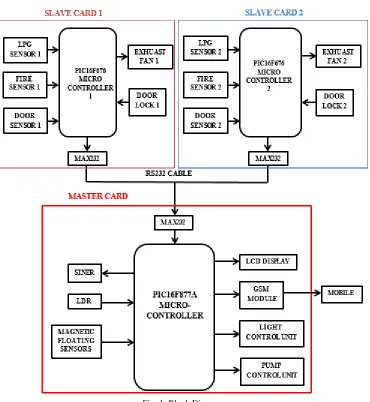
Fig. 1: Block Diagram
This project has two main units namely the slave unit and master unit. The slave unit is fitted in each flat of the apartment. This slave unit has three sensors the LPG detecting sensor, temperature sensor and the magnetic reed switch (door sensor). Using these sensors our project keeps track of all the flats for any faults. In the control cabin there will be a master unit which takes the inputs from the Slave cards. Whenever any sensor detects a fault the master unit activates the siren and it displays the flat number as well as the type of problem occurred on the LCD placed in control Cabin and simultaneously sends error SMS to the flat owner’s cell phone through the GSM modem. The master unit have light control unit which looks after the auto intensity control of parking lights using microcontroller. The master unit also have a water pump control unit which looks after automated Water Level Sensing and Controlling.
III. MICROCONTROLLER
A microcontroller is a small computer on a single integrated circuit containing a processor core, memory, and programmable input/output peripherals.
Microcontrollers are used in automatically controlled products and devices, such as automobile engine control systems, implantable medical devices, remote controls, office machines, appliances, power tools, toys and other embedded systems.
Different Micro-controllers available are: Intel
Motorola
Microchip Technology Atmel
Texas Instruments
PIC Microcontrollers
PIC stands for Peripheral Interface Controller given by Microchip Technology to identify its single-chip microcontrollers. These devices have been very successful in 8-bit microcontrollers. The main reason is that Microchip Technology has continuously upgraded the device architecture and added needed peripherals to the microcontroller to suit customers' requirements. The development tools such as assembler and simulator are freely available on the internet at www.microchip.com .
In this project we are using two PIC microcontrollers PIC16F676 and PIC16F877A. PIC16F676 is used in slave cards and PIC16F877A in master card.
IV. SENSORS
MQ-5 LPG Detecting Sensor
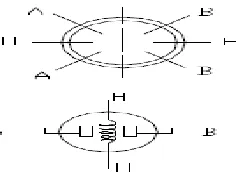
The MQ5 is used in gas leakage detecting equipment’s in consumer and industrial applications; this sensor is suitable for detecting LPG, natural gas and coal gas. The sensitivity can be adjusted by using the potentiometer.
Fig. 2: MQ-5 Fig. 3: Internal Structure of MQ-5
Specifications:
Power supply needs: 5V Interface type: Analog
Pin Definition: 1-Output 2-GND 3-VCC High sensitivity to LPG, natural gas, town gas Small sensitivity to alcohol, smoke
Fast response Stable and long life Simple drive circuit
Size: 40x20mm
Thermistor (NTC-103R)
Thermistor (NTC-103R) is used as fire detecting sensor. It is an analog Temperature Sensor. NTC-103-R is a Negative Temperature Coefficient (NTC) Thermistor. Increase in temperature decreases resistance and vice versa.
Fig. 4: NTC-103R
Magnetic Reed Switch
Fig. 5: Magnetic Reed Switch Fig. 6: Internal Structure of magnetic Reed Switch Working of Magnetic Reed Switch
When the device is exposed to a magnetic field, the two ferrous materials inside the switch pull together and the switch closes. When the magnetic field is removed, the reeds separate and the switch open. This makes for a great non-contact switch. This switch can carry up to 1.2A.
Fig. 7: Show the Working of Magnetic Reed Switch
Magnetic Floating Sensor
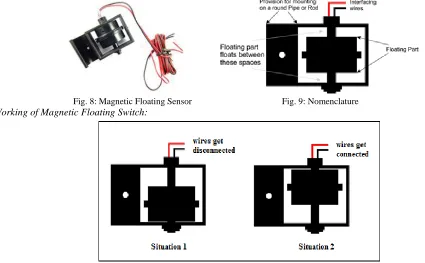
A float sensor is a device used to detect the level of liquid within a tank. The switch may be used in a pump, an indicator, an alarm, or other devices. Magnetic float sensor is an electromagnetic ON/OFF switch. It helps to sense the level of water present in the overhead tank or sump. This sensor has a permanent magnet in the float. The Switch is present in the white stem of the sensor. As the float rises or falls with level of water in the tank, the switch gets activated by the magnet in the float, thereby the signal which is obtained from the sensors is used along with the water level controllers for controlling the motor pump.
Fig. 8: Magnetic Floating Sensor Fig. 9: Nomenclature Working of Magnetic Floating Switch:
In Situation 1, the wires get disconnected and output is low. In Situation 2, the wires get connected and output is high.
V. COMPONENTS
GSM Module
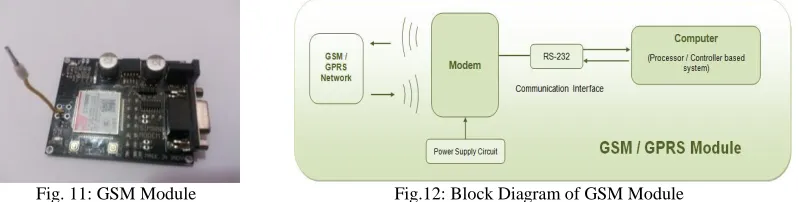
GSM/GPRS module is used to establish communication between a computer and a GSM-GPRS system. Global System for Mobile communication (GSM) is an architecture used for mobile communication in most of the countries. Global Packet Radio Service (GPRS) is an extension of GSM that enables higher data transmission rate. GSM/GPRS module consists of a GSM/GPRS modem assembled together with power supply circuit and communication interfaces (like RS-232, USB, etc) for computer/controller. The MODEM is the soul of such modules.
Fig. 11: GSM Module Fig.12: Block Diagram of GSM Module
GSM/GPRS MODEM is a class of wireless MODEM devices that are designed for communication of a computer with the GSM and GPRS network. It requires a SIM (Subscriber Identity Module) card just like mobile phones to activate communication with the network. Also they have IMEI (International Mobile Equipment Identity) number similar to mobile phones for their identification.
A GSM/GPRS MODEM can perform the following operations: 1) Receive, send or delete SMS messages in a SIM.
2) Read, add, search phonebook entries of the SIM. 3) Make, Receive, or reject a voice call.
The MODEM needs AT commands, for interacting with processor or controller, which are communicated through serial communication. These commands are sent by the controller/processor. The MODEM sends back a result after it receives a command. Different AT commands supported by the MODEM can be sent by the processor/controller/computer to interact with the GSM and GPRS cellular network.
LCD Display
LCD (Liquid Crystal Display) screen is an electronic display module and find a wide range of applications. A 20x4 LCD display is very basic module and is very commonly used in various devices and circuits. These modules are preferred over seven segments and other multi segment LEDs. The reasons being: LCDs are economical; easily programmable; have no limitation of displaying special & even custom character (unlike in seven segments), animation and so on.
A 20x4 LCD means it can display 20 characters per line and there are 4 such lines. In this LCD each character is displayed in 5x8 pixel matrix. This LCD has two registers, namely, Command and Data.
The command register stores the command instructions given to the LCD. A command is an instruction given to LCD to do a predefined task like initializing it, clearing its screen, setting the cursor position, controlling display etc. The data register stores the data to be displayed on the LCD. The data is the ASCII value of the character to be displayed on the LCD. Click to learn more about internal structure of a LCD.
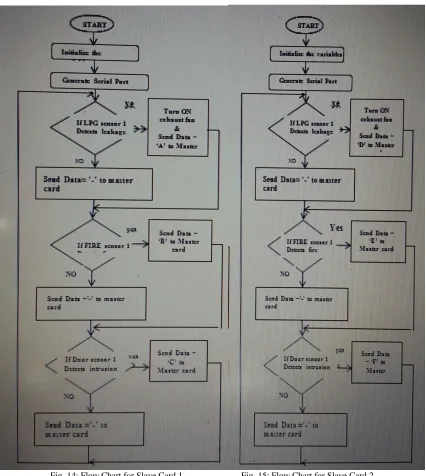
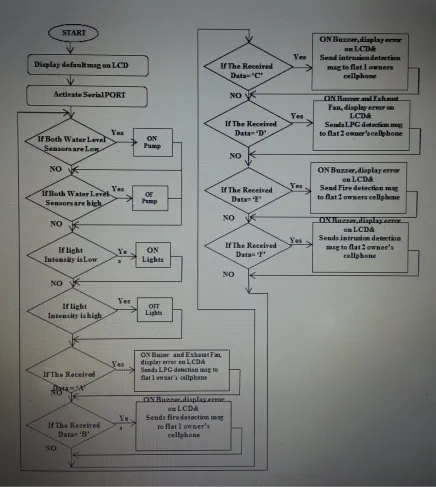
VI. FLOW CHART
Fig. 16: Flow Chart for Master Card
VII.SOFTWARE SECTION
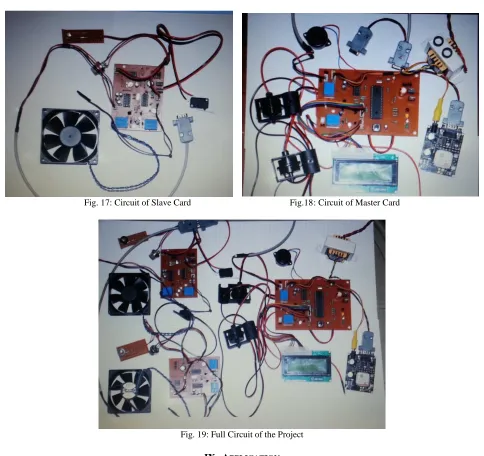
VIII. CIRCUITS
Fig. 17: Circuit of Slave Card Fig.18: Circuit of Master Card
Fig. 19: Full Circuit of the Project
IX. APPLICATION
LPG detection. Fire detection. Intrusion detection.
Automatic water level sensing and controlling. Auto intensity control of passage and parking lights.
X. CONCLUSION
In recent households, the use of LPG is taking a big troll. From the use of cylinder up to the use of petroleum pipelines. The biggest threat in using this technology is security. And our project will prove to be boom for households and industries. Plus the wastage of water and electricity will be reducing due to automatic controlling of water pump and lights.
ACKNOWLEDGMENT
REFERENCES
[1] www.microchip.com
[2] http://robokits.co.in/sensors/gas-sensors/mq-5-liquefied-gas-coal-gas-sensor-module [3] http://robokits.co.in/sensors/sensor-switch/magnetic-reed-switch
[4] http://roboindia.com/tutorials/floating-sensor
[5] http://www.engineersgarage.com/articles/gsm-gprs-modules?page=1 [6] www.mikroe.com
[7] http://embeddedlifehelp.blogspot.in